


Compare Top Belgian Crypto Exchanges
1. Bybit EU
Bybit EU tops our Belgian ranking because it delivers the most complete regulated account a resident can open today. Its Vienna entity, Bybit EU GmbH, has held CASP authorization from the Austrian FMA since May 2025 and covers the whole EEA with it, so Belgian users deal with a supervised European entity rather than an offshore parent. It is the second-largest exchange globally with over $20 billion in daily trading volume.
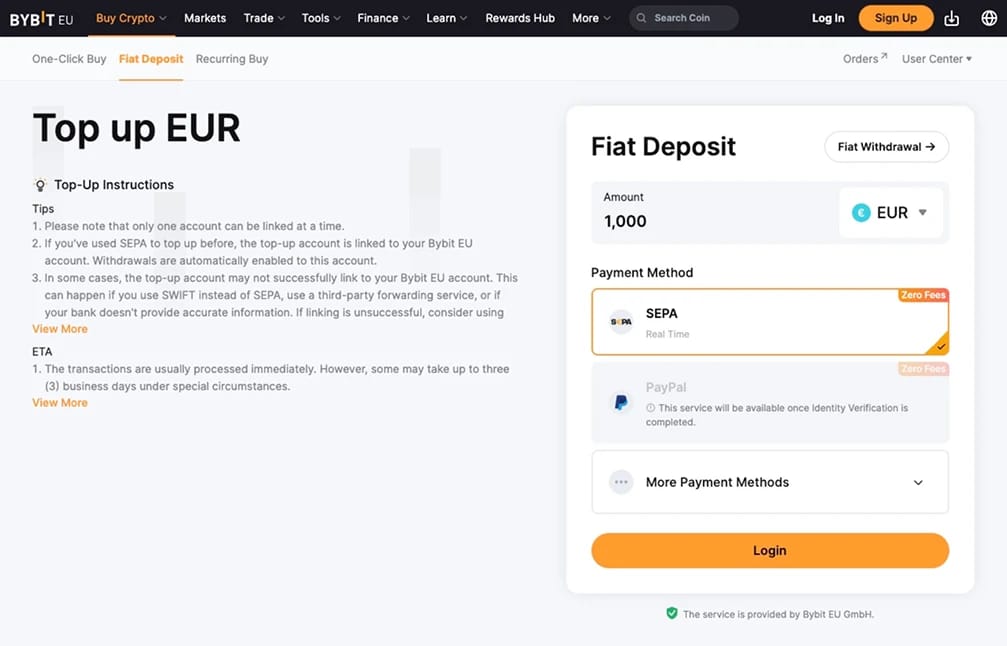
The account itself outclasses everything else on this page. More than 600 cryptocurrencies are tradable, spot orders cost 0.10%, and one login opens copy trading, Earn products, a demo practice mode, crypto loans and TradingView charts. Euro deposits arrive through SEPA transfers, bank cards, PayPal, Apple Pay and Google Pay, and the express buy feature credited our test payment before we had closed the banking app.
It’s important to clarify that the European entity concentrates on spot markets, so the leveraged perpetual contracts Bybit offers outside the EEA are unavailable to Belgian retail clients. The exchange also suffered a $1.5 billion theft by North Korea's Lazarus Group in February 2025, repaid in full from its own reserves within days. Our Bybit review walks through that episode and the security rebuild that followed.
Pros
- Vienna-based Bybit EU GmbH holds an Austrian MiCA license that covers Belgium directly.
- Over 600 assets priced at a flat 0.10% fee, the broadest cheap selection in this guide.
- Euro deposits by SEPA, card, PayPal, Apple Pay and Google Pay settle almost instantly.
Cons
- High-leverage derivatives are unavailable to Belgian retail accounts on the EU entity.
- The 2025 Lazarus theft sits on its record even though clients lost nothing.
- The sheer number of features can slow down someone making a simple first purchase.
2. Kraken
Kraken is the venue we recommend to Belgians moving serious size, because regulatory substance and market depth matter more at scale than a few basis points of fee. Its Irish company is authorized as a CASP by the Central Bank of Ireland, with a trading-venue permission that fewer than twenty companies across the EU have obtained, sitting alongside earlier MiFID and e-money approvals.
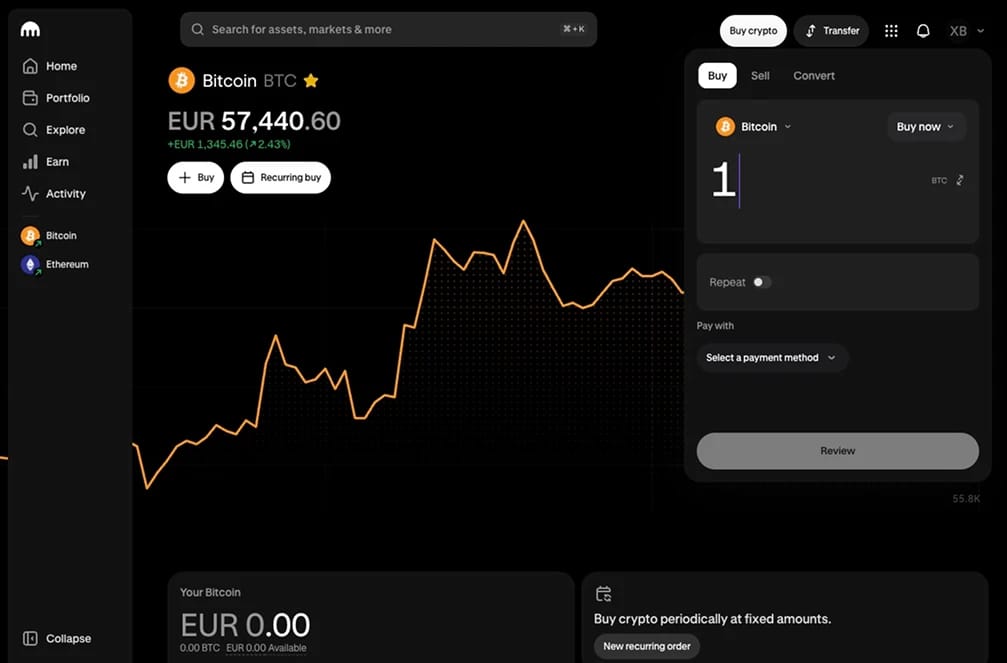
In daily use, the case rests on execution quality. A SEPA Instant deposit costs nothing and arrives within seconds, large orders move through the BTC/EUR market with minimal price impact, and over 640 assets are priced at 0.16% for makers and 0.26% for takers. Kraken Pro held up through every volatile session of our test window, staking spans the major networks, and proof-of-reserves attestations date back to 2014.
Compliance narrows the shelf. USDT pairs are withheld from European clients, some smaller tokens went with them, and the headline fee schedule sits above Bybit, OKX, and Gate. For a portfolio worth protecting, the Irish authorization and the depth behind each quote justify that premium. Our Kraken review examines the security record and available features in full.
Pros
- Central Bank of Ireland authorization with the rare trading-venue permission.
- Free SEPA Instant funding into the deepest BTC/EUR market open to Belgians.
- Proof-of-reserves publications running continuously since 2014.
Cons
- No USDT trading for European customers.
- Each order costs more than the equivalent trade on OKX or Gate.
- Kraken Pro offers more instrumentation than a newcomer needs on day one.
3. Bitvavo
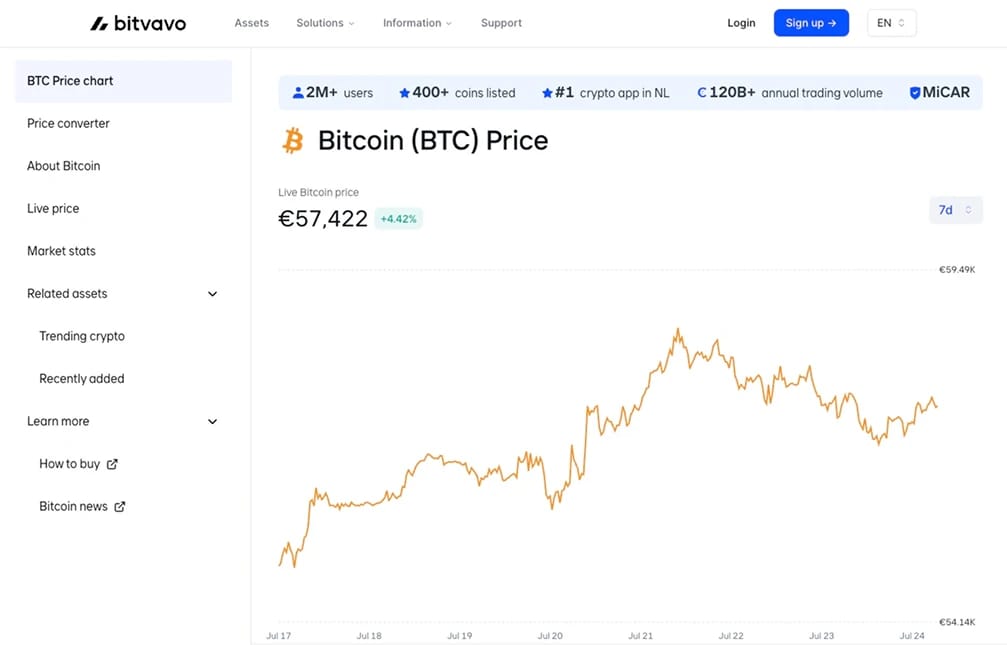
Bitvavo is the platform Belgian readers mention to us most often. The Amsterdam company received its MiCA license from the Dutch AFM in June 2025, among the first major spot exchanges in Europe to do so, and it runs the busiest euro retail spot market on the continent with roughly two million customers.
Belgium gets treated like a home market. Bancontact deposits work natively, something no global platform on this list offers, alongside SEPA, SEPA Instant and card payments, and the interface runs in Dutch and French, matching both sides of the language border. Around 450 cryptocurrencies are listed, taker fees are capped at 0.25% and fall with volume, and staking rewards accrue on dozens of assets with no lock-up.
The limits show once ambitions grow. There are no futures, margin or bot products; the catalog trails Bybit and Gate by a wide margin, and until volume discounts kick in, an active trader gives up more of each order to fees than on OKX or Gate. As a first account funded straight from a Belgian bank, though, nothing here is as frictionless.
Pros
- Native Bancontact support plus SEPA Instant, the easiest funding path from a Belgian account.
- Dutch AFM license held since June 2025, well before the deadline forced the issue.
- Interface and support in Dutch and French, with staking on dozens of assets.
Cons
- No derivatives, margin or automated trading tools for advanced strategies.
- Around 450 assets is less than half of what Bybit or Gate carry.
- Entry-level fees run above the maker rates on OKX and Gate.
4. Coinbase
Coinbase suits Belgians buying crypto for the first time, and its European base sits one border away. The Nasdaq-listed group operates through Coinbase Luxembourg S.A., authorized under MiCA by the CSSF, so the entity holding a Belgian customer's assets publishes audited accounts and answers to a regulator within driving distance of Brussels.
Onboarding is where it wins. Opening an account took us minutes with a Belgian identity card, SEPA Instant and PayPal deposits cleared immediately, and every screen explains what a fee or an order type means before asking for a decision. USDC is treated as a native asset with rewards paid on balances, and Coinbase Advanced adds a full order book when the simple view starts to feel small.
Price is the trade-off, with some of the highest fees in the industry. Instant purchases carry a 1.5% charge with a spread built into the quote, and Coinbase Advanced, at 0.40% for makers and 0.60% for takers, is the priciest option in this guide. Anyone trading weekly will feel it. Visit our Coinbase review, which sets out exactly what the convenience costs.
Pros
- CSSF authorization in neighboring Luxembourg plus Nasdaq-listed transparency.
- The gentlest learning curve here, with SEPA Instant and PayPal funding.
- Native USDC with rewards on balances held.
Cons
- The highest fee schedule on this list at every trading tier.
- Instant buys hide a spread inside the quoted price beyond the stated charge.
- A cautious asset list that experienced altcoin traders will exhaust quickly.
.webp)
5. OKX
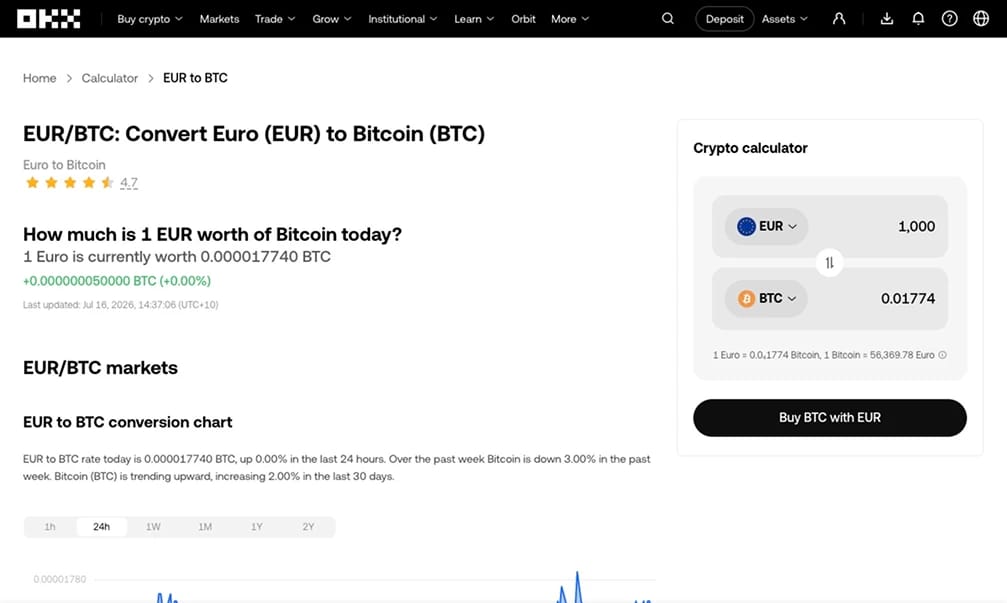
OKX charges the least per trade of any platform in this guide and doubles as the cleanest bridge from a Belgian bank account to on-chain finance. OKCoin Europe Limited, its Malta-licensed subsidiary, sets spot pricing at 0.08% for makers and 0.10% for takers, credits SEPA Instant deposits within seconds at no cost, and is the world's third-largest exchange with over 50 million users.
The built-in Web3 wallet is what separates it. The wallet connects to more than 100 networks with a DEX aggregator attached, so euros deposited from a Belgian account can end up in on-chain staking or a decentralized swap without installing anything else. OKX has also published monthly Merkle-tree proof-of-reserves reports for over three years, a consistency few rivals of its size have matched.
The caution flags are shared with Gate. ESMA questioned the rigor of Malta's licensing process in a peer review, USDT is not tradable for European customers, and the on-chain toolkit is more than a passive investor will ever open. For active traders watching costs, it is the sharpest deal available. Our OKX review details the platform's security setup.
Pros
- The lowest spot fees in this guide, starting at 0.08% per order.
- A Web3 wallet reaching 100+ networks directly from the exchange account.
- Monthly proof-of-reserves reports published for more than three years running.
Cons
- Its Maltese license carries the supervisory doubts ESMA raised in its peer review.
- No USDT trading for European accounts.
- On-chain features add layers a buy-and-hold investor never touches.
6. Gate
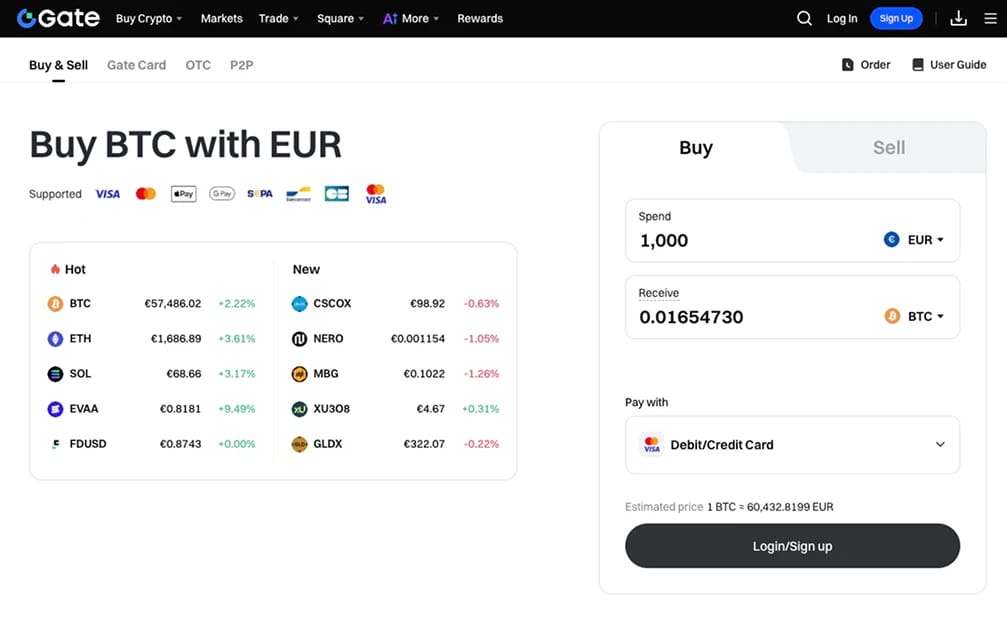
Gate is the licensed answer for Belgians who want to invest in a wide range of cryptocurrencies. Its European arm, Gate Technology Ltd, secured MFSA authorization in Malta during October 2025, yet the compliant platform lists more than 1,000 cryptocurrencies, roughly double Bybit's range and several multiples of what Coinbase or Bitvavo offer. Emerging sectors tend to appear here first.
Running costs stay low, at 0.09% for makers and 0.10% for takers, reduced further by holding GateToken (GT), and euros arrive by SEPA transfer or card. Bots for automated trading, yield products and a launch platform complete a setup aimed at active altcoin traders who want their access to stay inside the EU regulatory perimeter. The European front-end does omit parts of the global Gate product line.
The Maltese license attracts the ESMA scrutiny noted for OKX, and order books thin out fast beyond the top few hundred names, so exiting a small position at a fair price can take patience. Read our Gate review, which covers the history, including a 2018 breach after which all users were reimbursed, and goes into the features.
Pros
- More than 1,000 tradable assets, the largest MiCA-licensed selection open to Belgians.
- Maker fees from 0.09% with further GateToken discounts.
- Early listings bring new sectors to a regulated venue months ahead of rivals.
Cons
- Malta's authorization standards drew criticism in ESMA's peer review.
- Liquidity fades quickly outside the majors, making small-cap exits slow.
- A dense interface that first-time buyers will find harder than Bitvavo or Coinbase.
How to Choose a Crypto Exchange in Belgium
All six platforms above carry valid MiCA licenses, so the decision in Belgium turns on which regulator stands behind each license, how smoothly your euros travel, and what your own trading pattern costs. Before sending a first deposit anywhere, we work through the following checks.
- Confirm the license in the ESMA register: The FSMA has not yet authorized any CASP of its own, so every legal platform serving Belgium appears in the ESMA register under a foreign entity name. Search for Bybit EU GmbH or Bitvavo B.V. rather than the brand, and cross-check the warnings the FSMA publishes in case the name appears there.
- Judge the license by who issued it: All licenses grant the same EU access, but they were not equally hard to earn. The Central Bank of Ireland and the CSSF in Luxembourg ran demanding reviews, the Dutch AFM enforced crypto rules earlier than most, and Malta's MFSA drew ESMA criticism over the pace of its approvals.
- Match the funding method to your bank: A SEPA Instant transfer from KBC, Belfius, BNP Paribas Fortis or ING now costs no more than an ordinary transfer and lands in seconds, while Bancontact on Bitvavo debits your account directly.
- Understand fees: A €1,000 instant buy on Coinbase costs about €15 plus spread against €1 on Bybit EU or OKX. Place one small purchase and sale on each shortlisted platform and compare what the round trip costs you.
- Prepare for the new tax before the first trade: The 10% capital gains regime values every holding at its 31 December 2025 level and taxes growth from there, and foreign platforms will not withhold anything for you. Export statements from day one, since your declaration through MyMinfin depends on records only you keep.
Crypto and Bitcoin Regulation in Belgium
Crypto is legal in Belgium and now fully regulated under MiCA, the European Union's single rulebook for the sector. Supervision is shared between the FSMA, which oversees most crypto-asset service providers and all marketing to consumers, and the National Bank of Belgium, which supervises banks and payment institutions entering the sector.
Here is a timeline of crypto regulation in Belgium:
- May 2022: A registration regime for exchange and custody wallet providers took effect, administered by the FSMA. Its sharpest edge was a ban on companies governed by the law of a non-EEA country offering these services in Belgium at all, backed by criminal sanctions.
- 17 May 2023: The FSMA's advertising regulation entered into force. Every crypto advertisement aimed at Belgian consumers must state that virtual currencies carry real risks and that the only guarantee in crypto is risk, and mass campaigns reaching 25,000 people must be notified to the regulator ten days in advance.
- 23 June 2023: The FSMA ordered Binance to stop offering exchange and custody services in Belgium with immediate effect, finding that the services were provided from entities outside the EEA. Binance later resumed under an EEA-registered company before exiting the region entirely this year.
- 30 December 2024: MiCA took full effect across the EU. One CASP authorization from any member state now unlocks all 30 EEA countries, and Belgium let existing providers use the entire transitional window rather than cutting it short.
- 11 December 2025: The Belgian implementing law was adopted, dividing authorization and supervision between the FSMA and the National Bank and taking effect in early January 2026. From that point, providers offering regulated crypto services in Belgium require MiCA authorization.
- 16 February 2026: KBC became the first Belgian bank to offer Bitcoin and Ether trading to retail investors, through its Bolero investment platform. The service is closed-loop, meaning coins bought there cannot be withdrawn to an external wallet.
- 1 July 2026: The EU-wide transitional period ended. Binance, which had withdrawn its license application shortly before, switched off access for EEA users, and within days the FSMA named six unauthorized firms on its list of fraudulent crypto-asset service providers.
The practical outcome for a Belgian user is binary. Either the platform’s licensed entity appears in the ESMA register, or the platform cannot lawfully accept your money.
How Is Crypto Taxed in Belgium?
Belgium ended one of Europe's most generous crypto tax arrangements this year. Through the end of 2025, a private investor managing assets prudently owed nothing on crypto gains.
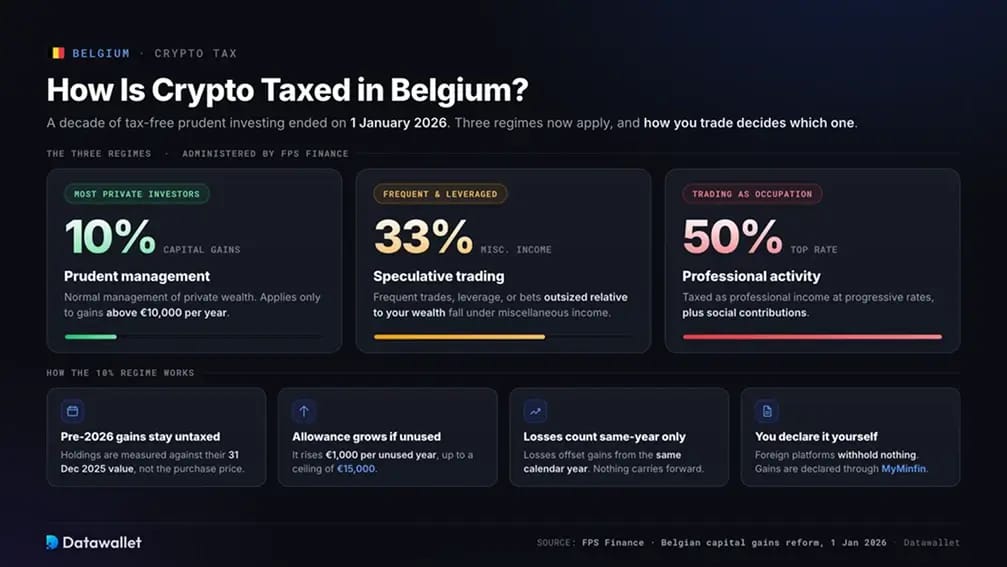
The reform that took effect on 1 January 2026 introduced a capital gains tax on financial assets, crypto included, administered by FPS Finance. Three regimes now sit side by side, and which one applies depends on how you trade.
- Prudent investors now pay 10% above an allowance: Gains realized on crypto held as part of the normal management of private wealth are taxed at 10% on the portion exceeding €10,000 per year. The unused allowance grows by €1,000 for each year it is not fully used, up to a ceiling of €15,000.
- Gains built up before this year stay untaxed: The tax applies only to value gained from 1 January 2026 onward, so each holding is measured against its level at the end of December 2025 rather than its original purchase price. Keeping evidence of those year-end values protects early buyers.
- Losses offset gains within the same year only: Realized losses reduce taxable gains from the same calendar year, but nothing carries forward. A bad year produces no credit against a good one.
- Speculative trading is still taxed at 33%: Frequent trading, leverage, or bets outsized relative to your wealth can push gains into the miscellaneous income category at 33%, the classification the tax authority applied to aggressive traders long before this reform.
- Professional activity pays progressive rates: Where trading amounts to an occupation, profits are taxed as professional income at rates reaching 50%, plus social contributions.
The boundaries between prudent, speculative and professional remain judgment calls, and the ruling service publishes a questionnaire for borderline cases. For anything beyond a simple portfolio, an hour with a Belgian tax adviser costs less than guessing wrong.
Cryptocurrency Adoption in Belgium
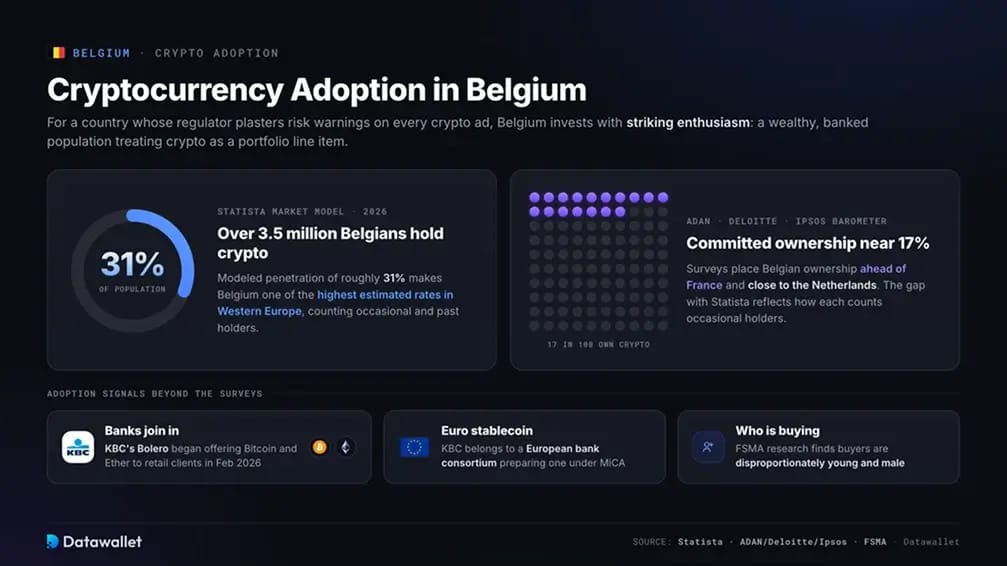
For a country whose regulator plasters risk warnings on every crypto advertisement, Belgium invests with striking enthusiasm.
- Belgium ranks among Europe's most invested markets: Statista's market outlook models Belgian crypto penetration at roughly 31% of the population, over 3.5 million people, making it one of the highest estimated penetration rates in Western Europe.
- Surveys place committed ownership in the high teens: Surveys such as the European barometer run by ADAN with Deloitte and Ipsos measure Belgian ownership near 17%, ahead of France and close to the Netherlands. The gap with Statista's model reflects how each counts occasional and past holders.
- The banks have stopped watching from the sidelines: KBC's Bolero platform began offering Bitcoin and Ether to retail clients in February, and KBC also belongs to a consortium of European banks preparing a euro stablecoin under MiCA.
- The regulator studies its own market: FSMA-commissioned research consistently finds Belgian crypto buyers are disproportionately young and male.
Against the global data in our crypto adoption statistics, Belgium reads as a wealthy, banked population treating crypto as a portfolio line item rather than a payments tool.
How to Buy Bitcoin in Belgium
A first Bitcoin purchase in Belgium takes about fifteen minutes on any licensed platform above, with no currency conversion at any step. We followed this sequence on every exchange here.
- Choose your platform: Bybit EU offers the fullest low-cost account, Kraken handles size, Bitvavo brings Bancontact and a local-language interface, Coinbase guides a first purchase, OKX charges the least, and Gate reaches deepest into altcoins.
- Verify your identity: A Belgian identity card or passport cleared verification on every platform we tested, usually within minutes. Enter your name exactly as it appears on the document, because a mismatch with your bank details is the most common reason a first deposit is held for review.
- Deposit euros: Send a SEPA Instant transfer from your KBC, Belfius, BNP Paribas Fortis, ING or Argenta account, or use Bancontact on Bitvavo for a direct debit. Transfers landed in seconds during our tests. Cards and Revolut work as backups but add processor costs.
- Place a limit order instead of using instant buy: Every platform quoted us a worse price on its one-click screen than on its own BTC/EUR market, a gap reaching a few percent once the hidden spread counts. A limit order takes an extra minute and keeps that money.
Final Thoughts
Bybit EU takes the top spot in Belgium by combining the largest regulated product range with a flat 0.10% fee and euro funding that behaves like a local payment. Kraken is the account we would open for size, Bitvavo the one for a relative, Coinbase for a first purchase, OKX for cost, and Gate for reach.
The bigger shift is that Belgium's crypto market finally has clean edges. The FSMA's old ban on non-EEA providers has given way to a single European license check, and the new capital gains tax replaces years of case-by-case uncertainty with a rate and an allowance.
Put each platform through a small deposit, trade and withdrawal before trusting it with real money, and file your records as you go rather than reconstructing them in April.
Our Methodology
Our ranking reflects what someone living in Brussels or Antwerp gets from each platform in practice rather than what the marketing claims. Every account was opened with Belgian documents and funded in euros from Belgian bank accounts. Six criteria decided the order.
- Trust Score: Our in-house rating out of 5, combining regulator strictness, the openness of reserve disclosure, the response to any past incident, and the length of the operating record.
- License Verification: Looked up every operating entity in the ESMA register, then searched the FSMA's warnings for anything connected to the brand, both before and after the 1 July deadline.
- EUR Funding Methods: Sent SEPA, SEPA Instant and, where supported, Bancontact deposits from Belgian accounts to every platform, then timed each arrival and noted what it cost.
- Security Track Record: Reviewed each platform's breach history, its custody arrangements, the regularity of its reserve attestations, and the protections an account holder can enable, including two-factor login and withdrawal address locks.
- Assets and Liquidity: Executed real orders in BTC/EUR, ETH/EUR and one mid-cap pair on each venue, logging the spread paid and whether fills came back clean.
- Fee Structure: Calculated what a full euro round trip costs on each platform, including trading fees, any instant-buy spread, deposit charges and withdrawal costs on commonly used networks.
Platforms lacking a MiCA license that covers Belgium were struck from consideration before testing began, Binance and the offshore venues among them. Testing ran through June and July, and each license was reconfirmed in the ESMA register after the transitional period closed.