







Compare Top Colombian Crypto Exchanges
1. Bybit
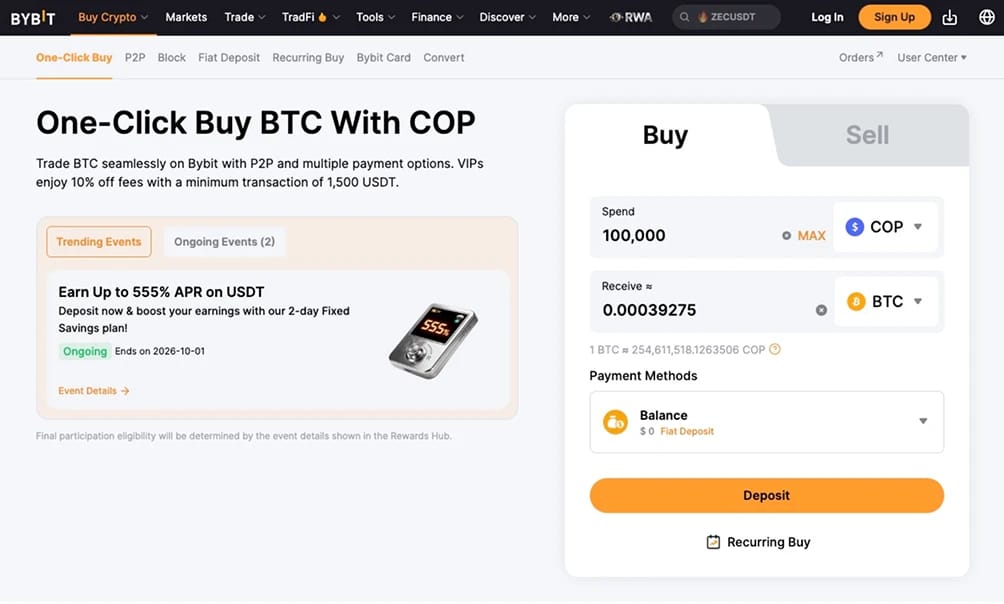
Bybit ranks first for its peso funding and withdrawal routes. Its fiat gateway accepts PSE and cards through integrated providers. The P2P marketplace lists Nequi, Daviplata, Bancolombia, and Davivienda as payment methods, with no commission for either party. Our test transfer from Nequi to a merchant released USDT from escrow in under ten minutes during Bogotá office hours. Bybit is the world’s second-largest crypto exchange, with 80 million+ users.
A funded account provides access to 2,600+ trading pairs with a flat 0.1% spot fee. Perpetual futures charge makers 0.02% and takers 0.055%. The same login includes options, copy trading, grid and DCA bots, demo mode, lending and borrowing, and Earn for idle coins. The interface runs fully in Spanish, with a Lite view that keeps beginners away from leverage until they seek it out.
In February 2025, attackers took roughly $1.5 billion in Ether from a Bybit cold wallet in what remains the largest single exchange theft on record. Bybit covered every customer balance within days and never paused withdrawals. Hacken now audits its monthly reserve report. The mid-2026 edition showed backing above 100% across $16.5 billion in assets. Our Bybit review covers the full product range.
Pros
- Colombians have more peso routes here than at any other ranked platform, including PSE, cards and commission-free P2P with Nequi and Daviplata.
- Trading costs stay predictable, with a flat 0.1% spot fee across 2,600+ coins and a 0.02% futures maker fee.
- Every monthly reserve report verified by Hacken since the 2025 incident has shown full backing.
Cons
- The February 2025 theft remains part of Bybit's record, although no customer lost funds.
- Casual buyers pay more than the headline rate because instant buy screens add a spread well above the order-book fee.
- Bybit has no Colombian authorization. Every platform here shares that limitation until Congress passes a licensing law.
2. Gate
Gate earns its place in this ranking for its diverse selection of digital assets. More than 4,400 cryptocurrencies are listed, significantly more than the catalogs of any other platform available to Colombians. New tokens often arrive months before larger venues add them. For traders seeking assets beyond the top few hundred, no comparable choice offers a working COP on-ramp.
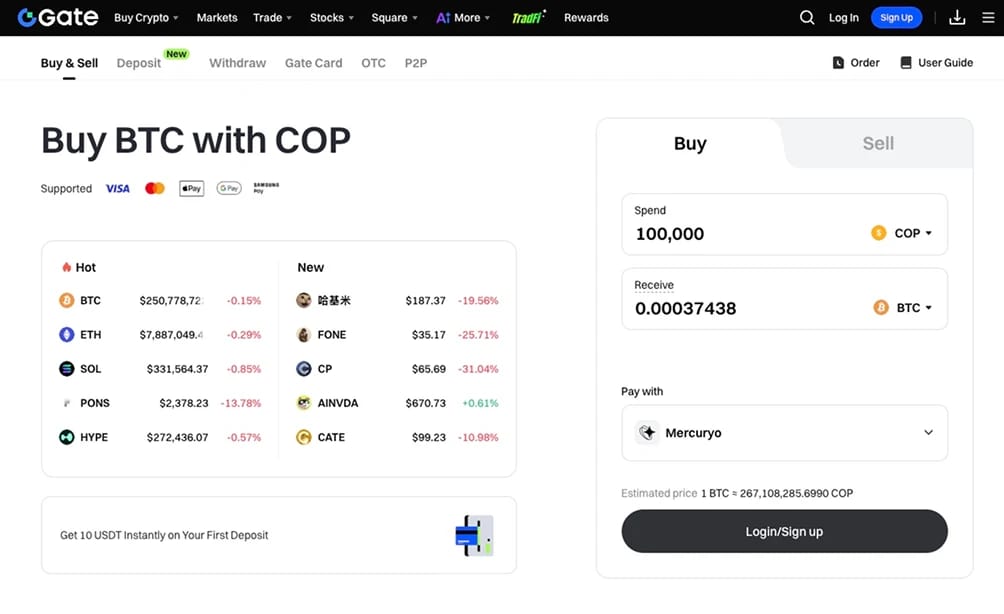
Third-party processors handle peso funding through cards, PSE, Apple Pay, and Google Pay. Gate's P2P desk also accepts Nequi, Daviplata, Bancolombia, Davivienda and BBVA, though fewer COP merchants operate here than on Bybit. Quotes can drift outside mid-market hours. The product range helps offset that limitation, with futures and options sharing a single Spanish-language account that includes copy trading, bots, lending, and Simple Earn.
Gate's main trade-off is a 0.2% base spot fee, double the rate at Bybit, KuCoin and Bitget. Thin small-cap order books can widen the cost gap further. Monthly reserve attestations provide more transparency than its offshore status might suggest, with the August 2026 report showing $8.2 billion in holdings and a 127% coverage ratio. Our Gate review breaks down the fee tiers and supported features.
Pros
- With more than 4,400 listed coins, Gate has the deepest altcoin catalog accessible from a Colombian bank account.
- Its monthly reserve reporting showed 127% coverage across $8.2 billion in August 2026.
- A single account covers spot, futures, options, copy trading, bots, and Simple Earn in a full Spanish interface.
Cons
- Before volume discounts, Gate's 0.2% base spot fee is one of the highest in this ranking.
- Many weak projects sit among its thousands of listings. Due diligence falls entirely to the trader.
- Bybit has greater COP P2P merchant depth, and Gate's crowded mobile layout takes time to learn.
3. KuCoin
KuCoin is the most popular yield-earning platform in this ranking. Its Earn section combines flexible and fixed savings, staking, lending, and structured products such as Dual Investment across 1,000+ listed assets. The "up to 500% APY" figure in its marketing refers to short promotional campaigns on small tokens, not mainstream assets like Bitcoin or Ethereum.
GemSPACE highlights new tokens early. Spot and futures traders can use grid, DCA, and rebalancing bots, while the account also includes KuCard and a built-in Web3 wallet. KuCoin publishes proof of reserves and holds SOC 2 Type II, ISO 27001, and PCI DSS certifications. Together, these provide more external validation than most offshore exchanges offer.
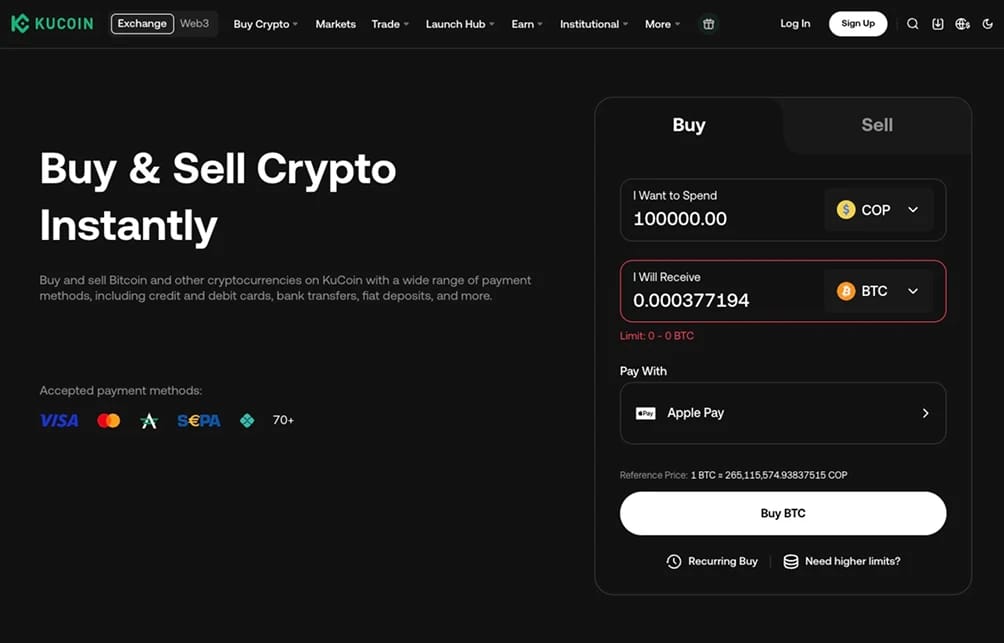
KuCoin lacks a direct peso rail. Card processors add markups, and limited COP P2P depth leads most local users to buy USDT on Bybit or Bitso and transfer it across. In 2025, KuCoin pleaded guilty to US anti-money-laundering charges and left that market, later rebuilding its position through licensed entities in Europe and Asia. Our KuCoin review weighs those trade-offs.
Pros
- Its Earn menu is the broadest here, covering staking, savings, lending, and structured products across 1,000+ assets.
- Small-cap traders get access months before larger exchanges through GemSPACE and early listings.
- Published proof of reserves and three third-party security certifications support KuCoin's safety claims.
Cons
- The headline APYs come from promotions on minor tokens, not sustainable Bitcoin or stablecoin returns.
- Without direct COP deposits, KuCoin works best as a secondary account funded with USDT.
- Its compliance record still includes the 2025 US guilty plea.
4. Bitso
Bitso is the only platform built from the ground up for Latin America. Founded in Mexico City in 2014, it now serves more than 9 million users across the region and has a dedicated Colombian support team. It also participated in the SFC's regulatory sandbox, partnering with Banco de Bogotá and Movii to test peso cash-in and cash-out under supervision before the pilot closed in 2024.
PSE deposits start at COP 10,000 with no fee, plus withdrawals to Bancolombia, Nequi, and Davivienda accounts are also free. Our test PSE deposit from Bancolombia arrived within minutes, well inside Bitso's quoted 24-hour window. The app supports 100+ cryptocurrencies. Bitso+ pays weekly yield on idle balances, and cross-border transfers settle in stablecoins.
Regular buyers should switch to Bitso Alpha for maker and taker pricing. The standard app includes trading costs in the spread instead of displaying a separate fee. Product depth is limited, with no derivatives and a catalog far smaller than Gate's or KuCoin's. Bitso launched US stocks and ETFs in Mexico in 2025, with Colombia scheduled to follow during 2026. Check the app before assuming they are live locally.
Pros
- Free PSE deposits and peso withdrawals to major banks and wallets make Bitso the cheapest COP on and off-ramp here.
- Participation in the sandbox with Colombian banks gives Bitso a longer local compliance record than any global exchange.
- Users moving beyond the simple app can find transparent maker and taker pricing on Bitso Alpha.
Cons
- The standard app builds its cost into the spread, which can exceed 1% on smaller trades. The maker fees start at 0.50% and the taker fees at 0.65%.
- A catalog of around 100 assets and no derivatives limits Bitso's appeal to active or altcoin-focused traders.
- Colombian access to products such as stocks and the Bitso Card can lag Mexico because launches happen country by country.
.webp)
5. Bitget
Bitget suits Colombians who prefer following an existing strategy and using automated trading services. Its core copy trading product covers spot, futures, and bots. Each lead trader publishes returns, drawdown, and a risk score, and followers can cap allocation and set stop levels before committing a peso. In a market without licensed advisers, that visibility has real value.
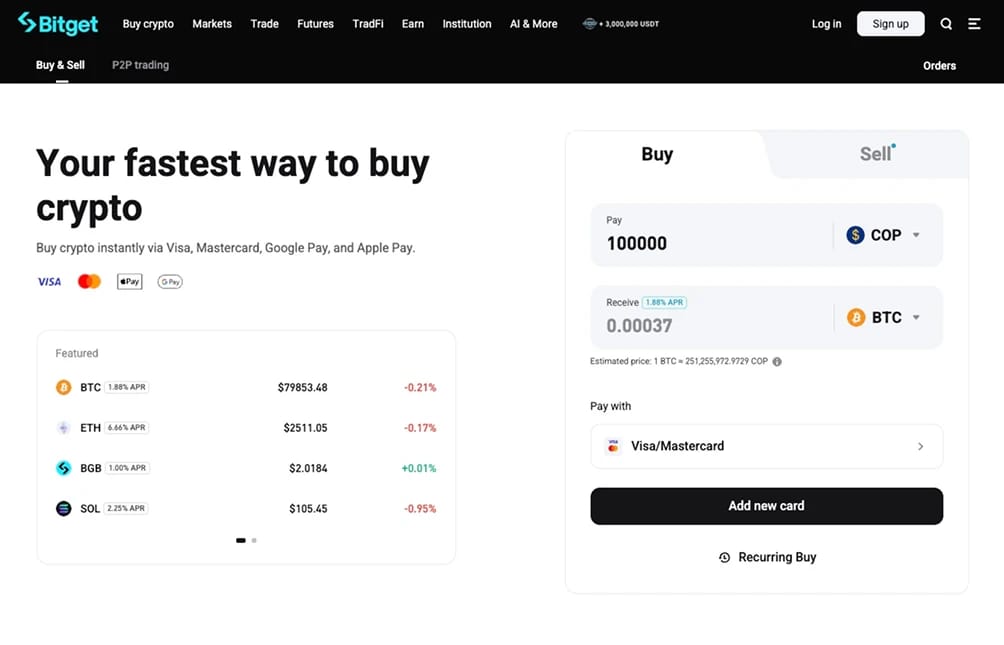
Bitget's expanded product range, branded Universal Exchange, puts tokenized stocks, gold, and forex priced in USDT alongside 800+ cryptocurrencies. Spot trading costs 0.1%, and TradingView charts are built in. Futures fees are 0.02% for makers and 0.06% for takers. Cards and a P2P desk accepting Nequi and Bancolombia handle COP funding, although merchant depth trails Bybit.
Bitget's unusually thorough safety disclosures include monthly reserve attestations dating to December 2022, the longest unbroken run among large exchanges. Its February 2026 report recorded 169% coverage. The Protection Fund averaged $451 million during March 2026 against a committed floor of $300 million. Our Bitget review explains the copy engine and VIP tiers.
Pros
- The ranking's most developed copy trading system displays performance data before users allocate funds.
- Crypto shares a USDT-margined account with tokenized stocks, gold, and forex.
- Reserves at 169% and a Protection Fund above $400 million support Bitget's safety case.
Cons
- Followers inherit the leverage of copied strategies, so losses can come faster than expected.
- Liquidity on the COP P2P desk is still developing, and spreads widen outside peak hours.
- Prominent leverage features make Bitget a poor starting point for cautious beginners.
6. BloFin
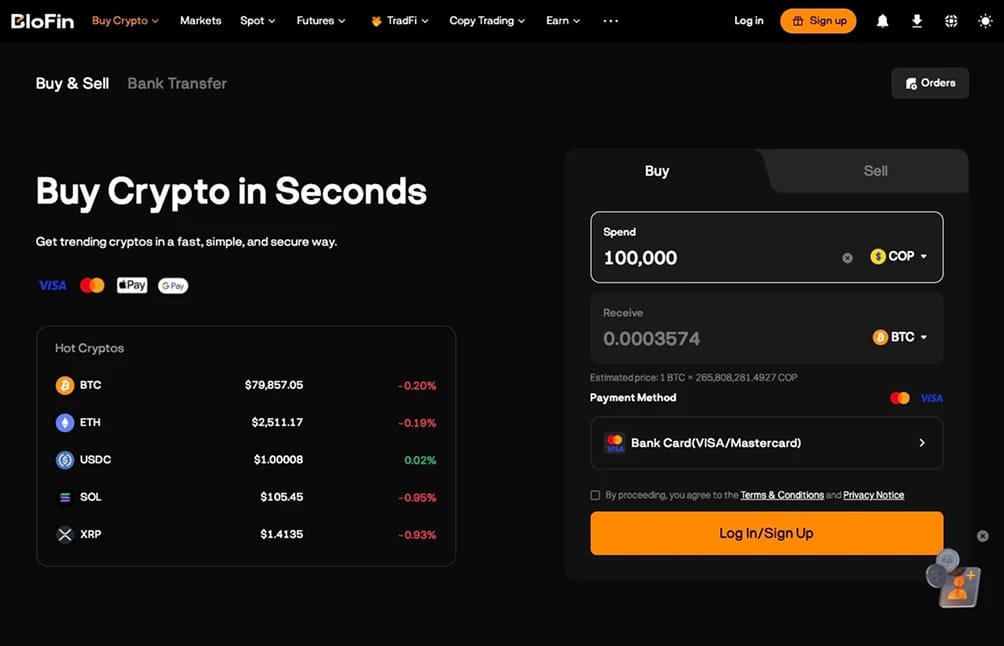
BloFin closes out the ranking as the option for traders who want access to derivatives without handing over identity verification documents. An email address unlocks spot, 350+ perpetual contracts with up to 150x leverage, copy trading, grid bots, and Earn, with daily withdrawals capped at 20,000 USDT until verification. Colombia sits on its supported list, and the interface is available in Spanish.
For a futures-first venue, its 0.02% maker and 0.06% taker fees are competitive. Spot trades cost 0.1%. Fireblocks handles custody with insurance coverage, while BloFin holds ISO 27001 certification and publishes Merkle tree proof of reserves. These are system audits rather than licenses, a distinction that matters when something goes wrong.
Peso funding requires Level 1 verification, which opens fiat purchases and P2P channels. Unverified users must deposit crypto bought elsewhere. Cayman-based BloFin has no authorization from any major regulator, and disputes go to arbitration in Hong Kong. Our guide to the best no-KYC crypto exchanges compares BloFin with the alternatives.
Pros
- An email-only account provides full spot and derivatives access with daily withdrawals of 20,000 USDT.
- Its 0.02% maker and 0.06% taker futures fees match the largest derivatives venues.
- Fireblocks custody, ISO 27001 certification, and published reserve proofs go beyond what most no-KYC platforms disclose.
Cons
- The no-KYC tier requires crypto from another platform, as peso funding requires identity verification.
- Offshore dispute resolution and no license from any major regulator leave users with little recourse.
- Thin spot liquidity relative to the derivatives books makes BloFin unsuitable as a primary exchange.
How to Choose a Crypto Exchange in Colombia
Colombian law does not yet distinguish between licensed and unlicensed exchanges, leaving peso handling as the basis for choosing a platform. Work through these five checks:
- Confirm the peso route before registering: Check the deposit page for PSE or Bre-B, then count active COP merchants on the P2P desk. Card-only funding costs more and suffers more frequent declines. Bre-B transfers are capped at 1,000 UVB, or COP 12.11 million in 2026. Larger deposits need PSE or several transfers.
- Check what the platform reports locally: There is no SFC license register because it supervises no exchange. Check whether the platform files with the UIAF under Resolution 314 and identifies as a reporting provider under DIAN Resolution 000240. Bitso is the easiest to check given its Colombian team and sandbox history.
- Price the full round trip: Start with the P2P premium over the TRM or the instant-buy spread, then add the spot fee and the withdrawal network charge. Our tests found COP P2P premiums of 1% to 2.5% on the deepest desks. One-click widgets cost several times the 0.1% order-book rate.
- Match names across every account: Complete verification with your cédula and a selfie before depositing. P2P payments from a relative's Nequi account caused most of the delays we encountered. Merchants and exchanges treat these as third-party funding.
- Test the exit while amounts are small: Make a modest deposit, buy and sell, then withdraw pesos to the originating account. A COP 200,000 withdrawal that clears in minutes provides more useful evidence than a marketing page.
Crypto and Bitcoin Regulation in Colombia
Colombia permits the ownership, buying, and selling of crypto. The peso remains the only legal tender, and the Banco de la República does not recognize crypto as money. Exchanges must meet anti-money-laundering and tax reporting duties without a licensing regime. The framework developed in stages:
- 2014 to 2017: The first warnings from the Banco de la República and the SFC stated that Bitcoin was neither currency nor a supervised product. The SFC barred supervised entities from holding, trading, or intermediating crypto and maintains that position.
- December 2021: The UIAF issued Resolution 314, requiring providers of crypto-asset services to submit suspicious operation reports and monthly transaction reports. From 1 July 2022, reporting applied to individual transactions from USD 150 and combined transactions from USD 450.
- 2021 to June 2024: The SFC ran a supervised pilot in its "La Arenera" sandbox. Seven bank-exchange pairings tested peso cash-in and cash-out, including Bancolombia with Gemini, Banco de Bogotá with Bitso and Buda, and Movii with Bitso. At the pilot's close, the SFC reiterated that it does not supervise crypto platforms.
- 17 October 2023: The DIAN published its Unified Concept on Crypto-Assets, which classified crypto as an intangible asset and confirmed that crypto-to-crypto swaps are taxable exchanges.
- 6 October 2025: Bre-B went live, giving exchanges a 24/7 peso rail that PSE had never offered. It settled 64.4 million transactions in its first month.
- 24 December 2025: DIAN Resolution 000240 adopted the OECD's Crypto-Asset Reporting Framework. Reporting providers must collect user and transaction data starting with the 2026 tax year and file it by the last business day of May 2027.
- June 2026: Bill 510 of 2025 was archived at the session's close. It would have created a registration and conduct regime for providers. DIAN Concept 5146 clarified on 26 June that CARF reporting creates no new tax.
- 7 August 2026: President Abelardo de la Espriella took office. His government has announced a September tax reform, and industry groups have asked it to revive a provider framework.
The DIAN receives its first exchange reports in 2027. Exchanges still set their own terms, and no Colombian authority guarantees client assets. A new provider law would be the next event to change this ranking.
.webp)
How Does DIAN Tax Crypto?
The DIAN applies the general rules of the Estatuto Tributario to digital assets as intangible property. Colombia has no crypto-specific tax. These five points cover most individual investors:
- Qualifying fixed assets held for at least two years can receive 15% treatment: The flat 15% occasional gains rate applies when crypto held for at least two years is sold, swapped, or used for payment. The asset must qualify as a fixed asset held for at least two years. Trading inventory does not qualify merely because time passes.
- Shorter-term holds are ordinary income: Disposals within two years are subject to progressive personal rates of 0% to 39%, determined by total income in UVT. Frequent trading also falls here, as do staking rewards and DeFi yields.
- Swapping one coin for another is taxable: The Unified Concept treats a BTC-to-USDT trade as a permuta, with each side counting as a sale. A move into stablecoins does not defer tax.
- Wealth tax starts at 72,000 UVT: With the UVT at COP 52,374 for 2026, the threshold is about COP 3.77 billion in net assets on 1 January. Crypto is counted at year-end value. Holdings on foreign platforms above 2,000 UVT must also be included on Form 160, the foreign assets return. The threshold concerns aggregate foreign assets on 1 January, not simply an overseas exchange balance.
- Exchanges now report to the DIAN: Resolution 000240 requires reporting providers to collect identity and transaction data throughout 2026 and file it in May 2027. Declared holdings will be checked against platform records. Keep dated COP-value records for every purchase, sale, and swap.
VAT does not apply to crypto sales, though intermediation services attract the 19% rate. Individuals file between August and October according to NIT digits. Confirm your position with a Colombian accountant, as this is general information, not tax advice.
.webp)
Cryptocurrency Adoption in Colombia
Chainalysis recorded $44.2 billion in on-chain value received by Colombia between July 2024 and June 2025. That puts it fifth among Latin America's crypto economies, behind Brazil, Argentina, Mexico, and Venezuela. Statista Market Insights projects 10.4 million users in 2026, roughly 19% of the population. Three themes shape this activity:
- Stablecoins are the entry product: More than half of exchange purchases made with pesos went into stablecoins, according to Chainalysis. For 2025, Bitso's regional data puts USDC at 25% and USDT at 21% of Colombian purchases, compared with 15% for Bitcoin. Remittances and freelancer income drive demand, as do dollar savings.
- Bitcoin is what people keep: Bitcoin appeared in 49% of Colombian portfolios in the same dataset despite its smaller share of purchases. It ranked ahead of stablecoins, Ether, and XRP. About 21% of users hold four or more assets, the second-highest share in the region after Mexico.
- The macro picture shifted in 2026: The peso has been among the strongest emerging-market currencies this year, with the TRM near seven-year lows around COP 3,130 in mid-August. The policy rate stood at 12%, and inflation still ran at 6.03% in July, double the central bank's target.
Colombian crypto users skew young. Bitso puts 32% between 25 and 34 and 28% between 18 and 24. Women make up 28% of its Colombian user base. Our crypto adoption statistics page compares Colombia with other markets.
.webp)
How to Buy Bitcoin in Colombia
The cheapest reliable route is to fund USDT from a Colombian bank or wallet, then trade on the spot order book. With documents ready, the process takes under an hour and avoids card surcharges and instant buy spreads:
- Choose a platform with a working peso rail: Our overall pick is Bybit for its PSE gateway and deep P2P desk. Bitso offers the simplest first purchase, with free PSE deposits and withdrawals. Set Colombia as your country of residence when registering to avoid flagged withdrawals later.
- Verify your identity first: Submit your cédula and complete the selfie check, then wait for approval before sending money. A legible document is cleared within minutes on every platform we tested. Mismatched names on the profile and bank account cause most delays.
- Deposit pesos: Use PSE or Bre-B if the exchange offers a direct rail. For P2P, filter for Nequi or bank transfer and choose a merchant with a completion rate above 95%. Pay from an account in your own name, then mark the order paid. The USDT is released from escrow once the merchant confirms.
- Buy Bitcoin with a limit order: Go to the BTC/USDT spot market rather than the express buy screen. Place a limit order at your chosen price to keep costs at the published fee. This saved 1% to 3% against one-click purchases in our tests.
- Move long-term holdings off the exchange: With no Colombian authority backing exchange balances, coins held for months belong in a wallet you control. Our best crypto wallets guide compares hardware devices, while the best USDT wallets ranking covers stablecoin storage. Before every withdrawal, confirm the network and address.
To sell, reverse the steps. Export trade history quarterly so it matches what the DIAN receives in 2027.
Final Thoughts
Bybit leads for its peso deposits and withdrawals, plus a low 0.1% spot trading fee. Gate wins on selection and KuCoin on yield products. Bitso offers the cheapest peso rails in the country. Bitget suits copy traders, while BloFin fits derivatives traders who skip verification.
Tax oversight still exceeds investor protection. Exchanges collect data for the DIAN under CARF, but Congress let the bill that would have governed custody, reserves, and insolvency expire. Until it returns to that bill, every platform here operates on offshore terms. Self-custody reduces exposure to exchange custody while placing key security and recovery responsibilities on the owner.
Use bank transfers to fund the account and limit orders to trade. Keep dated peso records for every trade. Our guides to the best crypto exchanges in Mexico, Argentina and Venezuela cover neighboring markets with similar funding routes.
Our Methodology
A Colombian resident's experience guided our assessment, rather than global feature counts. We ranked exchanges on six criteria:
- Trust score: A Datawallet rating out of 5 reflecting security history, reserve reporting, regulatory standing abroad, and the handling of past incidents.
- COP funding in practice: We timed peso deposits through PSE, Bre-B where available, and P2P desks using Nequi, Daviplata, and Bancolombia accounts until the funds became tradable.
- True round-trip cost: The full cost of converting pesos to Bitcoin and back, including P2P premiums over the TRM, instant buy spreads, trading fees, and withdrawal charges.
- Regulatory position: Reporting duties in Colombia, licenses elsewhere, and readiness for DIAN reporting under Resolution 000240.
- Product depth: Markets and order types available to a verified Colombian account, along with bots, copy trading, Earn products, and Web3 tools.
- Local fit: Spanish-language support, performance on Colombian payment rails, and a local team or sandbox history.
Testing ended in September 2026. Before publication, every legal and tax claim was rechecked against primary sources. Our editorial methodology explains the process.
.webp)