






Compare Top Cypriot Crypto Exchanges
1. Bybit EU
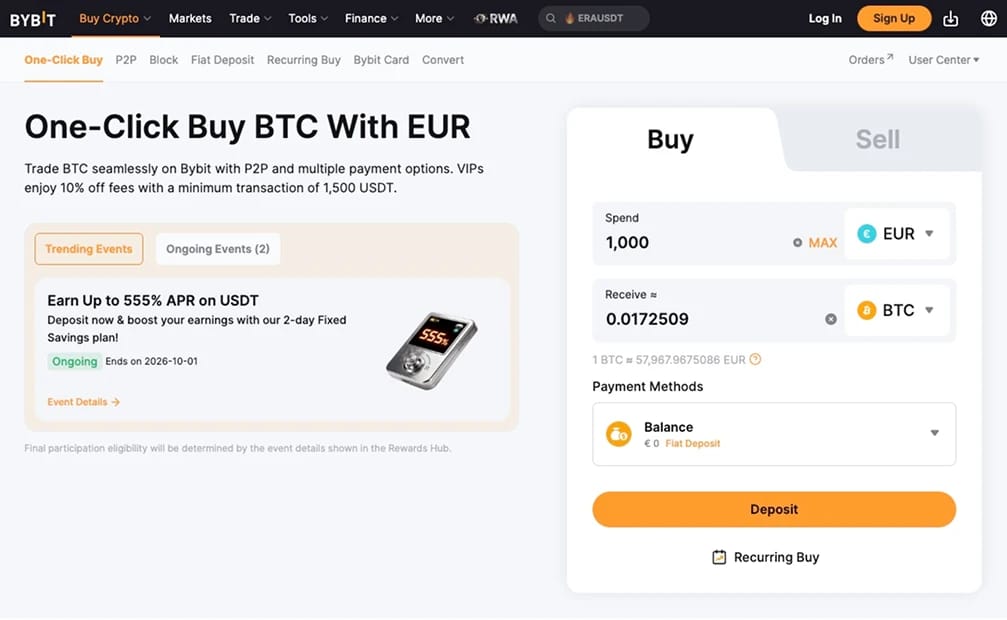
Bybit EU is the best crypto exchange in Cyprus. It serves Cypriots through Bybit EU GmbH, a Vienna company holding MiCA authorization from Austria's Financial Market Authority since May 2025, with a license that passports across the EEA. Behind the European entity stands the world's second-largest crypto exchange, a group counting more than 80 million clients and roughly $20 billion in daily turnover.
More than 600 cryptocurrencies carry a uniform 0.10% spot fee, and the account extends into copy trading, Earn products, crypto loans, demo trading, and TradingView charting. Euro deposits arrive over SEPA, bank cards, Apple Pay, and Google Pay, with PayPal supported through the express buy screen. A transfer from our Bank of Cyprus account arrived before we had finished setting up the first order.
Two limits belong in the assessment. The EU entity concentrates on spot markets, closing the leveraged perpetuals sold elsewhere to Cypriot retail accounts, and in February 2025 the Lazarus Group stole roughly $1.5 billion from the global platform, a loss Bybit refunded from reserves within three days. Our Bybit review covers the recovery and the security rebuild that followed.
Pros
- An Austrian MiCA license that reaches Cyprus through EEA passporting.
- The widest low-cost selection in this guide, with 600+ assets at 0.10% per trade.
- Euro funding by SEPA, card, Apple Pay, Google Pay, and PayPal, credited within seconds.
Cons
- High-leverage derivatives are unavailable to European retail accounts.
- The February 2025 theft remains on the record even though every client was repaid in full.
- The volume of products can slow down someone who only wants to buy Bitcoin.
2. Kraken
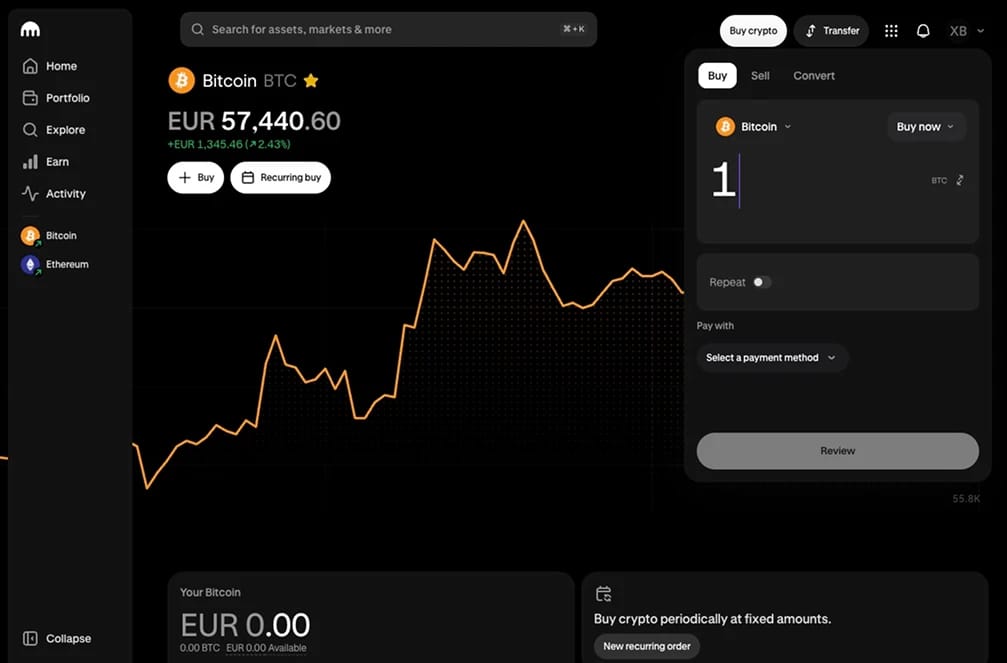
Kraken is our recommendation for anyone trading meaningful size in euros. Its European entity holds CASP authorization from the Central Bank of Ireland, including the trading-platform permission that only around 14 firms across the EU have secured, layered on earlier MiFID and e-money licenses. Few regulators examine applicants as closely, and the authorization passports into Cyprus.
No European exchange quotes deeper BTC/EUR markets. More than 640 assets are priced at 0.16% for makers and 0.26% for takers, SEPA Instant deposits carry no fee, and staking covers the main proof-of-stake networks. Kraken has published proof-of-reserves attestations since 2014 and has never suffered a platform-level breach. It is considered one of the most secure platforms in Europe.
The compliant European product cuts a few corners. USDT pairs are withheld from EU customers, the standard fee schedule sits above OKX and Bybit EU, and Kraken Pro presents more depth than a first-time buyer needs. Our Kraken review examines the platform in full.
Pros
- CASP authorization from the Central Bank of Ireland, among the hardest licenses to obtain in the EU.
- No-fee SEPA Instant funding into the deepest euro order books in Europe.
- Proof-of-reserves attestations dating to 2014 alongside a clean breach history.
Cons
- Per-trade costs exceed OKX and Bybit EU at standard tiers.
- USDT pairs are not offered to European customers.
- The professional interface takes time to learn and can be confusing for beginners.
3. Coinbase
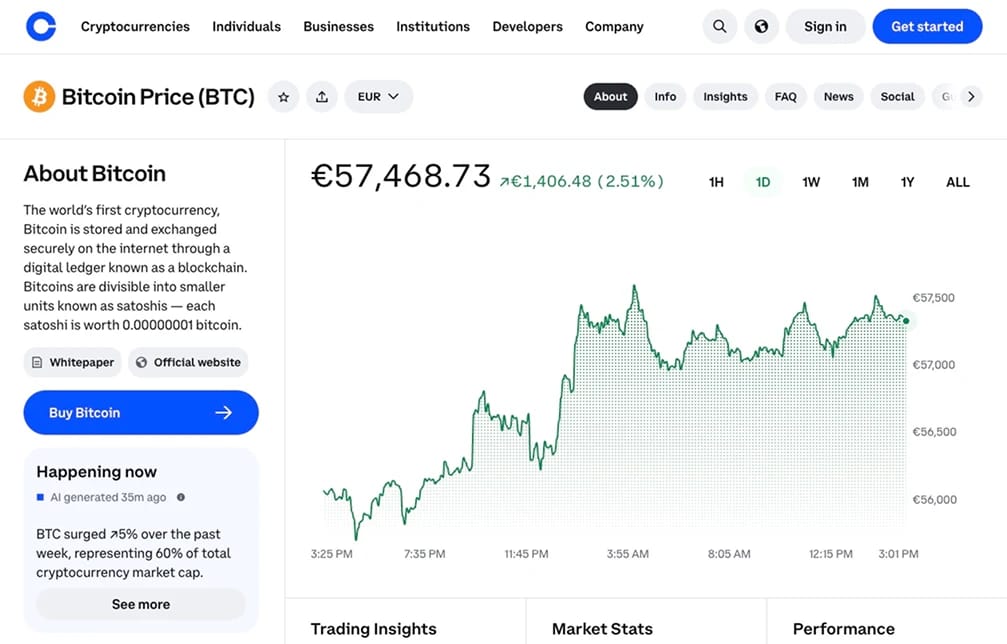
Coinbase suits Cypriots making a first purchase. The Nasdaq-listed company serves Europe through Coinbase Luxembourg S.A., authorized under MiCA by Luxembourg's CSSF, and it even owns a CySEC-licensed investment firm on the island, Coinbase Financial Services Europe, acquired from broker BUX to carry EU derivatives permissions. Regulated-entity details and risk warnings appear throughout the app rather than in the small print.
Onboarding is where it earns its place. SEPA Instant deposits carry no fee and settle in seconds; every screen explains what happens next, native USDC balances earn rewards, and Coinbase Advanced opens a full order book once the simple view feels limiting.
The cost structure explains the mid-table position. Instant purchases carry a fee near 1.5% plus an embedded spread, and Coinbase Advanced charges 0.40% maker and 0.60% taker, the highest order-book rates in this guide. These fees are much higher than the industry average, which sits between 0.1% and 0.3%. To learn more about the exchange, visit our Coinbase review, which prices each purchase path in detail.
Pros
- A Luxembourg CSSF license plus the disclosure duties of a Nasdaq-listed company.
- No-fee SEPA Instant deposits and the gentlest onboarding for a first purchase.
- Offers native USDC with rewards paid on balances, which is a great alternative for Europeans who can’t invest in USDT.
Cons
- The highest trading fees in this guide once activity increases, with the instant buy fee starting at 1.5%.
- Instant purchases hide a spread inside the quoted price.
- A shorter asset list than Bybit EU, Gate or Kraken, with only 200 cryptocurrencies supported.
4. eToro
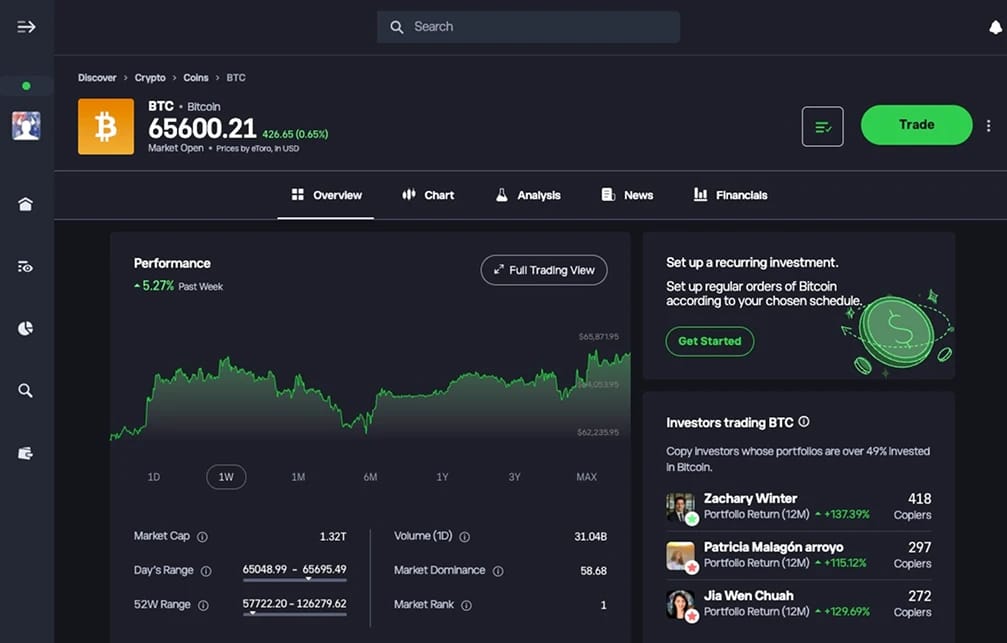
eToro has operated from Cyprus longer than any other platform here. Its European business, eToro (Europe) Ltd, runs from Limassol under CySEC license 109/10 and received one of the first MiCA permits in the EU in January 2025, so a Cypriot customer deals with the home regulator rather than an authority abroad. The parent company listed on Nasdaq in May 2025 under the ticker ETOR.
The account mixes asset classes. Over 100 cryptocurrencies sit beside thousands of stocks and ETFs, CopyTrader replicates the positions of vetted investors automatically, and Smart Portfolios bundle whole themes into one holding. Deposits land by SEPA transfer, card, or PayPal, and the interface assumes no trading experience.
Pricing is the compromise. Crypto trades cost 1% in each direction plus a spread, ten times the Bybit EU rate, and charting tools trail the dedicated exchanges. Moving coins into self-custody also requires the separate eToro Money wallet, an extra step pure crypto platforms avoid. For an occasional buyer who values home supervision, the premium is defensible.
Pros
- Supervised by CySEC in Cyprus, with a MiCA permit granted in January 2025.
- Crypto, stocks, and ETFs in one account, with CopyTrader for automated strategies.
- A Nasdaq-listed parent that publishes audited accounts, giving users peace of mind in terms of security.
Cons
- A 1% fee in each direction makes frequent trading expensive.
- Charting and order types are thinner than on a dedicated exchange.
- Withdrawing coins to self-custody requires the separate eToro Money wallet.
5. OKX
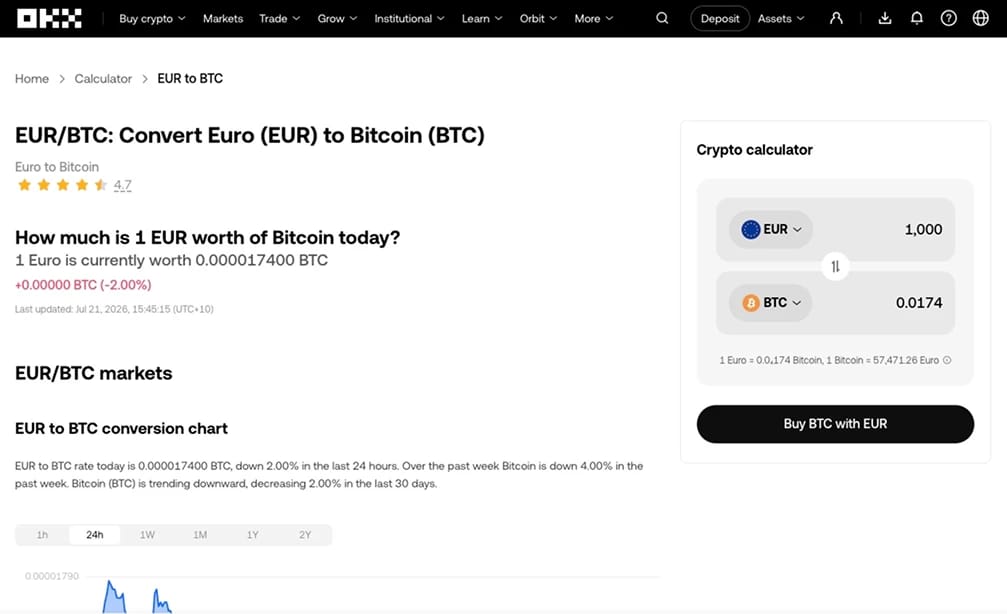
OKX undercuts everyone here on price. OKCoin Europe Limited, its Maltese entity, holds a CASP license from the MFSA and charges 0.08% maker and 0.10% taker on spot, with SEPA Instant deposits credited at no charge. Around 350 assets are open to European customers, and monthly Merkle-tree reserve reports have appeared without interruption since late 2022.
The account extends beyond spot trading. A built-in Web3 wallet connects to more than 100 networks with a DEX aggregator attached, so euros deposited from a Cypriot bank can end up in on-chain staking or a decentralized swap without separate software. The OKX Wallet gives users access to copy trading, signal trading and more.
The caveats mirror those of any Maltese licensee. ESMA questioned the rigor of the MFSA's authorization process in a peer review; USDT trading is unavailable to EU customers, and the on-chain tooling adds complexity a simple investor will never open. To learn more about what features are available on the platform, our OKX review sets out the full record.
Pros
- The lowest trading costs in this guide, from 0.08% per order.
- A Web3 wallet spanning 100+ networks without leaving the app.
- Monthly reserve attestations published continuously since late 2022.
Cons
- Its Maltese authorization carries the supervision question ESMA raised.
- USDT cannot be traded from European accounts, which is the same for all the exchanges on this list.
- On-chain features add complexity that buy-and-hold investors will not use.
6. Gate
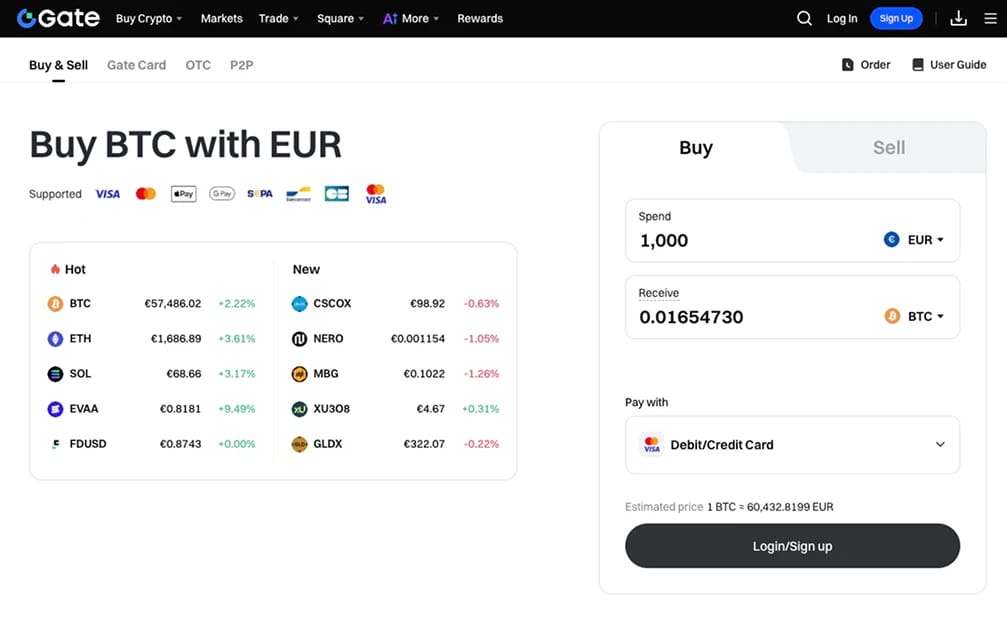
Gate carries the longest asset list available to Cypriots by a wide margin. Its European arm, Gate Technology Ltd in Malta, secured MiCA authorization from the MFSA in September 2025 and passports the license across the EEA, then added a Maltese payment-institution permit in February 2026 to run euro services in-house. Behind that entity sits a global group founded in 2013 that passed 40 million users after rebranding from Gate.io.
Breadth is the reason to open the account. More than 3,800 cryptocurrencies are listed, many of them long before the larger platforms add them, and spot pricing starts at 0.10% for makers and 0.20% for takers, with discounts for paying fees in GT. Euro deposits reach the Maltese entity over SEPA, while card payments run through third-party processors at a higher cost, and a P2P market covers further currencies. Our Gate review walks through each funding path.
The size demands matching caution. Small caps sit on thin order books where spreads widen quickly; complaint platforms score Gate poorly on stalled withdrawal reviews, and the Maltese license carries the supervision question already noted for OKX. Monthly reserve reports verified with zk-SNARKs, showing coverage above 100%, offset part of that concern, and treating Gate as a listing venue rather than long-term storage answers the rest.
Pros
- MiCA authorization from the MFSA, backed by a Maltese payment license for euro services.
- The widest selection in this guide, with more than 3,800 listed cryptocurrencies.
- Monthly proof-of-reserves reports verified with zk-SNARKs at coverage above 100%.
Cons
- Complaint platforms report frozen accounts and slow withdrawal reviews.
- Spreads widen quickly outside the major pairs.
- The Malta supervision caveat that applies to OKX applies here as well.
How to Choose a Crypto Exchange in Cyprus
Every platform above operates on a valid MiCA license, so the real choice concerns the regulator behind that license, the path your euros take, and the cost at the size you trade. We work through five checks before funding anything.
- Search the registers for the legal entity: CySEC publishes both a list of authorized providers and a warning list, while ESMA keeps the central record for every passported firm. Look up Bybit EU GmbH, eToro (Europe) Ltd, or Gate Technology Ltd rather than the brand name, since one brand can operate many companies.
- Decide how much home supervision matters: eToro answers to CySEC directly, so complaints and enforcement stay in Cyprus. The rest hold licenses issued in Austria, Ireland, Luxembourg, or Malta, and ESMA has publicly questioned how thoroughly Malta vetted its applicants, a point that touches both OKX and Gate.
- Plan the euro leg around your bank: SEPA Instant transfers must now cost no more than ordinary ones across the euro area, but some Cypriot banks still review payments to exchanges. A Revolut top-up avoids that delay, and our guide to buying crypto with Alpha Bank explains the position at one of the island's retail banking groups.
- Price your own order, not the advertised rate: A €1,000 purchase costs about €10 at eToro, €4 to €6 on Coinbase Advanced, and €2 or less at Bybit EU, OKX, or Gate. Add the spread from any instant buy screen before comparing, and give large orders to Kraken's deeper books.
- Prepare for the 8% disposal tax before trading: Every sale, swap, and crypto payment is a taxable disposal under the new rules, and licensed platforms feed transaction data to the Tax Department under DAC8. Export your history from the first trade.
Crypto and Bitcoin Regulation in Cyprus
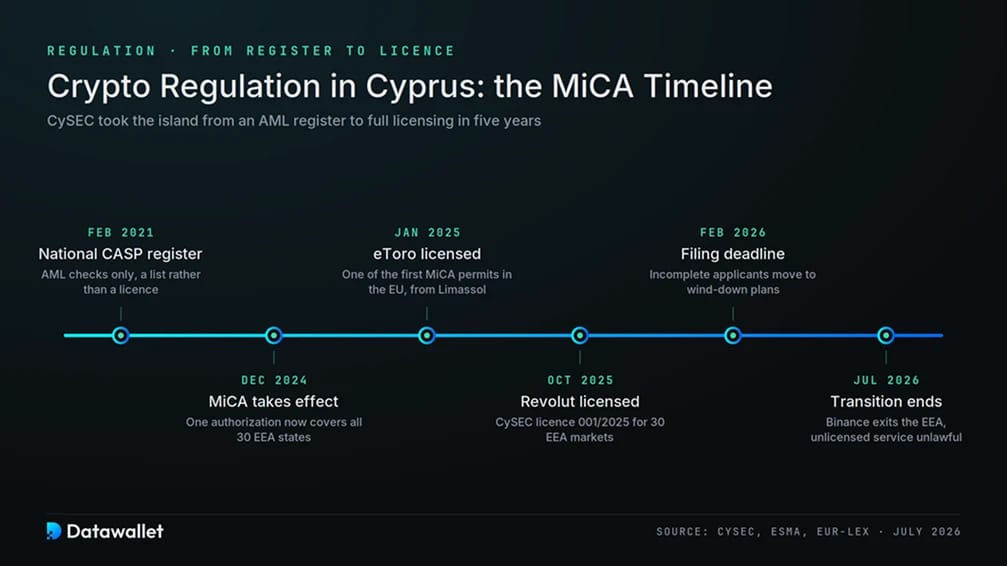
Crypto is legal in Cyprus and regulated as tightly as anywhere in the EU. CySEC supervises the sector as the national competent authority under MiCA, and the island moved from a simple registration list to full licensing over five years.
- February 2021: An amendment to the anti-money-laundering law created a national CASP register at CySEC. Registration confirmed AML controls but imposed no capital or client-asset requirements, a list rather than a license.
- 30 December 2024: MiCA took full effect across the bloc, and a single CASP authorization issued in any member state now covers all 30 EEA countries, retiring the national regimes.
- January 2025: CySEC granted eToro (Europe) Ltd one of the first MiCA permits in the bloc, covering crypto trading and custody across the EEA from Limassol.
- 23 October 2025: Revolut Digital Assets Europe Ltd received license 001/2025, bringing the neobank's crypto services for 30 EEA markets under Cypriot supervision.
- 27 February 2026: CySEC's filing deadline passed for firms on the national register. Those that filed complete applications could keep operating, while the rest had to prepare wind-down plans.
- 1 July 2026: The transition period ended after Cyprus used the full 18 months MiCA allows. Binance, which had abandoned its application, shut off access for its EEA customers, and offering crypto services without authorization became unlawful.
The result is a market without a middle ground. Any provider missing from the CySEC and ESMA registers cannot lawfully take a Cypriot deposit, and licensed firms must attach originator and beneficiary details to each transfer under the travel rule.
How Is Crypto Taxed in Cyprus?
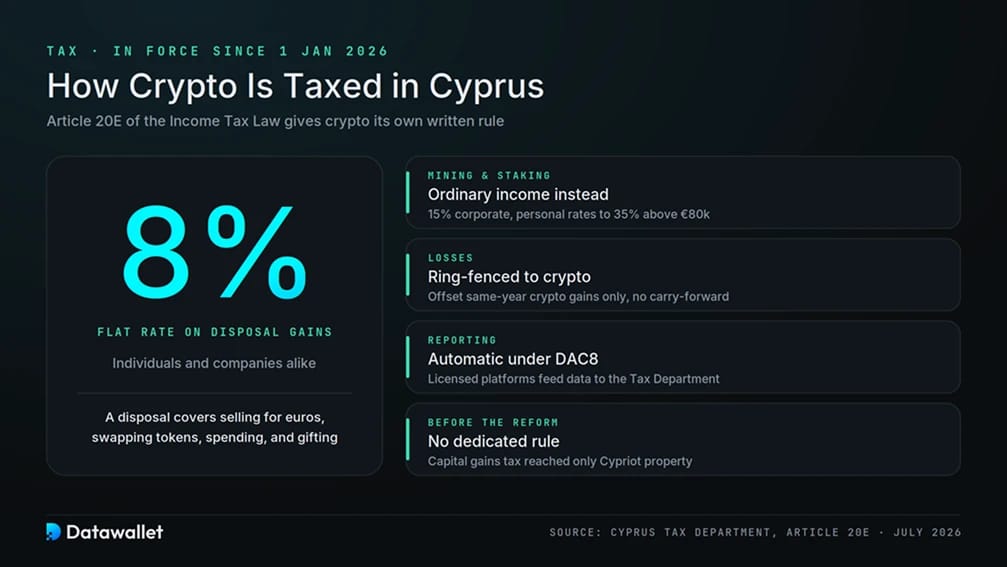
The tax reform that took effect on 1 January 2026 gave crypto its own article of the Income Tax Law for the first time, closing years in which gains fell between income tax and a capital gains regime that covers only property on the island. The Tax Department administers the rules.
- Disposal gains carry a flat 8% rate: Article 20E taxes profits from selling crypto for euros, swapping one token for another, spending it, or gifting it, and the rate applies to individuals and companies alike.
- Mining sits outside the flat rate: Coins earned through mining count as ordinary income, taxed at the 15% corporate rate or progressive personal rates reaching 35% above €80,000. Staking rewards are likewise treated as income rather than disposals.
- Losses are ring-fenced: A crypto loss offsets only crypto gains realized in the same year. Nothing carries forward, and nothing reduces salary or business income.
- Reporting is automatic: Licensed platforms report balances and transactions to the Tax Department under the EU's DAC8 framework, so assume your exchange activity is visible and keep dated records of every disposal.
None of this is tax advice, and anyone with holdings beyond a simple personal portfolio should speak to a Cypriot tax professional.
Cryptocurrency Adoption in Cyprus
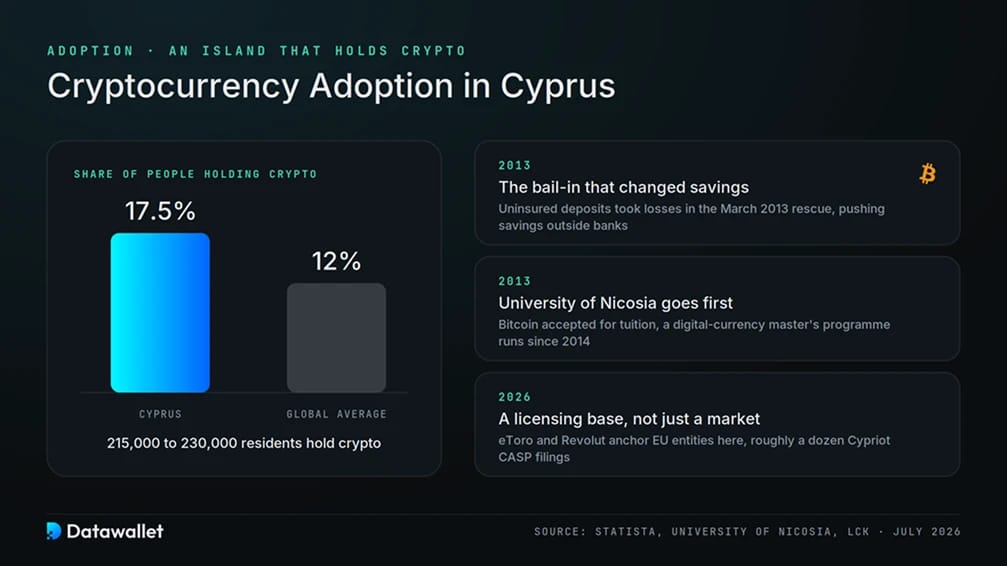
Crypto ownership in Cyprus runs well above the European average, and the island's recent financial history explains much of it.
- Around one resident in six holds crypto: Statista estimates 215,000 to 230,000 crypto users in Cyprus, an adoption rate near 17.5% against a global average of roughly 12%.
- The 2013 deposit write-downs still shape behavior: Uninsured deposits at the island's largest bank took losses during the March 2013 banking rescue, an experience that taught a generation of Cypriots to hold part of their savings outside the banking system.
- The island trained its own crypto workforce: The University of Nicosia began accepting Bitcoin for tuition in 2013 and has run a digital-currency master's program since 2014, while the investment-firm cluster around Limassol supplies compliance and trading staff to crypto companies.
- Cyprus became a licensing base, not just a market: eToro and Revolut both anchored their EU crypto entities on the island, and advisers tracking the register counted roughly a dozen Cypriot firms authorized or in the pipeline as the transition closed.
Readers weighing nearby markets can see how the same framework plays out across the water in our best crypto exchanges in Greece guide.
How to Buy Bitcoin in Cyprus
A first Bitcoin purchase in Cyprus takes about a quarter of an hour, and because the island already uses the euro, there is no conversion cost between bank and exchange. The steps below match how we ran our own tests.
- Choose a licensed platform: Bybit EU for the widest low-cost account, Kraken for large orders, Coinbase for a gentle start, eToro for CySEC supervision at home, OKX for the cheapest orders, or Gate for the longest altcoin list. Confirm the legal entity in the ESMA or CySEC register before signing up.
- Complete identity verification: A Cypriot identity card or passport clears every platform here. Enter your name exactly as it appears on the document, because a mismatch with your bank details is the most common cause of a stalled first withdrawal.
- Send euros by SEPA Instant: A transfer from a Cypriot bank should land in under ten seconds without a charge. If your bank questions payments to exchanges, top up Revolut by card and buy there, or move the balance onward from the app.
- Use a limit order instead of the instant-buy screen: On every venue we tried, the instant quote sat above the live order-book price once the hidden spread was counted. Setting your own price on the BTC/EUR pair recovers most of that difference.
- Decide on custody and start a record: Coins held for years belong in a wallet you control, and the choices are compared in our best crypto wallets guide. Save your trade history the same day, since each future disposal will be taxed on the gain above your documented purchase price.
Selling works in reverse, and euro withdrawals over SEPA reach a Cypriot bank account the same day.
Final Thoughts
Bybit EU leads in Cyprus on the combination of selection, cost, and euro funding under a valid license. Kraken handles size, Coinbase handles first steps, eToro keeps supervision on the island, OKX handles cost, and Gate carries the longest asset list.
The wider change is CySEC's role. A regulator once known mainly for licensing CFD brokers now authorizes some of the largest crypto businesses in Europe, and the flat 8% disposal tax gives those platforms a cleaner fiscal environment than most of the bloc offers. Our guide to the best crypto exchanges in Europe shows how the wider region compares.
Before committing serious money, put a small amount through a complete cycle on your shortlisted platform, from deposit to withdrawal, and judge the costs and delays for yourself.
Our Methodology
We scored these platforms the way a customer in Nicosia or Limassol encounters them rather than the way their marketing presents them. We verified accounts with Cypriot documents, funded them in euros from local banks and Revolut, placed trades, and withdrew the remaining balances. Six criteria determined the order.
- Trust Score: Our in-house rating out of 5, weighing how demanding the licensing regulator is, the transparency of reserve reporting, incident history and its resolution, and time in operation.
- License Verification: Confirmed each legal entity's authorization in the ESMA register, checked CySEC's registers and warning list, and rechecked every status after the 1 July transition deadline.
- EUR Funding Methods: Moved euros by SEPA and SEPA Instant from Cypriot bank accounts and a Revolut balance, tested card and mobile-wallet deposits, and timed each credit.
- Security Track Record: Reviewed breach histories, custody arrangements, reserve attestation frequency, and available account defenses such as two-factor authentication and address allowlists.
- Assets and Liquidity: Executed BTC/EUR and ETH/EUR orders and one mid-cap position per venue, noting what each order cost in spread, how much depth sat behind the quote, and how cleanly it filled.
- Fee Structure: Calculated the all-in cost of depositing, trading, and withdrawing on each platform, including instant-buy spreads and network withdrawal charges.
Any platform lacking a MiCA authorization that covers Cyprus was excluded at the outset, a rule that removed Binance along with every offshore venue. Testing ran through June and July.
.webp)