






Compare Top Crypto Exchanges in Finland
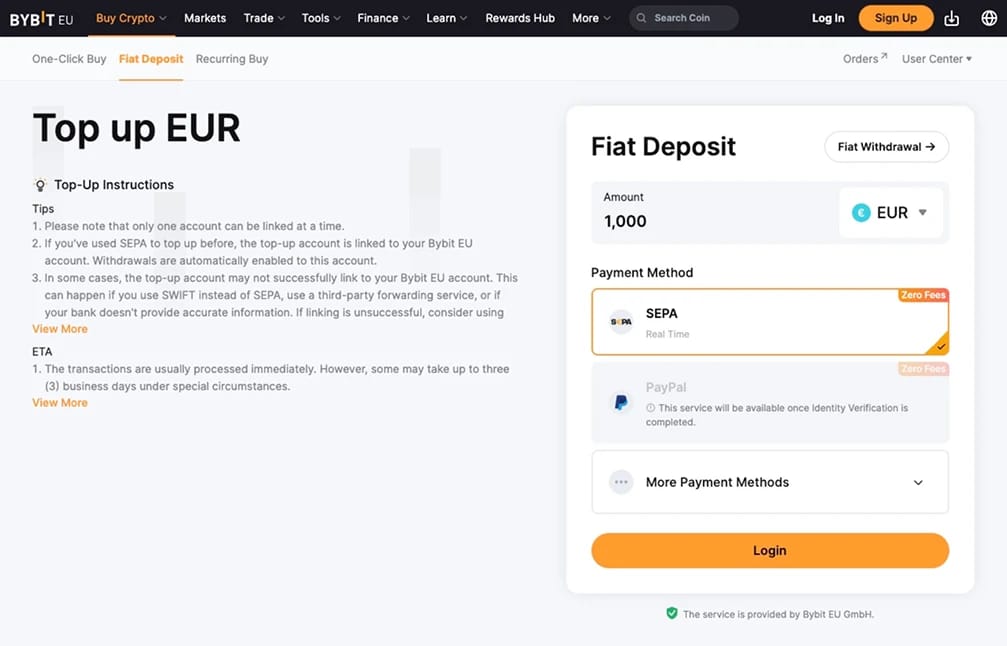
1. Bybit EU
Bybit EU takes first place in Finland by pairing global scale with paperwork that satisfies the FIN-FSA. Its Vienna-based entity, Bybit EU GmbH, was authorized by Austria's Financial Market Authority in May 2025 and passports into Finland with the rest of the EEA. It is the second-largest crypto exchange in the world, serving over 80 million clients with $20 billion in daily trading volume.
The platform gives Finnish traders more to work with than any rival here. Offering more than 600 cryptocurrencies to trade at a flat 0.10% spot fee, the same app supports copy trading, Earn, demo trading, crypto loans and TradingView charting. EUR funding is completed via SEPA transfers, cards, Google Pay, or Apple Pay, and a test deposit from our OP account appeared faster than the app could refresh.
It’s important to mention that the EU entity is built around spot trading, so the high-leverage perpetuals Bybit sells elsewhere are unavailable to Finnish retail accounts. In addition, in February 2025, attackers linked to Lazarus drained about $1.5 billion in ETH, a theft that Bybit absorbed by restoring reserves within three days without touching customer balances. Our Bybit review weighs the full record.
Pros
- Austrian MiCA license covers Finnish users directly through Bybit EU GmbH.
- 600+ cryptocurrencies at a flat 0.10% fee, the broadest low-cost catalog here.
- Instant euro deposits over SEPA, cards, Apple Pay and Google Pay.
Cons
- No high-leverage derivatives for Finnish retail under the EU entity.
- A $1.5 billion theft in early 2025 stays on its record even though every user was made whole.
- The product diversity can be overwhelming for someone opening their first account.
2. Kraken
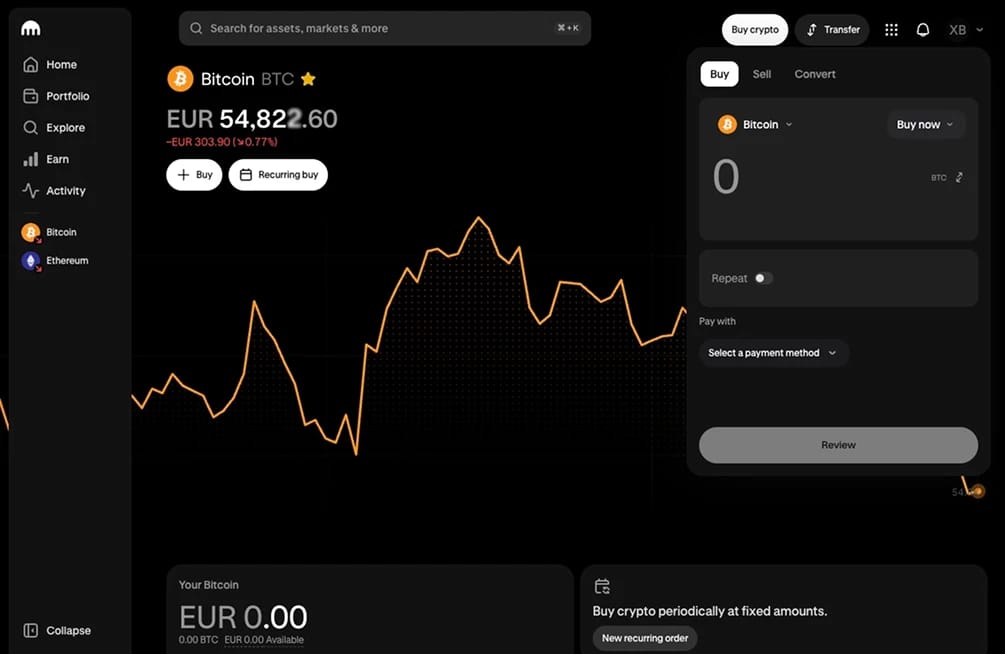
Kraken is where we point serious euro investors, because its licensing goes further than anyone else's. The Central Bank of Ireland granted it CASP authorization, including the trading-platform permission only around 14 firms hold across the EU, stacked on existing MiFID and e-money licenses. No other exchange available to Finns has secured that breadth of permissions from such a demanding regulator.
Day to day, its strengths are liquidity and entry costs. SEPA Instant deposits are free and settle in seconds; the BTC/EUR order book is the deepest in Europe, and the 640+ listed assets cost 0.16% maker and 0.26% taker. Kraken Pro stayed responsive through every volatile session, staking covers the major proof-of-stake networks, and proof-of-reserves audits stretch back to 2014.
The compliant front-end has trade-offs. EU users cannot trade USDT pairs; a few smaller tokens were removed alongside them, and the standard fee schedule is higher than OKX's or Gate's charges. For a Finnish investor holding a meaningful size, the Irish license and the euro book are worth that premium. Our Kraken review covers the platform’s features and security measures in depth.
Pros
- Central Bank of Ireland authorization, including the rare trading-venue permission.
- Free SEPA Instant euro funding into Europe's deepest BTC/EUR order book.
- Reserve audits have been published every cycle since 2014 alongside a clean security history.
Cons
- Trading costs more per order here than on OKX or Gate.
- No USDT pairs are offered to European customers.
- Kraken Pro carries more depth than a beginner will use at first.
3. Coinbase
Coinbase is our pick for Finns making their first crypto purchase. The Nasdaq-listed company operates in Europe through Coinbase Luxembourg S.A., which the Luxembourg CSSF authorized under MiCA, files audited public accounts, and surfaces its regulated-entity details and risk disclosures throughout the app.
The onboarding experience justifies the reputation. SEPA Instant deposits from our Nordea account settled in seconds; the interface explains each step in plain language, and USDC is native, with rewards paid on balances. Once you have outgrown the simple screen, Coinbase Advanced adds a real order book without a new account.
Cost is the reason it sits third rather than higher. The standard fees of 1.5% are applied to instant buy orders, and the 0.40% maker and 0.60% taker on Coinbase Advanced are the highest among the platforms here. Simple purchases also carry an embedded spread. Our Coinbase review prices the convenience in full.
Pros
- CSSF authorisation in Luxembourg plus the accountability of a Nasdaq-listed operator.
- The clearest onboarding for a first purchase, with free SEPA Instant funding.
- Native USDC support with rewards on balances.
Cons
- The most expensive fee schedule on this list once trading picks up.
- Simple Buy embeds a spread on top of the stated fee.
- A conservative asset list that experienced traders will find narrow.
.webp)
4. Gate
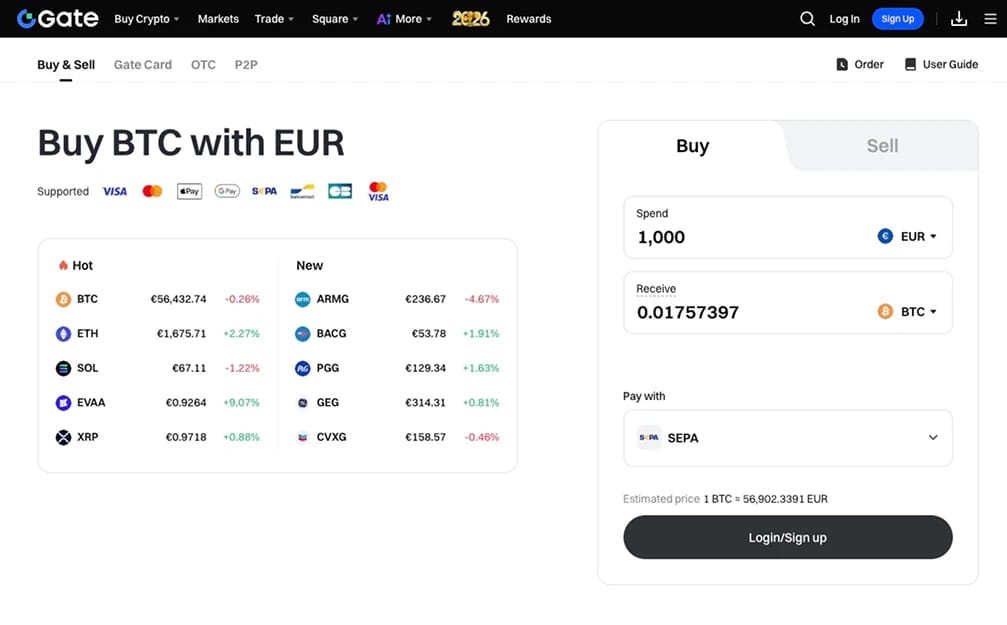
Gate earns its slot as the licensed route to tokens nothing else here carries. Gate Technology Ltd, its European company, won CASP authorisation from the Maltese MFSA in October 2025, and the compliant front-end still lists over 1,000 cryptocurrencies, several times the selection at Coinbase or Coinmotion. New sectors appear here weeks or months before conservative venues touch them.
Costs stay competitive at 0.09% maker and 0.10% taker, with discounts for holding GateToken, and euro deposits run over SEPA and cards. Trading bots, an Earn suite, and a launch platform round out an account suited to an active altcoin trader wanting a licensed EU base. Unfortunately, the dedicated EU platform does not support the full product suite of the global Gate exchange.
The downsides are the regulator and the long tail coins. ESMA flagged Malta's authorization process in a peer review, so the license carries less supervisory weight than an Irish or Luxembourg one, and liquidity thins quickly once you start trading beyond the majors, so a small cap bought here can prove stubborn to sell. Our Gate review covers the record, including a 2018 breach for which every user was repaid.
Pros
- Over 1,000 tradable assets, the widest selection available under a MiCA license.
- Spot fees from 0.09% with additional GateToken discounts.
- Early listings give Finnish altcoin traders regulated access to new sectors.
Cons
- ESMA's peer review questioned how rigorously the MFSA vets applicants.
- Order books turn shallow beyond the majors, complicating small-cap exits.
- The product-dense interface slows down a simple first purchase.
5. OKX
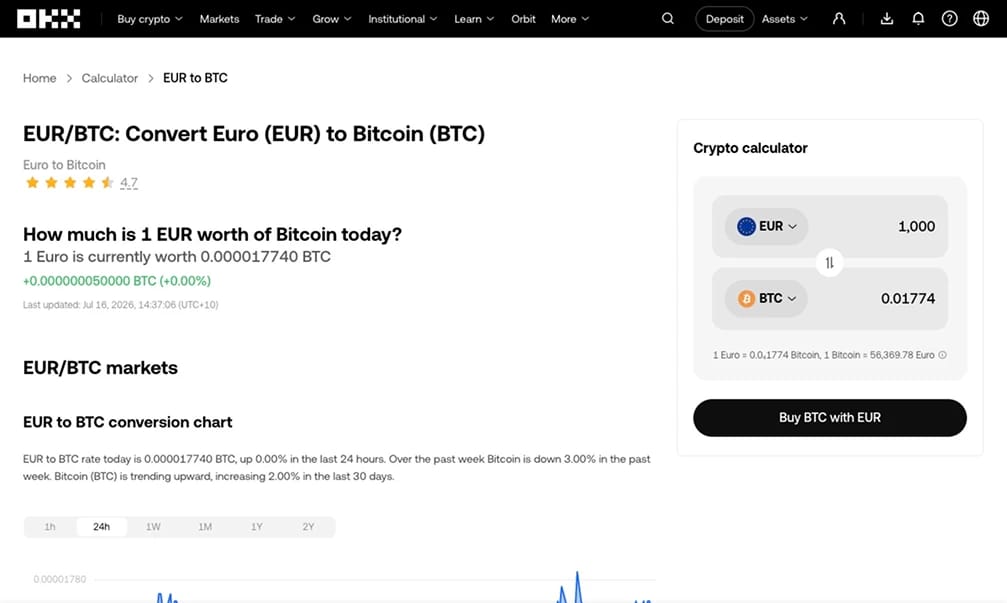
OKX offers the cheapest trading on this list and the shortest path to go from using an exchange account to exploring DeFi with OKX Wallet, the exchange’s portal to Web3. OKCoin Europe Limited, its Maltese-licensed EU company, prices spot at 0.08% maker and 0.10% taker and credits SEPA Instant euro deposits in seconds, free of charge. It is the third-largest exchange, with over 50 million clients worldwide.
The distinguishing feature is the built-in Web3 wallet. It reaches more than 100 networks with DEX aggregation attached, so euros from a Finnish bank can move from a spot purchase into on-chain staking or a DEX swap without separate software. Reserve reporting has been a monthly Merkle-tree routine here for over three years, a disclosure streak few large platforms match.
The Maltese license question raised for Gate applies here too; European customers cannot trade USDT, and the on-chain toolkit exceeds what a buy-and-hold investor needs. For cost-conscious traders and anyone heading on-chain, no platform here fits better. Our OKX review includes the full feature set and a breakdown of its security history.
Pros
- Cheapest trading on this list, from 0.08% per order.
- A built-in Web3 wallet spanning 100+ networks with DEX aggregation.
- An unbroken monthly reserve-attestation streak stretching back years.
Cons
- Its Maltese authorization shares the ESMA rigor question raised for Gate.
- European accounts cannot trade USDT.
- Web3 depth adds complexity that simple investors will never touch.
6. Coinmotion
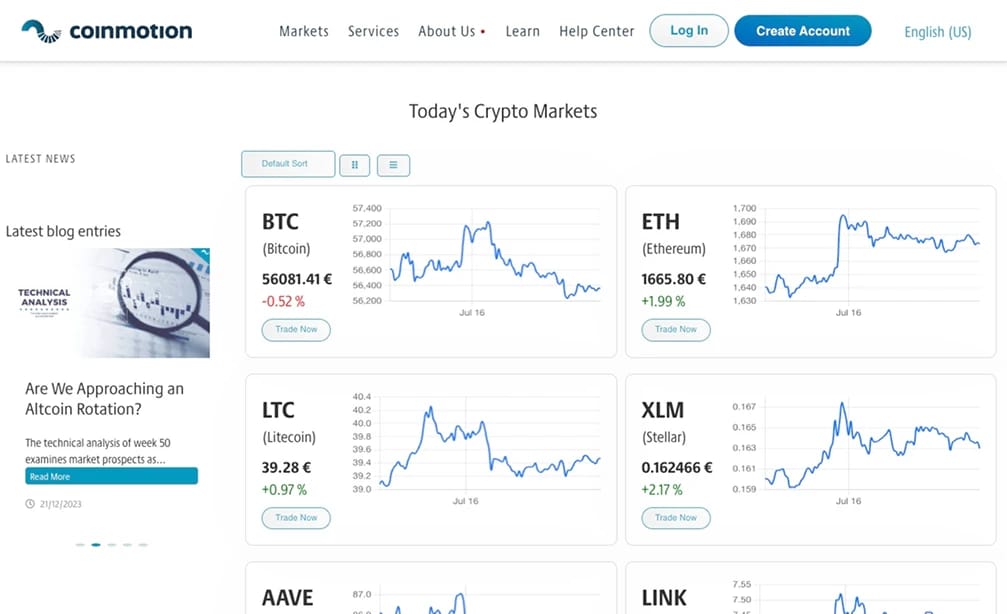
Coinmotion is the platform most Finns already know. Founded in Jyväskylä in 2012, it became the first company in Finland to receive a full MiCA license from the FIN-FSA in June 2025, alongside its long-held payment institution license. According to the K33 crypto adoption survey, 31% of Finnish crypto owners use it, more than any other single platform.
Onboarding is where being Finnish shows. You verify with your online banking credentials rather than photographing documents; everything runs in Finnish, Swedish, and English, and instant deposits arrive through Finnish online bank payments alongside SEPA transfers and cards. Around 200 cryptocurrencies are available, with a Monthly Savings plan from €10, a time-locked Vault for storage, and an OTC desk for orders above €5,000.
Cost is why it finishes last despite the local pedigree. Trading starts at 2%, easing toward 0.8% only with volume, so a €1,000 purchase pays €20 here against €1 on Bybit EU, and every platform above delivers more assets for a fraction of the price. The FIN-FSA license and bank-credential login still make it the easiest recommendation for a cautious relative, but anyone trading regularly will outgrow the fee schedule within a month.
Pros
- First Finnish MiCA license from the FIN-FSA, supervised at home rather than abroad.
- Identity verification through Finnish online banking credentials in minutes.
- Monthly Savings from €10, a time-locked Vault, and an OTC desk for large orders.
Cons
- Entry fees of 2% are the highest here by a wide margin, twenty times Bybit EU's rate.
- Around 200 assets are a fraction of what Bybit or Gate carry.
- No futures, margin, or passive yield products for active traders.
How to Choose a Crypto Exchange in Finland
Every platform above holds a valid MiCA license, so the choice in Finland depends on which regulator backs it, how your euros get there, and what the account costs at your trading size. These are the checks we run before depositing.
- Verify the license in an official register: The FIN-FSA publishes its register of authorized supervised entities alongside a warning list, and every EEA-passported platform appears in the ESMA register. Search for the legal entity, such as Bybit EU GmbH or Coinmotion Oy, not the brand name.
- Weigh the regulator behind the passport: Every license grants identical EU access, but Ireland's central bank and Luxembourg's CSSF tested their applicants harder than Malta's MFSA, which ESMA criticized in a peer review. The FIN-FSA supervises Coinmotion directly at home.
- Fund with SEPA Instant and keep the transfer free: Euro-area banks must now support instant payments at no premium over ordinary transfers, so a deposit from Nordea, OP or Danske Bank should land in seconds. Skip card deposits and their processor markup unless speed genuinely matters.
- Price your own trade size, not the headline fee: A 2% fee on Coinmotion costs €20 on a €1,000 purchase against €1 on Bybit or OKX, while a large order gets better treatment from Kraken's deep euro book than from a cheaper but thinner venue. Run a small buy and sell on each shortlisted platform and measure the round trip.
- Plan for Vero before the first trade: Finnish and foreign providers now report activity to the Tax Administration, and MyTax asks you to separate gains made through each. Export your trade history from day one, because reconstructing purchase prices years later is the most common Finnish crypto tax headache.
Crypto and Bitcoin Regulation in Finland
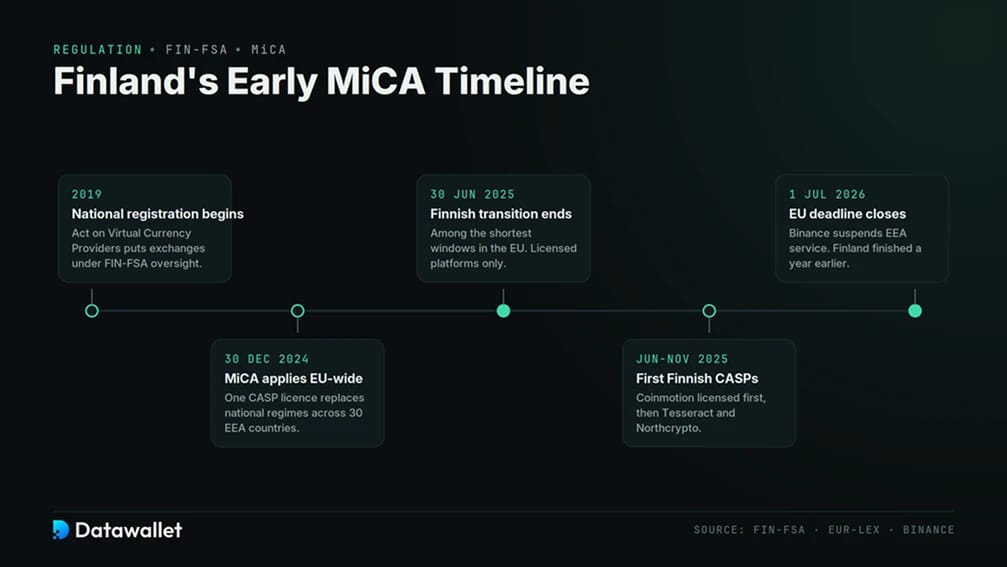
Crypto is legal and comprehensively regulated in Finland. The FIN-FSA supervises the sector under MiCA, the EU's crypto framework, which Finland implemented through its national Act on Crypto-Asset Service Providers and enforced earlier than almost anyone else. The path to the current regime ran through a series of firsts.
- 2019: The Act on Virtual Currency Providers made Finland an early mover, requiring exchanges and custodians serving Finns to register with the FIN-FSA and meet anti-money laundering duties years before EU-wide rules existed.
- 30 December 2024: MiCA became fully applicable across the EU, replacing national registration regimes with a single authorization, the CASP license, valid in all 30 EEA countries.
- 30 June 2025: Finland's national transition ended, a six-month window that was among the shortest in the EU. From this date, only fully authorized CASPs could serve Finnish customers, a full year before the bloc-wide deadline forced the same discipline everywhere.
- June to November 2025: The FIN-FSA authorized Finland's own CASPs, starting with Coinmotion, the country's first MiCA license, followed by Tesseract for portfolio management and Northcrypto for custody and execution. Finnish-licensed Paxos Issuance Europe also launched USDG, among the first regulated dollar stablecoins issued under MiCA in the EU.
- 1 July 2026: The EU-wide grandfathering window closed. Binance, which had withdrawn its license application days earlier, suspended services for EEA users, while every platform in this guide continued operating on a valid license.
The practical effect for a Finnish user is a market with no grey zone. A platform either appears in the FIN-FSA or ESMA registers, or it cannot legally take your euros, and the travel rule now attaches sender and recipient details to every crypto transfer regardless of size.
How Is Crypto Taxed in Finland?
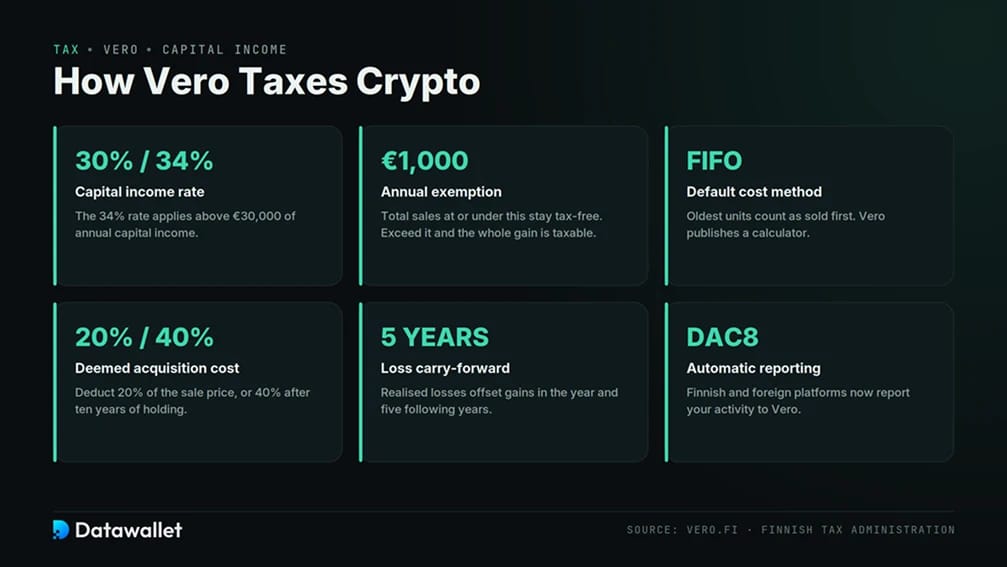
The Finnish Tax Administration (Vero) treats gains from crypto as capital income, and its rules contain several features that catch new investors out. Selling for euros, swapping one coin for another, and spending crypto on goods all count as taxable disposals.
- Capital gains are taxed at 30% or 34%: Capital income up to €30,000 in a year is taxed at 30%, and the portion above that at 34%. The rate applies to your combined capital income, so share dividends and rental income count toward the same threshold.
- Small disposals stay tax-free: If the total selling prices of all assets you dispose of in a year stay at or under €1,000, the gains are exempt. Cross that line and the whole gain becomes taxable, not just the part above it, and losses on such small disposals are equally non-deductible.
- FIFO decides which coins you sold: Vero assumes your oldest units go first unless you can prove otherwise, and it publishes a FIFO calculator for working through a trading history. Crypto-to-crypto swaps trigger the same calculation as a sale for euros.
- The deemed acquisition cost can cap your bill: Instead of the actual purchase price, you may deduct 20% of the selling price, or 40% for assets held at least ten years. This caps the taxable gain at 80% of any sale, regardless of how cheap your coins were, a genuine advantage for early Bitcoin buyers, though it replaces all other deductions on that disposal.
- Losses carry forward for five years: Realized losses offset capital gains in the same year and the five following years, provided your annual disposals exceed the €1,000 threshold. Paper losses on coins you still hold deduct nothing.
- Mining and staking are taxed differently: Proof-of-work mining rewards are earned income at progressive rates, while staking and lending rewards count as capital income valued in euros at the moment they arrive in your wallet.
Reporting runs through MyTax under capital gains with the property type set to crypto assets, and from the current tax year, Vero receives transaction data from both Finnish and foreign providers under the EU's DAC8 reporting rules.
Assume the Tax Administration can already see your exchange activity, keep dated records of every disposal, and speak to a professional for anything beyond straightforward personal holdings.
Cryptocurrency Adoption in Finland
Finland has quietly become the Nordic region's most committed crypto market, and the profile of who owns it is changing fast.
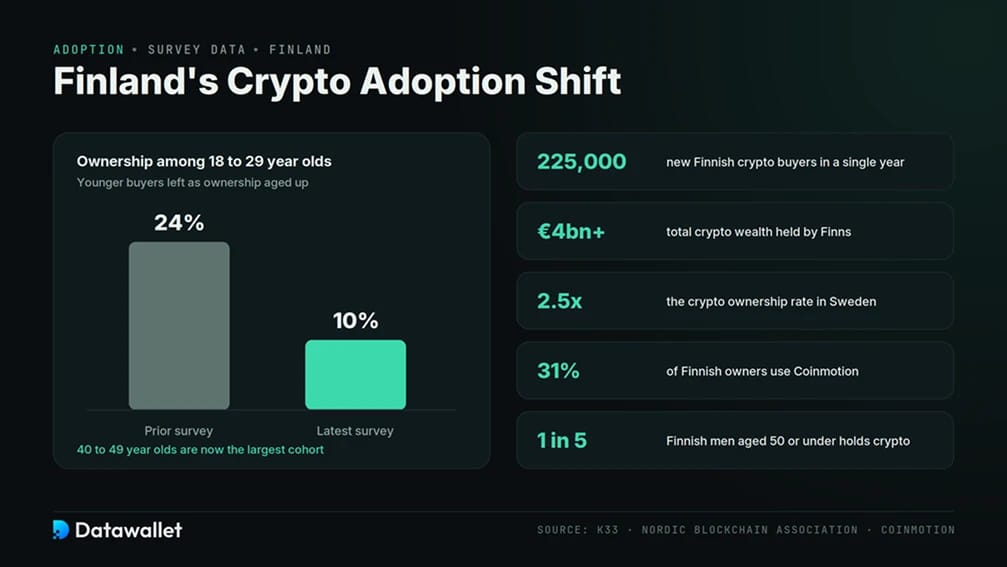
- Finland leads the Nordics on ownership: Coinmotion's market research found Finnish crypto ownership running at roughly two and a half times Sweden's rate, a surprising result for a country with a famously cautious investment culture.
- A quarter of a million Finns joined in a single year: The K33 and Nordic Blockchain Association survey counted around 225,000 new Finnish crypto buyers over one year, the largest absolute growth anywhere in the Nordics, and estimated total Finnish crypto wealth at over €4 billion.
- Ownership is aging up: The latest survey round recorded ownership among 18-to 29-year-olds falling from 24% to 10%, while adults aged 40 to 49 became the largest crypto-owning cohort. Around one in five Finnish men aged 50 or under holds crypto, and Bitcoin dominates portfolios.
- Domestic platforms hold unusual loyalty: 31% of Finnish crypto owners use Coinmotion, and preference for local providers is stronger in Finland than nearly anywhere in Europe. Trust and security rank ahead of fees in Finnish platform choice, with half of investors naming security their top criterion.
Set against the global picture in our crypto adoption statistics, Finland looks less like a speculative market and more like a savings one, built on regulated platforms, monthly buying plans and long holding periods.
How to Buy Bitcoin in Finland
A first BTC purchase in Finland is a fifteen-minute job on any licensed platform, and the euro makes it cheaper than anywhere else in the Nordics because nothing needs converting. This is the sequence we followed.
- Pick a licensed platform from the list above: Bybit EU for the broadest low-cost account, Kraken for size and liquidity, Coinbase for a gentle first purchase, Gate for altcoins, OKX for the lowest fees, or Coinmotion for a home-grown Finnish platform. Confirm the entity in the ESMA or FIN-FSA register before signing up.
- Verify your identity: A Finnish passport or identity card clears every platform here, and Coinmotion accepts your online banking credentials instead. Type your name precisely as it appears on the document, because name mismatches against your bank account are what most often leave a first transfer sitting in review.
- Deposit euros over SEPA Instant: Send a transfer from your OP, Nordea, Danske Bank or S-Pankki account, which should arrive within seconds at no fee. Cards and mobile wallets work everywhere here but carry a processor markup, so reserve them for a small test amount.
- Skip the instant buy screen: Place a priced limit order on the BTC/EUR book instead of accepting the quoted rate. Each platform we tested quoted a worse instant price than its own order book, with the gap typically running 1% to 3% once the hidden spread is counted.
Selling reverses the steps, and euro withdrawals over SEPA land back in a Finnish account the same day, often within seconds on platforms supporting instant payouts.
Final Thoughts
Bybit EU earns first place in Finland by giving the most complete account a licensed platform can offer, with 600+ assets, flat 0.10% fees and instant euro funding under an Austrian license. None of the six options requires any compromise on legality, which is the quiet achievement of Finland's early MiCA enforcement.
While much of Europe spent June 2026 scrambling before the licensing deadline, the Finnish market had already run its cleanup a year earlier. Test any platform with a small round trip, deposit, buy, sell, and withdraw, before committing meaningful money, and keep every record for Vero.
Our Methodology
We ranked these platforms on how they behave for someone in Helsinki, not on their global marketing pages. Each account was opened with Finnish documents or bank credentials, funded in euros from Finnish banks, put through real trades, and emptied back out at the end. Six criteria set the order.
- Trust Score: Our in-house score out of 5, built from the strictness of the issuing regulator, the quality of reserve disclosure, how any past incident was handled, and years in operation.
- License Verification: Confirmed each entity's CASP authorization in the ESMA register and checked the FIN-FSA's registers and warning list for anything attached to the brand.
- EUR Funding Methods: Sent SEPA and SEPA Instant deposits from Finnish bank accounts to every platform, confirmed which cards and mobile wallets each accepts, and timed how quickly funds appeared and at what cost.
- Security Track Record: Examined each platform's incident history, how customer assets are held, how often reserves are attested, and which account defenses exist, from two-factor authentication to withdrawal allowlists.
- Assets and Liquidity: Ran live BTC/EUR and ETH/EUR orders plus one mid-cap trade per venue, then logged the spread paid, the depth behind it, and how cleanly each order filled.
- Fee Structure: Priced a full euro round trip per platform, counting the published trading schedule, any instant-buy spread, deposit costs and the withdrawal charge on networks Finns realistically use.
Platforms without a valid MiCA license covering Finland were excluded outright, which removed Binance and every offshore venue. We tested between June and July, then reconfirmed every license in the ESMA register once the 1 July transition deadline had passed.
.webp)