



Compare Top Ghanaian Crypto Exchanges
1. Bybit
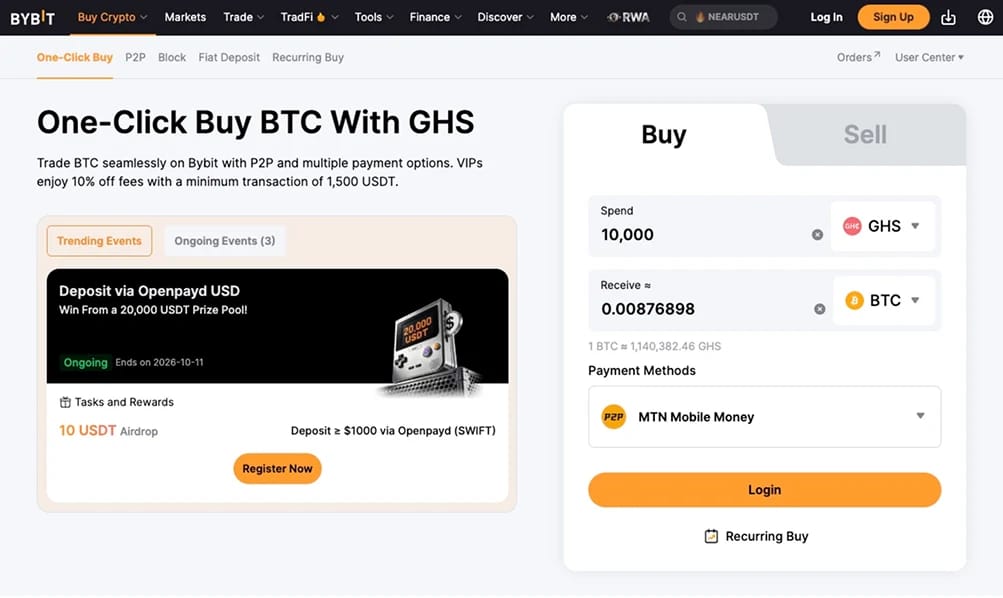
Bybit takes first place because its cedi desk was unaffected by the June directive and its products remained usable without a workaround. Advertisers on the GHS P2P market accept MTN MoMo, Telecel Cash, and bank transfers, with no exchange charge for either party. In our weekday afternoon test, USDT was released from escrow in under fifteen minutes after we paid an Accra merchant by MoMo.
Base spot trading costs 0.1% across 2,600+ pairs. For perpetuals, makers pay 0.02% and takers 0.055%, some of the lowest in the industry. The same login provides options and copy trading, plus grid and DCA bots. There is also a practice demo account, lending and borrowing, and Earn for idle stablecoins, while beginners can use a Lite view that hides leverage. Visit our Bybit review to learn more about the supported products.
In February 2025, roughly $1.5 billion of Ether was taken from a Bybit cold wallet, the largest theft any exchange has suffered. Withdrawals stayed open, and customers were repaid in full within days. Hacken has since audited monthly reserve reports; the mid-2026 report showed backing above 100% on $16.5 billion of assets. Bybit appears in neither Ghanaian sandbox.
Pros
- Commission-free P2P escrow accepts cedi through MTN MoMo, Telecel Cash or bank transfer. Merchants were active throughout Accra business hours in our tests.
- Base spot fees are 0.1%, while perpetual makers pay 0.02%.
- Every monthly reserve report published since the 2025 incident has had full backing confirmed by Hacken.
Cons
- February 2025's cold wallet theft remains part of its record, although customers bore none of the loss.
- Third-party processors handle card purchases, and cedi card approvals are unreliable under the June 2026 directive.
- Bybit has no Ghanaian crypto license as of September 2026.
2. KuCoin
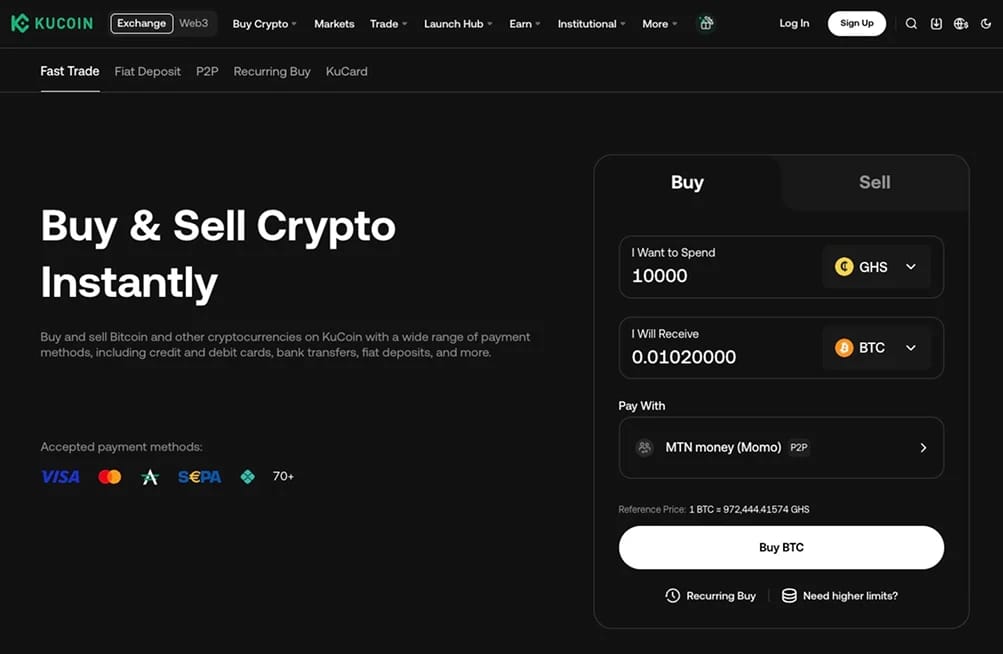
KuCoin ranks second for its Earn and staking products, despite weaker cedi access. Across 1,000+ coins, it offers flexible and fixed-term savings, staking and lending, as well as structured notes such as Dual Investment. Advertised yields of 500% apply to short campaigns on smaller tokens and do not represent typical returns on Bitcoin, Ether or stablecoins. Before using an Earn product, check its loss conditions, withdrawal restrictions and settlement terms.
Grid, DCA and rebalancing bots cover spot and futures, while GemSPACE lists new tokens ahead of bigger exchanges. KuCoin also has a built-in Web3 wallet and KuCard for spending balances at the till. It publishes reserve proofs and holds PCI DSS, ISO 27001, and SOC 2 Type II certifications from external auditors. Our KuCoin review dives into the security measures and history.
Cedi funding is the weakness. Although the P2P desk lists GHS, only a handful of merchants advertised during our tests, with quotes above those on Bybit and Binance. Most users buy USDT elsewhere and transfer it. KuCoin admitted US anti-money-laundering violations in January 2025 and withdrew from that market before rebuilding around licensed subsidiaries in Europe and Asia.
Pros
- Its yield menu includes flexible and fixed-term products, staking, lending and Dual Investment.
- GemSPACE lists small-cap tokens well before they reach larger platforms.
- Reserve proofs and three external security certifications support its safety claims.
Cons
- Triple-digit promotional yields apply to minor tokens rather than major coins.
- Limited GHS merchant activity makes KuCoin a second account, funded with USDT bought on Bybit or Binance.
- Its record includes the January 2025 admission of US anti-money-laundering violations.
3. Binance
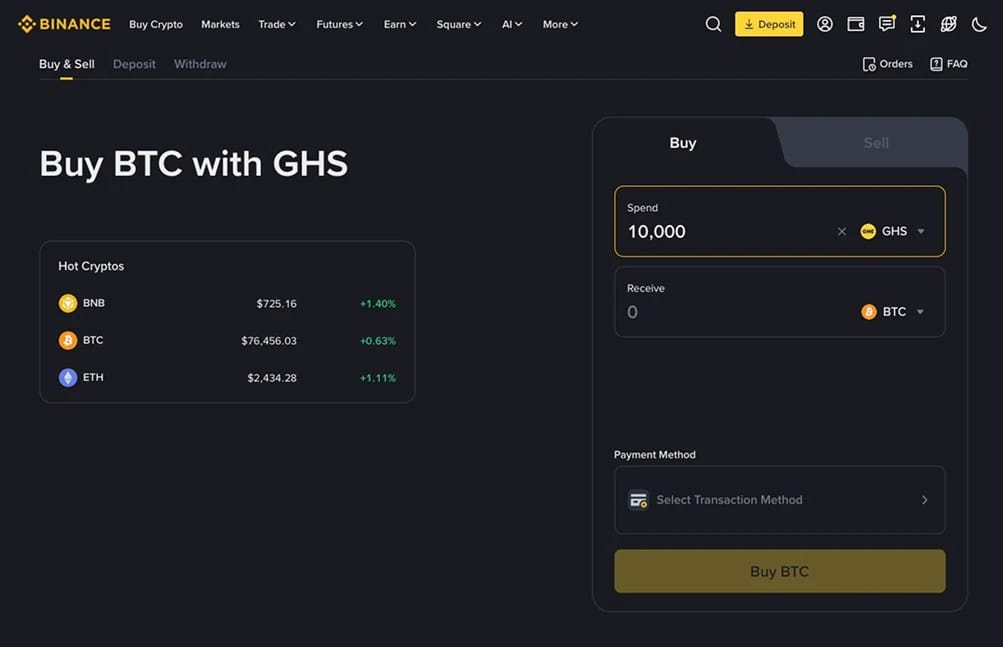
Binance has the oldest and deepest cedi marketplace among global exchanges, with GHS P2P trading dating to June 2020. When mobile money followed that November, neither party paid P2P fees. Six years later, we still found more advertisers on its GHS/USDT desk than on any rival. Payment filters include MTN MoMo, Telecel Cash and AT Money, plus transfers from GCB Bank, Ecobank Ghana, Stanbic and Absa.
Without direct cedi deposits, P2P is the only way to fund Binance from a Ghanaian account. Spot trading covers 500+ coins at 0.1%, with 25% off when fees are paid in BNB. Perpetual makers pay 0.02% and takers 0.06%. Margin and auto-invest are available alongside Earn and Binance Pay. For Ghanaian businesses and larger traders, the OTC desk, VIP pricing and Ceffu custody make Binance the starting point for institutions.
Binance paid US authorities $4.3 billion in 2023, the industry's largest penalty and a reason to keep only working balances on any offshore exchange. Monthly reserve reporting has continued since, and the SAFU emergency fund remains in place. Binance has not joined either Ghanaian sandbox. Read our Binance review, which covers the wider ecosystem and regulatory history.
Pros
- Mobile money GHS P2P has been fee-free since 2020. No competing desk had as many active advertisers in our tests.
- Paying spot fees in BNB cuts the 0.1% rate by a quarter; futures makers pay 0.02%.
- For larger balances, Binance offers an OTC desk and Ceffu custody, plus monthly reserve reports and the SAFU fund.
Cons
- The 2023 US settlement of $4.3 billion is still crypto's largest compliance penalty.
- With no direct GHS deposit available, every cedi purchase requires a P2P counterparty.
- First-time buyers are only a few taps from leveraged products in a dense interface.
4. Gate
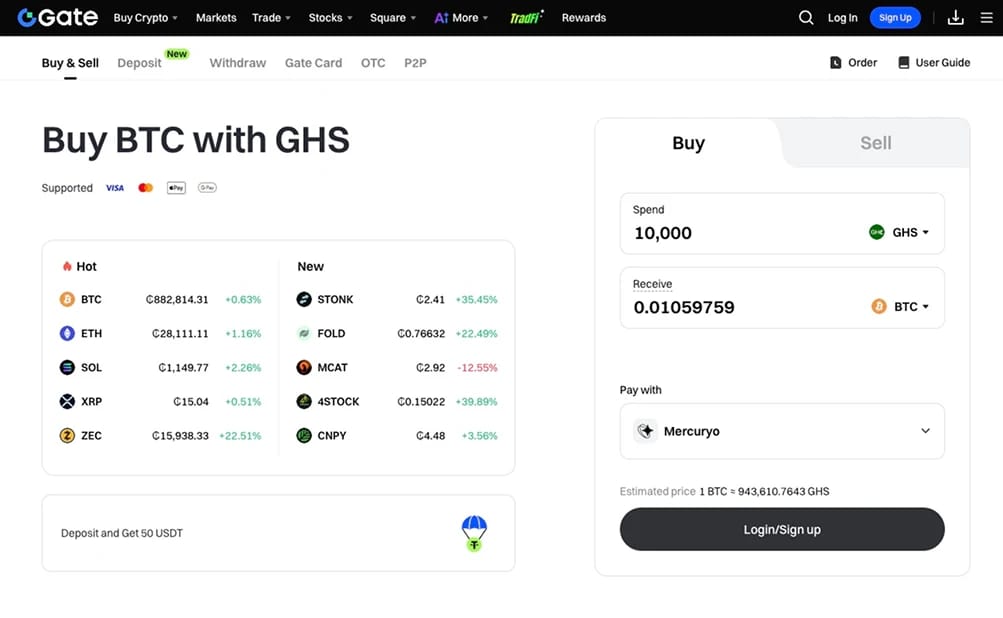
Gate ranks fourth for its selection of more than 4,400 cryptocurrencies, the largest catalog among these six exchanges. That breadth suits traders looking beyond major coins, although the smaller listings require closer checks on liquidity and project quality. This is the main reason why the platform is so popular among Ghanaian investors.
Its August 2026 monthly attestation reported holdings of $8.2 billion, equivalent to 127% of customer liabilities. The account also includes perpetuals and options, with copy portfolios, automated bots, lending, and Simple Earn. Users can also trade global stock markets from the US, Japan, Hong Kong and Korea.
Cost and cedi access are the trade-offs. Base spot fees are 0.2%, twice those on Bybit, KuCoin, or Bitget, with shallow order books on small coins adding to the gap. Few advertisers were active on Gate's GHS P2P desk during our tests. Local users generally fund accounts with USDT bought on Bybit or Binance, and the nested mobile menus also take patience. Fee tiers are detailed in our Gate review.
Pros
- Gate's 4,400+ listings give it the largest catalog in this guide.
- Holdings reached $8.2 billion in the August 2026 attestation, covering 127% of customer balances.
- A single spot login also provides derivatives and copy portfolios, alongside bots and Simple Earn.
Cons
- The 0.2% starting spot fee is double the base rate on the other order-book exchanges here.
- GHS merchants are scarce on its P2P desk, usually requiring users to buy USDT elsewhere first.
- Many of the thousands of listed projects are weak. Traders must screen them.
5. Bitget
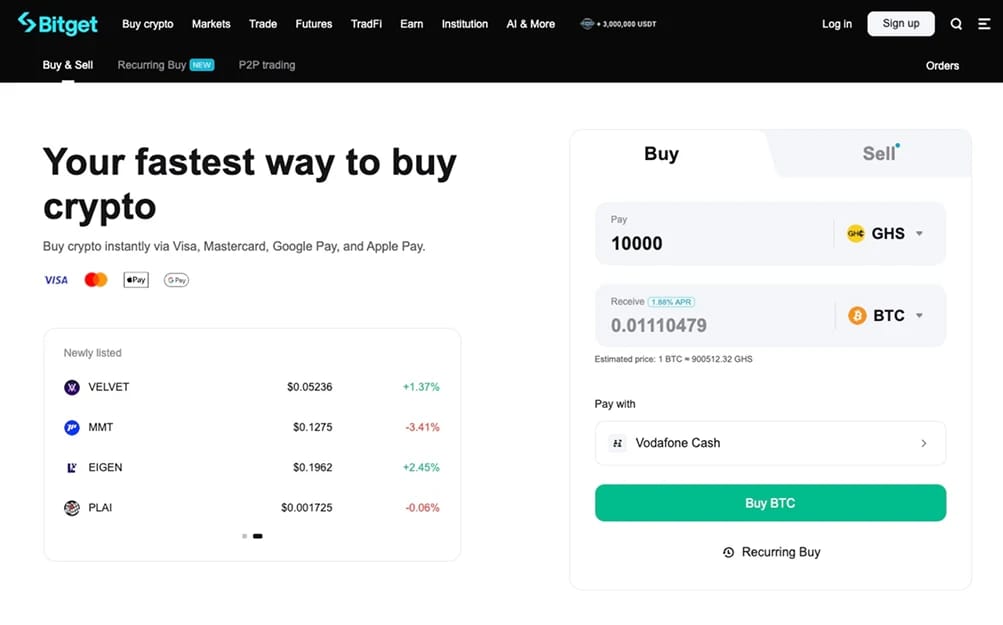
Bitget is our pick for Ghanaians who want copy trading. Its copy trading covers spot and futures, as well as bots. Before committing any cedi, followers can review a lead trader's return history, maximum drawdown and risk grade, then cap their allocation and attach a stop. Past returns do not guarantee future results, and copying a trader can produce losses. Our Bitget review explains the copy system and VIP levels.
The GHS P2P desk takes MTN MoMo, Telecel Cash, and AT Money, with identity checks using a Ghana Card or passport. It has fewer advertisers than Bybit or Binance, so we check each quote against the Bank of Ghana reference rate before accepting. Spot fees are 0.1% across 800+ coins. Perpetual makers pay 0.02%, compared with 0.06% for takers, while Universal Exchange adds USDT-priced stocks, gold and forex.
Bitget has published reserve disclosures since December 2022. Coverage stood at 169% in February 2026. Its Protection Fund has a committed floor of $300 million and averaged $451 million during March 2026. These figures describe reported reserves and fund size; they do not establish that every customer loss would be reimbursed.
Pros
- Followers can assess returns, drawdown and risk grades before allocating money to a lead trader.
- The GHS P2P desk accepts mobile money from all three Ghanaian networks.
- Bitget reported 169% reserve coverage in February 2026 and an average Protection Fund value of $451 million in March 2026.
Cons
- Copying a trader also means taking on their leverage, so drawdowns arrive quickly.
- Merchant depth for GHS is still building, with wider spreads after hours.
- Home-screen access to leverage makes Bitget a poor first exchange for cautious beginners.
6. BloFin
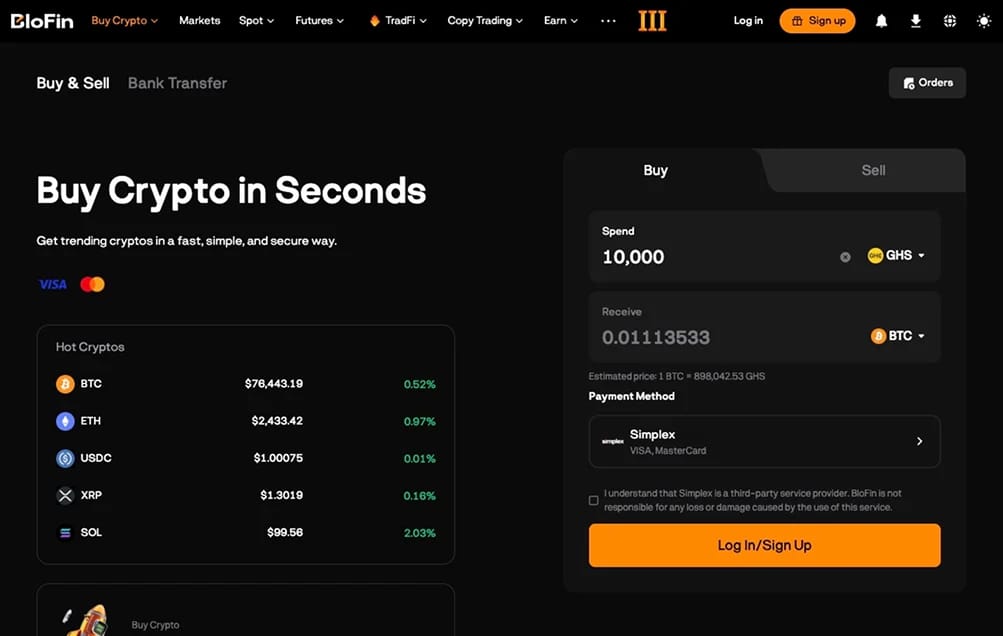
BloFin is our final pick for Ghanaians seeking derivatives without submitting ID as an email address is enough to open an account. Unverified accounts can trade spot and more than 350 perpetual markets with up to 150x leverage. They also have access to copy portfolios, grid bots, and Earn, with withdrawals capped at 20,000 USDT a day until verification.
Perpetual pricing is lower than spot, with maker fees of 0.02% and taker fees of 0.06% against 0.1% for spot orders. BloFin uses Fireblocks custody, holds ISO 27001 certification, and publishes Merkle tree reserve proofs. These measures do not establish regulatory supervision or guarantee reimbursement if funds are lost.
The no-KYC tier requires traders to bring crypto from elsewhere because buying with cedi or using P2P needs Level 1 verification. No major regulator supervises the Cayman Islands company, and its terms direct disputes to arbitration in Hong Kong. Our best no-KYC crypto exchanges ranking compares the alternatives.
Pros
- Email registration provides access to spot and derivatives, with daily withdrawals of up to 20,000 USDT.
- Maker fees of 0.02% and taker fees of 0.06% on perpetuals match the biggest derivatives venues.
- Its disclosed security measures include Fireblocks custody, ISO 27001 certification and published reserve proofs.
Cons
- Unverified users must bring USDT from elsewhere, as cedi funding requires verification.
- BloFin has no major regulatory supervisor, and disputes are settled offshore.
- Spot order books are shallow compared with its derivatives markets, ruling it out as a primary exchange.
How to Choose a Crypto Exchange in Ghana
As of September 2026, none of the exchanges in this guide holds a Ghanaian crypto license. Focus on cedi funding and withdrawal access, then calculate the full cost. We recommend using these five checks:
- Count the cedi merchants before you register: In the P2P section, filter for GHS and count advertisers accepting MTN MoMo or transfers from your bank. Check both buy and sell advertisements for the amount you plan to trade. Merchant availability can change, so a busy marketplace does not guarantee an immediate sale.
- Check the platform's standing with the regulators: Firms testing under supervision appear on the SEC sandbox list and the Bank of Ghana's virtual assets page. None of these six exchanges is listed. Check the company named in your account terms before relying on a foreign license. A license held by another group company may not cover your account, and reserve reports do not guarantee repayment.
- Price the whole round trip: Compare a merchant's GHS/USDT quote with the Bank of Ghana interbank rate. In our tests, the busiest desks charged 1% to 3% above that reference; quieter desks asked for more. Add trading fees and the network charge for withdrawing coins. A one-tap purchase screen can cost several multiples of the order book's 0.1% fee.
- Verify with your Ghana Card and keep names identical: Complete the selfie check using a Ghana Card or passport before sending money. MoMo accounts are linked to the Ghana Card. Merchants reject payments from wallets in a different name, and this caused almost every delay in our tests.
- Sell a small amount before you scale: Start by buying, trading, and cashing out a few hundred cedis. Some banks have flagged transfers linked to crypto platforms since the June directive. A small sale tests the current payment route, although a successful transfer does not guarantee that later payments will be accepted.
Crypto and Bitcoin Regulation in Ghana
Act 1154 established a licensing and supervisory framework for businesses providing crypto services in Ghana. Rules for businesses providing crypto services developed in stages:
- 2018 to 2022: Bank of Ghana notices described digital currencies as unlicensed under the Payment Systems Act and instructed regulated institutions not to facilitate them. In 2019, the SEC warned that investors had no protection. Neither regulator banned ownership.
- 10 June 2025: A BoG notice identified YellowPay and HanyPay as unlicensed platforms. Yellow Card said the product had never been offered in Ghana. Its local subsidiary joined the SEC sandbox nine months later.
- 10 July 2025: Notice BG/GOV/SEC/2025/18 required every VASP serving Ghanaians to register with the central bank by 15 August, whether based locally or abroad. More than 100 were registered, but registration did not confer approval.
- 19 December 2025: Parliament passed the VASP Bill, which became Act 1154 after presidential assent at the end of the month. The Bank of Ghana oversees payments, custody, stablecoins, and financial stability. Exchanges, brokerage, tokenization, and investment products fall to the SEC.
- 22 January 2026: The Bank of Ghana admitted six firms to a one-year sandbox for exchange, custody, administration and issuance.
- 20 February 2026: Before marketing rules existed, the two regulators jointly gave every crypto firm 48 hours to remove public advertising, including billboards in Accra.
- 10 March 2026: The SEC announced 11 sandbox participants, among them Yellow Card Ghana, WhiteBIT Ghana and Hyro Exchange. It expanded the cohort to 20 on 19 August, adding the Ghana Gold Board as a gold custodian for tokenized assets.
- 12 June 2026: Banks, electronic money issuers and payment providers were directed to stop supporting foreign-currency wallets offered by unauthorized crypto platforms under Notice BG/GOV/SEC/2026/14. Citing the Payment Systems and Services Act and the Foreign Exchange Act, the notice allowed no grace period.
- 25 August 2026: Governor Johnson Asiama inaugurated the Virtual Assets Coordinating Committee. Both regulators sit alongside the Ministry of Finance, the Cyber Security Authority and the Financial Intelligence Centre. He confirmed that guidelines were being drafted, with full implementation targeted for 2027.
According to the Bank of Ghana, its application page and fee schedule will be live by the end of September 2026. Offshore exchanges will continue setting their own terms for Ghanaian accounts until licenses are issued, with no local authority standing behind balances. The first license announcements will change this ranking.
.webp)
How Does the GRA Tax Crypto?
With no crypto-specific tax rules in Ghana, the Ghana Revenue Authority treats digital assets like other assets under the Income Tax Act, 2015 (Act 896). Its Commissioner-General confirmed in August 2025 that existing law already taxes crypto profits. Most individual traders should understand these five points:
- Capital gains are taxed at 15% for individuals: For an isolated transaction, individuals pay 15% on the net gain, calculated as disposal proceeds minus acquisition cost and related expenses. A capital gains return must be filed for the period of realization.
- Swaps can count as realization: Exchanging an asset falls within the GRA's definition of realization, even without a cash sale. A Bitcoin-to-USDT trade may therefore be taxable without any cedi withdrawal. Record the cedi value of both sides when each swap takes place.
- Frequent trading may be business income: The GRA can classify profits from organized, continuous trading as business income. Graduated personal rates then apply, reaching 35% on annual income above GHS 605,000. Ask a Ghanaian tax practitioner to confirm how mining proceeds, staking rewards and airdrops should be classified and when any tax becomes due.
- Your Ghana Card is your tax number: Capital gains returns ask for both parties' Ghana Card PINs, which act as their Taxpayer Identification Numbers. The 2026 mid-year budget reaffirmed the PIN as the sole identifier for all tax transactions.
- Keep records for tax reporting: Save transaction dates, acquisition costs, disposal proceeds and fees, with their cedi values. Keep exchange exports and wallet records so you can explain how you calculated your gains if the GRA requests information.
File returns through the GRA taxpayers' portal. Anyone trading meaningful volume should ask a Ghanaian tax practitioner to confirm how their activity is classified.
.webp)
Cryptocurrency Adoption in Ghana
More than three million Ghanaians hold or transact in digital assets according to the Bank of Ghana. Governor Asiama cited SEC data showing GHS 113 billion (about $10 billion USD) in transaction value through November 2025, up from roughly $6 billion USD a year earlier.
Ghana also ranks among Sub-Saharan Africa's five largest crypto economies in Chainalysis data. The region received $205 billion on-chain in the year to June 2025. Three forces shape activity in Ghana:
- Mobile money is how cedi gets in and out: Every P2P desk here settles through MTN MoMo, Telecel Cash or AT Money. The 1% Electronic Transfer Levy was repealed on 2 April 2025, removing a charge on every cedi payment to a merchant.
- Stablecoins absorb dollar demand: Stablecoins dominate regional transfers, according to Chainalysis. Sub-Saharan Africa also has the world's highest share of transactions under $10,000. After gaining about 21% against the dollar in 2025, the cedi lost roughly a tenth in the first half of 2026 and traded near GHS 11.4 in early September. Inflation was 5.0% in August and the policy rate 14%, yet USDT remains the default store of value for freelancers, importers and remittance recipients.
- Banks and the state are moving toward tokenized assets: At Standard Chartered's first Digital Assets Summit in Accra in June 2026, First Deputy Governor Zakari Mumuni described tokenization as a way to deepen capital markets. The central bank has floated gold-backed settlement instruments. The Ghana Gold Board's sandbox role suggests where that idea is headed.
Buyers tend to be young and mobile-first, with USDT more common than Bitcoin as a first purchase. For a comparison with other African markets, see our crypto adoption statistics.
.webp)
How to Buy Bitcoin in Ghana
The best way to invest in BTC is to buy USDT from a cedi merchant on P2P, then place a Bitcoin limit order on the spot market. You will need a Ghana Card or another accepted identity document and a funded payment account. Completion time depends on verification, the merchant’s response and whether your trading order fills:
- Register on an exchange with active GHS merchants: We recommend Bybit first, while Binance has the deepest cedi desk. Set Ghana as your country of residence to prevent an ID mismatch from delaying a later withdrawal review.
- Verify before you pay anyone: Submit a Ghana Card or passport and complete the selfie check. Wait for approval before proceeding. With a legible document, approval took minutes on every platform we tested.
- Buy USDT through escrow: Filter advertisements for MTN MoMo, Telecel Cash or your bank. Choose a merchant with a completion rate above 95% and a recent last order. Pay from a wallet or account in your own name, mark the order as paid, and wait for the USDT release. Larger desks list transfers from GCB Bank, Ecobank Ghana, Stanbic, Absa, and Fidelity.
- Place a BTC/USDT limit order: Set the highest price you are willing to pay and check the estimated trading fee. A limit order can execute at that price or better, but it may remain unfilled if the market does not reach your price.
- Withdraw long-term holdings to your own wallet: Ghanaian law provides no backing for exchange balances. Keep coins you intend to hold in a wallet whose keys you control. Our best crypto wallets guide ranks hardware devices, while the best USDT wallets page covers stablecoin storage. Check both the network and the address before sending.
To cash out, sell your crypto for USDT, then place a P2P sell order with a merchant paying in cedi. Confirm the full payment in your actual mobile money or bank account before releasing the USDT. Do not rely on screenshots or payment messages.
If payment is missing, disputed or from a different name, keep the crypto in escrow and contact the exchange’s support team. Export your trade history regularly and retain the cedi values needed for your tax records.
Final Thoughts
Bybit is our first choice for cedi P2P funding and spot trading. Binance is a strong alternative when merchant availability is the priority. KuCoin is better treated as a secondary account for yield products, while the remaining platforms suit more specific trading needs.
None of these exchanges holds a Ghanaian crypto license as of September 2026. Compare P2P quotes, test a small purchase and sale, and keep cedi records for tax reporting. If you move holdings to your own wallet, check the receiving address and network before sending.
For regional comparisons, see our guides to the best crypto exchanges in Nigeria and Kenya.
Our Methodology
We ranked platforms by the experience available to Ghanaian residents rather than global feature counts. Six criteria determined the order:
- Overall rating: The score out of 5 summarizes our editorial assessment of the platform. Readers should consider the individual findings on funding, costs, and security alongside that score.
- Cedi funding: We checked GHS merchant availability and advertised payment methods, including MTN MoMo, Telecel Cash and bank transfers. Completed P2P orders let us time escrow releases. The comparison identifies platforms that require crypto transfers.
- Total cost from cedi to Bitcoin and back: We combined the P2P premium over the Bank of Ghana interbank rate with trading fees and network withdrawal charges.
- Regulatory position: We assessed each exchange's standing under Act 1154, its licenses elsewhere, and its exposure to the June 2026 directive.
- Product depth: We examined the markets and order types available to Ghana-registered accounts, plus bots, copy tools and yield products.
- Safety infrastructure: The assessment covered custody arrangements and reserve attestations, along with account security choices and incident disclosure.
Testing ended in September 2026. The regulatory and tax sections draw on Bank of Ghana, SEC and GRA publications. Where crypto-specific tax guidance is unavailable, readers should confirm the treatment of their activity with a Ghanaian tax practitioner. Our editorial methodology describes the research and review process.