







Compare Top Crypto Exchanges in Qatar
1. Bybit
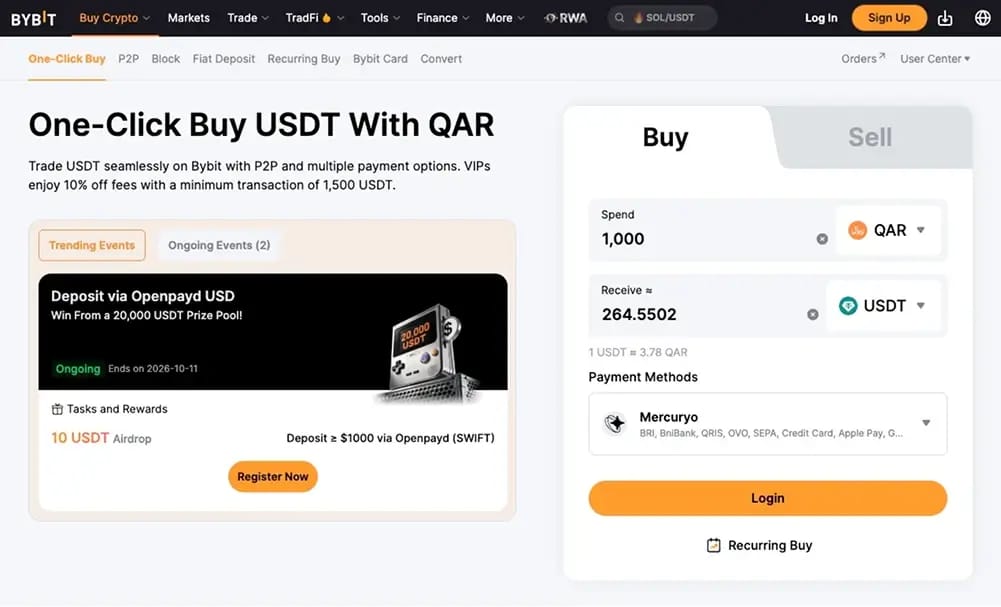
Bybit is first in our ranking for its QAR card payments, an interest-free account and Arabic support. Its Islamic Account operates as a separate sub-account restricted to spot trading and two automated tools. Each token must pass a review by Shariah advisers CryptoHalal and ZICO Shariah before entering the account. Bybit began adding 100 more approved pairs on September 1, 2026, with batches released roughly every two weeks.
Outside the Islamic Account, the main account offers more than 2,000 cryptocurrencies at a 0.1% spot fee. Additional features include bot trading, staking, copy trading and crypto loans. Visa and Mastercard cards support riyal purchases, as do Apple Pay and Google Pay. The riyal is also listed on Bybit's P2P market, but a P2P tracker showed no active riyal advertisements when we checked in October. Most Qatar users should therefore expect to pay by card.
There is a serious security incident that we need to mention. In February 2025, hackers stole about $1.5 billion in Ether from a Bybit cold wallet, a storage system kept offline. Withdrawals stayed open, customer funds were not affected and Bybit restored its reserves within days. Our Bybit review covers the incident in detail. Qatar accounts operate under Bybit's global terms without a Qatari license.
Pros
- Certified Islamic Account for interest-free spot trading, with 100 additional approved pairs arriving in stages.
- Riyal payments by card, Apple Pay and Google Pay, plus an Arabic app and support chat.
- More than 2,000 cryptocurrencies at a 0.1% spot fee.
Cons
- No riyal P2P advertisements when we checked, leaving cards as the practical payment method.
- The 2025 cold wallet theft remains part of its security record, although no customer lost funds.
- Complaints follow Bybit's own terms because no Qatari regulator supervises the account.
2. Rain
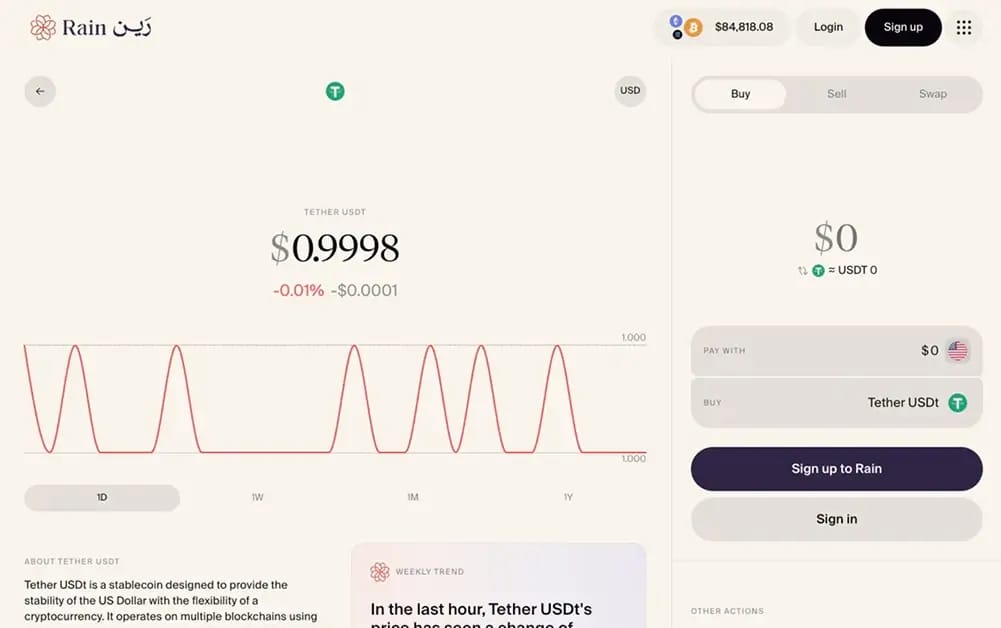
Rain, based in Bahrain, was founded in 2017 and is a regional broker that includes Qatar among its ten Middle East markets. Rain Management W.L.L. holds a Category 3 crypto-asset license from the Central Bank of Bahrain (CBB). Its sister company is authorized in Abu Dhabi, while a Dubai entity received in-principle approval in May 2026. Qatar customers can fund Rain with a Visa or Mastercard card in their own name.
Card purchases use the simple buy page. Rain adds 0.5% to the source price and displays the full cost before confirmation. For balances already in the account, the Rain Pro order book charges 0% for maker orders and 0.05% for taker orders. Maker orders wait in the order book; taker orders execute immediately against an existing offer.
The Shariyah Review Bureau has certified Rain's brokerage, trading and custody services, so the whole account follows Islamic finance rules. Disclosure remains a weakness in Rain's record. About $14.8 million left company wallets in April 2024, but Rain confirmed the theft only after investigator ZachXBT published his tracing. As our Rain review explains, customers lost nothing.
Pros
- Riyal card purchases through a CBB-licensed broker, with the full cost displayed before confirmation.
- Shariah certification for brokerage, trading and custody, with Arabic and English support at all hours.
- Rain Pro's 0% maker and 0.05% taker fees are the lowest base spot cost in this guide.
Cons
- Funding depends on a card the issuer may decline, as Qatari banks cannot transfer money to Rain.
- About 150 assets and no futures, staking or Earn products for retail accounts.
- The April 2024 wallet theft became public only after an outside investigator reported it.
3. Binance
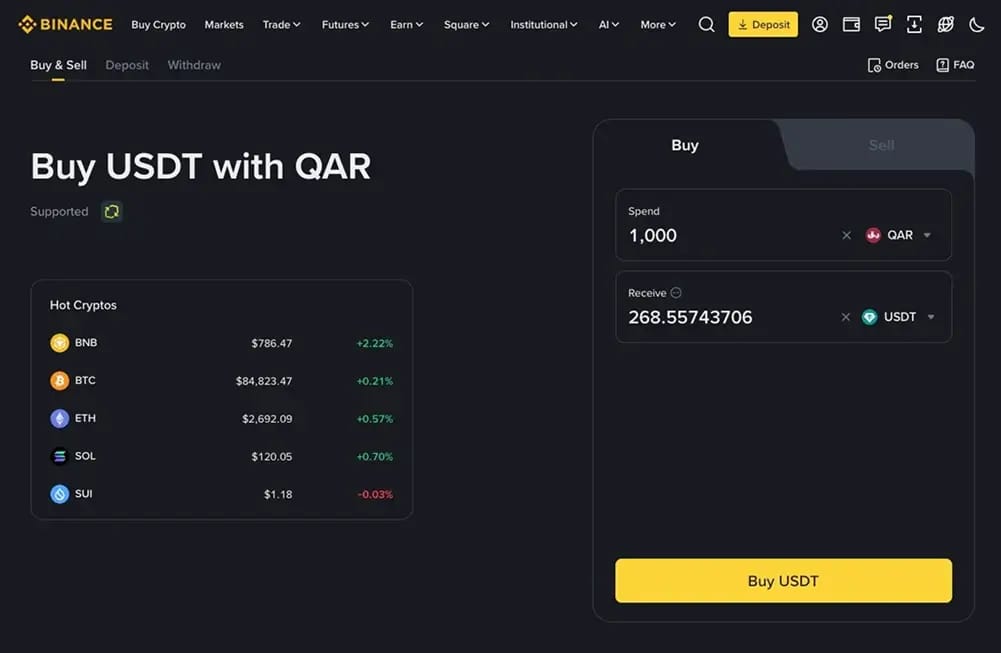
Binance has the most active riyal P2P market that we found, and it also handles more trading volume than any other crypto exchange. Its P2P pages list local payment methods, including Qatar Islamic Bank (QIB). Buyers transfer riyals to a seller's personal account, so the bank sends no money to the exchange. Binance keeps the seller's coins in escrow, locked until the seller confirms receipt of the riyals.
Since January 5, 2026, Binance.com has operated under authorization from the Financial Services Regulatory Authority of Abu Dhabi Global Market (ADGM). That gives Qatar users a Gulf regulator behind the platform, but no local complaint channel. No Qatari authority recognizes a crypto provider. For Muslim savers, Sharia Earn offers BNB, ETH and SOL staking certified by Amanie Advisors under a Wakala agency contract.
The standard spot fee is 0.1%, falling to 0.075% when paid in BNB, Binance's own token. In 2023, Binance pleaded guilty to US criminal charges and agreed to pay $4.3 billion over failures in its anti-money-laundering controls. The exchange maintains the SAFU emergency fund and publishes monthly reserve reports. Our Binance review examines its compliance changes after the settlement.
Pros
- The guide's most active riyal P2P market, with local bank payment methods and escrow on every order.
- ADGM authorization for the global platform since January 2026 and Sharia Earn staking certified by Amanie Advisors.
- Spot fees of 0.1%, or 0.075% when paid in BNB, alongside the SAFU fund and monthly reserve reports.
Cons
- A 2023 guilty plea in the United States and a $4.3 billion penalty on its record.
- Buyers must check a P2P seller's history before paying, as trades depend on private sellers.
- The app promotes leveraged products, which can confuse users who only want to buy and hold.
4. Gate
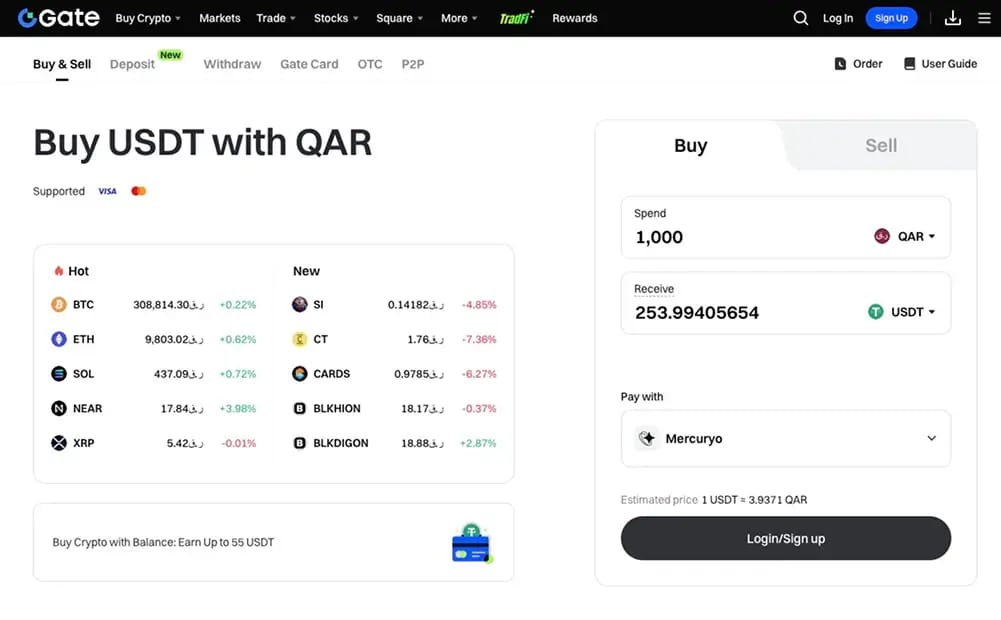
Gate lists more than 4,800 cryptocurrencies, far more than any other platform in this guide. A single verified account gives access to spot markets and Simple Earn, plus copy trading and bots. It also includes perpetual futures, leveraged contracts with no expiry date. Unlike Bybit, Rain, and Binance, Gate does not offer Shariah-compliant trading, which makes it unsuitable for Muslim investors based in Qatar.
On April 9, 2026, base spot fees rose to 0.2% for both maker and taker orders. Holding GT, Gate's own token, or trading larger volumes qualifies users for lower fee levels. Gate reported reserves of $8.215 billion on August 19, 2026, equivalent to 127% of customer balances. Such reports show whether an exchange holds enough assets to cover what it owes customers.
With no active riyal P2P market, Qatar users fund Gate by card or send USDT from another exchange. Check a coin's daily volume before buying. Smaller coins often have few buyers and sellers, and the gap between buy and sell prices can exceed the trading fee. Our Gate review covers the exchange's security measures and features in detail.
Pros
- More than 4,800 cryptocurrencies, the largest selection available to a Qatar account in this guide.
- August 2026 reserves of $8.215 billion, equivalent to 127% of customer balances.
- Futures, copy trading, bots and Simple Earn under one login.
Cons
- A 0.2% base spot fee, twice the rate at Bybit or Binance.
- Card purchases are the only riyal funding method, so many users send USDT from another exchange.
- Low trading volumes can make many small coins slow to sell.
5. KuCoin
KuCoin's Earn section offers flexible savings, staking and lending for idle balances. Most of these products pay interest prohibited by Islamic finance rules. Grid and DCA bots are free to use apart from trading fees, which start at 0.1% for spot trades and rise for smaller coin classes. More than 1,000 cryptocurrencies are listed, with a focus on smaller coins. Qatar users generally buy by card or transfer USDT from Bybit or Binance.
On March 5, 2026, Dubai's Virtual Assets Regulatory Authority ordered four KuCoin entities to stop unlicensed activity aimed at Dubai residents, a regulatory action Gulf users should review. KuCoin's operator had pleaded guilty in the United States in January 2025 and paid about $297 million. A March 2026 court order made its US exit permanent. Hacken audits KuCoin's reserve reports. Our KuCoin review covers both cases in detail.
Pros
- More than 1,000 cryptocurrencies, including smaller coins absent from larger platforms.
- A broad Earn section and grid and DCA bots at no extra charge.
- Reserve reports audited by Hacken and updated regularly.
Cons
- A March 2026 Dubai cease-and-desist order and a January 2025 US guilty plea.
- Cards are the only riyal funding method, with no active riyal P2P market.
- Most Earn products pay interest, which conflicts with Islamic finance rules.
6. OKX
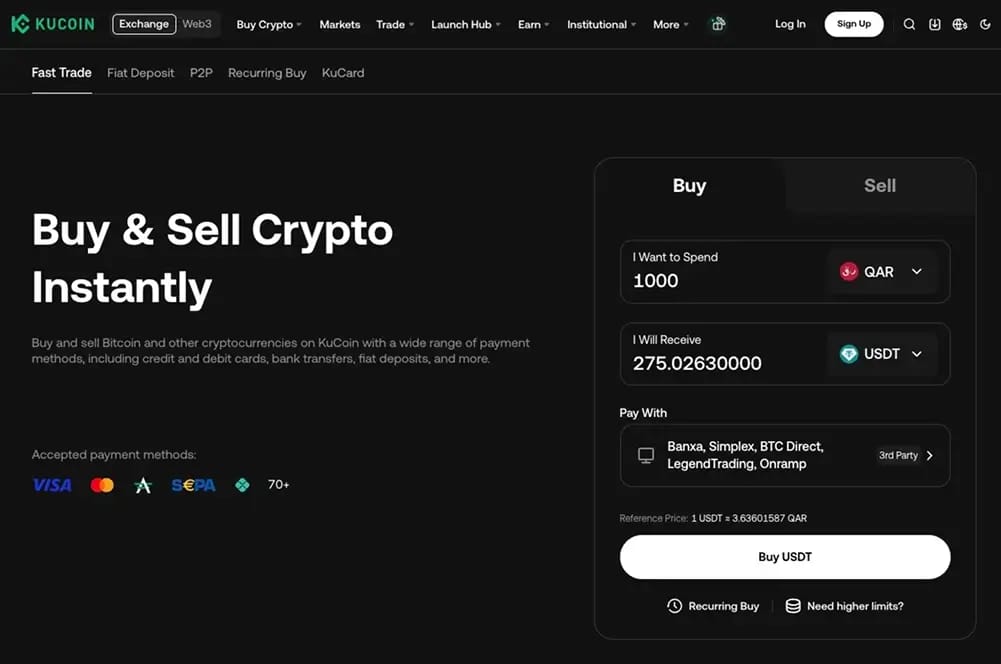
OKX includes a self-custody Web3 wallet in its exchange app for Qatar users who want control of their own keys. The wallet supports more than 100 networks, so purchased coins can move into self-custody without a second application. Spot fees are low, starting at 0.08% for maker orders and 0.10% for taker orders across more than 350 cryptocurrencies.
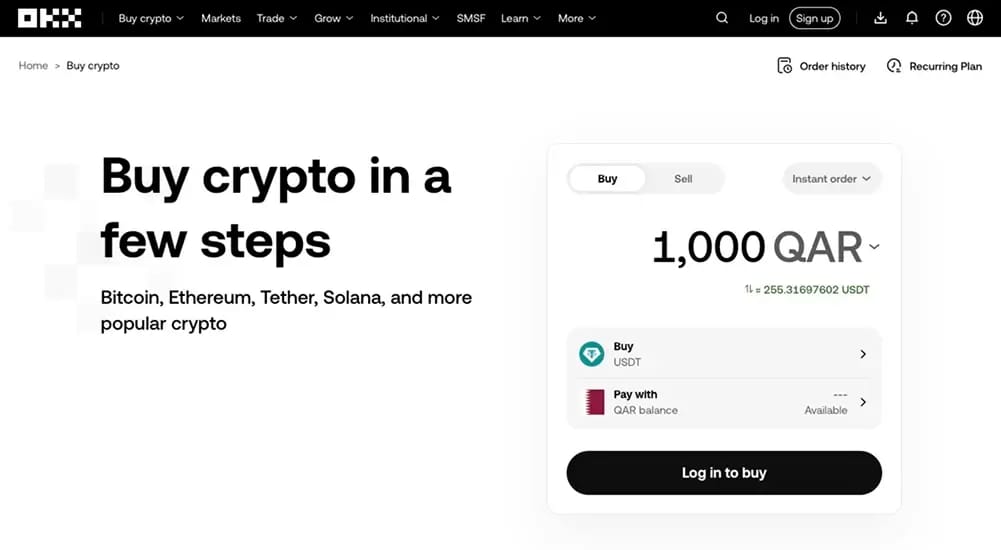
Qatar residents can fund purchases by card or through the riyal P2P market. OKX holds a seller's coins in escrow until payment is confirmed. Because we could not confirm how many riyal sellers are active on a given day, compare each offer against the 3.64 peg before accepting it.
Monthly reserve reports have been published since late 2022. In February 2025, OKX's operator pleaded guilty in the United States to operating an unlicensed money transmitting business and agreed to pay more than $504 million. UAE residents use a licensed local entity, whereas Qatar accounts belong to the global platform. For more information about the platform, visit our detailed OKX review.
Pros
- Spot fees of 0.08% for maker orders and 0.10% for taker orders, among this guide's lowest base rates.
- A built-in self-custody wallet supporting more than 100 networks.
- Monthly reserve reports dating back to late 2022.
Cons
- A February 2025 US guilty plea and penalties above $504 million.
- No Shariah-certified account or savings product for Muslim users.
- Support cannot reverse mistakes made inside a self-custody wallet.
How to Choose a Crypto Exchange in Qatar
All six platforms serve Qatar residents from abroad. Before sending riyals, we check five points.
- Decide how riyals will reach the platform: Cards and P2P are the available routes because Qatari banks cannot transfer money to crypto exchanges. Cards are fastest, though processors add a fee and issuers can decline payment. Binance and OKX P2P trades complete within the order window.
- Compare P2P prices with the dollar peg: The QCB fixes the riyal at 3.64 per US dollar. Since USDT is a stablecoin designed to stay at one dollar, a seller asking much more than 3.64 riyals per USDT is charging a premium.
- Pay only from your own account: Exchanges and P2P sellers reject payments from friends or relatives. Fawran, the QCB's instant payment service, moves riyals between local accounts in seconds. Check the seller's name and account details before sending.
- Check whether you need Shariah certification: Rain's certification covers its whole service, while Bybit's Islamic Account permits approved spot pairs and two bots. Binance's Sharia Earn covers staking for three coins. Avoid margin, futures, lending and interest-paying Earn products on other accounts.
- Test a small round trip first: Buy a small amount of USDT or Bitcoin, then sell and receive the riyals back by the same method. Keeping the test to a few hundred riyals reduces the cost of a name mismatch or declined card.
Qatar National Bank (QNB), QIB, Commercial Bank and Doha Bank issue Visa or Mastercard cards. Any of these banks can decline a payment identified as a crypto purchase. International banks' Qatar branches follow the same QCB rule.
Crypto and Bitcoin Regulation in Qatar
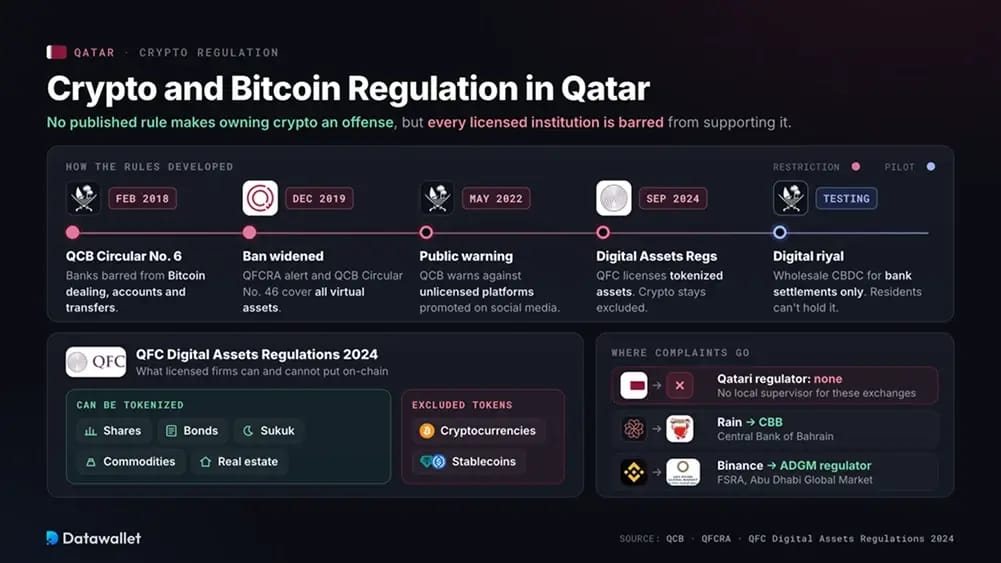
As Qatar builds a licensed market for tokenized real-world assets, it continues to exclude crypto from its banks and financial center. No published rule makes individual crypto ownership an offense. Every licensed institution, however, is barred from supporting the activity.
- February 2018: QCB Circular No. 6 of 2018 prohibited banks from dealing in Bitcoin, opening accounts for it, or sending and receiving transfers to buy or sell it. Breaches carry penalties under the QCB law.
- December 2019: The QFC Regulatory Authority (QFCRA) issued an alert on December 26 restricting virtual asset services in or from the QFC. QCB Circular No. 46 of 2019 broadened the central bank's position from Bitcoin to all virtual assets.
- May 2022: After social media posts promoted a virtual asset trading platform in Qatar, the QCB warned the public against unlicensed providers.
- September 2024: Licensed firms can tokenize shares, bonds, sukuk, commodities and real estate under the QFC Digital Assets Regulations 2024. Cryptocurrencies and stablecoins remain outside the regime as Excluded Tokens.
- Central bank digital currency: A digital riyal is being tested by the QCB for settlements between banks. The project page limits it to this wholesale use, so residents cannot hold it.
Complaints about the exchanges in this guide go to their home regulators, such as the CBB for Rain or the ADGM regulator for Binance. None is supervised by a Qatari authority. Our USDT legal status tracker compares Qatar with other restricted markets.
How Is Crypto Taxed in Qatar?
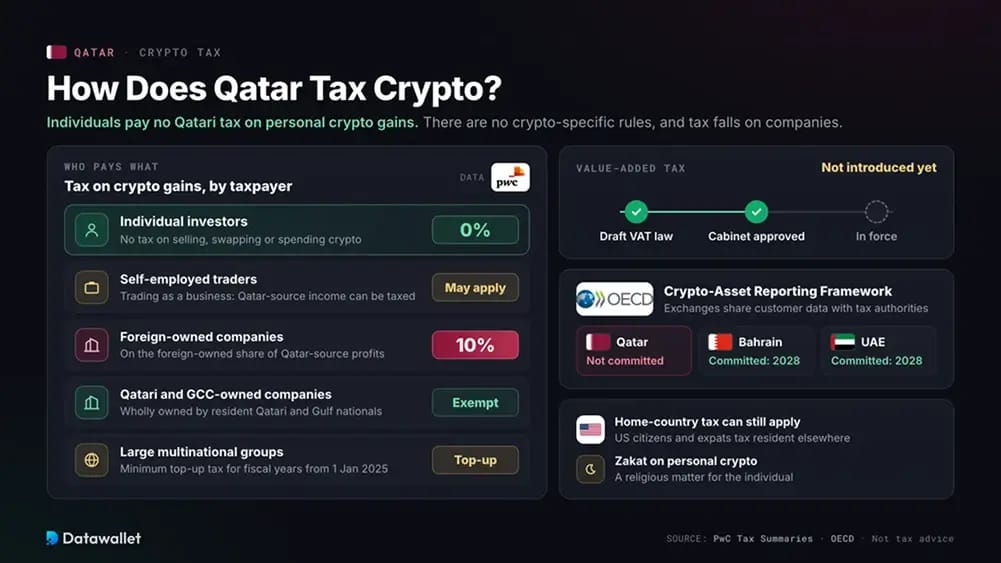
Qatar has no tax rules written specifically for crypto, and individuals pay no Qatari tax on personal crypto gains.
- No tax on personal gains: Qatar does not tax salaries, wages or allowances. Private investors also owe no Qatari tax when selling, swapping or spending crypto. Trading as a business may receive different treatment, since self-employed people can be taxed on qualifying Qatar-source business income.
- Foreign-owned companies pay 10%: Qatar applies a 10% corporate income tax to the foreign-owned share of Qatar-source profits, including crypto gains. The current exemption covers companies wholly owned by resident Qatari and Gulf nationals.
- A minimum tax for large groups: For fiscal years starting on or after January 1, 2025, large multinational groups face a domestic minimum top-up tax. Individual investors are unaffected.
- No value-added tax yet: Although the Cabinet has approved a draft VAT law, Qatar has not introduced VAT.
- Cross-border reporting is limited for now: Under the Crypto-Asset Reporting Framework (CARF), exchanges share customer data with tax authorities. Qatar is absent from the OECD's list of committed jurisdictions. Bahrain and the UAE have committed to first exchanges by 2028.
Zakat on personal crypto holdings remains a religious matter for the individual. Tax at home can still apply to US citizens and expatriates who remain tax resident elsewhere. This section provides general information and does not replace tax advice. For comparisons with other jurisdictions, see our list of low-tax crypto countries.
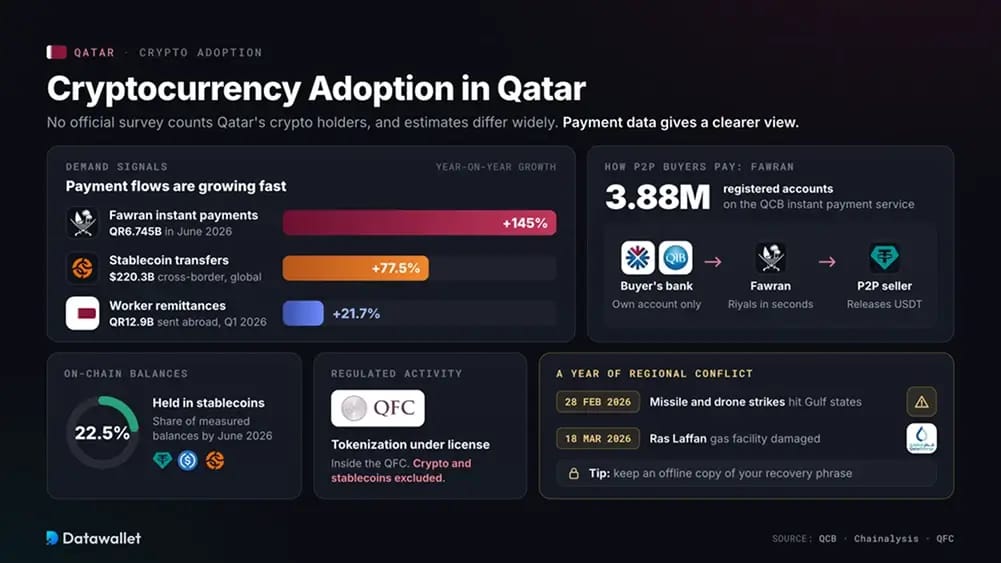
Cryptocurrency Adoption in Qatar
Published estimates of Qatar's crypto ownership differ widely, with no official survey counting holders. Payment data offers a clearer view of demand.
- High remittance volumes: In the first quarter of 2026, workers in Qatar sent QR12.9 billion abroad, a 21.7% increase from a year earlier. Chainalysis reported that worldwide cross-border stablecoin transfers grew 77.5% to $220.3 billion in the year to June 2026.
- Instant local payments: Fawran processed QR6.745 billion in June 2026, up 145% over one year, across 3.88 million registered accounts. The service lets P2P buyers pay a local seller within seconds.
- Tokenization under license: Asset tokenization inside the QFC accounts for Qatar's regulated digital asset activity.
- A year of regional conflict: Iranian missiles and drones struck Gulf states from February 28, 2026, and an attack on March 18 damaged Ras Laffan, Qatar's main gas facility. Crypto held in your own wallet is only as safe as its recovery phrase. Keep an offline copy in a secure place.
Chainalysis also found that stablecoins accounted for 22.5% of measured on-chain balances by June 2026. Our crypto adoption statistics provide the global context.
How to Buy Bitcoin in Qatar
Have your QID, or a passport with a residence permit, ready along with a card or bank account in your own name. Here are the steps:
- Choose an exchange: We recommend Bybit for card payments and an Islamic Account. Rain is the choice for a Gulf-licensed broker, while Binance offers P2P. Register with Qatar as your country of residence.
- Verify your identity: Every platform requires KYC, the identity check known as "know your customer". Submit your QID or passport and complete a face scan. Make sure the Latin spelling of your name matches your bank account exactly.
- Fund the account: Enter the riyal amount on Bybit or Rain and pay by card, with a one-time code expected from your bank. For Binance P2P, select a seller with many completed orders. Pay the exact amount from your own account, then confirm payment.
- Buy with a limit order: Set the highest price you will pay on the BTC/USDT spot market, or Rain Pro if you use Rain. Instant-buy screens include a markup in their quoted price.
- Move long-term holdings to self-custody: In a self-custody wallet, only you control the private keys. Our best crypto wallets comparison ranks hardware devices. Check that the network matches on both sides and send a small test amount first.
Reverse these steps when selling. Release USDT from P2P escrow only once the riyals appear in your own banking app, as a screenshot in the chat does not prove payment. Our guide to buying USDT in Qatar covers the stablecoin step.
Final Thoughts
Bybit's riyal card payments and certified Islamic Account, together with Arabic support, make it the best crypto exchange in Qatar for most residents. Rain offers a Gulf license and full Shariah certification, and Binance has the most active riyal P2P market alongside Sharia Earn. Gate covers small coins, while KuCoin suits savers who accept interest-based products. OKX pairs low fees with a built-in self-custody wallet.
Qatar has not moved toward retail crypto. Its 2018 and 2019 circulars remain in force, and the 2024 framework excludes cryptocurrencies and stablecoins. Riyals sent to an exchange sit outside local protection.
Use your own account to fund purchases and keep records of every riyal transaction. Hold long-term coins in self-custody. Our guides to the best crypto exchanges in Bahrain, the UAE, and Saudi Arabia cover the neighboring markets.
Our Methodology
Our assessment applied six criteria to the services available to Qatar residents in October 2026.
- Trust Score: Our score out of 5 weighs regulation and reserve reporting alongside each platform's security record and incident handling.
- Riyal funding: Using the platforms' published terms for Qatar, we compared the cost and processing time of card payments and P2P markets.
- Shariah options: We recorded which accounts hold Shariah certification, who certifies them and which products they exclude.
- Total cost: Fees cover a complete purchase and sale, from spot fees and instant-purchase markups to withdrawal charges.
- Regulatory position: We checked each platform against the QCB circulars and QFC rules, then examined the licenses of the entity serving Qatar accounts and any enforcement history abroad.
- Product range and language: Our review covered the cryptocurrencies, order types, bots, copy trading and Earn products open to Qatar accounts, together with Arabic interface and support.
Checks were completed on October 4, 2026. Sources included QCB and QFCRA notices, PwC and OECD summaries, and the platforms' help centers. The full process is described in our editorial methodology.
.webp)