


Compare Top Indonesian Cryptocurrency Exchanges
1. Bybit
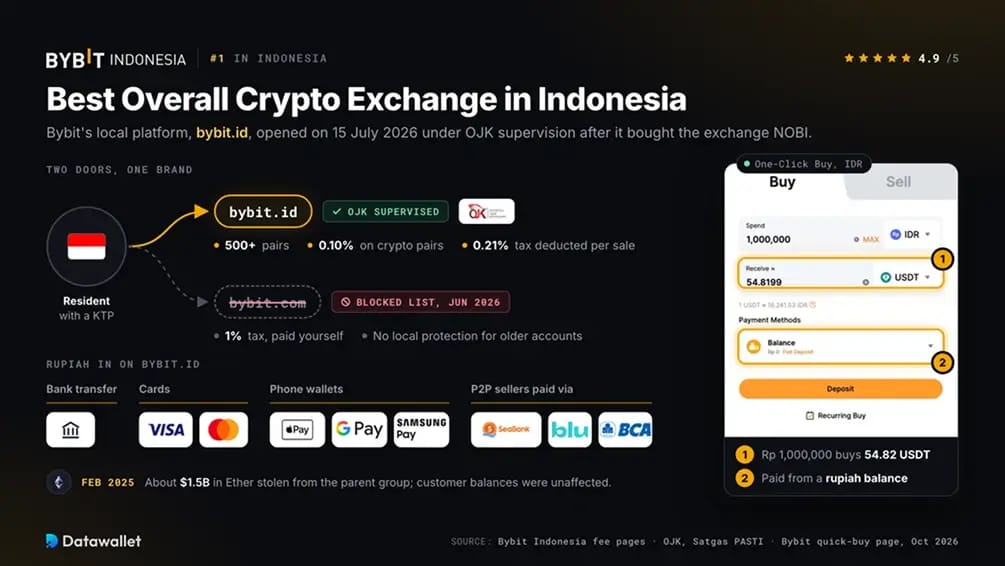
Bybit ranks first as it is now accessible to Indonesian residents without relying on its offshore website. The company launched Bybit Indonesia on 15 July 2026. Operating at bybit.id under OJK supervision, the local platform opened with more than 500 trading pairs. Spot trading and the Convert tool for instant swaps are available alongside two bots. This is a smaller product range than Bybit's international site offers, and the fee pages list no futures.
The fee schedule charges 0.10% on crypto pairs such as BTC/USDT. Rupiah pairs cost 0.10% for makers and 0.20% for takers. Two mandatory charges are added to every trade. CFX, a licensed Indonesian crypto exchange, charges 0.00555% on rupiah trades, and each sale is subject to 0.21% income tax. Funding methods include rupiah bank transfers and cards, as well as Apple Pay, Google Pay, Samsung Pay, and P2P (SEA Bank, Blu, and BCA Mobile).
Register at bybit.id because OJK's blocked list includes the global Bybit platform. The parent group suffered the largest crypto theft recorded to date in February 2025. Hackers removed roughly $1.5 billion worth of Ether from one of its wallets. Customer balances were unaffected, and Bybit covered the shortfall within days. Our Bybit review covers the incident and subsequent changes.
Pros
- Opened in July 2026 with more than 500 trading pairs under local OJK supervision.
- Rupiah funding by bank transfer, card, Apple Pay, Google Pay, Samsung Pay, and P2P, with automatic deduction of the 0.21% sales tax.
- Crypto-pair fees of 0.10% and monthly tax reports available in the account.
Cons
- No futures and a far smaller coin selection than the international site.
- Older offshore accounts have no local protection, and the international site appears on OJK's blocked list.
- About $1.5 billion was stolen from the parent group in 2025, although customers were not affected.
2. Binance
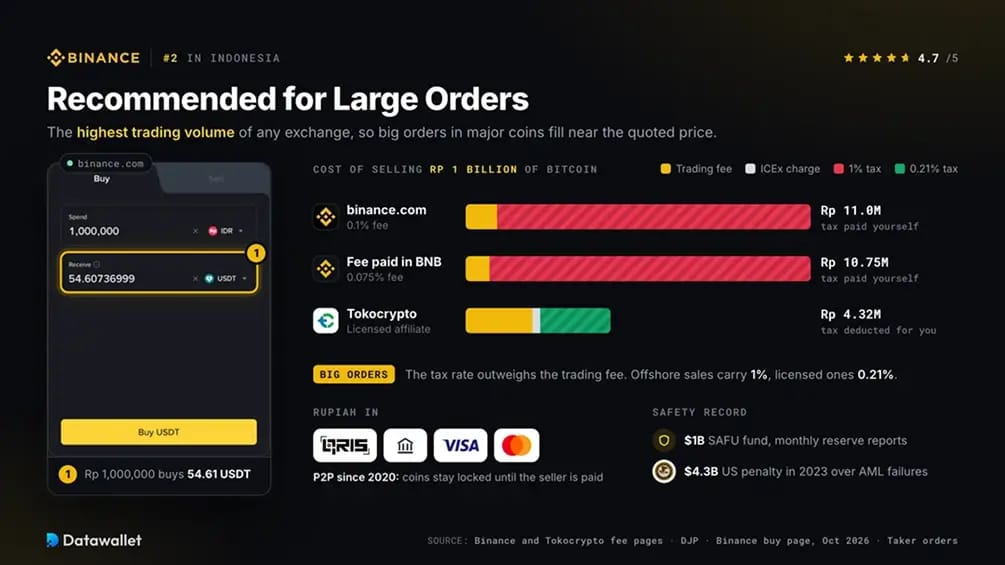
Binance is the largest crypto exchange by trading volume, helping large orders in major coins execute near the quoted price. It lists more than 500 cryptocurrencies and charges 0.1% for spot trades. Customers who pay fees in BNB, its own token, receive a lower rate of 0.075%. Tokocrypto, reviewed in sixth place below, is the group's licensed Indonesian business. The international website, binance.com, appears first on OJK's blocked list.
Binance accepts rupiah through QRIS, bank transfer, Visa, and Mastercard. Its P2P market has supported the currency since 2020, with sellers usually accepting bank transfers and e-wallets. Coins remain locked until the seller receives payment. International accounts operate outside OJK supervision, and sales on those accounts carry the 1% tax rate.
A US court accepted Binance's guilty plea over anti-money-laundering failures in 2023, when the company agreed to penalties of $4.3 billion. Binance maintains SAFU, a $1 billion emergency fund, and issues monthly reserve reports. Further details are in our Binance review and Bybit vs Binance comparison.
Pros
- The highest trading activity of any exchange, suited to large orders in major coins.
- Spot fees of 0.1%, reduced to 0.075% when paid in BNB.
- QRIS, bank transfer, Visa, Mastercard, and P2P support for rupiah, plus the licensed affiliate Tokocrypto.
Cons
- Binance.com is the first website named on OJK's blocked list.
- Offshore customers must pay the 1% tax themselves and have no Indonesian complaint channel.
- A 2023 US penalty of $4.3 billion for anti-money-laundering failures.
3. MEXC
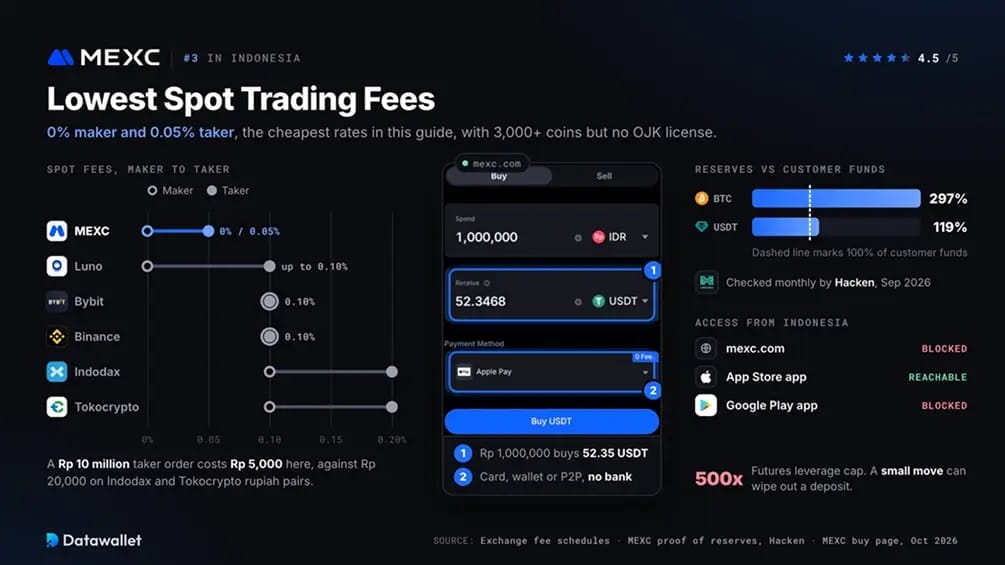
MEXC has the lowest published spot rates in this guide, with no maker fee and a 0.05% taker fee. Its list of more than 3,000 coins often includes new tokens before larger competitors add them. Monthly reserve reports checked by the audit firm Hacken compare MEXC's assets with the balances owed to customers. In September 2026, reported Bitcoin reserves stood at 297% of customer holdings and USDT reserves at 119%.
The exchange holds neither an OJK license nor a license from a major financial regulator. Its website, mexc.com, is on Indonesia's blocked list. The website and mobile app on the Apple App Store remain accessible, but the app on the Google Play Store is blocked. Perpetual futures allow up to 500x leverage, enough for a small price move to wipe out an entire deposit.
Rupiah purchases are available by card, Apple Pay and Google Pay, with the processor's fee displayed before payment. MEXC also runs a P2P market but accepts no direct bank deposits. Some customers instead buy USDT, a stablecoin pegged to the US dollar, on a licensed platform and transfer it to MEXC. Withdrawal limits are covered in our MEXC review.
Pros
- Zero maker fees and a 0.05% taker fee on spot trades.
- More than 3,000 listed coins and rupiah payments by card, Apple Pay, Google Pay and P2P.
- Hacken-audited reserve reports published monthly.
Cons
- Appears on the blocked list and holds no OJK license or major foreign license.
- No direct rupiah bank deposits; sellers must pay the 1% tax themselves.
- Up to 500 times futures leverage, which can wipe out a deposit within minutes.
4. Indodax
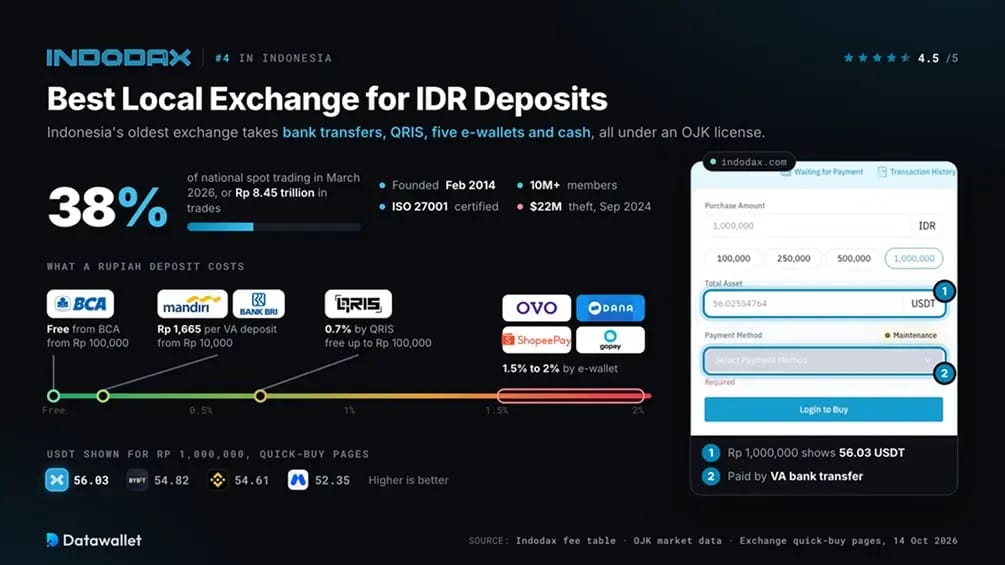
Indodax, founded in February 2014, is Indonesia's oldest crypto exchange and holds an OJK license. It reports more than 10 million members and over 500 coins on its website. Trades reached Rp 8.45 trillion in March 2026, representing about 38% of the national spot total reported by OJK. Indodax also holds ISO 27001 information security certification and has offices in Jakarta and Bali.
According to the Indodax fee table, direct transfers from BCA accounts are free, with a Rp 100,000 minimum. Mandiri and BRI VA deposits use payment numbers assigned to individual customers. They cost Rp 1,665 and start at Rp 10,000. QRIS, the national QR payment standard, costs nothing up to Rp 100,000 and 0.7% above that amount. Deposits through OVO, DANA, ShopeePay or GoPay carry fees of 1.5% to 2%; LinkAja is also supported.
Its trading fees are 0.10% for makers and 0.20% for takers on rupiah markets, before mandatory charges. On 1 October 2026, the CFX charge fell to 0.00555%. Each sale also incurs the 0.21% tax. Attackers stole a reported $22 million from Indodax's wallets in September 2024. The exchange promised to compensate affected customers. It publishes proof-of-reserves updates, though the January 2026 edition did not name an outside auditor.
Pros
- Founded in 2014, with an OJK license and more than 10 million members.
- Accepts bank transfers, QRIS, five e-wallets, and cash. QRIS and VA deposits start at Rp 10,000.
- Deducts the 0.21% tax on each sale, removing the need for customers to file it separately.
Cons
- Wallets lost a reported $22 million in a September 2024 theft.
- E-wallet deposit fees of 1.5% to 2%, well above the cost of bank methods.
- About 500 coins versus more than 3,000 on MEXC.
5. Luno
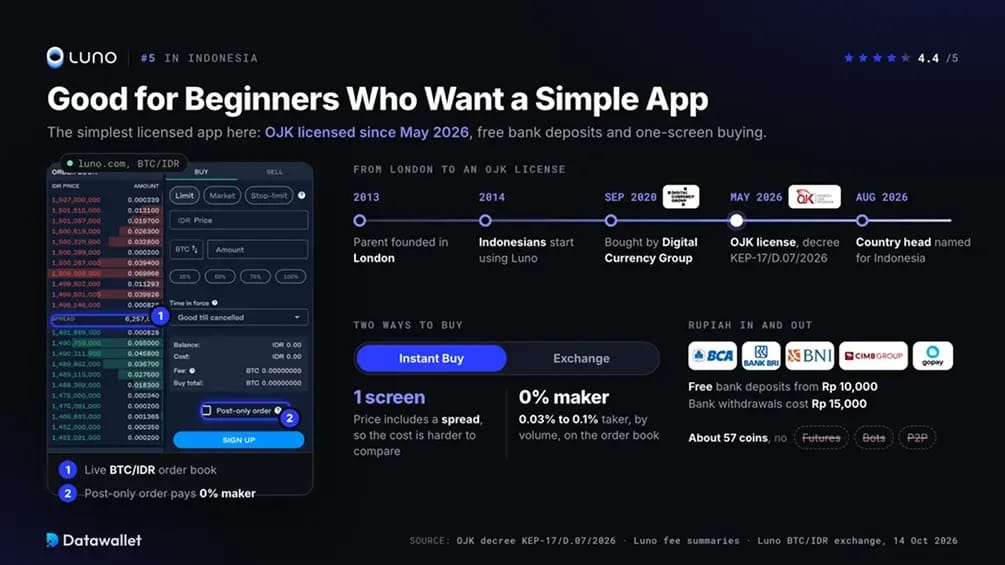
Luno offers the simplest licensed option for beginners. After years as a registered candidate, PT Luno Indonesia Ltd received its OJK trading license in May 2026 under decree KEP-17/D.07/2026. Its parent was founded in London in 2013 and has been owned by Digital Currency Group since September 2020. Indonesian customers have used Luno since 2014.
About 57 cryptocurrencies are available in the app, far fewer than on Indodax or Tokocrypto. An instant purchase screen includes the cost in a price spread, while the exchange offers an order book. Published fee summaries put exchange maker fees at zero and taker fees between 0.03% and 0.1%, depending on volume. The 0.21% tax is deducted from each sale. Confirm these figures in the app, as Luno's own fee page was unavailable when we checked.
Bank transfers from BCA, BRI, BNI or CIMB are free for rupiah deposits starting at Rp 10,000. GoPay is also accepted, and withdrawals to bank accounts cost Rp 15,000. Luno appointed an Indonesian country head in August 2026, naming Indonesia and Malaysia as its two priority markets in Asia Pacific. There are no futures or trading bots in the app, nor a P2P market.
Pros
- Licensed by OJK in May 2026, with a parent company owned by Digital Currency Group.
- Free rupiah bank deposits from Rp 10,000, alongside a simple instant buy screen.
- Zero maker fees on the exchange and automatic deduction of the 0.21% tax.
Cons
- The guide's smallest coin selection, at about 57.
- Instant buy spreads are harder to compare than published fees.
- No futures, bots or P2P market. Bank withdrawals cost Rp 15,000.
6. Tokocrypto
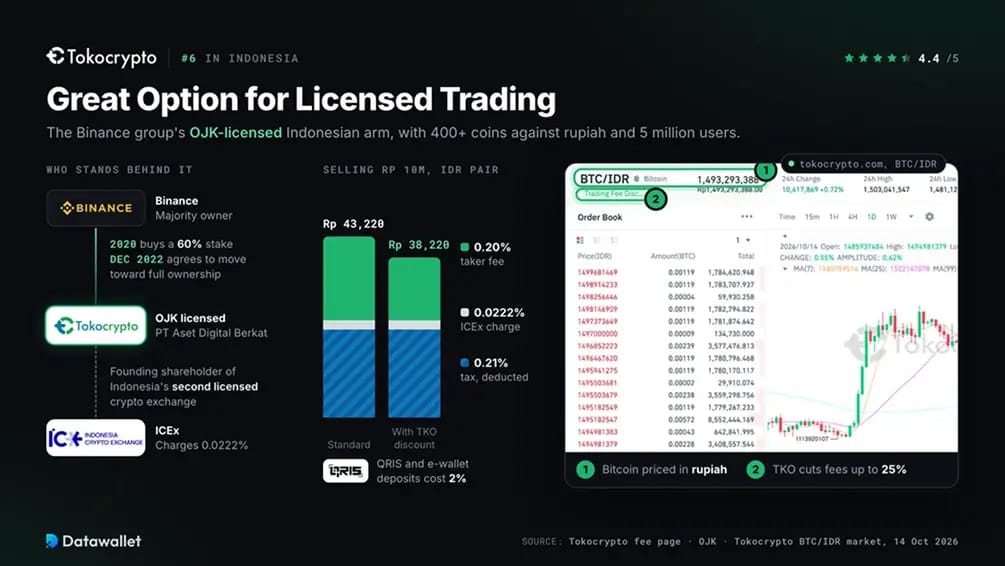
Tokocrypto provides access to the Binance group through an Indonesian license. Its operator, PT Aset Digital Berkat, holds an OJK trading license and reported 5 million users in May 2026, eight years after the company's founding. Binance acquired a 60% stake in 2020, then agreed in December 2022 to increase its stake toward full ownership. Tokocrypto is also a founding shareholder of ICEx, Indonesia's second licensed crypto exchange.
More than 400 cryptocurrencies can be traded against rupiah. On these pairs, the fee page lists 0.10% for makers and 0.20% for takers. An ICEx charge of 0.0222% also applies, along with the 0.21% tax on sales. USDT pairs cost 0.15% for either order type. Holding the exchange's TKO token cuts trading fees by up to 25%. Staking is available on a wide range of coins, and an OTC desk handles large orders.
Bank transfers, including BCA and Mandiri, are accepted for rupiah deposits. Customers can also use VA payments, QRIS, GoPay, OVO, DANA, ShopeePay or LinkAja. QRIS and e-wallet deposits cost 2%, while rupiah withdrawals cost Rp 10,000. The Indonesian license gives account holders access to the 0.21% tax rate and a local complaint channel, neither of which Binance's international website offers.
Pros
- Binance majority ownership and an OJK license, with 5 million users reported in May 2026.
- Bank transfers, VA payments, QRIS and five e-wallets for rupiah deposits.
- More than 400 coins and staking, plus trading fee discounts of up to 25% for TKO holders.
Cons
- Bank transfer is the only cheap funding method, with QRIS and e-wallet deposits costing 2%.
- Rupiah-pair taker fees of 0.20%, twice Bybit Indonesia's crypto-pair rate.
- A 2023 US guilty plea and $4.3 billion penalty involving its parent group, Binance.
How to Choose a Crypto Exchange in Indonesia
An exchange's license determines how you can fund it in rupiah, the sales tax rate, and who can handle complaints. Before opening an account, we check five points.
- Check the OJK whitelist: OJK's whitelist of licensed traders lists company names, app names, and web addresses. Match all three to avoid fraudulent websites that copy licensed firms' names. There were 28 licensed traders in September 2026. OJK's contact center, on 157, answers questions about licenses.
- Understand what an offshore account means: The international websites of Bybit, Binance, and MEXC appear on OJK's blocked list. Its notice targets operators and states no penalty for customers. OJK cannot help resolve disputes with foreign companies, and blocked websites may become unreachable without warning.
- Plan your rupiah deposit: Bybit, Binance, Indodax, Luno and Tokocrypto accept bank transfers. Indodax also takes cash, while QRIS is available on Binance, Indodax, and Tokocrypto. Bybit, Binance and MEXC support card payments, including Apple Pay and Google Pay, and all three have rupiah P2P markets.
- Add every charge: Selling Rp 10 million of Bitcoin for rupiah as a taker on Bybit Indonesia incurs a 0.20% trading fee, a 0.00555% CFX charge and 0.21% tax. Together, these cost Rp 41,555. Buying the same amount costs Rp 20,555 because purchases are not taxed. The two order types are explained in our maker and taker fees guide.
- Treat leverage as a separate decision: To offer futures, licensed platforms must use an OJK-approved exchange and require customers to pass a knowledge test. Bittime's licensed futures service, launched in July 2026, limits leverage to 25x.
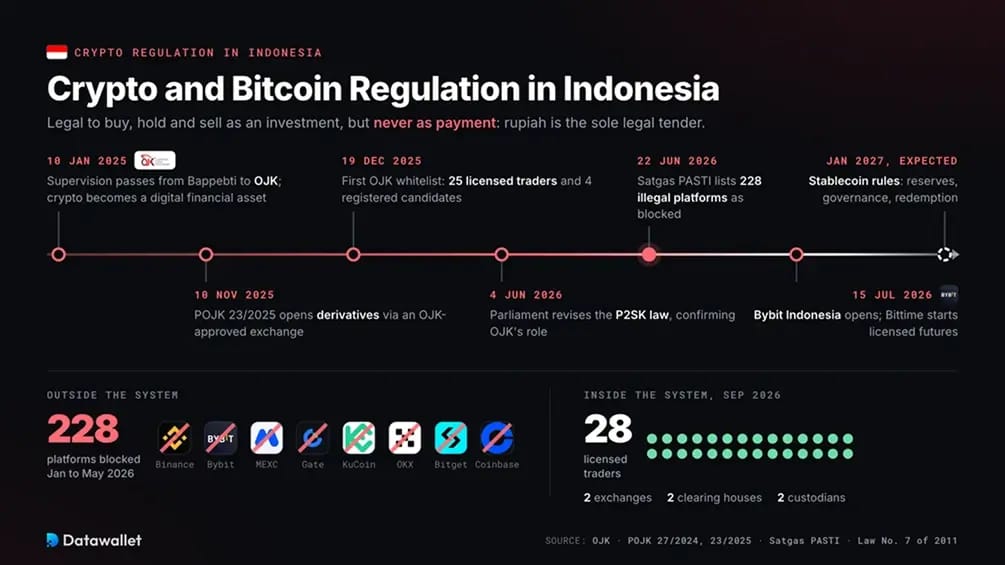
Crypto and Bitcoin Regulation in Indonesia
Residents may buy, hold, and sell crypto as an investment in Indonesia. They cannot use it for payment: the Currency Law (Law No. 7 of 2011) establishes rupiah as the sole legal tender. OJK supervises crypto trading. The main regulatory steps are set out below.
- 10 January 2025: Crypto supervision passed from commodities regulator Bappebti to OJK under the 2023 P2SK financial sector law and Government Regulation 49/2024. The main OJK trading rule, POJK 27/2024, reclassified crypto from a commodity to a digital financial asset.
- 10 November 2025: An amendment, POJK 23/2025, allowed licensed traders to offer derivatives through an OJK-approved exchange. Traders must keep margin in a separate account and test customer knowledge before trading.
- 19 December 2025: The first OJK whitelist named 25 licensed traders and four registered candidates. OJK said platforms absent from the list were neither licensed nor supervised.
- 4 June 2026: Parliament passed a revision of the P2SK law, strengthening crypto rules and confirming OJK's supervisory role. Implementing rules remained unpublished in October.
- 22 June 2026: Satgas PASTI announced that it had halted 228 illegal crypto traders between January and May. The task force described them as blocked. Its list includes bybit.com, binance.com and mexc.com, as well as Gate, KuCoin, OKX, Bitget and Coinbase.
- 15 July 2026: Bybit opened its licensed Indonesian platform, and Indonesian trader Bittime launched futures on the same day. Bittime's permit came from CFX under OJK supervision.
- October 2026: OJK said the direction of a stablecoin regulation should be ready around January 2027. Reserves, governance and redemption are expected to fall within its scope.
In September 2026, OJK counted 28 licensed traders. Its July figures listed two exchanges, two clearing houses, and two custodians. Licensing provides supervision and a formal complaint process but does not insure users against theft or falling prices.
How Is Crypto Taxed in Indonesia?
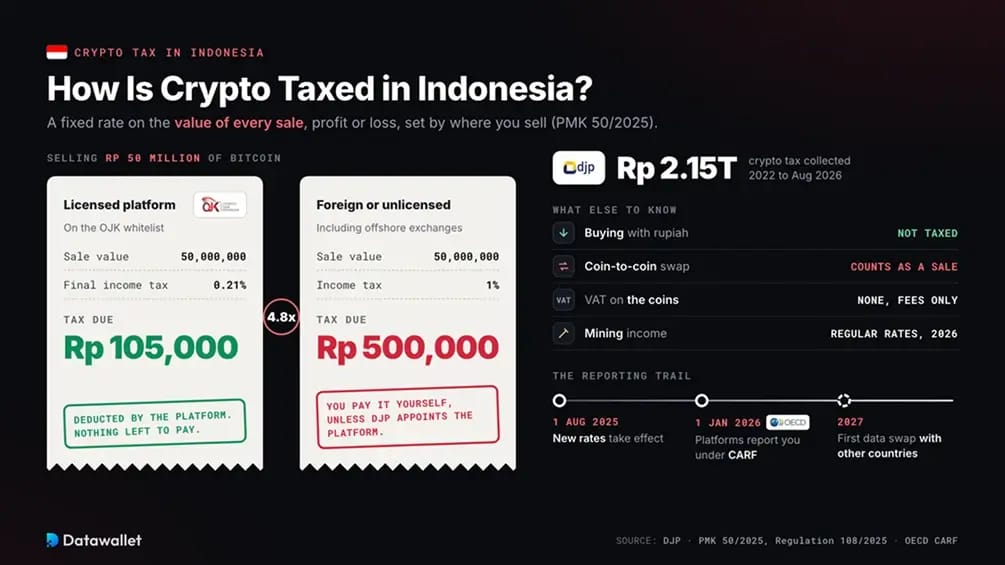
The value of each crypto sale determines the tax due in Indonesia, regardless of whether the seller makes a profit or loss. Under Finance Ministry Regulation 50/2025, effective 1 August 2025, the Directorate General of Taxes (DJP) applies a fixed percentage.
- Sales on licensed platforms: A final income tax of 0.21% applies to the sale value. The platform deducts the tax and pays DJP, leaving the customer with nothing further to pay on that trade.
- Sales on other platforms: Platforms without an Indonesian license, including foreign exchanges, carry a 1% rate. A foreign platform collects this tax only when appointed by DJP. Otherwise, sellers must pay the 1% directly.
- Purchases and swaps: Rupiah purchases of crypto are not taxed. A coin-for-coin exchange counts as a sale, with Bybit Indonesia's fee table applying the 0.21% rate.
- No VAT on the coins: Crypto is treated like a security under the regulation, so value-added tax (VAT) no longer applies to the coins. VAT still applies to platform service fees.
- Mining income: Ordinary income tax rates apply to miners' earnings from tax year 2026.
- Automatic reporting: Effective from 1 January 2026, Regulation 108/2025 requires Indonesian crypto providers to report customer identities and transactions. Reporting follows CARF, the Crypto-Asset Reporting Framework written by the OECD. The first exchange of this data with other countries will take place in 2027 and cover 2026.
A Rp 50 million sale generates Rp 105,000 in tax on a licensed platform or Rp 500,000 elsewhere. Between 2022 and August 2026, DJP collected Rp 2.15 trillion in crypto taxes. Save the monthly reports issued by licensed platforms and keep your own records of offshore sales. These notes provide general information; an Indonesian tax consultant can advise on your return.
Cryptocurrency Adoption in Indonesia
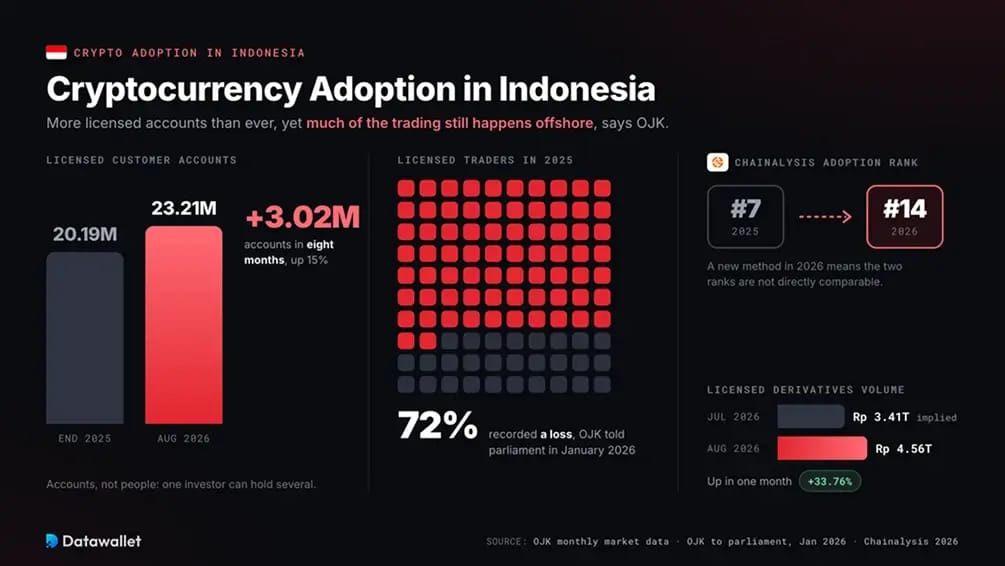
OJK's monthly figures for the licensed market provide the most reliable picture of crypto use in Indonesia.
- Accounts keep growing: In August 2026, licensed platforms held 23.21 million customer accounts, up from 20.19 million at the end of 2025. The number of investors is lower because one person can hold several accounts.
- Much trading happens offshore: In January 2026, OJK told parliament that 72% of licensed traders had recorded a loss in 2025. Investors still preferred global exchanges, according to the regulator.
- A lower global ranking: Indonesia ranked 14th in the Chainalysis 2026 adoption index, compared with 7th the previous year. A change to the 2026 method means these rankings are not directly comparable.
- Licensed derivatives are expanding: Derivatives trading on licensed platforms in August 2026 totaled Rp 4.56 trillion, a monthly increase of 33.76%.
Global comparisons are available on our crypto adoption statistics and crypto exchange statistics pages.
How to Buy Bitcoin in Indonesia
Have your KTP (national identity card) and a bank account in your own name ready. These steps use Bybit Indonesia. The process is the same on Indodax.
- Open an account on the local platform: Register with Bybit, ensuring that your account is created at bybit.id. Indonesia blocks the international website.
- Verify your identity: Upload your KTP and complete the app's face scan. Licensed platforms must perform KYC, the "know your customer" identity check.
- Deposit rupiah: Select bank transfer on the deposit screen, then send money from your own account. Cards, Apple Pay, Google Pay, and Samsung Pay are faster but include a processor fee. Use a small initial deposit to confirm that the money arrives.
- Place a limit order: In the Bitcoin market, enter the highest price you are willing to pay. A limit order that waits in the rupiah-pair order book incurs the 0.10% maker fee.
- Withdraw long-term holdings to a personal wallet: A personal wallet, where only you hold the private keys, is safer for coins you intend to keep for years. Our best crypto wallets ranking reviews hardware devices and software apps. Check that both sides use the same network and test the address with a minimal transfer.
When selling, place a sell order and withdraw rupiah to the same bank account. The platform deducts the 0.21% tax. Retain the tax report with your records.
Final Thoughts
Bybit ranks first for its OJK-supervised Indonesian platform and rupiah bank deposits. Binance suits large orders, and MEXC offers the lowest spot fees, although neither holds an Indonesian license. Indodax is the established local choice and the only platform here accepting cash deposits. For a first purchase, Luno offers the simplest licensed app, while Tokocrypto combines Binance ownership with an OJK license.
Rules tightened in 2026 as OJK expanded its blocked list and parliament revised the P2SK law. Automatic tax reporting also began, and stablecoin regulation is expected in 2027. Official figures show more accounts but lower trading value than in 2024, a gap OJK attributes partly to offshore platforms.
Before sending money, check the whitelist. Record every sale and keep long-term coins in a wallet you control. Our exchange guides for Malaysia, Singapore, and Thailand cover nearby markets.
Our Methodology
Our assessment covered services available to Indonesian residents on 12 October 2026, measured against six criteria.
- Trust Score: Licensing, reserve reports, and past security incidents inform our rating out of 5, along with how each incident was resolved.
- OJK status: Each operating company was checked against OJK's whitelist and the June 2026 blocked list. We also recorded any licensed Indonesian affiliate.
- Rupiah funding: We took deposit methods, minimums, and charges from published platform pages. For offshore platforms, we opened public P2P pages to check for rupiah sellers.
- Total cost: Calculations cover a full buy and sell cycle, combining trading fees with the CFX charge and applicable tax rate.
- Security record: We reviewed every known breach or legal case and the response. We also checked the reserve reporting frequency and the auditors' identities.
- Products for Indonesian accounts: We recorded the coins and order types available to KTP-verified accounts, along with access to bots and futures.
The update draws on published documents and live platform pages, including OJK and DJP publications, Chainalysis reports, and exchange fee pages. Our testing was completed on 14 October, 2026. Our editorial methodology explains the full review process.