







Compare Top Japanese Crypto Exchanges
1. bitFlyer
bitFlyer takes first place on the factors Japanese investors weigh most: operating history and market depth. The Tokyo company has run since January 2014 without losing customer funds or experiencing any serious security incidents. Its BTC/JPY order book is also the deepest in the country. No domestic competitor matches its three-region footprint across Japan, the United States, and the European Union.
Active traders use the bitFlyer Lightning terminal, where fees range from 0.01% to 0.15% depending on 30-day trading volume. Customers can fund an account by bank transfer, deposit cash at convenience stores, or use Quick Deposit through partners such as SBI Sumishin Net Bank. Everyday card spending earns Bitcoin through the bitFlyer credit card, a benefit unavailable from any other registered exchange.
The beginner user interface carries higher costs. Spreads on the simple Buy/Sell screen can reach several percent, far above the Lightning commission. Its catalog is limited to about 40 assets, and yen withdrawals cost between 220 and 770 JPY. However, the exchange is regularly updating its asset selection, adding Tron, Cosmos, and XDC in July 2026. We recommend that regular traders use Lightning from their first order.
Pros
- Twelve years of operation with no customer fund losses, supported by licenses in Japan, the US, and the EU. It is registered with the FSA under No. 00003.
- Lightning fees reach 0.01% at higher volumes, alongside the domestic market's strongest BTC/JPY depth.
- Quick Deposit and convenience-store cash funding connect the platform to Japanese banking, while its credit card earns Bitcoin rewards.
Cons
- Buy/Sell spreads can run into several percent, making the beginner screen an expensive route to purchase.
- The selection of around 40 assets excludes most coins, except for large caps.
- Yen withdrawals cost up to 770 JPY; GMO Coin and SBI VC Trade charge nothing.
.webp)
2. Bitbank
Bitbank is the platform professional Japanese traders name more often than any other venue. Every one of its 40+ assets trades directly against yen, and it consistently leads Japan in altcoin spot trading volume. XRP/JPY is currently the signature market. TradingView charting is available across all pairs, giving Bitbank the strongest technical toolkit among registered exchanges. It is registered with the FSA under No. 00004.
Its pricing favors patient orders. Makers earn a 0.02% rebate on most pairs, whereas takers pay 0.12%, which is unusually high compared to the industry average. Deposits by bank transfer are free, and the matching engine remains stable during volatile sessions. For mid-cap limit orders, the combination of direct JPY markets and maker rebates makes Bitbank the cheapest registered venue.
Bitbank deliberately keeps the offering focused and limited. It provides spot trading and lending, but no derivatives, credit card, or loyalty extras. Anyone buying through the sales office rather than the order book faces the same spread issue as at bitFlyer. Support and interface quality are also weaker in English than in Japanese, making it harder for foreigners to navigate the platform.
Pros
- A 0.02% maker rebate turns frequent limit orders into a small source of income instead of a trading cost.
- The country's deepest altcoin books, particularly XRP/JPY, reduce slippage on mid-cap trades.
- TradingView charts cover every pair, a technical package unmatched by other registered venues.
Cons
- Trading is limited to spot markets, without derivatives or margin products.
- Wide sales office spreads erase the order book's pricing advantage.
- The interface and support are noticeably weaker outside Japan.
.webp)
3. GMO Coin
GMO Coin, part of the Tokyo Stock Exchange-listed GMO Internet Group, has the lowest overall transfer costs. Instant Deposit is free, as are standard-size yen withdrawals and crypto transfers to external wallets. Almost no competitor matches that combination. Investors who keep coins under their own keys avoid the largest recurring charge associated with self-custody. It is registered with the FSA under No. 00006.
Order book fees are equally competitive. Makers receive a 0.01% rebate on major pairs such as BTC, ETH, and XRP, while takers pay 0.05%. Smaller pairs carry a 0.03% maker rebate and a 0.09% taker fee. The platform supports around two dozen assets, along with staking and lending. It also offers 2x leveraged trading, and deposits from partner banks settle instantly.
Its drawbacks are familiar among domestic venues. The sales office spread is far higher than the exchange fees, making the order book the practical choice. Asset coverage also falls well short of Bitbank and bitFlyer's list. Yen withdrawals above the standard threshold cost 400 JPY, and there are no copy trading, bot, or NFT products.
Pros
- Free yen deposits and withdrawals, together with free crypto transfers, make GMO Coin Japan's cheapest gateway to self-custody.
- Rebates of 0.01% on major pairs and 0.03% elsewhere beat every domestic competitor apart from Bitbank.
- Ownership by the listed GMO Internet Group brings staking, lending, and 2x leverage into a single account.
Cons
- The selection of roughly two dozen assets trails bitFlyer, Bitbank and SBI VC Trade.
- Costly sales office spreads make the exchange interface practically essential.
- Withdrawals over the standard threshold incur a 400 JPY fee, with no social or automated trading tools available.
.webp)
4. SBI VC Trade
SBI VC Trade is the crypto division of SBI Holdings, one of Japan's largest financial groups. It passed 2 million registered accounts in mid-2026. In March 2025, SBI VC Trade absorbed DMM Bitcoin's customers without requiring them to reopen accounts after the exchange closed following a $305 million theft. Acquiring these clients made SBI one of the biggest crypto contenders in Japan. It is registered with the FSA under No. 00011.
Fees are exceptionally straightforward. VCTRADE Pro charges neither makers nor takers, while account fees, deposits, withdrawals, and crypto transfers are also free. Roughly 40 assets are available for spot and 2x leveraged trading. Staking coverage is broader than at any domestic competitor. In March 2025, SBI became the first registered distributor of USDC in Japan, later adding Ripple's RLUSD.
The main weaknesses concern structure rather than price. Services remain split across separate apps and brands that are still being consolidated, which can confuse new customers. Liquidity is another limitation. On the most active pairs, shallower books than those at bitFlyer and Bitbank cause larger orders to move the market further.
Pros
- VCTRADE Pro charges no trading fees, and deposits, withdrawals, and crypto transfers are free as well.
- SBI Group ownership and the orderly transfer of DMM Bitcoin customers show the strength of its balance sheet.
- Japan's first registered USDC distribution combines with the broadest domestic staking menu to provide products unavailable elsewhere.
Cons
- Overlapping apps and service brands create a steeper learning curve than a single-interface exchange.
- About 40 assets leave out the long tail offered by the largest registered catalogs.
- Major-pair order book depth remains below bitFlyer and Bitbank.
.webp)
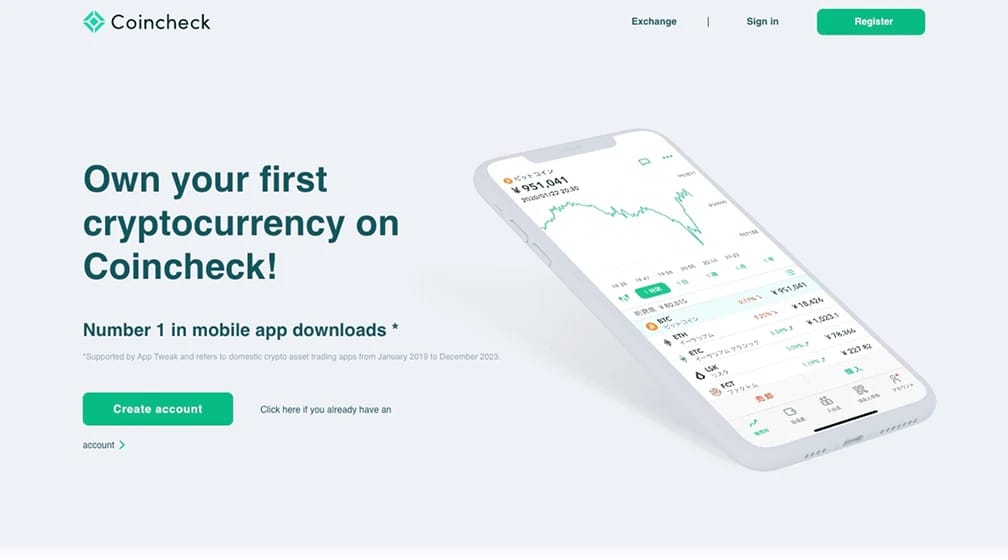
5. Coincheck
Coincheck is the platform most Japanese investors begin with. Its app has achieved the most annual downloads among domestic crypto apps for seven consecutive years. Parent company Coincheck Group listed on Nasdaq in December 2024 under the ticker CNCK, making it one of only two exchange operators traded on a US market. Its public filings provide a disclosure standard that privately held competitors do not match.
Accessibility shapes the product. A clean mobile interface supports more than 30 assets, while the order book charges no fees on major pairs. The same account includes staking, an NFT marketplace, and Japan's most active IEO program. Funding options include bank transfers, convenience store payments, and Quick Deposit.
Both history and pricing warrant attention. Coincheck repaid the roughly $530 million lost in the 2018 NEM theft and rebuilt its security under Monex Group ownership. Day-to-day, the more significant expense is the sales office spread, which most app customers pay without realizing an order book is available. Konbini and Quick Deposit also cost extra, unlike bank transfers.
Pros
- Japan's most downloaded crypto app for seven straight years has a beginner interface that sets the domestic standard.
- Its Nasdaq-listed parent publishes audited accounts, offering transparency unavailable from private domestic competitors. It is registered with the FSA under No. 00014.
- Major-pair order book trades cost nothing, and the account includes staking, an NFT marketplace, and regular IEO launches.
Cons
- Sales office spreads make casual purchases in the app much more expensive than order book trades.
- Although every customer was repaid, the 2018 NEM theft remains the second-largest exchange hack in Japanese history.
- Derivatives and leverage are unavailable, while convenience store deposits carry additional fees.
6. Binance Japan
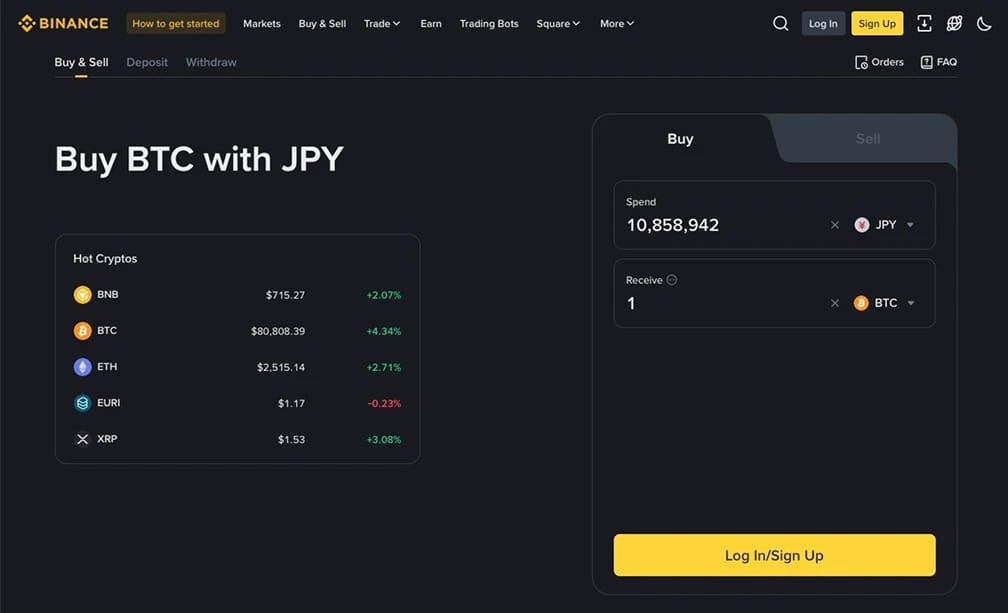
Binance operates for Japanese residents through Binance Japan Inc., the registered company formed after its 2022 acquisition of Sakura Exchange BitCoin. Launched in August 2023, the platform lists more than 60 cryptocurrencies, the broadest selection supervised by the FSA and the widest range on this list. Binance charges nothing for yen deposits or withdrawals made by bank transfer. It is registered with the FSA under No. 00031.
The flat spot trading fee is 0.10%, falling to 0.075% when paid in BNB. Simple Earn pays daily rewards on idle balances, while Auto-Invest handles scheduled purchases. An NFT marketplace is available through the same account. Both customer support and the interface are fully localized in Japanese. Our Binance review examines the global company behind the local entity.
Japanese registration comes with a deliberately smaller product set than the global exchange. Perpetual futures, margin, and Launchpad allocations are excluded, and listings must pass Japanese screening. The local entity has operated for barely three years, compared with the decade-plus histories of higher-ranked exchanges. Its coin selection is not enough to offset that shorter record.
Pros
- Its 60+ listed assets form the largest selection available from an FSA-registered exchange in Japan.
- Spot fees are 0.10%, dropping to 0.075% when paid in BNB, which is competitive with domestic order book pricing.
- Bank transfers in yen are free, with Simple Earn and Auto-Invest covering yield and scheduled purchases in one localized app.
Cons
- The Japanese platform excludes derivatives, margin, and Launchpad.
- More than 60 assets account for only a small share of the global exchange's thousands of listings, and the global platform no longer accepts Japanese signups.
- Since it launched in 2023, the local entity has the shortest operating record in this ranking.
How to Choose a Crypto Exchange in Japan
All registered platforms follow the same rules for segregation, cold storage, and audits. The meaningful distinctions are cost, market depth, and product coverage. Apply these five checks before sending yen:
- Confirm the operating company on the FSA register: A legal entity holds the registration, not the brand. Check the company named in the terms of service against the FSA's provider list. Regulators have warned unregistered platforms and had their apps removed from stores.
- Price the sales office against the order book: Japanese exchanges typically provide a simple purchase screen (hanbaijo) and an order book (torihikijo). The simple screen's spread can exceed the order book commission many times over. Compare the price of the same small order on each before setting a default.
- Match yen funding to your bank: Ordinary bank transfers are free across these platforms. At bitFlyer and GMO Coin, Quick Deposit from partner banks credits an account instantly; cash deposits at convenience stores work well for smaller amounts.
- Count the cost of reaching self-custody: Fees for withdrawing crypto vary considerably. GMO Coin and SBI VC Trade transfer assets to external wallets for free. Other venues apply network-linked charges that become costly with frequent withdrawals.
- Run a small end-to-end trial first: Make a limited deposit, purchase crypto, sell it, then withdraw the proceeds before committing serious capital. This test reveals actual spreads, verification friction, and transfer times, with little money at risk.
Crypto and Bitcoin Regulation in Japan
Crypto trading and ownership are legal in Japan, the first major economy to license exchanges. The Financial Services Agency oversees the sector. Its self-regulatory body, the JVCEA, screens token listings. The current framework was developed through the following milestones:
- April 2017: Amendments to the Payment Services Act took effect, requiring FSA registration for every platform serving Japanese residents.
- January 2018: Coincheck lost roughly $530 million in NEM tokens, then the largest exchange theft on record. Formed in response, the JVCEA received self-regulatory status that October.
- May 2020: Crypto derivatives came under the Financial Instruments and Exchange Act, and registered platforms became subject to a 2x cap on retail margin leverage.
- May 2024: Attackers later linked to North Korean groups stole 4,502 BTC, worth about $305 million, from DMM Bitcoin. The exchange closed, and its accounts moved to SBI VC Trade on 8 March 2025.
- February 2025: The FSA asked Apple and Google to block the apps of five unregistered exchanges, including Bybit, MEXC, and KuCoin. Apple removed the apps within days.
- 27 October 2025: Japan's first regulated yen-pegged stablecoin, JPYC, launched through a licensed funds transfer provider. Bank deposits and government bonds back the asset.
- 15 July 2026: The Diet passed the FIEA amendment, reclassifying about 105 crypto assets as financial products and applying insider trading rules plus securities-grade disclosure. Promulgated on 23 July, the act will begin on a date set by cabinet order within one year.
- 21 August 2026: Nomura-backed Laser Digital Japan received registration No. 00032, Japan's first new exchange license since 2022.
Before depositing, identify the company legally responsible for the account and verify its place on the FSA register. Recognition of the global brand cannot replace an active registration in Japan.
.webp)
How Does the NTA Tax Crypto?
The National Tax Agency (NTA) currently classifies crypto gains as miscellaneous income. Although this year's reform will change the treatment, it does not apply yet. The following rules govern returns filed now and the changes already enacted:
- Progressive rates still apply today: Crypto gains combine with other income and face national rates between 5% and 45%, plus roughly 10% local inhabitant tax. The top combined rate is therefore near 55%. A disposal occurs when crypto is sold for yen, exchanged for another coin, or spent. Merely holding it creates no taxable event.
- A flat 20.315% is enacted but not active: Under the FY2026 tax act, separate taxation will apply at 20.315%. The rate consists of 15% national income tax, 5% inhabitant tax, and a 0.315% reconstruction surtax. It starts only when the amended FIEA takes effect, which, based on current timing, points to the 2028 tax year.
- Only specified assets through registered platforms qualify: To receive the flat rate, a crypto asset must appear in the financial instruments register and be sold through a registered Japanese operator. Gains from offshore platforms, DeFi, and unlisted tokens are expected to remain under the progressive system.
- Losses gain a three-year carryforward: Qualifying crypto losses will be available to offset gains for as many as three subsequent years. Current rules offer no loss carryforward.
- Records are increasingly visible: Japan adopted the OECD's Crypto-Asset Reporting Framework, while registered exchanges already issue annual transaction reports. Because the NTA can check its records against tax filings, investors should export and review their transaction histories every quarter rather than rebuilding them each February.
This section provides general information rather than tax advice. Consult the NTA or a licensed tax accountant about complex positions before filing.
.webp)
Cryptocurrency Adoption in Japan
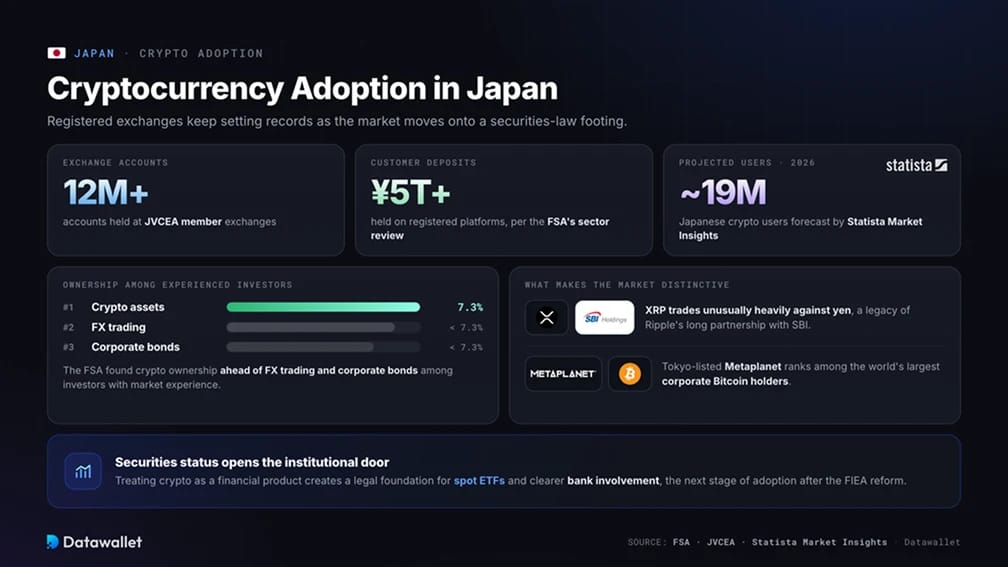
Japan's registered crypto market continues to grow. JVCEA member exchanges now hold more than 12 million accounts. The FSA's review of the sector recorded customer deposits above 5 trillion yen and found crypto ownership among 7.3% of experienced investors, higher than participation in FX trading or corporate bonds.
According to Statista Market Insights, the number of Japanese crypto users is projected to reach roughly 19 million during 2026. Local trading has several distinctive features. XRP activity against yen is unusually heavy due to Ripple's long partnership with SBI. Tokyo-listed Metaplanet is also among the largest corporate holders of Bitcoin.
Treating crypto as a financial product should encourage more institutional participation by establishing a legal foundation for spot ETFs and clearer bank involvement. Our crypto adoption statistics page compares Japan's figures with those of other major markets.
How to Buy Bitcoin in Japan
For the lowest costs, transfer yen free of charge to a registered exchange and place a limit order in its BTC/JPY market. The process usually takes less than an hour when your identification is ready:
- Open an account on a platform that fits your trading needs: bitFlyer has the deepest Bitcoin market. GMO Coin is the cheapest choice for investors transferring coins into self-custody, while Coincheck provides the gentlest first purchase.
- Complete identity verification: Residents can pass an eKYC selfie check with a My Number card, driver's license, or residence card. Approval usually arrives on the same day. Deposits remain locked until verification is complete.
- Deposit yen: Standard bank transfers are free at every exchange in this ranking. Quick Deposit provides instant credit through partner banks, while convenience stores take cash for smaller top-ups.
- Use the order book instead of the sales office: Select BTC/JPY in the exchange interface and place a limit order at your chosen price. The spread built into a simple purchase screen can exceed all other fees combined.
- Move long-term holdings to self-custody: Keep coins intended for long-term holding under keys you control. Our best crypto wallets ranking compares hardware devices for cold storage. Transfers out are free at GMO Coin and SBI VC Trade.
To sell, follow the steps in reverse. Yen withdrawals typically reach a domestic bank account within one business day. Export transaction records quarterly, as the NTA's reporting framework means the exchange will already hold those records when you file.
Final Thoughts
bitFlyer ranks first on the fundamentals. Its 12-year history without customer losses, Japan's deepest Bitcoin market, and strong banking connections remain ahead of newer competitors. Active traders are better matched with Bitbank, where altcoin liquidity and maker rebates favor frequent limit orders.
The wider shift is toward securities law. In less than 10 months, Japan introduced its first regulated yen stablecoin and passed the FIEA reclassification. It also enacted a flat 20.315% crypto tax and approved the first new exchange license in four years. Few countries combine reform at this pace with enforcement strong enough to drive out a top-five global exchange.
Good habits matter more than the final platform choice. Fund the account by bank transfer rather than card, trade through the order book instead of the sales office, and hold long-term positions in self-custody. For comparisons across the region, see our best crypto exchanges in Asia guide.
Our Methodology
Our review covered FSA-registered exchanges accepting new Japanese customers in August 2026. The ranking uses six criteria:
- Trust score: Datawallet's 5-point score accounts for regulatory status, past incidents, ownership transparency, and operating history.
- Registration verification: Each brand was traced to the relevant legal entity on the FSA provider register, including confirmation of the services covered by its registration.
- Yen funding in practice: We deposited yen through bank transfer and Quick Deposit, measured the time until funds were tradable, then withdrew proceeds to the same account.
- True transaction cost: A live Bitcoin purchase was made on every platform. We calculated the actual cost per trade by combining commissions, sales office spreads, and withdrawal charges, including the expense of transferring coins to self-custody.
- Market depth and products: We compared JPY order book depth, staking coverage, stablecoin support, and yield features.
- Local relevance: Scores also reflect Japanese-language quality and local bank connections, along with tax report exports and a domestic legal presence.
Testing finished in August 2026, after the FIEA amendment was promulgated. We checked every registration against the FSA list again before publication.
.webp)