



Compare Top Kenyan Crypto Exchanges
1. Bybit
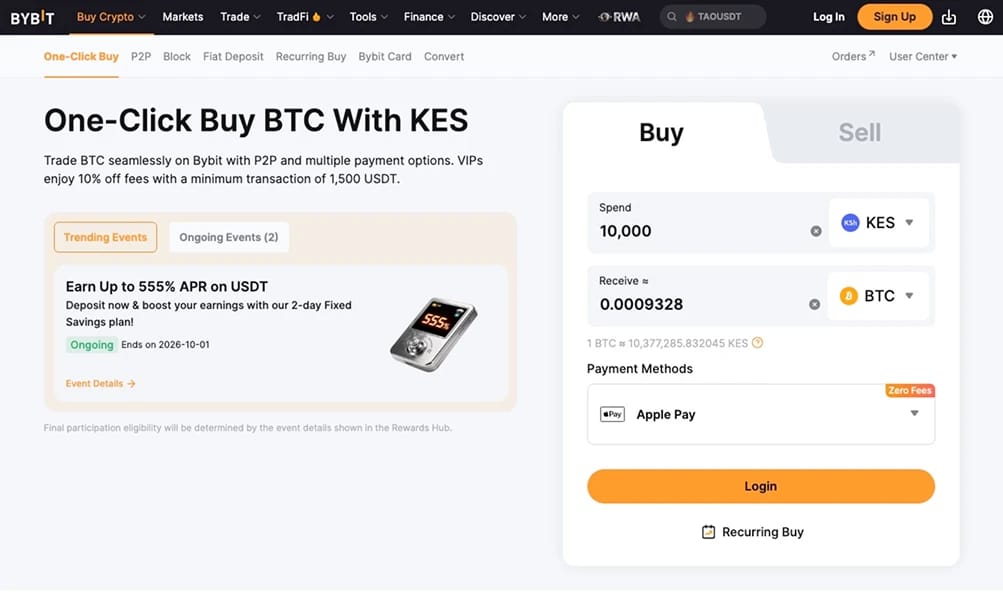
Bybit leads our Kenya ranking because it handles both M-Pesa funding and advanced trading well. Its P2P marketplace lists M-Pesa, Airtel Money, and Kenyan bank transfers as payment methods. P2P trades carry no fee, while escrow releases USDT after the merchant confirms payment. Most purchases we tested during Nairobi business hours settled within ten minutes.
Funding the account unlocks 2,600+ cryptocurrencies across spot, perpetual futures, and options. Traders also get grid and DCA bots, copy trading, demo trading, and Bybit Earn for idle stablecoins. The app offers Lite and Pro modes, which have practical value. Many Kenyan users complete their first P2P purchase in Lite before moving to Pro for charting and more advanced order types.
Bybit charges 0.1% for both maker and taker spot orders, while futures maker fees begin at 0.01%. The blemish is the February 2025 hack, in which roughly $1.5 billion was stolen from the platform. No customer funds were affected, as Bybit absorbed the loss in full and its Proof of Reserves reporting continued to show client assets were backed 1:1, though the episode still weighs on its security record. Our Bybit review covers the wider product range in detail.
Pros
- Its fee-free P2P desk processes KES payments from M-Pesa, Airtel Money, and bank transfers, usually within minutes during active hours.
- Spot fees are fixed at 0.1% across 2,600+ cryptocurrencies, and futures maker fees start at 0.01%.
- Continuing 1:1 Proof of Reserves reports, supported by third-party audits, substantiate its safety claims.
Cons
- The product menu is crowded, and new buyers may spend time finding the P2P tab.
- As with every global exchange in this guide, Bybit held no Kenyan VASP license at the time of publication.
- The platform is better suited to active trading than long-term storage. Move substantial holdings to self-custody.
2. Binance
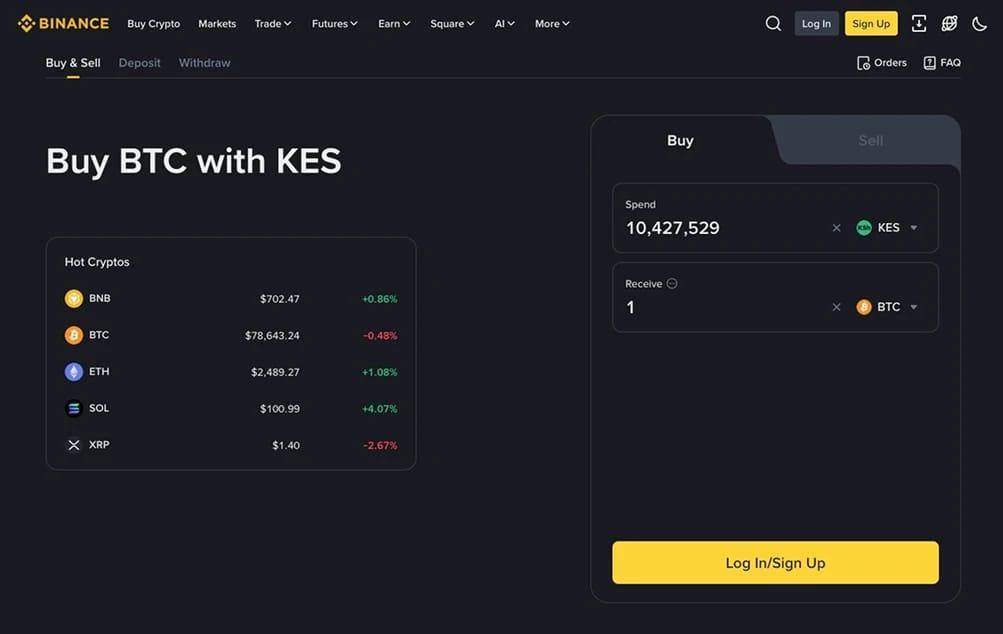
Binance has offered M-Pesa as a P2P payment method longer than any rival, and its liquidity reflects that history. Among the desks we tested, KES/USDT had the highest merchant count and order volume. That depth generally produces tighter spreads and faster completion, particularly outside peak hours when smaller marketplaces slow down.
Its regulatory position in Kenya has changed this year. After the final VASP Regulations were gazetted, Binance told TechCabal that it was preparing a Kenyan license application. Binance had previously resisted local registration, so the change indicates that it plans to remain in Kenya for the long term. Spot, margin, and futures markets are available, with leverage reaching 100x.
Binance also offers copy trading, auto-invest, and Binance Earn across 500+ listed assets. Both the interface and live support are available in English and Swahili, a feature still uncommon among global exchanges. The record is not spotless, though, as the $4.3 billion US settlement in 2023 over compliance failures still trails the brand and underlines why the Kenyan license matters. Our Binance review unpacks the full ecosystem.
Pros
- Kenya's deepest M-Pesa P2P liquidity supports high merchant counts and quick escrow settlement.
- Spot fees start at 0.1%, futures maker fees begin at 0.02%, and BNB holders receive further discounts.
- The full interface and customer support are available in Swahili as well as English.
Cons
- Its license application remained in preparation when this article was written, leaving limited local recourse for now.
- Direct KES deposits by card or bank remain inconsistent, so P2P is the practical funding method.
- The standard interface can overwhelm beginners. New users should start with the simple buy screen.
3. OKX
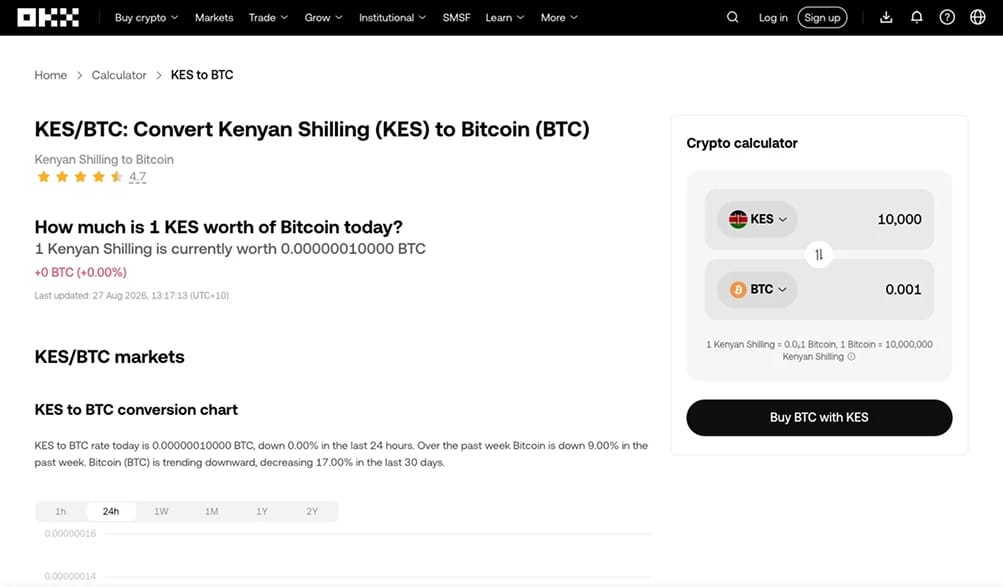
OKX has the lowest order-book fees in this guide. Rates start at 0.08% for makers and 0.10% for takers. The difference can become material for Kenyan traders who repeatedly move from KES to USDT and then into spot positions. Monthly zk-STARK Proof of Reserves reports have supported its solvency claims since late 2022.
M-Pesa and Kenyan bank transfers are available on its escrow-protected P2P desk. Merchant depth does not match Binance, which can produce slightly wider spreads outside busy periods, although our test transactions still finished within reasonable times. OKX also integrates TradingView, allowing orders to be placed directly from professional charts. Its interface is among the cleanest we tested.
A built-in Web3 wallet sets OKX apart from other low-fee exchanges. It supports more than 100 blockchain networks, compares DEX pricing for on-chain swaps, and connects users with DeFi, NFTs, and self-custody from the same app used for an M-Pesa top-up. The catch is language, since the interface runs in English with no Swahili option, unlike Binance and Bitget. Our OKX review goes deeper into the platform as a whole.
Pros
- Maker fees begin at 0.08%, the lowest rate in this ranking, while taker fees are 0.10%.
- Its Web3 wallet supports 100+ chains and provides access to DeFi, NFTs, and self-custody in the same app.
- OKX has published monthly zk-STARK Proof of Reserves reports since 2022.
Cons
- KES P2P merchant depth falls short of Binance and Bybit, so compare quotes before placing an order.
- Combining the exchange, wallet, and Earn products creates more complexity than occasional buyers need.
- OKX has no Kenyan VASP license and was not named among the early confirmed applicants.
4. KuCoin
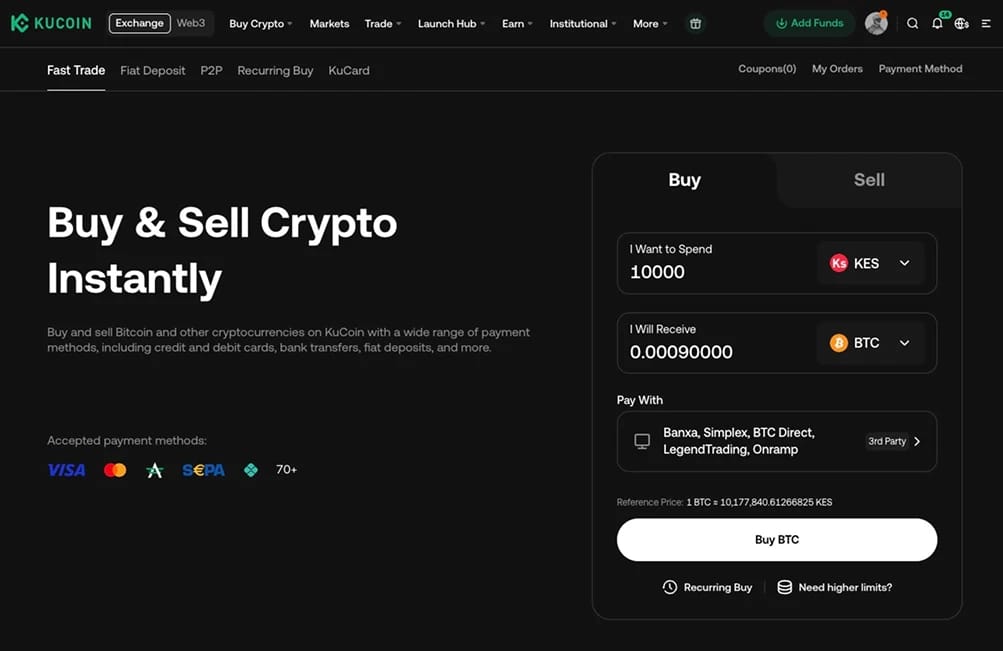
KuCoin earns its position for altcoin coverage. The platform lists 1,000+ cryptocurrencies and has a long history of adding small-cap tokens months before larger competitors. GemSPACE highlights new listings early, making KuCoin useful for strategies focused on assets that never reach exchanges with smaller catalogs.
KuCoin pairs those listings with margin and futures markets. Grid, DCA, and rebalancing bots automate different strategies, while KuCoin Earn provides staking, lending, and savings yields. Investors should also know that KuCoin pleaded guilty to US anti-money-laundering charges in 2024 and exited that market. It later rebuilt its regulatory position through licensed entities in Europe and Asia.
Kenyan users face an extra funding step. Card purchases are available but include processor markups, while KES liquidity on the P2P desk is much thinner than on the two largest marketplaces. Most Kenyan KuCoin users we know first buy USDT on Bybit or Binance, transfer it across, and keep KuCoin as a separate altcoin account. Our KuCoin review considers those trade-offs in full.
Pros
- KuCoin lists more than 1,000 cryptocurrencies and offers early access to new tokens through GemSPACE.
- Trading bots support active strategies, while KuCoin Earn adds passive alternatives.
- It occupies a practical middle ground between simple major-coin exchanges and Gate's much larger catalog.
Cons
- Limited KES P2P depth means most Kenyan users fund their accounts with USDT from another exchange.
- Its 2024 US guilty plea remains part of the platform's compliance record.
- KuCoin works better as a secondary altcoin account than a primary KES on-ramp.
5. Gate
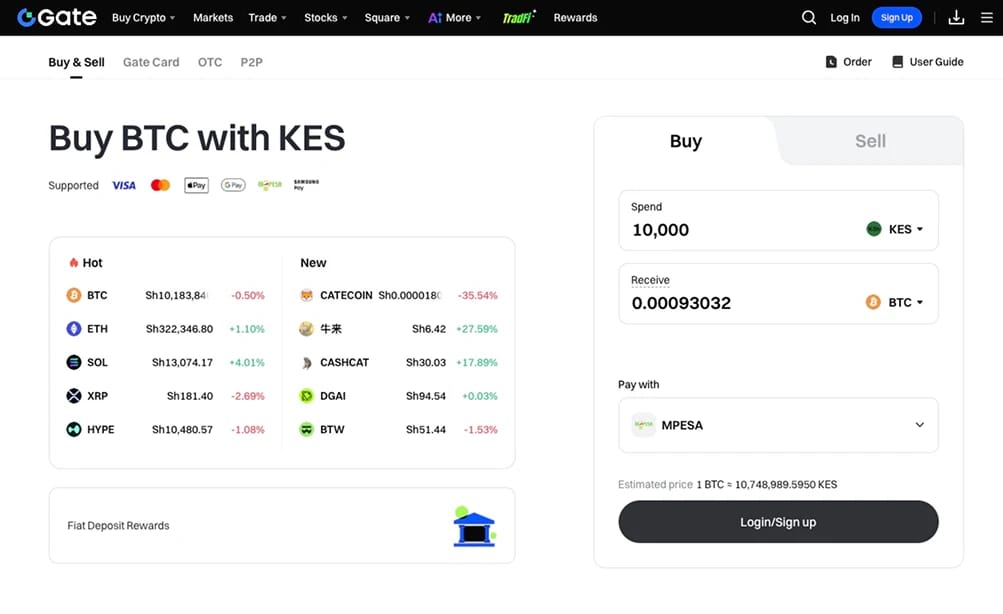
Gate makes this ranking for its coin selection. The exchange lists 4,400+ assets, including memecoins, micro-caps, and recent listings that do not reach mainstream platforms. Traders interested in less widely listed assets will find markets here that are unavailable elsewhere. Visit our Gate Review to learn more about the platform’s features, security history, and trading types.
Gate provides perpetual futures and options alongside copy trading and structured Earn products. The exchange has also maintained transparent reserve reporting. A January 2026 disclosure showed 125% coverage across roughly 500 assets, providing a meaningful safety signal in a market segment where many platforms publish no audits.
Kenyan funding works better than most traders assume. Gate has run a KES P2P marketplace since 2023, with M-Pesa Paybill, M-Pesa (Safaricom), and Equity Bank listed as payment methods, as well as card purchases through third-party processors. The weak point is merchant depth, which trails Binance and Bybit by a wide margin, so quotes can drift further from mid-market.
Pros
- Gate lists 4,400+ cryptocurrencies, the largest selection among the exchanges reviewed here.
- Its January 2026 reserve disclosure reported 125% coverage.
- The platform supplements its token catalog with futures, options, copy trading, and Earn products.
Cons
- Gate’s M-Pesa P2P desk has fewer merchants than Binance and Bybit, which can result in wider spreads.
- Its interface is crowded, especially on mobile devices.
- A catalog of this size contains many low-quality tokens, placing more responsibility for due diligence on the trader.
6. Bitget
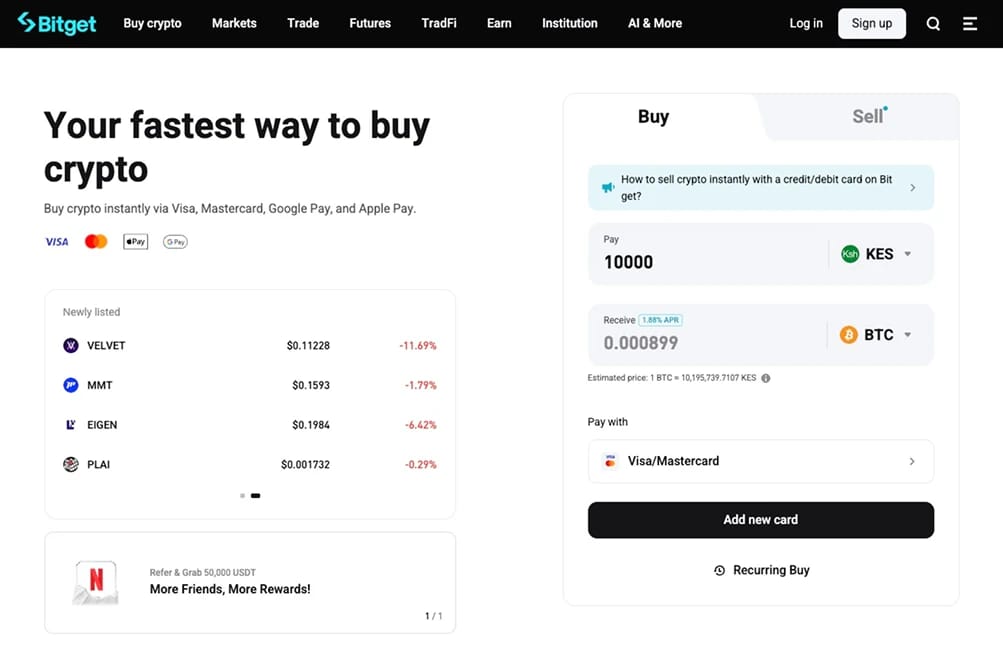
Bitget is our choice for Kenyan traders interested in copy trading. The feature is central to the platform rather than an add-on. Before allocating funds, users can review each lead trader's performance history, drawdown, and risk profile. Settlement is automatic after they subscribe, making it the top option for users interested in automated trading.
For KES funding, Bitget's P2P desk accepts M-Pesa and bank transfers. The interface supports Swahili as well as English. Liquidity continues to build but still trails Binance and Bybit, so compare the quoted rate with the mid-market price before opening a large order.
Bitget's February 2026 Proof of Reserves report showed a total reserve ratio of 169%. Its protection fund has remained above $400 million and is intended to compensate users following security incidents. The weak point is cash-out friction, with extra verification checks that can slow withdrawals. Our Bitget review examines the copy trading engine and the rest of the stack.
Pros
- Bitget has the most developed copy trading product in this ranking, supported by transparent performance data.
- Its P2P desk accepts M-Pesa and bank transfers, and users can select a Swahili interface.
- A 169% Proof of Reserves ratio and a large protection fund support its safety case.
Cons
- Copy trading can expose users to futures risk they may not fully understand.
- KES P2P liquidity is still developing, which can produce wider spreads than on the leading desks.
- Leverage is displayed prominently, making Bitget a poor starting point for cautious beginners.
How to Choose a Crypto Exchange in Kenya
Five practical checks should determine which exchange a Kenyan investor uses. Complete them in order before making a deposit. Strong charts offer little value if the platform cannot reliably handle local funding.
- Start with the licensing question: From 4 November 2026, only platforms licensed by the CBK or CMA may lawfully serve Kenyans. Check whether an exchange has confirmed an application. Once the first licenses are granted, the regulators' registers will provide the definitive list.
- Confirm the M-Pesa path actually works: Before registering, open the P2P marketplace and make sure M-Pesa is listed. Review the number of verified merchants active during East African hours and their completion rates. A desk that cannot complete an M-Pesa purchase within ten minutes during the day should not hold your funds.
- Price the full round trip: Compare the P2P rate with the mid-market price, then include the spot fee, any instant-buy markup, and the cost of converting back to KES. Despite an advertised trading fee of 0.1%, spread leakage can push the full cost to 2%. Card deposits commonly add another 2% to 5% in processor charges.
- Finish KYC before sending money: Verification using a Kenyan national ID or passport often takes only minutes. Name mismatches and unclear photos cause most of the delays we encounter. The Finance Act 2026 requires exchanges to collect and report more user information, making an accurate, consistent profile useful at tax time as well.
- Plan the exit before the entry: Make a small test withdrawal to M-Pesa or your bank soon after funding. Do not wait until you need the money to learn how much friction a cash-out creates.
Crypto and Bitcoin Regulation in Kenya
In less than a year, Kenya moved from official warnings to a complete licensing system. It is one of the fastest regulatory builds in Africa. The following milestones created the current framework:
- December 2015: The Central Bank of Kenya issued its first public notice warning that cryptoassets were not legal tender and had no consumer protection. This warning, rather than a ban, shaped the legal gray area in which Kenyans traded for the next decade.
- 15 October 2025: President William Ruto assented to the VASP Act, Kenya's first legislation dedicated to crypto. The law commenced on 4 November 2025 and divided supervision between two regulators. The CBK oversees stablecoin issuers, wallets, and payment-related services, while the CMA handles exchanges, brokers, and tokenization platforms.
- March 2026: The National Treasury released draft implementing regulations for public consultation. Industry groups responded by challenging capital thresholds they considered excessive.
- 22 July 2026: The final VASP Regulations, 2026 were gazetted as Legal Notice No. 134. Across 116 pages, the rules define ten activity categories and establish tiered paid-up capital requirements. The floors include KSh 100 million for exchanges and KSh 150 million for custodial wallet providers.
- 4 November 2026: The statutory transition period ends. Existing providers must secure a license by this date or stop serving Kenyans. Offshore platforms are also covered because any company targeting Kenyan consumers or earning revenue from the country falls under the rules, regardless of its place of incorporation.
No VASP had received a license when this guide was published in late August 2026, and regulators had only recently opened applications. The first approvals are expected to alter this ranking, as licensed exchanges will provide recourse rights that unlicensed competitors cannot offer.
.webp)
How Does Kenya Tax Crypto?
Kenya's crypto tax rates are now among the most trader-friendly in Africa, while its reporting rules are among the most aggressive on the continent. Transaction value is no longer taxed, but the Kenya Revenue Authority is gaining far greater visibility into trading activity.
- Excise duty of 10% applies only to platform fees. The Finance Act 2025 abolished the 3% Digital Asset Tax on gross transaction value from 1 July 2025. A 10% excise duty now applies to the fees charged by VASPs. For a KSh 1 million trade with a 0.1% fee, the duty is KSh 100 rather than the KSh 30,000 charged under the former system.
- Trading as a business is taxed as income: Profits from frequent trading, mining, staking, or airdrops are treated as business income. Progressive individual rates reach 35%, while company rates are 30%. Occasional sales of coins held for longer periods may receive capital gains treatment instead.
- Annual reporting to the KRA is now law: Assented on 23 June 2026, the Finance Act 2026 requires VASPs to submit annual information returns that identify Kenyan users and their transaction activity. Missing a return can trigger penalties of up to KSh 1 million.
- Records are your only defense: Retain dated records of every transaction and its value in KES at the time. When exchange data begins reaching the KRA, discrepancies between platform reports and personal declarations may trigger an audit.
This section provides general information, not tax advice. Anyone trading substantial volume should confirm their position with a Kenyan tax professional before filing.
.webp)
Cryptocurrency Adoption in Kenya
Practical uses, rather than speculation alone, drive crypto adoption in Kenya across market cycles. Remittances and freelancer payments play major roles, alongside import payments and savings held in dollars.
- The market is one of Africa's largest: Chainalysis estimated that Kenya received roughly $19 billion in crypto during the year to June 2025. Over the same period, the Sub-Saharan African market grew 52% year on year to more than $205 billion. Triple-A estimates that more than six million Kenyans use crypto, placing the country among the continent's leaders by penetration.
- Stablecoins are the workhorse: Tokens pegged to the dollar account for about 43% of crypto transaction volume in Sub-Saharan Africa, and Kenya is among the region's largest recipients of stablecoins. During periods of inflationary pressure on the shilling, traders and savers use USDT on exchanges or in self-custody as an informal dollar account.
- M-Pesa is going on-chain: M-Pesa Africa announced a partnership with the Abu Dhabi-backed ADI Foundation in January 2026. The project will integrate blockchain infrastructure, including stablecoin payment rails, across eight African markets. If even a portion of M-Pesa's more than 60 million monthly users gains direct access to stablecoins, it would mark the largest crypto adoption event in African history.
- Regulation is pulling activity into the open: The licensing system, fee-based taxation, and KRA reporting requirements all encourage activity to move onto supervised exchanges. Volume once handled in informal P2P chats is shifting to regulated platforms, while local companies such as Kotani Pay and Yellow Card prepare license applications.
.webp)
How to Buy Bitcoin in Kenya
The least expensive reliable route from Kenyan shillings to Bitcoin starts with M-Pesa, continues through a P2P desk, and finishes on the spot market. This method avoids card surcharges and instant-buy spreads. With documents prepared, the process takes less than half an hour.
- Pick a platform with real KES depth: Inspect the P2P page before creating an account. Bybit and Binance have the most active M-Pesa merchants, which supports tighter spreads and faster settlement. Check that merchant counts remain healthy during your preferred trading hours.
- Verify your identity properly: Register using a Kenyan national ID or passport, ensuring that the account name matches the document exactly. Accurate submissions often clear within minutes. Mismatched details and unclear photos are the main causes of delays lasting a day.
- Buy USDT through P2P: Set M-Pesa as the payment method and select a verified merchant with a high completion rate. After opening the order, make the M-Pesa payment and confirm it in the exchange app. Escrow will then release USDT to your account.
- Convert on the spot market: Avoid the one-click buy screen because its cost is included in the spread. Open the BTC/USDT pair and submit a limit order. In our tests, using the spot market reduced the effective price by 1% to 3%.
- Decide where the Bitcoin lives: Funds used for active trading can remain on the exchange. Long-term holders should transfer Bitcoin to a wallet they control after confirming the address and network. Self-custody also offers the strongest protection against platform risk until Kenyan licenses are granted.
To sell, follow the same steps in reverse. Exchange BTC for USDT on the spot market, sell the USDT on P2P, and receive the shillings in your M-Pesa account.
Final Thoughts
Bybit leads this ranking for its free M-Pesa deposits, which come with flat 0.1% spot pricing and the broadest product range listed here. Binance still has the strongest KES liquidity and has committed to applying for a license. OKX offers the lowest fees and broad Web3 access, while KuCoin and Gate are better choices for altcoin traders. Bitget remains the leading copy trading platform.
The approaching deadline matters more than small differences in fees. After 4 November 2026, Kenya's crypto market will divide between licensed exchanges with legal accountability and platforms operating outside the law. Check the CBK and CMA registers as approvals are published, because an exchange's status will soon outweigh its pricing schedule.
Run a small test cycle before committing substantial funds. Deposit a modest amount through M-Pesa, buy and sell, then withdraw the shillings to your phone. The total cost of that process is a better measure than the advertised fee. For a comparison with another major African market, see our guide to the best crypto exchanges in Nigeria.
Our Methodology
We tested every exchange from the position of a Kenyan user. Where available, funding started on an M-Pesa P2P desk and continued through the full deposit-to-withdrawal process. The rankings reflect six criteria:
- Trust score: A Datawallet rating out of 5 based on security history, Proof of Reserves procedures, responses to past incidents, and general transparency.
- KES funding quality: Whether M-Pesa is available as a genuine P2P payment method, along with merchant depth during East African hours, escrow reliability, and settlement speed in live tests.
- True cost of a round trip: The total expense of moving KES into Bitcoin and back. This calculation includes P2P spreads, trading fees, instant-buy markups, and withdrawal costs, rather than relying solely on published headline rates.
- Regulatory posture: Each exchange's standing under the VASP Act, its public statements about a Kenyan license application, and its status with overseas regulators.
- Product depth: The quality and selection of markets, order types, bots, Earn products, and Web3 tools available to a verified account in Kenya.
- Local fit: Swahili language support, performance on Kenyan payment rails, and the speed of customer support during East African business hours.
Testing ended in August 2026. We checked every platform's regulatory status again immediately before publication. Our full editorial methodology explains how we research and fact-check each guide.