



Compare Top Pakistan Crypto Exchanges
1. Bybit
Bybit is the account we would open first in Pakistan. It is a global exchange offering a multilingual interface available in Urdu, English, and 14 other languages. Its PKR P2P book is slightly thinner than Binance's but still liquid, merchants take Easypaisa, JazzCash, and bank transfer, and every escrow release we timed cleared fast. Flat 0.1% spot fees and tight spreads keep the round trip into crypto cheap from start to finish.
The platform earns the top slot on more than price. Bybit runs one of the deepest derivatives books open to Pakistani traders, copy trading with a genuine local following, and regular proof-of-reserves disclosures. It absorbed a roughly $1.4 billion hack in February 2025 without customer losses and rebuilt reserves within days, a solvency test that almost no exchange has passed at that scale. The app is lighter than Binance's too.
The caveats are small. The rupee merchant pool thins for very large orders, so size can nudge the spread, and Bybit does not yet hold a PVARA No Objection Certificate like Binance and HTX. For most users, cost-focused ones above all, neither outweighs the lower fees and proven security. To learn more about the platform's features and products, visit our Bybit review, which has the full breakdown.
Pros
- Fast PKR P2P escrow with Easypaisa, JazzCash, and bank transfer at low spreads.
- Flat 0.1% spot fees, deep derivatives liquidity, and mature copy trading.
- Regular proof of reserves and a proven recovery from a major 2025 hack.
Cons
- A thinner rupee merchant pool than on Binance, so very large orders can move the price.
- No PVARA No Objection Certificate yet, unlike Binance and HTX.
- The derivatives products warrant caution for anyone new to leverage.
.webp)
2. Binance
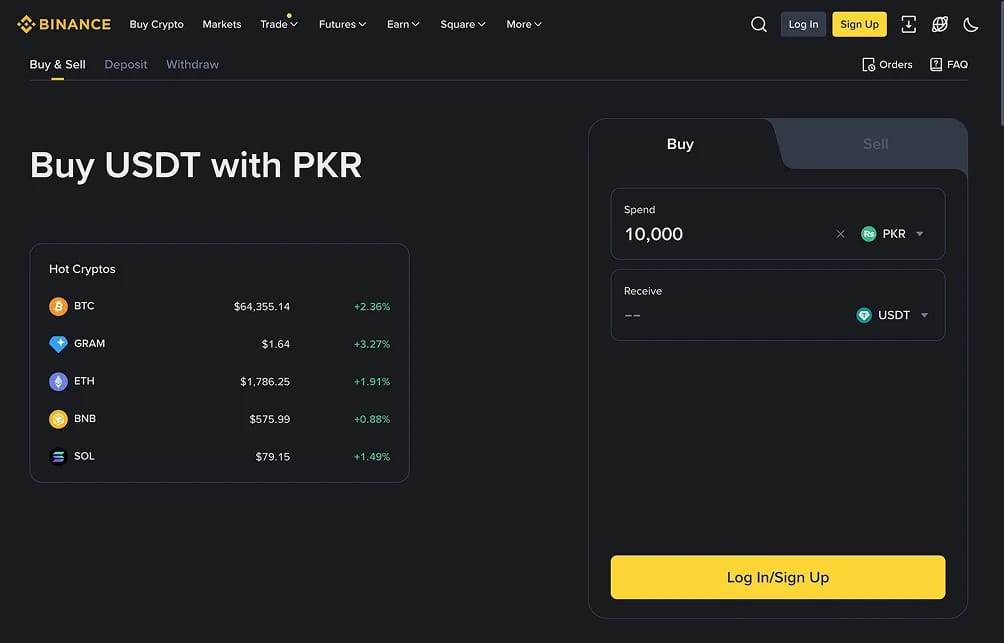
Binance has been the default answer in Pakistan for years, and lands second only because Bybit edges it on cost. What it owns outright is depth. Its rupee P2P desk carries by far the largest merchant count in the country, so orders in Easypaisa, JazzCash, bank transfer, and Raast fill at any hour without a foreign-currency leg. An Easypaisa order we placed cleared escrow in under seven minutes at a spread near 1% against the open-market dollar.
In December 2025, it became one of the first two platforms to win a No Objection Certificate from PVARA, then signed an MoU with Easypaisa and registered for local AML supervision by June 2026, putting it ahead of every rival on compliance. The trading side backs up the on-ramp. Spot fees are 0.1% and get lower for BNB token holders, the SAFU insurance fund backs customer balances, and liquidity is deep.
Two things belong in the decision. The NOC is a preliminary clearance, not a full operating license, so Binance is not yet formally licensed here, and its 2023 settlement with the US Department of Justice still sits on the record. Neither stops you trading today, but both matter before you park a large balance. If deep liquidity or the most compliant ranks highest for you, Binance is a fair pick for the top spot. Our Binance review covers the wider platform.
Pros
- The largest PKR P2P merchant base in Pakistan, covering Easypaisa, JazzCash, Raast, and bank transfer.
- A PVARA No Objection Certificate, local AML registration and an Easypaisa MoU, making Binance the furthest along the compliance path on this list.
- Deep global liquidity at 0.1% spot fees with the SAFU fund behind balances.
Cons
- The NOC is a first step, not a full operating license, so formal local authorization is still pending.
- The 2023 US Department of Justice settlement remains part of the compliance history.
- The sheer number of products can overwhelm someone who only wants to hold USDT.
3. OKX
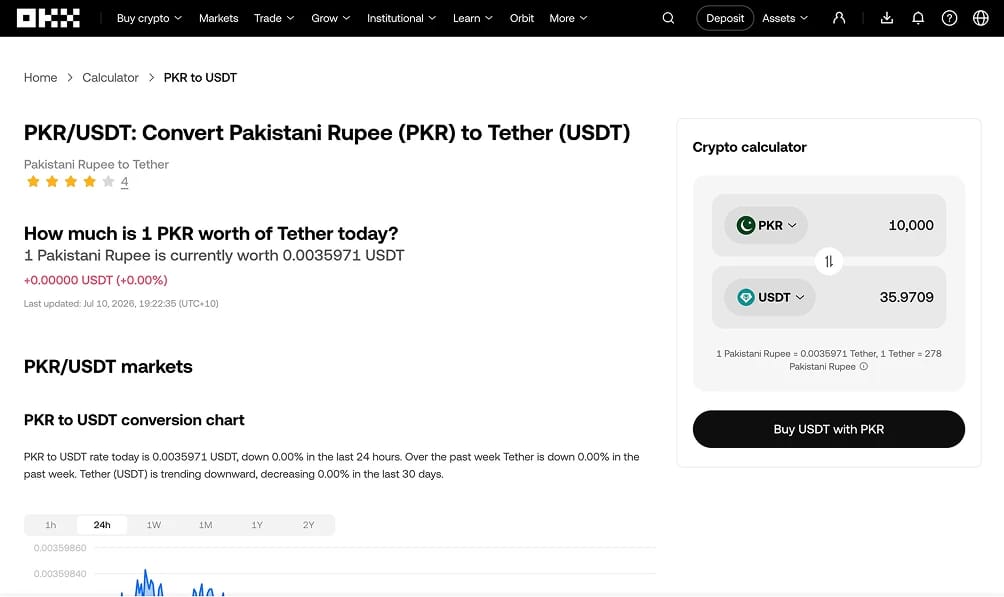
OKX makes its case on price and on-chain reach, not rupee rails. Its PKR P2P listings are slim when compared to the top two exchanges, so most Pakistani traders buy USDT on Bybit or Binance and send it over the TRC20 network, a hop that settles for a few cents in minutes. From there, the 0.08% maker rate undercuts everyone here.
What repays the extra step is the wallet baked into the app. One login covers spot trading, hundreds of chains, a DEX aggregator and tokens that never reach a central listing, which matters when a second app means another slow load on a weak signal. OKX also attests to proof of reserves monthly with a Merkle tree that anyone can audit.
In practice, it is where capital sits once the rupee conversion is handled, not a starting account. The deposit costs are also high. Card top-ups incur the standard 2% to 5% processing charge, so save them for urgent purchases. This is why we recommend depositing on other exchanges and using OKX for trading purposes. Our OKX review goes deeper into the products offered.
Pros
- A 0.08% maker rate, the cheapest spot pricing of any major venue reachable from Pakistan.
- One app spanning a regulated exchange, self-custody, a DEX aggregator and 100+ chains.
- Independently verifiable Merkle-tree reserves are published every month.
Cons
- Thin PKR P2P coverage, so most users fund it by moving USDT in from elsewhere.
- Instant card buys sit at a 2% to 5% markup.
- The breadth of tools can bury a beginner who only wants to park stablecoins.
4. Bitget
Bitget makes its name through its diverse copy trading system. It lets a beginner shadow an experienced trader's positions automatically, and it has caught on with the Telegram and YouTube crowd of younger Pakistani traders who learned markets from screens, not order books. A protection fund of $400 million backs the platform, with reserve ratios published above 100%.
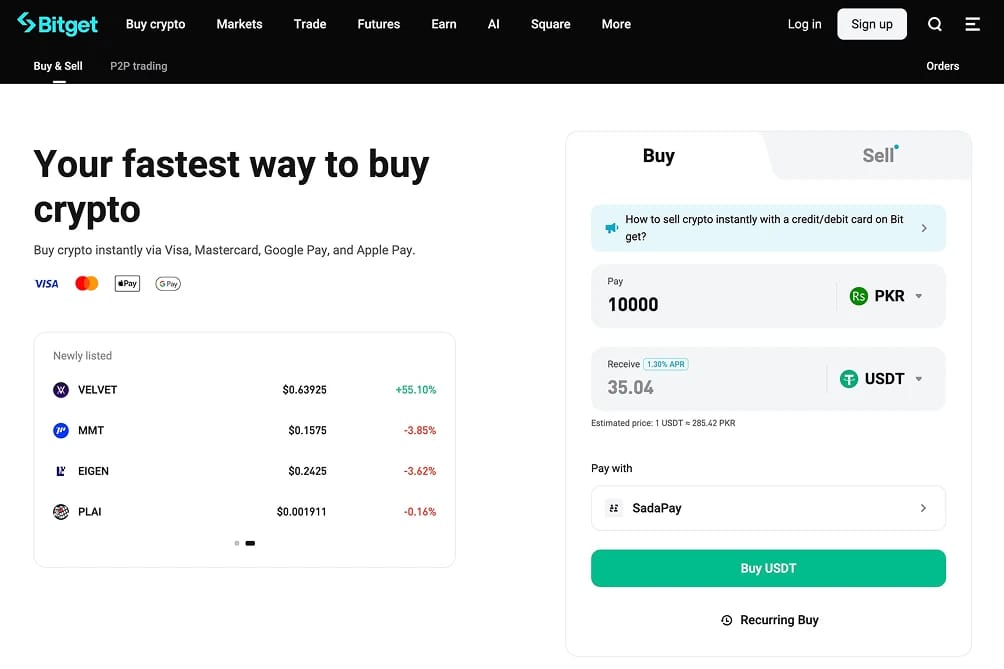
Funding mirrors OKX, with P2P only supported via SadaPay, Easypaisa, ABA, UBL Omni, and Upaisa. With no deep rupee desk, most users push TRC20 USDT over from Bybit or Binance, or eat the markup on a card buy. Spot trades then cost 0.1% before BGB discounts, and the futures desk stretches to heavy leverage.
At roughly 800 coins, Bitget sits above the simple global crypto exchanges that support around 250 coins, without chasing every micro-cap, and its derivatives stack is strong. We file it as a capable second account for copy trading and futures rather than a first on-ramp, since it cannot get rupees in on its own. Our Bitget review covers the trading services in detail.
Pros
- Well-developed copy trading with a wide bench of screened lead traders.
- A $400 million+ protection fund with reserve ratios reported above 100%.
- Around 800 assets paired with a competitive futures desk.
Cons
- Little PKR P2P depth, so it depends on inbound transfers from another platform.
- Mirroring leveraged traders can make outsized risk feel routine to a newcomer.
- Card deposits carry the usual processor charge.
5. MEXC
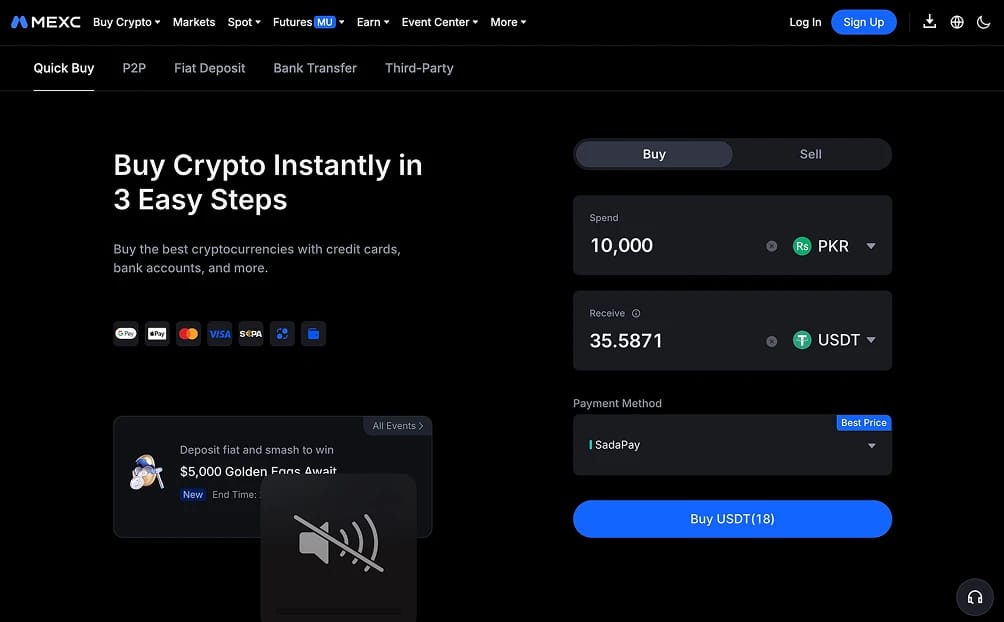
When cost and access to brand-new tokens decide it, MEXC wins. Makers pay 0% on spot, and takers pay only 0.05%, which adds up fast for anyone buying a fixed rupee amount of BTC or USDT each week. Its listing engine is the quickest here, with more than 2,800 assets and new coins often landing a fortnight before the bigger names.
Rupees never touch it directly, so users top up with USDT from a P2P buy elsewhere, keeping 3% to 5% of card buys for emergencies. The trade-off is weaker transparency, since MEXC reports reserves less thoroughly and less frequently than the three platforms above it. Our MEXC fees breakdown lays out the numbers.
We keep our own use disciplined, treating it as a low-cost trading and token-discovery account, holding little there and rotating gains back to a venue with firmer disclosure. The app is unusually light too, which helps when the connection is not. The only downside is the lack of regulation and licensing for this platform, which may mean your funds are not protected if something happens to the exchange.
Pros
- No maker fee on spot and one of the lowest taker rates on the market.
- A 2,800+ catalog with the fastest listing cadence of the majors.
- A stripped-back app that stays responsive on weak mobile data.
Cons
- No real rupee funding, leaving it reliant on inbound transfers.
- Reserve reporting sits behind the leaders on this list.
- Better suited to small working balances than to long-term storage.
6. KuCoin
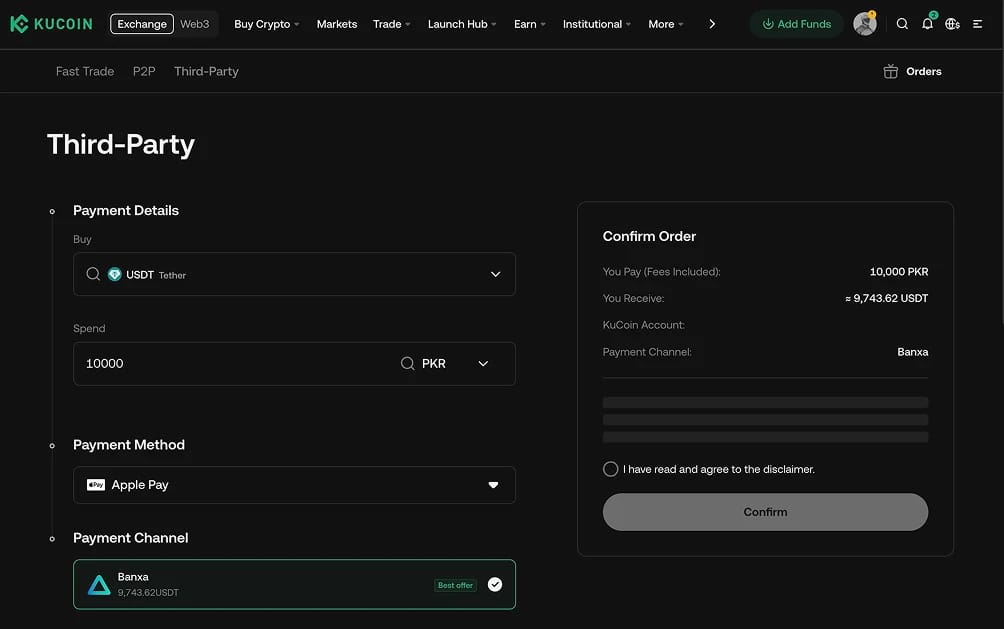
KuCoin closes the list as a support act for altcoins. Offering 1,000+ cryptocurrencies, automated grid and DCA bots, lending services, and Earn products for parked USDT gives it a clear role beside a funded main account, and thinly traded tokens often surface here before Bybit or Binance. Its main attraction is the high yields of up to 400% APY that users can earn for staking, KCS staking, or KuMining.
With no rupee door in place, the USDT transfer routine repeats. Automation is what sets KuCoin apart. A grid bot on a major pair earns its keep through the flat, grinding weeks that exhaust hands-on traders, and setup takes a few taps on mobile. Similar to Bybit and Binance, the user interface can be accessed in both Urdu and English, simplifying access for local residents.
The security record calls for honesty. In January 2025 the company admitted to running an unlicensed money-transmitting business in the US, settling for $297 million. Compliance has been rebuilt, and no customer money was lost, but that episode should shape how large a balance you leave there. Visit our KuCoin review to understand what happened in the settlement and learn about the exchange overall.
Pros
- Roughly 1,000 assets, often listing small-caps before the larger exchanges.
- Set-and-forget grid, DCA and rebalancing bots.
- Earn products that put idle USDT to work.
Cons
- No rupee entry point, so it can only ever be a secondary account.
- The 2025 US guilty plea still weighs on its record.
- A dense interface that makes for a rough first exchange.
How to Choose a Crypto Exchange in Pakistan
In Pakistan, the choice hangs on four questions. Can you get rupees in, are the merchants trustworthy, does your ID clear KYC, and what does a full round trip actually cost? Work through these five checks before you send a single rupee.
- Confirm a live PKR P2P desk first: Open the P2P section, filter for PKR, and count active merchants during Karachi or Lahore business hours. Bybit and Binance carry the deepest books. Everywhere else, plan to fund by USDT transfer from one of those two.
- Line up the rail you actually hold: Easypaisa and JazzCash cover most retail users, Raast handles instant bank-to-bank transfers, and standard IBFT still works. Choose merchants advertising the exact method in your hand so a payment window does not lapse mid-trade.
- Vet the merchant, not just the exchange: On P2P, your counterparty matters as much as the platform. Pick merchants with a 98%+ completion rate, hundreds of orders, and fast release times, and keep every trade and its proof inside the app so escrow protects you.
- Price the whole round trip, not the headline fee: A 0.1% trading fee tells you almost nothing. The P2P spread on each leg, plus any cash-out charge, sets your real cost, and a venue can run 2% to 4% all-in. Push a small PKR-to-USDT-to-PKR loop through and treat that number as the truth.
- Set up for tax and reporting from trade one: Crypto is now inside Pakistan's tax net, and from July 2026, licensed platforms are expected to hand user data to the FBR. Save clean transaction exports from the start, since rebuilding them later is far more painful.
Crypto and Bitcoin Regulation in Pakistan
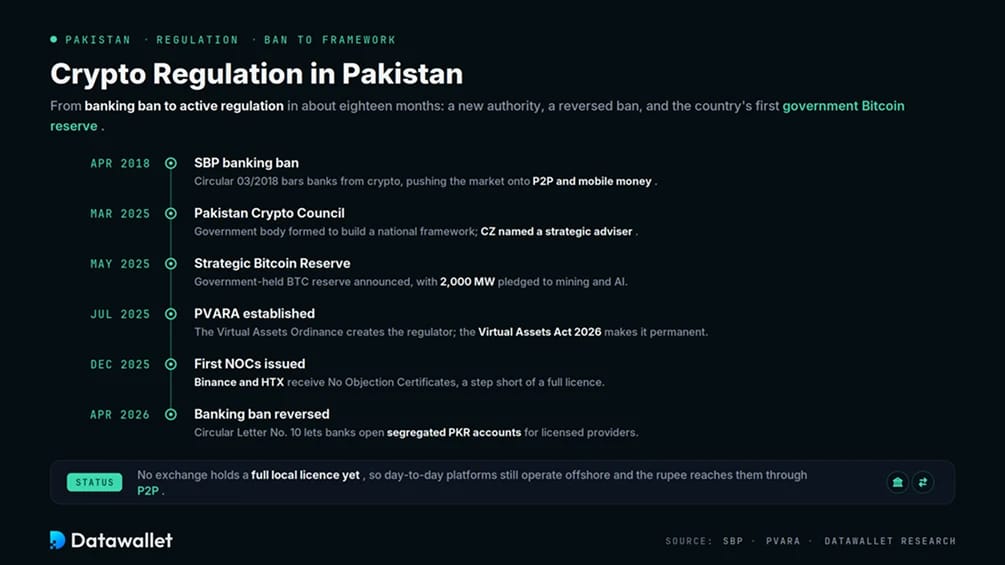
Crypto in Pakistan has shifted from being banned to actively regulated in about eighteen months, with a new authority, a reversed banking ban, and the country's first government Bitcoin reserve all arriving in quick succession.
- The 2018 banking ban: In April 2018, the State Bank of Pakistan issued BPRD Circular 03/2018, barring banks and payment institutions from processing virtual-currency transactions. Ownership was never criminalized, but cutting off the banks pushed the whole market onto P2P and mobile money, where it still sits.
- March 2025 - Pakistan Crypto Council: The government established the Pakistan Crypto Council to develop a national framework, later appointing Bilal Bin Saqib as Special Assistant to the Prime Minister on Blockchain and Cryptocurrency. Binance founder Changpeng Zhao was named a strategic adviser in April 2025.
- May 2025 - Strategic Bitcoin Reserve: At the Bitcoin 2025 conference, Pakistan announced a government-led Strategic Bitcoin Reserve, seeded initially with crypto seized in criminal cases and held rather than sold, alongside a plan to allocate 2,000 megawatts to Bitcoin mining and AI data centers.
- July 2025 - PVARA established: President Zardari signed the Virtual Assets Ordinance, 2025, creating the Pakistan Virtual Assets Regulatory Authority to license exchanges, custodians and token issuers. Parliament later passed the Virtual Assets Act 2026 to give PVARA a permanent statutory footing and classify crypto as property.
- December 2025 - First NOCs: PVARA granted No Objection Certificates to Binance and HTX, letting them register for AML supervision and prepare full license applications. PVARA was clear that an NOC is not an operating license.
- April 2026 - Banking ban reversed: The SBP issued BPRD Circular Letter No. 10 of 2026, formally undoing the 2018 directive. Banks may now open segregated, rupee-denominated, non-interest-bearing accounts for PVARA-licensed providers, though they still cannot hold or trade crypto with their own or depositors' funds.
The direction is unmistakable, but timing matters. Until the first full licenses land and licensed banks open provider accounts, the exchanges Pakistanis use day-to-day will still operate offshore, and the rupee will still reach them through P2P.
How Is Crypto Taxed in Pakistan?
Pakistan is still developing a crypto tax policy as the licensing framework settles, so the rules are firmer than a year ago but still evolving. The safest assumption is that gains are taxable and that the FBR expects to see them.
- Gains are entering the tax net: As it legalizes the sector, Pakistan is preparing to tax crypto gains, folding digital-asset income into Section 37 of the Income Tax Ordinance, 2001. Reports point to a rate near 15% on profits above an annual threshold, though the figure is not yet settled in law.
- A live budget debate: Officials have floated a 10% to 20% rate in the 2026-27 budget cycle, so the number may still shift. Watch the finance bill for your tax year rather than an older article.
- Reporting is going automatic: From July 2026, licensed exchanges are expected to report user transactions to the FBR, and individuals file through the IRIS portal, with deadlines near 30 September for salaried filers and 31 October for business filers.
- Records decide the outcome: Whatever the final rate, the tax only works cleanly if you can show acquisition dates, cost basis and disposal values. Export your history regularly, since P2P trades and USDT transfers scatter across apps and are painful to reconstruct.
None of this is tax advice, and the framework is changing quarter to quarter. Anyone trading a meaningful size should sit down with an FBR-registered tax adviser before filing.
.webp)
Cryptocurrency Adoption in Pakistan
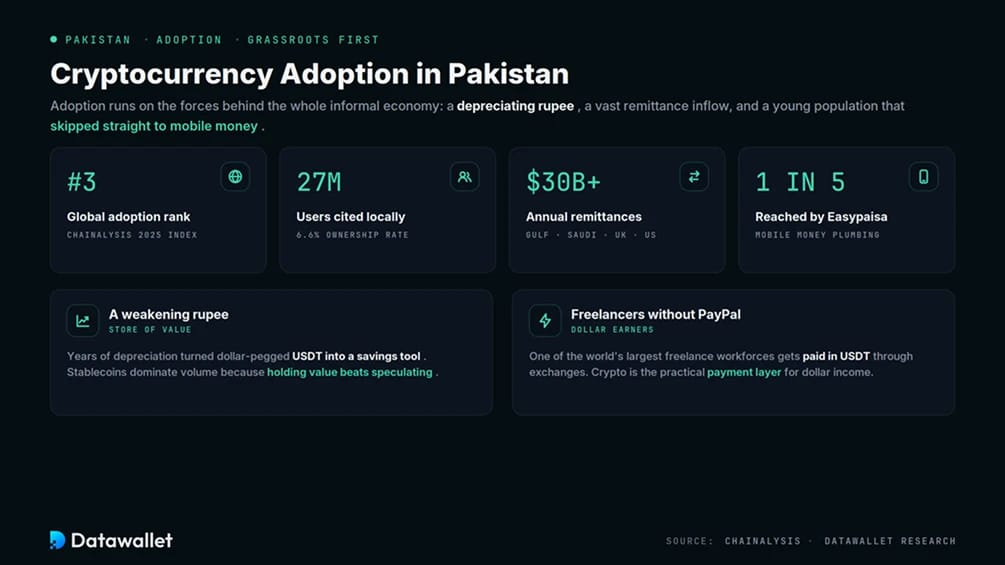
Crypto adoption in Pakistan runs on the forces behind its whole informal economy, a depreciating rupee, a vast remittance inflow, and a young population that skipped straight to mobile money.
- Third largest crypto economy globally: The Chainalysis 2025 Global Crypto Adoption Index ranks Pakistan third, behind only India and the United States and ahead of Vietnam and Brazil. Chainalysis puts ownership at 6.6% of the population, while government and industry figures cite up to 27 million users.
- The rupee is the real driver: Years of rupee depreciation have turned dollar-pegged USDT into a savings tool, not a trading chip. For many, moving rupees into USDT is about holding value rather than speculating, which is why stablecoins dominate volume here.
- Freelancers and the missing dollar rails: Pakistan has one of the world's largest freelance and IT export workforces, and with PayPal absent from the country, many are paid in USDT via exchanges like Binance. Crypto is the practical payment layer for a generation earning in dollars.
- Mobile money is the plumbing: Easypaisa and JazzCash together cover tens of millions of accounts, and Easypaisa alone reports reaching one in five Pakistanis. That rail is what makes P2P crypto so frictionless, since a rupee transfer clears in seconds at any hour.
- Remittances give it scale: Pakistan is one of the world's largest remittance economies, taking in well over $30 billion a year from workers in the Gulf, Saudi Arabia, the UK and the US. A stablecoin leg can undercut the fees on traditional corridors, which our guide to buying crypto with Western Union compares in detail.
What stands out locally is how far ahead grassroots usage has run ahead of the formal rules, a gap the new framework is only starting to close.
How to Buy Bitcoin in Pakistan
For most Pakistanis, the most affordable route to Bitcoin is to buy USDT with rupees on a P2P desk, then trade that USDT into BTC on the spot market. Here is the sequence we followed.
- Register where the rupee book is deepest: Bybit and Binance carry the strongest PKR merchant pools. Scan the P2P tab for live merchants before you move any money in.
- Get verified cleanly: Submit a photo of your CNIC or passport and a selfie and match the account name to the document letter for letter, since mismatches stall more applications than anything else. Approval usually lands the same day.
- Pick up USDT on P2P: Set the filter to PKR, choose a seller with a 98%+ completion rate who takes Easypaisa, JazzCash, Raast or IBFT, send the rupees from that account, and let escrow release the coins. Expect the whole thing to wrap up inside ten minutes.
- Convert to BTC with a limit order: Leave the one-tap convert button alone. A limit order on BTC/USDT usually shaves 1% to 3% off what the instant screen would charge.
- Send long-term coins to self-custody: Anything you plan to hold rather than trade belongs in a wallet you control, with the address checked twice and the network confirmed before you send. Compare options in our best crypto wallets guide, and see the best USDT wallets page for stablecoin storage.
Our dedicated guide to buying USDT in Pakistan covers the stablecoin side in more depth.
Final Thoughts
Bybit is the account we would open first in Pakistan today. It keeps the most rupee in your pocket through low fees and tight P2P spreads, funds through the mobile wallets people already use, publishes reserves regularly, and proved its solvency through a major 2025 hack.
Binance is the strongest second account, and a credible first for anyone who prizes the deepest liquidity or the furthest-along compliance, while OKX, Bitget, MEXC and KuCoin each earn a role once the rupee leg is handled.
The market is mid-transition. A banking ban is lifted, an authority is issuing its first clearances, and the government holds Bitcoin in reserve, yet no exchange has a full local licence and the rupee still reaches every platform through P2P. That window will not stay open in its current form, so build good habits now.
For the wider region, our guides to the best crypto exchanges in India and across Asia map the neighbouring markets.
Our Methodology
Every rating here comes from hands-on use under Pakistani conditions, not marketing pages. We signed up on each exchange, cleared KYC with a CNIC and passport, paid rupee P2P orders through Easypaisa and JazzCash where markets existed, moved USDT into the platforms that lack a deep rupee desk, traded live, and withdrew back to local accounts.
Six factors decided the order.
- Trust Score: A proprietary score out of 5 that weighs security history, reserve transparency, regulatory posture, years in operation and audit coverage.
- PKR Funding Methods: Which venues run deep rupee P2P books, the mobile-money and bank rails their merchants take, how fast payments settle, and the spread against the open-market dollar.
- Local Usability: How the app holds up on weak mobile data, the quality of English and Urdu support, and how fast a newcomer gets from signup to a filled order.
- Security Track Record: Past breaches, custody setup, how often reserves are attested, and account safeguards such as 2FA and withdrawal whitelists.
- Assets and Liquidity: Live market and limit orders on BTC/USDT, ETH/USDT and one mid-cap pair per venue, logging spread, depth and fill quality.
- Fee Structure: Maker and taker rates, PKR P2P spreads, withdrawal costs, and the total price of a rupee-to-USDT round trip.
Platforms with no workable funding route for Pakistanis, open compliance failures, or recurring access issues were left out. We tested these exchanges from May through July 2026.