






Compare Top Romanian Crypto Exchanges
1. Bybit EU
Bybit EU is where Romanian traders go now that Binance is withdrawals-only. Austria's FMA authorized Bybit EU GmbH under MiCA, and the approval passports into Romania, with one login opening access to 600+ cryptocurrencies at a flat 0.10% on spot, margin trading up to 10x, grid and DCA bots, Earn, copy trading, and the Bybit Card. Nothing else on the market replicates the breadth of products Binance customers gave up in July.
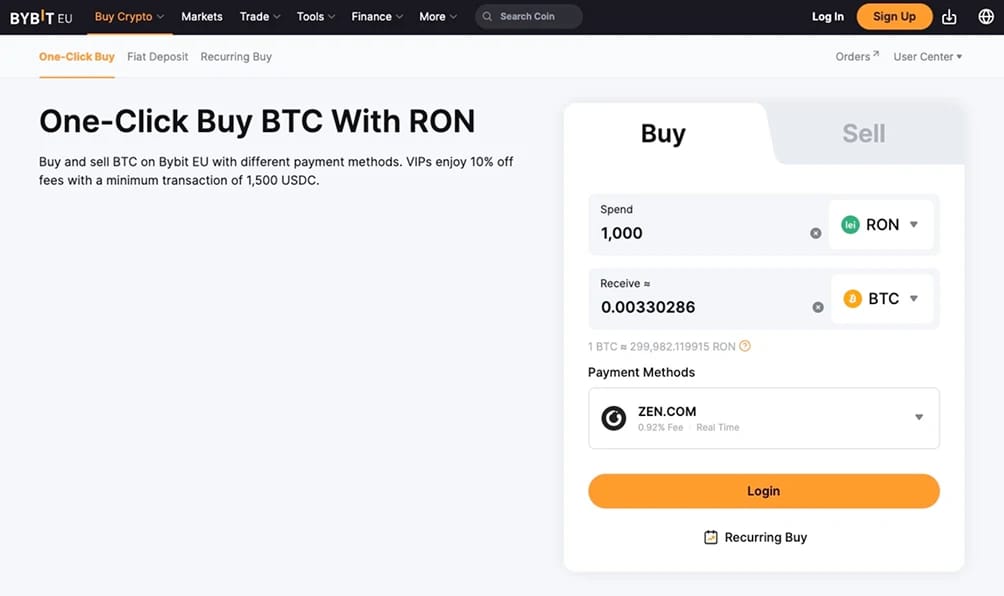
It is also the one platform here that accepts RON deposits. The Express Buy feature lets users purchase BTC directly with RON using a bank card, Apple Pay, Google Pay, or a ZEN.com account, so a first purchase needs no euro conversion at all. Our RON card buy settled in seconds, a SEPA transfer from a Banca Transilvania euro account arrived the same afternoon for order-book trading, and the Bybit app has a Romanian-language interface.
There are two things users should know before migrating. The EU platform runs as its own Austrian company, so users of the global app must repeat identity verification, and perpetual futures remain closed to retail clients across the EEA. Tether never pursued a MiCA license either, so USDC and euro stablecoins serve as substitutes for USDT. Our Bybit review covers the platform’s features, services, security history and more.
Pros
- The closest legal Binance replacement available to Romanians.
- Flat 0.10% spot pricing across 600+ assets, plus margin, bots, Earn, and a card under Austrian supervision.
- Direct RON purchases by card, Apple Pay, Google Pay, and ZEN, plus SEPA funding and a Romanian-language app.
Cons
- Retail accounts in the EEA cannot touch perpetual futures.
- Identity checks are restarted even for longtime users of the global Bybit app.
- USDT is absent since Tether skipped the EU licensing process.
2. Kraken
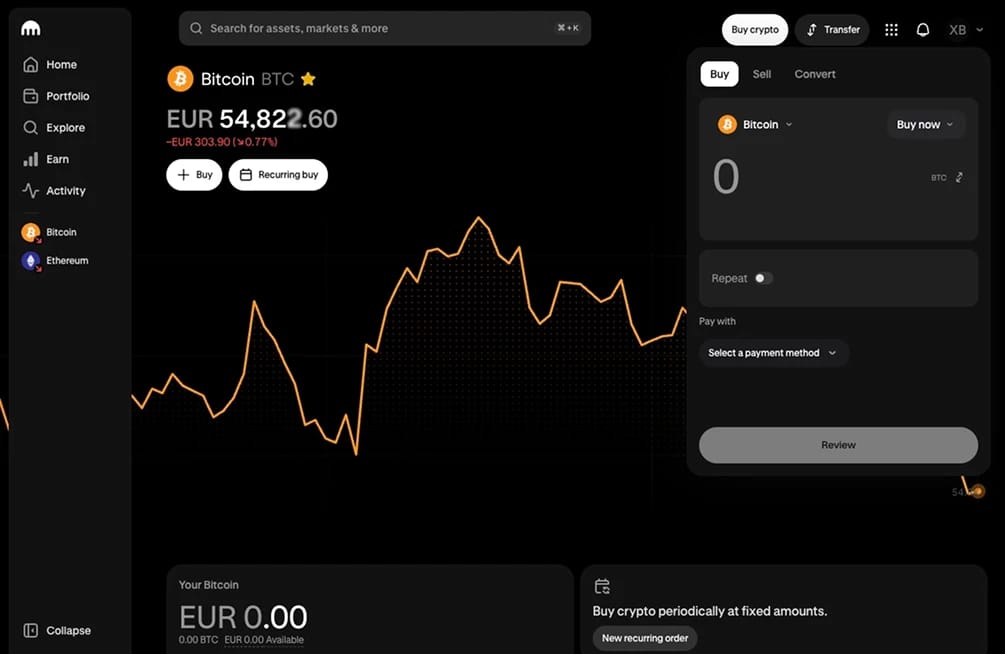
Kraken is the custody benchmark of this lineup. Ireland's central bank issued its MiCA authorization, one of the tougher approvals in the bloc to earn; a separate MiFID permission lets it run regulated derivatives that remain off the menu at most rivals here, and customer funds have gone untouched by attackers through the platform's entire history. Reserve attestations date back to 2014, longer than any competitor on this page.
Depth backs up the security story. Over 600 assets trade against some of the thickest EUR liquidity in Europe, staking covers the major coins, and euro deposits by SEPA cost nothing. Our transfer from an ING Romania euro sub-account showed up inside an hour, and a Revolut SEPA Instant payment beat us to the app. Kraken lists no RON pairs, so users must convert to euros before leaving their bank.
Price is the concession. Entry-level spot pricing of 0.25% maker and 0.40% taker fees is above what Bybit EU and OKX charge, and Kraken Pro greets a first-time buyer with more charting than most will ever need to open again. Anyone parking serious size will find the Irish oversight worth that premium. Our Kraken review examines the whole platform.
Pros
- Zero customer losses to hacks across the platform's history and reserve reporting since 2014.
- Irish MiCA authorization alongside a MiFID permission covering regulated derivatives.
- Euro deposits by SEPA and SEPA Instant cost nothing and settle fast into deep EUR markets.
Cons
- Starting fees of 0.25% and 0.40% exceed those of Bybit EU, OKX, and Gate.
- No RON pairs, so every purchase begins with a currency conversion.
- Kraken Pro can intimidate someone making their first purchase.
3. Coinbase
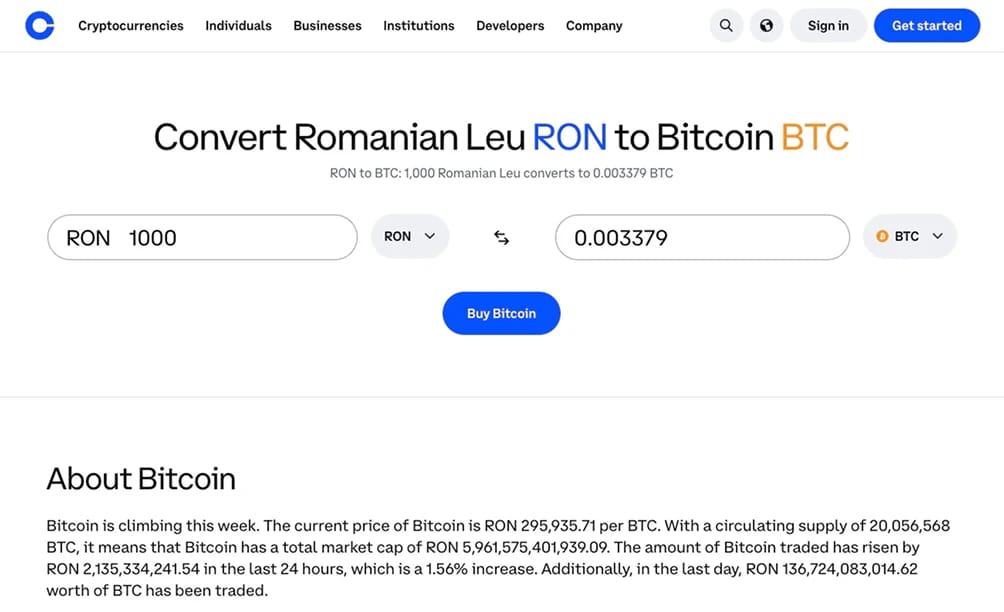
Coinbase is the platform we point Romanian companies and funds toward. Luxembourg's CSSF granted Coinbase Luxembourg S.A. its MiCA license in June 2025; the Nasdaq listing forces audited quarterly accounts to be made public, and 14 years have passed without a security incident. Coinbase Prime bolts institutional custody, OTC execution, and trading APIs onto that base, a combination no rival serving Romania publishes the paperwork to match.
Retail users are far from an afterthought. Our passport check cleared in minutes, a SEPA Instant euro deposit landed almost before the confirmation email, and recurring buys can accumulate Bitcoin every payday without further thought. USDC sits natively on the platform and pays rewards on balances, filling the stablecoin role Tether vacated.
Cost is the honest weakness, and most of it can be avoided. The one-tap purchase screen buries a spread heavy enough to make it the most expensive purchase on this list, while the Advanced interface waits behind a toggle at 0.40% maker and 0.60% taker. Flip that toggle before the first order, and the gap to cheaper rivals shrinks considerably. Our Coinbase review prices everything out.
Pros
- Luxembourg CSSF license, supported by audited public company accounts and 14 hack-free years.
- Coinbase Prime brings institutional custody, OTC execution, and APIs to Romanian corporate clients.
- Native USDC with rewards covers the gap USDT left behind on authorized venues.
Cons
- Simple buys hide the largest spread in this lineup.
- Advanced pricing of 0.40% and 0.60% still costs more than OKX, Bybit EU, and Gate.
- A catalog of around 250 mainstream assets skips the altcoin long tail.
4. OKX
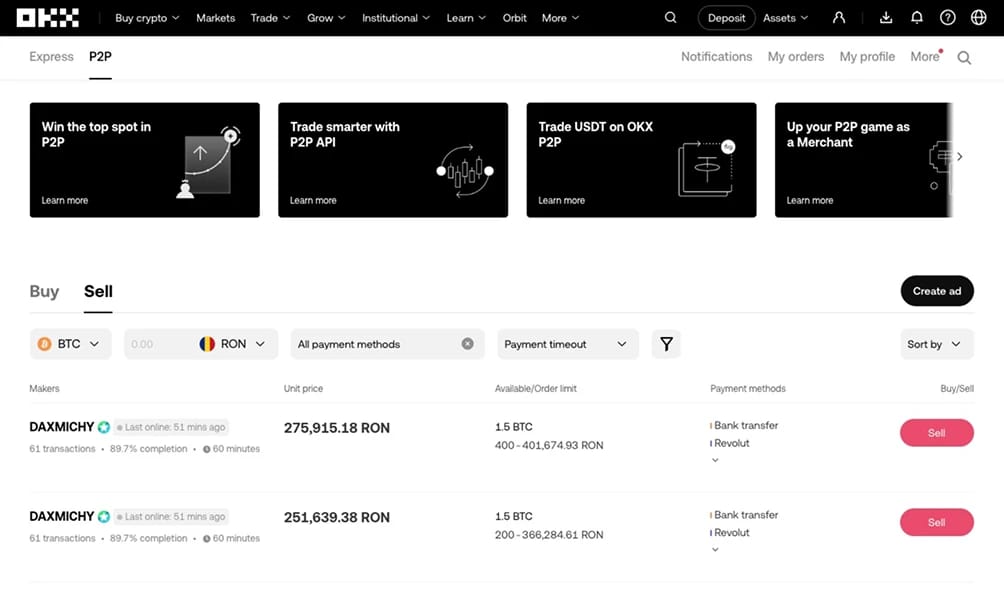
OKX wins when it comes to costs, offering the lowest trading fees on the market. Makers pay 0.08% and takers 0.10%, cheaper than any large authorized platform available to Romanians. Reserve reports, verified with Merkle trees, have appeared every month since late 2022, so anyone can confirm the assets exist. Malta's MFSA issued the MiCA authorization, which reaches Romania through passporting.
The second argument is on-chain reach. OKX Wallet, the self-custodial side of the app, connects to more than 100 networks and folds in DEX aggregation, so the same login covers both a regulated exchange and DeFi. That suits Romanians holding EGLD and other assets that live outside centralized platforms. Our euro transfer arrived the following morning without a query from the bank.
The caveats sit at the supervisory level. ESMA's peer review raised questions about how rigorously Malta vetted some early approvals, so the Maltese stamp commands less confidence than Dublin's or Luxembourg's, and the sheer feature density can steer a newcomer toward instruments beyond their experience. Our OKX review digs deeper into the exchange’s features, products and costs.
Pros
- The lowest spot pricing among authorized platforms is at 0.08% for makers and 0.10% for takers.
- Merkle-tree reserve reports are published monthly and open to independent checking.
- A self-custodial wallet reaching 100+ networks with DEX aggregation built in.
Cons
- ESMA's peer review dented confidence in Malta's early authorizations.
- Feature density can push beginners into products they are not ready for.
- No local presence, so oversight runs entirely through the Maltese regulator.
5. Gate
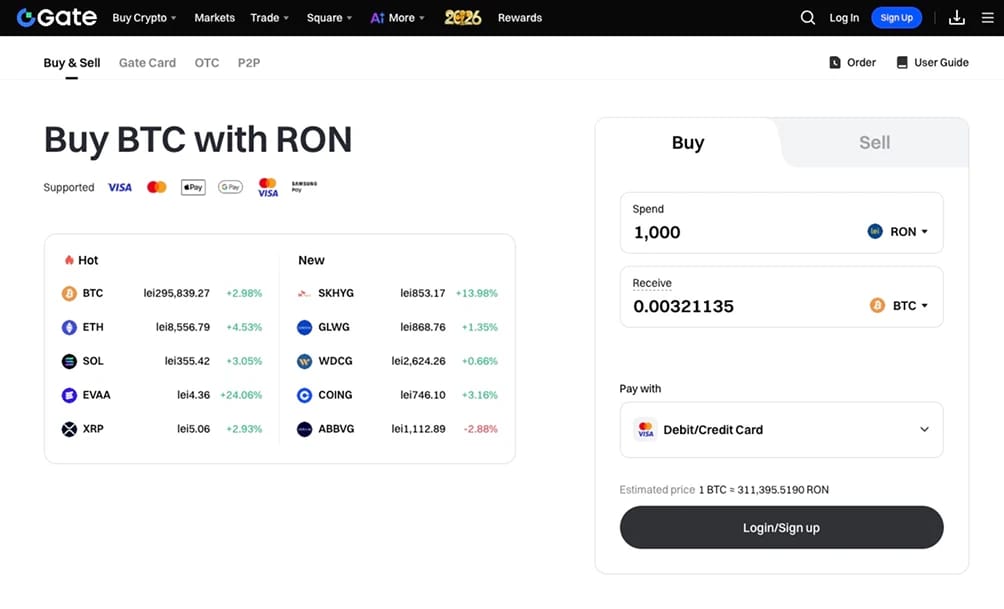
Gate exists for the assets that the major exchanges will never list. The global platform carries more than 3,800 cryptocurrencies, and Gate Technology Ltd, the group's EU company, secured Maltese approval under MiCA spanning custody, order execution, exchange services, and transfers. When a new narrative coin appears months before Kraken or Coinbase notice it, this is usually where Romanians find it first.
Pricing holds up for a digital asset selection that deep. Makers pay 0.10% and takers pay 0.20%, with additional reductions for users who hold GateToken (GT). The platform layers copy trading and Earn products on top of a proof-of-reserves system built on zero-knowledge cryptography that any user can query. Our euro deposit took a day to arrive and traded immediately.
Treat it as a trading account rather than a base. The EU entity's compliant listing count runs below the global headline, order books thin out fast down the long tail, and small listings carry genuine drawdown risk. Gate repaid users in full after its 2018 hack and has rebuilt its security program since, a story our Gate review tells properly.
Pros
- More listed assets than any authorized platform serving Romania.
- Maker pricing from 0.10% plus copy trading, Earn, and verifiable zk reserve proofs.
- Early listings that arrive here months ahead of the conservative majors.
Cons
- The EU-compliant listing count sits below the global 3,800+ headline.
- Order books turn thin and risky far down the catalog.
- Maltese supervision carries the same ESMA caveat as OKX.
6. Bitpanda
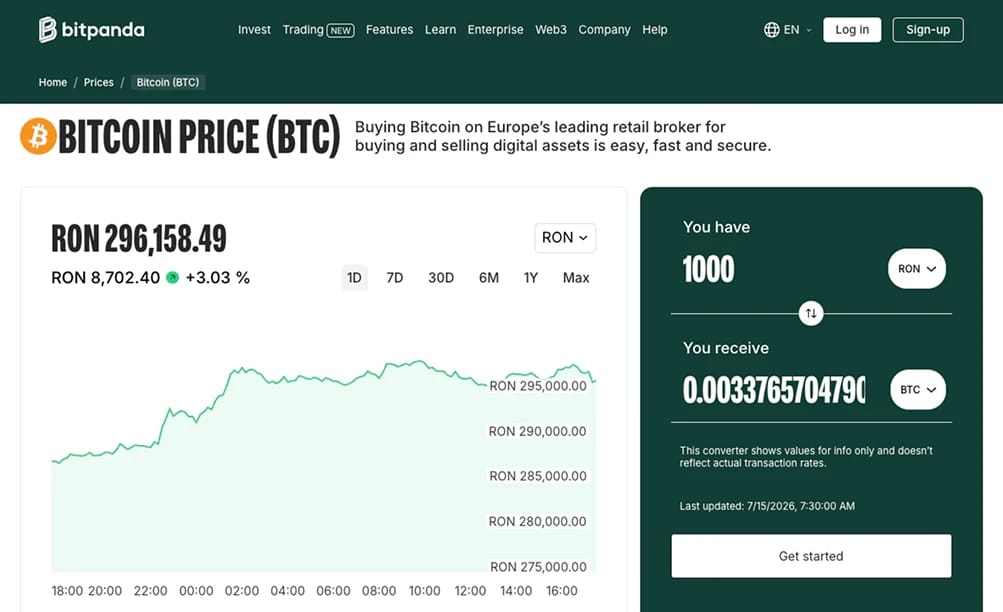
Bitpanda is the choice for a Romanian investor when crypto is only part of the portfolio. The Vienna platform, founded in 2014 and serving several million Europeans, collected three MiCA licenses during 2025, from Germany's BaFin in January, then Malta's MFSA, then its home regulator, FMA, in April. Around 650 cryptocurrencies sit alongside stocks, ETFs, and precious metals in a single app, so one account can hold Bitcoin alongside an S&P 500 position.
The experience is built for accumulation rather than trading. Savings plans automate weekly or monthly purchases, staking covers the larger coins, crypto indices bundle the market into one instrument, and the Bitpanda Card spends any asset in the portfolio. Our euro SEPA deposit from Raiffeisen cleared the next morning, and card top-ups worked instantly.
Pricing is where the broker model shows. Instead of maker and taker fees, Bitpanda wraps a spread of roughly 1.49% around Bitcoin purchases, several times the cost of an order-book trade on Bybit EU or OKX, and the stock and ETF positions are derivative contracts rather than shares held in your name. Our Bitpanda countries page maps where the platform operates.
Pros
- Three MiCA licenses, from BaFin, the MFSA, and Austria's FMA, more than any rival in Europe.
- Crypto, stocks, ETFs, and metals in one account plus savings plans that automate buying.
- Simple onboarding and instant card or PayPal funding are suited to first-time investors.
Cons
- Spreads near 1.49% on Bitcoin cost several times the order-book fee.
- Stock and ETF exposure comes through derivative contracts, without shareholder rights.
- No advanced order types, so active traders will outgrow it quickly.
How to Choose a Crypto Exchange in Romania
Since 1 July, the shortlist starts with the license and ends with your bank, and the collapse of Romania's own licensing timetable means the checking falls on you.
- Look up the entity in ESMA's register: a license belongs to one legal entity. Bybit EU GmbH, Coinbase Luxembourg S.A., and Kraken's Irish company are all searchable in ESMA's public CASP list, and the ASF has warned that unauthorized providers carry none of MiCA's client-asset protections.
- Decide how your lei becomes euros: Order books across the licensed field run in EUR, and only Bybit EU sells crypto against RON directly. Everywhere else, converting inside Revolut at the interbank rate on a weekday is usually cheapest, while a euro sub-account at your bank costs a 0.5% to 1.5% spread on the rate.
- Send a small test transfer before real money: Romanian banks screen crypto payments under AML rules, and treatment varies by institution. Our pages on buying crypto through ING, Raiffeisen, and UniCredit explain each bank's stance.
- Check that your coins made it through the compliance filter: Authorized EU platforms dropped USDT after Tether declined to seek a MiCA license, and the EU versions of global apps list fewer coins than their international parents. If one token matters to you, confirm the compliant entity carries it before moving funds.
- Plan for ANAF before the first sale: Gains realized this year are subject to a 16% tax, and exchanges now automatically report Romanian users' activity under DAC8. Export your trade history from day one so the numbers ANAF receives match the ones you declare.
Crypto and Bitcoin Regulation in Romania
Crypto is legal in Romania, MiCA applies directly, and the ASF is the designated competent authority for crypto-asset service providers. What makes the country unusual in mid-2026 is that its own licensing machinery has stalled while the EU deadline arrived on schedule.
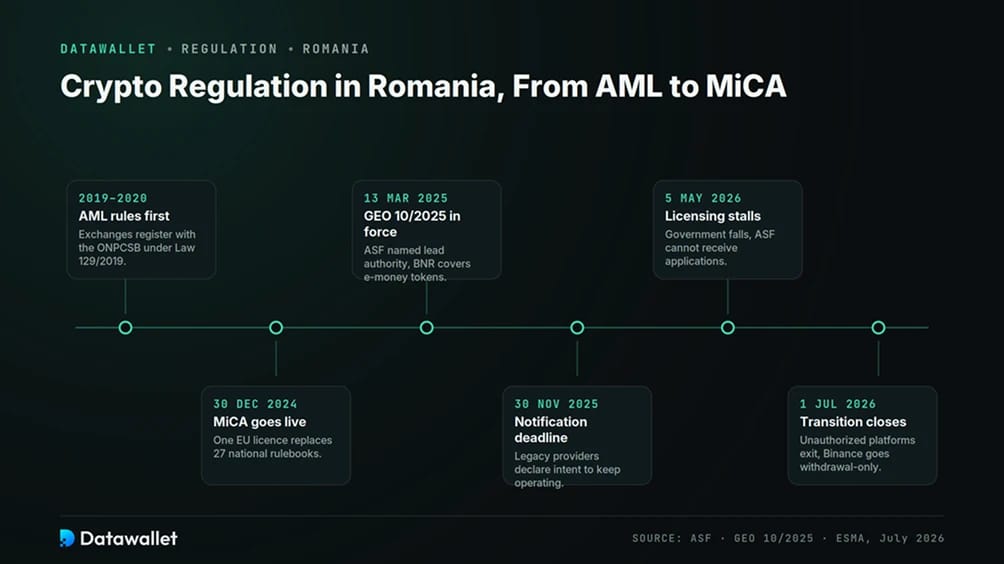
- AML rules came first: Law 129/2019 and GEO 111/2020 required exchanges and wallet providers to register with the ONPCSB, Romania's financial intelligence unit, a light regime that offered no passport and no prudential supervision.
- 30 December 2024: MiCA's provider rules took effect, consolidating 27 national rulebooks into a single license valid throughout the EEA.
- 13 March 2025: GEO 10/2025 entered into force, naming the ASF as the lead authority for exchanges and custodians and the BNR for e-money tokens issued by banks and e-money institutions.
- 30 November 2025: Legacy providers registered before MiCA took effect had to tell the ASF they intended to keep operating under the transitional window, which Romania ran to the full 1 July 2026 limit.
- 2 April 2026: The complete implementing ordinance reached a first reading in government, covering sanctions and crypto ATM rules. A censure motion then dismissed the government on 5 May, and with Parliament in recess, the ASF still cannot receive or decide license applications.
- 1 July 2026: The EU-wide transition closed. Platforms holding no MiCA authorization anywhere in the bloc lost the right to serve Romanian clients, which is why Binance suspended its EU services after pulling its Greek application, keeping withdrawals open while trading stopped.
The practical consequence for a Romanian user is simple. Every legal platform today holds a license issued in another member state, as local platforms wait in a queue because the state has not built the proper framework, and ESMA's register is the only document that settles whether an exchange may serve you.
How Is Crypto Taxed in Romania?
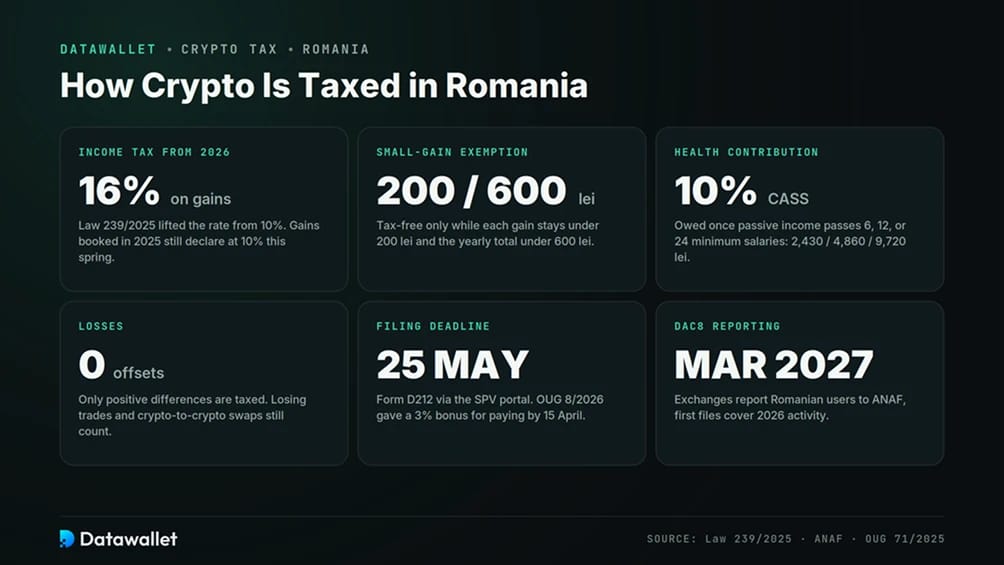
Romania taxes crypto harder than it did a year ago, and the anonymity that once softened enforcement is gone. Gains from the transfer of virtual currency are treated as income under the Fiscal Code.
- The rate is now 16%: Law 239/2025 lifted the tax on crypto gains from 10% to 16% for income realized from 1 January 2026. Gains booked during 2025 and declared this spring still carry the old 10% rate.
- Small gains stay exempt: A gain of up to 200 lei per transaction is exempt, but only if total gains for the year remain under 600 lei. Both conditions must hold at once, and crossing either one makes everything taxable.
- Losses cannot be deducted: Tax applies to each positive difference between sale and purchase price, minus direct transaction costs. A losing trade reduces nothing, crypto-to-crypto swaps count as taxable events, and values convert to lei at the BNR rate on the transaction date.
- CASS can double the bill: Once your combined passive income, crypto included, passes 6 gross minimum salaries (24,300 lei at the current 4,050 lei minimum), you owe a health contribution of 2,430 lei, rising to 4,860 lei above 12 salaries and 9,720 lei above 24. Each band applies in full the moment you cross it.
- File Form D212 by 25 May: The Declarația unică reaches ANAF through the SPV portal by 25 May of the following year, and OUG 8/2026 offered a 3% discount to taxpayers who filed and paid in full by 15 April.
- DAC8 ends non-reporting: Under OUG 71/2025, exchanges serving Romanians must report user transactions to ANAF annually, and the first files covering this year's activity are due in March 2027. The tax office will hold your trading history, whether you declare it or not.
None of this substitutes for a Romanian tax adviser, particularly for staking rewards, mining, or activity that starts to resemble a business.
Cryptocurrency Adoption in Romania
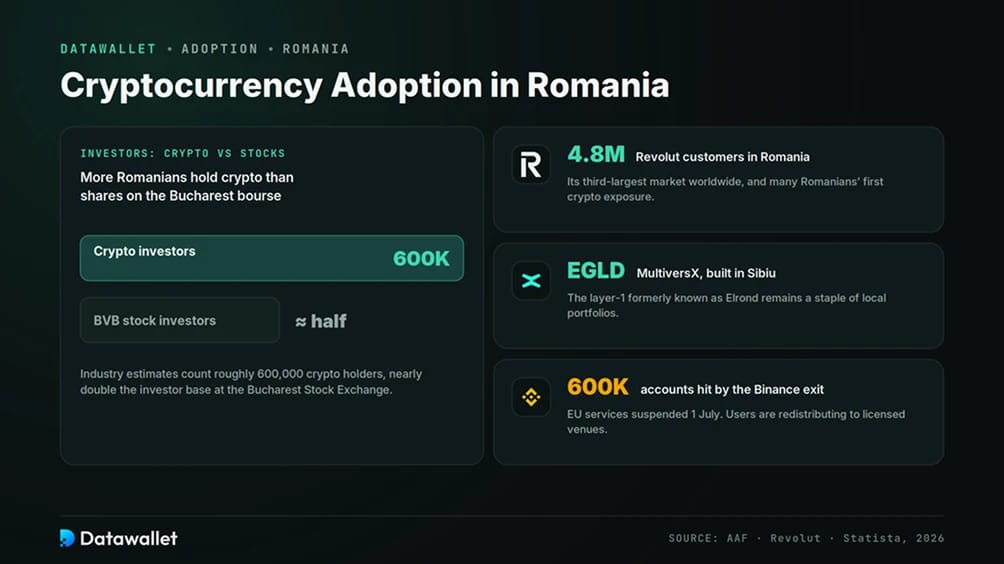
Romania's crypto base is larger than its stock market and more embedded in daily banking than the headline numbers suggest.
- More crypto investors than stock investors: Industry estimates put around 600,000 Romanians in crypto, nearly double the investor count at the Bucharest Stock Exchange. Broader surveys, such as Statista, count anyone who has ever held a digital asset and land far higher, so definitions matter when comparing figures.
- Crypto arrived inside the banking app: Revolut counts 4.8 million retail customers in Romania, its third-largest market worldwide, and in-app crypto trading was the first exposure many Romanians ever had to the asset class.
- Romania builds as well as buys: MultiversX, the layer-1 formerly known as Elrond, was founded in Sibiu, and its EGLD token remains a staple of Romanian portfolios and a point of genuine local pride.
- The Binance migration is the story of the year: With the country's most popular platform reduced to withdrawals, hundreds of thousands of users are redistributing across licensed venues, and the winners of that migration will define the local market for years.
Our crypto adoption statistics page tracks how Romania compares globally.
How to Buy Bitcoin in Romania
Buying BTC here takes under half an hour once you decide how your lei will reach the platform. This is the process we followed.
- Pick a licensed platform: Bybit EU for range at 0.10%, Kraken for depth and the cleanest record, Coinbase for institutions and easy starts, or Bitpanda for mixing crypto with stocks. Confirm the entity in ESMA's register before creating an account.
- Clear verification: A Romanian ID card or passport plus a selfie completed KYC on every platform we tested, usually within minutes. Type your name exactly as it appears in your document, since mismatches cause most stalled applications.
- Fund the account: Convert lei to euros in Revolut or a bank euro account and send a SEPA transfer, which carries no exchange-side charge at Kraken and Coinbase. Cards and mobile wallets work instantly on Bybit EU and Bitpanda for smaller amounts.
- Buy with a limit order: Set a limit order against BTC/EUR wherever an order book exists, because it almost always beats the instant-buy button, which hides a 1% to 3% spread in the quoted price.
- Choose custody and start records: MiCA obliges licensed venues to segregate client assets, so active traders can reasonably stay on the platform, while long-term holdings belong in self-custody. Our best crypto wallets guide ranks the options. Export the trade history immediately, because ANAF will eventually see the same data through DAC8.
Selling reverses the steps, and euro withdrawals back to a Romanian bank landed within a day in our tests before the final conversion into lei.
Final Thoughts
Bybit EU is our first choice in Romania. Romanian traders lost the platform they knew, and no licensed alternative rebuilds the toolkit as completely, from 600+ assets at 0.10% to bots, Earn, direct RON purchases, and a Romanian-language app under Austrian supervision.
The country's most popular exchange disappeared from Romanian phones within a week for lack of a license, while the state meant to issue local licenses could not pass its own law. A sensible setup pairs one strong authorized platform for daily use with records tidy enough that a 16% tax bill never becomes an argument with ANAF.
Readers weighing regional options can compare neighboring markets in our best crypto exchanges in Europe guide.
Our Methodology
Every position in this ranking reflects hands-on use from inside Romania. We opened accounts using Romanian documents, funded them via local banks and Revolut, placed live orders, and withdrew funds back to lei. Six criteria set the order.
- Trust Score: Our in-house score out of 5, built from the MiCA authorization and its issuing regulator, reserve disclosure, breach record, platform age, and audit depth.
- Regulatory Standing: Each platform's legal entity was checked against ESMA's CASP list, the dividing line between legal operators and everyone else since the transition closed.
- Funding From Romania: We timed EUR SEPA and SEPA Instant transfers from ING and Banca Transilvania, plus Revolut conversions and card payments, then priced the total conversion cost of each path.
- Security Track Record: We weighed hacking history, client-asset segregation, how often reserves are disclosed, and controls such as 2FA options and withdrawal allowlists.
- Assets and Liquidity: Live orders went through on BTC and ETH, plus one smaller pair per platform, logging spread, depth, and execution quality.
- Fee Structure: We stacked up published trading commissions, hidden instant-buy and broker spreads, card surcharges, and the total cost of a complete round trip starting and ending in lei.
Any platform lacking a current MiCA authorization was ruled out, which excluded Binance after its Greek withdrawal, as well as Romania's local platforms whose CASP applications remain stuck in the ASF queue. Platform testing took place between May and July.
.webp)