







Compare Top Taiwanese Crypto Exchanges
1. Bybit
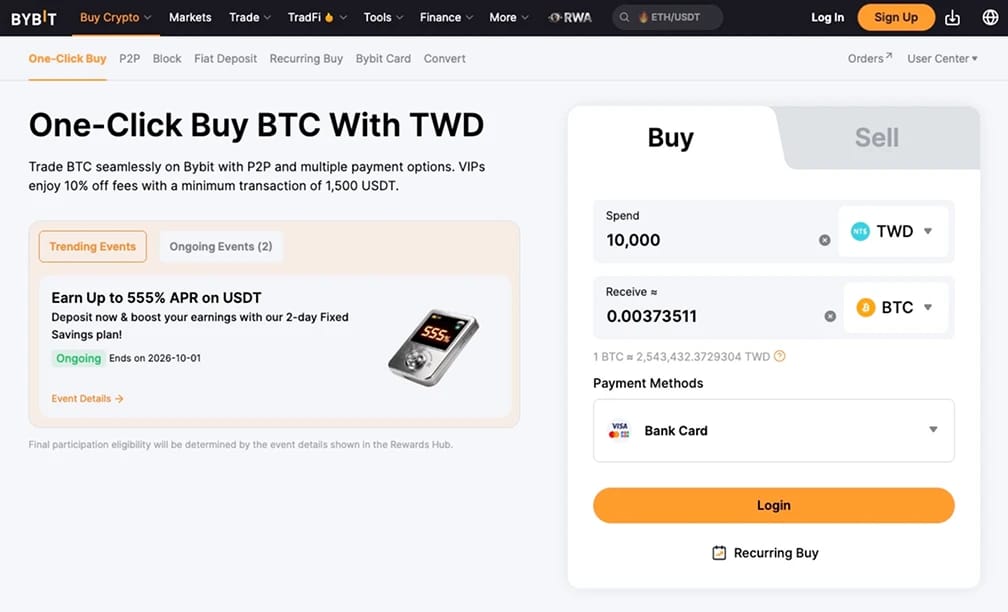
Bybit combines the widest product range with the lowest flat cost among exchanges Taiwanese residents can still use, earning first place. Every spot order across more than 2,600 coins costs 0.1%, while perpetual contract fees are 0.02% for makers and 0.055% for takers. Traditional Chinese is available throughout the app and help center, as well as in live support.
You can deposit TWD onto Bybit in three ways. Card and Apple Pay purchases run through third-party processors, and the peer-to-peer (P2P) desk matches buyers with merchants who accept TWD bank transfers under escrow. Card payments charged up to 5%, whereas Apple Pay incurred no fees. Another dependable route is to buy USDT on MAX or BitoPro and send it to Bybit.
In February 2025, attackers stole close to $1.5 billion of ETH from a Bybit cold wallet, the largest single loss suffered by any exchange. The company covered every customer balance and kept withdrawals open. Hacken now verifies monthly reserve reports, and the mid-2026 attestation reported $16.5 billion in customer assets with ratios above 100% for every major coin. Our Bybit review examines the incident and products in detail.
Pros
- Spot trading costs 0.1% across more than 2,600 coins. Futures makers pay 0.02%, below taker rates on Taiwan's registered platforms.
- One login provides spot, futures, options, copy trading, grid bots, and Earn with full Traditional Chinese support.
- Hacken checks the reserve report each month. Every edition since the 2025 breach has shown customer balances fully backed.
Cons
- No direct TWD bank deposit exists, so funding relies on processors, Apple Pay, or P2P merchants.
- Bybit holds no FSC registration and is on the VASP Association warning list. Disputes therefore fall under offshore terms.
- The 2025 cold wallet breach remains part of its record, although no customer money was lost.
2. MAX
MAX, operated by Modernity Financial Technologies, is best for moving TWD to and from crypto. It is the largest of the eight platforms on the FSC's registered provider list. Customer TWD is separated from company funds in a trust account at Far Eastern International Bank. Deposits from a verified bank account are free. Withdrawing TWD costs NT$30, or nothing when sent to a Bankee digital account at the same bank.
Its fees are higher than Bybit's but competitive among local exchanges. Standard users pay 0.08% as makers and 0.16% as takers, with a 30% reduction when fees are paid in MAX Token. Taiwan's deepest USDT/TWD market usually fills stablecoin purchases for onward transfer close to the interbank dollar rate. MAX also offers recurring purchase plans and grid bots, but no futures.
The selection is limited to around 30 coins, covering Bitcoin, Ether, Solana, XRP, and the major stablecoins with little beyond them. In November 2024, before completing registration the following year, MAX was fined by the FSC for customer due diligence and record-keeping failures. It has since obtained company-wide ISO 27001 certification and operates a staffed Taipei storefront.
Pros
- FSC registration and a TWD trust account at Far Eastern International Bank give customers legal standing that offshore platforms lack.
- TWD deposits are free, and withdrawals cost NT$30. Its USDT/TWD order book is the most liquid in Taiwan.
- Paying fees in MAX Token cuts the charge by 30%. New accounts receive a further 20% discount for six months.
Cons
- With roughly 30 listed coins and no futures, active traders need a second account.
- At 0.16%, the taker fee is 60% higher than the flat rate on Bybit or Binance.
- The November 2024 FSC fine reflects a compliance program still maturing before registration.
.webp)
3. Binance
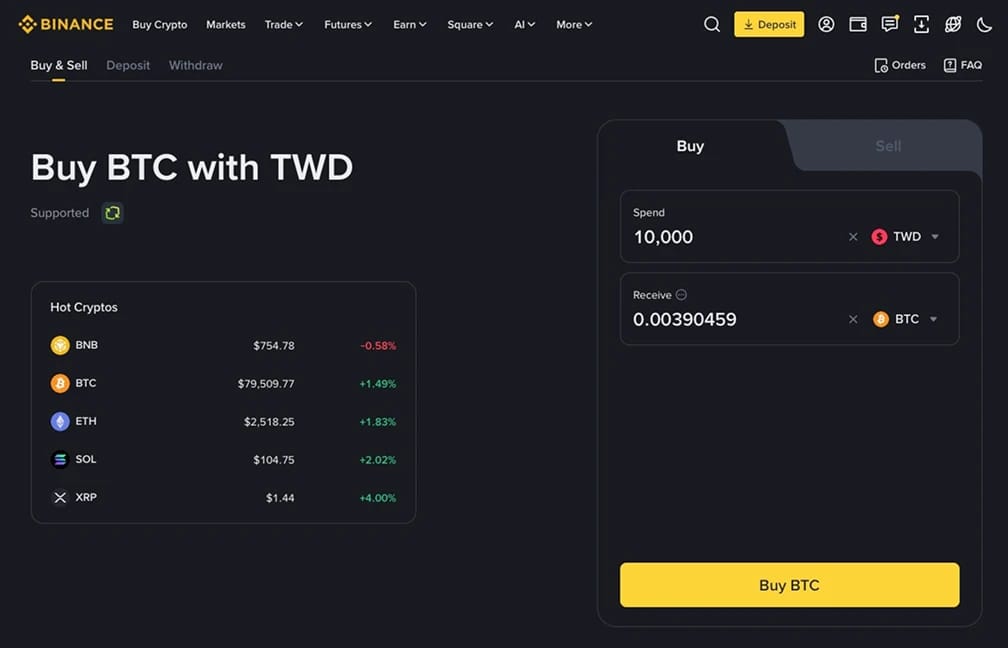
Binance is our recommended option for large orders and copy trading as their order books are the deepest available to Taiwanese accounts. More than 500 spot coins trade at 0.1%, with a reduction of a quarter when fees are paid in BNB. Margin, perpetual futures, auto-invest, and Binance Earn share one balance in a Traditional Chinese interface. Native customer support is also available 24/7.
Binance offers the broadest TWD funding menu of the offshore platforms. The Buy with TWD screen lists bank transfer, card, and Apple Pay, and our bank transfer was credited within the hour. Because Binance holds no FSC registration, TWD does not sit in a Taiwanese bank trust account the way it does at MAX or BitoPro. Card purchases carry processor charges, and some Taiwanese issuers decline them, so we use bank transfer.
In August 2026, the VASP Association placed Binance on its warning list for operating without FSC registration, which bars it from soliciting Taiwanese customers. Its years of cooperation with Taiwanese prosecutors on fund recovery do not replace registration. A monthly reserve attestation and the SAFU insurance fund provide offsetting protections, covered in our Binance review.
Pros
- The ranking's deepest BTC and ETH order books reduce slippage for copy trading and large orders.
- Paying in BNB lowers the 0.1% spot fee to 0.075%. Futures makers pay 0.02%.
- The SAFU insurance fund and a monthly reserve attestation protect a user base of over 320 million.
Cons
- Binance holds no FSC registration and was added to the Taiwan VASP Association warning list on August 10, 2026.
- We do not rely on its TWD P2P desk for funding because merchants operate outside the registered system.
- The 2023 settlement with US authorities remains crypto's costliest compliance case.
4. BitoPro
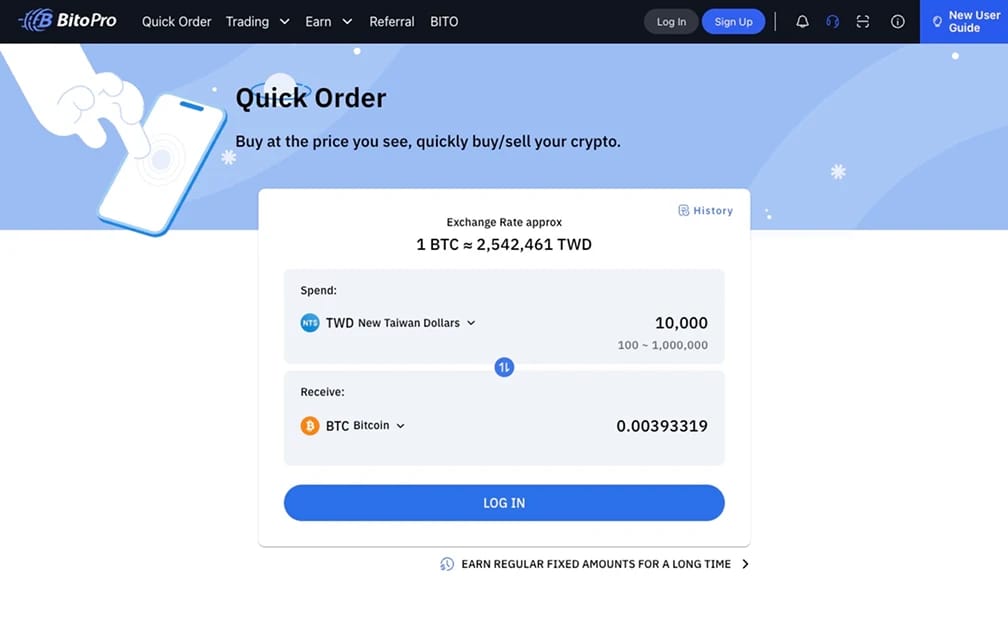
BitoPro is our fourth pick and the second FSC-registered TWD platform in this ranking. Its custody policy keeps at least 85% of crypto in cold storage, with customer TWD held in trust at Far Eastern International Bank. The company holds ISO 27001 certification. BitoDebt pays fixed interest on stablecoin lending, while grid bots charge a flat 0.05%. Users can also schedule recurring purchases.
Only BitoPro among the ranked platforms accepts US dollar deposits through a dedicated Bankee account. Conversion to USDT runs around the clock at a fixed one-to-one rate, allowing residents holding dollars from overseas income to avoid converting to TWD first. Base spot fees are 0.1% for makers and 0.2% for takers, reduced by 20% when paid in BITO.
On May 8, 2025, attackers drained about $11 million from an old hot wallet during a BitoPro system upgrade. BitoPro used its own reserves to replenish the wallets, and no customer lost funds. It confirmed the breach only on June 2, after an independent investigator published the evidence, and later attributed the attack to North Korea's Lazarus Group. The company has since completed FSC registration and joined KGI Bank's custody pilot.
Pros
- BitoPro operates inside Taiwan's supervised system with FSC registration, a bank trust account for TWD, and ISO 27001 certification.
- Bankee USD deposits convert to USDT at a fixed rate. No other ranked exchange offers this service.
- Grid bots, recurring purchases, and BitoDebt lending provide tools MAX lacks.
Cons
- Disclosure of the May 2025 hot wallet theft came three weeks late, a mark against its transparency.
- About 20 listed coins restrict the selection to major assets and stablecoins.
- For the first month after verification, new accounts have a NT$100,000 daily deposit cap.
5. Gate
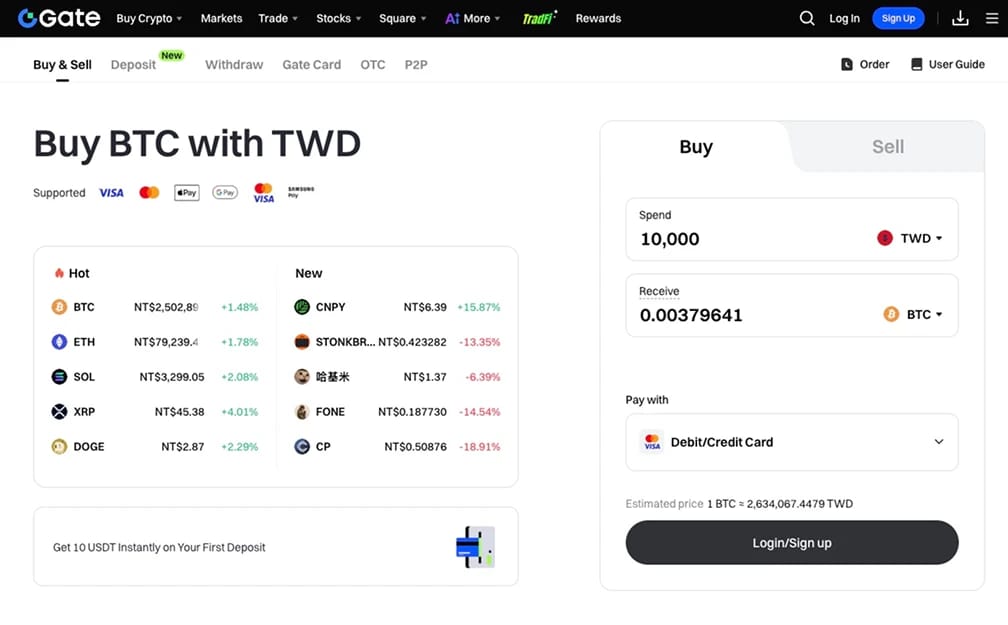
Gate takes fifth place for asset selection, with more than 4,800 cryptocurrencies. Some of its new tokens reach MAX or BitoPro months later, if they arrive at all. One Traditional Chinese account covers perpetuals, options, copy portfolios, bots, lending, and Simple Earn. Its August 19, 2026 reserve report disclosed $8.215 billion of reserves against customer balances, a 127% ratio, placing Gate among the more transparent offshore venues.
An April 2026 fee restructuring set base spot fees at 0.2% for both makers and takers, double the rate on Bybit or Binance. Holding GT or reaching volume tiers reduces the charge, but an occasional buyer pays the full amount. Gate accepts card purchases through processors but has no TWD bank deposits. USDT bought on MAX is the practical way to fund an account with minimal fees.
Gate appeared on the VASP Association warning list before Binance was added. Its thousands of listings include many weak projects, leaving traders responsible for due diligence on smaller tokens. We use Gate as a second account for tokens that larger exchanges have not listed, as explained in our Gate review.
Pros
- Gate's catalog is the broadest of the six platforms, with more than 4,800 listed cryptocurrencies.
- The August 2026 attestation showed $8.215 billion in reserves, covering customer balances at 127%.
- Derivatives, copy portfolios, and Simple Earn provide products well beyond spot trading.
Cons
- Entry-level spot trading costs 0.2%, double the Bybit and Binance rate.
- Gate holds no FSC registration and appears on the VASP Association warning list.
- Wide spreads in long-tail markets can cost more than the trading fee.
6. Bitget
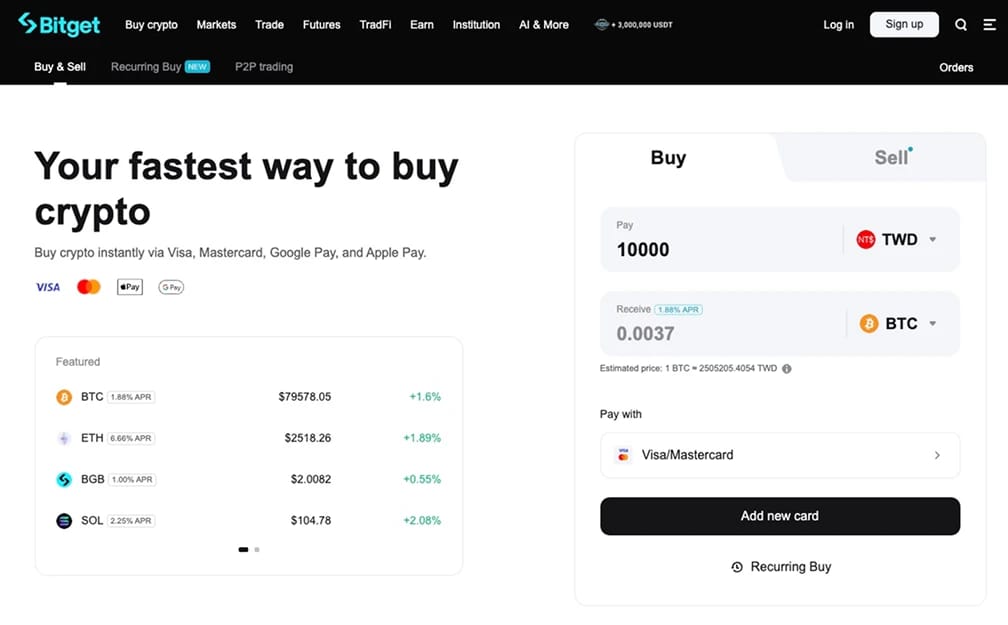
Bitget is our top pick for Taiwanese traders who prefer following a lead trader to managing their own positions. Before allocating money, users can review each trader's past performance, maximum drawdown, and risk grade. Allocation caps limit the amount one strategy can control. Copy trading covers spot, futures, and bots, and the exchange lists more than 800 cryptocurrencies with a 0.1% spot fee.
Bitget's disclosures are stronger than those of most derivatives platforms. It has published reserve attestations every month since December 2022, including coverage of 169% in the February 2026 edition. The Protection Fund has a pledged minimum of $300 million and stayed above $400 million during 2026. Tokenized stocks and gold, priced in USDT, are available alongside crypto.
Funding and status carry caveats. Bitget accepts TWD by card and Google Pay only, both through processors that add a markup, so a USDT transfer from MAX or BitoPro is the cheaper entry for larger sums. Bitget is on the warning list without FSC registration. The main screen prominently advertises leverage up to 125x, making it a poor first exchange for a cautious beginner. Our Bitget review explains the copy trading engine in depth.
Pros
- Copy trading is the core product, supported by transparent lead trader statistics and allocation controls.
- Its safety claims rest on 169% coverage in the February 2026 attestation and a Protection Fund exceeding $400 million.
- The same USDT balance can fund trades in crypto, tokenized stocks, and gold.
Cons
- Following a lead trader means inheriting their leverage settings, so drawdowns can be steep.
- Merchant depth on TWD P2P is thin, and Bitget holds no FSC registration.
- Prominent high-leverage products make it unsuitable as a first account.
How to Choose a Crypto Exchange in Taiwan
Of the six ranked platforms, two are FSC-registered, and four are offshore exchanges on the association's warning list. That divide shapes each decision. We make five checks before depositing:
- Check the FSC register first: The Securities and Futures Bureau's list of registered providers currently names HOYA BIT, ZONE Wallet, KryptoGO, MAX, TWEX, Chainss, BitoPro, and XREX. Any platform accepting TWD transfers belongs on it.
- Decide how TWD will enter and leave: Registered platforms hold TWD from a verified bank account in a trust account at a Taiwanese bank. Offshore platforms take TWD by card, mobile wallet, P2P, or, at Binance, bank transfer, but without that trust protection.
- Price the full deposit, trading, and withdrawal cycle: A 0.1% Bybit spot fee is only part of the cost. Buying USDT on MAX adds a 0.16% taker fee, plus a network withdrawal charge and the reverse trip on exit. Processor card purchases added 3% to 5% in our tests.
- Verify bank limits before a large deposit: Taiwanese banks cap non-designated online transfers at NT$30,000 per transaction. Designating the exchange trust account raises the limit, although some banks refuse crypto platforms. BitoPro also caps new accounts at NT$100,000 a day for 31 days after verification.
- Test a short round trip first: Deposit a modest amount and buy USDT. Send it to the offshore platform, trade, then withdraw to your bank. This test exposes name mismatches, withdrawal reviews, and bank holds while sums are small.
Crypto and Bitcoin Regulation in Taiwan
Taiwanese residents may legally own and trade cryptocurrency, with the FSC as the designated regulator since 2023. In three years, the framework has moved from guidelines through registration to licensing:
- September 2023: Ten guiding principles published by the FSC covered segregated customer assets and listing review. The regulator also stated that unregistered offshore platforms could not solicit Taiwanese customers.
- November 30, 2024: Amendments to Article 6 of the Money Laundering Control Act took effect. All crypto service providers must complete FSC AML registration. Foreign providers must first establish a Taiwanese company or branch.
- September 22, 2025: The FSC published its first registered provider list, with nine companies qualifying and eighteen applicants excluded. ACE Exchange, once among Taiwan's largest platforms, had already been removed after its founders were indicted for fraud. HzBit's later withdrawal left eight.
- February 5, 2026: KGI Bank launched Taiwan's first bank custody pilot for crypto assets, involving five registered platforms and insurance cover. By April, the FSC had approved five banks for custody trials, including CTBC, Cathay United, Taishin, and Union Bank.
- June 30, 2026: The Legislative Yuan passed the Virtual Asset Service Act. The 56-article statute requires FSC permission for exchange, trading platform, transfer, custody, underwriting, and lending providers. It sets minimum capital and guarantee deposits, with unlicensed operation punishable by up to seven years in prison and a NT$100 million fine. Registered providers have 12 months from commencement to apply and 21 months to obtain a license.
- August 2026: Binance was added to the VASP Association warning list on August 10. Three days later, the FSC opened consultation on Travel Rule amendments requiring sender and recipient details on transfers above NT$30,000. These are expected to apply between registered providers from October 2026 and to cross-border transfers by the end of 2027.
The FSC is drafting nine subordinate regulations before commencement. Registration remains the operative rule until the Act takes effect, and only the eight registered platforms lawfully handle TWD.
.webp)
How Does the Ministry of Finance Tax Crypto?
Taiwan has no dedicated crypto tax statute, so the Ministry of Finance applies the Income Tax Act. In January 2025, it told the Legislative Yuan that individual trading profits fall under Article 14 as property transaction income. Four points matter for residents:
- Profits are added to comprehensive income: Calculate a gain by subtracting acquisition cost and related expenses from sale proceeds. For 2026 income, the progressive brackets begin at 5% on net income up to NT$610,000, rise through 12%, 20%, and 30%, and reach 40% above NT$5,190,000. Returns are filed in May 2027.
- Offshore gains may count as overseas income: Taiwan taxes individuals on a territorial basis. Profits realized on an offshore exchange are therefore commonly reported as overseas income under the Income Basic Tax. Overseas income below NT$1 million is disregarded. The 20% basic tax applies only when total basic income exceeds NT$7.5 million.
- Frequent trading can become business income: Regular, organized trading may qualify as a profit-seeking activity. Companies pay 20% enterprise income tax, while business sales of crypto assets carry 5% business tax.
- Records matter more from 2026: Registered exchanges must retain transaction records. The Travel Rule amendments add identity data to transfers above NT$30,000, and electronic invoices for fees from MAX and BitoPro document acquisition cost.
This is general information rather than tax advice. Anyone with meaningful gains should retain dated TWD valuations for each trade and check the classification with a Taiwanese tax adviser.
.webp)
Cryptocurrency Adoption in Taiwan
Crypto ownership is modest across Taiwan's population, but investors hold substantial amounts. Triple-A estimates about 568,000 Taiwanese owners, close to 2.4% of the population, placing Taiwan around 51st worldwide.
A survey of investors by Far Eastern International Bank's Bankee and BlockTempo for the 2025 Taiwan Crypto Industry Report found that 62.7% held crypto and 82.7% were in profit. Of those surveyed, 30% had committed more than NT$1 million.
Statista projects Taiwan's digital assets segment to grow 7.74% annually from 2024, reaching US$3.39 billion by 2028. Assets under management were roughly US$1 billion at the start of that period. MAX and BitoPro each report more than one million members, while BitoPro's USDT/TWD pair alone often clears $8 million a day.
.webp)
How to Buy Bitcoin in Taiwan
The reliable route uses a registered exchange for TWD and the spot order book for pricing. A transfer to an offshore platform is optional for products local exchanges lack. With documents ready, the process takes under an hour:
- Open a registered TWD exchange account: We recommend MAX for the deepest USDT/TWD market. BitoPro suits users who want grid bots, recurring purchases, or USD deposits. Both require a Taiwanese ID or Alien Resident Certificate, a local mobile number, and a bank account in the same name.
- Complete Level 2 verification and bank binding: Submit your ID and complete the selfie check, then verify the bank account with a small transfer. TWD deposits are accepted only from that account.
- Deposit TWD by bank transfer: Use online banking or an ATM, not a payment app or counter deposit. Transfers to Far Eastern International Bank arrive within minutes during banking hours. For larger amounts, the trust account must be set as a designated payee.
- Place a limit order on the order book: Buy BTC/TWD directly, or USDT/TWD if the coins will move to Bybit or Binance. Let a resting limit order earn the maker rate. Skip the one-click screen, where the spread is built into the quote.
- Transfer or store the coins: Check that the address and network match before sending USDT to an offshore exchange over a low-cost network such as Arbitrum. Store long-term Bitcoin holdings in a wallet whose keys you control. Our best crypto wallets article compares hardware devices.
To cash out, reverse the process. Move USDT to MAX or BitoPro and sell it for TWD on the order book, then withdraw to the verified bank account. Requests made before 1 pm on a business day settle that afternoon.
Final Thoughts
Bybit ranks first for its 0.1% flat fee and 2,600-coin catalog, with full Traditional Chinese support. MAX is the registered platform we rely on for TWD banking. BitoPro adds USD deposits and grid bots within the same supervised system, while Binance provides the deepest liquidity. Gate and Bitget are secondary accounts for altcoin and copy trading strategies.
Regulation changed faster in 2026 than at any point since the FSC took charge. The Virtual Asset Service Act moves Taiwan from registration to licensing. The industry association has placed every major offshore exchange on its warning list, and the Travel Rule reaches domestic transfers from October. Holding an offshore account remains legal for an individual.
Investor discipline matters more than platform choice. Use a registered exchange for funding and limit orders for trading. Keep TWD valuations for tax, and move long-term holdings into self-custody. Nearby markets face similar shifts, covered in our best crypto exchanges in Japan and best crypto exchanges in Hong Kong rankings.
Our Methodology
We evaluated exchanges as a Taiwanese resident would in August 2026, after the Act passed but before commencement. Six criteria determined the ranking:
- Trust score: The score out of 5 considers security history, reserve reporting, and regulatory standing in Taiwan and abroad, along with how past incidents were handled.
- Registration status: We checked each platform against the FSC register and the VASP Association warning list on the publication date.
- TWD funding in practice: Testing included deposits from a Taiwanese bank account where accepted, settlement timing, and offshore card and P2P alternatives.
- Full-cycle cost: We calculated the cost of a TWD-funded Bitcoin purchase using the local exchange fee, network withdrawal charge, offshore trading fee, and return trip.
- Product depth: Markets, order types, bots, copy trading, Earn products, and derivatives available to a Taiwan-registered account.
- Local relevance: Traditional Chinese interface quality, support hours in Taiwan time, bank trust arrangements, and participation in bank custody pilots.
Testing ended at the close of August 2026. Before publication, we verified every regulatory and tax statement against FSC, Ministry of Finance, or Legislative Yuan sources. Our editorial methodology describes the full process.
.webp)