







Compare Top Thai Crypto Exchanges
1. Binance TH
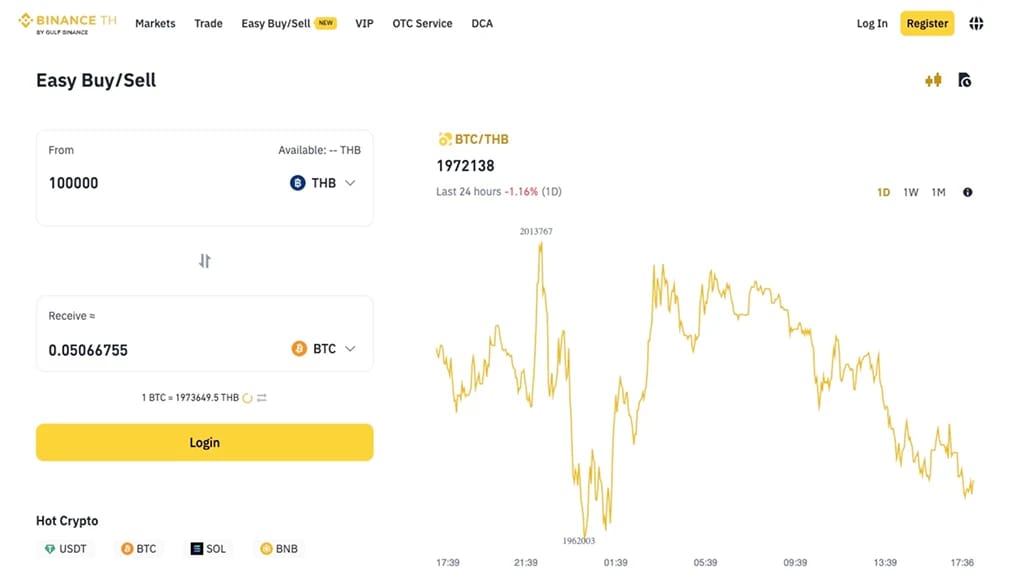
Binance TH is the best overall because it brings Binance's engine inside Thai rules. Run as Gulf Binance, a joint venture with Gulf Energy launched in early 2024, it holds an SEC license, takes baht by PromptPay and bank transfer, and puts the global matching engine and a broad SEC-approved list behind a local account. Spot fees start at around 0.1%, below the 0.25% that most local platforms charge.
In testing, the app felt closer to Binance's global app than to a stripped-back local build, with Earn and deeper liquidity than local exchanges. The catalog is a curated slice of Binance's global list, since every token needs SEC clearance, and the interface assumes more comfort than a first-timer may have. The user interface is accessible in both Thai and English. The wider platform sits in our Binance review.
Gains realized here qualify for the SEC-licensed tax exemption, and Binance TH is one of the venues in the TouristDigiPay trial, so it sits at the center of Thailand's regulated push. One caveat for newcomers is that Binance TH is a separate, Thai-licensed login from global Binance with its own KYC, so you onboard as a local rather than carry a global account across.
Pros
- Binance's order book and tooling are licensed by the Thai SEC via Gulf Binance.
- Spot fees are around 0.1%, the lowest among the platforms here.
- PromptPay and bank-transfer deposits, plus Earn for idle balances.
Cons
- The Thai catalog is a curated, SEC-approved slice of global Binance.
- The interface leans advanced for a first buy.
- Local THB banking links are newer than Bitkub's.
2. Bitkub
Bitkub is where most of the country trades, and that depth carries real weight for a local. It runs the deepest THB books on the licensed side, so a market order on BTC or ETH fills tight against THB without the spread you eat through a stablecoin first. Funding by PromptPay, the baht landed in seconds at no cost, and a Kasikornbank transfer cleared the same day.
It is spot only, with around 250 assets paired against the baht, and holds client funds with BitGo and Coinbase Custody. New Thai accounts pass a short financial-literacy quiz and the 7-Eleven dip-chip ID check, the same gate every licensed venue here uses. The KUB token trims fees for frequent traders.
Local trust is the other draw. Bitkub carries full Thai-language support and 24-hour service, joined the TouristDigiPay trial, and its gains qualify for the tax exemption, which together make it the default first account for most Thais. The KUB token also plugs into Bitkub Chain for anyone who wants an on-chain ecosystem beyond spot.
Pros
- Deepest THB liquidity in the country, so baht pairs fill tight without a stablecoin step.
- Free PromptPay and bank-transfer deposits that settle in minutes.
- SEC-licensed, with BitGo and Coinbase Custody holding client assets.
Cons
- The 0.25% spot fee is higher than on Binance TH.
- There is only spot trading available, with no margin or futures.
- Past outages drew an SEC fine, so keep records during congestion.
.webp)
3. Orbix
Orbix is the safest first account for a beginner, mostly for those who own it. Formerly Satang Pro, it now sits inside Kasikornbank, one of Thailand's largest banks, putting real institutional weight behind a new user's funds. It lists around 50 major coins against the baht and keeps the buying screen simple.
Onboarding was the smoothest of the local set, helped by Wallet Lock, a two-stage unlock with a password and face check. Fiat deposits are free, and a THB withdrawal costs 20 baht. With roughly 50 tokens and a flat 0.25% fee, Orbix suits steady accumulation in the majors over chasing small caps and carries no leverage.
The Kasikornbank tie runs deeper than ownership. Orbix sits inside a wider KBank digital-asset group spanning the exchange, custody, and fund management, and a transfer from a KBank account lands cleanly, which reassures a first-timer wary of moving money into crypto. The reach stays modest, so pair it with a broader venue once you outgrow the majors.
Pros
- Owned by Kasikornbank, so a beginner's funds sit behind a major Thai bank.
- Clean onboarding with Wallet Lock and three ISO security certifications.
- Free baht deposits and a flat 0.25% trading fee.
Cons
- Around 50 assets, narrow next to Bitkub or Binance TH.
- No margin, futures, or advanced order types.
- A 20 baht fee on each THB withdrawal.
.webp)
4. Bitazza
Bitazza earns its place on access over size. It pairs a standard order book with an OTC desk for larger tickets and a cross-border ASEAN network, which suits a user sizing up past what a retail screen handles. Maker fees sit at 0.15% and taker fees at 0.25%, with no charge on crypto deposits.
Funding runs through bank transfer, card, and crypto, with KYC tiers setting daily withdrawal ceilings that lift sharply at the higher levels. The Freedom Visa card converts crypto to baht before you spend, a workaround for the ban on paying directly in crypto. The list is around 90 tokens and local depth thins off-peak.
The ASEAN angle is the differentiator. Bitazza links into a regional broker network rather than a single-country book and layers on an NFT marketplace, which suits a user who wants more than the majors while staying inside a Thai license. Liquidity on smaller pairs still trails Binance TH and Bitkub, so size larger orders through the OTC desk.
Pros
- OTC desk and tiered limits that handle larger orders than a retail screen.
- Maker fees at 0.15%, below the flat 0.25% most local venues charge.
- ASEAN network and a Freedom Visa card for converting crypto to baht.
Cons
- Around 90 assets, behind Bitkub and Binance TH.
- Local order-book depth thins outside peak hours.
- Higher withdrawal ceilings require the upper KYC tiers.
.webp)
5. Upbit Thailand
Upbit Thailand is the cleanest app for buying and holding without clutter. A local arm of Korea's Upbit, it leans mobile-first, with lock-screen prices and custom alerts that make watching a position simple. It lists roughly 160 assets across its baht markets at around 0.25%.
We rate it for polish over depth. The buying screen is among the most readable here, and 24-hour monitoring with real-time alerts helps a new holder track moves without living in the app. It lacks the liquidity and spread of Bitkub or Binance TH, and the flat fee gives ground to Binance TH on cost.
Backing gives it weight beyond the app. Upbit Thailand runs as a venture between Korea's Upbit, one of Asia's largest exchanges, and local Thai partners, which brings a tested platform and security record to a clean local build. It fits a first-time buyer who values a simple, reliable screen over the deepest order book or the longest asset list.
Pros
- Mobile-first design with lock-screen prices and custom alerts.
- Backed by Korea's Upbit, with SEC licensing and clean baht onboarding.
- Around 160 assets to trade, which is enough for most retail buyers.
Cons
- Liquidity and spread trail Bitkub and Binance TH.
- The 0.25% fee sits above Binance TH.
- Spot only, with no advanced trading tools.
.webp)
6. KuCoin TH
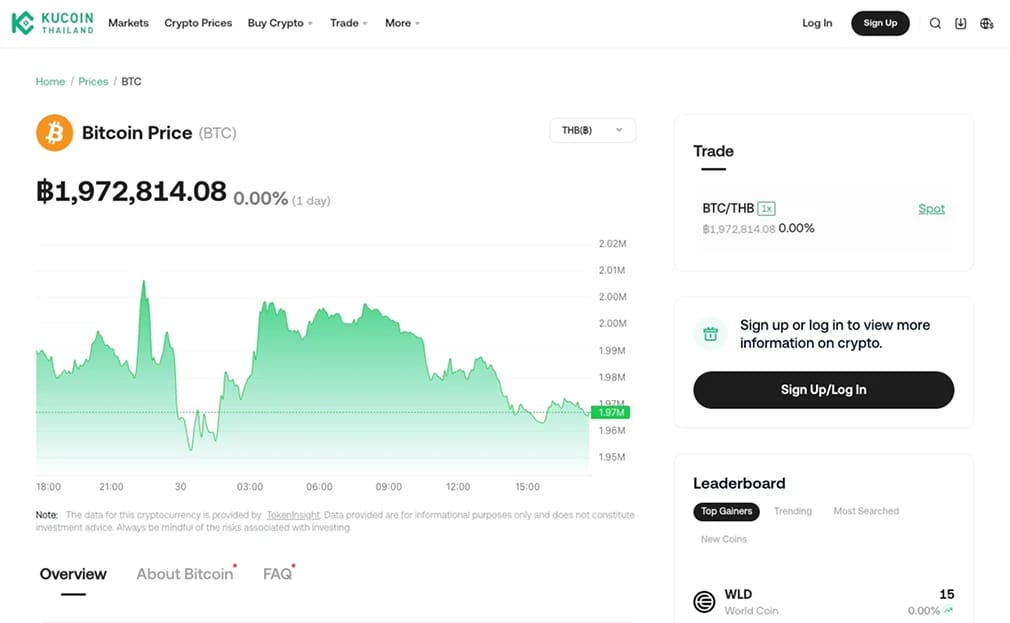
KuCoin TH is the licensed local arm of a major global brand, and we list it for awareness over use today. Operated by ERX, Thailand's first SEC-licensed digital token exchange, it rebranded under KuCoin in April 2025, carrying KuCoin's technology and its SOC 2 Type II and ISO 27001 certifications.
It sits last on the current status. The SEC suspended ERX in January 2026 when its capital fell short, and after extended deadlines, the company told customers to withdraw all assets and halted its system, with no confirmed restart. Even when live, the lineup was narrow at around eight assets.
The shortfall was traced to a shareholder dispute rather than a liquidity hole, and management has floated a pivot toward a digital-asset broker license once capital is restored. Until the SEC approves a restart, treat KuCoin TH as off-limits for funding and keep any remaining balance withdrawn to a live, licensed venue or to self-custody.
Pros
- Carries KuCoin's brand, technology, and SOC 2 Type II and ISO 27001 certifications.
- Built on ERX, Thailand's first SEC-licensed digital asset exchange.
- A possible re-entry for KuCoin users in 2026 if it reclears capital and SEC approval.
Cons
- SEC-suspended since January 2026 over a capital shortfall, with no confirmed restart.
- Customers were told to withdraw all assets, so it is not a venue to fund now.
- Even when active, the lineup was narrow, with roughly 8 assets.
How to Choose a Crypto Exchange in Thailand
The right platform depends on how you fund, how much you value the tax exemption, and whether a feature you need even exists onshore. Run these five checks before sending real baht.
- Confirm the venue is SEC-licensed and live: This is the first filter, not the last. Bybit, OKX, CoinEx, 1000X, and XT are blocked, and even a licensed operator can be suspended, as KuCoin TH was in 2026. Check it against the SEC's licensed list and confirm it is trading before funding.
- Match the on-ramp to your bank: Licensed platforms take PromptPay and transfers from Kasikornbank, Siam Commercial Bank, Bangkok Bank, and Krungthai, so funding is fast and free. PromptPay clears in seconds, while a bank transfer can lag during busy hours.
- Price the exemption in: Selling through a licensed exchange means zero personal income tax on the gain until the end of 2029. Trading offshore puts that gain back in the standard brackets, usually outweighing any fee savings abroad.
- Clear KYC against the right document: Thai nationals verify with a national ID and the 7-Eleven dip-chip step, while foreigners use a passport plus proof of address. Enter your name exactly as printed, since a mismatch is the usual cause of a stalled check.
- Decide whether you need leverage or breadth: Licensed Thai exchanges are spot-only, so anyone wanting futures or a long tail of small caps has no fully compliant onshore option. Weigh that against the protection and tax treatment you give up offshore.
Crypto and Bitcoin Regulation in Thailand
Thailand runs one of Asia's more defined frameworks, built around licensing rather than tolerance. Owning and trading are legal through regulated venues; paying with crypto is not, and the SEC enforces the line.
- A licensing regime, actively policed: The Emergency Decree on Digital Asset Businesses 2018 requires any exchange, broker, or dealer serving Thai users to hold an SEC license granted by the Ministry of Finance. More than a dozen operators carry one, including Bitkub, Gulf Binance, Orbix, Upbit Thailand, and Bitazza.
- The offshore block is real: On 28 June 2025, the SEC and the Ministry of Digital Economy and Society blocked Bybit, OKX, CoinEx, 1000X, and XT for unlicensed operation, with charges filed through the Economic Crime Suppression Division. Reaching them now forfeits THB rails, tax relief, and recourse.
- Capital rules carry teeth: The SEC enforces ongoing capital requirements on licensed operators and suspended KuCoin TH's parent, ERX, in January 2026 when its capital fell short. Licensing is not a permanent guarantee, so check that a venue is still trading.
- Crypto is not a means of payment: The Bank of Thailand and the SEC barred businesses from accepting crypto for goods and services in April 2022. You can hold and trade freely, but settling a bill directly in crypto is off-limits.
- A tourist payment lane is in testing: The TouristDigiPay sandbox, an 18-month trial begun in late 2025, lets foreign visitors convert crypto to baht in a regulated e-wallet and spend it via QR code, with merchants paid only in baht. Bitkub and Binance TH are among the participants.
The practical takeaway is that holding and trading are legal and well-served onshore; the venues you should use are subject to the SEC; and the direction runs firmly toward licensed, baht-settled, taxed trading.
.webp)
How is Crypto Taxed in Thailand?
Thailand's tax setup is the strongest argument for staying licensed. A five-year exemption rewards onshore trading, while everything outside it falls back to standard rules.
- Zero tax on licensed gains until 2029: Under Ministerial Regulation No. 399, published in the Royal Gazette on 5 September 2025, profit from selling crypto through an SEC-licensed exchange, broker, or dealer carries no personal income tax for gains realized between 1 January 2025 and 31 December 2029.
- Offshore gains stay taxable: The exemption applies only to licensed Thai platforms. Sell on an unlicensed venue and the gain is assessable income at progressive rates that reach 35%, the financial heart of the case for trading onshore.
- No VAT on licensed trades: Transfers through licensed operators are exempt from value-added tax, a relief in place since April 2022, so a single trade is not charged twice.
- Not every reward qualifies: The exemption covers capital gains on disposal. Staking, mining, and airdrop income sit outside it pending Revenue Department guidance, so keep that activity in a separate account for clean reporting.
- Residency and remittance still matter: Anyone in Thailand for 180 days or more in a calendar year is a tax resident, and foreign-sourced income brought into the country can be assessable. Your home country may also tax the same gain, so coordinate the two.
Keep baht records of every disposal, its date, and the licensed platform it ran through, since the exemption depends on showing the trade went through an authorized operator. None of this is tax advice, and because the rules are new, confirm your position with a Thai tax adviser.
.webp)
Cryptocurrency Adoption in Thailand
Thailand ranks among the world's heaviest crypto users, driven less by currency fear than by a mobile-first population that treats digital assets as a mainstream investment.
- Top tier on the global index: Thailand ranks in the upper group of the 2025 Chainalysis Global Crypto Adoption Index, within an APAC region that saw on-chain value received grow 69% year on year, the fastest of any region.
- Broad ownership: Industry estimates put ownership at about a fifth of the population, among the highest rates in Southeast Asia, with a skew toward younger, app-native users.
- An investment culture, not a lifeboat: The baht is stable, so adoption runs on trading and saving in digital assets rather than escaping inflation, which is why Thailand built licensing and a tax exemption rather than leaving a grey market to grow.
The wider comparison sits on our crypto adoption statistics page. What stands out for Thailand is how far the formal framework has caught up with the user base, from licensed exchanges to a tax holiday to a tourist payment trial.
.webp)
How to Buy Bitcoin in Thailand
Buying BTC here is simpler than in most of Asia because a licensed exchange can transfer baht straight from your bank. Follow these steps to trade BTC in Thailand:
- Open a licensed exchange: Start with Binance TH or Bitkub, the two with the deepest baht liquidity. Both are SEC-licensed, so any gain you later realize through them qualifies for the tax exemption.
- Clear KYC with the right document: Thai nationals verify with a national ID and the 7-Eleven dip-chip step; foreigners with a passport and proof of address. Enter your name exactly as printed to avoid a stalled check.
- Fund baht by PromptPay or transfer: Scan the PromptPay QR in the app with your banking app for an instant, free deposit, or send a transfer from Bangkok Bank, Kasikornbank, or SCB. You can also start from a stablecoin using our buy USDT in Thailand guide.
- Buy BTC with a limit order: Skip the one-tap convert and place a limit order on the BTC/THB pair, which usually prices better than an instant market buy.
- Decide where the BTC lives: Active traders can leave it on the exchange. Long-term holders should withdraw to self-custody, checking the address and network first. Our best crypto wallets guide covers hardware and software options.
Selling reverses the path. Sell BTC for baht on a licensed exchange, withdraw to your Thai bank account, and record the disposal value and the platform for tax exemption purposes.
Final Thoughts
For most users in Thailand, start with Binance TH, which pairs Binance's engine and the lowest fees here with a Thai SEC license and baht funding. Bitkub is the call for the deepest local liquidity and the largest user base, Orbix suits a beginner who wants a bank-owned account, and Bitazza and Upbit Thailand round out the field on OTC access and app polish.
Watch the license, not the offshore noise. Bybit and OKX are blocked; the tax exemption only applies onshore; and the tourist payment trial aligns with the rules already in place. The cleanest setup is a licensed trading exchange, a baht rail through your own bank, and clear records for the exemption.
For the wider region, our guide to the best crypto exchanges in Asia covers the neighboring markets. Before committing real money, run a small loop. Buy a few hundred baht's worth of BTC, sell it back, and measure the round-trip cost at your bank. Ten minutes of testing beats any review, this one included.
Our Methodology
We evaluated the exchanges accessible from Thailand by opening accounts, completing KYC with a Thai ID and a passport, funding baht through PromptPay and bank transfer, trading, and withdrawing to a local account. Each platform scored across six criteria.
- Trust Score: Our proprietary rating out of 5, weighting SEC licensing and current standing, custody and reserve transparency, security history, platform longevity, and audit coverage. Licensed venues with audited custody scored highest, and a suspended operator is flagged rather than rated.
- THB Funding Methods: Confirmed PromptPay and bank-transfer support across major Thai banks, testing settlement speed, deposit minimums, and withdrawal fees.
- Regulatory Standing: Verified each platform's SEC license, current operating status, and eligibility for the 2025 to 2029 tax exemption, the dividing line between onshore and offshore here.
- Security Track Record: Reviewed breach history, custody setup, and protections like 2FA, withdrawal whitelists, and Wallet Lock-style controls.
- Assets and Liquidity: Placed market and limit orders on BTC/THB, ETH/THB, and at least one mid-cap pair to measure spread, depth, and fill quality.
- Fee Structure: Compare maker and taker fees, withdrawal charges, and the all-in cost of a baht-to-BTC round trip.
We excluded platforms blocked by the SEC and those with no functional baht funding path, and flagged any licensed operator currently suspended. Testing ran from April to June 2026.
.webp)