






Compare Top Ukrainian Crypto Exchanges
1. Bybit
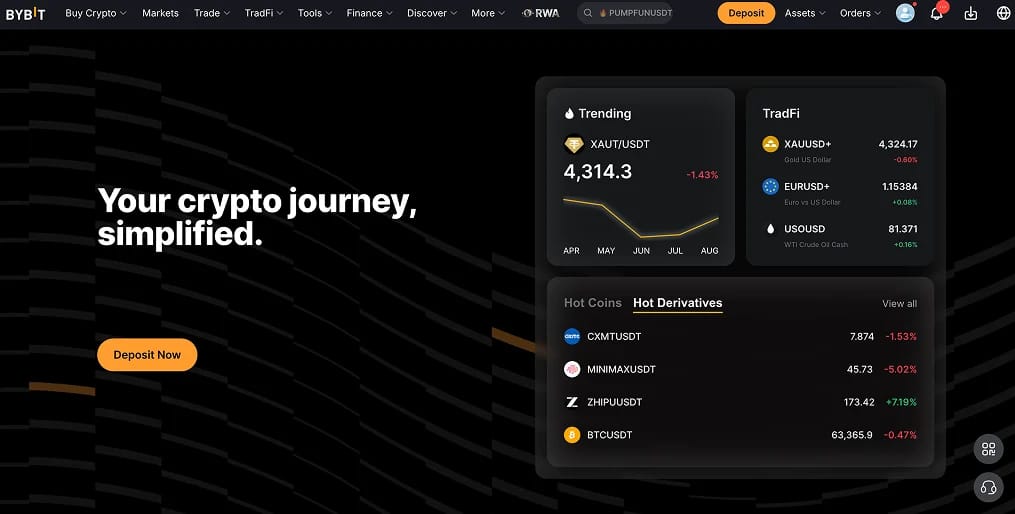
Bybit leads our Ukrainian rankings because P2P functions as a core product rather than an add-on. Its UAH order book was the deepest we tested, with sellers accepting transfers from Monobank, PrivatBank, PUMB, and A-Bank cards. Neither side pays a platform fee. In our Monobank tests, escrow cleared in under three minutes at rates within half a percent of the interbank dollar.
The exchange lists more than 2,600 assets and charges a flat 0.1% spot trading fee. Both the interface and live support are available in Ukrainian. A Unified Trading Account allows the same balance to collateralize spot and derivatives positions, while copy trading, grid bots, and the Earn suite cover most retail strategies. Proof-of-reserves attestations verified by Hacken are published regularly.
Attackers linked to North Korea's Lazarus Group drained approximately $1.5 billion of ETH from a Bybit cold wallet in February 2025, making it the largest exchange theft on record. Withdrawals remained open, no customers lost funds, and Bybit restored full 1:1 reserves within 72 hours using emergency funding. Our Bybit review examines the entire platform.
Pros
- Ukraine's deepest UAH P2P market, with escrow on every trade and no platform fees.
- A full Ukrainian-language interface with live customer support, which remains uncommon among global exchanges.
- More than 2,600 assets at a flat 0.1% spot fee, supported by Hacken-verified proof of reserves.
- Managed the February 2025 hack without customer losses or freezing withdrawals.
Cons
- Despite its recovery, the 2025 breach remains the largest theft in crypto history.
- Unavailable in the occupied territories of Crimea, Donetsk, and Luhansk.
- First-time buyers may find the range of Earn products, bots, and derivatives overwhelming.
2. Binance
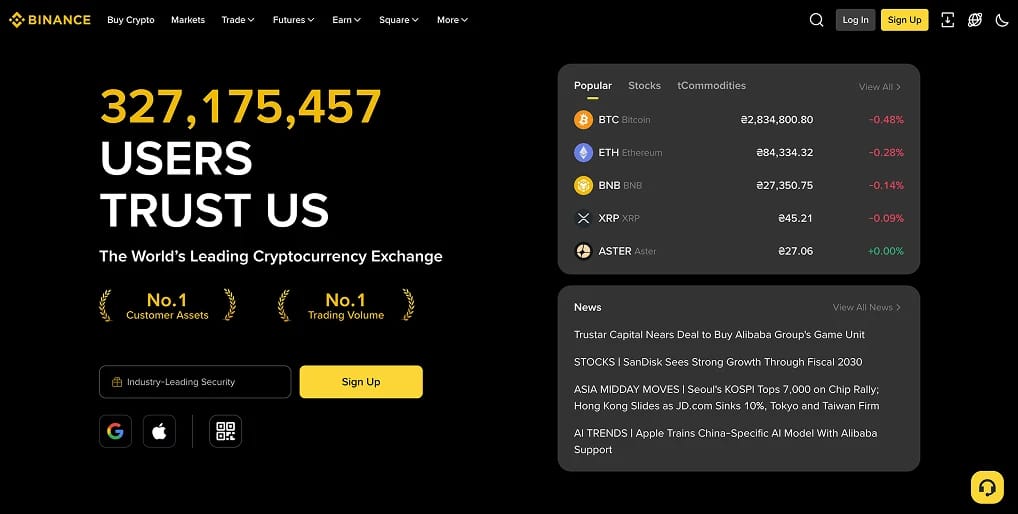
Binance takes second place because of its market depth. No rival absorbs large orders with less slippage. Spot trades cost 0.1%, falling to 0.075% when fees are paid in BNB, while the OTC desk can quote blocks that would move prices elsewhere. That depth is the main appeal for Ukrainian businesses paying suppliers in stablecoins and traders handling meaningful size.
Ukrainian retail chains such as the WOG fuel network and Varus supermarkets accept Binance Pay, allowing customers to spend exchange balances without using a card. Its UAH P2P market covers the same major banks as Bybit and offers nearly as much depth. Direct card deposits are less attractive because third-party provider fees can reach about 2.5%. The interface and 24/7 support line operate in Ukrainian, and users can complete Diia-based verification with an internal passport.
In 2023, the global entity reached a $4.3 billion settlement with the US Department of Justice over anti-money-laundering failures. Founder Changpeng Zhao later served a prison term. Binance has since undertaken an extensive compliance rebuild, and verification is now strict across its markets. Our Binance review covers that record in detail.
Pros
- The world's deepest crypto liquidity, plus an OTC desk suitable for Ukrainian businesses moving large amounts.
- Binance Pay is accepted by major Ukrainian retailers, including WOG and Varus.
- P2P support for the main Ukrainian banks, with spot fees of 0.1% or 0.075% when paid in BNB.
Cons
- Third-party providers charge approximately 2.5% for direct UAH card deposits.
- The 2023 DOJ settlement remains a significant part of Binance's global compliance record.
- Compliance pressure has previously caused abrupt product changes in other markets, and that risk remains relevant.
3. Gate
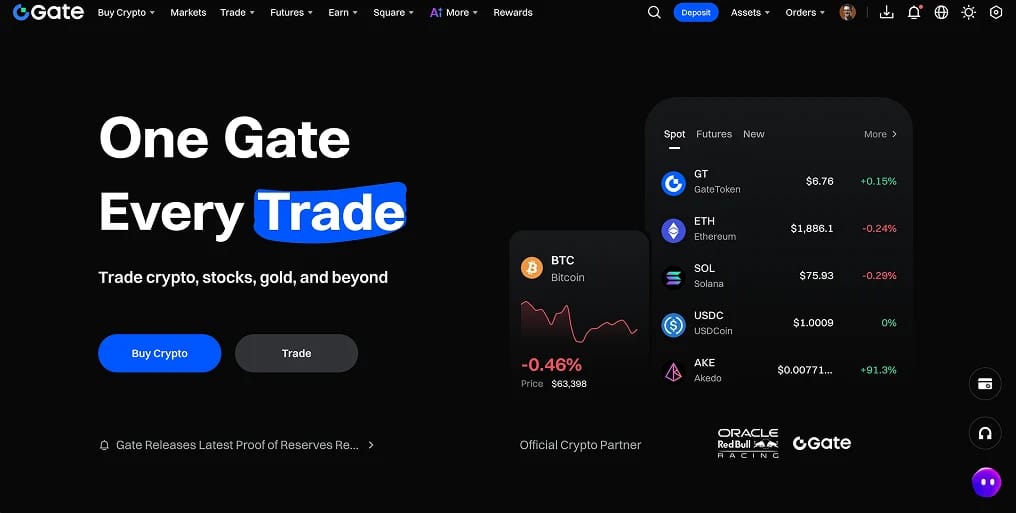
Gate ranks third because of its unmatched asset catalog. Ukrainian users can trade more than 4,400 cryptocurrencies, far more than on any other platform reviewed here. New tokens also tend to reach Gate months before appearing on Bybit or Binance.
Spot fees begin at 0.2% and decline through higher trading volume or GT token discounts. Gate also offers mature automated bots, copy trading, and HODL & Earn products across thousands of tokens. The exchange reports a 126% reserve ratio that users can verify on-chain through its proof-of-reserves dashboard. Its European entity holds a MiCA license issued through Malta's MFSA.
Liquidity is less consistent beyond the major assets. Market orders in low-cap tokens can lose several percent to thin books and wide spreads. The amount of data shown in the interface can also feel crowded on mobile, and Ukrainian localization is unavailable. Our Gate review assesses the full platform.
Pros
- More than 4,400 cryptocurrencies, the largest asset selection available to Ukrainian users.
- A 126% on-chain reserve ratio and a MiCA-licensed European entity.
- Established copy trading, bot, and earn products covering the broader catalog.
Cons
- Small-cap listings often have thin order books and wide spreads.
- A data-heavy interface that can feel cluttered, particularly in the mobile app.
- No Ukrainian-language interface or local-language support.
4. OKX
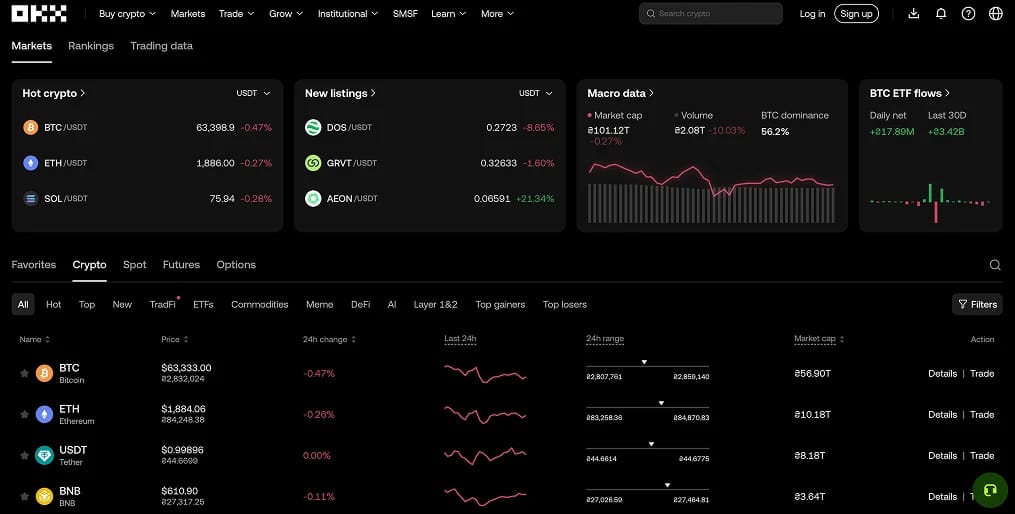
OKX suits Ukrainians who want to move beyond centralized exchange trading. Its integrated Web3 wallet supports more than 100 blockchains, while the DEX aggregator searches multiple venues for the best swap price. Users can move from a spot purchase into DeFi, NFTs, or airdrop farming without leaving the app. None of the other platforms on this list connects those functions as effectively.
At 0.08% maker and 0.10% taker, OKX has the lowest spot fees in this comparison. It has published monthly Merkle-tree proof-of-reserves disclosures since late 2022, and the European entity holds a MiCA license through Malta's MFSA. Ukrainians can fund accounts through P2P or card providers supporting Apple Pay and Google Pay. Its P2P order book is thinner than Bybit's, however, and competitive offers tend to disappear sooner.
Around 350 spot assets make the catalog mid-sized. The Web3 features also require more knowledge because self-custodial wallet mistakes cannot be reversed by a support desk. For traders seeking direct access to DeFi alongside a regulated exchange account, OKX provides the strongest package. Our OKX review explains it further.
Pros
- The lowest spot fees listed here, at 0.08% maker and 0.10% taker.
- An integrated Web3 wallet supporting 100+ chains, with built-in DEX aggregation.
- Monthly proof-of-reserves disclosures and a MiCA-licensed European entity.
Cons
- Fewer active sellers and less UAH P2P liquidity than Bybit or Binance.
- Roughly 350 spot assets, well below the catalogs offered by Gate and Bybit.
- Beginner errors in self-custody may leave no recovery option.
5. Kraken
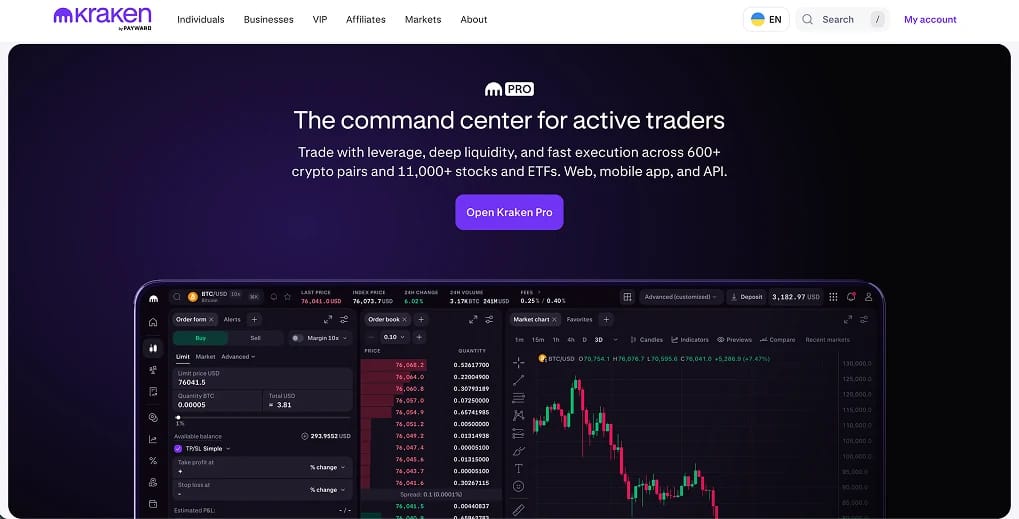
Kraken earns a place despite offering no hryvnia funding. The exchange has issued proof-of-reserves attestations since 2014 and has never lost customer funds through a platform breach. Its European arm is licensed under MiCA by the Central Bank of Ireland. For Ukrainians choosing where to keep substantial holdings, Kraken's security history is its defining feature.
Funding an account requires another route. Ukraine has no local Kraken P2P market or UAH trading pair, so users typically purchase USDT through Bybit or Binance before transferring it. Millions of Ukrainians living in the EU can instead deposit euros directly through SEPA. Once the account is funded, Kraken Pro provides access to roughly 600 assets at base fees of 0.25% maker and 0.40% taker. It offers staking for major assets and reliable order books for serious execution.
We view Kraken as the vault in a two-exchange setup. Use another platform where hryvnia can enter and leave easily, then hold or trade larger positions on the exchange with the longest security record. Kraken's Instant Buy widget costs around 1% plus spread, so the lower rates require the Pro interface. Our Kraken review provides more detail.
Pros
- Proof of reserves dating to 2014, with no customer funds lost to a platform breach.
- A MiCA license through the Central Bank of Ireland and SEPA funding for Ukrainians living in the EU.
- Deep, orderly books on Kraken Pro, with base fees of 0.25% maker and 0.40% taker.
Cons
- No UAH deposits, withdrawals, trading pairs, or P2P marketplace.
- Ukrainian-language support and interface options are unavailable.
- Instant Buy costs roughly three times the Pro rate.
6. KuCoin
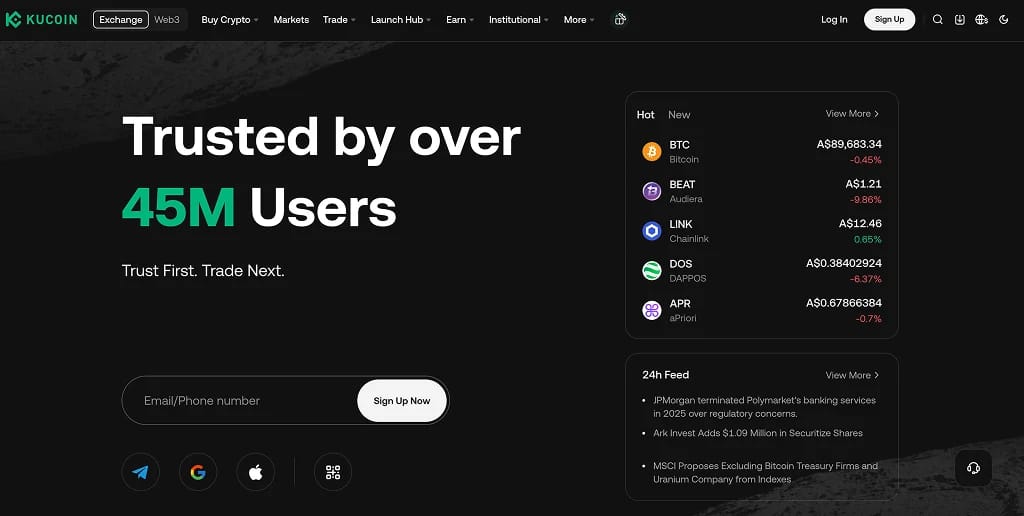
KuCoin completes the ranking as an exchange for altcoin traders. Its catalog exceeds 900 assets, with meme coins and niche projects often listed early. The built-in automation suite is the most capable in this comparison, offering free grid, DCA, and infinity grid bots. Using the native KCS token to pay fees reduces the standard 0.1% spot rate.
Operator Peken Global pleaded guilty in the US to running an unlicensed money transmitting business in January 2025. It paid nearly $300 million and withdrew from the American market. KuCoin has since rebuilt around regulation. In November 2025, its European arm received a MiCA license from Austria's FMA, which also licensed Bybit's EU entity.
Ukrainian users get a functional UAH P2P market and mandatory KYC, ending KuCoin's former reputation as a no-ID exchange. The interface can still lag during volatile market sessions. Our KuCoin review covers the platform end to end.
Pros
- More than 900 assets, including early listings for meme coins and niche projects.
- Free DCA, grid, and infinity grid bots, with KCS discounts on the 0.1% spot fee.
- A MiCA license issued by Austria's FMA in November 2025 supports its compliance rebuild.
Cons
- The January 2025 US guilty plea and nearly $300 million penalty remain recent.
- Many early-stage listings fade quickly and require extensive research.
- Performance can slow during periods of high volatility.
How to Choose a Crypto Exchange in Ukraine
Start by testing the exchange's P2P market. You should also understand your bank's transfer limits and maintain the records likely to be required under the tax regime being finalized by parliament.
- Test the UAH P2P market with a small order first: Begin with UAH 1,000 before committing a larger amount. Confirm that the exchange supports your bank and holds the crypto in escrow until payment arrives. The seller should release within minutes. A deep market will display dozens of offers priced within one percent of the dollar rate.
- Know your bank's monthly transfer ceiling: The banking transparency memorandum sets outgoing transfer limits of around UAH 100,000 per month for customers without confirmed income. PrivatBank applies that cap to P2P card transfers across all cards. Confirming income through the bank's app raises the ceiling.
- Understand what the NBU rules block: Resolution No. 18 classifies crypto purchases as quasi-cash. Payments from hryvnia accounts therefore fail, while foreign currency card purchases are capped at UAH 100,000 per month. This is the rule functioning as intended. Domestic P2P transfers between individuals remain the compliant route used by most Ukrainians.
- Weigh foreign licenses while Ukraine's regime is pending: Ukraine does not yet issue a domestic crypto license. Until it does, MiCA authorization is the closest proxy for supervised custody and segregated client funds. Bybit, OKX, Gate, Kraken, and KuCoin each hold one through an EU entity. We monitor these platforms in our guide to the best MiCA-licensed crypto exchanges.
- Keep records the coming tax law will demand: Bill 10225-d calculates tax from the net financial result in hryvnia. Export transaction CSVs and record the UAH value of every purchase. People holding coins purchased years ago should monitor the transitional period, which provides a preferential 5% rate for pre-existing holdings sold during the first year.
Crypto and Bitcoin Regulation in Ukraine
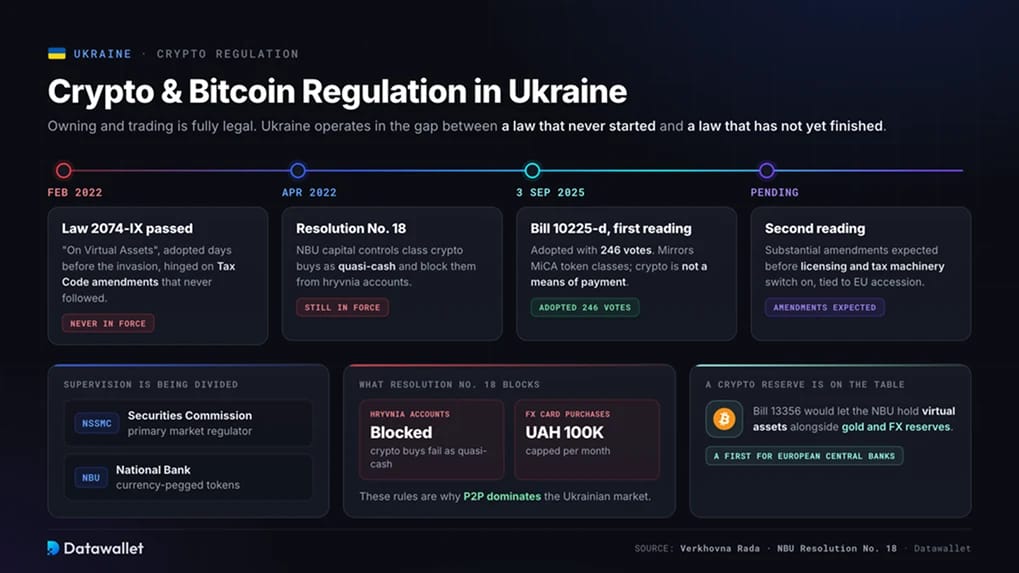
Crypto is legal to own and trade in Ukraine. The country is still operating between a law that never took effect and a replacement that has yet to be completed.
- The 2022 law never entered into force: Parliament passed Law No. 2074-IX "On Virtual Assets" in February 2022, days before the full-scale invasion. Its commencement depended on Tax Code amendments that never followed. Exchanges have since operated without a domestic licensing regime, serving Ukrainians under general civil and anti-money-laundering law.
- Bill 10225-d is the replacement: On 3 September 2025, the Verkhovna Rada adopted the bill at first reading with 246 votes. It classifies virtual assets as digital things under civil law and follows the EU's MiCA categories for asset-referenced tokens, e-money tokens, and other virtual assets. The bill also confirms that crypto is not a means of payment. A second reading remains pending, with substantial amendments expected.
- Supervision is being divided: Once the framework takes effect, the National Securities and Stock Market Commission is expected to become the primary market regulator. The National Bank of Ukraine will oversee currency-pegged tokens. Until then, virtual asset service providers are governed mainly by financial monitoring obligations.
- Martial law controls shape daily use: Under the NBU's Resolution No. 18 capital controls, crypto purchases are treated as quasi-cash. They are banned from hryvnia accounts, while foreign currency card purchases have a UAH 100,000 monthly cap. In force since April 2022, these rules explain why P2P dominates Ukraine's crypto market.
- A crypto reserve is on the table: Bill No. 13356, submitted in June 2025, would allow the NBU to hold virtual assets alongside gold and foreign currency reserves at its discretion. No other European central bank has taken such a step.
- The government is committed to the direction: Virtual asset legalization appears as a priority in the Cabinet's digital transformation plan. The plan connects this work to Ukraine's EU accession commitments and the implementation of MiCA-equivalent rules.
Buying and holding crypto remain permitted. The unresolved issue is when Ukraine's licensing and tax systems will begin operating. Every major platform serving the country is preparing for that change.
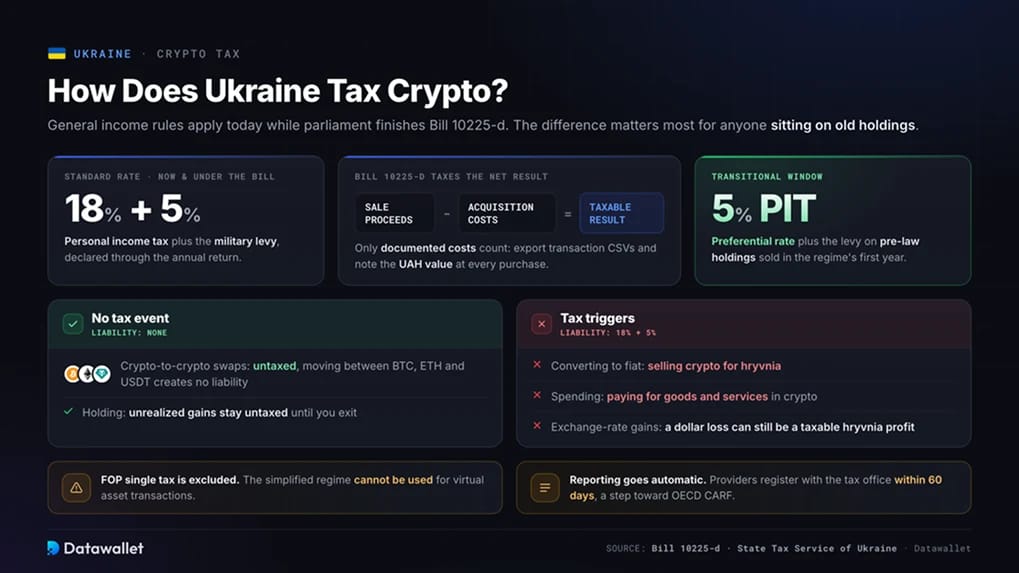
How Does Ukraine Tax Crypto?
General income tax rules currently apply to crypto gains while parliament completes a dedicated framework. The difference between the existing treatment and the proposed regime is particularly important for people with older holdings.
- Today, general rules apply: The State Tax Service treats crypto income under standard personal income taxation. Declared gains are subject to 18% personal income tax and a 5% military levy, reported through the annual return. Cost-basis treatment remains unclear without dedicated legislation, which the bill is designed to address.
- Bill 10225-d taxes the net result: The adopted first-reading text charges individuals 18% PIT plus the 5% military levy on their positive financial result for the year. That result is calculated by subtracting documented acquisition costs from sale proceeds.
- A transitional discount rewards early declaration: Crypto acquired before the law takes effect qualifies for a preferential 5% PIT rate, plus the military levy, when sold during the regime's first year. The original draft identified this period as calendar 2026. Using the window could reduce tax for holders of older portfolios.
- Crypto-to-crypto swaps stay untaxed: Liability arises when crypto is converted to fiat or spent on goods and services. Exchanges between BTC, ETH, and USDT do not create a taxable event by themselves.
- Exchange-rate differences count: Financial results are calculated in hryvnia. A position may therefore produce a taxable hryvnia gain even when its dollar value has fallen because of currency devaluation. This provision may catch more people than any other clause in the bill.
- Entrepreneurs on the single tax are excluded: Virtual asset transactions cannot use FOP status under the simplified system. This closes the lower-tax route many traders had expected to use.
- Reporting will reach the tax office automatically: Providers serving Ukrainian clients must register with the tax authorities within 60 days. This is an initial step toward the OECD's Crypto-Asset Reporting Framework and EU-style automatic exchange of account information.
This is not tax advice. Anyone with a large or complex position should consult a Ukrainian tax adviser before the second reading. Our guide to buying USDT in Ukraine explains the practical stablecoin process.
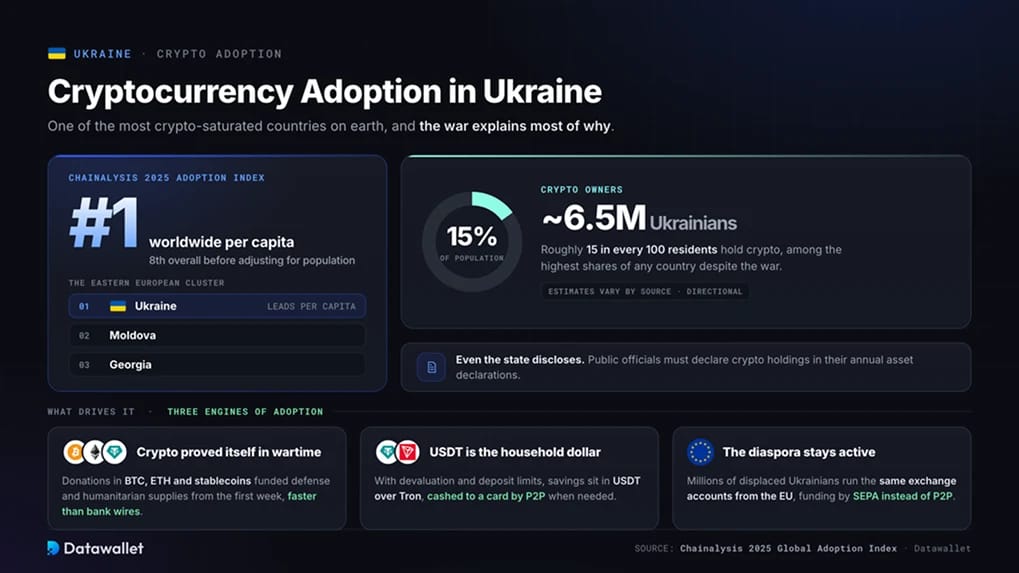
Cryptocurrency Adoption in Ukraine
Ukraine has one of the world's highest levels of crypto adoption, with the war accounting for much of its use.
- First in the world per capita: Ukraine places eighth overall in the Chainalysis 2025 Global Crypto Adoption Index and first worldwide after scores are adjusted for population. It ranks ahead of Moldova and Georgia within an Eastern European cluster that the report links to economic uncertainty, distrust of banks, and strong technical literacy.
- Millions of holders despite the war: Around 6.5 million Ukrainians, or roughly 15% of the population, are estimated to own crypto. That is among the highest ownership rates globally. Exact figures differ by source, so we consider these estimates directional.
- Stablecoins are the savings vehicle: Hryvnia devaluation and deposit limits have made USDT function like a household dollar account. Users often move it over Tron for lower fees, then cash out through P2P when they need money on a card. Our best USDT exchanges guide compares the platforms holding those balances.
- Crypto proved itself in wartime: From the first week of the full-scale invasion, donations in BTC, ETH, and stablecoins financed defense and humanitarian supplies faster than bank wires. Ukrainian public officials must also disclose crypto holdings in their annual asset declarations.
- The diaspora keeps accounts active abroad: Millions of displaced Ukrainians continue using the same exchange accounts from within the EU. Many now fund them through SEPA rather than P2P, creating considerable overlap with our guide to the best crypto exchanges in Europe.
Our crypto adoption statistics page provides global comparisons. Ukraine is distinctive because adoption continued to deepen while its banking system faced extraordinary strain.
How to Buy Bitcoin in Ukraine
The process of buying Bitcoin in Ukraine takes about twenty minutes from start to finish. Because card purchases usually fail under NBU rules, the most reliable method begins with a P2P stablecoin trade.
- Pick a platform with a real UAH P2P market: Choose Bybit for the deepest market and a Ukrainian interface, Binance for institutional liquidity, or OKX if you value the Web3 wallet. Before creating an account, check that your bank appears among the available P2P payment methods.
- Verify with your Ukrainian ID: Most platforms accept a biometric passport or internal ID card alongside a selfie, with approval usually taking a few minutes. Use exactly the same Latin spelling shown on your document. Name mismatches are the most common reason verification stalls.
- Buy USDT through P2P: Open the P2P section and filter offers by bank. Select a seller with a strong completion rate, then transfer the exact amount by card. Leave the payment comment empty because references to crypto may trigger financial monitoring by your bank. Once the payment arrives, the seller releases the USDT from escrow.
- Convert to Bitcoin with a limit order: Open the BTC/USDT spot market rather than using the instant-convert screen. Placing a limit order avoids the convert spread and generally saves around one percent on the purchase.
- Decide on custody and start a record: Active traders may keep assets on the exchange. Long-term holders should consider withdrawing to self-custody, with the main options compared in our best crypto wallets guide. Export transaction records as you trade because the proposed tax regime calculates hryvnia gains from documented acquisition costs.
To sell, follow the same steps in reverse. The hryvnia returns to your card through P2P escrow.
Final Thoughts
Bybit ranks first because of the factor that matters most in Ukraine: the speed and depth of its UAH P2P market. It combines that advantage with Ukrainian-language support, 0.1% spot fees, and a reserve system that endured the most severe test faced by any exchange. Binance remains the strongest liquidity venue for large orders. Gate has the broadest asset selection, while OKX provides the best connection to DeFi. Kraken serves as the security-focused vault, and KuCoin is built for altcoin traders.
Ukraine's improvised crypto market is moving toward formal regulation. Bill 10225-d proposes MiCA-style licensing, a tax of 18% plus 5% on net gains, and a one-year discounted period for older holdings. A separate proposal would permit the central bank to hold Bitcoin in its reserves. Exchanges already operating MiCA entities in the EU are best positioned for the framework that emerges from the second reading.
Before trusting any platform with a meaningful amount, complete a small round trip. Buy UAH 1,000 of USDT through P2P, convert it to BTC, sell it, then withdraw the hryvnia to your card. This test reveals the real spread, escrow speed, and your bank's response more clearly than any review, including ours.
Our Methodology
We created accounts with each exchange and verified them using Ukrainian documents. Testing included P2P card transfers from Monobank and PrivatBank, trades on live order books, timed escrow releases, and withdrawals back to hryvnia cards. Scores were based on six criteria. You can read the full breakdown of how we test and rank platforms in our editorial methodology.
- Trust Score: Our proprietary rating out of 5 considers regulatory standing, custody practices, reserve transparency, security history, longevity, and audit coverage.
- UAH Funding Quality: We assessed P2P depth and bank coverage across Monobank, PrivatBank, PUMB, and A-Bank. Testing also measured escrow release times, spreads against the interbank dollar rate, and card deposit costs.
- Regulatory Position: Our review verified foreign licenses, the MiCA status of European entities, and enforcement histories. We also assessed readiness for the licensing system proposed under Bill 10225-d.
- Security Track Record: We examined previous breaches and incident responses alongside cold storage practices. Proof-of-reserves frequency and verification were assessed separately, as were 2FA and withdrawal allowlisting.
- Assets and Liquidity: Tests included market and limit orders on BTC and ETH pairs, plus at least one mid-cap asset on each platform. We measured depth, spreads, and execution quality.
- Fee Structure: The comparison covered maker and taker schedules, deposit charges, and P2P spreads. We prioritized the total cost of completing a hryvnia round trip over advertised headline rates.
We excluded exchanges without a functional UAH route, platforms with unresolved sanctions exposure or continued service to Russian users in occupied territories, and venues that lacked verifiable reserves. Testing took place throughout the first half of the year. Regulatory statuses were checked again as the second reading of Bill 10225-d approached.
.webp)