


%201.svg)
Can I Bridge to Base?
Yes, and there are three different ways to do it. Exchange withdrawals send funds straight to a Base address, the official bridge contracts built into the network, called the canonical contracts, move assets from Ethereum under Ethereum's own security, and third-party cross-chain bridges cover everything else, from Arbitrum and BNB Chain to Base transfers through to non-EVM chains like Solana and Tron.
Before picking a bridge, check whether you need one at all. Coinbase supports direct withdrawals to Base for ETH, USDC, and dozens of other assets, and USDC withdrawals are free because Coinbase covers the network fee itself. If your funds already sit on the exchange, that beats every bridge on cost.
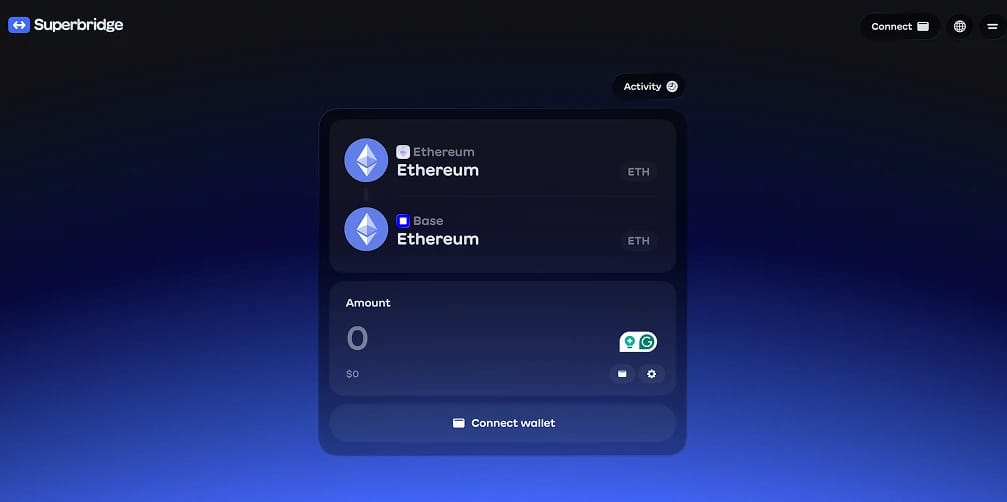
Coinbase has also retired the bridge.base.org interface. The official documentation now points users to independent operators such as Superbridge and Brid.gg for transfers over the canonical contracts, part of a shift away from Coinbase-run infrastructure.
How to Bridge to Base
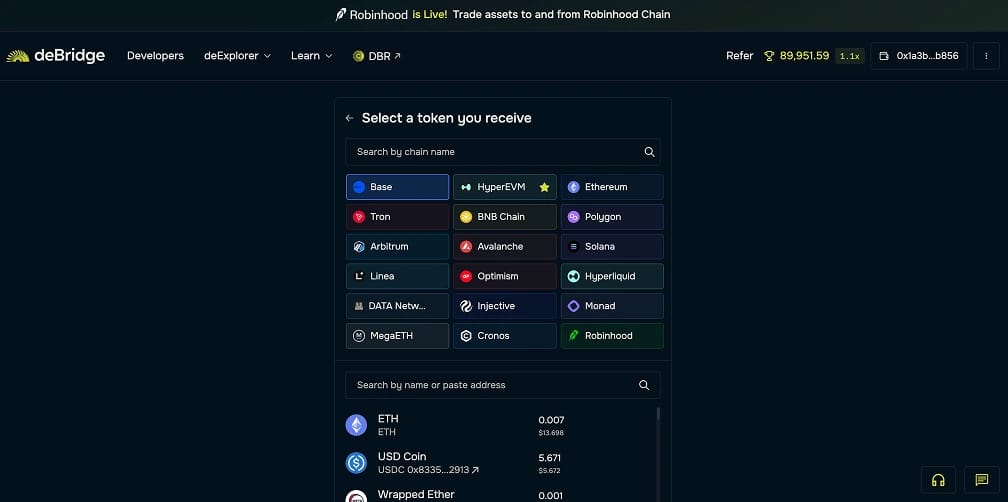
To bridge to Base, connect your wallet to deBridge, pick the chain your funds sit on, choose an asset, and confirm the transfer. Settlement takes seconds because market makers, called solvers, fill your order from their own funds at the exact rate you were quoted, and any order that goes unfilled cancels with every fee refunded.
Steps to bridge to Base with deBridge:
- Connect Your Wallet: Open deBridge and link MetaMask, Rabby, Phantom, or another supported wallet.
- Choose Chains and Asset: Select your source network, set Base as the destination, and pick a token. USDC and ETH offer the tightest pricing.
- Review and Approve: Check the quoted amount, fee, and arrival estimate, then sign the transaction in your wallet.
- Receive on Base: Solvers typically deliver funds within seconds. If Base is missing from your wallet, add it with our guide to adding Base to MetaMask.
What Are the Fees for Bridging to Base?
deBridge charges two fees on every order. The flat fee is paid in your source chain's gas token, currently 0.001 ETH from Ethereum, Base, or Arbitrum, and a 0.04% variable fee comes out of the amount you send.
Gas is the swing factor. A USDC transfer from Arbitrum or Optimism to Base lands for well under a dollar all-in, while starting from Ethereum mainnet can add several dollars during congestion, so check live gas prices before moving a large amount. Once your funds arrive, a simple transaction on Base costs a fraction of a cent, so bring a few dollars of ETH and it will cover gas for months.
Bridging USDC to Base
USDC is the dominant stablecoin on Base and has a transfer mechanism no other asset gets. Circle's Cross-Chain Transfer Protocol burns USDC on the source chain and mints fresh, Circle-issued USDC on Base, so nothing is wrapped and no liquidity pool sits in the middle. The second version added Fast Transfers that settle in seconds instead of waiting for the source chain to finalise.
You rarely interact with CCTP directly. Bridges and aggregators such as Across and deBridge tap it under the hood for larger USDC orders, since Circle can mint whatever was burned while a solver can only fill what its own inventory allows. On arrival, the token itself matters. Native USDC is what every major Base protocol wants, while USDbC is a legacy bridged version that keeps losing liquidity, so confirm which one your transfer delivers before lending or swapping it.
Best Base Bridges Compared
We compared the platforms we trust most for Base transfers on coverage, pricing, and settlement speed.
Base Bridging Risks
A few traps still catch bridgers out on Base, and each takes seconds to avoid:
- Wrong destination network: Base's chain ID is 8453. If your wallet shows anything else when you sign, stop, since funds sent on the wrong chain are difficult or impossible to recover.
- Exchange deposits that reject Base: Not every exchange accepts deposits on Base. Sending to a deposit address that only supports Ethereum can strand your funds, so confirm network support before withdrawing back out.
- Slow canonical exits: Leaving Base over the canonical contracts historically meant a seven-day challenge window. The Azul upgrade is cutting that to around a day as its proof system matures, but most users still exit through a third-party bridge for speed.
- Standing token approvals: Grant exact-amount approvals where possible and revoke permissions you no longer use, since a forgotten approval gives a compromised contract permanent access to that token.
How to Bridge to Base Sepolia Testnet
Developers can move test assets to Base Sepolia through Superbridge's testnet interface, which connects Ethereum Sepolia to Base's testing environment. Grab free Sepolia ETH from a faucet first, since the bridge needs it for gas and as the asset you transfer.
Base Sepolia mirrors mainnet behaviour, making it the right place to trial smart contracts, token transfers, and integrations before committing real funds.
About Base
Base is the Ethereum Layer 2 incubated by Coinbase, live since August 2023 and now securing around $11 billion in value according to L2Beat, which rates it a Stage 1 rollup, a status that means users can withdraw to Ethereum even if the operators disappear. It has no token of its own and gas is paid in ETH, though the team confirmed it is exploring one.
The network has been rebuilt under the hood. Base left the Optimism Superchain's shared release cycle and shipped Azul, its first independent upgrade, in May 2026. Azul pairs secure-hardware proofs with zero-knowledge proofs so that withdrawals to Ethereum can finalise in about a day instead of a week, and it aligns Base with the Osaka specifications from Ethereum's Fusaka upgrade. Flashblocks, live since mid-2025, publishes early confirmations every 200 milliseconds, so bridged funds become usable almost the moment they land.
What you bridge into is unusually deep for a Layer 2. Aerodrome anchors trading liquidity, Morpho runs the lending markets behind Coinbase's own USDC loan product, and Uniswap and Aave both run major deployments, so arriving stablecoins and ETH find somewhere productive to go immediately.
Final Thoughts
The best way to bridge to Base depends on where your funds start. Money on Coinbase should be withdrawn directly, since USDC moves free of charge. USDC on another chain travels safest over CCTP-powered platforms like Across. Everything else, from ETH on Arbitrum to SOL on Solana, is a job for deBridge, and only large Ethereum deposits that put security above speed justify the canonical contracts through Superbridge.
Whichever path you take, confirm chain ID 8453 before signing, send a small test amount on a first transfer, and check you received native USDC rather than USDbC. From there, using Base costs next to nothing.