







Can I Bridge to BNB Chain?
Yes, and there are two very different ways to do it. The first is a centralized exchange withdrawal, sending assets from an account like Binance straight to a BNB Chain wallet. The second is an onchain bridge, where a smart contract locks or burns your tokens on the source chain and mints the BEP-20 version on BNB Chain.
BNB Chain is EVM compatible, runs at chain ID 56, and uses BNB for gas, so any Ethereum wallet (MetaMask, Rabby, Trust Wallet) works with no extra setup. You only need a destination address and a funding source.
Here is what most guides miss: Binance runs on BNB Chain rails internally, so a BEP-20 withdrawal behaves like a native transfer, not a wrapped-asset bridge. You get the asset directly, in one block, without trusting a third-party contract. For most users, that is where I start.
The Safest Way to Bridge to BNB Chain
If you already hold assets on Binance, or you are buying in with fiat, withdrawing straight to BNB Chain is the shortest path. The exchange handles settlement, so there is no protocol fee, no slippage, and no clone-site risk.
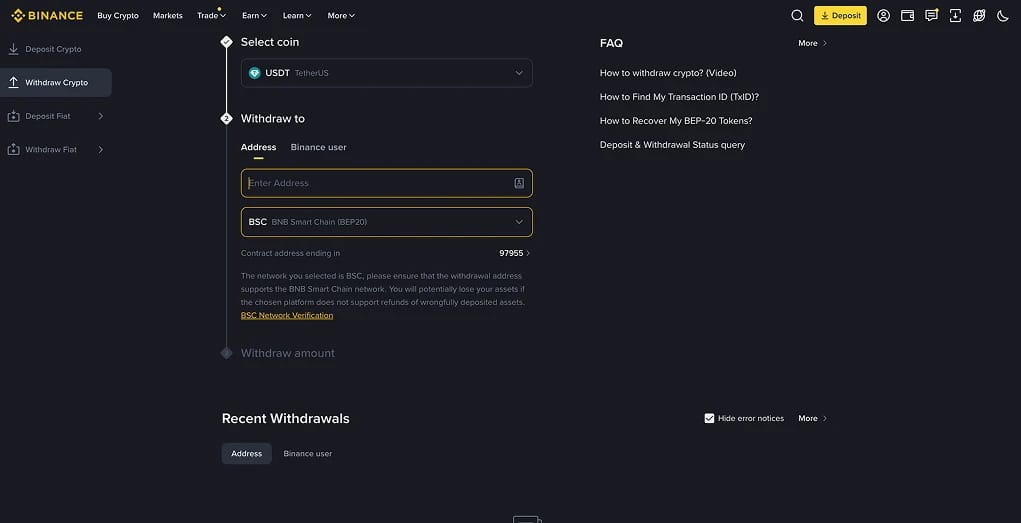
Steps to move assets from Binance to BNB Chain:
- Get your BNB Chain address: Open a BSC-compatible wallet like MetaMask or Trust Wallet, confirm BNB Smart Chain is selected, and copy your receiving address. The format matches Ethereum, so verify the network, not just the address.
- Open Binance withdrawals: Log in, go to Wallet then Withdraw, and pick your asset (BNB, USDT, USDC, and most major tokens are supported).
- Select the BEP-20 network: Paste your address, then choose BNB Smart Chain (BEP-20). This step matters most, since the wrong network is how people lose funds here.
- Enter the amount and review: Binance shows the fee and the exact amount arriving. I send a small $20 test the first time I use any new address.
- Confirm with 2FA: Approve with your two-factor device. Funds usually land in under a minute, with a confirmation email once processed.
For the official steps, see Binance's BEP-20 withdrawal guide.
BNB Chain Bridging Fees
Cost depends entirely on the path, and the gap is wider than people expect.
With the Binance withdrawal, you pay one per-asset fee: a flat 0.1 USDT for USDT, or a fraction of a cent in gas for BNB. There is no percentage cut, so the cost stays flat as your transfer grows.
An onchain bridge splits into three costs: source-chain gas, a protocol or liquidity-provider fee, and destination gas. Ethereum mainnet gas alone can run several dollars; from a Layer 2 it is usually under a dollar, and BNB Chain gas on arrival is negligible.
So the flat exchange fee wins on small and mid-sized transfers, which covers most users. Percentage bridge fees only compete on large five-figure transfers, and even then the security trade-off remains.
Why I Skip Onchain Bridges for BNB Chain
My default is the exchange withdrawal, and the reasoning is risk-adjusted. Bridges concentrate huge amounts of locked capital behind code that verifies messages between chains, which makes them the highest-value target in crypto.
The numbers are stark. Chainalysis estimated around $2 billion stolen from bridges in 2022 alone, 69% of all crypto stolen that year. Ronin lost roughly $624 million, Wormhole around $320 million, and Nomad about $190 million, all from bridge flaws.
It is not just history. In April 2026, an attacker drained roughly $292 million from the Kelp DAO bridge by forging a valid-looking cross-chain message, proof that even major messaging layers carry tail risk.
A Binance withdrawal removes that surface entirely. No liquidity pool to drain, no wrapped token to depeg, no bridge contract to exploit. You trust Binance's withdrawal system instead, a more manageable risk for most users than an experimental contract.
Onchain Bridge Alternatives Compared
If you want self-custody end to end, or you are moving assets that never sat on an exchange, a reputable onchain bridge is the answer. The options below all support BNB Chain and have solid track records.
The official BNB Chain Bridge pools Celer, deBridge, and Stargate liquidity, a reasonable canonical start. For speed and low fees on self-custodial transfers, deBridge is what I test first. Either way, bookmark the real URL and verify it before connecting.
BNB Chain Bridge Risks
These risks apply mainly to the onchain path. The exchange withdrawal avoids most of them, but knowing what you skip is useful.
- Smart contract risk: Bridge code can carry bugs that wipe out pooled funds. Favor protocols with multiple independent audits and an active bug bounty.
- Phishing and clone sites: Fake front-ends are a top way wallets get drained. Bookmark official URLs and ignore bridge links on social media.
- Wrong network mistakes: BNB Chain uses the Ethereum address format, so the right address on the wrong network can strand funds. Confirm BEP-20 or chain ID 56 before signing.
- Slippage on pool bridges: Liquidity-pool bridges like Stargate show price impact on large transfers. Check pool depth before moving size.
- Finality delays: Source-chain congestion can stall the initial transaction before the bridge releases funds on BNB Chain.
About BNB Chain
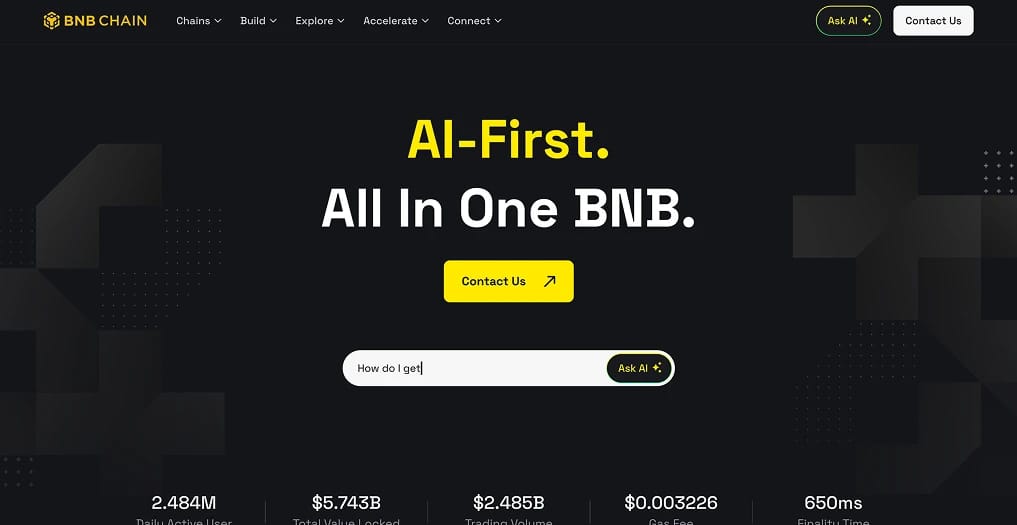
BNB Chain is an EVM-compatible smart contract network that started as Binance's exchange-token chain and became one of the busiest blockchains by daily activity. It uses Proof of Staked Authority, with BNB as both the gas token and the asset behind Binance's quarterly burns.
The chain closed the performance gap in 2025. Four hardforks (Pascal, Lorentz, Maxwell, Fermi) cut block time to 0.45 seconds and finality to 1.125 seconds, with Fermi live in January 2026. Gas fell roughly twentyfold.
Usage tracked the upgrades. TVL rose over 40% in 2025, the chain's stablecoin supply roughly doubled to around $14 billion, and tokenized real-world assets passed $3 billion in early 2026, with issuers like Franklin Templeton and VanEck onboard.
The 2026 roadmap targets 20,000 transactions per second and sub-second finality via a dual-client setup and parallel execution. The practical takeaway: BNB Chain is fast, cheap, and liquid, everything you want from a destination chain.
Final Thoughts
For most users, the best way onto BNB Chain is the boring one: withdraw from Binance with BNB Smart Chain (BEP-20) selected. It is fast, the fee is flat and small, and it removes the bridge-exploit risk that has cost users billions.
Save onchain bridges for when you need end-to-end self-custody, or your assets never touch an exchange. There, deBridge and the canonical BNB Chain Bridge are dependable, as long as you verify the URL and start small.
Either way, send a test transfer first and confirm arrival before moving size. Once funds land, put them to work across BNB Chain's decentralized exchanges and DeFi apps. For the full picture, see our best crypto bridges guide, and if Binance is new to you, our Binance review breaks down fees and security.
.webp)