


%201.svg)
Can I Bridge to Solana?
Yes, you can bridge to Solana from Ethereum, Base, Arbitrum, BNB Chain, and most other major networks. Solana uses its own execution environment and address format instead of the EVM, so only cross-chain bridges with dedicated Solana support can deliver assets there.
Wrapped tokens defined the early years of this corridor. Transfers now settle in native assets, whether that is SOL itself, USDC minted directly by Circle, or USDT connected through Tether's cross-chain infrastructure, so what lands in your wallet is the same token the rest of the network already trades.
How to Bridge to Solana
We recommend deBridge, which reports more than $21 billion in settled cross-chain volume with over 30 audits and no security incidents. DefiLlama tracks its transfer volume independently.
Instead of locking funds in a shared pool, deBridge auctions each transfer to solvers who deliver the destination asset from their own inventory. That design is why transfers land in one to four seconds at a rate locked when you place the order.
Phantom, Solflare, and other major wallets also build deBridge into their swap features, so you may already have it inside the wallet you use.
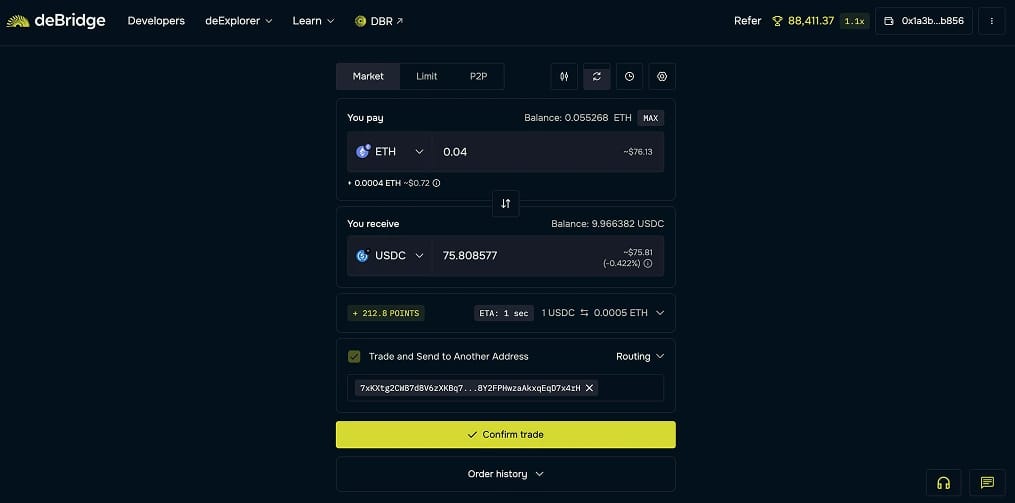
Follow these steps to bridge to Solana with deBridge:
- Connect Your Wallets: Open deBridge and connect the wallet holding your funds, such as MetaMask or Rabby, then connect a Solana wallet like Phantom or paste your Solana address as the destination.
- Set the Transfer: Choose your source chain, select Solana as the destination, and pick the asset you want to move, such as USDC, ETH, or SOL.
- Review the Quote: Check the guaranteed output amount and total fees shown before signing.
- Sign and Receive: Confirm the transaction in your wallet, and your assets should appear on Solana almost immediately.
Keep a little SOL in the destination wallet, since every onward transaction needs it for network fees, though those rarely exceed a cent.
What are the Fees?
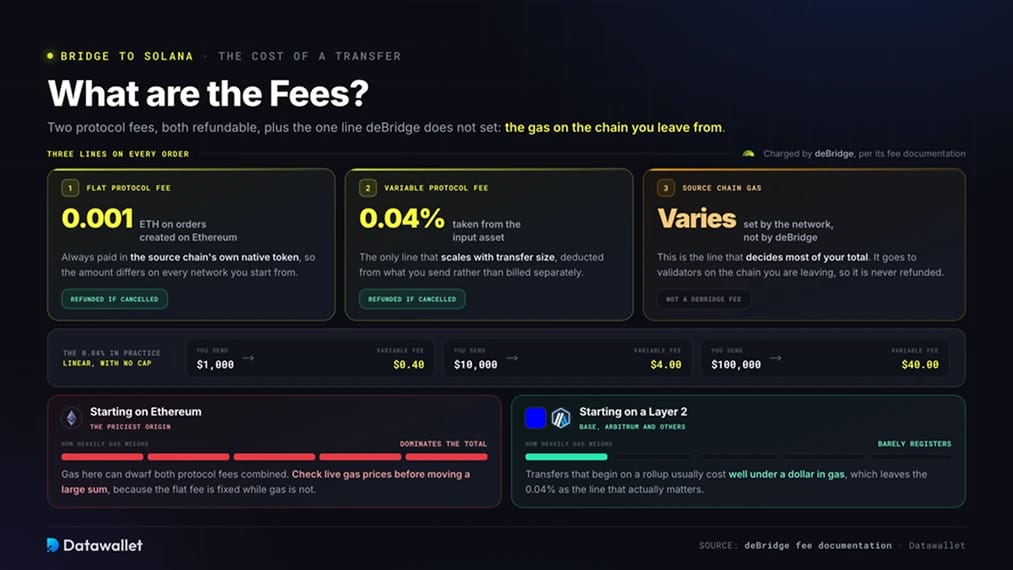
deBridge charges two protocol fees on every order, according to its fee documentation. The first is a flat fee paid in the source chain's native token, set at 0.001 ETH for orders created on Ethereum, and the second is a variable fee of 0.04% taken from the input asset. Both are refunded if an order is cancelled before a solver fills it.
Source-chain gas sits on top and decides most of the total cost. Ethereum remains the priciest starting point, so check live gas prices before moving a large sum, while transfers that begin on Base, Arbitrum, or another Layer 2 usually cost well under a dollar in gas.
Native Assets vs Wrapped Tokens
The biggest change over the past year is that the major stablecoins now reach Solana natively rather than as wrapped substitutes. Circle's Cross-Chain Transfer Protocol burns USDC on the source chain and mints canonical USDC on Solana, and USDT joined the USDT0 Legacy Mesh in October 2025, linking Solana's native supply with Ethereum, Tron, and TON through direct mint and burn operations.
This matters because wrapped tokens depend on the solvency of whichever bridge issued them, and they often trade at a discount or need a swap before Solana apps accept them. Our guide to USDC.e versus USDC covers how to tell the two apart, and any wrapped SOL from an older transfer can be converted back to native SOL in a single transaction.
Solana Bridging Risks
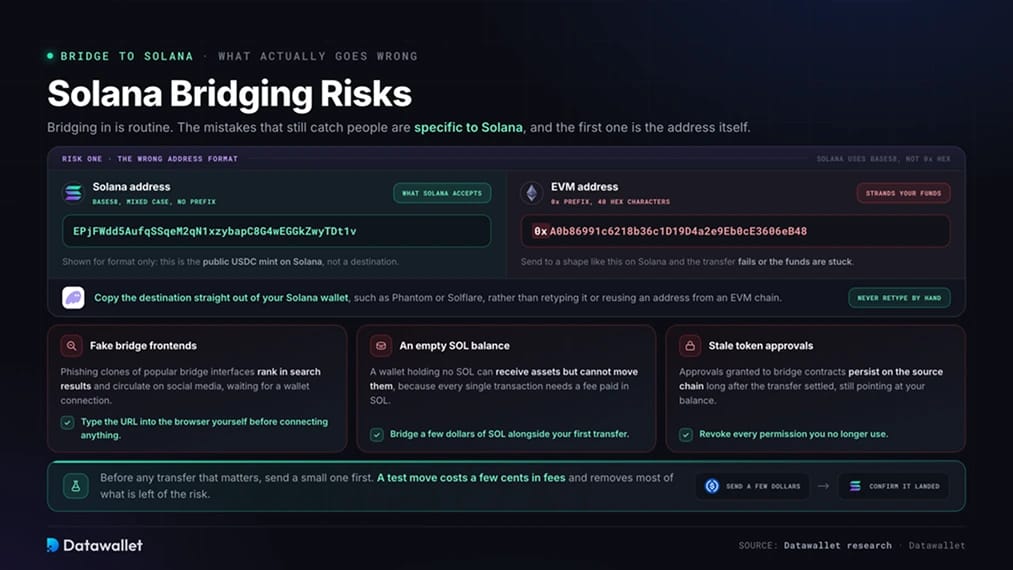
Bridging into Solana is routine, but a few Solana-specific mistakes still catch people out:
- Fake bridge frontends: Phishing clones of popular bridge interfaces rank in search results and circulate on social media. Type the URL into your browser yourself before connecting a wallet.
- Wrong address format: Solana addresses are base58 strings that look nothing like the 0x format on EVM chains. Sending to an Ethereum address on the Solana network fails or strands funds, so copy the destination straight from your Solana wallet.
- Empty SOL balance: A wallet with no SOL can receive assets but cannot move them, since every transaction needs a fee in SOL. Bridge a few dollars of SOL alongside your first transfer.
- Stale token approvals: Approvals granted to bridge contracts on the source chain persist after the transfer. Revoke permissions you no longer use so a compromised contract cannot reach your wallet later.
A small test transfer before any large move costs a few cents in fees and removes most of the remaining risk.
Alternative Solana Bridges
Beyond deBridge, several other platforms handle transfers into Solana reliably.
Wormhole's Portal Swap, powered by Mayan, folds cross-chain swaps directly into the Portal interface, so the two projects increasingly work as a single product.
About Solana
Solana is a high-throughput Layer 1 that processes transactions in parallel on a single base layer, keeping fees at fractions of a cent without pushing activity onto rollups. The Firedancer validator client, an independent implementation built by Jump Crypto, is now live on mainnet, diversifying the software that runs the network.
The Alpenglow consensus upgrade comes next, targeting transaction finality of around 150 milliseconds. Institutional demand has grown alongside the technology, and our Solana ETF tracker follows the spot funds now holding SOL on behalf of traditional investors.
Bottom Line
Bridging to Solana takes seconds with deBridge, which delivers native assets at a rate locked before you sign, while Wormhole Portal, Mayan, and Allbridge cover the remaining paths. The shift to native settlement for USDC and USDT means what arrives in your wallet works everywhere on the network immediately.
Use a Solana wallet as the destination, bring some SOL for fees, and send a test transfer first if the amount matters.