







Compare Top Norwegian Crypto Exchanges
1. Bybit EU
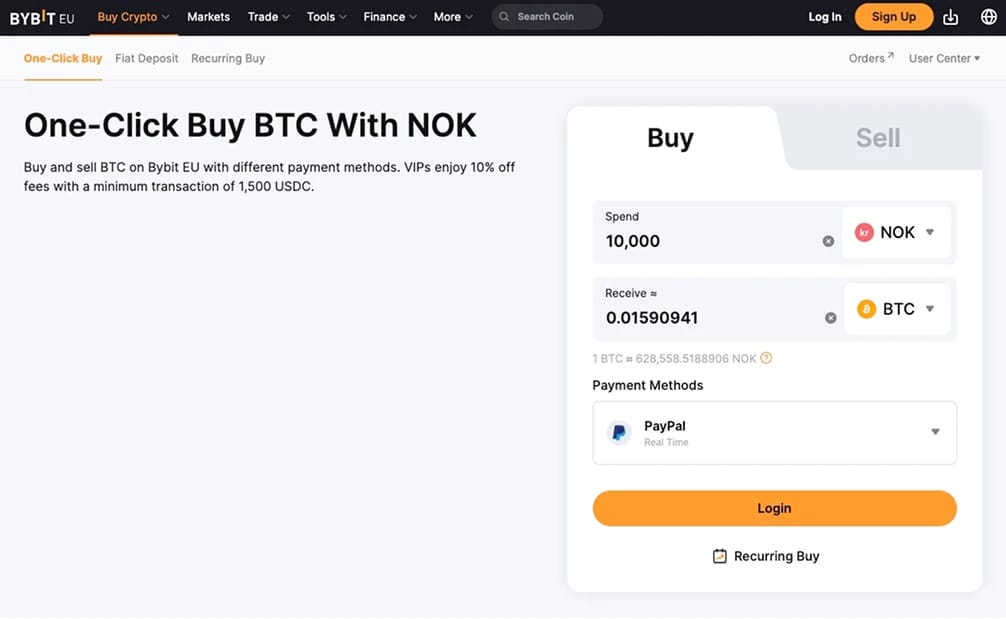
Bybit EU takes first place because no other licensed exchange offers a Norwegian this much market access from a single login. Bybit EU GmbH holds a MiCA authorization from Austria's FMA, granted in May 2025, and passports across the EEA, including Norway. Behind it sit 600+ cryptocurrencies, spot margin up to 10x, Earn products, trading bots, and the Bybit Card, all on a 0.10% spot fee that undercuts every rival here except OKX.
On funding, it handles the krone better than any other global platform in this comparison. Card, PayPal, and mobile wallet purchases are charged directly in NOK, so a quick buy skips the currency step entirely, while larger amounts are routed via SEPA in euros. We tested an Apple Pay purchase that settled in seconds, then sent a SEPA transfer converted from kroner at our bank, which landed the next business day.
Two constraints apply before you commit. Bybit EU runs as its own Austrian entity, which means a second full KYC even for verified global Bybit accounts, and EEA retail cannot trade the perpetual futures the brand is known for under the current authorization. USDT is also missing since Tether skipped EU authorization, leaving USDC and euro stablecoins to fill the gap. The full platform is covered in our Bybit review.
Pros
- MiCA CASP license from Austria's FMA, valid in Norway past the 30 June 2026 cutover.
- 600+ assets on a flat 0.10% spot fee, the best value at this catalog size.
- Direct NOK card and mobile-wallet purchases plus Earn, spot margin, bots, and the Bybit Card.
Cons
- Perpetual futures are off the menu for EEA retail for now.
- Moving over from global Bybit means repeating KYC on a separate entity.
- The February 2025 hack is part of its history, although no customer lost funds.
2. Kraken
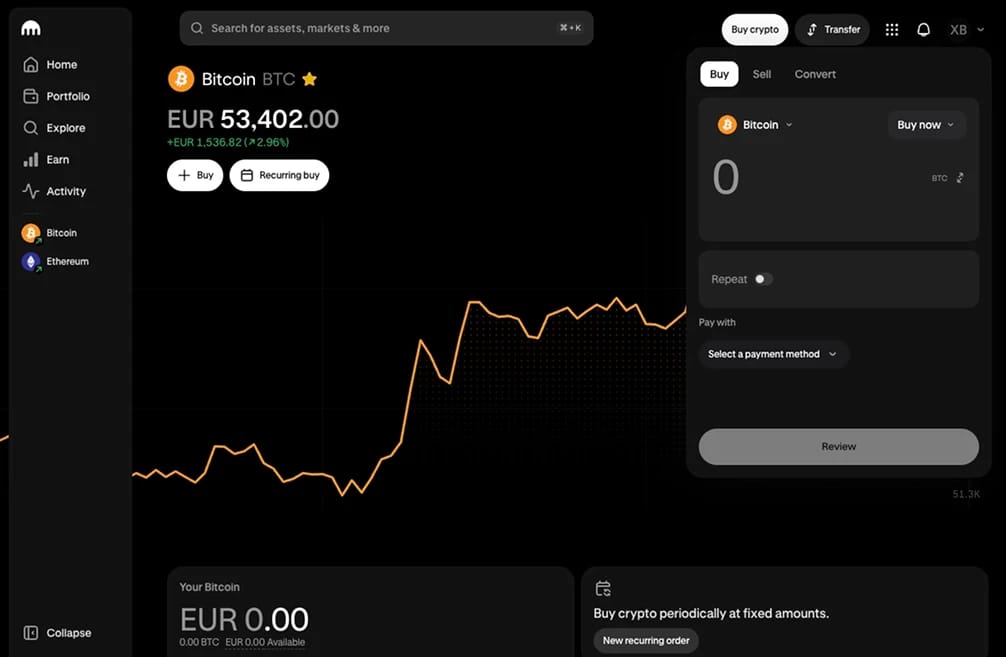
Kraken runs second on trust, and it is the account we suggest when a Norwegian plans to hold size. Its MiCA license, granted by the Central Bank of Ireland in June 2025, sits alongside a MiFID license for regulated derivatives. It has published proof-of-reserves attestations since 2014 and has never been breached, a record nothing else in this lineup matches.
Practicality lives in the euro funding. Kraken charges nothing for SEPA or SEPA Instant deposits, which is useful because the bank already takes a spread when converting kroner to euros, and doubling up on fees would sour the round trip. Our Nordea transfer converted and arrived the following morning, opening 600+ assets against some of Europe's deepest euro books, with staking on the majors.
The gaps are local ones. There is no NOK balance, no Vipps, and the Kraken Pro interface shows a first-time buyer far more screen than they need. Pro fees open at 0.25% maker and 0.40% taker, above OKX and Bybit EU, a premium we think holders of size can justify for the Irish supervision and audit history. Features and fees are covered in depth in our Kraken review.
Pros
- Irish MiCA authorization alongside a MiFID license for regulated derivatives.
- Twelve years of proof-of-reserves publication and zero security breaches.
- No-fee SEPA and SEPA Instant funding into deep euro markets with staking.
Cons
- Spot fees of 0.25% and 0.40% cost more than OKX and Bybit EU.
- No NOK or Vipps support, so every deposit includes a currency conversion.
- Kraken Pro is heavier than a casual investor needs.
3. Coinbase
Coinbase suits the Norwegian who wants the regulatory question settled by a company their bank has heard of. Its European arm, Coinbase Luxembourg S.A., operates under a MiCA license from the CSSF, and the Nasdaq listing means audited public financials that no crypto native competitor publishes. For a cautious first account, that disclosure level does a lot of quiet work.
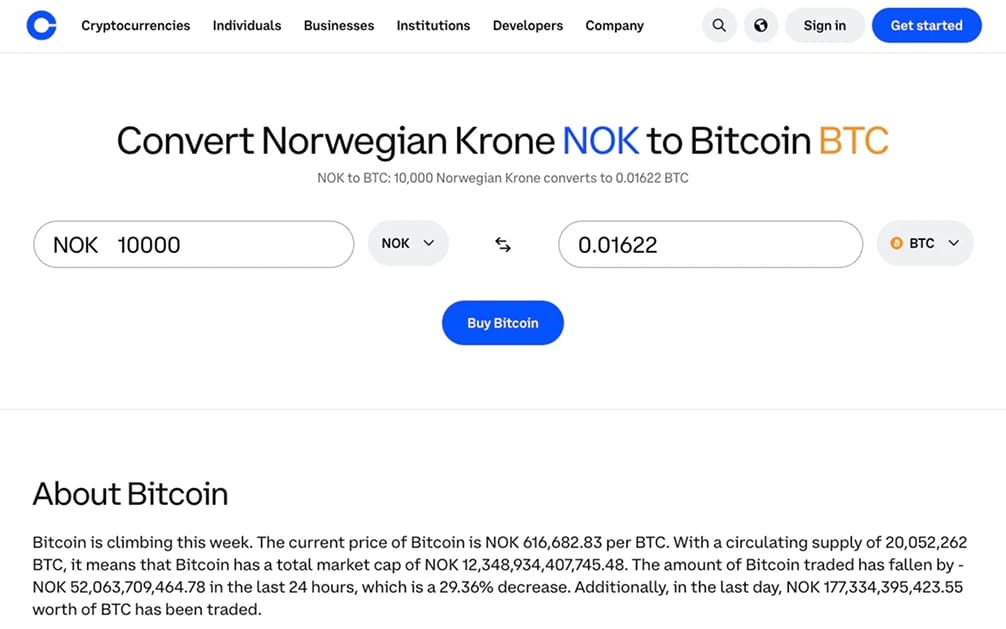
The app remains the gentlest entry point on this list. Simple buys work with a Norwegian card charged in kroner or from a euro balance funded by SEPA, recurring purchases put a monthly buy on autopilot, and with USDT delisted from licensed EU venues, USDC covers the stablecoin role. Our passport verification cleared within a few minutes, and the roughly 250 assets on the EU front end cover what a mainstream investor is likely to want.
Cost is the catch, and it is avoidable. Simple buys stack a spread on top of fees, while Coinbase Advanced sits behind a mode toggle that many new users never discover, pricing from around 0.40% maker and 0.60% taker at entry tiers. Buy through Advanced from the first order, and the platform charges fairly, though still above OKX and Bybit EU. More details about the exchange can be found in our Coinbase review.
Pros
- Luxembourg CSSF authorization backed by the audited disclosures of a public company.
- Gentlest onboarding in this lineup, with NOK card buys and automated recurring purchases.
- USDC serves as the compliant stablecoin for idle balances.
Cons
- Instant buys are the priciest way to purchase crypto in this comparison.
- Entry-tier Advanced fees still trail the cheapest venues here.
- No NOK balance or Vipps, so bank funding runs through euros.
4. Firi
Firi is the account nearly half the Norwegian market already runs on, and after the cutover, it carries regulatory weight no rival can copy. The Oslo company, founded in 2017 as MiraiEx, became the first CASP authorized to operate a crypto trading platform in Norway on 22 May 2026, adding to the e-money license it has held since 2024. It answers directly to Finanstilsynet and has begun passporting into Sweden on the back of the new license.
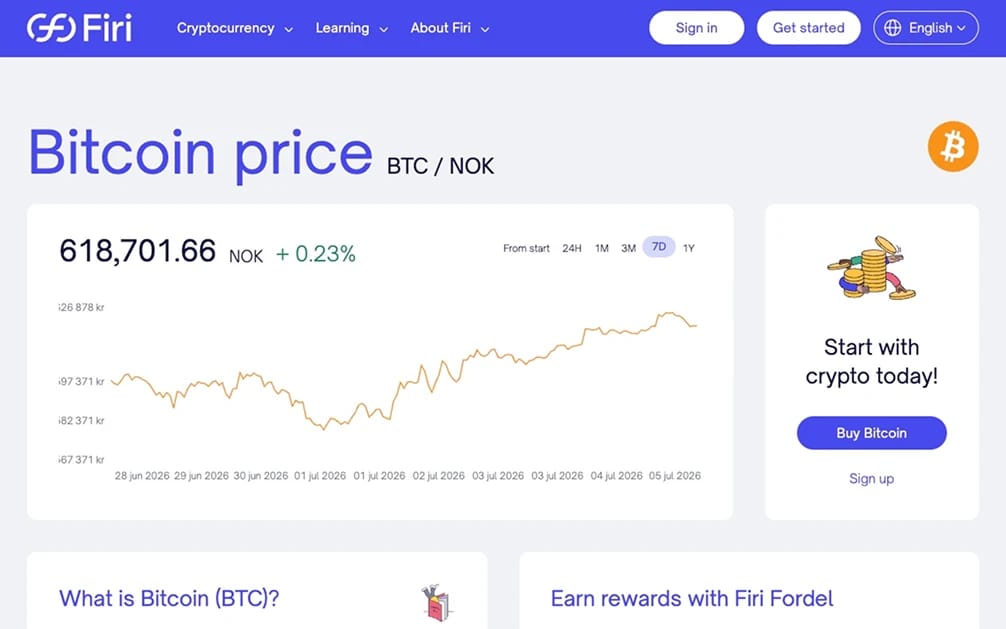
Onboarding and funding are where it feels built for this country. You register with Vipps, verify with BankID, and move kroner in via Vipps, Open Banking, or a regular transfer, with bank deposits free of charge. Our Vipps deposit was credited within seconds, though the instant methods carry a surcharge, so a standard bank transfer is the cheaper option for regular buying. The free tax report, formatted for the Norwegian skattemelding, saves hours every April.
Price and breadth are the trade-offs that place it fourth. The flat 0.7% trade fee is several times what Bybit EU or OKX charge; the list of roughly 100 assets skips most of the long tail coins, and there are no margin or derivatives products. Its role in a Norwegian setup is the kroner account that clears every bank check without friction, with ETH staking and a savings plan layered on, while a second venue handles anything beyond the majors.
Pros
- First Norwegian trading platform CASP, supervised directly by Finanstilsynet, plus an e-money license.
- NOK moves in and out via Vipps, Open Banking, and ordinary bank transfer, with BankID handling login.
- Free Norwegian tax report, ETH staking, and an automated savings plan.
Cons
- The flat 0.7% fee is expensive next to the global order-book venues.
- Around 100 assets, so altcoin hunters will need a second account.
- Spot only, with no margin, futures, or advanced product shelf.
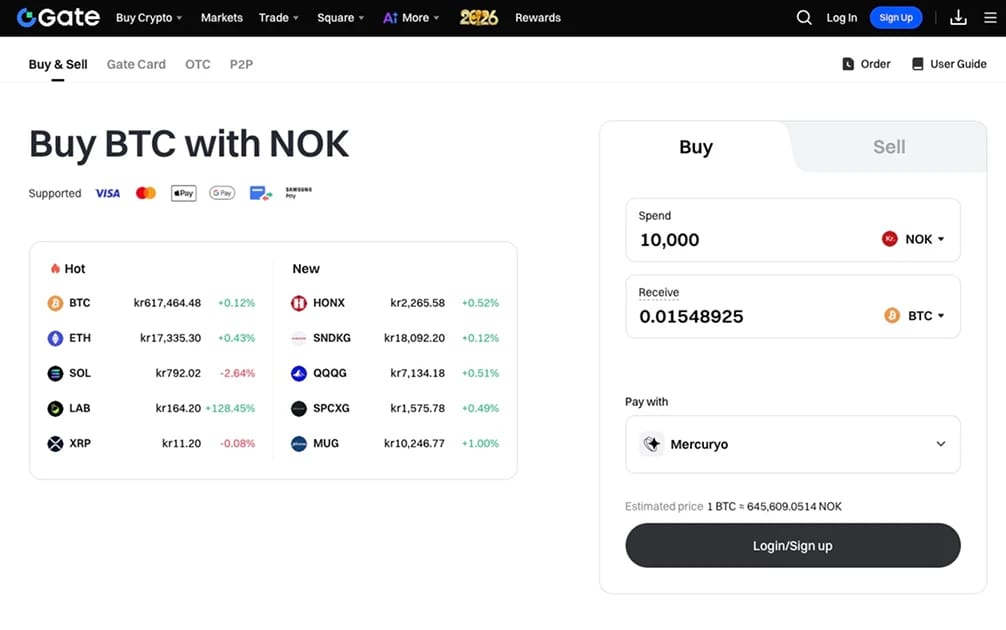
5. Gate
Gate is the licensed answer to the altcoin problem. Operating since 2013 and serving over 30 million users, it lists 3,800+ cryptocurrencies globally, and its European arm, Gate Technology Ltd, received a MiCA authorization from Malta's MFSA in the autumn of 2025 covering custody, trading platform operation, exchange, execution, and transfer services across the EEA.
For a Norwegian, the appeal is reach at a fair price. Spot fees start at 0.10% for makers and 0.20% for takers, with GateToken holdings cutting them further, and the platform layers on copy trading, Earn products, and a zero-knowledge proof-of-reserves system that lets anyone verify assets exceed liabilities. Funding runs by SEPA in euros or by card, and our test deposit from a Danske Bank account arrived within a day.
Read the fine print before treating it as home base. The MiCA license applies specifically to Gate Technology Ltd, so check in the app that the EU entity is the one serving your account. Depth also cuts both ways, since thousands of small listings mean thin books and real drawdown risk far down the list. The company suffered a breach back in 2018, made users whole, and has rebuilt its security reputation since, as our Gate review covers in detail.
Pros
- The widest selection of any licensed venue serving Norway, from a 3,800+ global catalog.
- MiCA authorization via Malta's MFSA, plus zk proof-of-reserves anyone can verify.
- Competitive 0.10% maker pricing with GateToken discounts, copy trading, and Earn.
Cons
- The EU entity's compliant catalog is smaller than the global headline number.
- Long-tail listings carry thin liquidity and elevated risk.
- No NOK balance, so kroner convert to euros on the way in.
6. OKX
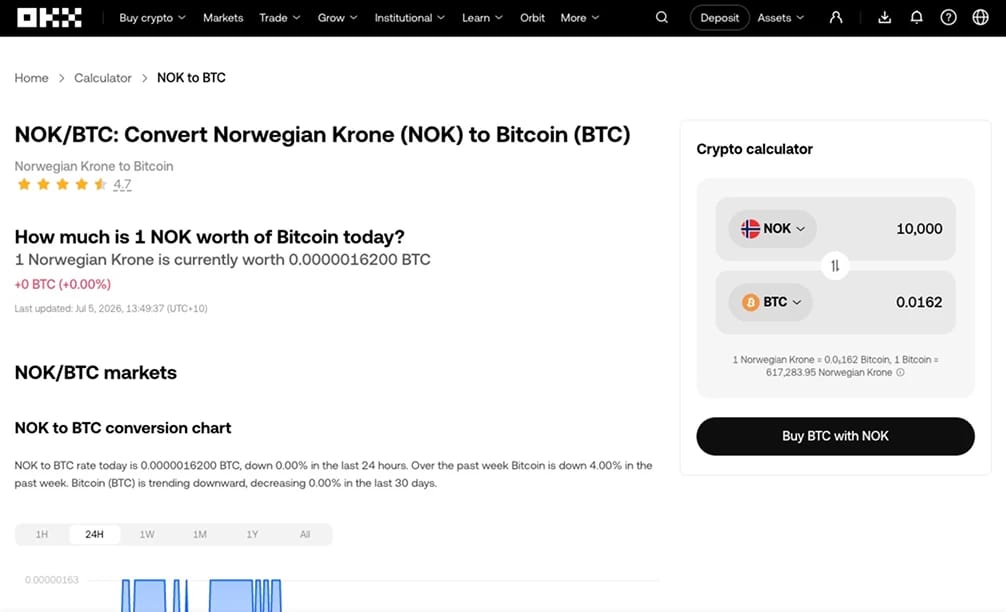
OKX competes on cost and on-chain tooling. At 0.08% maker and 0.10% taker, its spot pricing beats every major platform serving Norway. Malta's MFSA issued its MiCA authorization, and reserves are published monthly with Merkle-tree verification that anyone can check. Since the cutover, it has dangled a migration bonus of up to 8% on balances moved across from unlicensed platforms.
The on-chain side is the real differentiator. The self-custodial OKX Wallet covers 100+ chains and includes a DEX aggregator, turning one app into both a regulated exchange and a gateway to DeFi. Funding runs through SEPA in euros or by card, and our transfer from a Sparebank 1 account was converted and settled the next morning without the bank raising a query.
Two things to consider when using the exchange. ESMA's 2025 peer review questioned how rigorously Malta assessed its authorizations, a shadow OKX shares with Gate, so the license works across the EEA yet carries a touch less weight than Irish or Luxembourg supervision. The product depth also makes it easy for a newcomer to wander into instruments they do not understand. The complete picture is in our OKX review.
Pros
- Cheapest spot pricing among the big licensed venues, at 0.08% and 0.10%.
- Monthly reserve attestations with Merkle-tree verification, licensed via Malta.
- A self-custodial wallet spanning 100+ chains with DEX aggregation included.
Cons
- ESMA's peer review left Malta's supervisory standing a step behind Ireland and Luxembourg.
- Breadth can overwhelm someone who only wants to buy and hold.
- No NOK balance, so kroner convert to euros on the way in.
How to Choose a Crypto Exchange in Norway
After 30 June 2026, the shortlist starts with the license and ends with how your kroner get in. Work through these five checks before funding anything.
- Verify the CASP authorization: An authorization attaches to one legal entity rather than a brand. Firi AS, Bybit EU GmbH, and Gate Technology Ltd appear in Finanstilsynet's register and ESMA's interim MiCA register, while Norwegian applicants such as NBX and Bare Bitcoin do not yet, and cannot lawfully take your business until they do.
- Decide how the krone gets in: Firi accepts NOK directly via Vipps, Open Banking, and bank transfer, and Bybit EU accepts cards, PayPal, and mobile wallets in kroner. Kraken, Coinbase, Gate, and OKX hold euros, so the bank converts your NOK on the SEPA leg.
- Confirm that your bank passes the payment: Norwegian banks screen crypto transfers under AML rules, and payments to licensed venues clear far more reliably than anything else. Our guides for Sparebank 1, Nordea, and Danske Bank cover what each permits, and DNB customers should expect the same scrutiny.
- Check your assets survived the compliance filter: USDT is gone from licensed EEA venues, and EU front-ends trim parts of global catalogs, Gate's included. If one token matters to you, confirm it trades on the compliant version of the platform before depositing.
- Plan for Skatteetaten from the first trade: Every disposal is taxable, crypto holdings count toward wealth tax, and exchanges now report your activity automatically under CARF. Pick a platform with clean exports, and note that Firi generates a Norwegian tax report for free.
Crypto and Bitcoin Regulation in Norway
Crypto is legal in Norway and regulated under MiCA, brought into Norwegian law by the Crypto Assets Act with Finanstilsynet as the competent authority. The krone remains the only legal tender, but owning, trading, and paying by private agreement are all lawful.
A short chain of dates explains the market Norwegians trade in today.
- October 2018: Exchange and custody providers were pulled into Norway's AML regime with a registration duty at Finanstilsynet, the framework under which 13 providers, including Firi and NBX, operated for years.
- 30 December 2024: MiCA's CASP rules took effect across the EU, and the regulation was incorporated into the EEA Agreement so it would bind Norway.
- 1 July 2025: The Crypto Assets Act, kryptoeiendelsloven, entered into force and made Finanstilsynet the MiCA supervisor, with registered providers given a transition window to apply for authorization.
- December 2025: Finanstilsynet extended the transition from 30 December 2025 to 30 June 2026, the maximum MiCA allows, after applications proved heavier than expected.
- May 2026: The first full licenses landed. TÝR Markets became the first Norwegian CASP authorized under Article 63, and Firi followed on 22 May as the first authorized to run a trading platform, with cross-border rights into Sweden and Denmark.
- 1 July 2026: The window closed. Across the EU and EEA, only around 210 of more than 1,200 legacy-registered providers finished the authorization process in time; Binance pulled its MiCA application days before the deadline, and the Norwegian applicants, NBX, K33, and Bare Bitcoin among them, were told to pause until decisions arrive.
Passporting now runs both directions. A CASP authorized anywhere in the EEA can serve Norway after notifying its home regulator, which is how Bybit EU, Kraken, Coinbase, Gate, and OKX operate here, while Firi uses the same mechanism outward into the rest of Scandinavia.
Norges Bank, for its part, has studied a digital krone for years without committing to launch one, with its recent work leaning toward wholesale settlement rather than a retail coin.
How is Crypto Taxed in Norway?
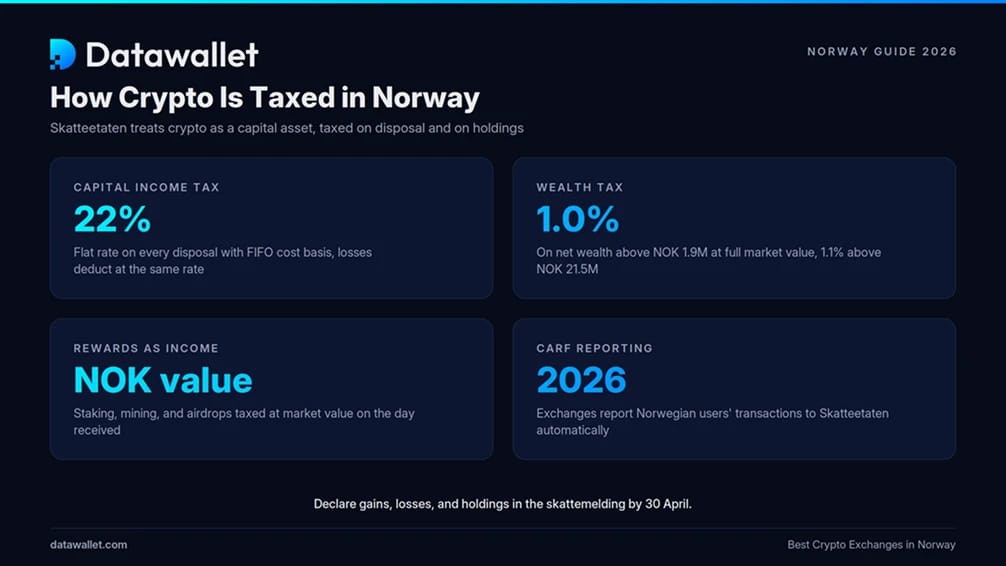
Norway taxes crypto twice, once when you dispose of it and once each year simply for holding it. Skatteetaten treats coins as capital assets, not currency.
- A flat 22% on gains: Every disposal triggers the calculation, whether you cash out to kroner, swap between coins, or spend crypto on goods, with the net gain taxed as capital income at 22%.
- FIFO sets the cost basis: Skatteetaten's recommended method is first in, first out, calculated per asset in NOK. Documented transaction fees are deductible, and every figure must be reconstructable if the tax office asks.
- Wealth tax reaches your holdings: Crypto counts toward formuesskatt at full market value on 1 January, with no valuation discount. For 2026, net wealth above NOK 1.9 million per person is taxed at 1.0%, rising to 1.1% above NOK 21.5 million, which means a large enough portfolio owes tax in years with no sales at all.
- Rewards are income on arrival: Staking, mining, and airdrop income are taxed at their NOK value when received, and that value becomes the cost basis for the later disposal calculation.
- Reporting turned automatic: From 1 January 2026, Norway's implementation of the OECD's CARF framework obliges exchange and custody providers, foreign ones included, to report user transactions to Skatteetaten annually. Undeclared holdings now face an additional tax of 20% to 60% with a lookback of up to ten years, so voluntary correction beats waiting to be found.
Declare gains, losses, and year-end holdings in the virtual assets section of the skattemelding by 30 April. Nothing here replaces professional advice, and anything involving DeFi or business-scale activity belongs with a Norwegian tax adviser.
Cryptocurrency Adoption in Norway
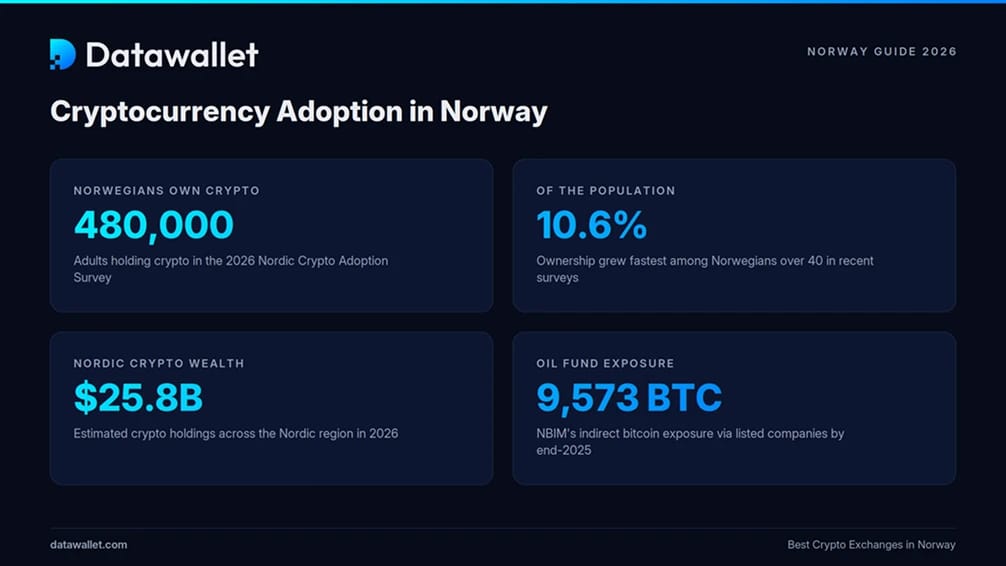
Norwegian adoption is broad, wealthy, and unusually loyal to local platforms, shaped by a fully digital banking culture where Vipps and BankID already handle daily money.
- Ownership is mainstream: The 2026 Nordic Crypto Adoption Survey puts Norwegian ownership at 480,000 adults, 10.6% of the population, within a Nordic region holding an estimated USD 25.8 billion in crypto wealth. Earlier editions found more Norwegians under 40 own crypto than own shares.
- Local venues punch above their weight: Nordic survey data has consistently shown Norwegians among the most likely in the region to use domestic exchanges, which helps explain how Firi built the largest user base in the Nordics from Oslo, and why the CASP race mattered so much here.
- Even the oil fund is exposed: Norges Bank Investment Management held indirect exposure of roughly 9,573 BTC through listed companies with bitcoin on their balance sheets by the end of 2025, after two years of about 150% annual growth, so most Norwegians now touch crypto through the state fund, whether they know it or not.
The global comparison sits on our crypto adoption statistics page. What stands out in Norway is that ownership grew fastest among people over 40 in recent surveys, a sign the market has moved well past its early-adopter phase.
How to Buy Bitcoin in Norway
Buying BTC here is quick once you decide whether to stay in kroner or accept a euro conversion. Here is the process we used.
- Pick a licensed venue for your funding style: Firi for kroner through Vipps and BankID, or Bybit EU and Kraken for bigger catalogs and lower trading fees. Check the entity against Finanstilsynet's or ESMA's register before depositing.
- Clear KYC with BankID or a passport: BankID gets you through Firi in minutes. On the global platforms, upload a passport or national ID with a selfie, and type your name exactly as the document prints it, since mismatches cause most stalled verifications.
- Fund in NOK or convert to EUR: Vipps lands on Firi in seconds, and a free bank transfer follows within a day or two, while Bybit EU charges cards in kroner instantly. For the euro venues, send SEPA from your bank and accept the conversion spread, or convert kroner first in a multi-currency account for a tighter rate.
- Buy BTC with a limit order: Where an order book exists, a limit order on BTC/NOK or BTC/EUR nearly always beats the quoted price on an instant buy, so skip the one-tap button.
- Decide where the BTC lives: Leaving coins on a licensed exchange is reasonable for active trading, since MiCA requires client assets to be segregated. For long-term holdings, withdraw to self-custody once you have double-checked the address and network. Our best crypto wallets guide compares hardware and software options.
Cashing out runs the same steps backward. Sell on a licensed venue, withdraw to a bank account in your own name, and note the NOK value and date of each disposal for the skattemelding.
Final Thoughts
Bybit EU is the account we would open first in Norway today. It cleared the July licensing cutover with one of the biggest asset lists in the compliant field, prices spot at a flat 0.10%, and takes kroner by card without a conversion step.
Kraken is the pick for audited custody and deep euro books, Coinbase for the softest first account, and Firi for kroner through Vipps under a Norwegian license with painless tax reporting. Gate carries the deepest altcoin shelf of any licensed venue, and OKX serves the fee-sensitive and the on-chain crowd.
Judge platforms by the register, not the logo. Half of Norway's homegrown industry entered July without authorization, and Binance's exit showed that scale buys no exemption. A sensible Norwegian setup in 2026 is one NOK-native account, one licensed global venue, and records clean enough to drop straight into the tax return.
For the neighboring markets, our guide to the best crypto exchanges in Europe maps the wider region. Before committing real money, run a small test. Buy a thousand kroner of BTC, sell it straight back, and see what the loop cost you at your bank. Ten minutes of testing beats any review, this one included.
Our Methodology
We built this ranking by using the platforms the way a Norwegian would. That meant registering with BankID and a passport, moving money in through Vipps, card, domestic transfer, and SEPA, executing real trades, and pulling funds back out to a Norwegian bank account. Six criteria set the scores.
- Trust Score: Our proprietary rating out of 5, weighting CASP authorization and the issuing regulator, custody and reserve transparency, security history, platform longevity, and audit coverage.
- Norway Funding Methods: Confirmed Vipps, Open Banking, bank transfer, card, and SEPA support, measuring settlement speed, the NOK conversion spread where one applies, and withdrawal costs back to Norwegian accounts.
- Regulatory Standing: Verified each platform's authorization against Finanstilsynet's records and ESMA's interim MiCA register, the dividing line in this market since 30 June 2026.
- Security Track Record: Weighed each platform's breach history, how client assets are custodied, how often reserves are disclosed, and account-level protections like 2FA and withdrawal whitelists.
- Assets and Liquidity: Ran market and limit orders across BTC, ETH, and a mid-cap pair on each venue, recording spreads, book depth, and how cleanly orders filled.
- Fee Structure: Compared maker and taker fees, deposit surcharges, and the all-in cost of a kroner round trip, including the bank's conversion where relevant.
Platforms without a live MiCA authorization were left out; Binance was included after its withdrawal; and pending Norwegian applicants, such as NBX, appear only where flagged for context. Testing ran from April through July 2026, with every licensing status rechecked after the 30 June deadline.
.webp)