







Can I Buy Bitcoin with ICICI Bank?
Yes, although the purchase never touches iMobile Pay. ICICI runs no crypto desk, custodies no digital assets, and lists no Bitcoin ETF or note. The bank allows a plain rupee payment to an FIU-registered exchange, where you place the order.
In practice, you open an account at an FIU-registered exchange, move INR across from ICICI, and buy there. We have funded Bybit from an ICICI savings account this year over both UPI and IMPS P2P. Neither was declined, though the first transfer to a new counterparty drew a one-time app confirmation.
ICICI is unusual in one respect. Since 2021 its outward remittance form has required customers to declare that money sent abroad under the Liberalised Remittance Scheme is not for buying crypto, though that only touches foreign-currency wires to overseas platforms, not the domestic INR transfers that fund Bybit.
How to Buy Crypto with ICICI Bank
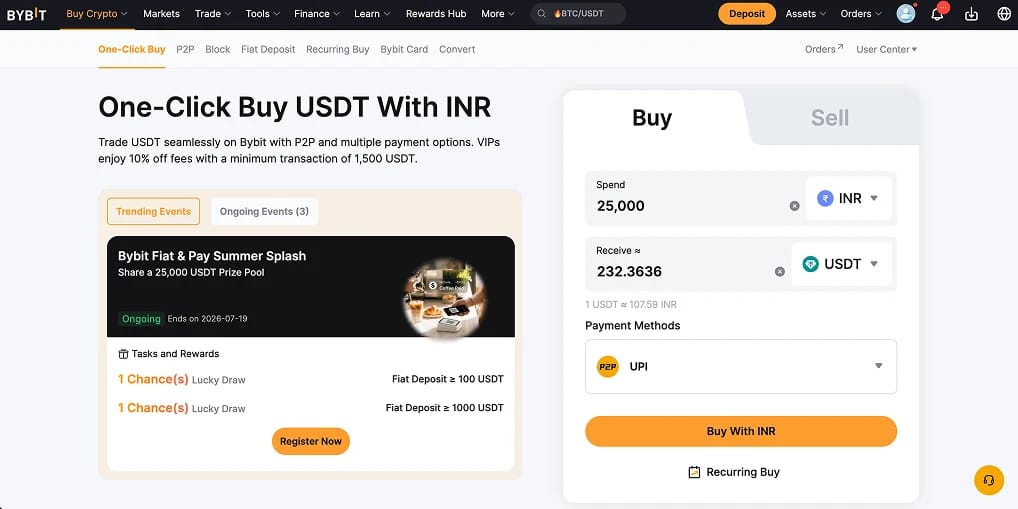
You move INR onto Bybit, then buy your asset. P2P over UPI is the steadiest INR method for Indian banks, because you pay a verified user directly rather than a crypto payment gateway. Bybit takes no direct INR bank deposit, so the peer-to-peer market is where the rupees land.
Steps to buy crypto with ICICI Bank:
- Create an account: Sign up on Bybit and complete KYC with your PAN and Aadhaar. Verification must clear before you can trade or open a P2P order.
- Open P2P and choose a seller: Go to Buy Crypto > P2P Trading, pick USDT or BTC, and filter by payment method. Set UPI or IMPS in your payment options first, since it has to match the seller's listing.
- Check your ICICI limits: UPI through iMobile Pay caps at ₹1,00,000 per transaction and per day, and IMPS runs up to ₹5,00,000 per transfer. Lift either ceiling in iMobile Pay or Net Banking before you send more.
- Pay and confirm: Place the buy order, pay the seller from your ICICI account using the exact name and reference shown, then mark it paid. The seller releases crypto to your Funding wallet once the rupees land, usually within minutes.
- Buy your asset: If you bought USDT, open the spot market, search BTC/USDT or your preferred pair, and place the order. For anything sizeable we set a limit order, since the one-click quote builds in a wider spread than the 0.10% spot fee.
Fees, Tax and Transfer Limits for ICICI Bank Customers
Your real cost in India is the ICICI transfer, the exchange fee, and the tax. Most people price the first two and forget the tax.
ICICI Bank costs and limits
- UPI: Free and instant through iMobile Pay, capped at ₹1,00,000 per transaction and per day across up to 20 transactions. A new UPI ID is held to ₹5,000 on day one. Best for smaller P2P buys.
- IMPS: Real-time and 24/7, up to ₹5,00,000 per transfer by account number and IFSC, inside an iMobile Pay daily ceiling of ₹20,00,000.
- NEFT and RTGS: Free when initiated online through iMobile Pay or Net Banking. RTGS handles high-value transfers from ₹2,00,000 up and settles in real time during banking hours.
- Debit and credit cards: ICICI cards work on some exchange gateways, but 1.5% to 3.5% surcharges make them worth only a small first test.
- AML checks: ICICI follows PMLA reporting. A large or first-time transfer to a new beneficiary can prompt a source-of-funds query, which exchange statements and your ITR filings clear quickly.
Tax and the 1% TDS
- 30% on gains: Profit on any virtual digital asset is taxed at a flat 30% under Section 115BBH, plus 4% cess, with no lower rate for holding longer.
- No loss offset: A loss on one coin cannot be set against a gain on another or carried into a future year, and only your purchase cost is deductible.
- 1% TDS: A 1% tax is deducted at source on transfers under Section 194S. Domestic exchanges withhold it for you; Bybit, as an offshore platform, does not, so the buyer deducts and deposits it on P2P and foreign-platform trades.
- 18% GST: Charged on Bybit's trading and service fees for Indian users, not on the crypto itself.
- Reporting: Declare crypto under Schedule VDA in ITR-2 or ITR-3. The Income Tax Act 2025, effective from 1 April 2026, keeps this treatment unchanged.
Bybit fees
- P2P deposit: No platform fee. You pay only the price agreed with the seller, which usually carries a small spread.
- Spot trading: 0.10% maker and taker at the standard tier, before GST.
- One-click INR buy: A wider spread sits inside the quoted rate. Fine for a first test, dearer than spot at size.
- Crypto withdrawal: Network fee only. USDT on Tron (TRC-20) is usually around a dollar.
A free P2P deposit with 0.10% spot keeps the exchange leg cheap. In India the 30% tax shapes your returns far more than any trading fee.
Best Exchanges for ICICI Bank Customers
Indian users have a mix of offshore and home-grown platforms, all FIU-registered. For an ICICI customer, the deciding line is whether the platform withholds your 1% TDS or leaves it to you.
ICICI Bank Cryptocurrency Policy
ICICI Bank offers no retail crypto product or custody, and has signalled no intent to add one. Its one venture into digital money is the RBI's retail Digital Rupee pilot, where ICICI was a first-phase bank issuing the e₹, a central bank token that counts as legal tender rather than a tradable asset. The stance matches peers such as HDFC, SBI and Axis.
ICICI has long been among the more cautious large banks on crypto, and its 2021 remittance declaration applied only to cross-border wires, never to domestic rupee payments.
India's banking access to crypto turned on one court ruling. The Reserve Bank of India barred regulated entities from servicing crypto businesses in an April 2018 circular, cutting exchanges off until the Supreme Court struck it down in March 2020 in Internet and Mobile Association of India v RBI. The RBI later confirmed banks cannot rely on the withdrawn circular to refuse service.
Crypto is legal to hold and trade in India, but a digital asset is not legal tender and sits outside SEBI-style investor protection. Oversight runs through FIU-IND, which since 2023 has required every exchange serving Indian users to register as a reporting entity under PMLA. Bybit completed that registration in 2025 after a ₹9.27 crore penalty and temporary suspension, then restored full app and website access that September.
About ICICI Bank
ICICI Bank is India's second-largest private sector bank, serving retail, SME and corporate customers nationwide. Incorporated in 1994 as a subsidiary of ICICI Limited, it keeps a registered office in Vadodara and its corporate office in Mumbai, and has been led by MD and CEO Sandeep Bakhshi since October 2018.
Retail customers bank through the iMobile Pay app and ICICI Net Banking, with a core line of savings and salary accounts, Visa and Mastercard debit and credit cards, fixed deposits, and investing through ICICI Direct. Rupees move on UPI, IMPS, NEFT and RTGS, the same rails used to fund an exchange.
The bank is licensed and supervised by the Reserve Bank of India, which classes it as a domestic systemically important bank alongside SBI and HDFC. It neither endorses nor takes part in crypto trading, and no part of its retail offering includes digital assets.
Final Thoughts
Buying Bitcoin with ICICI Bank means moving rupees to a registered exchange and handling the tax properly. ICICI does not block domestic transfers to FIU-registered platforms, P2P over UPI or IMPS is the most dependable INR method, and your limits adjust inside iMobile Pay.
Bybit is our pick for most ICICI customers on cost and asset range, with 0.10% spot and free P2P deposits. If you would rather the 1% TDS be withheld inside India, a domestic exchange like CoinDCX is cleaner at a higher trading fee.
Either way, the 30% tax and Schedule VDA filing apply.
.webp)