




Can I Buy Bitcoin with SBI Bank?
Yes, you can buy Bitcoin with SBI, but not inside YONO or OnlineSBI. SBI is the payment rail, while the trade happens on a separate crypto platform. The main SBI funding methods are UPI through BHIM SBI Pay, YONO fund transfer, NEFT, RTGS, IMPS, or an SBI debit card.
For most retail users in India, an INR funding route through UPI or bank transfer is usually a better fit than an international card purchase. SBI says new or renewed debit cards are enabled only for domestic ATM cash and merchant POS by default, so customers need to switch on e-commerce and international usage themselves.
The main compliance check is whether the platform follows Indian KYC and AML requirements, including FIU-IND registration where relevant. Tax matters too, because crypto gains are taxed at 30%, and transfers of virtual digital assets are subject to 1% TDS under section 194S.
How to Buy Crypto with SBI
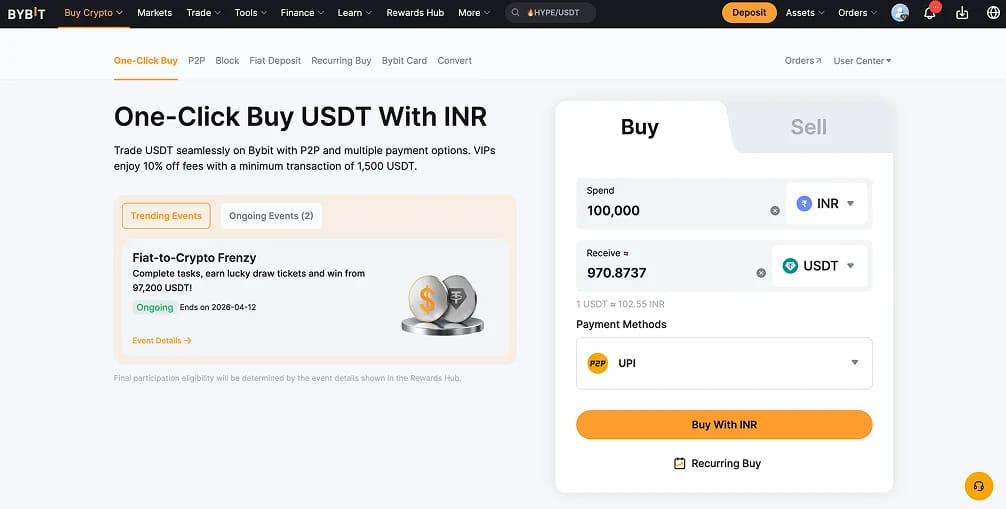
The best way to buy crypto with SBI is to use your account to fund Bybit, then place the trade there. Bybit is registered with India’s Financial Intelligence Unit and supports India-facing funding routes such as cards, P2P, and INR third-party buy flows.
Here is a step-by-step guide to buy crypto with SBI Bank:
- Create a Bybit account: Sign up and complete KYC to unlock fiat purchases and withdrawals.
- Choose your funding method: For smaller buys, UPI or an INR third-party payment route is usually easiest. For larger payments, NEFT or RTGS may be better, while IMPS is useful when faster bank settlement is supported.
- Get the payment details: If you use Bybit’s INR third-party flow, choose INR, select the coin, then follow the provider instructions. Bybit says providers such as Onmeta may ask for extra details during payment review.
- Send a small test payment from SBI: Start with a small amount and double-check the beneficiary details, VPA, or payment reference. First-time transfers and small mismatches often cause more friction than the crypto order itself.
- Buy the crypto once the INR clears: Review the quote, fees, and final amount before confirming. For a first purchase, start small, then scale up once you know which SBI funding method works best.
SBI Bank Fees and Deposit Limits
Before using SBI to buy crypto, check payment rail, card charges, trading fees, cash-out costs, and tax. In India, the biggest leak often comes from payment friction, card markups, and tax, not just the spot fee.
- UPI / IMPS / NEFT / RTGS: SBI gives you several INR rails, and they do not work the same way. NEFT has no minimum or maximum amount, while RTGS starts at ₹2 lakh. SBI says online NEFT and RTGS are free, which makes bank transfer a better fit when a provider gives you account details instead of a UPI ID.
- Card deposits: SBI debit cards can work, but this is usually the least reliable and most expensive funding route. International card transactions can add 3% plus GST in SBI charges alone, before the exchange or payment provider adds its own spread or processing fee.
- Trading fees on Bybit: Fees depend on the screen and product you use. Bybit’s current schedule shows VIP 0 crypto-crypto spot at 0.10% maker / 0.10% taker, while fiat-crypto spot pairs at VIP 0 are 0.15% maker / 0.20% taker. That matters because an INR buy flow can price differently from a standard spot order.
SBI Cryptocurrency Policy
SBI does not run a built-in crypto investing product, so crypto-related activity sits inside its normal payment controls, beneficiary checks, and transaction monitoring. That is clear from SBI’s own YONO fund transfer and beneficiary management flows.
For SBI users, the policy issue is usually payment clearance, not access to Bitcoin inside the bank. SBI’s beneficiary cooling period, transfer controls, and channel-based limits mean an INR bank transfer is often easier to execute cleanly than a higher-friction card payment.
The key compliance check sits with the platform receiving the funds. In India, that means using an exchange with FIU-IND registration and completing full KYC, which is why our editorial team recommends Bybit after its FIU registration announcement.
Best Alternative Crypto Exchanges for SBI
If you want alternatives to Bybit when funding from SBI, focus on platforms that fit India’s actual payment stack: UPI, INR bank transfers, P2P, and debit card funding where it works.
For an SBI user, the strongest choices are crypto exchanges in India that combine FIU-IND compliance, INR-friendly funding, decent execution, and low payment friction.
Here are some of the top options:
*Trust Score is our editorial view based on regulation, INR funding options, fees, execution quality, and India-specific usability.
About SBI
SBI, short for State Bank of India, is the country’s largest bank and a full-scale retail banking network built around products such as YONO, BHIM SBI Pay, NEFT, RTGS, debit cards, and YONO Cash, rather than just a standard savings account.
SBI says it serves over 50 crore customers through 23,226+ branches and 63,580 ATMs/ADWMs, which helps explain why it remains so central to everyday payments, transfers, and digital banking in India.
.webp)
Final Thoughts
SBI can work well for buying Bitcoin, but the better setup in India is to treat the bank as the INR funding rail, not the place where the trade happens.
In most cases, that means using UPI or bank transfer first, keeping card deposits as a backup, starting with a small test payment, and using an FIU-registered platform like Bybit so the payment flow, KYC, and compliance side are aligned with how the Indian market actually works today.