







Compare Top Crypto Exchanges in the United Kingdom
1. Kraken
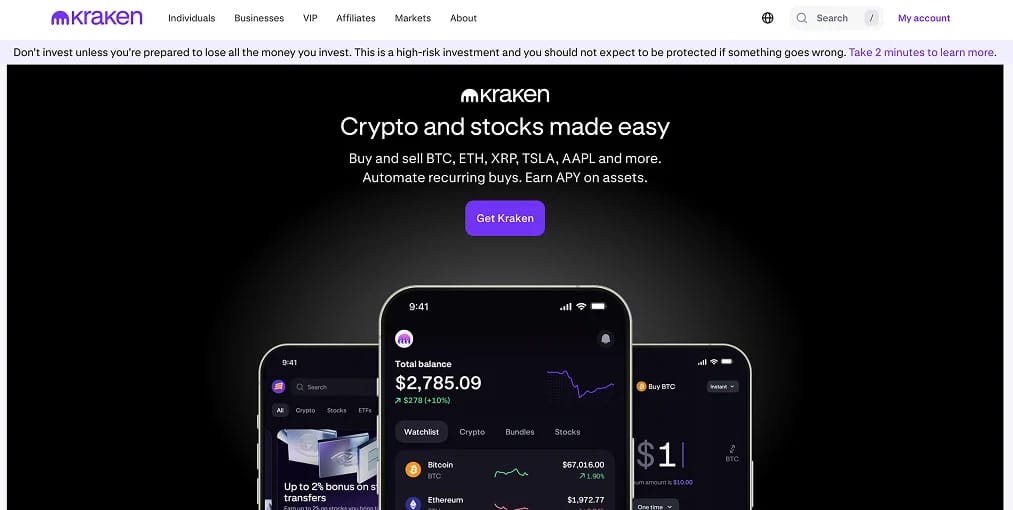
Kraken holds more FCA permissions than any other exchange serving British retail, and the benefit shows up when you move money. Its UK arm Payward Ltd sits on the cryptoasset register, sister company Payward Services gained a full e-money licence in March 2025, and Crypto Facilities holds a separate FCA investment firm authorisation for professional derivatives. That e-money licence means the FCA supervises Kraken's GBP handling under the same rules as payment firms like Wise, which is why Faster Payments deposits are free from £1 and land in under a minute once the first transfer clears.
Trading costs reward anyone willing to leave the simple app. Kraken Pro charges 0.25% maker and 0.40% taker at the base tier, falling with volume, against roughly 1% plus spread on the Instant Buy screen. Kraken listed the first major BTC/GBP pair in 2014 and still runs the deepest sterling order books we tested, it has published proof-of-reserves audits for over a decade, and no customer funds have been lost to a breach since launch in 2011. Staking covers the majors for UK accounts.
The frictions are regulatory rather than Kraken's own. New UK customers complete an appropriateness questionnaire, then wait out a mandatory 24-hour cooling-off period before the first trade, and futures and margin are reserved for professional clients. GBP withdrawals carry a £1.95 charge, small on a serious cash-out and irritating on a £50 one. Our Kraken review covers the rest.
Pros
- Cryptoasset registration, an e-money licence, and an authorised investment firm give Kraken the deepest set of FCA permissions of any exchange here.
- Free Faster Payments deposits from £1, with Kraken Pro fees of 0.25% and 0.40% undercutting every spread-based rival.
- Proof of reserves published since 2014 and no customer funds lost to a breach in fifteen years.
Cons
- A £1.95 fee applies to every GBP withdrawal, and card deposits cost 3.75% plus a fixed charge.
- Futures and margin are limited to professional clients under the retail derivatives ban.
- The appropriateness test and 24-hour cooling-off delay a first purchase by a day.
2. Coinbase
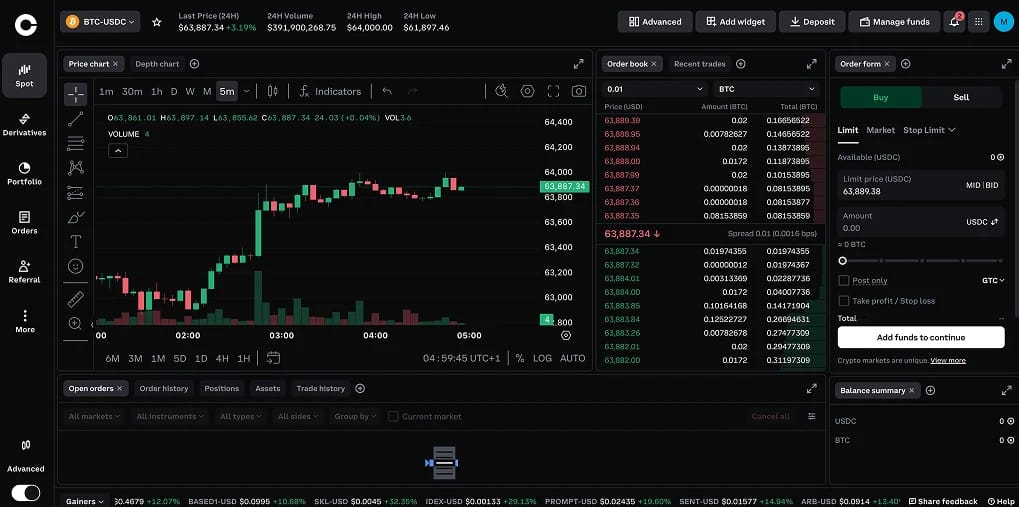
Coinbase pairs the smoothest GBP banking on this list with a level of financial transparency no crypto-native rival can offer. It joined the FCA cryptoasset register in February 2025, its UK arm CB Payments Ltd holds an e-money authorisation, and as an S&P 500 company it publishes audited accounts every quarter. Faster Payments deposits and withdrawals are free, our test transfer was tradable within two minutes, and USDC support gives sterling users a credible dollar stablecoin without leaving the app.
Costs depend on which screen you open. The default buy screen charges a transaction fee plus a hidden spread, while Coinbase Advanced runs a genuine order book with fees from 0.40% maker and 0.60% taker. Switching between the two costs nothing and takes seconds. Around 250 assets are available to UK accounts, staking covers a short list of majors, and the app remains the gentlest introduction here for a first-time buyer. Our Coinbase fees guide breaks the tiers down.
The record has one dent. The FCA fined CB Payments £3.5 million in 2024 for taking on more than 13,000 high-risk customers it had agreed with the regulator not to serve, the FCA's first enforcement action under the e-money rules. The controls have since been rebuilt and the episode says more about 2020-era compliance than today's platform, but it belongs in any fair assessment. Our Coinbase review weighs it all.
Pros
- Free Faster Payments deposits and withdrawals, with funds tradable in minutes.
- S&P 500 membership and audited financials on top of FCA registration and an e-money licence.
- Coinbase Advanced replaces the spread-heavy simple buy with a proper order book in the same app.
Cons
- Advanced fees of 0.40% and 0.60% at the entry tier cost more than Kraken Pro or Bitstamp.
- The 2024 £3.5 million FCA penalty over customer onboarding failures remains a blemish.
- Staking covers only a handful of assets for UK customers.
3. eToro
eToro clears a regulatory bar the rest of this list has not attempted. eToro (UK) Ltd is fully authorised by the FCA as an investment firm under reference 583263, a status that requires it to hold minimum capital, keep client money separate from its own, and answer to the FCA for how it treats customers, none of which a cryptoasset registration demands. The practical draw is breadth. Bitcoin sits in one portfolio with FTSE shares, US stocks, ETFs, and commodities, and CopyTrader lets newcomers mirror vetted investors.
The GBP experience improved once eToro Money UK launched local currency accounts. Holding a GBP account removes the dollar conversion fee that used to hit every deposit, and Faster Payments funding is free. A $100,000 demo account is the best risk-free training ground we tested, and the interface explains its spread rather than hiding it.
Pricing is the trade-off. Crypto carries a flat 1% fee on both buy and sell, plus the market spread, so an in-and-out position costs upwards of 2%. That suits someone buying once a month and punishes anyone trading often, and a $10 monthly inactivity charge starts after a year away. Frequent traders belong on an order book, while investors who want crypto next to their share portfolio will not find a better regulated home.
Pros
- Full FCA authorisation as an investment firm, the highest regulatory status on this list.
- Crypto, stocks, ETFs, and commodities in one account, with CopyTrader and a free $100,000 demo.
- GBP accounts through eToro Money remove currency conversion on deposits and withdrawals.
Cons
- The 1% fee applies on entry and exit, before the spread, making active trading expensive.
- A $10 monthly inactivity fee starts after twelve months without a login.
- Crypto cannot sit inside its Stocks and Shares ISA, which covers traditional assets only.
4. Revolut
Revolut is the convenience pick. Revolut X, the standalone exchange for its UK customers, charges 0% maker and 0.09% taker fees, and money moves instantly between the main Revolut balance and the exchange, so someone already banking with the app can hold Bitcoin within a minute of the thought occurring. The firm holds FCA e-money authorisation, was granted a UK banking licence with restrictions in 2024, and lists over 220 cryptocurrencies alongside stocks, commodities, and savings products.
The headline rate lives only on Revolut X. The main app charges up to 1.49% per trade on entry-level plans, a gap our Revolut crypto fees breakdown maps tier by tier, with spreads on top. Staking covers a set of majors, and on-chain withdrawals are supported for a growing list of tokens.
For a Revolut customer making occasional purchases, or an active trader happy inside the X interface, the maths works. Anyone wanting deep altcoin order books, a standalone exchange, or friction-free self-custody will still prefer the specialists above.
Pros
- Revolut X charges 0% maker and 0.09% taker on a live order book.
- Instant transfers between the banking app and the exchange remove funding delays.
- Crypto sits alongside current accounts, stocks, and commodities in one application.
Cons
- Main-app trades cost up to 1.49% plus spread on entry-level plans.
- The best pricing requires using the separate Revolut X interface.
- Cashing out means passing funds back through the Revolut app rather than straight to any bank.
5. Uphold
Uphold does something none of the larger venues attempt, trading anything against anything in a single step. XRP moves directly into gold, euros, or another altcoin without converting to pounds in between, across 300 or so cryptocurrencies, multiple fiat currencies, and precious metals. FCA registered since 2023 alongside an e-money licence, it publishes a real-time transparency page showing assets held one-to-one against customer balances.
The XRP community adopted Uphold years ago and the loyalty is earned through deep support for the asset. Staking spans more than 20 assets for UK users, and the Uphold debit card converts crypto at the till with cashback and a £10,000 daily spending ceiling. Faster Payments deposits are free, and the app makes a first purchase simple.
Costs are the reason it sits fifth. There is no separate trading fee, with the cost sitting inside the spread at roughly 1.4% on major coins and closer to 3% on smaller ones, making Uphold the most expensive platform here for simple buying and selling. It suits people swapping between asset classes and long-term XRP holders far better than cost-conscious regular buyers. Our Uphold review runs the full numbers.
Pros
- One-step swaps between crypto, fiat currencies, and precious metals with no GBP intermediary.
- Real-time one-to-one reserve transparency plus FCA registration and an e-money licence.
- Staking on 20+ assets and a debit card with cashback and £10,000 daily spending.
Cons
- Spreads of roughly 1.4% to 2.95% make it the costliest platform here for pure trading.
- No order book, so large trades take whatever price the engine quotes.
- Spread pricing is harder to audit than a visible maker and taker schedule.
6. Bitstamp
Bitstamp has been matching orders since 2011, longer than any other exchange in the world, and has served British customers since 2013. The FCA-registered platform now belongs to Robinhood, whose 2025 acquisition added a Nasdaq-listed parent to a venue institutions already trusted for reliable GBP trading. Faster Payments funding is supported, and uptime through volatile sessions has been a Bitstamp signature for years.
Fees are straightforward order book pricing. The base tier charges 0.30% maker and 0.40% taker, dropping to 0.20% and 0.30% once 30-day volume passes $10,000, with TradingView charting built in. The catalogue of around 110 assets leans towards established names, and staking runs on ETH and ADA for UK accounts.
This is a platform for buyers who value a long, uneventful record over novelty. The interface is functional rather than polished, new listings arrive slowly, and there is no ecosystem of cards or earn products. For a large Bitcoin or Ethereum order handled without drama, few venues inspire the same confidence.
Pros
- The longest continuous operating record in crypto, running since 2011 with UK service since 2013.
- Robinhood ownership adds a Nasdaq-listed parent and deeper resources behind the exchange.
- Volume discounts cut fees to 0.20% maker and 0.30% taker past $10,000 in monthly turnover.
Cons
- Around 110 assets, with slow additions and little beyond spot trading and staking.
- The interface trails modern rivals on design and mobile polish.
- Entry-tier fees are higher than Kraken Pro.
How to Choose a Crypto Exchange in the UK
Choosing a crypto exchange in the UK means verifying FCA registration, learning your bank's crypto policy before it surprises you, funding by Faster Payments, and pricing the whole trade rather than the headline fee.
- Check the FCA register, then check the transition: Every platform legally serving UK customers appears on the FCA cryptoasset register. Exchanges can apply for full authorisation from 30 September, and firms that fail to apply before the window closes in February 2027 must wind down UK business when the new regime starts in October 2027. An exchange that talks openly about its authorisation plans is telling you it intends to stay.
- Know your bank's crypto policy before depositing: Chase UK, Starling, TSB, Metro Bank, and Virgin Money block transfers to exchanges entirely, while NatWest caps them at £1,000 a day and £5,000 per 30 days, Santander at £1,000 per transaction, and HSBC and Barclays at £2,500 per transfer. Our guides to buying crypto with Barclays, NatWest, and Monzo cover each bank's rules, and our best crypto-friendly banks in the UK guide lists the accounts that cooperate.
- Fund by Faster Payments, never by card: Bank transfers are free on every platform here and settle in minutes, while debit card deposits cost 1.5% to nearly 4%. Send £20 first. The initial transfer to a new payee may sit in a fraud check, then later payments clear near-instantly.
- Find the pro screen before your first order: Kraken Pro, Coinbase Advanced, and Revolut X replace instant-buy screens that hide costs in the spread with real order books, cutting the cost of an identical purchase by half or more. Run a small buy and immediate sell to measure the true round-trip cost, spread included.
- Plan for HMRC from the first trade: Every registered exchange now collects your details under CARF and reports transaction data annually. Pick a platform with clean CSV exports or integrations with Koinly or Recap, and keep records as you go rather than reconstructing them in January.
Crypto and Bitcoin Regulation in the UK
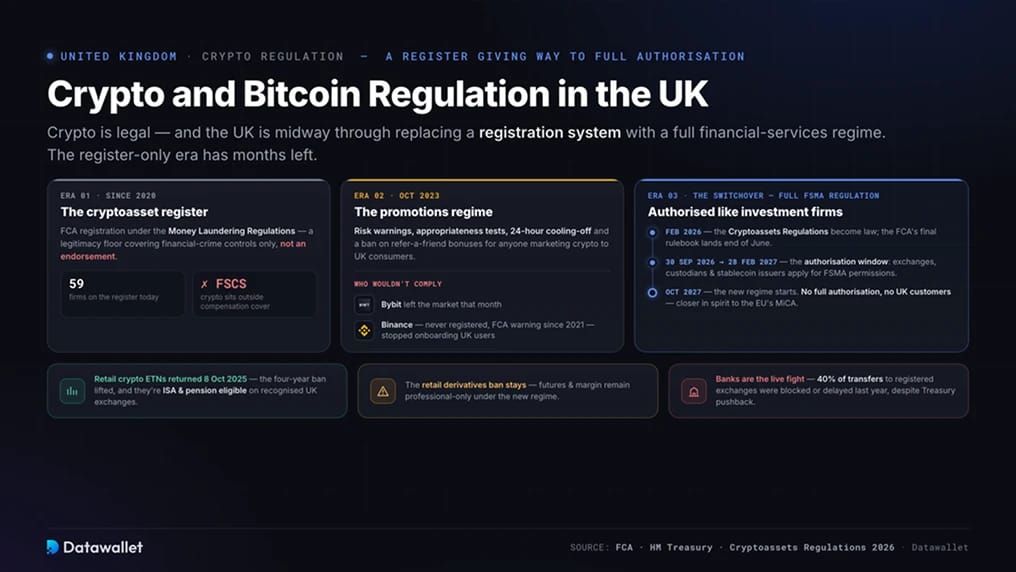
Crypto is legal in the UK, and the country is midway through replacing a registration system with a full financial services regime.
- The cryptoasset register has been the entry requirement since 2020: Firms must register with the FCA under the Money Laundering Regulations before serving UK customers, and 59 sit on the register today. Registration covers financial crime controls only, so it is a legitimacy floor rather than an endorsement, and crypto held on any platform sits outside FSCS protection.
- The financial promotions regime reshaped access in October 2023: Risk warnings, appropriateness tests, 24-hour cooling-off periods for new customers, and a ban on refer-a-friend bonuses became mandatory for anyone marketing crypto to UK consumers. Bybit left the market that month rather than comply, and Binance, never registered and subject to an FCA consumer warning since 2021, stopped onboarding new UK users when its promotions arrangement collapsed.
- Full FSMA regulation arrives in October 2027: The Cryptoassets Regulations became law in February, the FCA published its final rulebook at the end of June, and exchanges can apply for authorisation between 30 September and 28 February 2027. Trading platforms, custodians, and stablecoin issuers will need permissions comparable to traditional investment firms, a shift closer in spirit to the EU's MiCA framework, covered in our guide to the best MiCA-licensed crypto exchanges. The bar is already thinning the field, with Gemini closing all UK accounts in April rather than seek authorisation.
- Retail crypto ETNs returned on 8 October 2025: The FCA lifted its four-year ban on retail access to crypto exchange traded notes listed on recognised UK exchanges, and the products became eligible for ISAs and pensions on the same date. The ban on crypto derivatives for retail investors stays in place.
- Banking access is the live political fight: HM Treasury said in January it does not expect FCA-registered firms to face blanket transaction restrictions from banks, yet most still cap or block transfers, leaving the bank transfer itself as the last unregulated bottleneck in the system.
The exchanges preparing authorisation applications now are the ones planning to be here in 2028, and the register-only era has months left.
How Does the UK Tax Crypto?
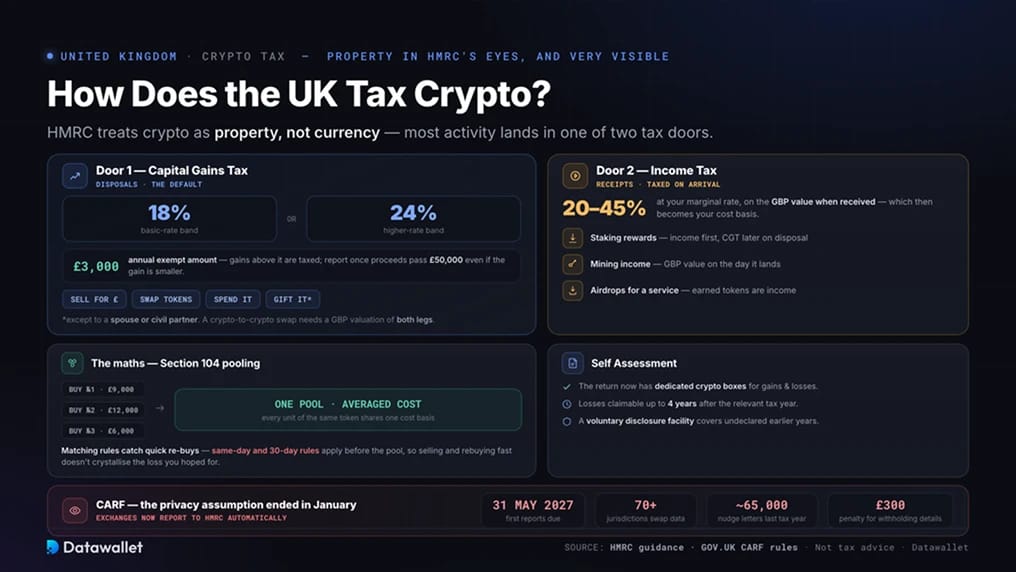
HMRC treats crypto as property rather than currency, and its visibility into UK trading activity took a major step up this year.
- Disposals trigger Capital Gains Tax: Selling for sterling, swapping one token for another, spending crypto, and gifting it to anyone other than a spouse or civil partner all count as disposals. Gains above the £3,000 annual exempt amount are taxed at 18% or 24% depending on your income band, and disposals must be reported once total proceeds pass £50,000 even where the gain is below the allowance.
- Some receipts are income first: Staking rewards, mining income, and airdrops received in return for a service are taxed as income at their GBP value on receipt, at rates from 20% to 45%, and that value becomes the cost basis for a later disposal.
- Pooling rules govern the maths: UK investors calculate gains using the Section 104 pool, which averages the cost of every unit of the same token, with same-day and 30-day matching rules that catch anyone selling and quickly rebuying. Swapping between two cryptoassets requires a GBP valuation of both legs even though no pounds change hands.
- CARF ended the privacy assumption in January: UK exchanges must now collect and report user and transaction data to HMRC, with first reports covering this calendar year due by 31 May 2027 and automatic exchange with more than 70 other jurisdictions from 2027. Users who refuse to supply their details face penalties of up to £300, and HMRC sent around 65,000 nudge letters to suspected non-compliers in the last tax year.
- The Self Assessment return now has crypto boxes: Gains and losses are reported in a dedicated section, losses can be claimed up to four years after the relevant tax year, and a voluntary disclosure facility exists for anyone with undeclared gains from earlier years.
None of this constitutes tax advice, and DeFi positions or high-frequency activity deserve a crypto-literate accountant. For stablecoin purchases specifically, our guide to buying USDT in the UK covers the practical side.
Cryptocurrency Adoption in the UK
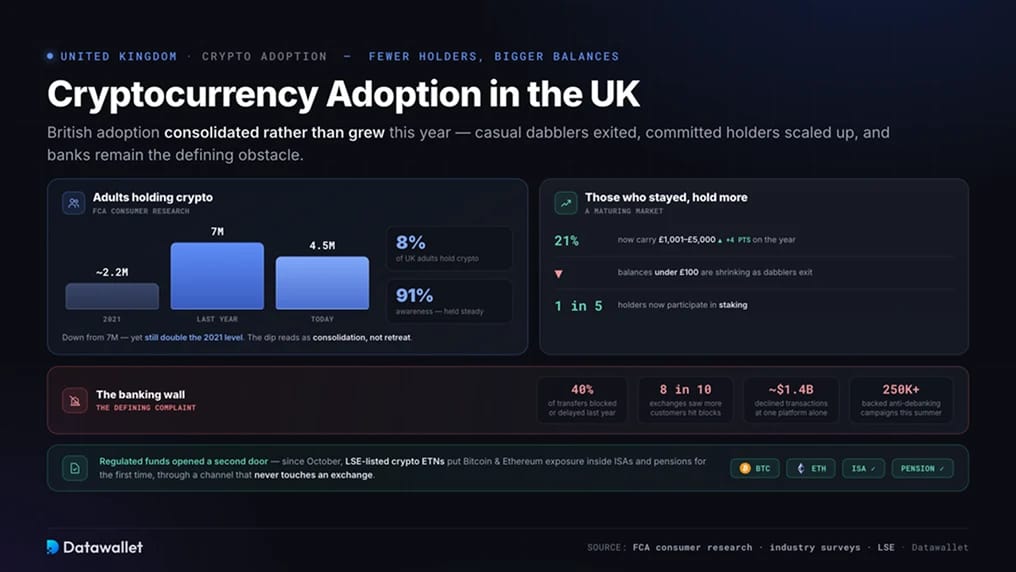
British crypto adoption consolidated rather than grew this past year. The FCA's latest consumer research found around 4.5 million adults hold crypto, 8% of the population, down from 7 million a year earlier yet still double the 2021 level. Awareness held at 91%, and those who stayed hold more, with the share of users carrying £1,001 to £5,000 up four points to 21%, balances under £100 shrinking, and roughly one in five participating in staking.
Bank friction remains the defining complaint. Eight in ten exchanges reported more customers hitting transfer blocks last year, one platform saw nearly $1.4 billion in declined transactions, and industry campaigns against debanking gathered over a quarter of a million supporters this summer.
Regulated fund products opened a second door. Since retail crypto ETNs listed on the London Stock Exchange became available in October, British investors can hold Bitcoin and Ethereum exposure inside ISAs and pensions for the first time, through a channel that never touches an exchange.
Global comparisons can be found on our crypto adoption statistics page, and the UK pattern reads as a maturing market, with casual dabblers exiting and committed holders scaling up despite the banking obstacles.
How to Buy Bitcoin in the UK
Buying Bitcoin in the UK takes about a day thanks to the mandatory cooling-off period, and the cheapest path pairs a free Faster Payments deposit with a limit order on a pro interface.
- Pick the platform that fits your habits: Kraken for the strongest mix of low fees and licensing, Coinbase for the easiest start, eToro for crypto alongside shares, Revolut X for anyone already inside the app. Confirm the FCA registration before signing up.
- Verify and clear the regulatory checks: A passport or driving licence handles identity in minutes, then UK rules require an appropriateness questionnaire on crypto risk, followed by a 24-hour cooling-off period before your first purchase.
- Deposit GBP by Faster Payments: It is free on every platform here and settles in minutes once your bank releases the first payment to a new payee. Skip debit cards, which add 1.5% to 4% for no benefit beyond immediacy.
- Buy with a limit order on the pro screen: A BTC/GBP limit order on Kraken Pro, Coinbase Advanced, or Revolut X avoids the instant-buy spread and typically saves 1% or more per purchase.
- Decide on custody and start a record: Active traders can stay on a registered exchange, while long-term holders should move coins to self-custody, an option our best crypto wallets guide compares. Export your transaction history as you go, because HMRC will already hold the exchange's copy.
Selling reverses the steps, with GBP withdrawals landing back in your current account in minutes on most platforms.
Final Thoughts
Kraken takes the top spot for combining the deepest FCA credentials with free Faster Payments funding and the lowest all-in costs of any full exchange. Coinbase turns public-company transparency into peace of mind for beginners, eToro is the pick for holding crypto beside stocks under full FCA authorisation, Revolut folds crypto into the app millions already bank with, Uphold serves multi-asset swappers and the XRP faithful, and Bitstamp offers the longest record in the industry.
The bigger story is structural. Within eighteen months the register that defined this market gives way to full authorisation, HMRC already receives exchange data automatically, and crypto exposure now lives inside ISAs through listed ETNs. The remaining weak link is the bank transfer itself, where bank policy rather than regulation decides who participates.
Whichever platform you choose, put £100 through the full loop before committing real size. Deposit by Faster Payments, buy on the pro screen, sell, and withdraw. The all-in cost and any friction from your bank will tell you more than any review can.
Readers weighing EU alternatives can compare the neighbouring market in our guide to the best crypto exchanges in Europe.
Our Methodology
We opened accounts on each exchange, completed KYC with UK documents, passed the appropriateness assessments, funded through Faster Payments and cards, traded the live GBP order books, and withdrew sterling back out. Each platform scored across six criteria.
- Trust Score: Our proprietary rating out of 5, weighting FCA regulatory standing, custody and reserve transparency, security history, longevity, and audit coverage.
- GBP Funding Methods: Confirmed Faster Payments, BACS, CHAPS, and card support, measuring settlement speed, new-payee holds, deposit minimums, and withdrawal times and fees.
- Regulatory Standing: Verified cryptoasset registration, e-money or investment firm authorisations, enforcement history, and readiness for the authorisation window opening on 30 September.
- Security Track Record: Reviewed breach history, cold storage arrangements, proof-of-reserves cadence, certifications such as SOC 2, and account protections including 2FA and withdrawal allowlisting.
- Assets and Liquidity: Placed market and limit orders on BTC/GBP, ETH/GBP, and at least one mid-cap pair per venue, measuring spread, depth, and fill quality against mid-market.
- Fee Structure: Compared maker and taker schedules, instant-buy spreads, funding costs, and the all-in cost of a £1,000 round trip on each platform.
We excluded platforms absent from the FCA cryptoasset register, those without a compliant UK onboarding path, and any exchange with unresolved UK enforcement actions. Testing ran from March to July, with regulatory statuses rechecked after the FCA published its final authorisation rulebook at the end of June.
.webp)