







Can I Buy USDT in Singapore?
Yes. Buying, holding, and selling USDT is legal in Singapore, inside one of Asia's most developed regulatory regimes. Digital payment tokens (DPTs) like USDT are not legal tender, and MAS has said plainly it does not consider them suitable for retail investors, but residents can trade them through licensed platforms.
The legal channel runs through DPT service providers licensed under the Payment Services Act 2019. These firms must meet MAS standards for anti-money-laundering, technology risk, and customer-asset safeguarding. As of early 2026, the licensed group spans global names like Coinbase, OKX, Crypto.com, and Bitstamp, plus Singapore-based Coinhako and Australian-founded Independent Reserve.
One thing people miss: a Payment Services Act licence is not MAS endorsing crypto as an asset. It certifies the operator meets AML, cyber, and asset-safeguarding rules. The token still carries the same volatility risk it does anywhere.
For a resident wanting a regulated, SGD-native path into USDT in 2026, Coinbase is my default, with OKX the alternative for buyers needing multi-chain USDT and lower fees.
How to Buy Tether (USDT) in Singapore
The setup is a Coinbase Singapore account funded by SGD over PayNow. Singpass integration handles verification, so onboarding is mostly automatic if you already hold a Singpass account, as nearly every resident does.
On my first order, the deposit surprised me: PayNow cleared SGD into my Coinbase balance in seconds, free. The friction came at withdrawal, where Coinbase offered USDT only on Ethereum. More on that below.
Steps to buy USDT on Coinbase in Singapore:
- Create a Coinbase account. Sign up at Coinbase and verify with Singpass Myinfo. Pre-filled details usually clear verification in minutes, with no manual document review.
- Add an SGD payment method. Link a bank account via FAST or PayNow under payment methods. It must be in your own name; Coinbase rejects third-party transfers from services like Wise, Revolut, Google Pay, or GrabPay.
- Deposit SGD. Use PayNow for a zero-fee, near-instant top-up, or FAST for a direct bank transfer. Deposit instructions are unique to your account, with no reference needed.
- Buy USDT. When your SGD balance shows, search USDT and place a buy order. The screen surfaces USDC first since Coinbase promotes its own stablecoin, so select Tether specifically. Coinbase blocks card payments for USDT, so fund from your SGD balance.
- Hold or withdraw. USDT lands in your balance at once. To move it on-chain, check the network first: Coinbase supports USDT only as ERC-20, so withdrawals settle on Ethereum and pay Ethereum gas.
If you want USDT on a cheaper network like Tron (TRC20) for onward transfers, OKX is the licensed venue listing multiple USDT chains. Coinbase stays the better place to buy and hold inside a regulated SGD wrapper.
SGD to USDT Fees
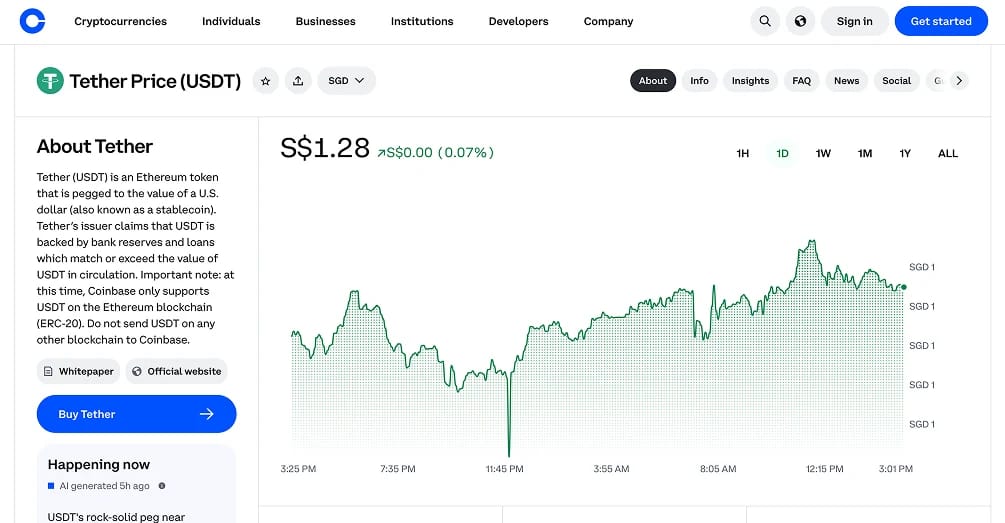
Coinbase runs two interfaces, and the gap between them drives most of your cost. The simple buy screen bakes in a spread of about 0.5%. Coinbase Advanced uses transparent maker-taker pricing with no spread.
Deposits
- PayNow (recommended): Free and near-instant for SGD, the cheapest and fastest way to fund.
- FAST bank transfer: Free, settling within seconds in banking hours. A first FAST deposit also verifies your bank account.
- SWIFT (USD): Free if you hold US dollars and prefer the USD book.
- Cards: Visa and Mastercard work for many assets but cannot buy USDT on Coinbase, and cost far more than bank transfers anyway.
Trading and Conversion
- Simple buy screen: Roughly 0.5% spread plus a variable fee by order size. Fine once, costly if repeated.
- Coinbase Advanced: Maker-taker fees from 0.00% to 0.60% scaling with 30-day volume, no spread. Use it for anything past a first buy. Full detail in our Coinbase fees breakdown.
- Coinbase One: From about S$4.99 per month for zero trading fees up to a monthly cap, worth modelling if you trade often.
- USDT withdrawal fees: USDT exits only on Ethereum, so cost tracks live ETH gas, usually a few dollars and more during congestion. This is the price of ERC-20-only support versus TRC20 elsewhere.
Off-Ramp Back to SGD
Selling back mirrors the buy side: convert USDT to SGD, then withdraw to your bank via FAST or PayNow free. The round trip on a PayNow loop is quick and sits well under typical bank FX costs.
Best USDT Exchanges in Singapore
The table ranks the top crypto exchanges in Singapore for USDT, weighted on SGD funding, MAS licensing, fees, and how cleanly each handles Tether.
The 2026 order is Coinbase for the safest regulated SGD-to-USDT entry, OKX for multi-chain USDT at the lowest fees, and Independent Reserve or Coinhako for a smaller locally focused venue. Bybit, the default on many of our other country pages, is absent here because it is not MAS-licensed for Singapore retail.
Regulatory Status of USDT in Singapore
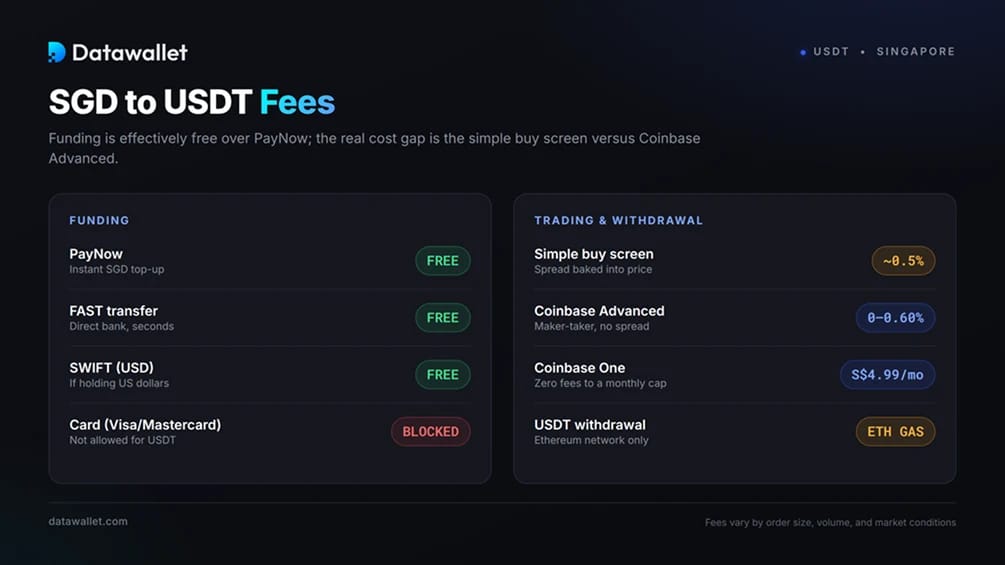
MAS regulates crypto through two frameworks that matter to a USDT buyer: the Payment Services Act 2019 governs the exchanges, and a separate framework governs which tokens earn the MAS-regulated stablecoin label.
In April 2024, MAS expanded the Payment Services Act with user-protection rules for DPT providers. Licensed platforms now hold customer assets on trust, segregated from their own funds. Retail customers cannot buy DPTs with a Singapore-issued card (foreign cards are allowed), get no incentives, margin, or leverage, and must pass a risk-awareness check first. Retail status is automatic unless you clear accredited-investor thresholds like S$1 million in net financial assets or S$300,000 in annual income.
On tokens, MAS finalised its stablecoin framework in August 2023. The MAS-regulated stablecoin label covers only single-currency stablecoins pegged to the SGD or a G10 currency and issued in Singapore. USDT and USDC are both issued overseas, so they stay digital payment tokens under the Payment Services Act, not regulated stablecoins. The local contenders for the label are names like StraitsX's XSGD.
MAS tightened its perimeter again in 2025. Since 30 June 2025, the Financial Services and Markets Act requires Singapore-incorporated firms serving only overseas customers to be licensed, and MAS grants those licences only in rare cases. It does not affect a resident buying through a local exchange, but it shows how little tolerance MAS has for unsupervised operators on its soil.
Tax Implications of USDT in Singapore
Singapore is among the better places worldwide to hold crypto, USDT included. The headline points are simple; the trading-versus-investing line is where people slip.
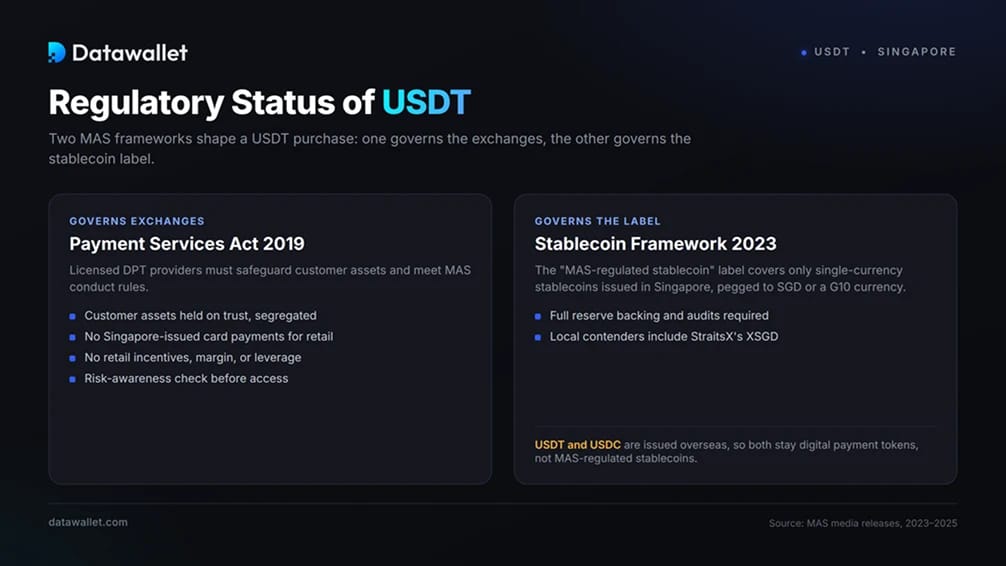
- No capital gains tax for individuals. Singapore has never had one. Gains from selling USDT or any token as a personal investment are not taxed, the same treatment as shares or property.
- GST exemption since 2020. Exchanging qualifying digital payment tokens, including buying and selling USDT, has been GST-exempt since 1 January 2020. The current 9% GST does not apply to the token exchange, though service fees can.
- Trading as a business is taxable. If activity resembles a trade rather than investment, profits become taxable income. IRAS applies its badges of trade test, weighing frequency, holding period, organisation, and intent. Individual income tax reaches 24% and corporate tax 17%.
- Records still matter. Even untaxed, IRAS can ask you to prove activity was investment in nature. Keep dated records of each transaction, the SGD value at the time, and fees. Data-sharing makes the "no one will know" assumption increasingly unsafe.
For a buyer holding USDT as a dollar proxy or trading base, personal-investment treatment means no tax event on a normal buy-and-hold. Trade at volume or through a company and a Singapore tax adviser earns their fee before you scale. This is general information, not tax advice.
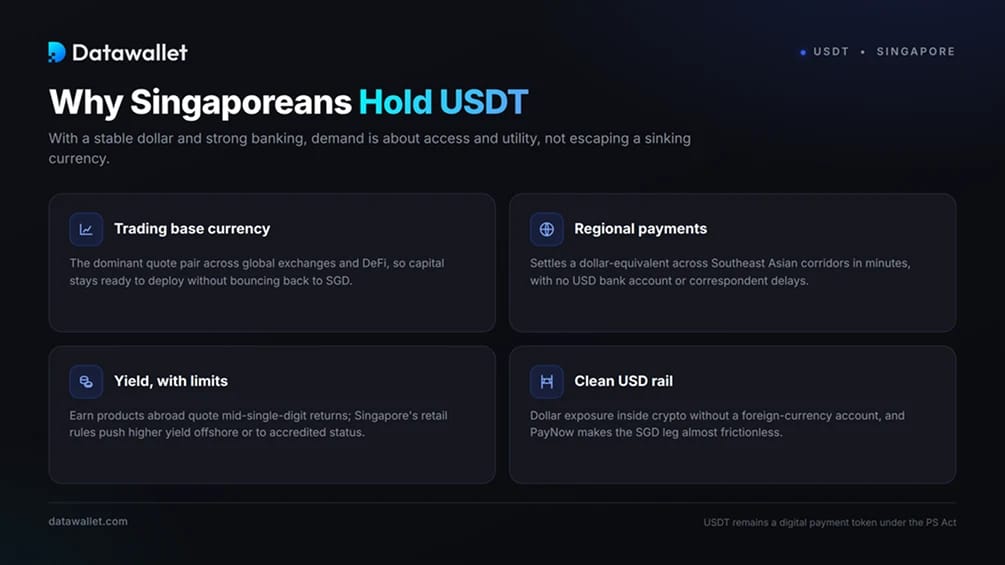
Why Singaporeans Hold USDT
USDT demand in Singapore looks nothing like demand in a high-inflation economy. The SGD is stable and banking works, so people hold a dollar stablecoin for access and utility, not to flee a sinking currency.
- Trading base currency. USDT is the dominant quote pair across global exchanges and DeFi. Holding it lets a trader move between positions without bouncing back to SGD each time, saving conversion friction and keeping capital deployable.
- Regional payments and dollar access. Singapore sits at the centre of Southeast Asian trade and remittance corridors. USDT settles a dollar-equivalent across borders in minutes, without a USD bank account or correspondent-banking delays.
- Yield, with onshore limits. USDT earn products abroad have quoted mid-single-digit returns. Singapore's retail rules bar licensed providers from offering lending or staking incentives to retail, so higher-yield products sit offshore or behind accredited-investor status. Coinbase instead rewards USDC holders, part of why its interface nudges that way.
- A clean USD-equivalent rail. For dollar exposure inside crypto without a foreign-currency account, USDT on a licensed exchange is low-effort, and PayNow makes the SGD leg almost frictionless.
For most residents, the question is not whether to use USDT but where to source it safely. A MAS-licensed venue with SGD funding answers that, which is why the regulated options above outweigh offshore platforms with looser oversight.
Final Thoughts
Coinbase is the answer I give most Singapore buyers in 2026. It holds a full MAS Major Payment Institution licence from October 2023, verifies you through Singpass in minutes, takes SGD over PayNow free, and holds customer assets under the trust rules MAS enforces. For a regulated, low-friction first USDT purchase, nothing else pairs those four as cleanly.
The caveat is Tether-specific. Coinbase supports USDT only on Ethereum, so if you plan to move it cheaply on Tron, OKX is the licensed venue built for it, with multi-chain support and lower fees. Coinbase wins on safety and ease of entry; OKX wins on USDT mechanics and cost.
The playbook: open a Coinbase account, verify with Singpass, link an own-name bank account, run a small PayNow-funded test buy, then move to Coinbase Advanced before trading in size. Keep records even though personal gains are untaxed, and revisit your venue if you shift from holding USDT to moving it across chains.
.webp)