







Can I Buy Bitcoin with SpareBank 1?
Yes. You can fund a licensed crypto exchange in Norway from your SpareBank 1 account and buy Bitcoin there. None of the 12 alliance banks offer crypto trading or custody, and their share-dealing service covers Oslo Børs.
SpareBank 1 has no published rule blocking payments to exchanges. Its written rules concern money returning to the bank, which each alliance member screens under Norway's anti-money-laundering law. When we funded an exchange from a SpareBank 1 account for our Norway guide, the deposit was instantly credited.
How to Buy Crypto with SpareBank 1
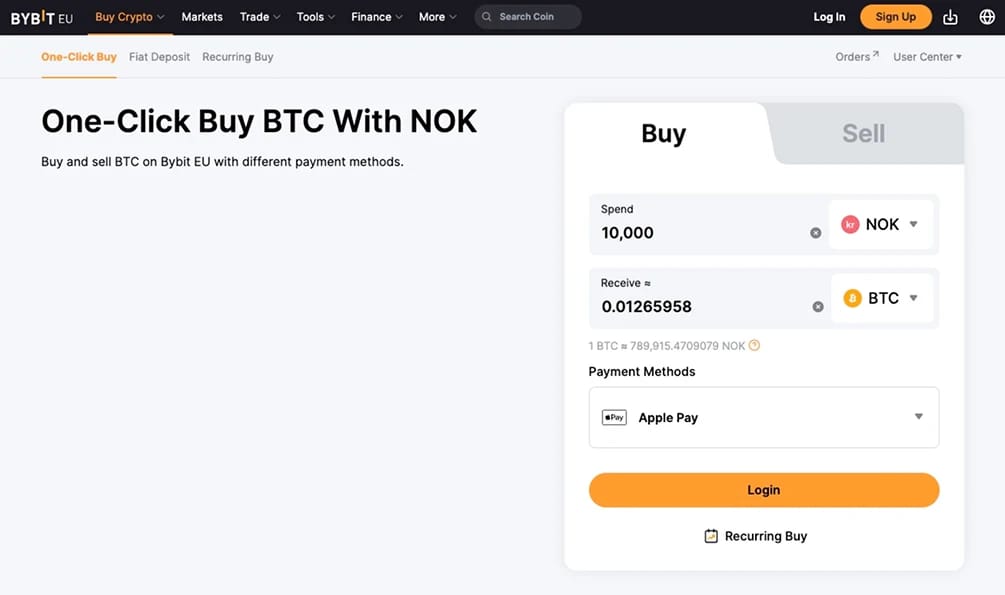
Bybit EU accepts kroner from a SpareBank 1 card, so smaller purchases need no foreign payment or currency conversion at the bank. The steps below use the Bybit EU app and the SpareBank 1 mobile banking app.
Follow these steps to buy crypto with SpareBank 1:
- Open and verify a Bybit EU account: Register on Bybit EU with a Norwegian passport or national ID card. Fiat deposits stay locked until identity verification is complete. Bybit EU GmbH serves Norway from Vienna under its MiCA license.
- Select NOK under Top Up: Open Top Up in the Bybit EU app and choose NOK as the currency. Bybit EU lists Norway for Visa, Mastercard, Apple Pay, Google Pay, and PayPal, and the deposit page shows every method your account can use.
- Prepare your SpareBank 1 card: Bybit EU only accepts cards registered to the account holder that allow international online payments and support 3D Secure, so check your card settings in the SpareBank 1 app first.
- Pay in kroner: Enter the amount and approve the 3D Secure prompt from SpareBank 1. Bybit EU charges no deposit fee; the card processor's fee appears before you confirm.
- Buy your crypto: With the kroner credited, buy Bitcoin or another coin from your fiat balance, and check the quoted price before confirming.
SpareBank 1's Rules for Crypto Withdrawals
Returning sale proceeds to SpareBank 1 attracts far more scrutiny than buying. SpareBank 1 Østlandet sets out its conditions for crypto gains, with near-identical wording used by Lom og Skjåk, Gudbrandsdal and Sogn og Fjordane.
- Complete history: Provide a record of every transaction from purchase to bank deposit. Lom og Skjåk asks for buy and sell history from all exchanges used, plus wallet statements showing balances over time.
- Origin of funds: When another bank funded the crypto purchase, you must show how that money was earned.
- A reporting exchange: As a general rule, trades should pass through an exchange that reports to Norwegian authorities. These pages still cite Finanstilsynet's former register of exchange and custody providers, which MiCA authorization has replaced.
- Tax evidence: Show that holdings and gains were declared to Skatteetaten, the Norwegian Tax Administration.
- Norwegian translation: Documents must show your personal details and be in Norwegian. Lom og Skjåk may also ask for a legitimacy report from the exchange at your expense.
- Processing time: Reviews can take several weeks, Lom og Skjåk warns. Funds may remain frozen until approval, and some are returned.
Large sums receive the heaviest review, including crypto gains used as equity for a home. Keeping records from the first trade takes minutes, whereas rebuilding years of exchange history can delay a property purchase.
Fees, Tax and Transfer Limits for SpareBank 1 Customers
With euro funding, you pay the bank's transfer fee and kroner conversion margin on top of the exchange's trading fee. Both bank charges depend on the alliance member and payment size.
SpareBank 1 costs and limits
- Euro transfer fee: A EUR payment to the EU or EEA through digital banking costs NOK 0 at Sør-Norge and Nord-Norge. Sogn og Fjordane charges NOK 20, SMN NOK 30 and Østlandet NOK 35. At Ringerike Hadeland, the fee starts at NOK 75.
- Currency conversion: SpareBank 1 uses the rate in force when it processes the payment. Its currency calculator is only indicative; compare the rate on your receipt with the mid-market rate to see the margin.
- Large amounts: For foreign payments above NOK 500,000, SpareBank 1 Østfold Akershus suggests agreeing a rate in advance.
- Payment limit: You set your own beløpsgrense, the calendar-month cap on bill payments, in the payment settings. Raise it before a large first deposit.
- Card deposits: Paying Bybit EU in kroner by card involves no foreign transfer, so the transfer fee and bank conversion margin fall away.
- Deposit guarantee: Bankenes sikringsfond covers deposits up to NOK 2 million per depositor per bank. Each alliance bank is a separate member. Coins held on an exchange have no such protection.
Bybit EU fees
- Spot trading until 5 October: Buying coins outright is spot trading. At the entry tier, taker orders fill immediately and cost 0.25%. However, maker orders cost 0.10% on crypto pairs or 0.15% on fiat pairs such as BTC/EUR.
- Spot trading from 5 October: Bybit EU switches to one rate of 0.25% for both order types. Accounts trading EUR 100,000 or more in spot over 30 days pay 0.22%.
- Deposits: Bybit EU charges nothing to receive fiat, though card and wallet processors may add their own fee. Deposits usually credit within three working days, and if Bybit cannot match a transfer, it asks for proof of payment, with review taking about two business days.
- Withdrawals: Crypto withdrawals carry a network fee per coin and chain. Euro payouts must go to an account in your name, usually the one used for deposits.
Norwegian tax on crypto
- Gains and losses: Skatteetaten treats crypto as an asset. Gains are taxed as capital income at 22%, and documented losses are deductible at the same rate.
- Taxable events: Selling for kroner, swapping coins and paying with crypto count as realization. Gifts do not.
- Staking and mining: Proof-of-stake and mining rewards count as income when received.
- Deductible costs: Documented trading and network fees reduce the gain or increase the loss.
- Wealth tax: Holdings are valued at the market price on 1 January following the income year. For 2026, the combined state and municipal rate is 1.0% on net wealth over NOK 1.9 million and 1.1% beyond NOK 21.5 million.
- Automatic reporting: CARF, the OECD crypto reporting standard, has been in force since 1 January 2026. Exchanges and custodians report users' transactions and holdings to Skatteetaten each year, with the first reports in 2027.
- Corrections: You can amend returns for the preceding three years. Fixing errors before Skatteetaten opens a review can avoid additional tax.
An SMN customer buying NOK 20,000 of Bitcoin pays NOK 30 for the euro transfer, plus the conversion margin, and about NOK 20 in Bybit EU trading fees at 0.1%. At Firi, the same purchase costs about NOK 140 in fees when funded by free bank transfer, with no currency conversion. Withdrawing the kroner after a later sale adds NOK 69.
Best Exchanges for SpareBank 1 Customers
Each of these four platforms holds MiCA authorization valid in Norway. Bybit EU has the lowest entry-tier fee, and Firi is the only one accepting kroner by bank transfer. Kraken suits larger balances, while Coinbase offers the simplest first account.
Earlier versions of this page included Binance. The exchange withdrew its Greek MiCA application in June and began winding down European services on 1 July. Our Bybit, Kraken and Coinbase reviews cover the remaining platforms.
SpareBank 1 Cryptocurrency Policy
SpareBank 1 offers no crypto product and has not announced one. Its policy pages describe crypto trading as legal but high-risk because of price swings and criminal misuse. The alliance's main control is anti-money-laundering review of incoming proceeds rather than blocks on outgoing payments.
At SpareBank 1 Utvikling, the alliance's development company, fraud accounts for much of that caution. Anti-fraud head Anna Rønning warned in June that investment scams increasingly start on social media, in comment sections and in private messages. They often use famous names and fake news articles. SpareBank 1 lists requests for BankID codes as a warning sign.
The bank's published rules lag behind regulatory changes. Norway's Crypto Assets Act (kryptoeiendelsloven) took effect on 1 July 2025 under Finanstilsynet's supervision, with transition rights for previously registered providers running until 1 July 2026. Finanstilsynet authorized Firi from 22 May, making it the first trading platform licensed as a crypto-asset service provider (CASP).
Foreign exchanges serve Norway by passporting a license from another EEA country. Several SpareBank 1 banks still direct customers to the pre-MiCA register. Check your platform in ESMA's register and keep its authorization details with your records. Our list of MiCA-licensed exchanges compares the choices.
About SpareBank 1
Founded in 1996, SpareBank 1 brings together 12 independent savings banks under a common brand and technology platform to keep regional banks competitive. The alliance says it is Norway's second-largest finance group by assets. Each bank retains its own board and price list, explaining why one member charges NOK 0 for a euro transfer and another NOK 75.
Members include Sør-Norge, SMN, Nord-Norge, Østlandet and Østfold Akershus, alongside seven smaller regional banks. They cooperate through SpareBank 1 Gruppen, which owns insurers Fremtind and SpareBank 1 Forsikring, and SpareBank 1 Utvikling, owner of the EiendomsMegler 1 estate agency. Norway's trade union confederation, LO, holds 9.6% of SpareBank 1 Gruppen.
The banks also directly own BN Bank, SpareBank 1 Markets and SpareBank 1 Betaling. Customers use BankID to sign in, and the shared mobile bank handles domestic payments, foreign transfers, and share dealing.
.webp)
Bottom Line
SpareBank 1 allows customers to fund crypto purchases but asks detailed questions when the money returns. Check your alliance bank's euro transfer fee before buying, and keep records of every trade from the start.
Our first choice is Bybit EU for its Austrian MiCA license and single 0.25% entry-tier fee from 5 October. Choose Firi if kroner deposits and Norwegian supervision matter more to you than trading costs. Exchanges now report to Skatteetaten under CARF, so declare holdings and gains by the 30 April tax deadline.
.webp)