



About Uphold
Halsey Minor, the entrepreneur behind CNET, founded Uphold in 2013 as a Bitcoin storage service called Bitreserve, rebranding it in 2015 into today's multi-asset platform. Headquartered in New York and led by CEO Simon McLoughlin, it serves more than 10 million customers across 140+ countries.
The core idea has never changed. Every supported asset sits in one wallet and trades directly against any other, so a customer can move from Solana into gold, or Bitcoin into Berkshire Hathaway shares, in one step without routing through dollars. Uphold sources liquidity from more than 30 trading venues, spanning centralized exchanges, DEXs, and market makers.
The business is in transition. Revenue grew from $80 million in 2022 to roughly $300 million in 2025, and the board hired FT Partners to explore a Nasdaq listing or trade sale above a $1.5 billion valuation. Then in July 2026, Uphold cut 17% of its global headcount and leaned harder into enterprise infrastructure, while promising tokenized securities, asset-backed lending, credit cards, and prediction markets in the consumer app by year-end.
Uphold Features
Uphold is a brokerage built around breadth rather than trading depth, so the feature list reads more like a fintech app than an exchange. Here is what the account includes:
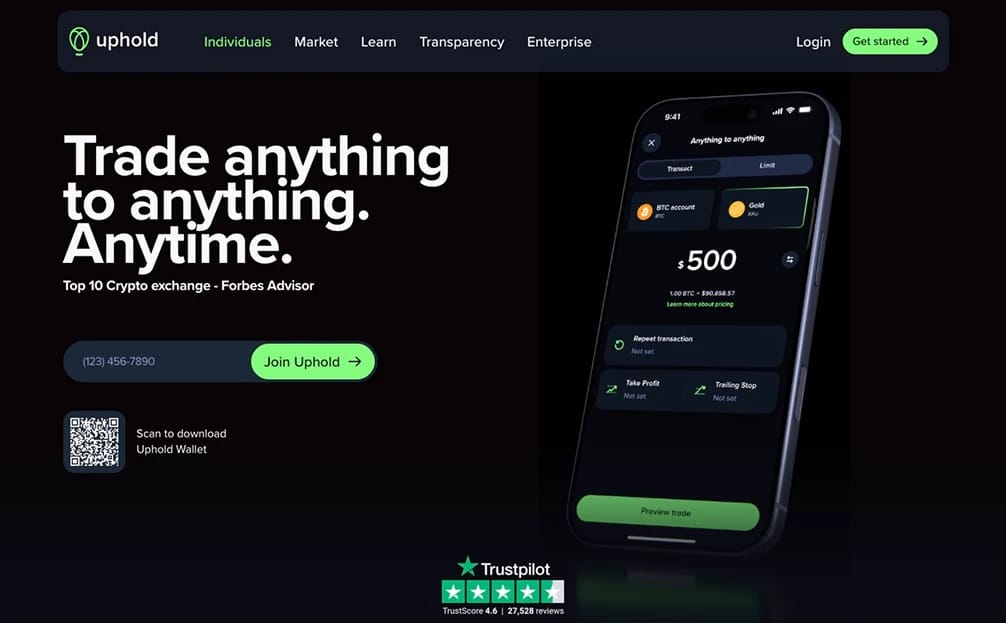
- Anything-to-anything trading: Direct conversions between any two supported assets, with the all-in price shown on the preview screen and held for 18 seconds before you confirm. Market, limit, take profit, and trailing stop orders are available, but there is no order book, charting workspace, or margin.
- Staking: Boosted staking covers around 20 proof-of-stake assets including ETH, SOL, and NEAR, with US access reinstated in March 2025. Uphold takes a 20% to 25% commission on Boosted rewards and 50% on Flexible staking, so run the advertised APY through our crypto staking calculator before assuming the headline rate.
- Uphold Debit Card: Relaunched in the US in October 2025 after a two-year absence, the Visa card issued by Cross River Bank spends any of the 300+ assets and pays XRP back on purchases. Standard rates sit at 3% to 4% depending on card tier and funding source, with promotional rates up to 6% plus a direct deposit bonus.
- USD Interest Account: US customers earn up to 4.5% APY on dollar balances of $1,000 or more, swept to FDIC-member partner banks. Balances under the threshold earn 2%.
- Vault and UpHODL: Vault is an assisted self-custody product using a two-of-three key scheme where you hold two keys, while UpHODL is a separate fully self-custodial multi-chain wallet app for tokens and NFTs.
- Enterprise services: OTC trading, treasury management, the Topper fiat on-ramp, and card issuance through Optimus now form a growing share of the business, serving banks, fintechs, and broker-dealers rather than retail users.
There are no perpetuals, futures, or margin products anywhere on the platform, which is a deliberate choice rather than a gap. Anyone who needs derivatives will need a second venue.
.webp)
Equities on Uphold
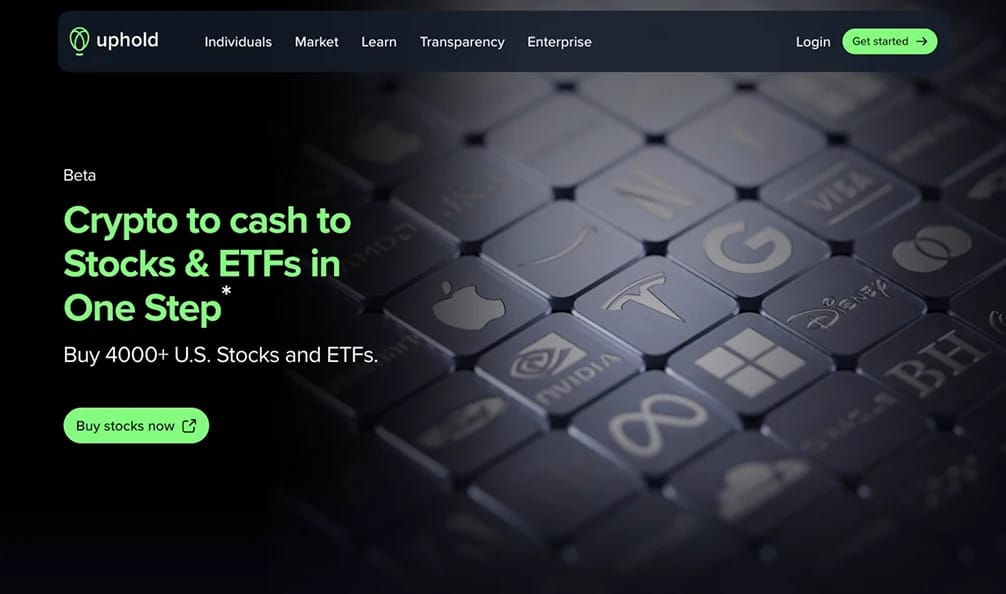
The most consequential launch of 2026 is share trading. Since July 21, 2026, US customers can trade more than 4,000 US stocks and ETFs inside the same app, with no Uphold commission and fractional share support from small dollar amounts.
What separates this from Robinhood or a standard broker is the settlement path. A customer can sell Bitcoin and buy Nvidia in one step, without converting to cash balances first or wiring funds to a separate brokerage. Equities are held through Uphold Securities Inc., a distinct affiliated legal entity from the crypto business, and extended trading hours are planned to stretch to 24/5.
These are real registered shares rather than synthetic tokens, which puts the product in a different category from the offshore wrappers we cover in our best tokenized stock trading exchanges guide. The trade-off is availability, since the service is US-only at launch while McLoughlin has flagged tokenized securities as the likely route for international customers later.
Uphold Fees Explained
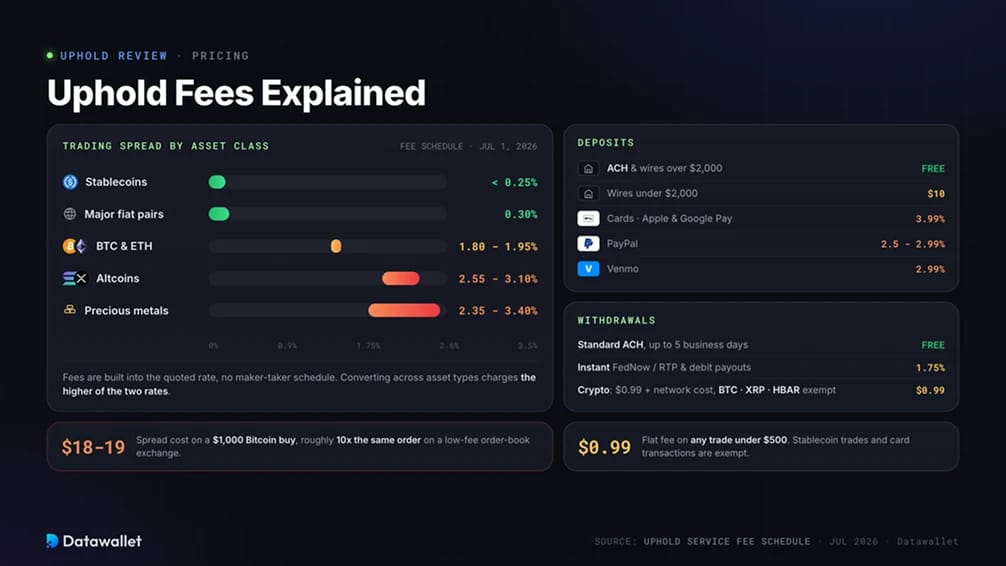
Uphold prices everything through a spread built into the quoted rate rather than a maker-taker schedule, and convenience costs real money here. The service fee schedule, last updated July 1, 2026, breaks down as follows:
- Trading spreads: Stablecoins trade under 0.25% and major fiat pairs at 0.3%, but Bitcoin and Ethereum run 1.8% to 1.95%, altcoins 2.55% to 3.10%, and precious metals 2.35% to 3.40%. Converting between two asset types charges the higher rate.
- Small trade fee: A flat $0.99 applies to any trade under $500, which stings on small recurring buys, though stablecoin trades and card transactions are exempt.
- Deposits: ACH and wires over $2,000 are free, wires under $2,000 cost $10, cards and Apple/Google Pay cost 3.99%, PayPal 2.5% to 2.99%, and Venmo 2.99%.
- Fiat withdrawals: Standard ACH is free within five business days, while instant withdrawals to FedNow or RTP banks and debit card payouts carry a 1.75% fee with a $1 minimum.
- Crypto withdrawals: A flat $0.99 platform fee plus the network cost applies on most chains, with BTC, XRP, and HBAR exempt from the platform fee. The full amount is itemized before you confirm.
Pricing is transparent, since the preview screen shows the exact all-in figure and nothing changes before confirmation. But a $1,000 Bitcoin buy costing around $18 to $19 in spread is roughly ten times the same order on a low-fee order book, so treat Uphold as a funding and diversification hub rather than an active trading venue.
Is Uphold Regulated?
Yes, though the regulatory picture in 2026 splits sharply by region, and where you live determines both your legal counterparty and what you can actually do.
- United States: Uphold HQ Inc. is registered with FinCEN as a Money Services Business and holds state money transmitter licenses, with its regulator list published in full.
- United Kingdom: Uphold Europe Limited is registered with the FCA as a cryptoasset business under the UK's money laundering regulations, and the UK remains one of its strongest markets with a locally issued debit card.
- European Economic Area: Uphold Digital Assets Europe is supervised by the Bank of Portugal and the CMVM, but its MiCA CASP application was still under review when the transition window closed. From July 1, 2026, all crypto and fiat deposits for EEA customers are paused until authorization lands, with withdrawals unaffected.
- Global entity: Uphold Worldwide Ltd. is incorporated in the Bahamas and operates under the DARE framework, serving most other supported countries.
Canada has been closed since mid-2023, and our Uphold supported countries page tracks the full blocked and restricted list, which currently spans 33 fully blocked jurisdictions.
.webp)
Is Uphold Safe?
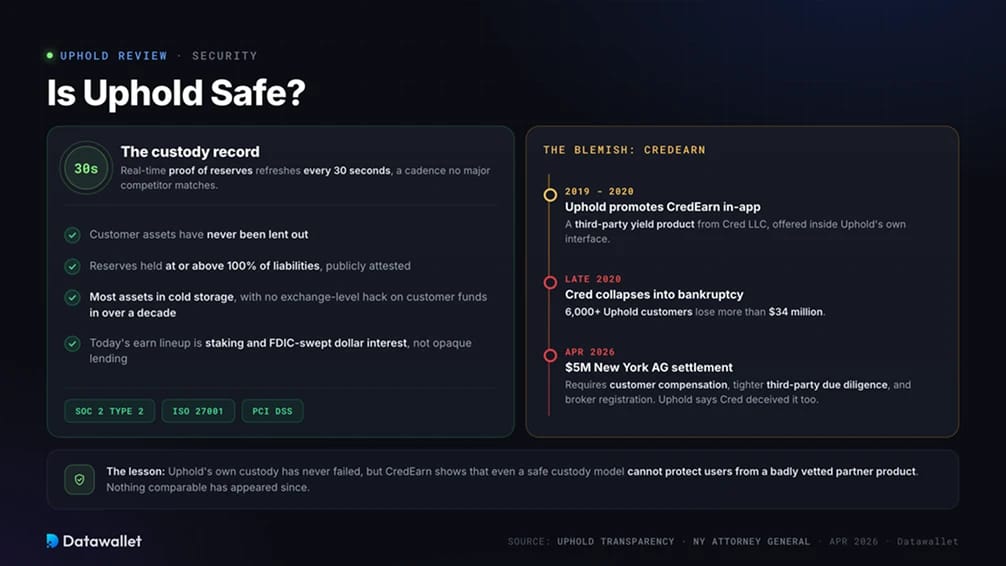
On custody, Uphold's record is strong. The platform has never lent customer assets, holds reserves at or above 100% of liabilities, and publishes a real-time proof of reserves attestation refreshing every 30 seconds, a cadence no major competitor matches. Certifications cover SOC 2 Type 2, ISO 27001, and PCI DSS, most assets sit in cold storage, and no exchange-level hack has hit customer funds in over a decade.
The blemish is a past product decision. Between 2019 and 2020, Uphold promoted CredEarn, a third-party yield product from Cred LLC, inside its own app. When Cred collapsed into bankruptcy in late 2020, more than 6,000 Uphold customers lost over $34 million, and in April 2026, the New York Attorney General secured a $5 million settlement requiring customer compensation, tighter third-party due diligence, and broker registration.
Uphold disputes the framing and says Cred deceived it too, but the episode shows that even the safest custody model cannot protect users from a badly vetted partner product. Nothing comparable has appeared since, and the current earn lineup consists of staking and FDIC-swept dollar interest rather than opaque lending.
Uphold User Reviews
Sentiment on Uphold is unusually good for a crypto platform, which tends to attract brutal complaint-site scores regardless of quality.
- Trustpilot: Uphold holds roughly 4.3/5 across more than 27,000 reviews, an outlier among exchanges where scores below 2/5 are the norm. Praise clusters around ease of use and responsive support, while the recurring criticisms target spread costs and account verification friction.
- App stores: The main app rates about 4.4/5 on iOS and 4.5/5 on Google Play, with reviewers citing the clean interface and asset breadth, alongside complaints about occasional login glitches on Android.
- UpHODL: The self-custody wallet fares worse at around 3.2/5 combined, with users reporting difficulty moving tokens out after transferring them in.
The pattern matches what the fee schedule predicts. People who value one simple app across many asset classes are happy, and people who compare their execution price against an order book are not.
Final Thoughts
Uphold in 2026 is the closest thing crypto has to an everything app for ordinary investors. One account now spans 300+ cryptocurrencies, real US equities, metals, staking, a 4.5% dollar account, and a debit card paying XRP back, all sitting on a reserve model transparent enough to verify every 30 seconds.
The costs are equally plain. Spreads of 1.8% to 3.1% on crypto make it an expensive place to trade actively, EEA customers are stuck in a deposit freeze until the Portuguese MiCA decision arrives, and the CredEarn settlement shows the risk of trusting any platform's product curation uncritically.
For a US or UK investor who wants diversification and simplicity over execution price, Uphold earns its place. Active traders chasing tight pricing and deep books should look instead at our Binance review or Coinbase review and keep Uphold for the things those platforms cannot do in one step.