




What is Bybit TradFi?
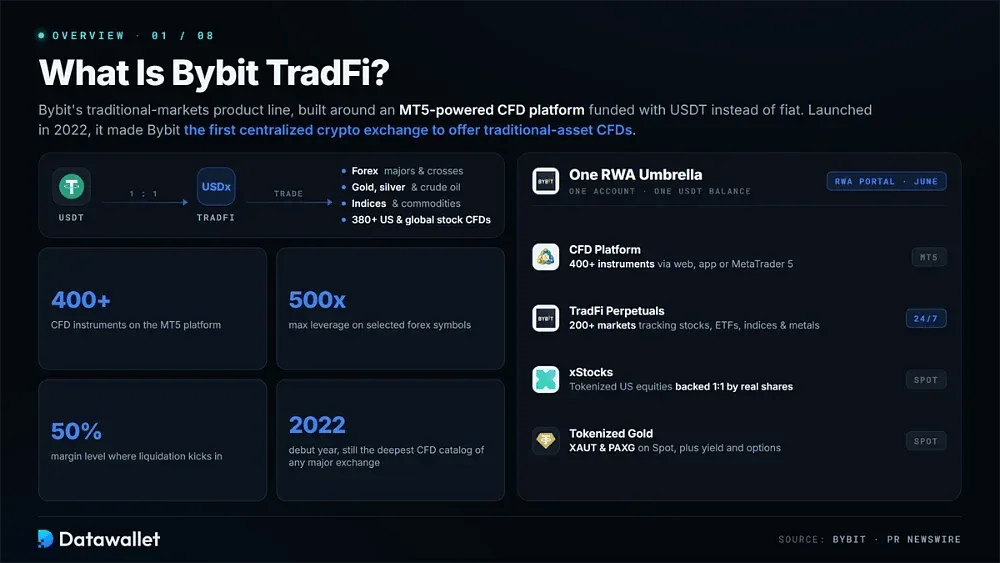
TradFi is Bybit's traditional-markets product line. It centers on an MT5-powered CFD platform accessible through the Bybit website, app, or MetaTrader 5. Traders use USDT rather than fiat as collateral, with funds converted into USDx at a 1:1 ratio inside the TradFi environment.
The CFD platform lists over 400 instruments. The selection covers forex, precious metals, crude oil, commodities, indices, and more than 380 US and global stock CFDs. When the product debuted in 2022, Bybit became the first centralized crypto exchange to offer traditional-asset CFDs, and it still has the deepest CFD catalog of any major exchange.
TradFi has since developed into a broader umbrella. This June, Bybit introduced a dedicated RWA portal bringing together the CFD platform, TradFi Perpetuals, xStocks tokenized equities, and tokenized gold on Spot. One account and one USDT balance can therefore access every traditional-market product offered by the exchange.
On the CFD side, leverage reaches up to 500x for selected forex symbols, while stock CFDs are capped at 5x. Margin requirements follow a tiered system, and liquidation occurs when the margin level drops below 50%. The platform also supports hedging, copy trading, Expert Advisors, and MQL5 marketplace tools.
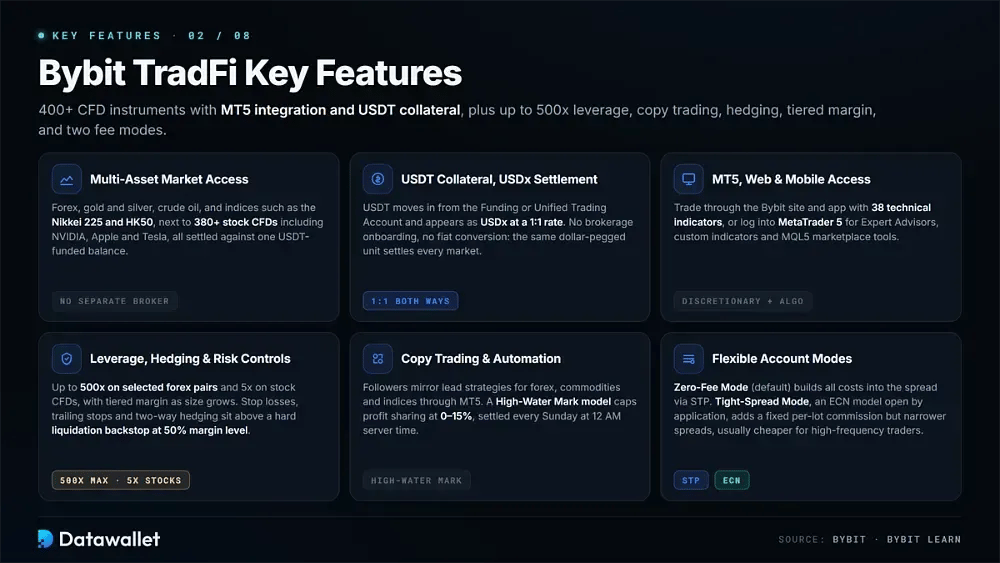
Bybit TradFi Key Features
Bybit TradFi combines 400+ CFD instruments with MT5 integration and USDT collateral. It also supports up to 500x leverage, copy trading, hedging, tiered margin, and two fee modes.
1. Multi-Asset Market Access
Bybit TradFi covers forex majors and crosses, along with gold and silver, crude oil, and benchmark indices such as the Nikkei 225 and HK50. Its stock CFD selection has expanded beyond 380 names, including NVIDIA, Apple, Tesla, Microsoft, and Google.
This range lets traders consolidate traditional-market exposure in one place. Gold, FX pairs, US equities, and indices can all be traded without opening separate brokerage accounts. As a result, TradFi operates more like a multi-asset CFD broker than a simple crypto exchange add-on, with every position settled against one USDT-funded balance.
.webp)
2. USDT Collateral and USDx Settlement
Stablecoins handle the funding process. Users transfer USDT from either their Funding Account or Unified Trading Account, after which the balance appears as USDx inside TradFi at parity. When funds are transferred back out, the conversion reverses at the same 1:1 rate.
For crypto-native traders seeking traditional exposure, this removes two major points of friction: separate brokerage onboarding and fiat currency conversion. Whether the position is in gold or a Tesla CFD, settlement uses the same internal dollar-pegged unit regardless of the underlying market's currency.
3. MT5, Web, and Mobile Access
At the center of Bybit TradFi is MetaTrader 5, the MetaQuotes platform used by forex and CFD brokerages since 2010. Trading is available through the Bybit website and app, while dedicated credentials provide access to MT5 on desktop and mobile.
The available tools depend on the interface. Bybit's app includes 38 technical indicators. MT5 adds Expert Advisors, imported custom indicators, MQL5 marketplace tools, and downloadable automated systems, supporting both discretionary trading and algorithmic strategies.
4. Leverage, Hedging, and Risk Controls
There is no single leverage limit across the platform because the maximum varies by symbol. Selected forex pairs offer up to 500x, metals and oil use lower limits, and stock CFDs are capped at 5x. Margin requirements also increase through a tiered system as position size grows.
Several controls are built into the product. Traders can use stop losses, trailing stops, margin level monitoring, and hedged positions in both directions. Liquidation below the 50% margin level threshold provides the hard backstop when account health deteriorates.
5. Copy Trading and Automation Tools
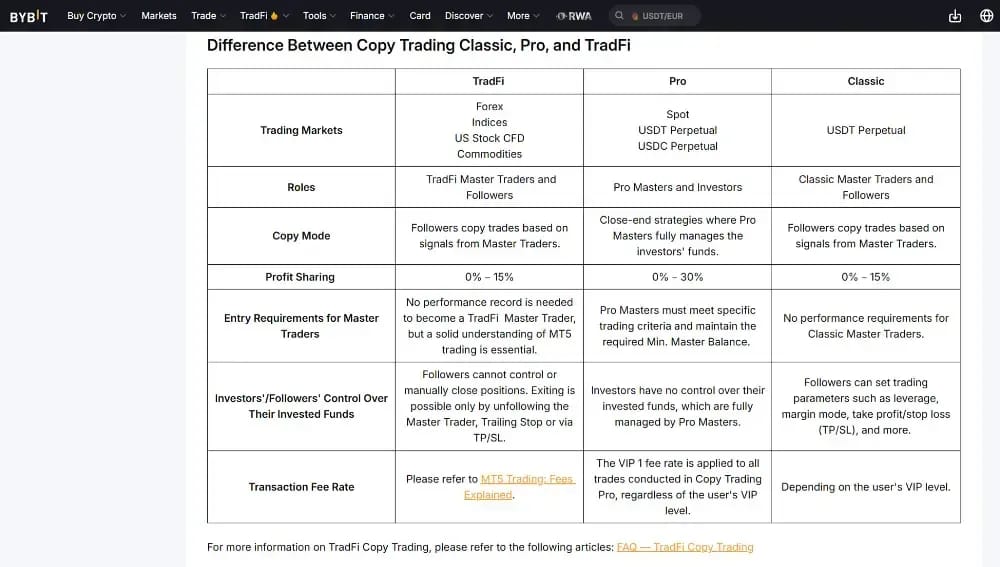
A dedicated copy trading system allows followers to mirror lead strategies for forex, commodities, and indices directly through MT5. It is aimed at beginners seeking professional positioning without analyzing every chart. The product operates alongside the crypto-focused programs included in our best crypto copy trading platforms ranking.
Its economics are defined in detail. TradFi Copy Trading follows a High-Water Mark model, so leaders earn only when profits reach new peaks. Profit sharing ranges from 0% to 15%, with settlement distributed every Sunday at 12 AM according to the MT5 server clock.
6. Flexible Account Modes
Two account modes are available on Bybit TradFi. Zero-Fee Mode is the default, using a Straight Through Processing model that incorporates all trading costs into the spread rather than charging a separate commission. This keeps the pricing structure straightforward for occasional traders.
Tight-Spread Mode is the alternative. Available by application once asset requirements are met, this ECN model offers deeper liquidity and narrower spreads while charging a fixed commission per lot. For high-frequency traders, that structure typically works out cheaper.
Bybit TradFi Perpetuals
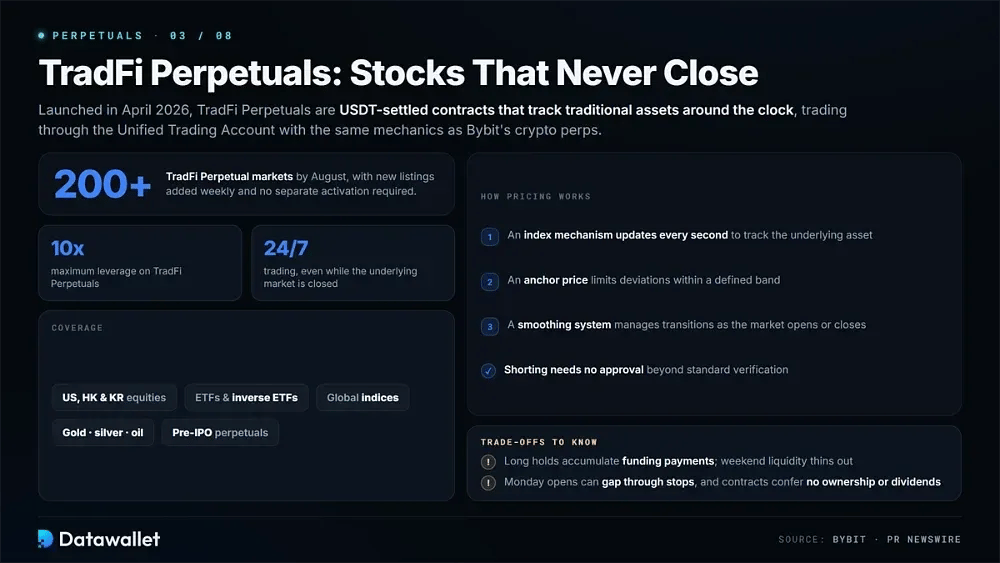
TradFi Perpetuals launched in April 2026 as USDT-settled contracts that track traditional assets around the clock. They trade through the Unified Trading Account and use the same margin, funding rate, and liquidation mechanics as Bybit's standard crypto perpetuals, with no separate activation required.
By August, the catalog had grown to over 200 TradFi Perpetual markets with weekly additions. Coverage includes US, Hong Kong, and South Korean equities, ETFs and inverse ETFs, global indices, gold, silver, crude oil, and pre-IPO perpetuals that provide exposure to private companies before listing.
Prices are determined through an index mechanism that updates every second. An anchor price limits deviations within a defined band, while a smoothing system manages transitions as the underlying market opens or closes. Leverage reaches up to 10x. Unlike a stock brokerage margin account, shorting requires no approval beyond standard verification.
The drawbacks are similar to those of crypto perpetuals. Positions held for weeks accumulate funding payments, liquidity becomes thinner on weekends while the underlying market is closed, and Monday openings can gap through stops. These contracts provide neither ownership nor dividends. Our Bybit Futures review examines the shared derivatives engine in detail.
xStocks and Tokenized Gold
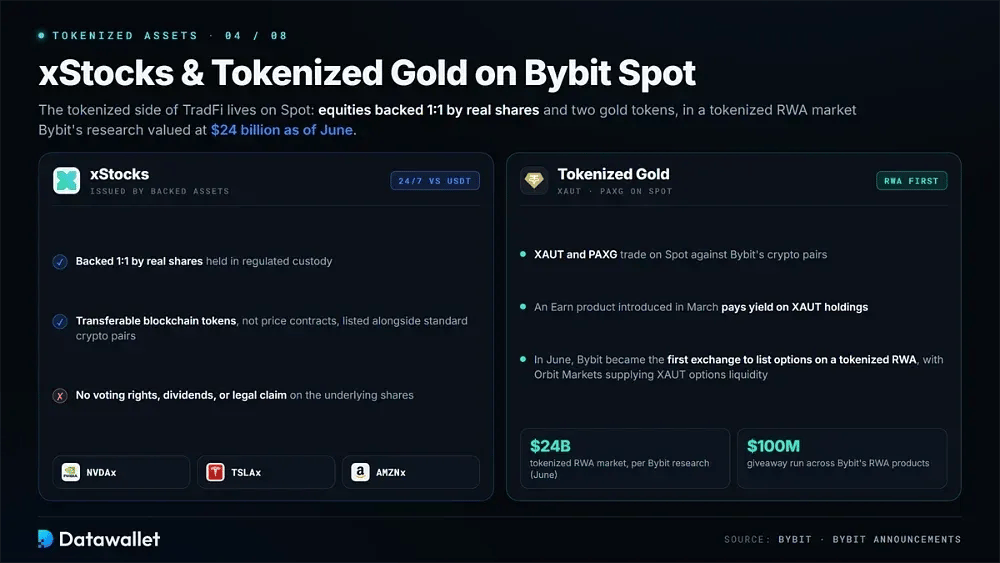
Bybit Spot hosts the tokenized side of TradFi. xStocks are tokenized US equities issued by Backed Assets and backed 1:1 by real shares held in regulated custody. They trade 24/7 against USDT, with instruments such as NVDAx, TSLAx, and AMZNx listed alongside Bybit's standard crypto pairs.
xStocks differ from CFDs and perpetuals because they are transferable blockchain tokens rather than price contracts. However, Bybit's RWA portal states explicitly that holders receive no voting rights, dividend entitlements, or legal claim on the underlying shares. Other venues offering this product class are covered in our best tokenized stock trading exchanges ranking.
Tokenized gold has developed into a separate product family. XAUT and PAXG trade on Spot, while an Earn product introduced in March pays yield on XAUT holdings. In June, Bybit became the first crypto exchange to list options on a tokenized RWA, with Orbit Markets supplying liquidity for XAUT options.
Bybit's own research valued the tokenized RWA market at $24 billion as of June. Earlier this year, the exchange also ran a $100 million giveaway across its RWA products to encourage adoption, so expect the tokenized shelf to keep widening.
Bybit TradFi Fees
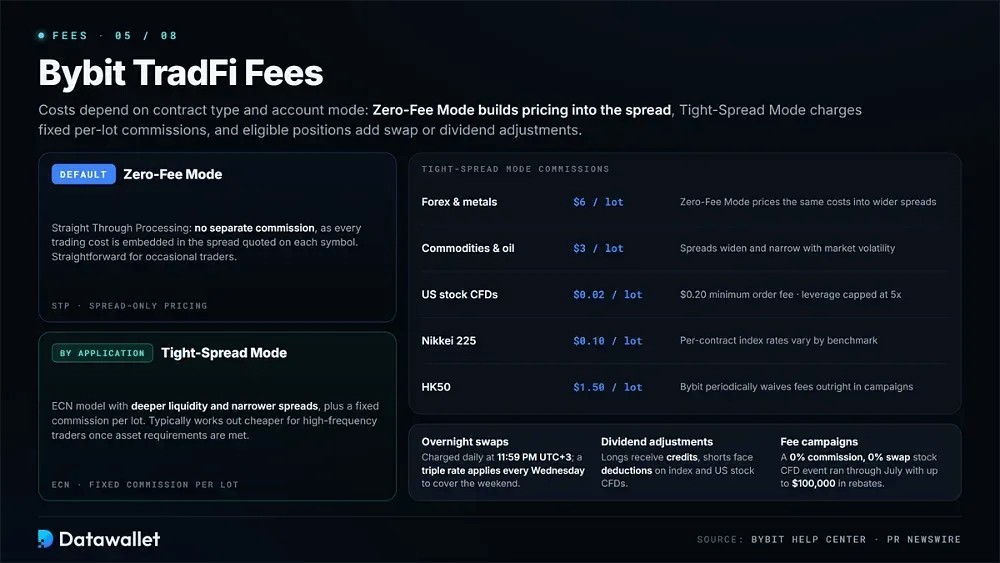
Bybit TradFi fees depend on both contract type and account mode. Zero-Fee Mode builds pricing into the spread, while Tight-Spread Mode applies fixed commissions. Eligible positions can also incur separate swap or dividend adjustments.
Key Bybit TradFi fee data at a glance:
- Zero-Fee Mode: Uses an STP model where no separate commission is charged because all trading costs are already embedded in the spread quoted on each symbol.
- Forex and Metals: Tight-Spread Mode charges a fixed $6 per lot commission on these pairs, while Zero-Fee Mode incorporates the same costs directly into wider spreads.
- Commodity and Oil: Trading energy contracts incurs a $3 per lot commission in Tight-Spread Mode, alongside standard spreads that widen and narrow with prevailing market volatility.
- Stock CFDs: US equities carry a $0.02 per lot commission with a $0.20 minimum order fee, and leverage on these symbols caps at 5x per position.
- Index Trading: Specific per-contract rates apply across benchmarks, such as $0.1 per lot for Nikkei 225 exposure and $1.5 per lot for HK50 contracts.
- Overnight Swaps: Charges apply daily at 11:59 PM UTC+3, calculated through point, money, or percentage formulas depending on the asset class of the open position.
- Dividend Adjustments: Long positions receive credits while short positions face deductions during dividend events, applying to both index CFDs and individual US stock CFDs.
- Three-Day Swap: A triple swap rate applies every Wednesday to account for weekend interest accrual while the underlying global markets remain closed to trading.
- Fee Campaigns: Bybit periodically waives costs outright, including a zero-commission, zero-swap stock CFD event that ran through July with up to $100,000 in total rebates.
How to Trade on Bybit TradFi
Bybit TradFi is available on web and mobile. Users can activate an account, transfer USDT, choose among 400+ instruments, and place leveraged trades.
Step 1: Activate Your TradFi Account
Create access before funding or trading.
- Log in to your Bybit account first.
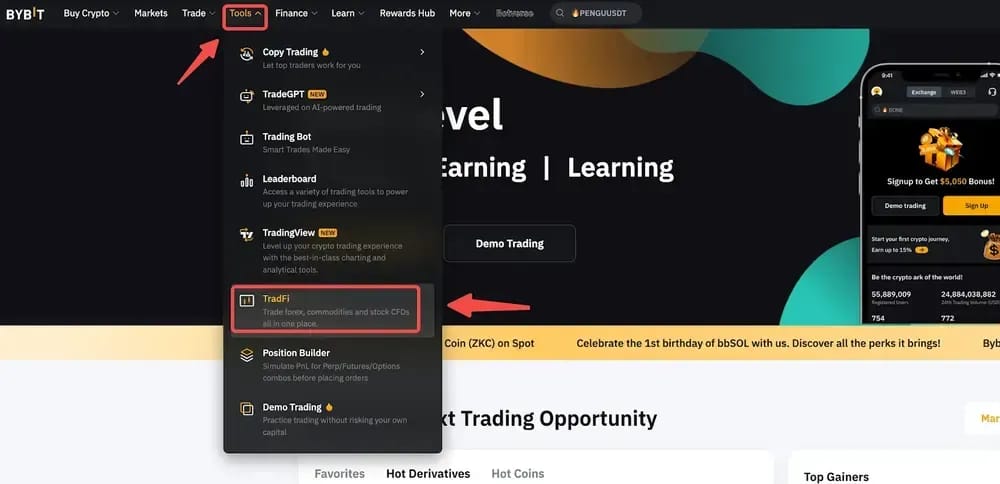
- Open Tools and select TradFi on web.
- Apply for TradFi if the account is inactive.
- Complete required identity and eligibility checks.
Step 2: Deposit Trading Funds
Deposit funds into the TradFi environment.
- Move USDT into your Funding Account first.
- Open the TradFi asset page afterward.
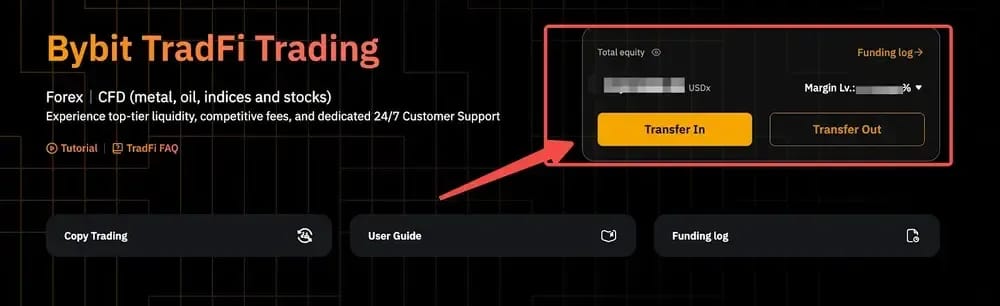
- Click Transfer In to begin funding.
- Enter amount and confirm the transfer.
- USDT converts into USDx at 1:1.
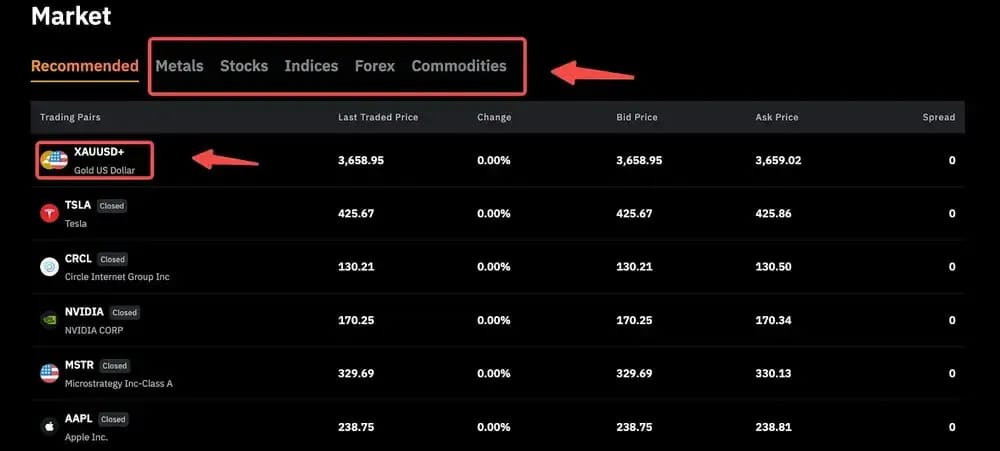
Step 3: Choose a Market
Pick the asset class and symbol.
- Browse Forex, Metals, Stocks, Indices, or Commodities.
- Select the instrument you want to trade.
- Review spread, chart, and contract details.
- Check trading hours before opening positions.
Step 4: Configure The Order
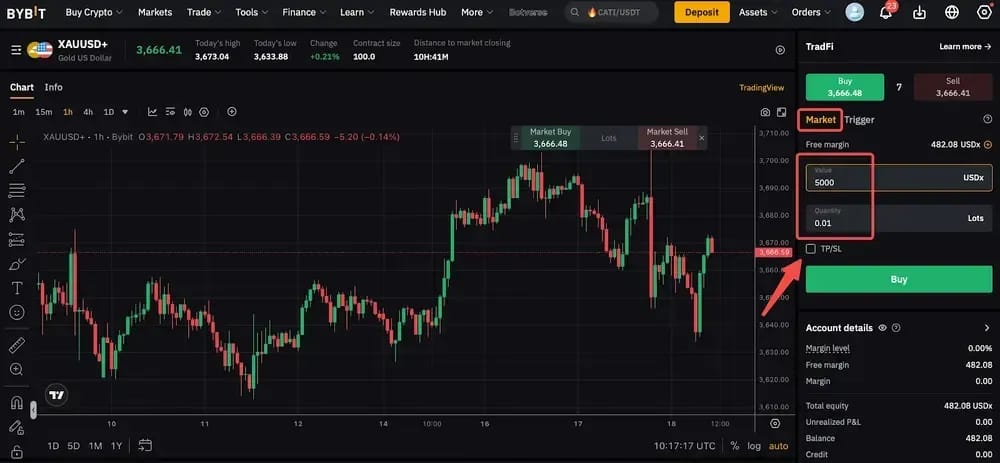
Set up trade direction and execution type.
- Choose Buy for long exposure.
- Choose Sell for short exposure.
- Select Market, Limit, Stop, Stop-Limit, or Trailing Stop.
- Enter value or quantity in lots.
- Adjust leverage where the symbol allows.
Step 5: Add Risk Management
Protect the position before submission.
- Set a Stop Loss level.
- Set a Take Profit target.
- Review used margin and exposure carefully.
- Confirm order details and place trade.
Step 6: Monitor Open Positions
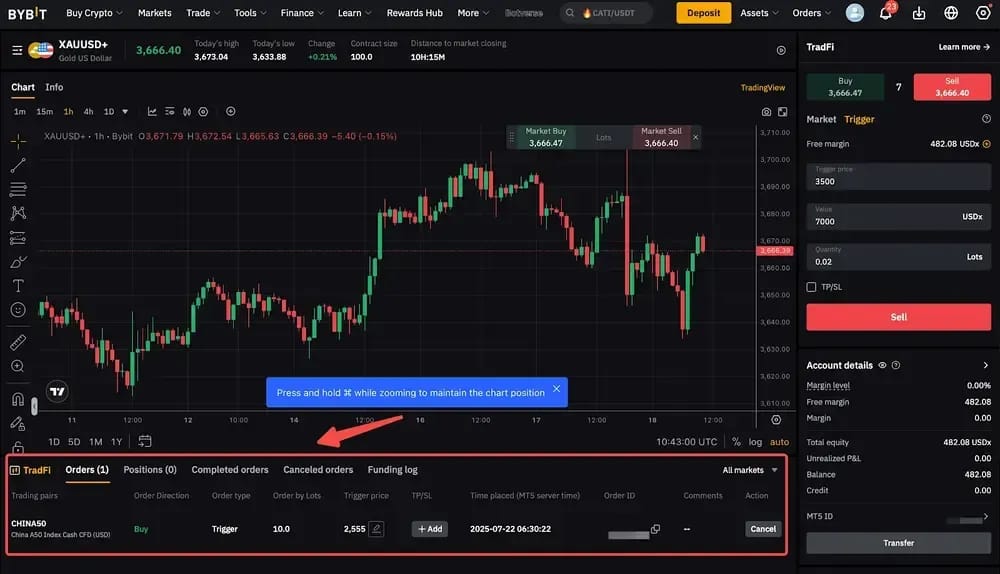
Track health and cost after entry.
- Watch equity and unrealized PnL.
- Monitor margin level to avoid liquidation.
- Remember liquidation occurs below 50% margin level.
- Check overnight exposure for possible swap fees.
Bybit TradFi Regulations
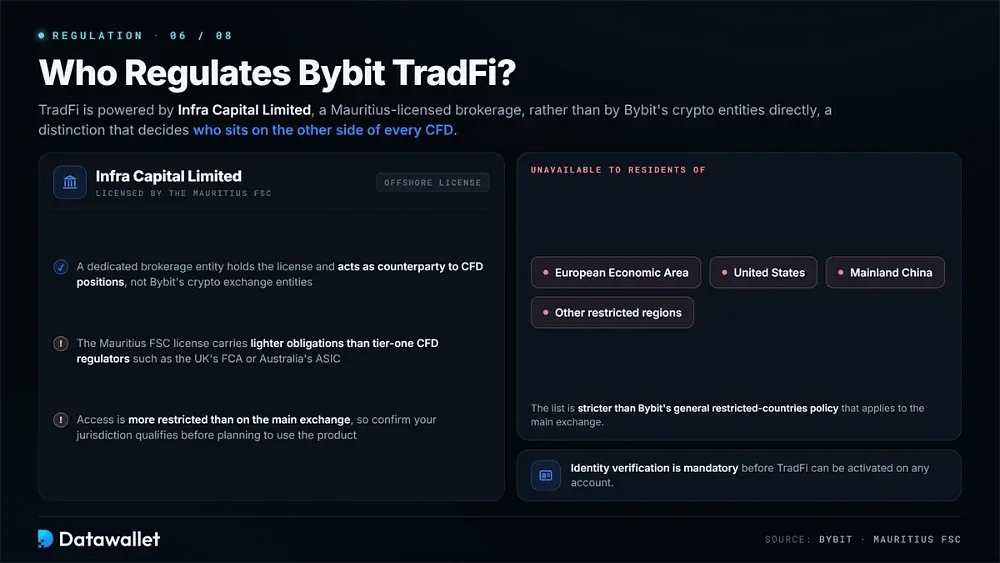
Bybit TradFi is powered by Infra Capital Limited, a brokerage licensed by the Mauritius FSC, rather than directly by Bybit's crypto entities. The distinction is important because Infra Capital is the counterparty to CFD positions. Its offshore license carries lighter obligations than tier-one CFD regulators such as the FCA or ASIC.
Access is more restricted than on the main exchange. TradFi is unavailable to residents of the European Economic Area, the United States, mainland China, and other restricted regions. Identity verification is also mandatory before activation, so users should confirm that their jurisdiction qualifies before planning to use the product.
Bybit TradFi Statistics & Adoption
Bybit does not publish a standalone user count for TradFi, but exchange-level volume, product growth, and third-party RWA data show how quickly the category is developing. The figures below separate Bybit-specific metrics from broader market data where necessary.
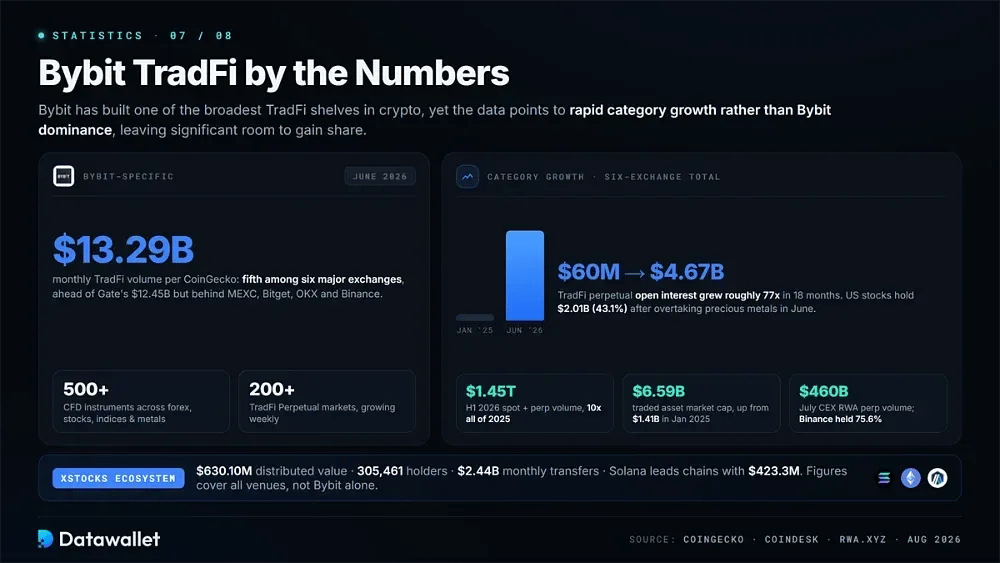
- TradFi Trading Volume: CoinGecko Research recorded $13.29 billion in Bybit TradFi volume in June 2026. Bybit ranked fifth among six major exchanges, ahead of Gate's $12.45 billion but behind MEXC, Bitget, OKX, and Binance.
- Market Growth: Crypto-based TradFi spot and perpetual volume reached $1.45 trillion in H1 2026, more than 10x the total generated during 2025. The market capitalization of actively traded crypto TradFi assets also rose from $1.41 billion in January 2025 to $6.59 billion by June 30, 2026.
- Open Interest: TradFi perpetual open interest across the six exchanges grew from $60 million on January 1, 2025 to $4.67 billion by June 30, 2026, roughly a 77-fold increase. US stocks represented $2.01 billion, or 43.1%, after overtaking precious metals in June.
- RWA Perpetual Adoption: CoinDesk Research recorded $460 billion in centralized-exchange RWA perpetual volume in July, up 47.8% month over month. Binance held 75.6% market share, followed by OKX at 14.8% and Gate at 4.39%, leaving Bybit outside the top three.
- Product Expansion: Bybit now supports more than 500 CFD instruments across forex, stocks, indices, commodities, and metals. TradFi Perpetuals separately cover more than 200 traditional assets, extending its product range well beyond the original MT5 offering.
- xStocks Asset Value: These figures cover the full xStocks ecosystem rather than Bybit alone. RWA.xyz tracked $630.10 million in distributed xStocks value as of August 29, 2026, up 22.01% over 30 days, with 305,461 holders and 203,924 monthly active addresses.
- xStocks Activity: Monthly transfer volume reached $2.44 billion, rising 22.63% over 30 days. Solana held $423.3 million of xStocks value, followed by Ethereum at $157.4 million and Arbitrum at $28.6 million.
- Tokenized Equity Scale: The xStocks network reports 714 tokenized stocks and ETFs with more than $35 billion in cumulative transaction volume. The products are 1:1 asset-backed and available across multiple chains and trading venues, so this volume should not be attributed to Bybit alone.
- Broader Adoption: xStocks reported nearly 200,000 holders, more than 100 integrations, and $12.5 billion in on-chain volume after its first year. Its distribution across centralized exchanges, wallets, and DeFi protocols gives Bybit access to an increasingly established tokenized-equity ecosystem.
The data points to rapid category growth rather than clear Bybit dominance. Bybit has built a broad TradFi product range, but its $13.29 billion June volume remained well below the market leaders, leaving significant room to gain share as crypto-based trading of traditional assets expands.
Bybit TradFi Pros and Cons
Consider the advantages and drawbacks of the integrated platform when deciding whether its traditional financial tools fit your current investment goals:
Bybit TradFi vs Main Bybit Trading
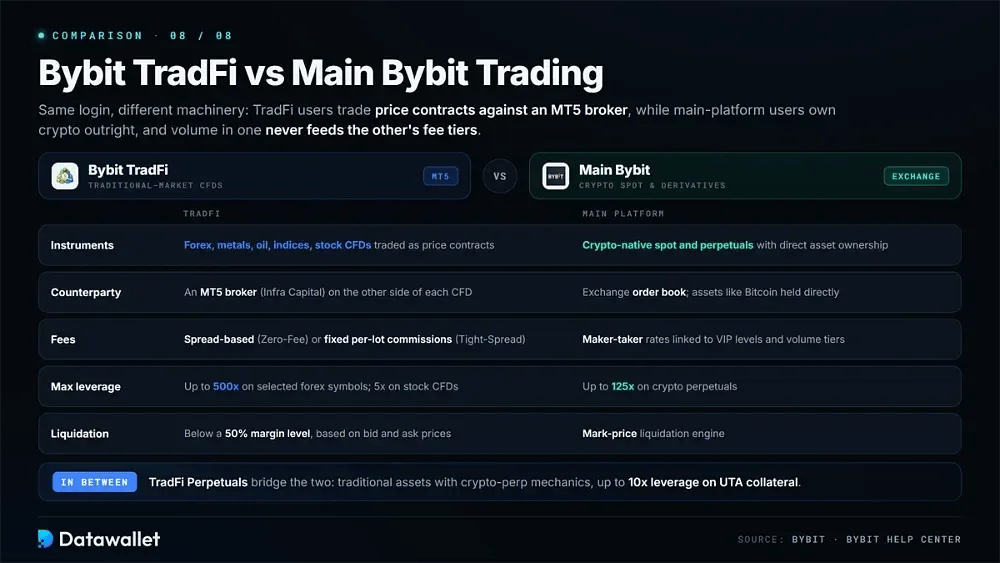
Bybit TradFi is built around traditional-market CFDs such as forex and metals. The main platform handles crypto-native spot and derivatives instead. TradFi users trade price contracts against an MT5 broker, whereas mainnet users can access assets such as Bitcoin through direct ownership and perpetuals.
The two platforms also use different fee structures. Mainnet follows a maker-taker system linked to VIP levels. TradFi either prices through the spread under Zero-Fee Mode or charges fixed lot-based commissions in Tight-Spread Mode. Trading volume in one structure does not feed the other's tiers.
Leverage and liquidation mechanics differ substantially as well. Mainnet allows up to 125x on crypto perpetuals and uses mark-price liquidation. TradFi CFDs reach 500x on selected symbols, with liquidation at a 50% margin level based on bid and ask prices. TradFi Perpetuals sit between the two, offering up to 10x leverage on UTA collateral.
Final Thoughts
Bybit TradFi has expanded from an MT5 side product into the widest traditional-markets suite on any crypto exchange. It now spans 400+ CFD instruments, 200+ TradFi Perpetual markets, and tokenized equities and gold, all accessible from the same USDT balance without opening a brokerage account.
Different parts of the suite suit different types of traders. The CFD platform is designed for FX and metals traders who value MT5 tooling. TradFi Perpetuals serve crypto-native users seeking 24/7 stock exposure, while xStocks are better suited to those who prefer a transferable token rather than a leveraged contract.
The limitations remain significant. Trading costs can accumulate through spreads, commissions, swaps, and funding. Leveraged positions on closed markets are exposed to weekend gaps, while the Mauritius-licensed counterparty provides limited recourse. Start small, test the withdrawal path, and read our full Bybit review before scaling.