



Bitcoin’s biggest long-term security debate is heating up. As quantum computing research accelerates, developers are starting to ask how Bitcoin could adapt before today’s cryptography becomes tomorrow’s vulnerability.
That is where BIP-360 enters the conversation. Rather than promising a complete fix, it offers a practical framework for reducing exposure, guiding migration, and preparing Bitcoin for a post-quantum future.
Explore the full breakdown below. 👇
Primer on Bitcoin's Quantum Computing Threats
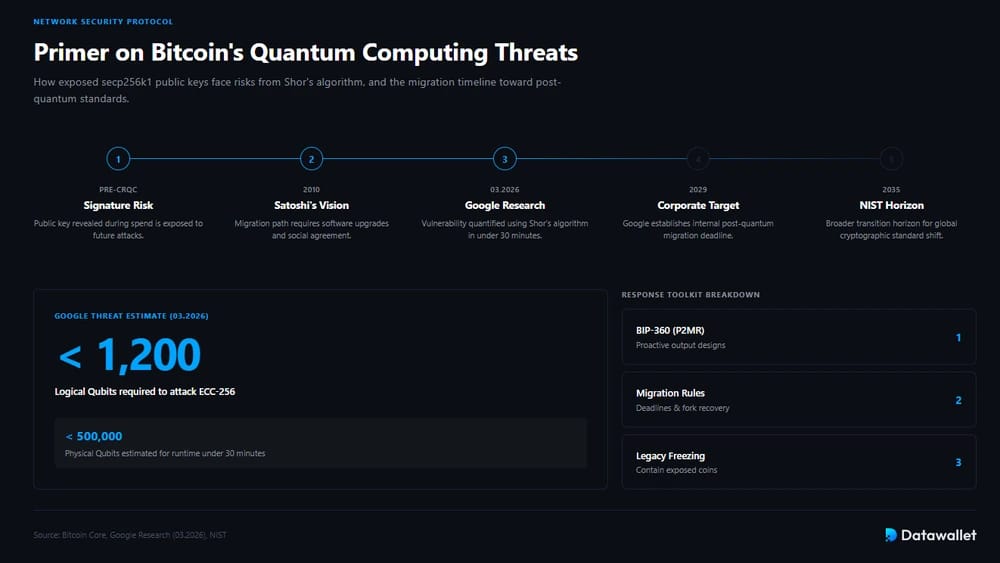
Bitcoin’s quantum threat centers on signatures (cryptographic proofs that authorize a transaction using a private key). When a Bitcoin spend reveals a secp256k1 public key, a sufficiently advanced quantum computer could run Shor’s algorithm, derive the corresponding private key, and authorize a fraudulent transaction. In practical terms, any exposed key becomes vulnerable once cryptographically relevant quantum machines exist.
This possibility has been part of Bitcoin’s threat model from the beginning. In 2010, Satoshi Nakamoto suggested that if cryptography weakened gradually, the network could migrate to stronger primitives through software upgrades and broad social agreement. That expectation still shapes current thinking around migration, address hygiene, and minimizing unnecessary public-key exposure.
The debate became more concrete in March 2026, when Google researchers estimated that attacking ECC-256 may require fewer than 1,200 logical qubits and under 500,000 physical qubits, with runtimes measured in minutes on a future CRQC. Google linked that warning to its own post-quantum migration target of 2029, while NIST’s broader transition horizon extends to 2035.
Against that backdrop, Bitcoin’s response debate now spans several layers: proactive output designs such as BIP-360’s P2MR, broader post-quantum signature upgrades, and more forceful options such as migration deadlines, freezing exposed legacy coins, or fork-based recovery rules. The next section can then examine where BIP-360 fits within that wider toolkit.
What is BIP-360 (Bitcoin Improvement Proposal 360)?
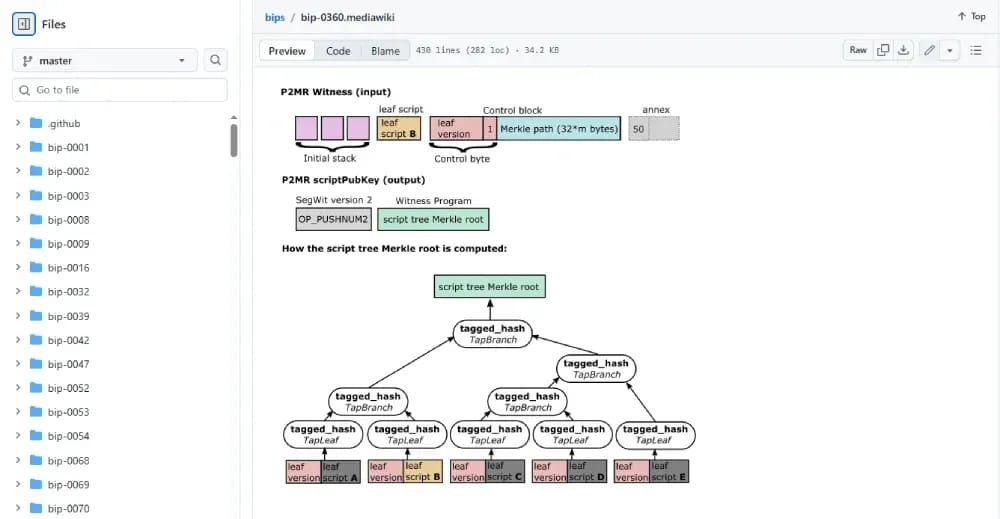
BIP-360 is a draft soft-fork proposal that introduces Pay-to-Merkle-Root, or P2MR, a new Bitcoin output type designed to preserve Taproot-style script trees while removing the quantum-vulnerable key-path spend. Ethan Heilman opened the related “algorithm agility” discussion on February 9, 2026, and the BIP entered the repository on February 10, 2026.
Its core idea is narrower than “make Bitcoin fully quantum-safe.” Instead, BIP-360 gives Bitcoin a cleaner structural base for future post-quantum upgrades by committing directly to a script-tree Merkle root, without an internal key. That makes it a first-step migration rail rather than a complete cryptographic replacement.
The proposal was authored by Hunter Beast, Ethan Heilman, and Isabel Foxen Duke, and it evolved materially across 2024 and 2025 before reaching draft form in early 2026. By March 2026, it had moved beyond theory into public testnet-style implementation work, giving the broader discussion more urgency and technical specificity.
BIP-360 Components
BIP-360 combines a new output format, familiar tapscript mechanics, and a deliberate removal of Taproot’s most quantum-exposed spending path. In practice, it changes how funds are committed and spent, while leaving room for later post-quantum signature upgrades.
Key elements at a glance:
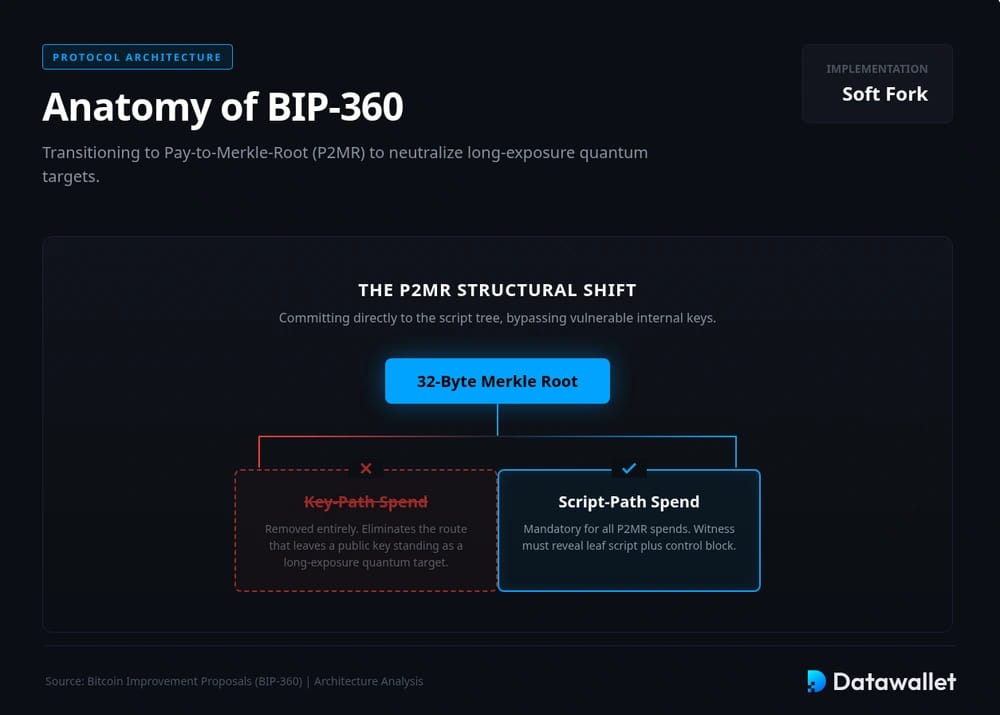
- P2MR: BIP-360 defines Pay-to-Merkle-Root as a new output type that behaves much like Taproot script paths, but removes the key-path route that leaves long-lived public keys exposed.
- Soft Fork: The proposal is framed as a soft fork, meaning upgraded nodes would enforce the new rules while preserving compatibility assumptions typical of SegWit-era incremental consensus changes.
- Merkle Root: Instead of committing to a tweaked internal key, P2MR commits directly to the 32-byte Merkle root of the script tree, making the structure cleaner for future algorithm swaps.
- No Keypath: The defining change is the removal of Taproot’s key-path spend, which is exactly the route that leaves a public key standing as a long-exposure quantum target.
- SegWit V2: P2MR uses SegWit version 2 and Bech32m encoding, producing mainnet addresses that begin with bc1z, a concrete marker that wallets and infrastructure would need to support.
- Script Path: Every P2MR spend is a script-path spend, so the witness must reveal the leaf script plus a control block proving that leaf belongs to the committed Merkle tree.
- Tapscript: BIP-360 keeps tapscript compatibility, allowing existing tapscript programs to be reused without modification, which is one reason proponents present it as a relatively unobtrusive first step.
- Tradeoff: P2MR gains quantum resistance against long-exposure attacks, but it gives up the compactness and privacy advantages of Taproot key-path spends, making some transactions larger and more revealing.
- Limits: On its own, BIP-360 does not solve short-exposure quantum attacks; the proposal explicitly assumes later soft forks would add post-quantum signature schemes for fuller protection.
Will BIP-360 Be Implemented?
Right now, BIP-360 is still a draft, not an activated upgrade, and Bitcoin has no formal onchain “vote” for BIPs. The people most associated with it are co-authors Hunter Beast, Ethan Heilman, and Isabel Foxen Duke, while broader influence sits with Bitcoin Core contributors, mailing-list participants, reviewers, wallet maintainers, and ecosystem educators such as Bitcoin Optech.
The dates that matter most are process milestones, not ballots: February 9, 2026 for the algorithm-agility mailing-list thread, February 10, 2026 for the draft BIP, March 2026 for public implementation activity, and any future Bitcoin Core or wallet PRs that move it from concept toward adoption. For now, the state to watch is rough consensus, code, and review and not a scheduled vote.
Critism and Concerns
Media reactions to BIP-360 and Bitcoin’s wider quantum response have split into a few clear camps. Some frame it as overdue preparation, others as manageable but non-urgent, and others as a reason to question Bitcoin’s long-term security assumptions.
The main media-framed concerns include:
- Too Early: The Guardian’s March 2026 coverage noted Google’s 2029 warning, but also quoted former Riverlane executive Leonie Mueck saying most realistic timelines for a cryptographically relevant machine still stretch into the 2030s or even 2050s.
- Still Serious: CoinDesk, citing Galaxy Digital’s Alex Thorn, described the quantum threat as real but “far from an existential crisis,” reflecting a common view that Bitcoin should prepare now without treating BIP-360 as an emergency patch.
- Market Skepticism: Business Insider reported that Jefferies strategist Christopher Wood removed Bitcoin from a model portfolio over quantum concerns, showing that some traditional finance observers see the issue as serious enough to alter long-term allocation decisions.
- Engineering Burden: Tom’s Hardware emphasized that decentralized governance makes post-quantum migration harder for blockchains than for centralized platforms, a concern that maps directly onto BIP-360 because adoption would require wallets, infrastructure, and users to coordinate.
- Not Enough Alone: Coverage of BIP-360 testnet deployment in Nasdaq and FXStreet highlighted it as a major step, but even that framing presents it as a first layer of protection rather than a complete post-quantum solution.
- Confidence Risk: Forbes and other market-focused outlets framed Google’s research as a fresh shock to Bitcoin’s narrative, suggesting that even helpful upgrades like BIP-360 can pressure sentiment by making the quantum threat feel more immediate to investors.

How BIP-360 Could Affect BTC Price
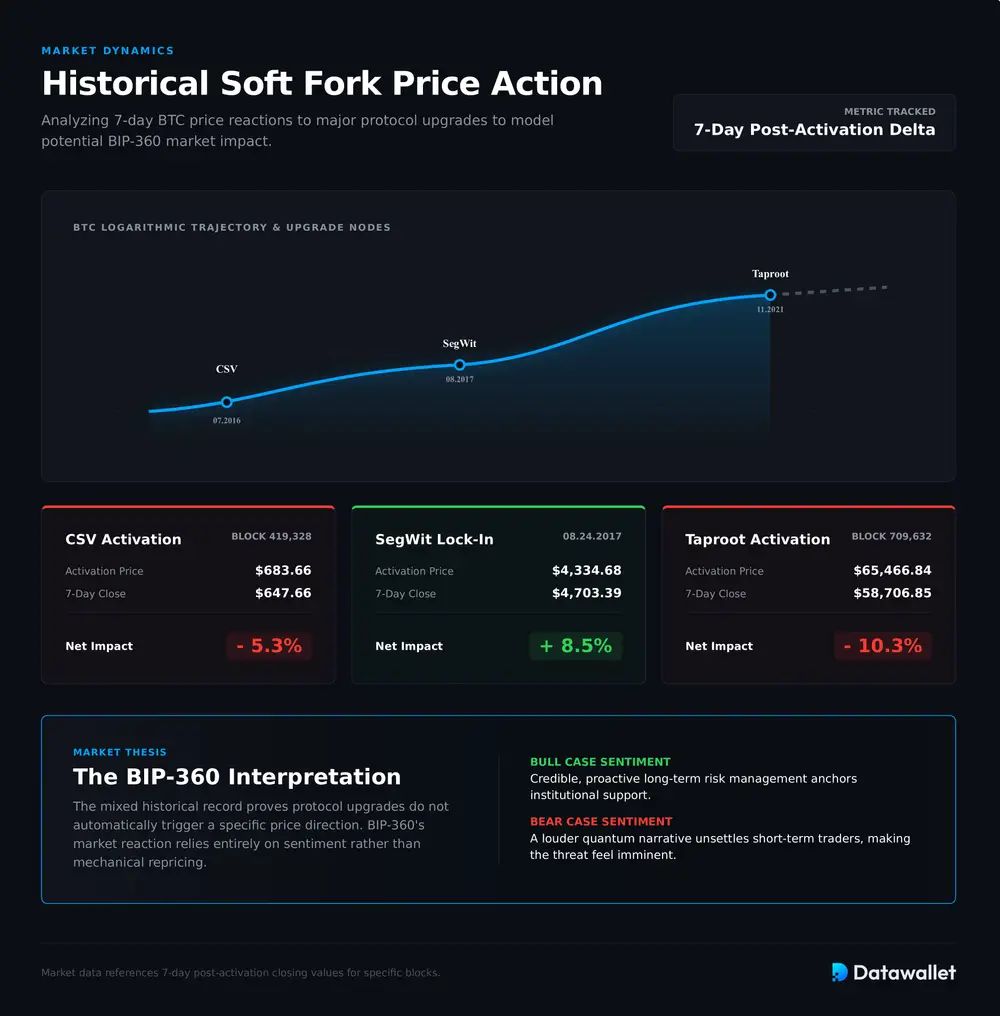
Past Bitcoin upgrades suggest BIP-360 would matter more through sentiment and confidence than through an immediate mechanical repricing. When the CSV soft fork activated at block 419,328 on July 4, 2016, BTC closed near $683.66; one week later, on July 11, it closed near $647.66, a roughly 5.3% decline.
SegWit’s market pattern was almost the opposite. Around the August 24, 2017 lock-in, BTC closed near $4,334.68; by August 31 it had reached about $4,703.39, an 8.5% gain. Taproot, activated at block 709,632 on November 14, 2021, saw BTC close near $65,466.84 and then fall toward $58,706.85 by November 22.
That mixed record suggests BIP-360 would not automatically send Bitcoin higher or lower. Because the proposal is still a draft, any price reaction would likely depend on interpretation: credible long-term risk management could support BTC, while a louder quantum narrative could unsettle traders by making the threat feel closer and more concrete.
BIP-360 Alternatives
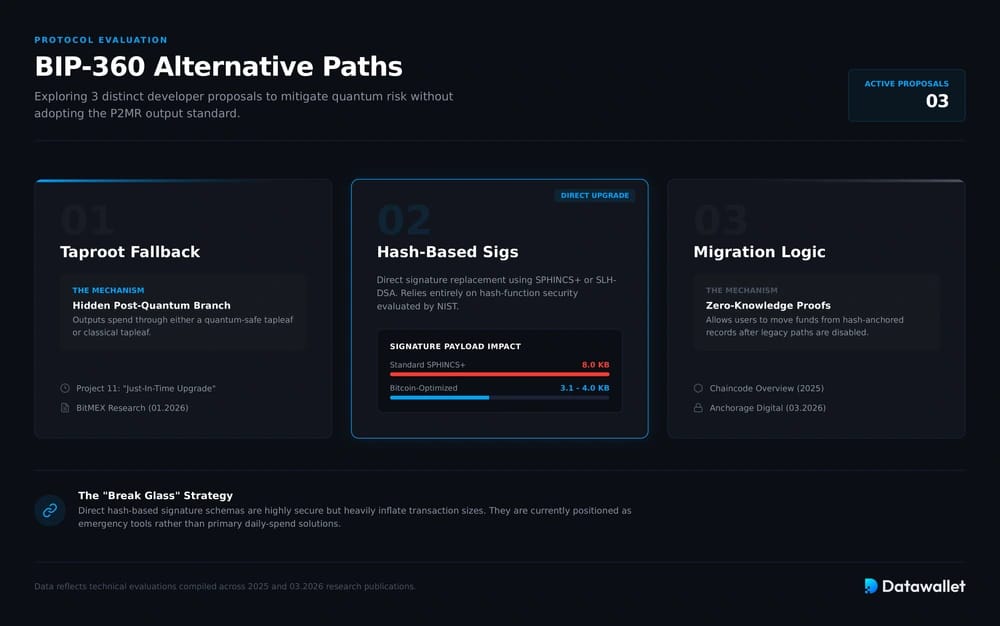
BIP-360 is not the only route under discussion. Bitcoin developers have also explored Taproot-based migration paths, covenant-backed commit-reveal constructions, and direct hash-based signature deployments that could reduce quantum risk without adopting P2MR.
1. Taproot-Based Fallback Designs
A widely discussed alternative is to keep Taproot’s structure and add a hidden post-quantum fallback spend path instead of replacing Taproot outputs with P2MR. Project Eleven described this as a “just-in-time” upgrade that preserves current efficiency until a quantum-safe branch is actually needed.
BitMEX Research outlined a similar direction in January 2026, arguing for a “new quantum safe version of Taproot” where the same outputs could be spent either through a quantum-safe tapleaf or a classical, quantum-vulnerable tapleaf. That approach tries to preserve privacy and compatibility longer than BIP-360.
2. Hash-Based Signature Upgrades
Another alternative is to upgrade Bitcoin’s signatures directly, using hash-based schemes such as SPHINCS+ or SLH-DSA rather than introducing a new output type first. Bitcoin Optech’s quantum-resistance topic page highlights ongoing work on SLH-DSA optimizations, Winternitz-style prototypes, and broader research into post-quantum signatures for Bitcoin.
The strongest case for this route is that hash-based signatures rely only on hash-function security. In late 2025, Mikhail Kudinov and Jonas Nick published work arguing that hash-based signatures are compelling because they rely only on hash-function security and have already been heavily analyzed during NIST’s post-quantum process.
That route is promising, but not lightweight. Their summary notes that standard SPHINCS+ signatures are nearly 8 KB, though Bitcoin-specific optimizations may bring them closer to roughly 3.1 KB to 4.0 KB depending on usage limits. Antoine Poinsot later described such schemes as useful “break glass” tools, even if they would make Bitcoin less attractive for ordinary spending.
3. Migration and Recovery Schemes
A third family of alternatives focuses less on permanent new spending formats and more on migration mechanics. Chaincode’s 2025 overview groups proposals such as pay-to-quantum-resistant-hash and commit-delay-reveal among the main strategies under active discussion for Bitcoin’s quantum readiness.
Anchorage Digital’s March 2026 “Quantum Turnstile” paper takes that idea further with a migration system based on zero-knowledge proofs of knowledge, allowing users to move funds from hash-anchored records after insecure signing paths are disabled. This is more complex than BIP-360, but it targets the migration problem directly.
Final Thoughts
BIP-360 matters because it turns Bitcoin’s quantum debate into something concrete. Instead of abstract warnings, it offers a draft architecture for limiting long-exposure key risk while leaving room for later post-quantum signature upgrades.
At the same time, the proposal is clearly not the only serious option. Taproot-based migration, covenant-backed defenses, and direct hash-based signature approaches all remain active parts of the same design space.
That is why BIP-360 should probably be viewed less as a final answer than as a coordination proposal. Its real significance lies in forcing Bitcoin to choose how it wants to prepare before urgency replaces optionality.