





.png)
.png)



What Is the Solana Liquidation Heatmap?
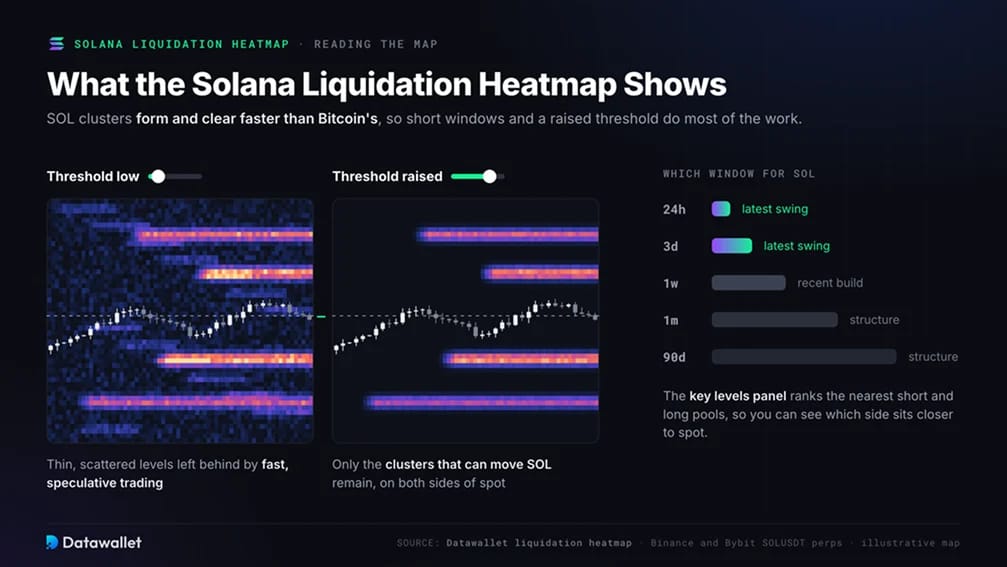
The Solana liquidation heatmap maps where leveraged SOL/USDT perpetual futures positions on Binance and Bybit are estimated to liquidate. Clusters above the SOL price are mostly shorts that would be forced to buy. Clusters below are mostly longs that would be forced to sell.
SOL clusters form and clear faster than Bitcoin's, so the shorter windows do most of the work here. The 24h and 3d views show the leverage built during the latest swing, and the key levels panel ranks the nearest short and long pools so you can see which side sits closer to spot. Raising the threshold slider strips out the thin, scattered levels that fast, speculative trading tends to leave behind.
SOL has historically moved more sharply than BTC in both directions. That makes SOL perpetuals a common way to take high-beta exposure, and it helps explain why SOL clusters can clear quickly once price starts moving.
How Does SOL Leverage Build and Unwind?
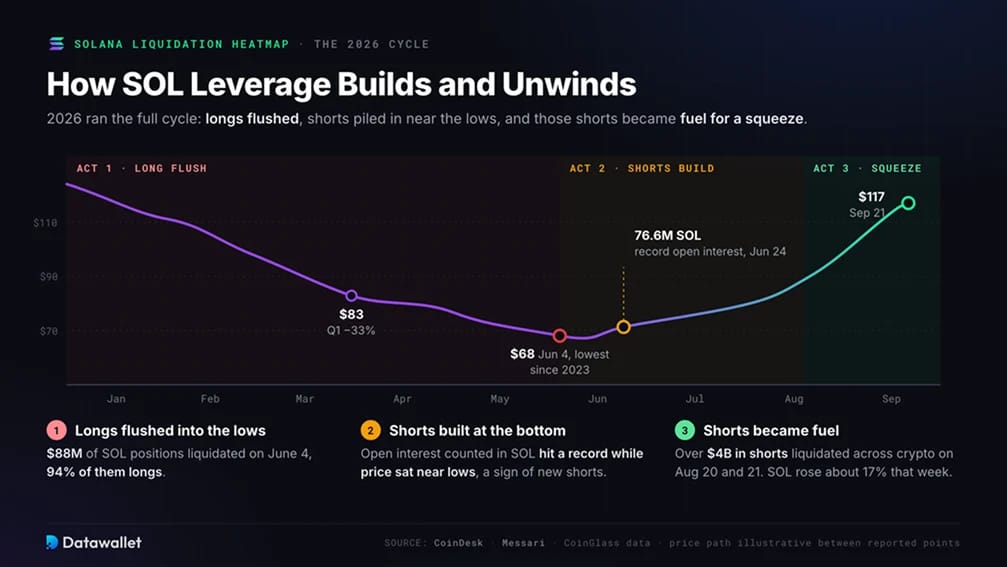
The SOL market in 2026 shows the full leverage cycle: longs flushed out, shorts piling in near the lows, and then a squeeze.
- Long liquidations into the lows: SOL fell 33% in the first quarter of 2026. On June 4 it reached about $68, its lowest price since December 2023. That day, $88 million of SOL positions were liquidated in 24 hours, 94% of them longs.
- Shorts built up at the bottom: On June 24, SOL futures open interest hit a record 76.6 million SOL while price sat near multi-year lows. Open interest rising while price falls usually means new shorts are opening, not new longs.
- The shorts became fuel: More than $4 billion of shorts were liquidated across crypto on August 20 and 21, and SOL gained about 17% that week. By September 21, SOL traded above $117, its highest since January, as more shorts were forced out.
The lesson for heatmap readers is to watch open interest measured in SOL, not just in dollars. When the dollar value of open interest falls but the SOL count keeps rising, traders are adding leverage while price drops, and that is how clusters form on the far side of price.
Where Else Does Leverage on Solana Sit?
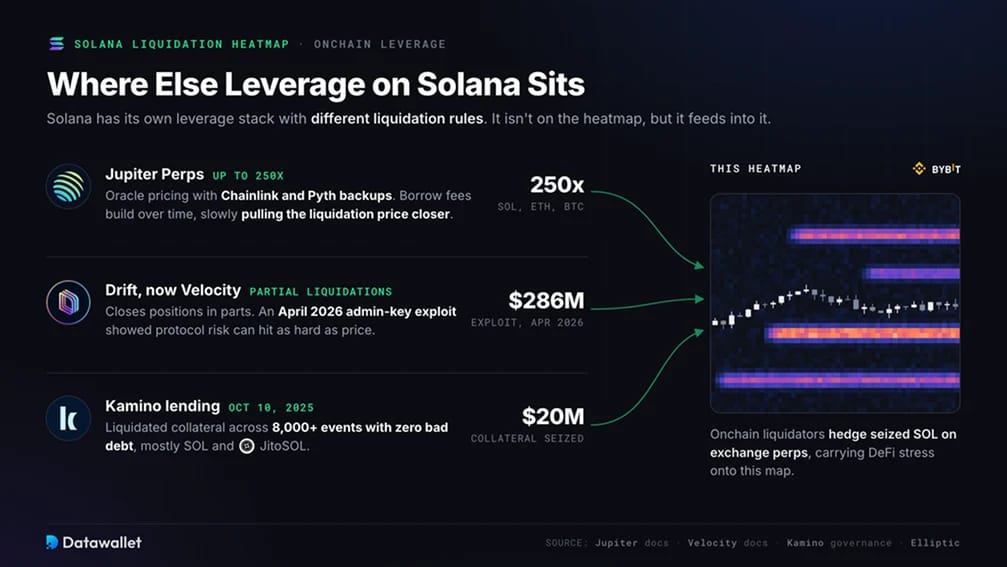
Solana has its own onchain leverage ecosystem. Its liquidation rules differ from those of centralized exchanges, and it isn't included in the heatmap.
- Jupiter Perps: Offers up to 250x leverage on SOL, ETH and BTC. It prices positions with a primary oracle backed by Chainlink and Pyth, and charges borrow fees that build up over time. A position left open for weeks slowly moves its liquidation price closer to the market even if SOL doesn't move.
- Drift, now Velocity: Drift's engine liquidates positions in parts and refuses to liquidate when the oracle price is far from its recent average. In April 2026, attackers took about $286 million through a compromised admin key. The protocol relaunched as Velocity in July. That episode showed that smart contract and governance risk can cost traders as much as market moves.
- Kamino lending: On October 10, 2025, Kamino liquidated $20 million of collateral across more than 8,000 events without taking on bad debt. Most of the seized collateral was SOL and JitoSOL, a sign that Solana DeFi borrowers mostly use SOL itself as collateral.
When onchain liquidators take over collateral, they often hedge it on centralized perpetuals. That links Solana DeFi stress back to the clusters on this heatmap.
Which Structural Forces Shape SOL Liquidations?
- Staking ETFs add unleveraged demand: US spot SOL ETFs launched in October 2025, and most stake their SOL holdings. By September 18, 2026 they had recorded 12 straight weeks of inflows. Unleveraged spot buyers can absorb forced selling that would otherwise extend a cascade. Datawallet's Solana ETF tracker follows those daily flows.
- Treasury companies carry SOL-backed debt: Forward Industries holds about 8.16 million SOL, roughly 1.4% of supply, and has a $105 million loan facility from Galaxy secured by pledged SOL. Collateralized borrowing at the company level brings its own liquidation-style risk if SOL falls far enough. The Solana treasury tracker lists every public company holding SOL.
- The network's record under stress: Solana stayed online through the October 2025 crash while processing about six times its normal volume of incoming transactions. Its last major outage was in February 2024.
- Alpenglow is coming: Solana's Alpenglow upgrade aims to cut transaction finality from about 12.8 seconds to about 150 milliseconds. It went live on testnet in September 2026, with mainnet targeted for later in 2026. Faster finality means onchain liquidations and oracle updates land faster, which could narrow the gap between centralized-exchange and onchain liquidation prices. Datawallet's Firedancer guide explains how Alpenglow and client diversity fit into Solana's roadmap.
How Should You Use the SOL Heatmap?
- Scale distances to SOL's volatility: A cluster 5% away is near-term for SOL in a way it might not be for BTC. Use 24h and 3d for immediate targets, and 1m or 90d for structural levels.
- Confirm with multiple venues: Clusters that show on Binance, on Bybit and in the Aggregated view are more reliable than clusters that show on only one.
- Watch BTC first: SOL cascades often start with a Bitcoin move. When BTC sweeps a major cluster, look at the next dense SOL band beyond spot as the likely stopping point.
- Remember what's missing: Jupiter, Velocity, Kamino, Hyperliquid and CME SOL futures aren't in the model. SOL posted as collateral in onchain loans can also liquidate at thresholds the heatmap never sees.
- Treat it as a map, not a signal: The heatmap shows where forced orders sit. It doesn't show whether price will reach them, or from which direction.