





.png)
.png)



What Does the HYPE Liquidation Heatmap Track?
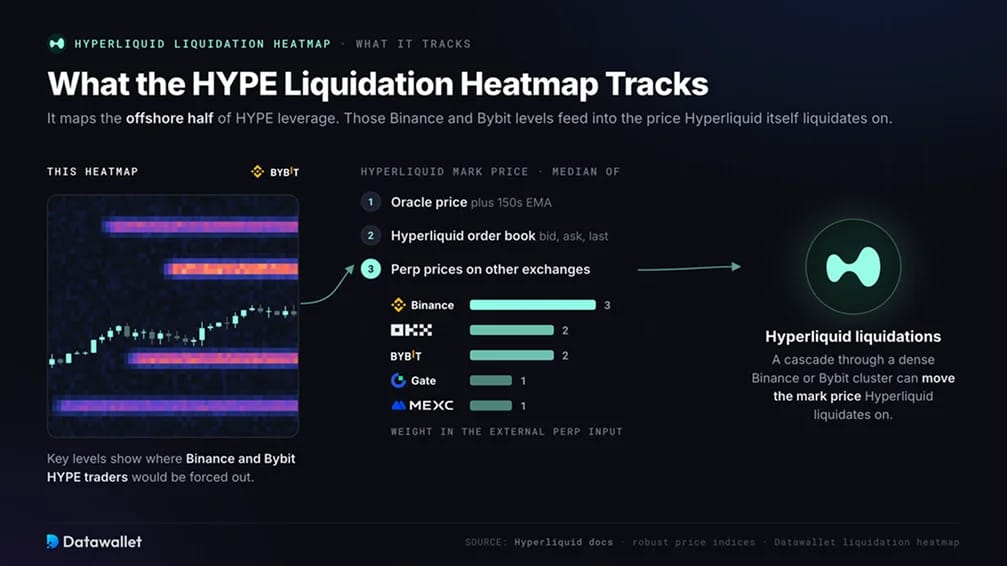
The Hyperliquid liquidation heatmap estimates where leveraged HYPE/USDT perpetual futures positions on Binance and Bybit would be force-closed. HYPE is the native token of Hyperliquid, the largest decentralized perpetual futures exchange. The heatmap covers the centralized-exchange side of HYPE leverage.
That coverage matters for Hyperliquid's own market too. Hyperliquid calculates its mark price partly from perpetual prices on outside exchanges, with Binance and Bybit among the most heavily weighted. So a cascade through a dense Binance or Bybit HYPE cluster can move the price Hyperliquid itself uses for liquidations.
Because HYPE's home venue is outside this model, read the Aggregated view as the offshore half of HYPE's leverage picture. The key levels panel shows where Binance and Bybit traders would be forced out. Those are the levels most likely to feed into Hyperliquid's own mark price if HYPE trades through them.
Why Do HYPE Liquidations Behave Differently?
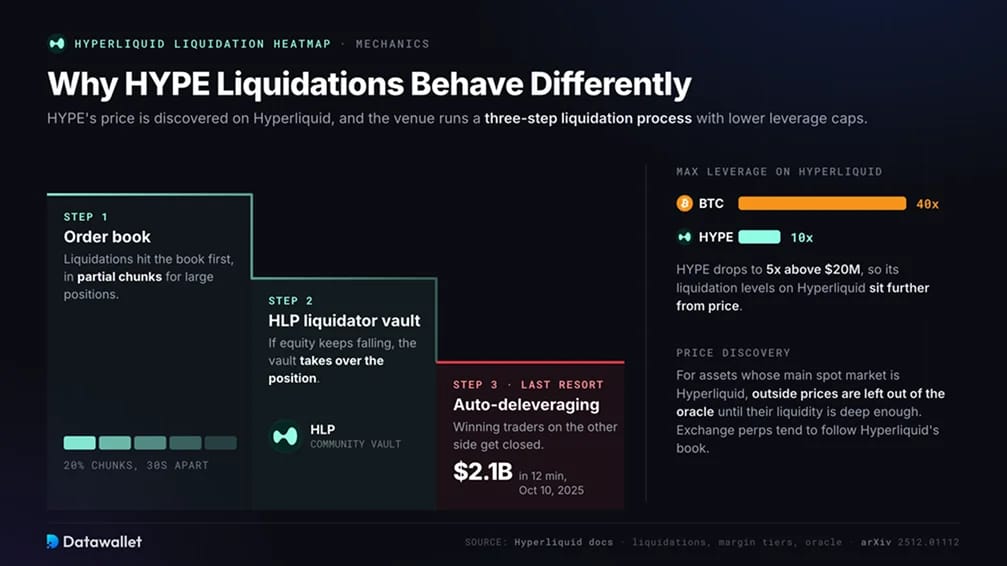
- Price discovery happens onchain: For most assets, Hyperliquid's oracle is a weighted median of spot prices on outside exchanges. For assets whose main spot market is Hyperliquid itself, such as HYPE, outside sources are left out of the oracle until their liquidity is deep enough. HYPE price discovery therefore leans on Hyperliquid's own order book, and centralized-exchange perpetuals tend to follow it.
- The token is reflexive: Hyperliquid sends almost all of its trading fees to HYPE buybacks. Heavy trading and liquidation activity raise platform revenue. A crisis at the platform itself would hit the token and the exchange at the same time.
- Lower leverage caps on Hyperliquid: Hyperliquid allows up to 10x on HYPE, and 5x on positions above $20 million, compared with 40x on BTC. Liquidation levels for HYPE positions on Hyperliquid therefore sit further from price than they would for majors.
- A three-step liquidation process: Hyperliquid first sends liquidations to the order book, in partial chunks for large positions. If an account's equity falls further, the liquidator vault inside HLP takes over the position. Auto-deleveraging is the last resort. On October 10, 2025, auto-deleveraging closed about $2.1 billion of positions in 12 minutes, Hyperliquid's first cross-margin auto-deleveraging event in more than two years. Datawallet's HLP explainer covers how the vault works and the risks it takes on.
What Is Moving HYPE Leverage?
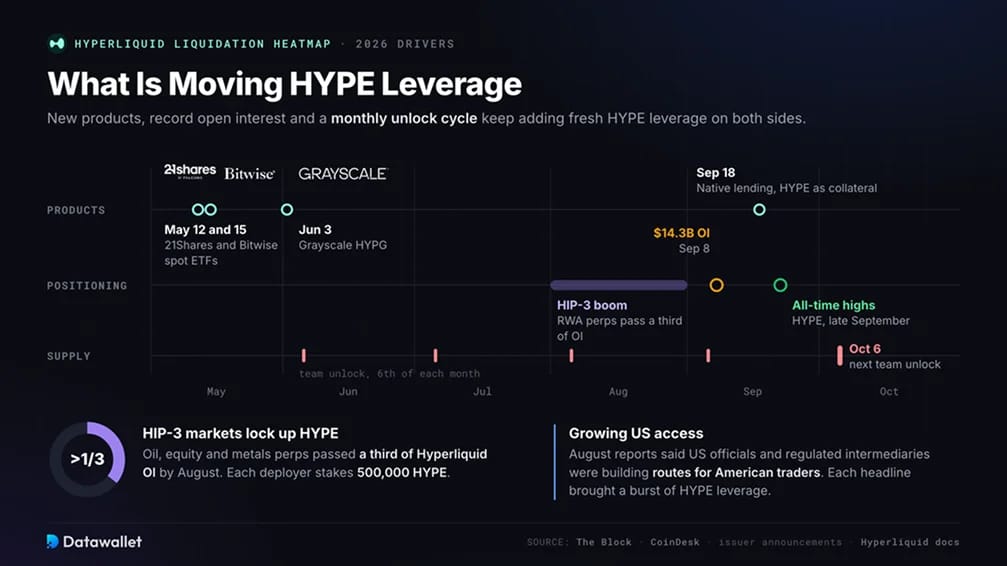
- Record highs and record open interest: HYPE set new all-time highs in September 2026. Hyperliquid's platform-wide open interest reached $14.3 billion on September 8, almost matching the $14.7 billion it held the day before the October 2025 crash.
- Real-world asset perpetuals: Builder-deployed HIP-3 markets for oil, equities and metals grew to more than a third of Hyperliquid's open interest by August 2026. Anyone deploying one of these markets must stake 500,000 HYPE, so HIP-3 growth locks up supply.
- A new layer of HYPE collateral: Hyperliquid launched native lending in September 2026, and borrowers can post HYPE as collateral. Those loans have their own liquidation thresholds, adding onchain liquidation pressure that this heatmap doesn't show.
- ETFs and treasury companies: Three US spot HYPE ETFs launched in 2026: 21Shares THYP on May 12, Bitwise BHYP on May 15 and Grayscale HYPG on June 3. The Hyperliquid ETF tracker follows their daily flows. Hyperliquid Strategies (PURR) holds about 29.4 million HYPE and reported no debt in its August 2026 annual filing, so it isn't a forced seller.
- Unlocks against buybacks: Hyperliquid team tokens unlock monthly on the 6th, and the next unlock is October 6, 2026. Traders often build positions ahead of these dates, betting on whether buybacks will absorb the new supply.
- Growing US access: In August 2026, reports said US officials and regulated intermediaries were working on routes for American traders to reach Hyperliquid markets. Each headline has brought new bursts of HYPE leverage.
How Should You Read HYPE Liquidation Clusters?
- Check Hyperliquid's public positions: Positions on Hyperliquid are visible onchain, so the liquidation prices of large traders can be seen through block explorers. When a large onchain position's liquidation price lines up with a heatmap cluster, that level carries extra weight.
- Compare funding across venues: HYPE funding often differs between Hyperliquid and centralized exchanges. When centralized-exchange funding runs hot while Hyperliquid funding stays flat, heatmap clusters may be building from speculative positioning on those exchanges.
- Plan around the 6th: Look at the 3d and 1w views before each monthly unlock. Leverage that builds ahead of a known supply event tends to unwind right after it.
- Size clusters to HYPE's volatility: HYPE regularly moves more than 10% in a week, so clusters within that range are active targets, not background structure.
What Can't the HYPE Heatmap Tell You?
- The largest venue is missing: Hyperliquid's own HYPE perpetual market, its native lending market and its spot order book aren't in the model.
- Estimated levels: Liquidation prices are modeled from open interest and common leverage ratios. Cross-margin accounts and large balances can liquidate at very different prices.
- Protocol risk isn't priced in: Past manipulation incidents on other Hyperliquid markets, such as JELLY in March 2025 and POPCAT in November 2025, caused losses for HLP. The resulting drops in HYPE had nothing to do with HYPE leverage.
- It doesn't predict direction: The heatmap shows where forced orders would land, not which side breaks first.