


Which Countries Does Rollbit Restrict?
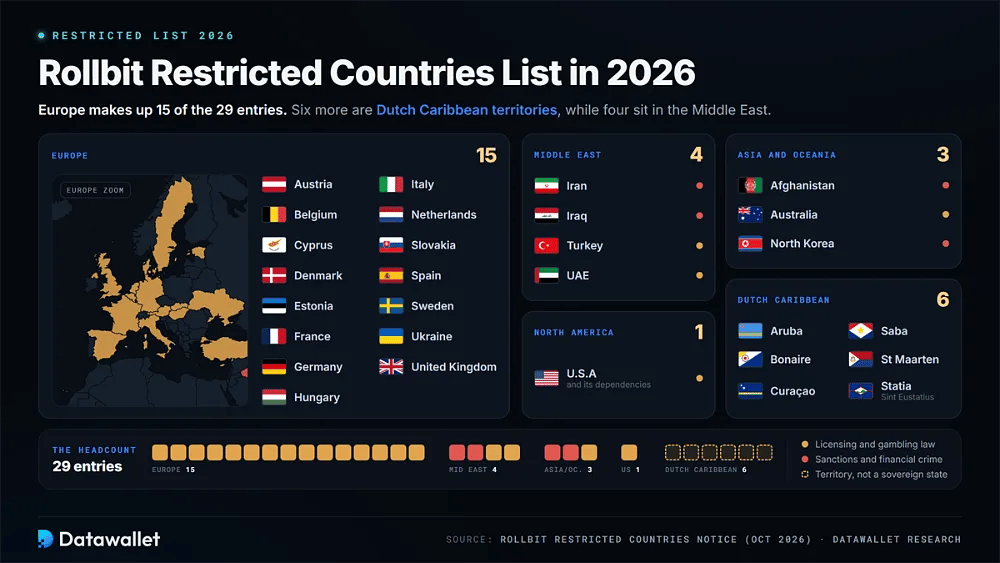
As of October 2026, Rollbit.com is closed to 29 jurisdictions. Residents of those locations cannot register or play under the operator's published Restricted countries notice. The same exclusions appear in its Terms and Conditions.
Those 29 entries represent 23 sovereign states plus six Dutch Caribbean territories, making the number of affected countries smaller than the headline total. Rollbit also retains discretion to reject customers from countries not explicitly named on the list.
Rollbit Restricted Countries List in 2026
Europe makes up 15 of the 29 entries. Six more are Dutch Caribbean territories, while four are in the Middle East. Every restricted jurisdiction is grouped by region below:
Why Does Rollbit Restrict These Countries?
Rollbit's exclusions reflect legal exposure the operator has decided not to assume. In some places, online gambling requires a domestic license. Other jurisdictions prohibit the activity, while sanctions regimes can make payment relationships too risky in certain markets.
Similar exclusion policies appear across crypto platforms such as Polymarket and Hyperliquid. Casinos face an additional layer because they must account for gambling regulation in each market alongside financial crime requirements.
1. Legal and Licensing Compliance
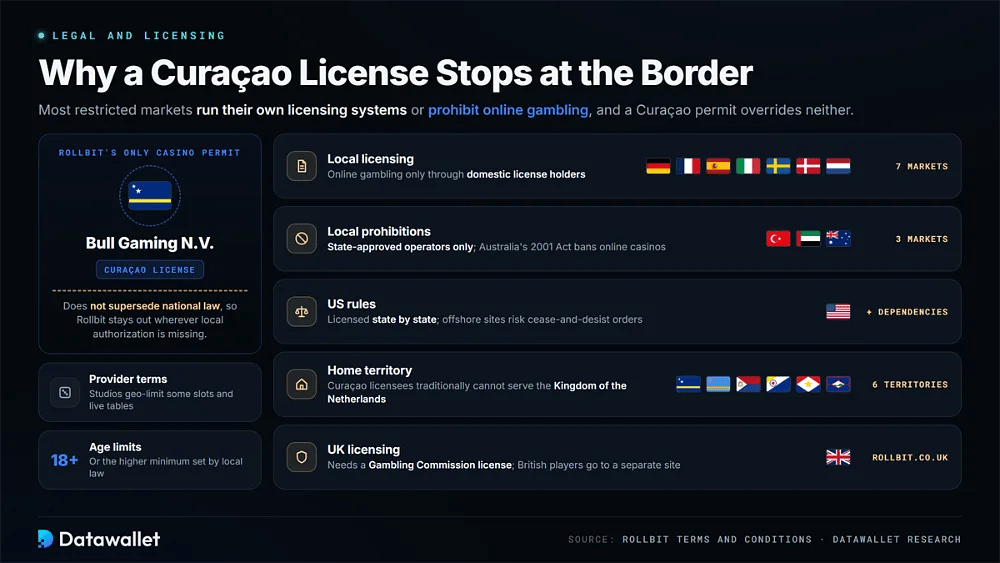
Most countries on the restricted list either maintain their own online gambling licensing systems or prohibit the activity altogether. A Curaçao license does not supersede national law, so Rollbit stays out of markets where Bull Gaming N.V. lacks the required local authorization.
The main legal and licensing drivers behind the list are:
- Local Licensing: Germany, France, Spain, Italy, Sweden, Denmark, and the Netherlands allow online gambling only through operators holding domestic licenses, which Bull Gaming N.V. has not obtained.
- Local Prohibitions: Turkey and the United Arab Emirates limit gambling to state-approved operators. Australia's Interactive Gambling Act 2001 separately prohibits online casino services from being offered to residents.
- US Rules: The United States licenses online gambling at state level. Unlicensed offshore operators can face cease-and-desist orders, which is why Rollbit excludes the country and its dependencies.
- Home Territory: Curaçao-licensed operators have traditionally been unable to serve the Kingdom of the Netherlands, accounting for the blocks on Curaçao, Aruba, St Maarten, Bonaire, Saba, and Statia.
- UK Licensing: Any operator serving consumers in Great Britain needs a Gambling Commission license. Rollbit.com therefore blocks the market and sends British players to a separately licensed site.
- Provider Terms: Individual game studios impose territory restrictions on their software. As a result, some slots and live tables remain unavailable in countries where Rollbit otherwise accepts players.
- Age Limits: All account holders must be at least 18 years old. Where local gambling law sets a higher minimum age, that higher threshold applies.
2. Financial Integrity and Security
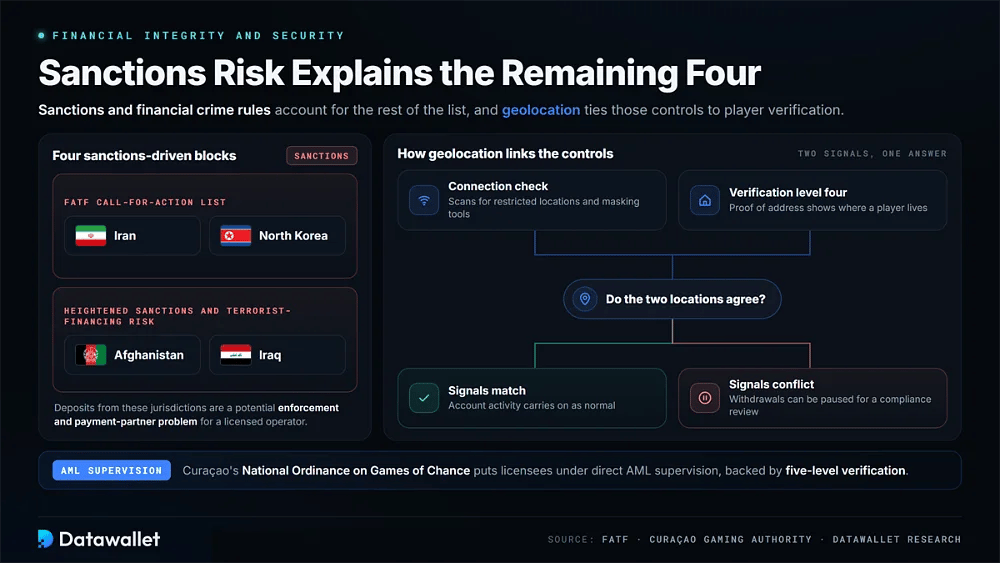
Sanctions and financial crime requirements account for the remaining restrictions. Iran and North Korea appear on the Financial Action Task Force call-for-action list. Afghanistan and Iraq carry heightened sanctions and terrorist-financing risk, making deposits from those jurisdictions a potential enforcement and payment-partner problem for a licensed operator.
Under Curaçao's National Ordinance on Games of Chance, licensees are subject to direct anti-money laundering supervision. Rollbit uses a five-level verification process, starting with basic personal information and extending to proof of address and source of funds. Any level may be requested when account activity appears unusual.
Geolocation links those licensing and financial crime controls. Rollbit checks connections for restricted locations and masking tools, while verification level four uses proof of address to establish where a player lives. If those signals conflict, withdrawals can be paused while the compliance team reviews the account.
Rollbit Supported Countries
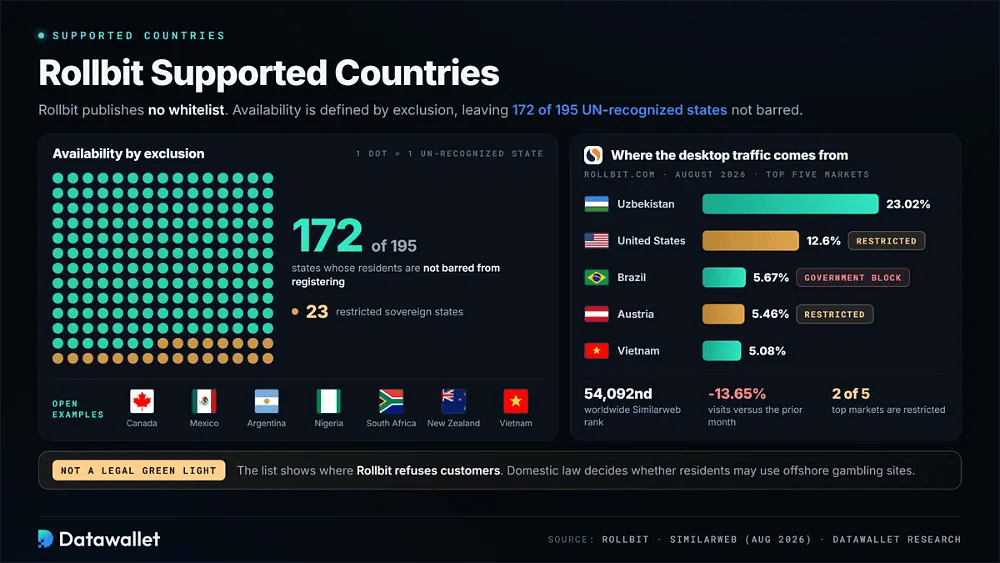
Rollbit does not publish a whitelist of supported countries. Instead, availability is defined by exclusion: residents outside the 29 restricted jurisdictions are not barred from registering. That leaves 172 of the 195 states recognized by the United Nations, including Canada, Mexico, Argentina, Nigeria, South Africa, New Zealand, and Vietnam.
Not appearing on the restricted list does not automatically make Rollbit legal. The list identifies where the operator refuses customers; domestic law determines whether residents may use offshore gambling sites. Players remain responsible for checking local rules, and some governments now block Rollbit without appearing on its own list. Brazil is the largest example.
Great Britain is the only restricted market with an official alternative. Rollbit.co.uk launched in July 2024 as a white label of Grace Media (Gibraltar) Limited, which is listed on the UK Gambling Commission register under account 57869. The British platform is fiat-only and does not offer crypto deposits, futures, or NFT products.
In August 2026, Similarweb ranked Rollbit.com 54,092nd worldwide, with visits 13.65% lower than the previous month. Uzbekistan generated 23.02% of desktop traffic, followed by the United States at 12.6%, Brazil at 5.67%, Austria at 5.46%, and Vietnam at 5.08%. Two of the five markets are restricted.
What Determines Rollbit Access in Practice
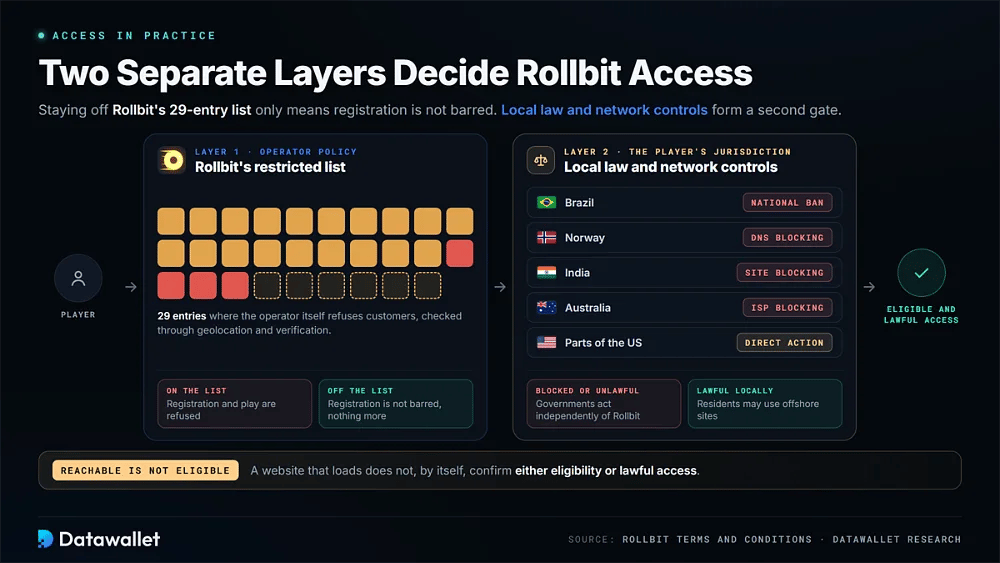
Rollbit access is determined by two separate layers: the operator's own restricted-country policy and the law or network controls in the player's jurisdiction. Staying off Rollbit's 29-entry list only means the platform has not barred registration; it does not establish that offshore gambling is legal locally.
That distinction matters where governments act independently of Rollbit. Brazil, Norway, India, Australia, and parts of the United States illustrate different enforcement approaches, from network-level blocking to direct action against offshore operators. A website being reachable therefore does not, by itself, confirm either eligibility or lawful access.
Crypto Futures Availability on Rollbit
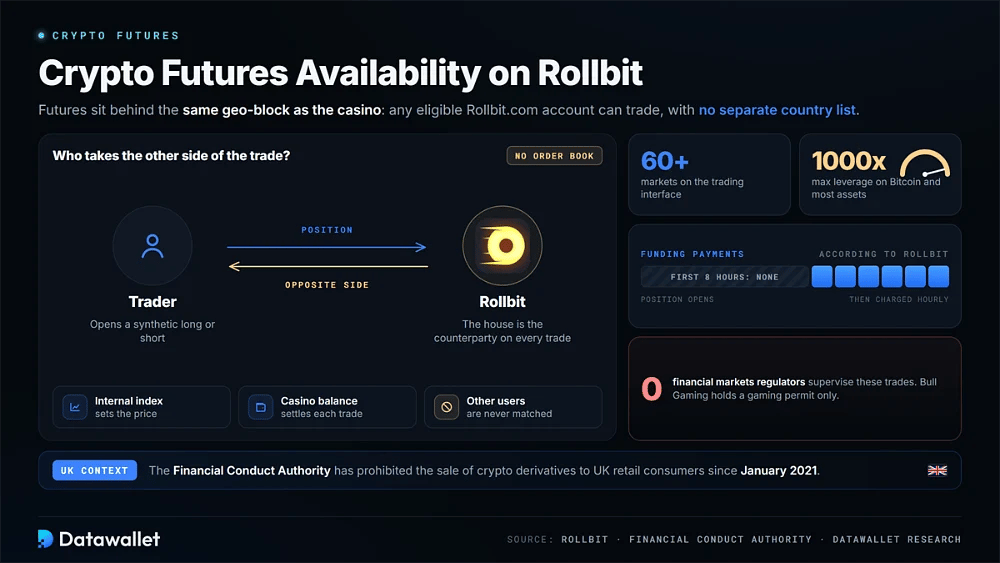
Rollbit applies the casino's geo-block to its crypto futures product as well. Any account eligible to register on Rollbit.com can open the trading interface, and there is no separate country list for futures. The platform offers more than 60 markets, with leverage reaching 1000x on Bitcoin and most other listed assets.
These trades are not matched with other users. Rollbit takes the opposite side of each synthetic position, uses an internal index for pricing, and settles trades from the casino balance. According to Rollbit, hourly funding payments begin after eight hours. Bull Gaming holds a gaming permit, so these trades are not supervised by a financial markets regulator.
That regulatory gap matters for a highly leveraged crypto product. The Financial Conduct Authority has prohibited the sale of crypto derivatives to UK retail consumers since January 2021. Traders seeking supervised venues with order books should compare the best crypto futures exchanges before using a 1000x product.
Can I Use Rollbit in the USA?
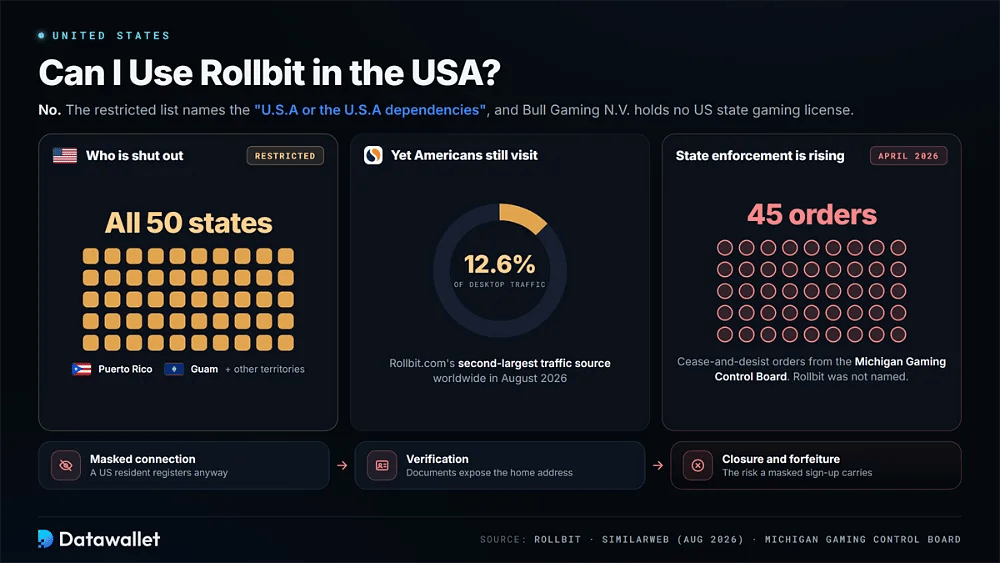
Rollbit is unavailable to anyone who lives in the United States. Its restricted list names the "U.S.A or the U.S.A dependencies", covering all 50 states as well as Puerto Rico, Guam, and other territories. The Terms and Conditions repeat that restriction. Bull Gaming N.V. holds no license from a US state gaming regulator.
Americans nevertheless continue to visit the domain. Similarweb recorded the United States as 12.6% of Rollbit.com's desktop traffic in August 2026, making it the site's second-largest source worldwide. Visiting the website is not the same as holding a funded account. A US resident registering through a masked connection risks closure and forfeiture once verification exposes the home address.
Enforcement against offshore gambling operators is also increasing at state level. In April 2026, the Michigan Gaming Control Board announced cease-and-desist orders against 45 offshore gambling sites, including several crypto casinos, although Rollbit was not named. US residents seeking regulated access can instead compare the best crypto exchanges in the USA.
Can You Use a VPN to Access Rollbit?
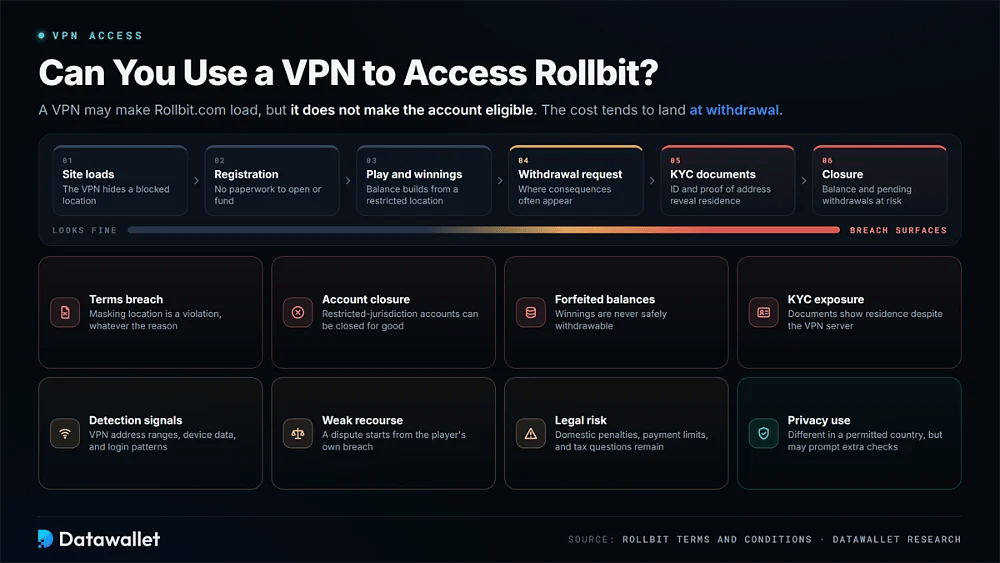
A VPN may make Rollbit.com load from a blocked location, but it does not make the account eligible. Rollbit treats location masking as a breach of its terms, with the consequences often appearing when a user tries to withdraw rather than during registration.
These are the main risks of using a VPN on Rollbit:
- Terms Breach: Rollbit's terms classify attempts to hide location with a VPN, proxy, or false residence information as a violation, regardless of why the player uses them.
- Account Closure: Accounts associated with a restricted jurisdiction may be closed permanently. Published player complaints describe bans after compliance reviews in which VPN use was disclosed.
- Forfeited Balances: A closure caused by a terms breach can include confiscation of the remaining balance and pending withdrawals. Winnings generated from a restricted location are therefore never safely withdrawable.
- KYC Exposure: Verification requires government identification and proof of address. Documents issued in a restricted country reveal residence regardless of the location displayed by the VPN server.
- Detection Signals: Geo-blocking is not limited to a single IP check. It can use known VPN address ranges, device information, and login patterns that move between countries.
- Weak Recourse: Someone who was never eligible to open the account has little standing in a dispute because the complaint begins with a breach of the operator's terms.
- Legal Risk: Circumventing a block does not alter domestic law. Residents of countries that penalize offshore gambling can still face local sanctions, payment restrictions, and tax questions.
- Privacy Use: Using a VPN solely for security while in a permitted country is different, although Rollbit may request additional verification whenever a connection appears masked.
Regulatory Changes Affecting Rollbit Access in 2026
Rollbit's restricted list remained at 29 jurisdictions during 2026, but the surrounding regulatory environment changed materially. Curaçao increased disclosure requirements for licensees, while several governments moved to block offshore casinos even when those countries were not named on Rollbit's restricted list.
Curaçao's New Rules for Licensed Operators
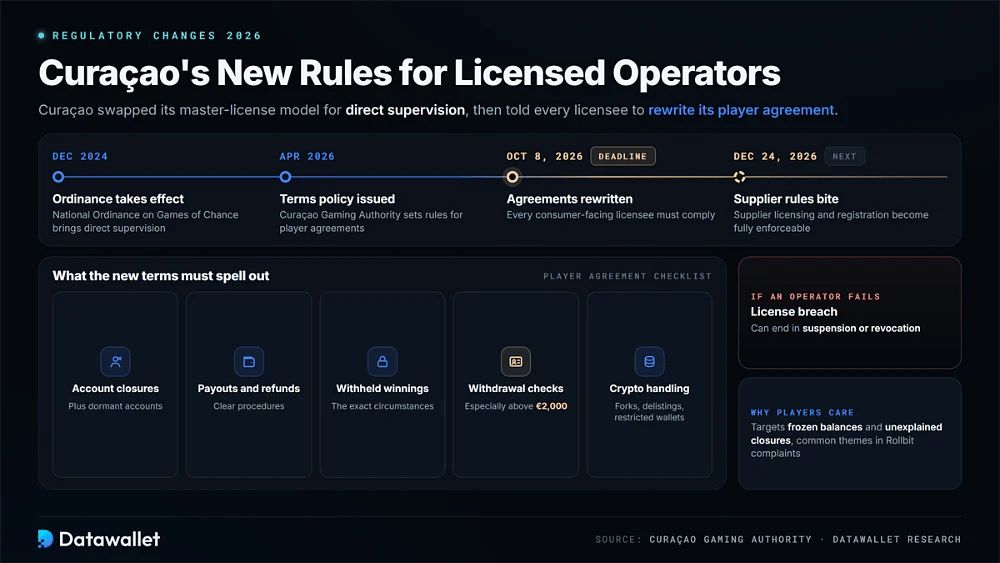
Curaçao moved from its former master-license model to direct supervision when the National Ordinance on Games of Chance took effect in December 2024. The Curaçao Gaming Authority followed in April 2026 with a terms and conditions policy requiring every consumer-facing licensee to rewrite its player agreement by October 8, 2026.
Operators must explain how accounts are closed and dormant accounts are handled. The policy also requires clear payout and refund procedures, along with the circumstances in which winnings can be withheld. Withdrawal terms must identify verification requirements, particularly above €2,000, and cover cryptocurrency forks, delistings, and restricted wallet addresses.
For players, the rules address issues frequently seen in Rollbit complaints, particularly frozen balances and unexplained account closures. Failure to comply is a license breach that can result in suspension or revocation. Another deadline arrives on December 24, 2026, when Curaçao's supplier licensing and registration rules become fully enforceable.
Government Blocks Beyond Rollbit's Restricted List
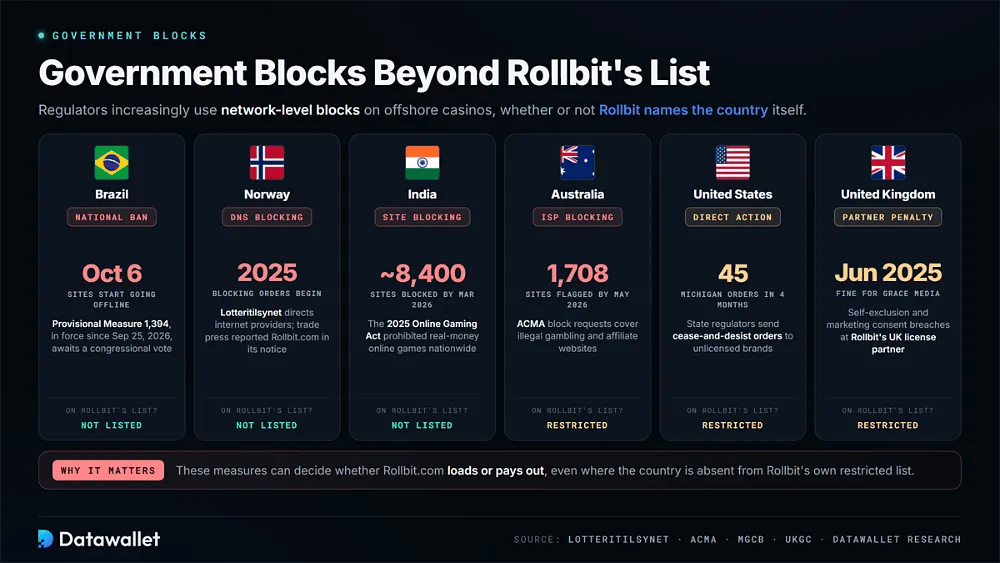
National regulators increasingly use network-level blocks against offshore gambling sites instead of waiting for operators to leave a market voluntarily. These measures can determine whether Rollbit.com loads or pays out even when the country is absent from Rollbit's own restricted list.
Recent enforcement actions that shape Rollbit access include the following:
- Brazil: Provisional Measure 1,394, effective since September 25, 2026 and pending a congressional vote, bans online betting and casino games, including offshore offers, with sites going offline from October 6.
- Norway: Lotteritilsynet began directing internet providers to DNS-block unlicensed gambling domains in 2025. Trade press later reported Rollbit.com among the sites included in its blocking notice.
- India: The 2025 Online Gaming Act prohibited real-money online games nationwide. By March 2026, the government reported that roughly 8,400 betting and gambling sites had been blocked.
- Australia: By May 2026, communications regulator ACMA had requested ISP blocks covering 1,708 illegal gambling and affiliate websites under the Interactive Gambling Act 2001.
- United States: State regulators increasingly target offshore brands directly. Michigan alone issued 45 cease-and-desist orders to unlicensed online casino and sportsbook sites within four months.
- United Kingdom: The Gambling Commission imposed a financial penalty on Grace Media in June 2025 over self-exclusion and marketing consent breaches, illustrating Rollbit's British site's dependence on its partner.
What Fiat Currencies Does Rollbit Support?
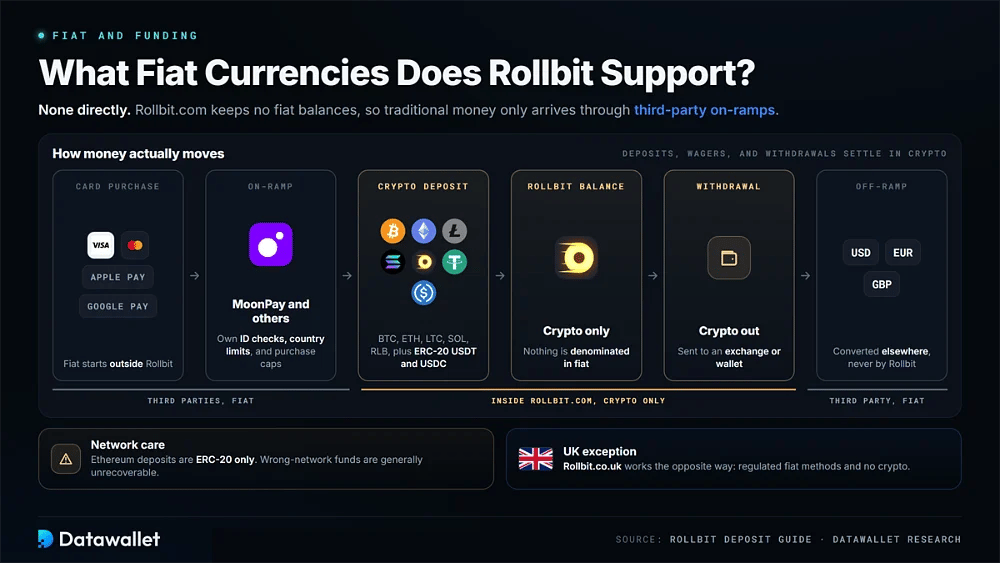
Rollbit.com does not maintain fiat balances. Deposits, wagers, and withdrawals are settled in cryptocurrency. Traditional currency enters the process only through third-party on-ramps, which convert card or bank payments into crypto before the funds reach a Rollbit account.
Here is how fiat and crypto funding works in practice:
- Crypto Deposits: According to Rollbit's official deposit guide, the cashier accepts Bitcoin, Ethereum, Litecoin, Solana, and RLB, along with ERC-20 stablecoins such as USDT and USDC. It accepts nothing denominated in fiat.
- Card Purchases: Third-party providers including MoonPay allow users to purchase crypto with Visa, Mastercard, Apple Pay, or Google Pay and send it directly to a Rollbit deposit address.
- Provider Checks: On-ramp providers impose their own identity verification, country restrictions, and purchase limits. A particular payment method can therefore be unavailable even when Rollbit accepts players from that country.
- Network Care: Rollbit accepts Ethereum deposits only over the ERC-20 network and warns that funds sent through the wrong network are generally unrecoverable. The network should be checked before transferring.
- Crypto Withdrawals: Withdrawals are made only in cryptocurrency. Converting funds to dollars, euros, or pounds requires sending them to an exchange or crypto wallet with fiat off-ramp support.
- UK Exception: Rollbit.co.uk works in the opposite way. It uses regulated fiat payment methods and does not offer British players cryptocurrency deposits or withdrawals.
Rollbit Licenses and Regulation
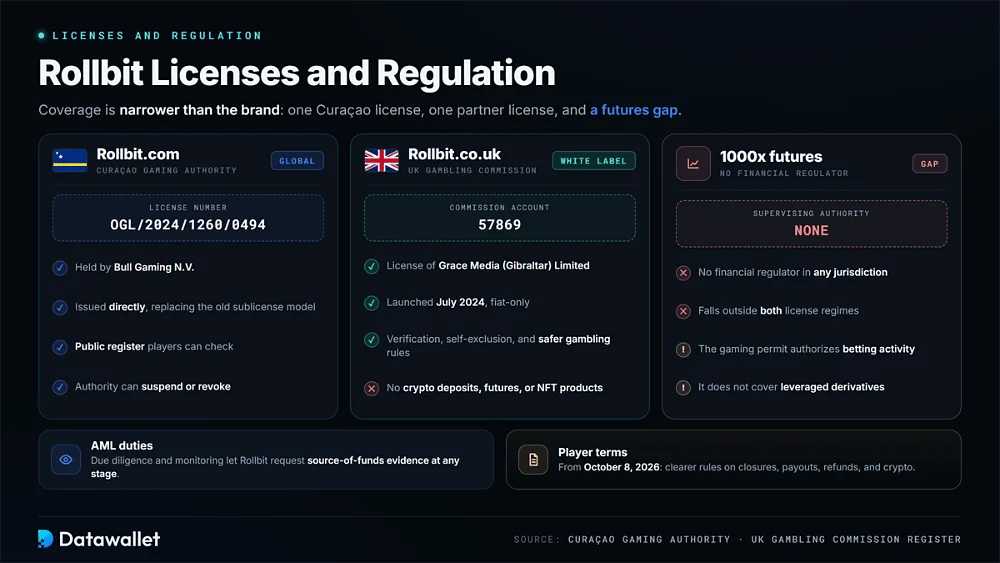
Rollbit's gambling products are licensed, although that regulatory coverage is narrower than the brand's overall reach. The global platform relies on one Curaçao license, while the British site uses a partner's license. Its futures product falls outside both forms of supervision.
The licenses and rules that govern Rollbit today are:
- Curaçao License: Bull Gaming N.V. holds Curaçao Gaming Authority license OGL/2024/1260/0494, issued under the National Ordinance on Games of Chance that replaced the previous sublicense model.
- Direct Supervision: The authority now issues licenses directly, maintains a public register, and can suspend or revoke permits. Players can therefore check a regulator rather than relying on a private master licensee.
- UK White-Label: Rollbit.co.uk operates under the remote casino license of Grace Media (Gibraltar) Limited, bringing the site under UK Gambling Commission requirements for verification, self-exclusion, and safer gambling.
- Futures Gap: No financial regulator in any jurisdiction supervises Rollbit's 1000x trading product. Its gaming permit authorizes betting activity but does not cover leveraged derivatives.
- AML Duties: Licensees must conduct customer due diligence, monitor transactions, and report suspicious activity. Those requirements allow Rollbit to request documents or source-of-funds evidence at any stage.
- Player Terms: From October 8, 2026, Curaçao requires clearer terms governing account closures, payouts, refunds, and cryptocurrency handling. Failure to comply is treated as a license violation.
Does Rollbit Require KYC?
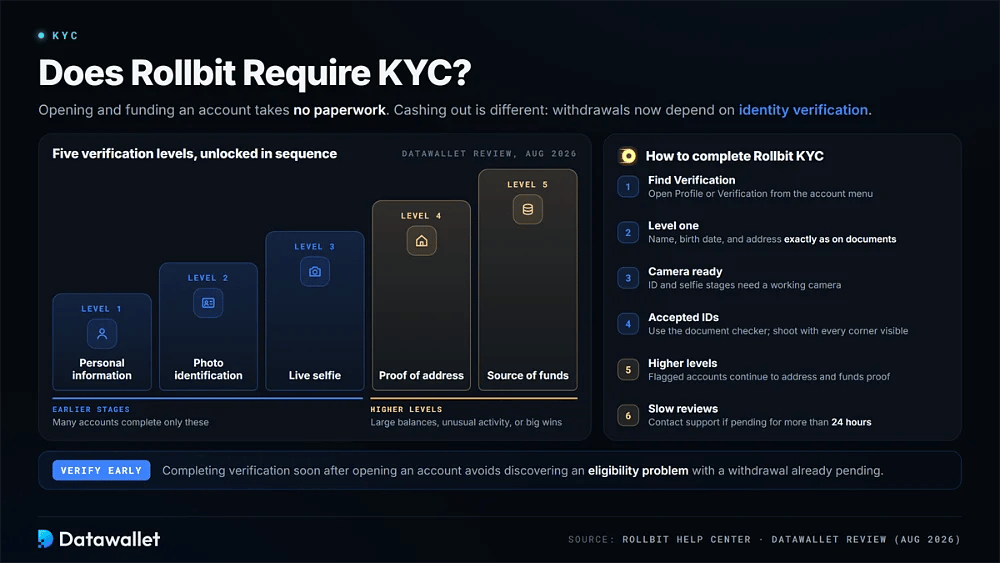
Opening and funding a Rollbit account initially requires no paperwork. Withdrawals are different. Datawallet's August 2026 review found that cashing out now depends on identity verification, putting Rollbit well outside the best no-KYC crypto exchanges.
The verification process has five levels: personal information, photo identification, a live selfie, proof of address, and source of funds. Many accounts complete only the earlier stages. Large balances, unusual activity, or substantial winnings can trigger the higher levels.
How to Complete Rollbit KYC
Verification takes place inside the Rollbit account dashboard. Its Help Center states that each level unlocks in sequence. Completing verification soon after opening an account reduces the risk of first discovering an eligibility problem when a withdrawal is already pending.
Follow these six steps to complete verification on Rollbit:
- Find Verification: Sign in and open the Profile or Verification page through the account menu. Find the panel showing each KYC level and its current completion status.
- Level One: Enter your legal name, date of birth, and home address exactly as they appear on your documents. Rollbit states that submitted entries cannot later be corrected.
- Camera Ready: Before beginning the ID and selfie stages, use a phone or laptop with a functioning camera. The Help Center says those stages cannot be completed without one.
- Accepted IDs: Check your country through Rollbit's linked supported-document checker, choose an accepted form of identification, and photograph it in good lighting with every corner visible.
- Higher Levels: After each completed stage, Rollbit indicates whether another is required. Flagged accounts can be asked to continue through proof of address and eventually source-of-funds evidence at level five.
- Slow Reviews: Contact Rollbit support when a submission is rejected or remains pending for more than 24 hours, the waiting period its Help Center specifies before escalation.
About Rollbit
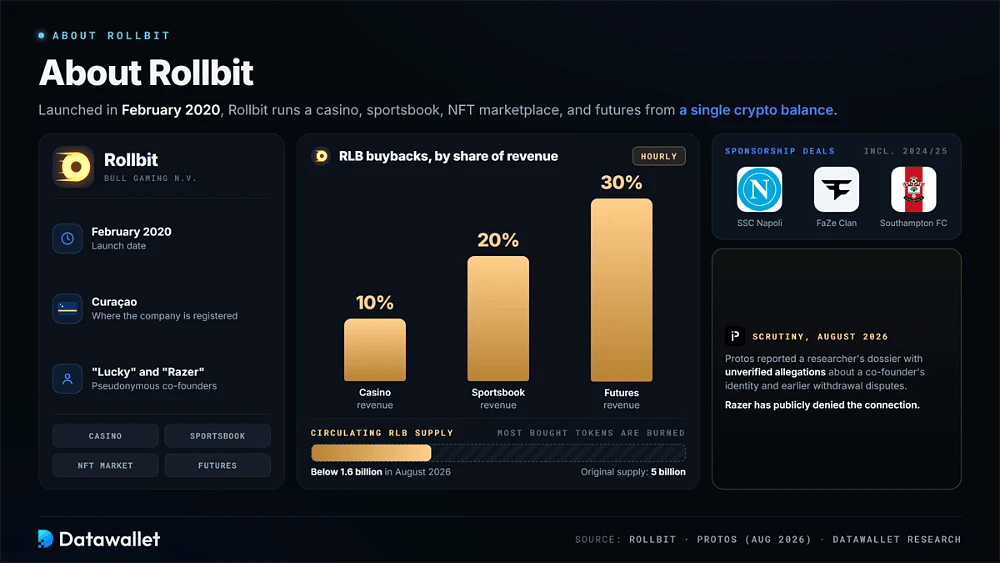
Rollbit launched in February 2020 under Bull Gaming N.V., a Curaçao-registered company. Its two co-founders use the pseudonyms Lucky and Razer and have never publicly confirmed their identities. A single cryptocurrency balance supports the casino, sportsbook, NFT marketplace, and synthetic crypto futures, giving the gambling operator an unusually broad range of products.
The RLB token connects those products. Hourly buybacks use 10% of casino revenue, 20% of sportsbook revenue, and 30% of futures revenue, with most purchased tokens subsequently burned. Circulating RLB supply dropped below 1.6 billion tokens in August 2026 from an original supply of five billion.
Brand growth has also relied on sponsorships, including agreements with SSC Napoli, FaZe Clan, and Southampton FC for the 2024/25 season. Scrutiny has increased alongside that visibility. In August 2026, Protos reported on a researcher's dossier containing unverified allegations about a co-founder's identity and earlier withdrawal disputes. Razer has publicly denied the connection.
Final Thoughts
Rollbit continues to list 29 restricted jurisdictions, but that number no longer gives a complete picture of access. Brazil's ban and Norway's DNS blocking show governments acting independently of the operator, while Curaçao's stricter licensing conditions are changing the rules Rollbit itself must follow.
Eligible players should verify local law, complete KYC before depositing meaningful amounts, and withdraw regularly. Residents of restricted countries should not depend on a VPN because Rollbit's terms permit closure and forfeiture. Anyone primarily seeking leveraged crypto exposure is better served by a regulated venue with a transparent order book.