



.svg)
What is Ether.fi?
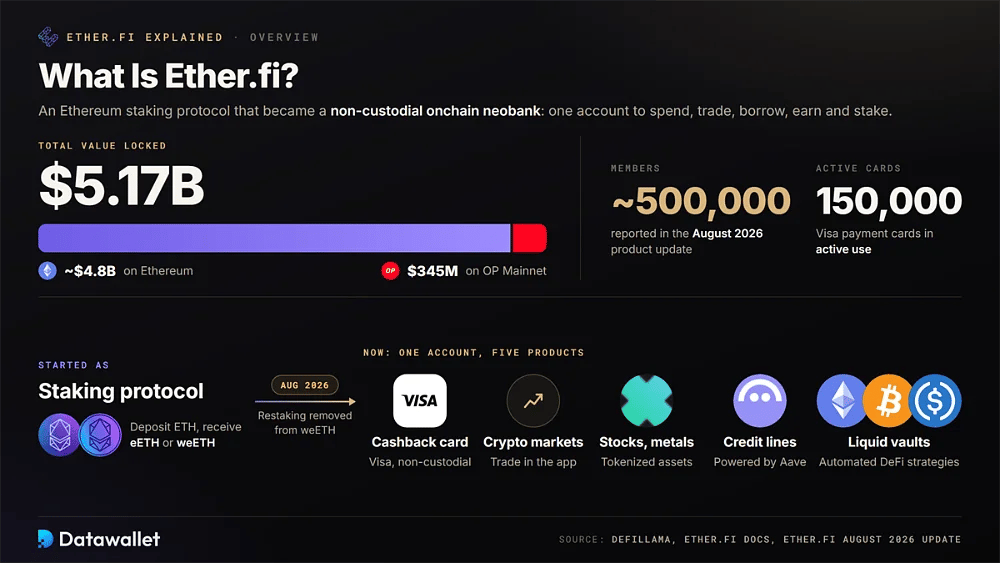
Ether.fi began as an Ethereum staking protocol and has since developed into a non-custodial onchain neobank. Depositors receive eETH, a rebasing liquid staking token, or weETH, its wrapped non-rebasing version designed for DeFi integrations, collateral markets, and transfers across multiple networks.
The protocol's documentation presents Ether.fi as a single account for spending, trading, borrowing, earning, and staking. Its product stack includes a Visa cashback card, crypto markets, tokenized stocks and metals, Aave-powered credit lines, plus Liquid vaults that automate DeFi strategies for ETH, BTC, and stablecoins.
Its scale remains significant despite a turbulent year for staking protocols. DefiLlama tracks roughly $5.17 billion in total value locked, including about $4.8 billion on Ethereum and $345 million on OP Mainnet. During its August 2026 product update, the company reported around 500,000 members and 150,000 active payment cards.
The most important strategic shift came in August 2026, when Ether.fi removed restaking from weETH and wound down its EigenLayer position. That move places it more clearly among liquid staking platforms rather than restaking protocols. Card fees, lending, and trading now contribute more of the revenue previously supported by staking incentives.
How Does Ether.fi Work?
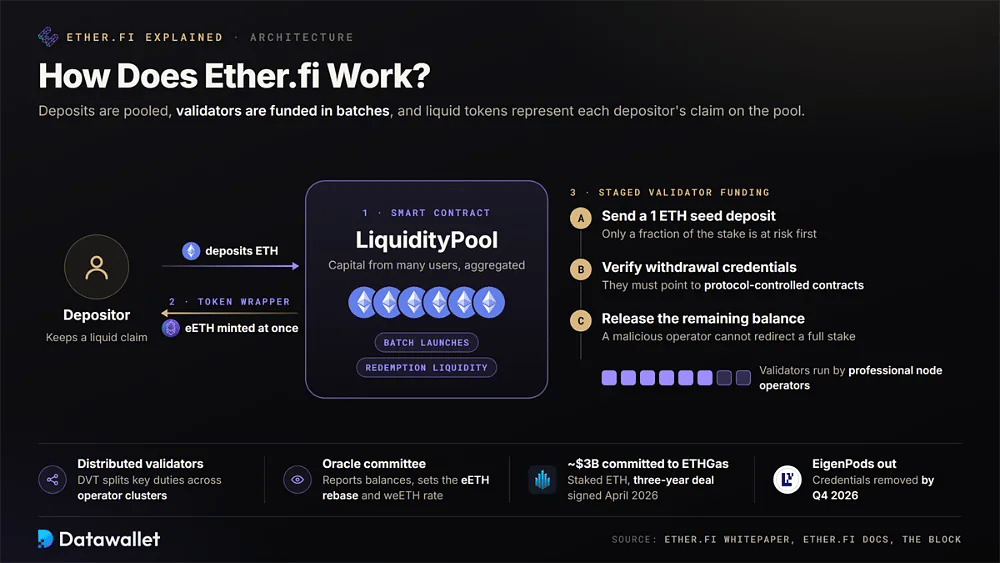
Ether.fi works by pooling user deposits, funding Ethereum validators, and issuing liquid tokens that represent each depositor's claim. The system depends on three main components: the deposit pool, the token wrapper, and validator operations that produce the underlying staking rewards.
1. LiquidityPool and Deposits
ETH deposits enter a smart contract called the LiquidityPool. Rather than matching every depositor with a dedicated validator, the pool aggregates capital from many users. This allows Ether.fi to launch validators in batches, maintain liquidity for redemptions, and mint eETH immediately so depositors can begin accruing rewards without waiting for validator activation.
Validator funding is staged to reduce operator risk. The whitepaper says the pool first sends a 1 ETH seed deposit and verifies that withdrawal credentials point to protocol-controlled contracts. Only after that confirmation does it release the remaining balance, preventing a malicious operator from redirecting an entire validator stake.
2. Tokenization Layer
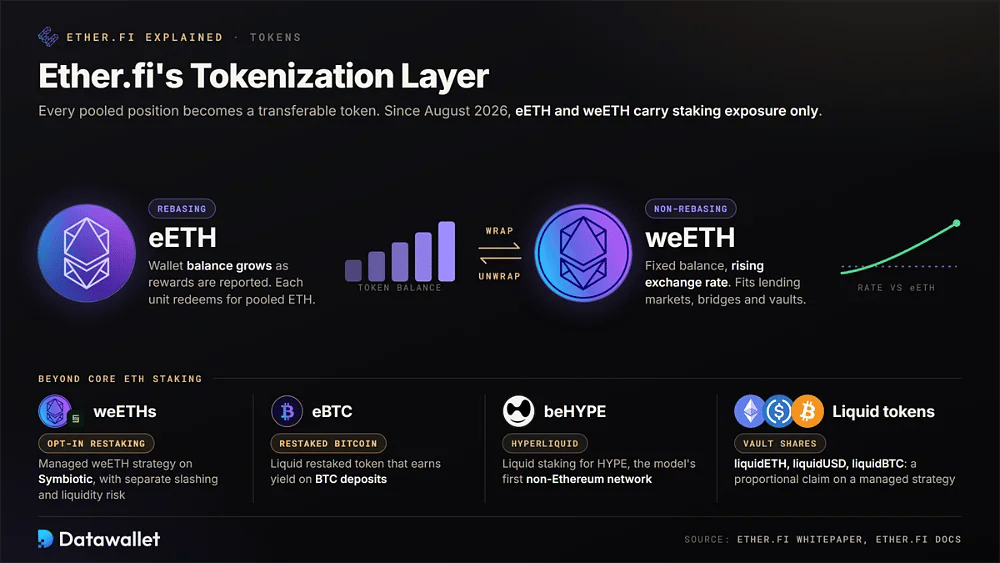
After ETH enters the pool, Ether.fi converts each position into a transferable token. The lineup now extends beyond Ethereum, while the August 2026 restructuring separated restaking from the core ETH products. Standard eETH and weETH therefore provide staking exposure without automatically adding restaking risk.
The main tokens in Ether.fi's lineup work as follows:
- eETH: The base liquid staking token rebases automatically. Wallet balances increase as Ethereum consensus and execution rewards are reported, while each unit remains redeemable for pooled ETH.
- weETH: This wrapped version maintains a fixed token balance while its exchange rate against eETH rises, making it better suited to lending markets, bridges, and vaults that cannot support rebasing balances.
- weETHs: An opt-in managed strategy using weETH and Symbiotic for holders who still want restaking rewards and are willing to accept separate slashing, liquidity, and dependency risks.
- eBTC: A liquid restaked Bitcoin token that generates yield on BTC deposits, applying the transferable yield-bearing format Ether.fi first developed for Ethereum stakers to Bitcoin.
- beHYPE: A liquid staking token for HYPE on Hyperliquid, bringing Ether.fi's receipt-token model to a non-Ethereum network as part of its expansion into multi-asset staking.
- Liquid tokens: Vault depositors receive share tokens including liquidETH, liquidUSD, and liquidBTC. Each represents a proportional claim on a managed strategy and the earnings accumulated within it.
3. Validator Operations
Professional node operators manage the validators that support the pool. Ether.fi's original design uses Distributed Validator Technology to divide key responsibilities across operator clusters. An oracle committee reports balances and rewards to the contracts, which then adjust the eETH rebase and the onchain weETH exchange rate.
The protocol is simplifying these operations following its restaking exit. Its staking documentation says EigenPod withdrawal credentials are scheduled for removal by Q4 2026. In April 2026, Ether.fi also committed roughly $3 billion in staked ETH to ETHGas under a three-year agreement, providing validator liquidity to the company's blockspace marketplace.
Ether.fi's Exit From Restaking
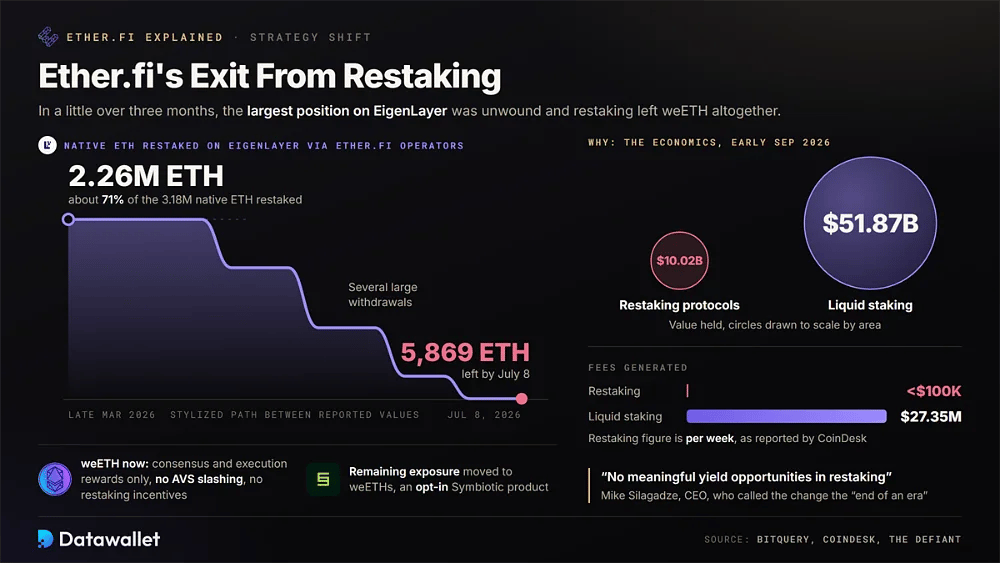
EigenLayer played a central role in Ether.fi's early growth, with deposits automatically restaked to generate points and additional rewards. That structure ended in August 2026. The team removed restaking from weETH and shifted the remaining exposure into weETHs, an opt-in Symbiotic product. Chief executive Mike Silagadze described the change as the “end of an era.”
Onchain data illustrates the speed of the unwind. Bitquery's analysis found that Ether.fi's node operators controlled 2.26 million of the 3.18 million native ETH restaked on EigenLayer in late March 2026, or about 71%. By July 8, following several large withdrawals, the position had dropped to 5,869 ETH.
Economics drove the decision. CoinDesk reported that restaking protocols held $10.02 billion in early September 2026 but generated less than $100,000 in weekly fees. Liquid staking, by comparison, earned $27.35 million on $51.87 billion. Silagadze said there were “no meaningful yield opportunities in restaking,” while stakers also perceived added risk.
For weETH holders, the result is a simpler risk profile and a more straightforward yield source. The token now earns Ethereum consensus and execution rewards without exposure to AVS slashing, an important distinction for lending markets that tightened collateral standards after April's Kelp bridge exploit. Holders no longer receive the restaking incentives that previously increased returns.
Ether.fi Yield Models
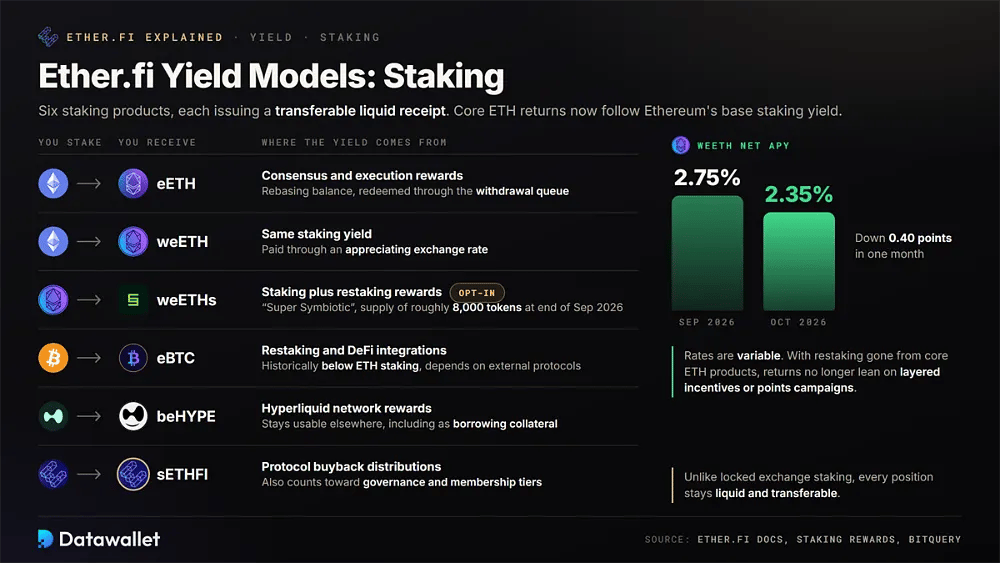
Ether.fi now divides yield primarily between direct staking tokens and managed vault strategies. Rates remain variable. Since restaking was removed from the core ETH products, their returns have tracked Ethereum's base staking yield rather than depending on layered incentive programs or points campaigns.
1. Staking
The staking lineup includes ETH, BTC, HYPE, and Ether.fi's governance token. Each product issues a transferable liquid receipt, distinguishing the model from locked exchange staking and many other Ethereum staking platforms.
Current staking products and their reward sources include:
- eETH: Generates Ethereum consensus and execution rewards through a rebasing balance. Redemptions move through the protocol's withdrawal queue, with timing determined by pool liquidity and validator exits.
- weETH: Receives the same staking yield through an appreciating exchange rate. Staking Rewards listed a 2.35% net APY in October 2026, compared with 2.75% a month earlier.
- weETHs: Marketed as Super Symbiotic, this optional strategy adds restaking rewards to weETH. Bitquery measured supply at roughly 8,000 tokens at the end of September 2026.
- eBTC: Seeks yield on Bitcoin deposits through restaking and DeFi integrations. Historical returns have generally remained below ETH staking and depend heavily on external protocols.
- beHYPE: Stakes HYPE on Hyperliquid while issuing a liquid token, allowing holders to keep receiving network rewards and still use the asset elsewhere, including as borrowing collateral.
- sETHFI: Users who stake ETHFI receive sETHFI. It earns tokens distributed through the protocol's buyback program while also counting toward governance participation and higher membership tiers.
2. Liquid Vaults
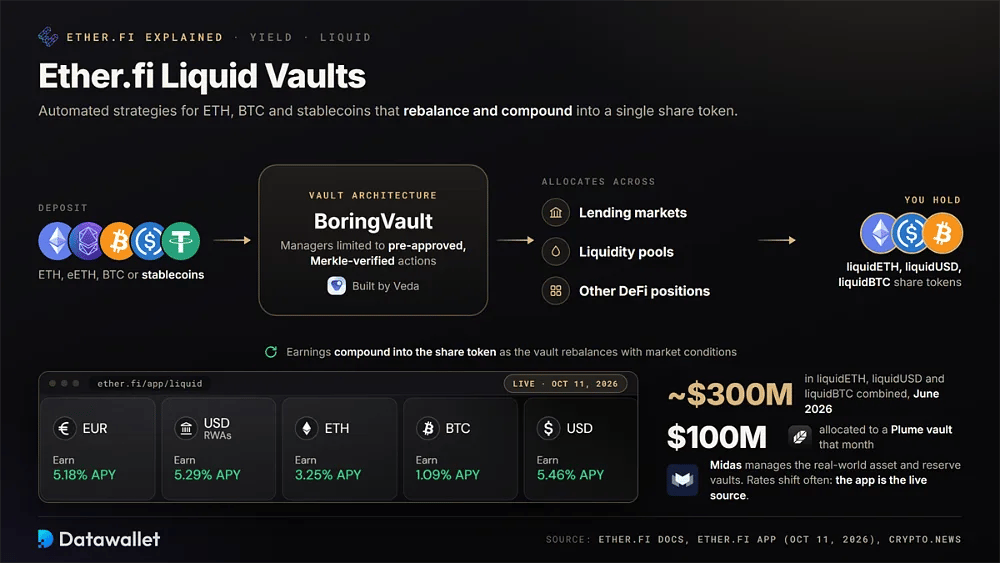
Ether.fi's Liquid product is aimed at users who want automated strategies rather than exposure to a single yield-bearing asset. Deposits can include ETH, eETH, BTC, or stablecoins. Vaults allocate this capital across lending markets, liquidity pools, and other DeFi positions, rebalance as conditions change, and compound earnings into the share token.
Most vaults use Veda's BoringVault architecture, which separates operational roles and limits managers to pre-approved, Merkle-verified actions. Midas manages the real-world asset and reserve vaults. In June 2026, the flagship liquidETH, liquidUSD, and liquidBTC vaults held around $300 million combined. Ether.fi also allocated $100 million to a Plume vault that month.
Vault yields change frequently, making the app the only reliable source for current rates. Stablecoin strategies usually offer more than ETH staking because they take on additional lending and liquidity risk. Comparing those returns with other stablecoin interest rates can help determine whether the added complexity is being compensated.
How to Use Ether.fi
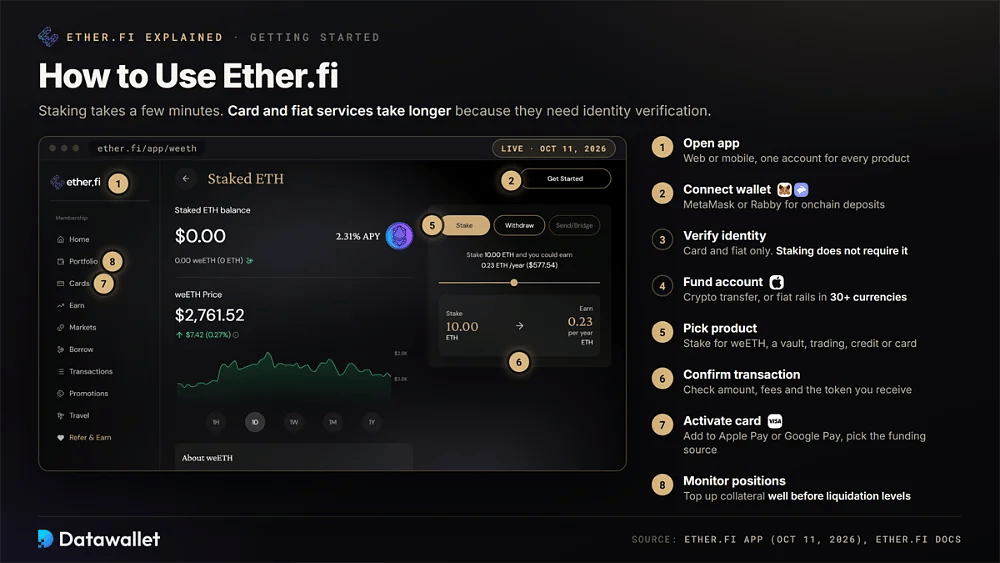
Basic staking can be set up within a few minutes, while card and fiat services take longer because they require identity verification. Ether.fi places its products under a single account, allowing the same overall balance to support multiple features.
A typical onboarding flow follows these eight steps:
- Open app: Visit Ether.fi's website or download the mobile app, then create an account for staking positions, vault shares, card balances, and trading activity.
- Connect wallet: Link an external wallet such as MetaMask or Rabby for onchain deposits. Our guide to the best Ethereum wallets compares suitable self-custody options for staking.
- Verify identity: Complete identity verification to access the card or fiat accounts. Onchain staking does not require it, and a single verification is reused across supported payment features.
- Fund account: Transfer crypto from a wallet or exchange, or use fiat rails that support more than 30 currencies and payment methods, including Apple Pay and Cash App.
- Pick product: Select ETH staking for weETH, a Liquid vault, crypto or tokenized asset trading, a credit line, or card funding.
- Confirm transaction: Check the amount, fees, and token you will receive. Approve the transaction so the smart contract can mint the position and update the account balance.
- Activate card: Order the Visa card, connect it to Apple Pay or Google Pay, and choose whether purchases use stablecoin balances or borrowed funds.
- Monitor positions: Follow rewards, cashback, vault performance, and borrowing health from the dashboard. Add collateral well before prices approach liquidation thresholds.
ETHFI Tokenomics
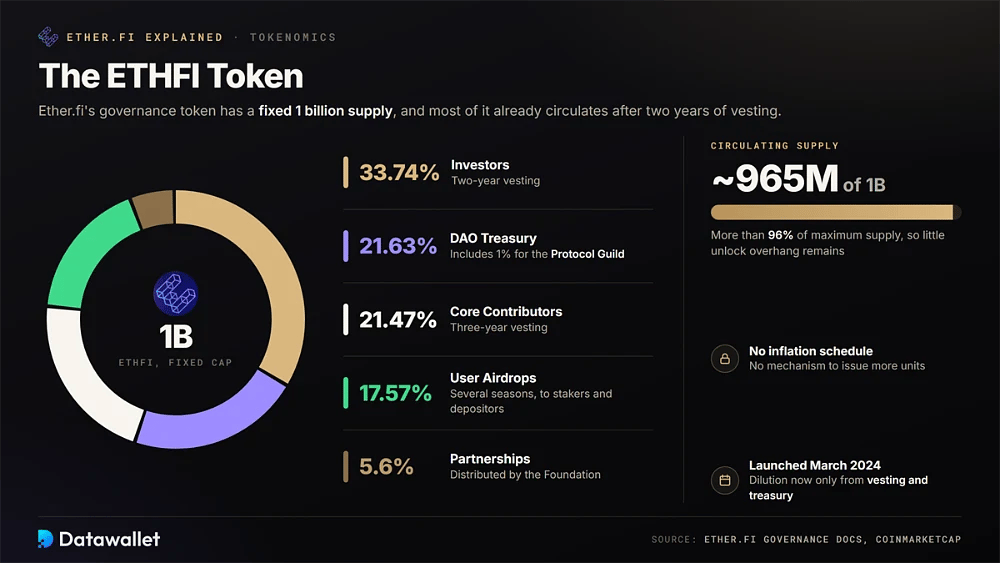
ETHFI is Ether.fi's governance token and the mechanism through which part of the protocol's revenue reaches long-term participants. Supply is fixed at 1 billion tokens, most of which is already circulating following two years of vesting and airdrop distributions.
Supply
The ETHFI supply was allocated among investors, contributors, the treasury, and users when the token launched in March 2024. No additional issuance is possible. Future dilution therefore comes only from outstanding vesting unlocks and treasury distributions.
The official allocation and current supply picture look like this:
- Supply cap: Total and maximum supply are both fixed at 1 billion ETHFI. The token has no inflation schedule or mechanism for issuing additional units.
- Investors: 33.74% was allocated to investors on a two-year vesting schedule, making early backers the largest individual category in the original distribution.
- DAO Treasury: 21.63% belongs to the DAO Treasury for ecosystem development, grants, and liquidity. That allocation includes a 1% commitment to the Protocol Guild supporting Ethereum core contributors.
- Core Contributors: 21.47% is reserved for the core team under a three-year vesting schedule, extending contributor incentives beyond the protocol's initial launch period.
- User Airdrops: 17.57% went to user airdrops across several seasons, rewarding stakers, vault depositors, and other participants who contributed activity during Ether.fi's growth.
- Partnerships: 5.6% is reserved for partnerships and distributed by the Foundation, generally supporting integrations, liquidity programs, and ecosystem relationships intended to extend ETHFI's reach.
- Circulating: CoinMarketCap reports roughly 965 million ETHFI in circulation, representing more than 96% of maximum supply and leaving relatively little future unlock supply compared with newer tokens.
Utility
Governance is ETHFI's core function. Holders can vote on protocol fees and contract upgrades, approve node operators, allocate grants, and decide on treasury diversification. The Ether.fi Foundation executes those decisions. Staking ETHFI produces sETHFI, which receives buyback distributions and contributes toward higher in-app membership tiers.
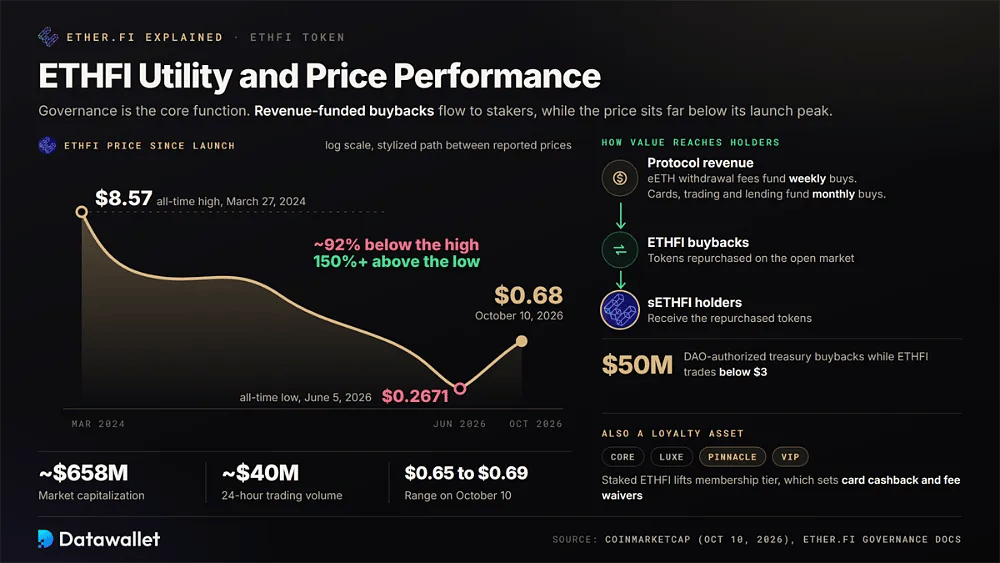
Token value accrual is tied to the buyback program. Revenue from eETH withdrawal fees funds weekly ETHFI purchases, while part of the broader product suite's revenue supports monthly purchases. Repurchased tokens are distributed to sETHFI holders. The DAO has also authorized up to $50 million in treasury buybacks while ETHFI trades below $3.
Membership gives the token an additional consumer use case. Core, Luxe, Pinnacle, and VIP tiers determine Cash card cashback rates and fee waivers, making staked ETHFI partly function as a loyalty asset. Ether.fi's August 2026 update also linked programmatic buybacks directly to revenue generated by cards, trading, and lending.
Price Performance
CoinMarketCap priced ETHFI at about $0.68 on October 10, 2026. Its market capitalization was near $658 million, with roughly $40 million in 24-hour trading volume. The token traded between $0.65 and $0.69 that day, while circulating supply stood at around 965 million of the 1 billion maximum.
ETHFI remains approximately 92% below its March 27, 2024 all-time high of $8.57, reached shortly after launch. The token has nevertheless risen more than 150% from its all-time low of $0.2671 on June 5, 2026. That recovery coincided with Ether.fi's restaking exit and the launch of its neobank products.
What is the Ether.fi Cash Card?
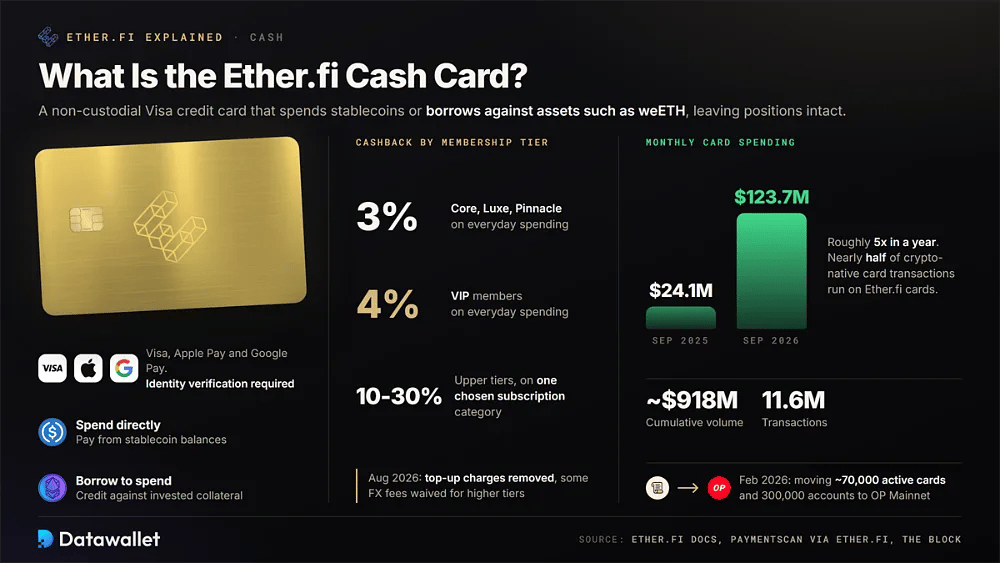
Ether.fi Cash is a non-custodial Visa credit card linked to an Ether.fi account. Users can either spend stablecoin balances directly or borrow against assets such as weETH, allowing invested positions to remain intact while funding everyday purchases. The card supports Apple Pay and Google Pay and requires identity verification.
Rewards depend on membership tier. Ether.fi advertises 3% cashback on everyday spending for Core, Luxe, and Pinnacle members and 4% for VIP members. Upper tiers can also receive 10% to 30% back on one selected subscription category. The August 2026 update removed top-up charges and waived certain foreign-exchange fees for higher membership levels.
The underlying infrastructure changed in 2026. In February, Ether.fi announced that Cash would migrate from Scroll to OP Mainnet, moving roughly 70,000 active cards and 300,000 accounts to access deeper swap liquidity and broader asset support. Data from The Block showed Ether.fi cards processing nearly half of crypto-native payment card transactions.
Card usage has expanded rapidly. Paymentscan figures cited by Ether.fi show $123.7 million of spending in September 2026, compared with $24.1 million a year earlier. Cumulative volume reached about $918 million across 11.6 million transactions, placing Cash among the most widely used crypto debit cards and credit products available today.
Ether.fi's Neobank Expansion in 2026
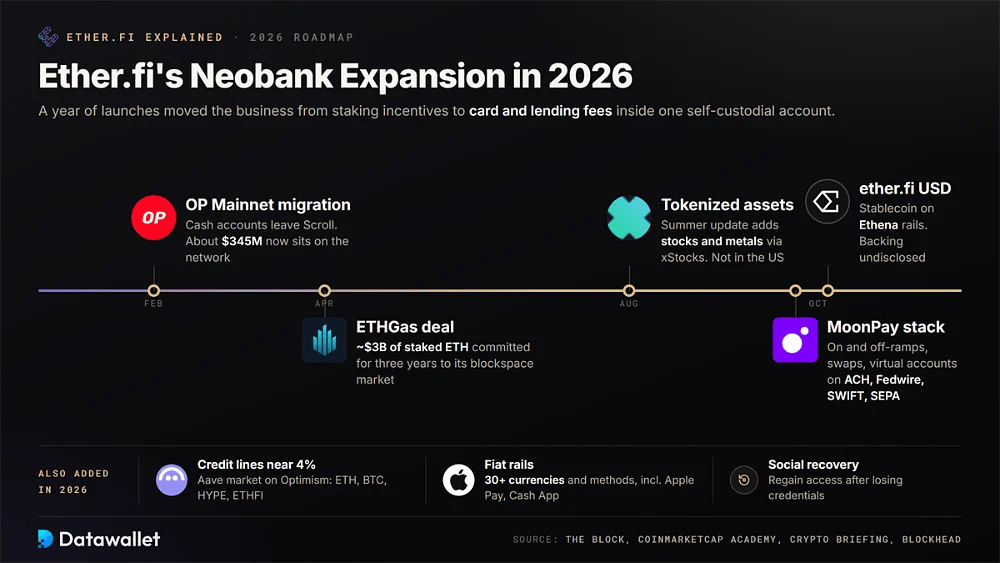
During 2026, Ether.fi shifted away from a business centered on staking incentives and added more banking-style services. Those launches expanded the functions available through one self-custodial account and help explain why card and lending fees now play a central role in revenue.
The most significant product and partnership milestones this year were:
- OP Mainnet: February's migration transferred Cash accounts from Scroll to Optimism's flagship chain. DefiLlama now records roughly $345 million of Ether.fi value on the network.
- ETHGas deal: Ether.fi committed about $3 billion of staked ETH for three years in April, providing validator liquidity to ETHGas's institutional Ethereum blockspace marketplace.
- Tokenized assets: The August Summer update introduced tokenized stock and metals trading through xStocks. Assets remain in self-custodial vaults, although the service is unavailable in the United States.
- Credit lines: A dedicated Aave market on Optimism allows borrowing near 4% against ETH, BTC, HYPE, and ETHFI, putting Ether.fi in competition with established crypto lending platforms on cost.
- Fiat rails: Deposits and withdrawals support more than 30 currencies and payment methods, including Apple Pay and Cash App, reducing the need to fund accounts through external exchanges.
- Social recovery: Users can recover account access after losing credentials, addressing a major usability problem that has kept many mainstream users from adopting self-custody.
- MoonPay stack: October's MoonPay integration adds embedded on- and off-ramps, cross-chain swaps, and virtual accounts supporting ACH, Fedwire, SWIFT, and SEPA, with the rollout continuing over the coming months.
- ether.fi USD: A dollar stablecoin announced in early October will use Ethena's white-label infrastructure for reserves and redemptions. Its backing, yield terms, and launch date have not yet been disclosed.
How Ether.fi's Products Fit Together
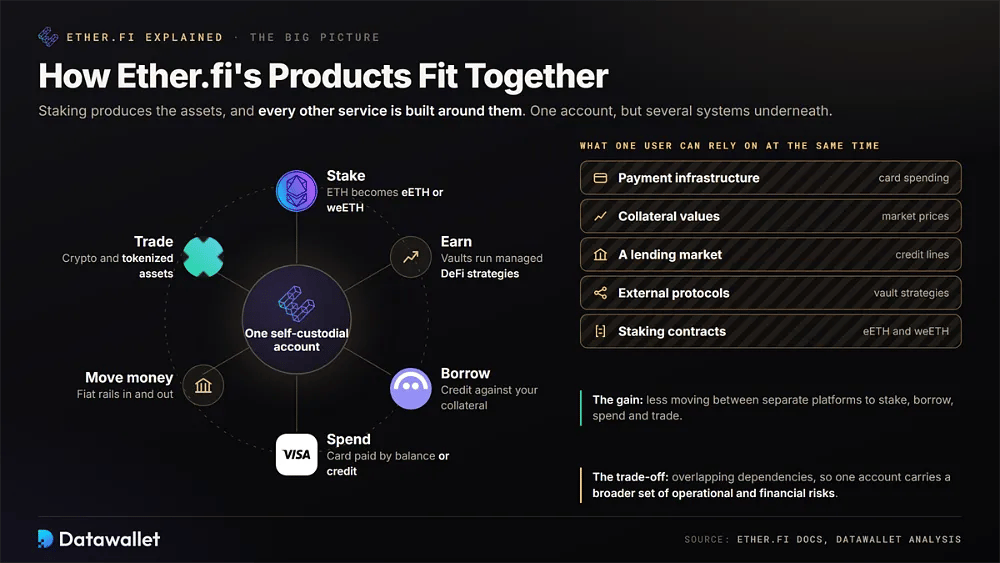
Ether.fi's current structure connects staking with services built around the resulting assets. ETH can become eETH or weETH, while vaults put supported assets into managed DeFi strategies. The same account also provides access to borrowing, card spending, fiat rails, and trading in crypto or tokenized assets.
That integration reduces the need to move between separate platforms, but it also creates overlapping dependencies. A user may simultaneously rely on staking contracts, a lending market, collateral values, payment infrastructure, and external protocols. The convenience of one account therefore comes with a broader set of operational and financial risks.
Ether.fi Founders
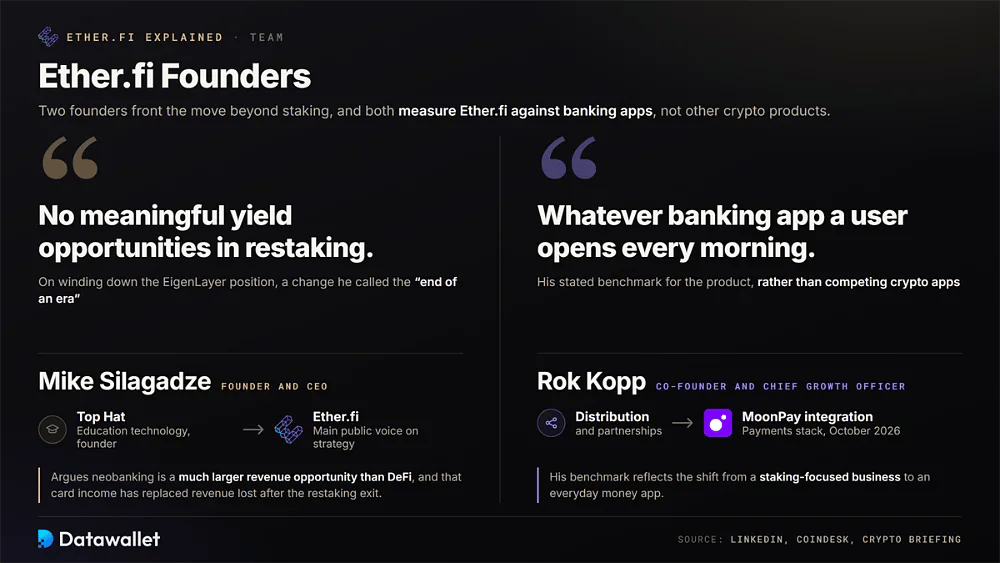
Ether.fi is led by founder and chief executive Mike Silagadze, who previously founded the education technology company Top Hat. He has been the main public voice behind Ether.fi's strategic shift, arguing that neobanking offers a much larger revenue opportunity than DeFi and that card income has replaced revenue lost after the restaking exit.
Co-founder and Chief Growth Officer Rok Kopp oversees distribution and partnerships, including the MoonPay integration. He has said the company's benchmark is “whatever banking app a user opens every morning” rather than competing crypto products, reflecting Ether.fi's move beyond a staking-focused business.
Is Ether.fi Safe?
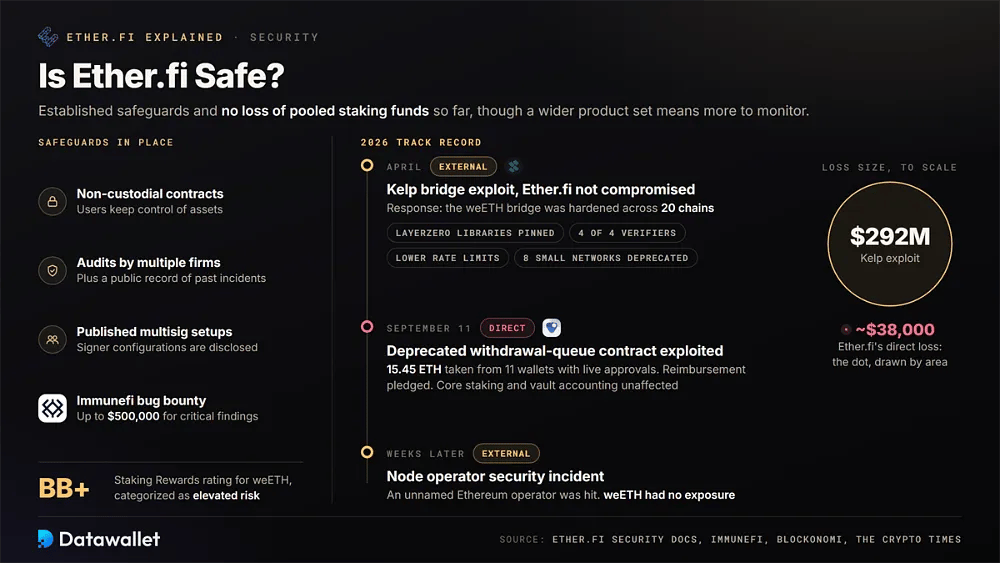
Ether.fi has several established security measures. Its system uses non-custodial contracts, has undergone audits by multiple firms, publishes multisig configurations, and operates an Immunefi bug bounty that pays up to $500,000 for critical smart-contract findings. The protocol's security documentation also contains a public record of previous incidents.
Those safeguards do not eliminate DeFi risk. Staking Rewards gives weETH a BB+ rating, categorized as elevated risk. Ether.fi's expansion into bridges, vaults, credit, and payments also increases the number of systems and dependencies users need to monitor.
Security Track Record
One of the biggest tests came from an external incident. Ether.fi itself was not compromised during April 2026's $292 million Kelp bridge exploit, but it subsequently hardened the weETH bridge across 20 chains. Changes included pinning LayerZero message libraries, requiring attestations from all four verifier networks, and reducing rate limits. The protocol also started deprecating weETH bridging on eight smaller networks.
Ether.fi suffered a direct incident on September 11, 2026. An attacker exploited a deprecated withdrawal-queue contract developed by Veda for the Liquid vault and took roughly 15.45 ETH, worth about $38,000, from 11 wallets that still had token approvals. Silagadze promised reimbursement. Core staking contracts and current vault accounting were not affected.
Several weeks later, Ether.fi said that a security incident involving an unnamed Ethereum node operator left weETH with no exposure. Across these events, pooled staking funds have not been lost. The direct legacy-contract exploit was comparatively small and accompanied by a reimbursement commitment, while the protocol has responded to broader ecosystem incidents by reducing bridge and counterparty dependencies.
Risks
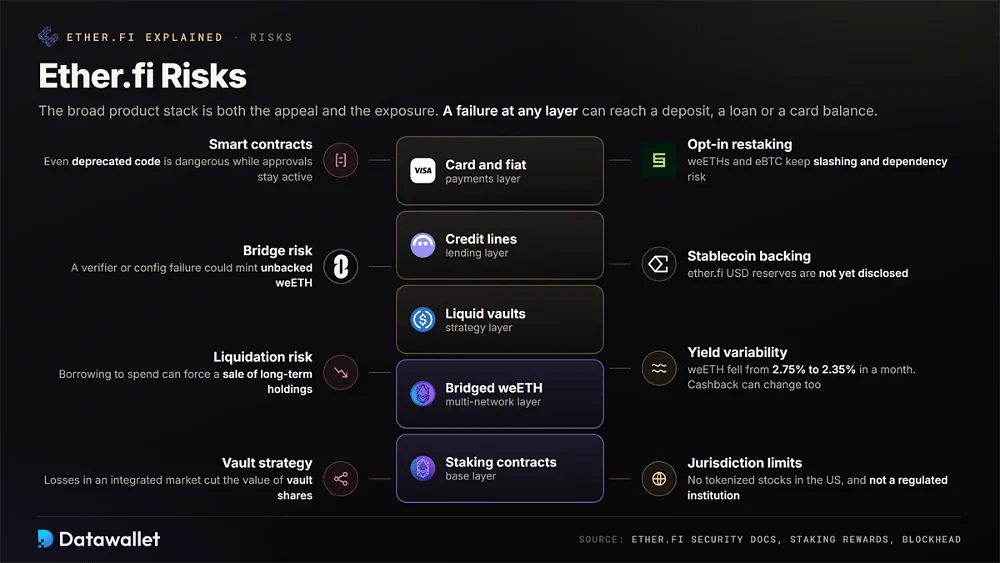
Ether.fi's broad product offering is both a major feature and a source of risk. Users who deposit assets, borrow against collateral, or maintain a card balance need to understand how failures at each layer could affect their position.
The most important risks to weigh before using the platform are:
- Smart contracts: Staking, vaults, credit, and card accounts all depend on smart contracts. September's legacy-queue exploit demonstrated that even deprecated code can remain dangerous when users have active approvals.
- Bridge risk: weETH is available across multiple networks using LayerZero messaging. A verifier or configuration failure could produce unbacked tokens, which was the same underlying mechanism involved in April's Kelp exploit.
- Liquidation risk: Funding card purchases by borrowing against volatile collateral creates liquidation exposure. A sudden market decline can turn ordinary spending into a forced sale of long-term holdings.
- Vault strategy: Liquid vaults rely on external protocols and manager decisions. Losses in an integrated lending market or liquidity pool can therefore reduce the value of depositors' vault shares.
- Opt-in restaking: weETHs and eBTC holders still accept slashing, liquidity, and dependency risks connected to Symbiotic and other restaking systems. Standard eETH and weETH no longer carry those exposures.
- Stablecoin backing: Ether.fi has not disclosed the reserves behind the planned ether.fi USD. If the stablecoin depends on Ethena's USDe, holders would inherit funding-rate and derivatives-venue exposure absent from Treasury-backed stablecoins.
- Yield variability: Returns can change quickly. weETH fell from 2.75% to 2.35% within one month, while cashback rates and membership rewards can also be changed by the company.
- Jurisdiction limits: Tokenized stock trading is unavailable in the United States, card issuance varies by country, and Ether.fi states that it is not a regulated financial institution, which limits consumer protections.
Final Thoughts
By late 2026, Ether.fi has evolved far beyond the liquid restaking protocol that launched ETHFI. Its model now combines Ethereum staking with card payments, credit, trading, and fiat infrastructure, placing it among the more ambitious DeFi projects aiming to compete with consumer banking apps, not just other protocols.
The financial logic is increasingly clear. Restaking fees have declined, while Ether.fi card spending surpassed $120 million per month and now contributes nearly half of revenue. Some of that income funds ETHFI buybacks, giving staked ETHFI a more direct link to business performance than governance rights alone.
More functionality also means more complexity. Each feature adds contract, counterparty, or regulatory risk, while products such as the stablecoin and MoonPay rollout are not yet fully live. Ether.fi is best suited to experienced users who value self-custody and integrated yield while closely monitoring collateral, token approvals, and product terms.