




Which Countries Does Gemini Restrict?
Gemini works from an availability list rather than a published blocklist. If a country does not appear on its official Areas of Availability page, residents there cannot register, which makes the restricted map far larger than the handful of sanctioned states most exchanges name in their terms.
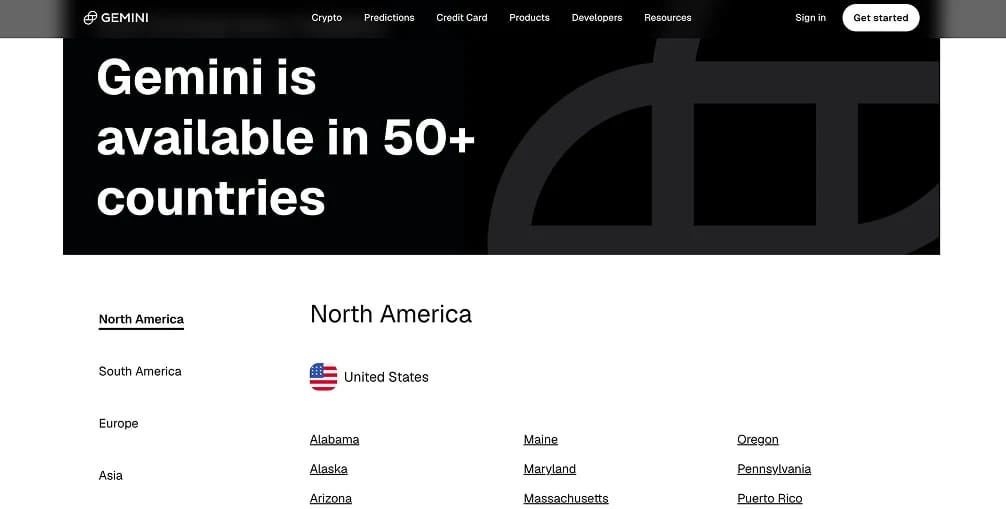
The biggest change arrived this year. Gemini shut all customer accounts in the United Kingdom, the European Economic Area and Australia on 6 April after placing them in withdrawal-only mode from 5 March, according to its official wind-down notice. Australian dollar withdrawals ended in late February, and the exchange partnered with eToro to give departing customers a transfer path.
On top of the market exits, Gemini's User Agreement commits the platform to the sanctions programmes administered by OFAC, so comprehensively embargoed jurisdictions are barred outright and accounts accessed from unserved regions can be suspended or terminated.
Why Gemini Left the UK, EU and Australia
Gemini announced the retreat in early February alongside a roughly 25% cut to its workforce, framing both moves as part of a strategy the Winklevoss twins call Gemini 2.0. Their letter argued that foreign markets had proven hard to win, stretched the company thin, and lacked the demand to justify the compliance overhead, so the business would double down on America, as Bloomberg reported.
The financial pressure behind the decision was visible in its results. Gemini posted a GAAP net loss of $159.5 million for the third quarter of 2025, and its share price had fallen sharply from the highs of its September 2025 debut while crypto trading volumes cooled across the industry.
What makes the exit unusual is that Gemini had spent the prior year building exactly the licences the region demands. It secured a MiFID II investment firm licence from the Malta Financial Services Authority in May 2025, followed by a MiCA licence that August, then rolled out staking, perpetual futures and tokenised stocks across the EEA. Walking away months later shows how heavily post-MiCA compliance costs now weigh against thin European revenues, even for fully authorised platforms.
Gemini Supported Countries
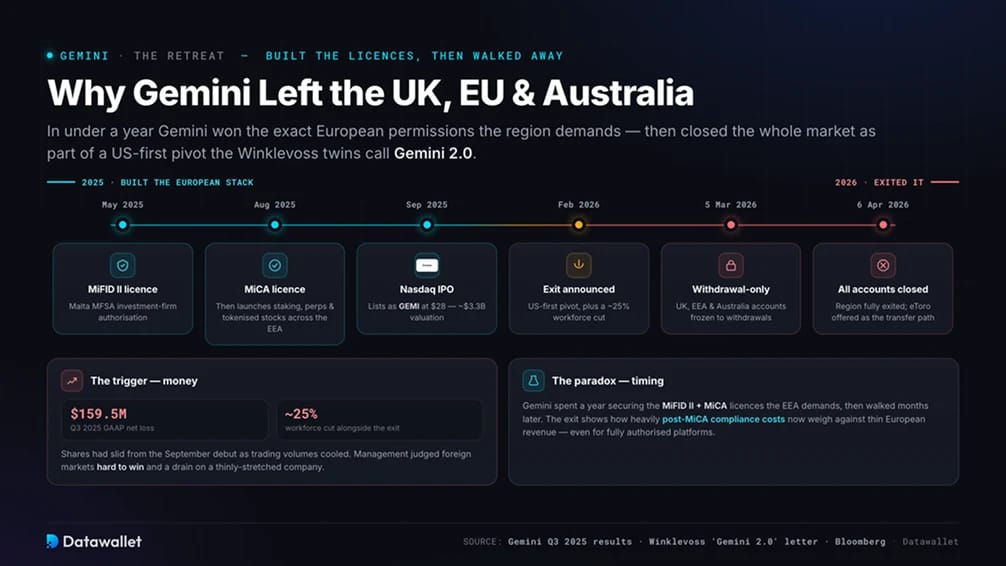
Gemini now lists just over 50 supported countries, concentrated in the Americas with a smaller presence across the Middle East, Asia and Africa. The United States is the core market, covering all 50 states plus Washington DC, Puerto Rico and the US Virgin Islands.
Gemini's supported regions after the April account closures:
- North America and the Caribbean: United States, Bahamas, Bermuda, British Virgin Islands, Cayman Islands, Costa Rica, Dominican Republic, Jamaica, Mexico, Panama, St Lucia, and St Vincent and the Grenadines.
- South America: Argentina, Brazil, Chile, Ecuador, Peru and Uruguay.
- Asia and the Middle East: Israel, Singapore and Turkey.
- Africa: Egypt, Ghana and South Africa.
- Crown dependencies: Guernsey and Jersey still appear on the availability page, sitting outside the UK and EEA closure wording.
Fiat support has narrowed with the footprint. US customers deposit dollars via wire, ACH or debit card, while Singapore users transact in SGD and USD through Gemini Digital Payments Singapore, the local entity holding in-principle approval from the Monetary Authority of Singapore.
Readers in the closed markets have well-regulated replacements. We cover them in our guides to the best MiCA-licensed crypto exchanges, the best crypto exchanges in the UK, and the best crypto exchanges in Australia.
Can You Use Gemini in the US?
Yes, and the US is now the whole story. Gemini operates nationwide as a New York limited purpose trust company, and its home market is where every new product lands first. That makes it one of the few venues we track in our best crypto exchanges in the USA guide that is actively narrowing, rather than widening, its overseas exposure to fund domestic expansion.
The clearest example is prediction markets. Gemini's affiliate Gemini Titan received a Designated Contract Market licence from the CFTC last December, a process that began back in 2020, and Gemini Predictions went live for US customers within a week. A follow-on derivatives clearing organisation approval in April lets the firm clear its own trades, with US crypto futures, options and perpetuals flagged as the next step. Our prediction market statistics page tracks how quickly that sector is growing.
Does Gemini Require KYC?
Yes. Gemini requires identity verification for every customer with no unverified trading tier. Its BSA/AML programme, built around the Bank Secrecy Act and Section 326 of the PATRIOT Act, obliges the exchange to collect and verify the name, date of birth, physical address and identification number of each person opening an account.
In practice, onboarding involves submitting a government-issued ID, confirming personal details, and in some cases completing a selfie check or providing proof of address. Gemini also reserves the right to request further documentation, run background checks, and investigate the source of funds at any point after sign-up.
Gemini Licences and Regulation
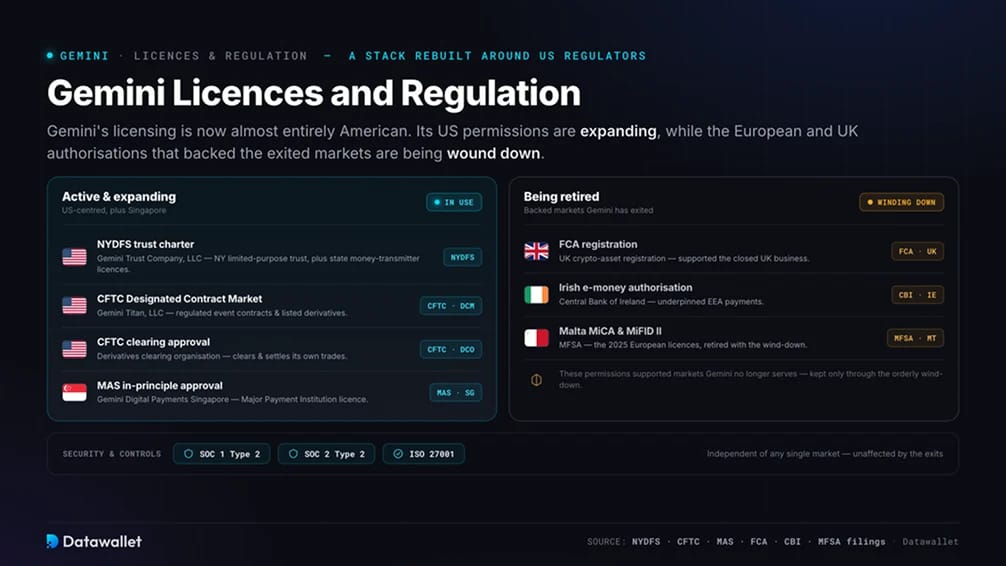
Gemini's licensing stack is now built almost entirely around US regulators, with the European and UK permissions wound down as part of the exit.
- NYDFS trust charter: Gemini Trust Company, LLC is a New York limited purpose trust company supervised by the New York State Department of Financial Services, with money transmitter licences across US states.
- CFTC Designated Contract Market: Gemini Titan, LLC holds a DCM licence, allowing it to offer regulated event contracts and, in future, other listed derivatives to US customers.
- CFTC clearing approval: A derivatives clearing organisation licence granted in April lets Gemini clear and settle its own derivatives and prediction-market trades.
- Singapore: Gemini Digital Payments Singapore, Pte. Ltd. holds in-principle approval from MAS for a Major Payment Institution licence and has managed Singapore accounts since April 2025.
- Former UK and EU permissions: The FCA registration in the UK, the Irish e-money authorisation, and the Maltese MiCA and MiFID II licences supported markets Gemini no longer serves and are being retired with the regional wind-down.
Beyond formal licences, Gemini maintains SOC 1 Type 2, SOC 2 Type 2 and ISO 27001 certifications covering its security and operational controls.
About Gemini
Gemini was founded in 2014 by Cameron and Tyler Winklevoss and is headquartered in New York. The platform combines a spot exchange with the ActiveTrader interface, institutional custody, staking, a crypto rewards credit card, the Gemini Dollar (GUSD) stablecoin, and the new Gemini Predictions marketplace.
The company listed on Nasdaq under the ticker GEMI in September 2025, pricing its IPO at $28 per share to raise about $425 million at a valuation near $3.3 billion, with Nasdaq itself investing $50 million in a concurrent private placement. At the time of listing, the platform held more than $21 billion in customer assets.
Since going public, Gemini has traded growth-by-geography for depth at home. Headcount has fallen from a 2022 peak of about 1,100 to a far leaner organisation, and management argues that AI-driven productivity and a single regulatory home market give the company its fastest realistic course to profitability.
Final Thoughts
Gemini is smaller on the map than it has been in years, and deliberately so. The exchange that once advertised availability in more than 60 countries now serves a US-centred list of about 50, having closed the UK, EEA and Australia despite holding the licences to stay.
For American users, the pivot brings tangible upside in the form of CFTC-regulated prediction markets and a pipeline of domestic derivatives. For everyone else, the lesson is to verify the current availability page before depositing, because even fully licensed exchanges can leave a market with two months' notice.
If your country sits on the closed or unlisted side of the table, a locally authorised platform is the safer home for your funds, and our regional exchange guides above are the best place to start comparing them.