




What is DefiLlama?
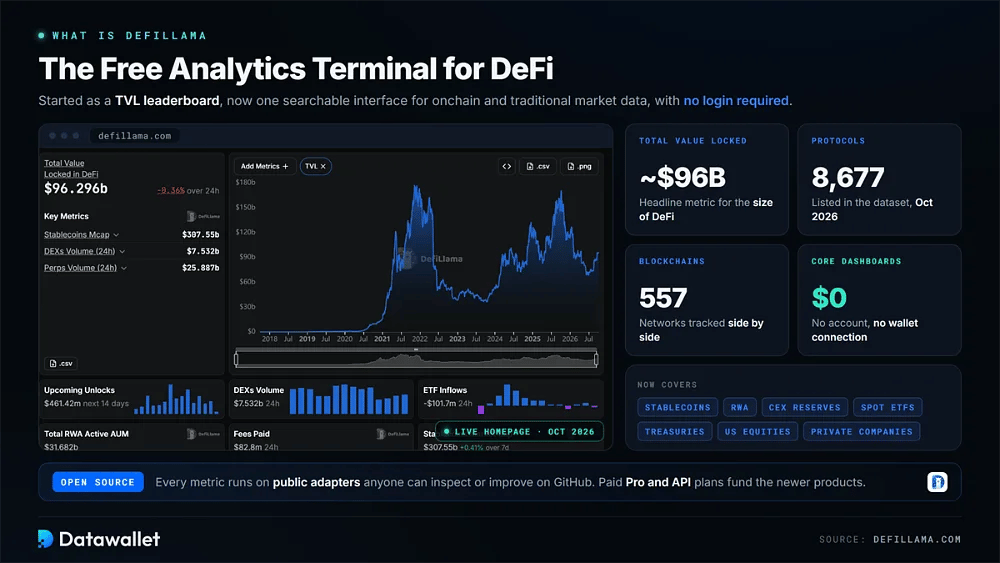
DefiLlama is a free analytics terminal for measuring the size and health of decentralized finance. Its headline metric, total value locked, currently stands near $96 billion. As of October 2026, the company's own app page lists 8,677 protocols across 557 blockchains in its dataset.
What started as a TVL leaderboard now covers considerably more than lending pools and exchanges. Dedicated dashboards track stablecoins, tokenized real-world assets, centralized exchange reserves, spot ETFs, corporate crypto treasuries, US equities, and private companies, bringing onchain and traditional market data into one searchable interface.
The core dashboards remain free and do not require a login. Each metric relies on open-source adapters that anyone can inspect or improve through public GitHub repositories. That level of transparency is one reason journalists, funds, and protocol teams routinely cite DefiLlama when sizing markets or comparing DeFi projects.
Paid Pro and API subscriptions fund newer products such as the LlamaAI research assistant, an iOS and Android app, and an MCP server for AI agents. Everyday users can still monitor yields, fees, hacks, and token unlocks without paying, creating an account, or connecting a wallet.
How Does DefiLlama Work?
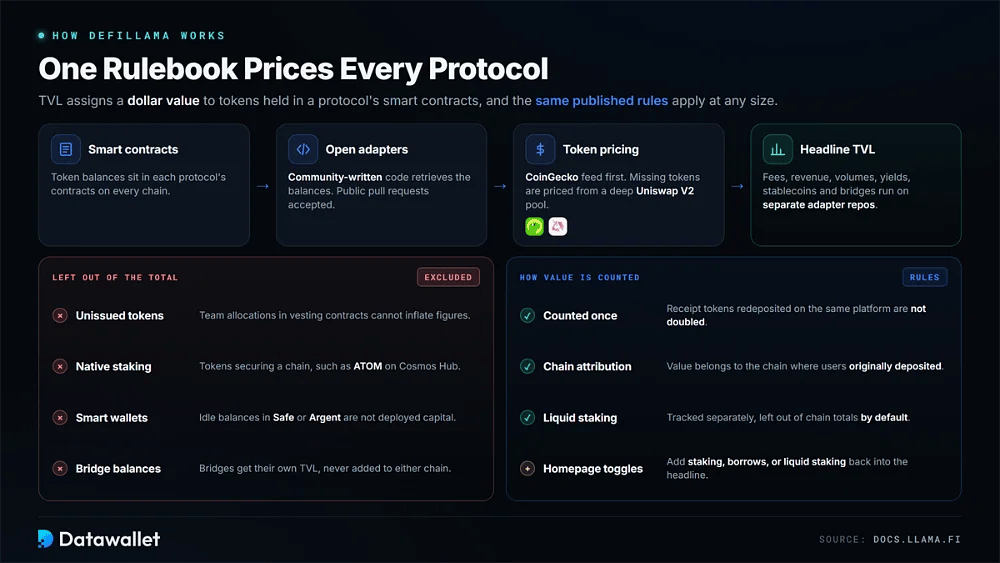
DefiLlama calculates TVL by assigning a dollar value to tokens held in a protocol's smart contracts. Community-written adapters retrieve those balances from each chain, while the same published rulebook applies to every project regardless of size.
The methodology applies these rules to every listed protocol:
- Token Pricing: Most assets use CoinGecko's price feed. If a token is missing, DefiLlama prices it onchain by reading the pool weights of a deeply liquid Uniswap V2 market.
- Unissued Tokens: Supply that has not entered circulation, including team allocations held in vesting contracts, is excluded so projects cannot inflate figures with tokens nobody holds.
- Double Counting: Deposits are counted once per protocol, even if users receive a receipt token and deposit it into another product belonging to the same platform.
- Native Staking: Tokens used to secure a chain, such as ATOM on Cosmos Hub, are excluded. Liquid staking protocols are tracked separately but left out of chain totals by default.
- Bridge Balances: Bridges appear as standalone projects with their own TVL, but that value is not added to the total for either the origin or destination chain.
- Smart Wallets: Capital sitting in smart contract wallets such as Safe or Argent is ignored because idle treasury balances do not represent funds actively deployed into DeFi protocols.
- Chain Attribution: If a protocol moves deposits across networks, the value is assigned to the chain where users originally deposited funds and interacted with the application.
TVL is only one part of the data pipeline. Separate adapter repositories supply fees, revenue, trading volumes, yields, stablecoins, and bridge data, with public pull requests accepted across them. Developers can access most datasets through the free public API. Homepage toggles also allow staking, borrows, or liquid staking to be added back into headline totals.
DefiLlama Dashboard: What Changed in the Redesign
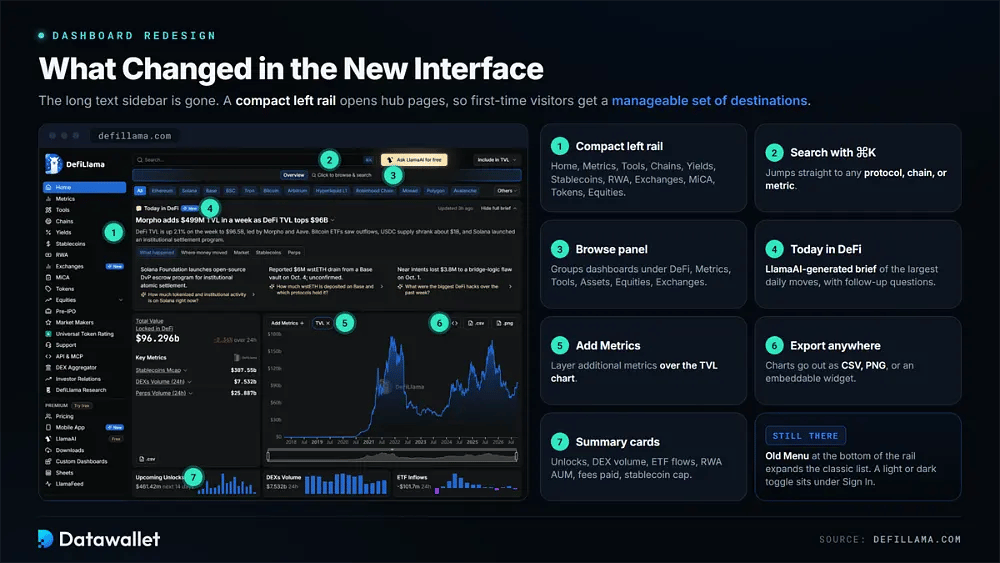
The redesigned interface replaces the long text sidebar with a compact left rail organized around Home, Metrics, Tools, Chains, Yields, Stablecoins, RWA, Exchanges, MiCA, Tokens, and Equities. Opening any entry leads to a hub page, giving first-time visitors a manageable set of destinations instead of dozens of nested links.
A search bar at the top, accessible with ⌘K, jumps directly to a protocol, chain, or metric. The browse panel below groups dashboards under DeFi, Metrics, Tools, Assets, Equities, and Exchanges. On the homepage, users can layer additional metrics over TVL and export charts to CSV, PNG, or an embeddable widget.
Above that chart sits "Today in DeFi," a LlamaAI-generated brief covering the day's largest moves and suggesting follow-up questions that open in chat. Summary cards below it show upcoming token unlocks, DEX volume, ETF flows, RWA assets under management, daily fees paid, and stablecoin market capitalization.
Existing users can still reach the older navigation. An "Old Menu" section at the bottom expands into the classic text list, including Oracles, Forks, Bridges, Raises, Treasuries, Unlocks, Airdrops, and the Narrative Tracker. A light or dark theme toggle appears beneath the sign-in button.
DefiLlama Features and Tools
DefiLlama now extends well beyond liquidity rankings. The sections below cover the dashboards that matter most in 2026, beginning with established DeFi trackers before moving into exchange analytics, tokenized assets, and equities.
Across the site, the same interface elements recur: sortable tables, chain filters, historical charts, and CSV export. Once users understand one dashboard, the others are easier to navigate because the interaction model remains consistent.
1. TVL and Chain Rankings
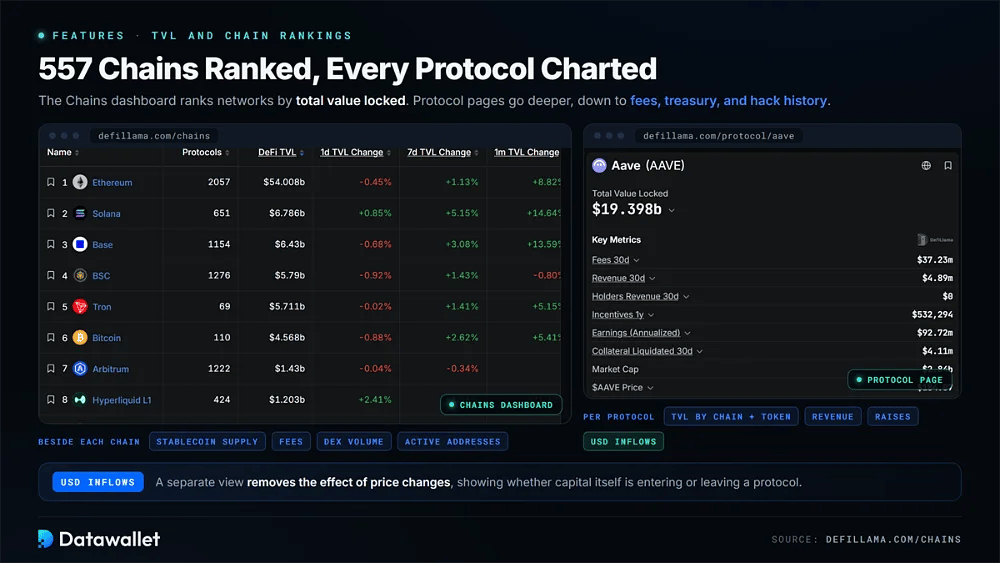
The Chains dashboard ranks 557 networks by total value locked and places stablecoin supply, fees, DEX volume, and active addresses alongside each entry. Ethereum, Solana, Base, and BNB Chain appear first in the homepage filter row, while newer entrants such as Robinhood Chain and Monad are already included.
Individual protocol pages provide more detail. They chart TVL from launch and split deposits by chain and token, while also showing fees, revenue, treasury holdings, funding rounds, and hack history. A separate USD Inflows view removes the effect of price changes, making it easier to see whether capital itself is entering or leaving.
2. Metrics Hub
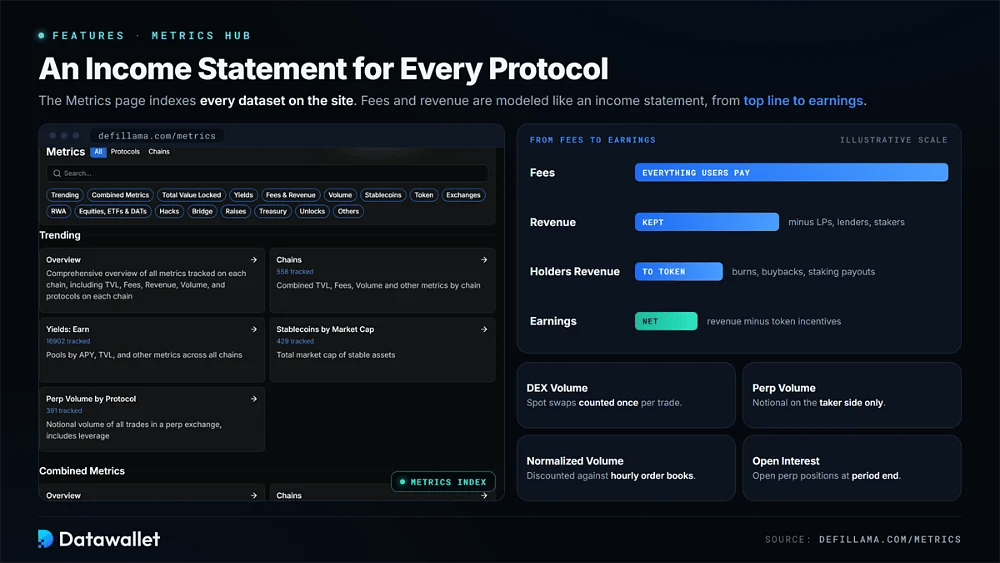
The Metrics page acts as an index for every dataset available on the site. Fees and revenue are modeled in a format similar to an income statement. Trading data is adjusted separately to remove double counting and wash trades.
These are the metrics most analysts open first:
- Fees: Everything users pay to use a protocol, comparable with top-line revenue at a traditional company. Fees are recorded when they accrue rather than when they are claimed.
- Revenue: The portion of fees retained by a protocol after liquidity providers, lenders, and stakers are paid, making it closer to gross profit than raw sales.
- Holders Revenue: Value directed to governance token holders through fee burns, buybacks funded by actual receipts, or staking payouts, functioning similarly to shareholder dividends in equity markets.
- Earnings: Revenue after subtracting token incentives emitted during the same period, showing whether activity is profitable or being subsidized through newly issued tokens.
- DEX Volume: Spot swaps counted once per trade. Low-fee pools and points-farming pairs are filtered where reported activity appears implausible relative to the liquidity supporting it.
- Perp Volume: Notional value of perpetual futures trades counted only on the taker side, never both sides, across venues ranked in Datawallet's guide to decentralized perpetuals exchanges.
- Normalized Volume: Reported perp activity discounted against hourly order book snapshots, removing trades that visible liquidity could not have supported and making venues more comparable.
- Open Interest: The dollar value of perpetual positions remaining open at the end of a period, providing a point-in-time measure that should move roughly alongside an exchange's deposits.
3. Yields and Verified APY
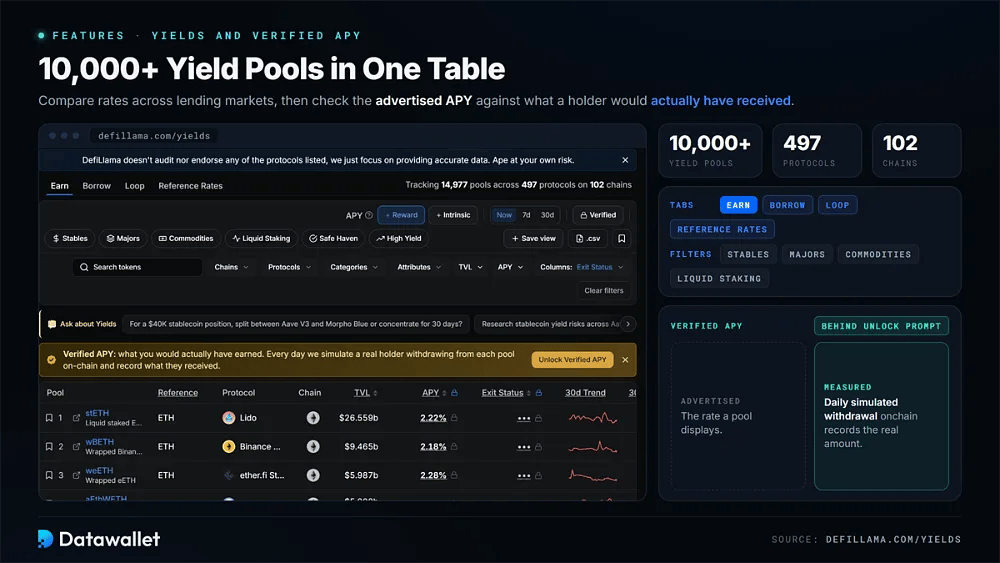
The Yields dashboard covers more than 10,000 yield pools from 497 protocols across 102 chains. Results are divided into Earn, Borrow, Loop, and Reference Rates tabs. Quick filters for stablecoins, majors, commodities, and liquid staking help users compare stablecoin interest rates across lending markets.
Verified APY is a newer metric available behind an unlock prompt. It simulates a real holder withdrawing from each pool onchain every day and records the amount they would have received, allowing users to compare a measured outcome with the advertised rate. DefiLlama also makes clear that listed pools are neither audited nor endorsed.
4. RWA Dashboard
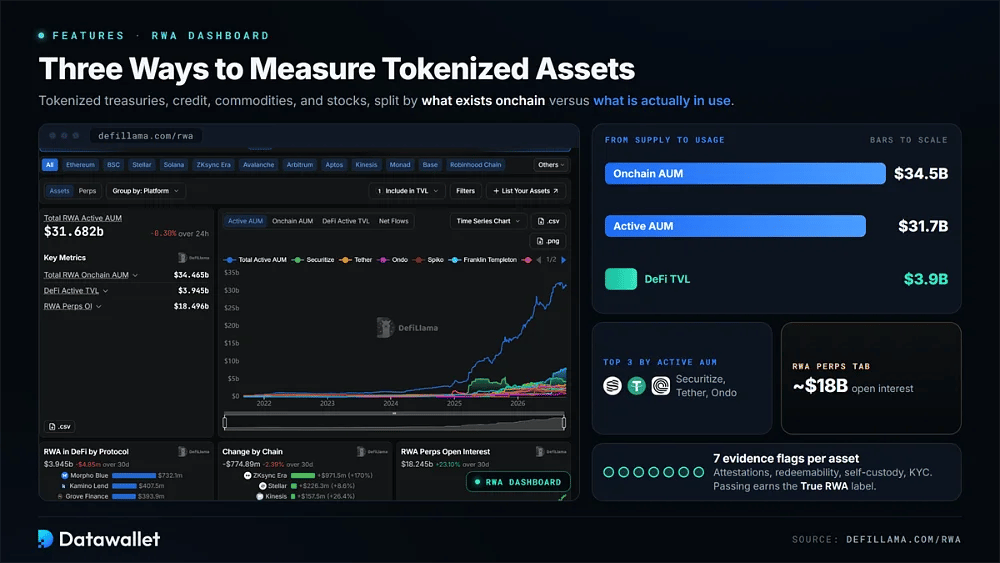
The RWA dashboard tracks tokenized treasuries, credit, commodities, and stocks. Active assets total roughly $31.7 billion at the time of writing, with Securitize, Tether, and Ondo ranking as the three largest platforms by that measure.
The dashboard separates tokenized assets into these distinct measures:
- Onchain AUM: The full dollar value of an asset existing onchain across all tracked networks, based on circulating supply and a reference price. The current figure is about $34.5 billion.
- Active AUM: Value held by independent owners in self-custody or third-party protocols, excluding issuer wallets, custody omnibus accounts, and internal operational transfers between related entities.
- DeFi TVL: Active value deployed in third-party DeFi protocols, currently around $3.9 billion, with Morpho, Kamino, and Grove holding the largest balances of tokenized collateral.
- Utilization: DeFi usage as a percentage of onchain supply, indicating how much of a tokenized asset is being used as collateral rather than remaining idle.
- Evidence Flags: Seven factual checks for each asset, covering items including attestations, redeemability, transferability, self-custody, and KYC requirements. These determine whether a token qualifies for the stricter True RWA label.
- RWA Perps: A dedicated tab for perpetual contracts on stocks and commodities. Open interest stood near $18 billion amid growing tokenized stock trading.
5. Stablecoins
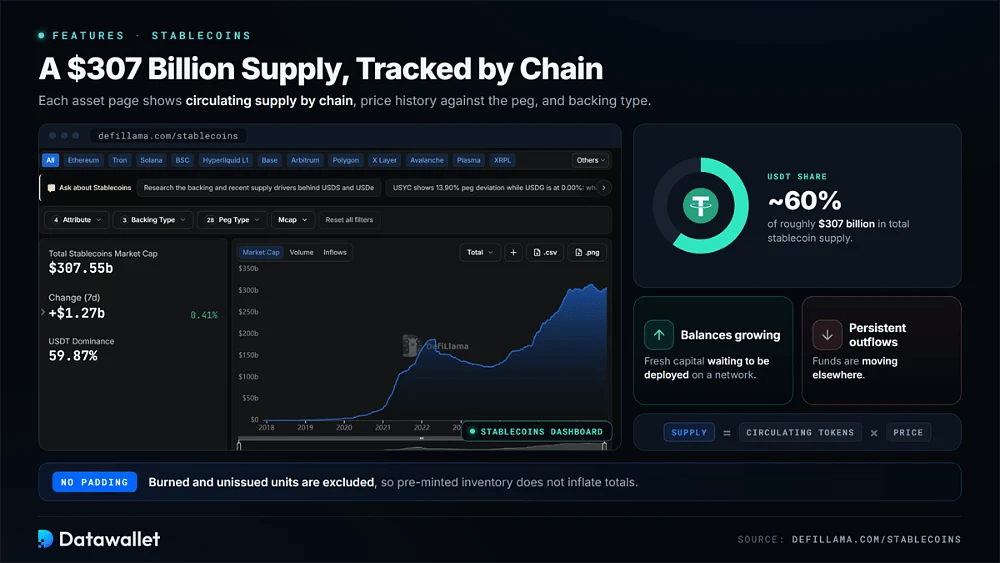
The Stablecoins dashboard shows total supply at roughly $307 billion, with USDT accounting for close to 60% of the market. Individual asset pages display circulating supply by chain, price history relative to the peg, and backing type, complementing Datawallet's stablecoin statistics report.
The chain views are particularly useful in practice. Growing stablecoin balances can indicate fresh capital waiting to be deployed on a network, while persistent outflows suggest funds are moving elsewhere. Supply equals circulating tokens multiplied by price, with burned and unissued units excluded so pre-minted inventory does not inflate totals.
6. Exchanges and REAL Ranking
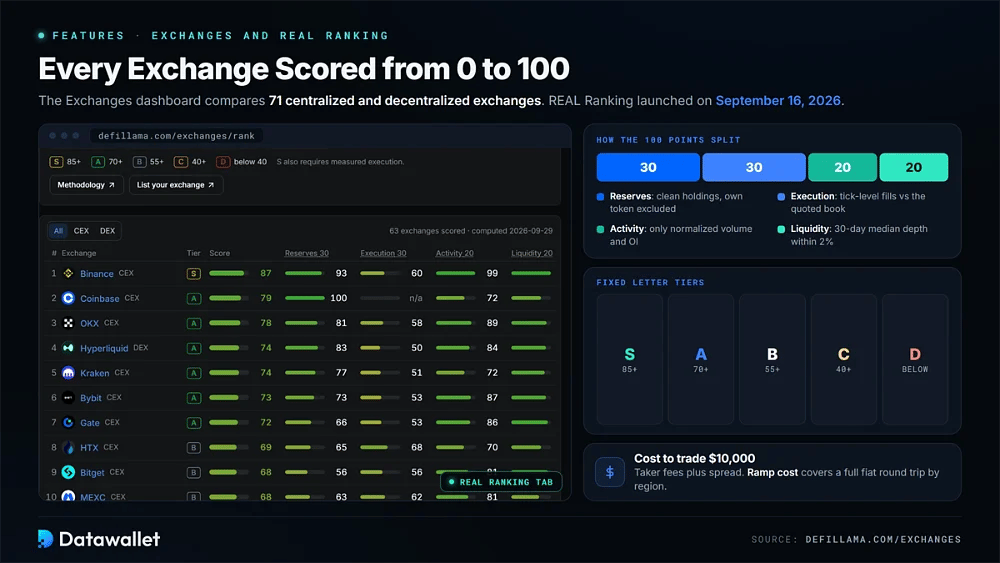
The Exchanges dashboard, marked as new in the sidebar, compares 71 centralized and decentralized exchanges using volume, depth, fees, and reserves. Its REAL Ranking launched on September 16, 2026 and scores each venue from 0 to 100.
The score and its supporting data rest on these components:
- Reserves: Worth 30 points, this pillar rewards clean holdings that exclude an exchange's own token. Live onchain wallets receive more credit than attestations or older company disclosures.
- Execution: Another 30 points come from tick-level fills comparing what an order book showed at a given size with the actual price paid by market orders.
- Activity: This 20-point component recognizes only normalized volume and open interest that the venue's order book and balance sheet could plausibly support.
- Liquidity: The remaining 20 points measure 30-day median depth within 2% of the mid price, capped at clean reserves, together with the number of markets maintaining meaningful depth.
- Tiers: Fixed letter grades are assigned from the numerical score. S begins at 85, A at 70, B at 55, and C at 40, while lower results receive a D.
- Normalized Volume: Reported trading activity is capped against observed order book liquidity and, for USD-margined perpetuals, open interest. The resulting discount appears beside each exchange's self-reported figure.
- Trading Costs: A cost-to-trade column estimates a $10,000 order including taker fees and spread. Ramp cost separately measures a full fiat round trip by region.
7. MiCA Dashboard
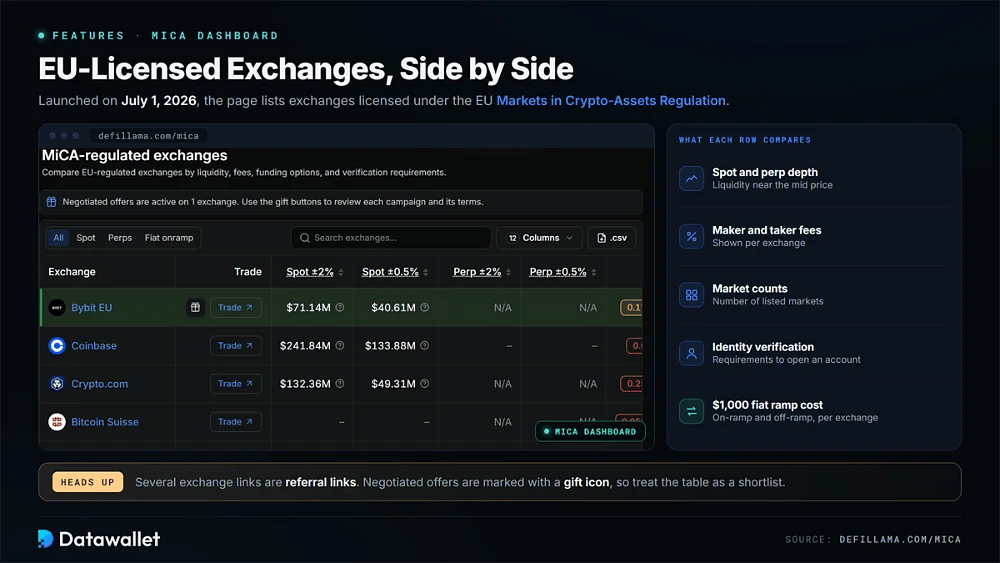
The MiCA dashboard, launched on July 1, 2026, lists exchanges licensed under the European Union's Markets in Crypto-Assets Regulation. Its rows compare spot and perpetual depth, maker and taker fees, market counts, identity verification requirements, plus the cost of a $1,000 fiat on-ramp and off-ramp for each venue.
Several venue links on the page are referral links, something European readers should keep in mind. DefiLlama identifies negotiated offers with a gift icon. The data still provides a useful shortlist, while Datawallet's separate review of MiCA-licensed exchanges offers a second view on fees and coverage.
8. Research Toolbox
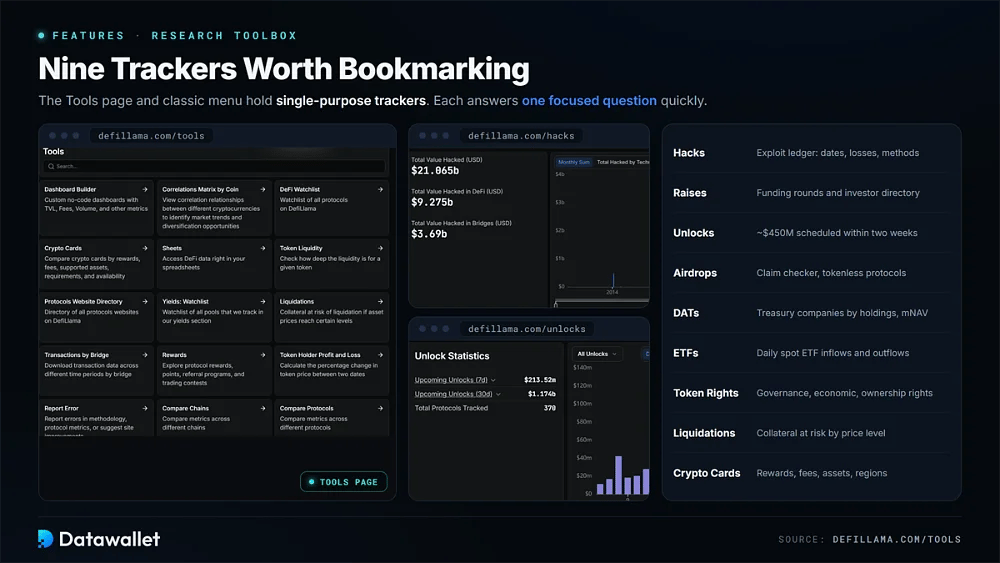
The Tools page and classic navigation contain a large collection of single-purpose trackers beyond the major dashboards. Most answer one focused question quickly, making them practical additions to regular due diligence.
These trackers are worth bookmarking for regular research sessions:
- Hacks: A running ledger of exploits showing dates, amounts lost, attack methods, and returned funds, useful for reviewing a protocol's security record before depositing capital.
- Raises: Funding rounds organized by date, amount, lead investor, and category, alongside an investor directory showing which venture firms most frequently back different parts of the market.
- Unlocks: Vesting schedules and an unlock calendar displaying circulating supply and the timing of large future tranches, with roughly $450 million scheduled within two weeks.
- Airdrops: A claim checker and list of tokenless protocols, which can be used alongside Datawallet's roundup of the top crypto airdrops currently running.
- DATs: Digital asset treasury companies organized by token holdings and mNAV ratios, including the corporate buyers Datawallet follows through its Bitcoin treasury tracker.
- ETFs: Daily inflow and outflow data for spot crypto exchange-traded funds, summarized on the homepage and available as full charts on a dedicated page.
- Token Rights: A register covering the governance, economic, and ownership rights associated with each token, clarifying whether holders have any direct claim on protocol revenue or equity.
- Liquidations: Charts showing collateral that would be liquidated at specific price levels across lending markets, helping traders identify crowded leveraged positions ahead of potential volatility.
- Crypto Cards: A comparison of crypto cards by rewards, fees, supported assets, and regional availability, broadly matching Datawallet's guide to the best crypto debit cards.
9. Equities and Pre-IPO
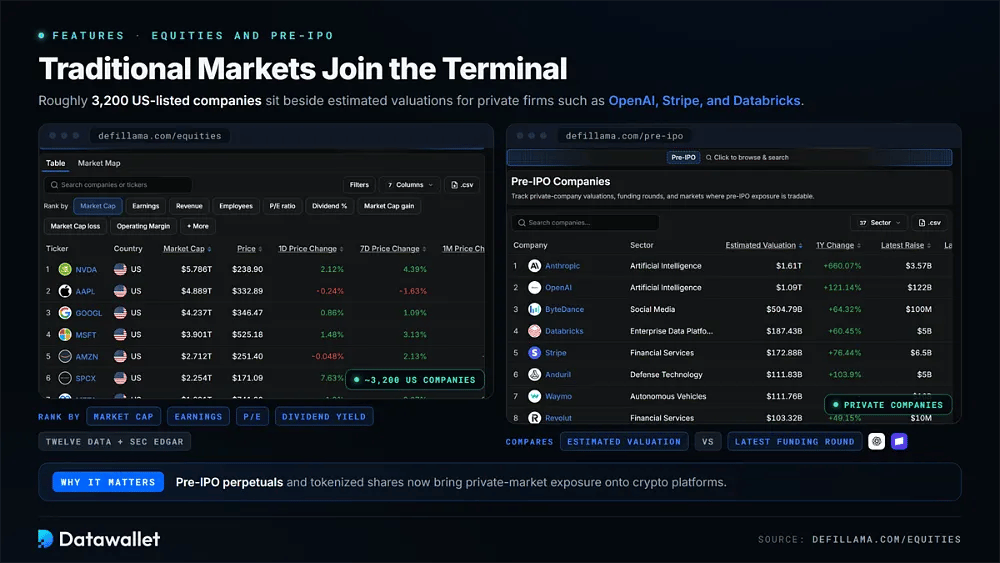
Traditional markets are now part of DefiLlama as well. The Equities section covers roughly 3,200 US-listed companies and ranks them by market cap, earnings, revenue, P/E ratio, dividend yield, or operating margin. It also includes a market map, sector and industry breakdowns, and an earnings calendar. Prices come from Twelve Data, while filings come from SEC EDGAR.
Private companies receive similar treatment on the Pre-IPO page. It estimates current valuations for firms including OpenAI, Stripe, and Databricks, then compares those figures with their latest funding rounds. That context has become relevant as pre-IPO perpetuals and tokenized shares bring private-market exposure onto crypto venues.
10. Universal Token Rating
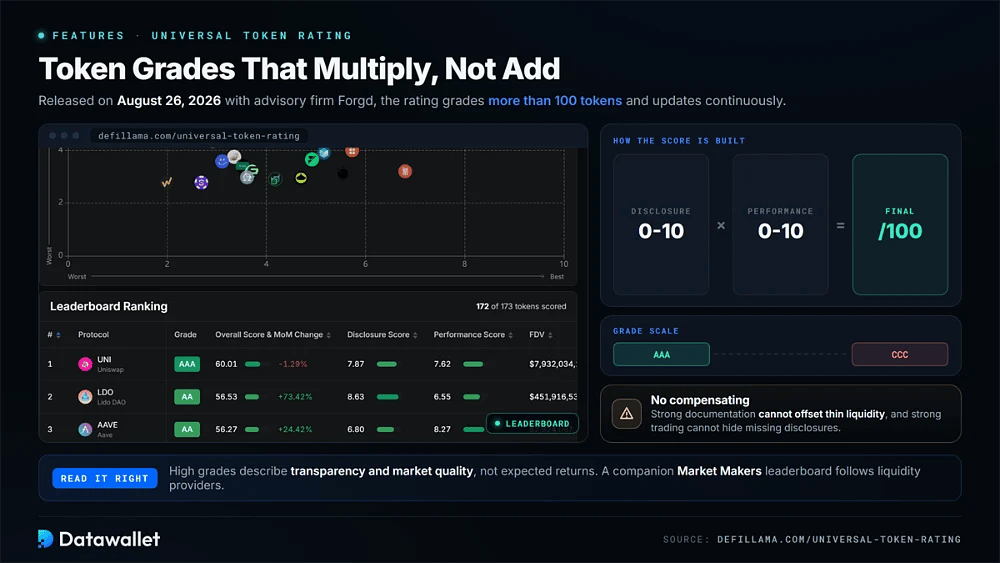
The Universal Token Rating, released on August 26, 2026 with advisory firm Forgd, grades more than 100 tokens from AAA to CCC. Projects receive separate Disclosure and Performance scores out of 10. Those figures are then multiplied to produce a final score out of 100.
Because the scores are multiplied, strong documentation cannot compensate for thin liquidity, just as strong trading cannot conceal missing disclosures. Ratings change continuously as unlocks, listings, and market maker arrangements evolve. A companion Market Makers leaderboard follows liquidity providers. Both teams emphasize that high grades describe transparency and market quality, not expected returns.
What is LlamaAI?
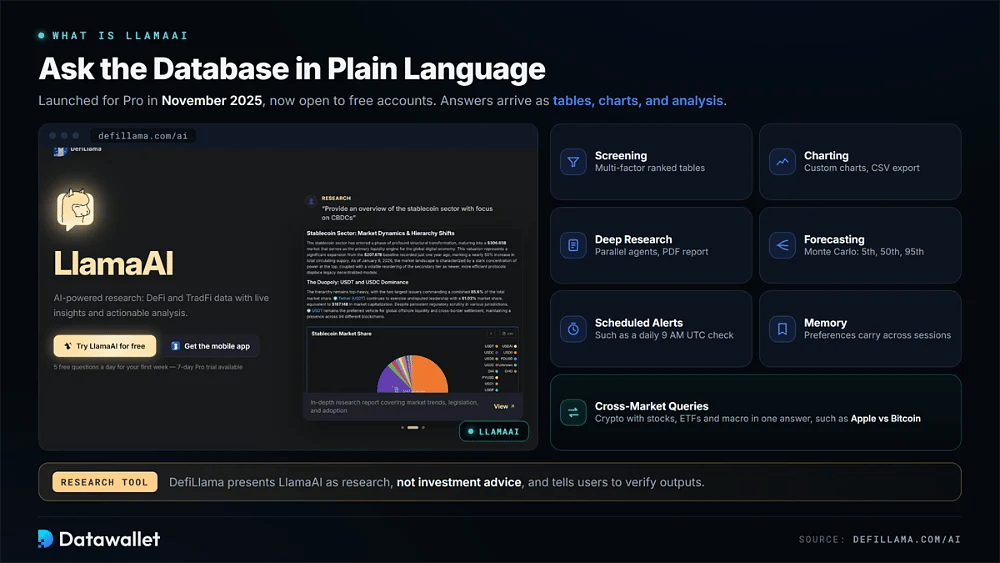
LlamaAI is DefiLlama's conversational research assistant. It launched for Pro subscribers in November 2025 and has since become available to free accounts. Users can ask questions in plain language, after which the tool queries DefiLlama's database and returns ranked tables, charts, and written analysis.
Its scope combines DeFi information with stocks, ETFs, macro figures, onchain analytics for EVM chains, and live web search. DefiLlama presents LlamaAI as a research tool rather than investment advice, and it tells users to verify outputs and apply critical judgment.
What LlamaAI Can Do
LlamaAI is more than a conversational layer over static pages because responses are assembled through tool calls against structured data. One request may involve database queries, code execution, and chart generation before the answer reaches the screen.
The assistant currently supports these research workflows for users:
- Screening: Multi-factor searches can identify cases such as protocols with rising TVL and revenue but falling token prices, producing ranked tables that would otherwise require several dashboards and a spreadsheet.
- Charting: Users can request custom charts, including normalized return comparisons across chosen assets and timeframes, with the underlying dataset available for export as CSV.
- Deep Research: Parallel agents can investigate areas such as regulation, market dynamics, and competitive positioning before combining their work into a single report downloadable as a PDF.
- Forecasting: Monte Carlo simulations display 5th, 50th, and 95th percentile price paths. Strategy backtests can also return historical equity curves and performance summaries.
- Scheduled Alerts: Prompts can run automatically on a schedule, including a daily 9 AM UTC price check or recurring portfolio and yield summaries.
- Memory: Saved preferences and custom instructions carry across sessions, allowing the assistant to retain preferred yield criteria, formatting choices, and desired levels of detail.
- Cross-Market Queries: Questions can combine crypto with traditional markets, such as comparing Apple's quarterly performance with Bitcoin using equities and macro data in one response.
DefiLlama Mobile App
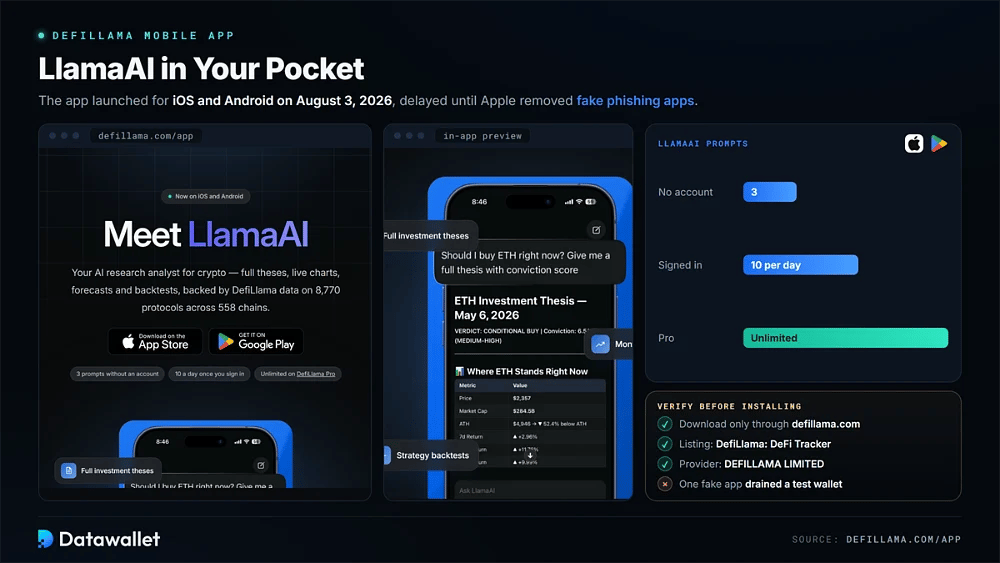
The DefiLlama app launched for iOS and Android on August 3, 2026, with LlamaAI at its center. Anyone can test three prompts without an account. Signed-in users receive ten free prompts each day, while Pro subscribers get unlimited access through the same subscription used on the website.
Its release was intentionally delayed. Founder 0xngmi said the team waited for Apple to remove fake apps, including one that drained a test wallet. Users should download only through defillama.com and verify that the App Store listing says "DefiLlama: DeFi Tracker" from provider DEFILLAMA LIMITED.
MCP Server for AI Agents
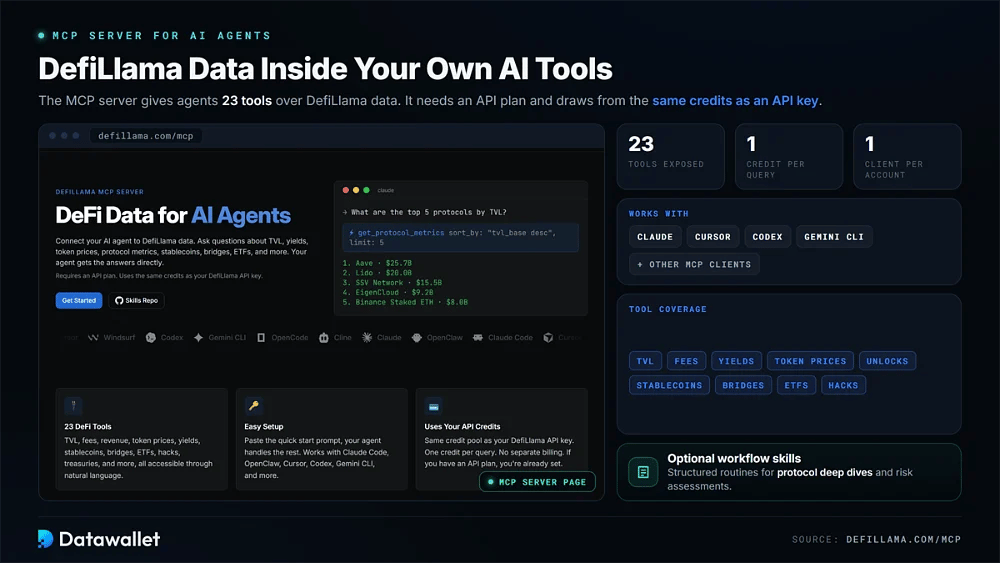
Developers using their own AI tools can connect through the DefiLlama MCP server. It provides 23 tools covering TVL, fees, yields, token prices, unlocks, stablecoins, bridges, ETFs, and hacks, with support for Claude, Cursor, Codex, Gemini CLI, and other Model Context Protocol clients.
An API plan is required. MCP usage draws from the same credits as a normal API key at one credit per query, and each account can connect to one MCP client at a time. Optional workflow skills give agents structured routines for tasks such as protocol deep dives and risk assessments.
DefiLlama Pricing
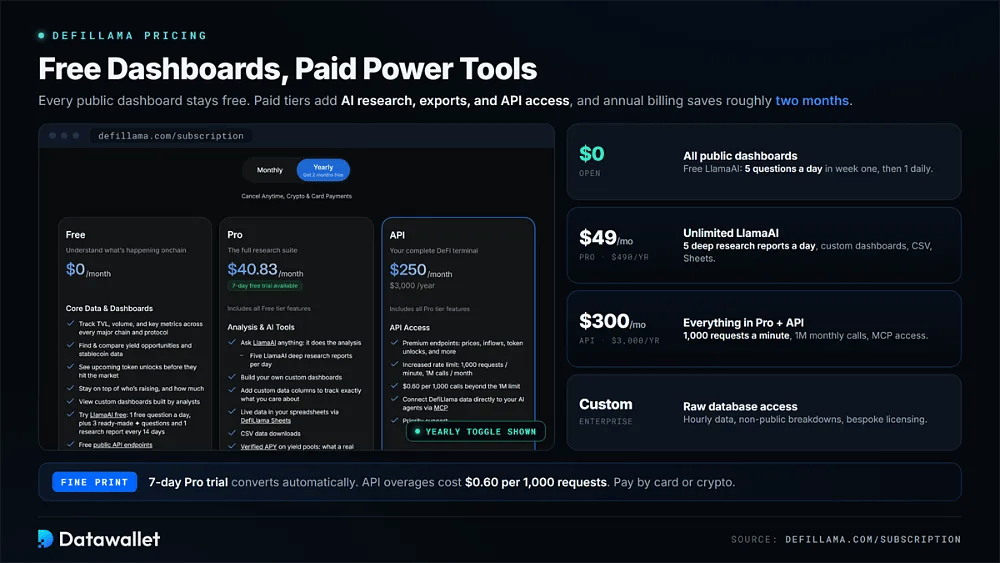
The main DefiLlama dashboards remain free, while power-user features carry a charge. Paid subscription tiers expand AI research capacity, data exports, and programmatic access. Choosing annual billing works out to roughly two months less than paying month by month.
Current plans and their main inclusions are listed below:
- Open (Free): Full access to public dashboards for TVL, fees, revenue, yields, and prices, along with LlamaFeed updates and community support by email or through the public Discord server.
- Free LlamaAI: Signed-in users receive five questions per day during their first week, followed by one daily question, plus three ready-made prompts and one research report every fourteen days.
- Pro ($49/Month): Pro costs $490 when billed yearly and includes unlimited LlamaAI questions, five deep research reports per day, custom dashboards, custom columns, CSV downloads, and DefiLlama Sheets.
- Pro Trial: The seven-day free trial automatically converts to a paid subscription. Deep research is limited to three reports in total, and CSV downloads remain disabled until billing begins.
- API ($300/Month): Annual billing costs $3,000. The plan includes everything in Pro, premium endpoints, 1,000 requests per minute, one million monthly calls, MCP access, and priority support.
- Overages: Usage above the API's monthly allowance costs $0.60 per 1,000 requests, allowing high-volume users to continue service without renegotiating their plan.
- Enterprise: Custom contracts through the sales team can include raw database access, hourly data, non-public breakdowns such as TVL by token address, and bespoke licensing terms.
Both monthly and annual payments can be made by credit card or crypto, as confirmed in the pricing documentation. Most casual researchers have little reason to pay because every public dashboard is included for free. Pro is aimed more directly at analysts who regularly export data or build spreadsheet models.
What is LlamaSwap?
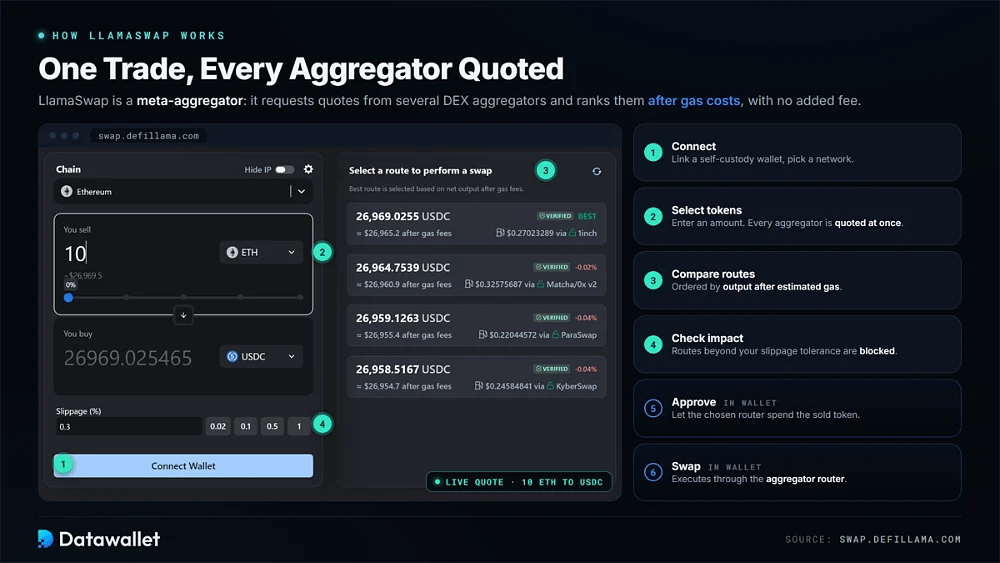
LlamaSwap is DefiLlama's meta-aggregator. Rather than routing through a single service, it requests quotes from several DEX aggregators and ranks the results after gas costs. Users can see which route returns the most tokens before executing through the selected aggregator's own contracts.
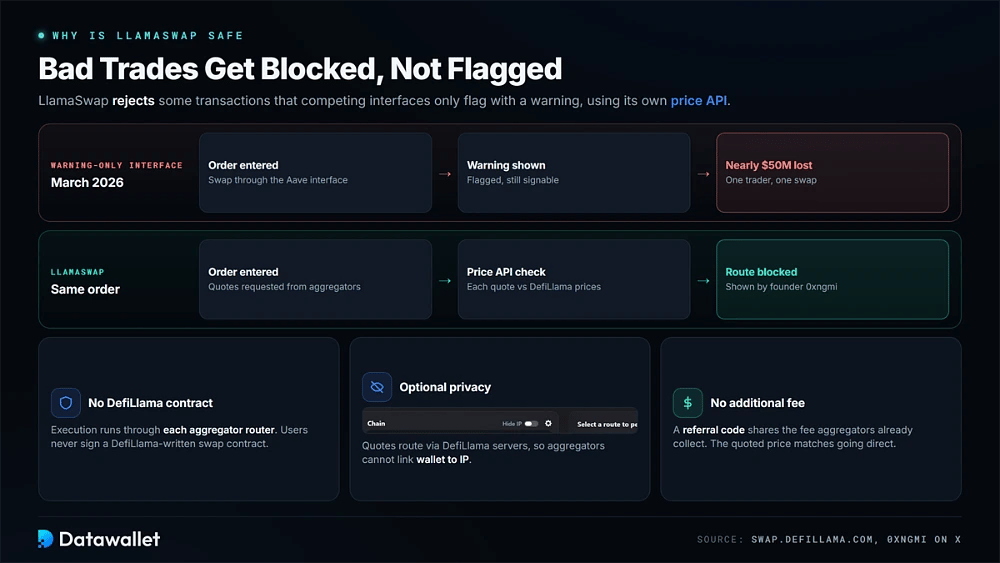
There is no additional DefiLlama fee. LlamaSwap adds a referral code to each trade, allowing aggregators with revenue-sharing programs to return part of the fee they already collect. As a result, the quoted price remains the same as using that aggregator directly.
How LlamaSwap Works
Using LlamaSwap resembles a normal decentralized exchange transaction, but the interface adds route comparison and safety checks before the user signs. There is no account, deposit requirement, or DefiLlama-issued token involved.
Each trade moves through the following stages in order:
- Connect: Link a self-custody wallet and select a supported network. Datawallet's guide to the best crypto wallets covers suitable choices for widely used chains.
- Select Tokens: Choose the asset to sell and the one to buy, then enter an amount. The interface simultaneously requests live quotes from every integrated aggregator.
- Compare Routes: Results are ordered by output after estimated gas, so users can see when a nominally worse exchange rate still produces a better result because execution costs are lower.
- Check Impact: Each quote is checked against DefiLlama's own price API. Routes are blocked when price impact or slippage exceeds the tolerance the user has set.
- Approve: Give the selected aggregator's router permission to spend the token being sold. This standard permission can later be removed by revoking token permissions.
- Swap: Confirm the transaction in the wallet. Execution takes place through the aggregator's router, keeping the trade eligible for any rewards that aggregator may distribute later.
Why is LlamaSwap Safe?
LlamaSwap rejects some transactions that competing interfaces only flag with warnings. After a trader lost nearly $50 million while swapping through Aave's interface in March 2026, founder 0xngmi showed that LlamaSwap would have blocked the same order. He credited years of work on a price API with broad token coverage.
Part of the security model comes from contracts DefiLlama does not operate. Users never sign a DefiLlama-written swap contract because execution happens through each aggregator's router. An optional privacy setting also sends quote requests through DefiLlama's servers, preventing aggregators from linking a wallet address to an IP address.
Is DefiLlama Data Accurate?
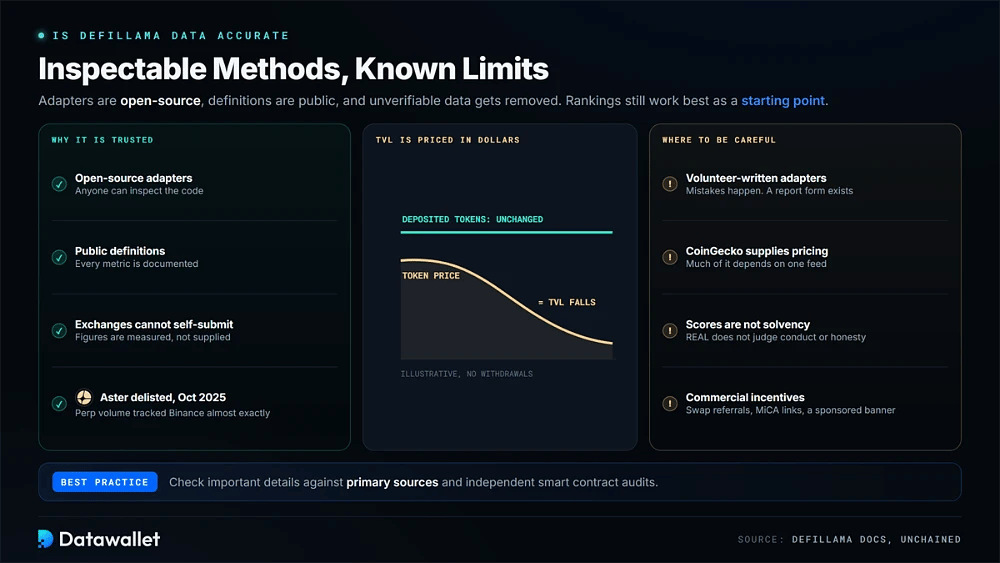
DefiLlama's reputation is closely tied to methods that can be independently inspected. Its adapters are open-source, definitions are public, and the team removes information it cannot verify. In October 2025, DefiLlama delisted Aster's perpetual volume after the numbers began tracking Binance's almost exactly, despite pushback from the exchange's community.
There are still limits to accuracy. TVL is denominated in dollars, meaning it can decline when token prices fall even if no users withdraw. Protocol teams or volunteers often write adapters, CoinGecko supplies much of the pricing, and mistakes happen. The site therefore includes a Report Incorrect Data form in its menu.
Newer scoring systems require separate caution. DefiLlama says a REAL score does not judge conduct, honesty, or solvency, while execution data currently covers only a minority of venues. Universal Token Ratings also reflect disclosure and market quality at a particular point in time rather than predicting future returns.
Commercial incentives are visible as well. LlamaSwap earns referral revenue, referral links appear on the MiCA page, and the Exchanges page includes a sponsored banner. DefiLlama says exchanges cannot submit their own figures. Even so, rankings are best treated as a starting point, with important details checked against primary sources and independent smart contract audits.
DefiLlama Founders
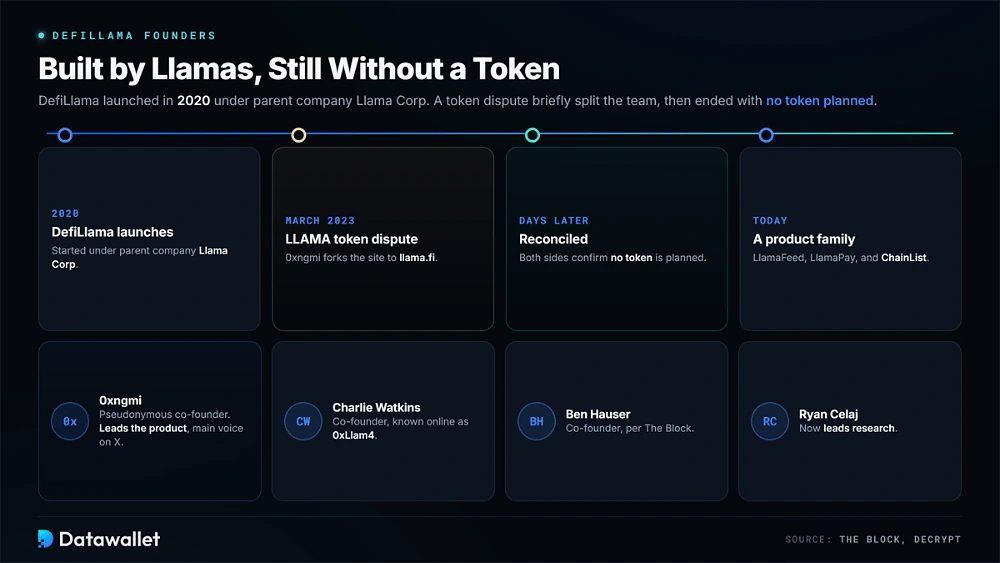
DefiLlama was launched in 2020 under parent company Llama Corp. The Block identifies Charlie Watkins, known online as 0xLlam4, and Ben Hauser as co-founders. Other publications also describe pseudonymous developer 0xngmi as a co-founder. Today, 0xngmi leads the product and is its main public voice on X.
A dispute over a proposed LLAMA token briefly split the team in March 2023, when 0xngmi forked the site to llama.fi. The parties reconciled within days and said no token was planned. Ryan Celaj now leads research, while the broader product family includes LlamaFeed, LlamaPay, and ChainList.
How to Use DefiLlama in a Research Stack
DefiLlama works best as a broad starting point rather than the only source behind a decision. Its public methodology, open adapters, free dashboards, and wide coverage make it useful for comparison, while critical figures still warrant checks against primary documentation, independent audits, or more specialized datasets.
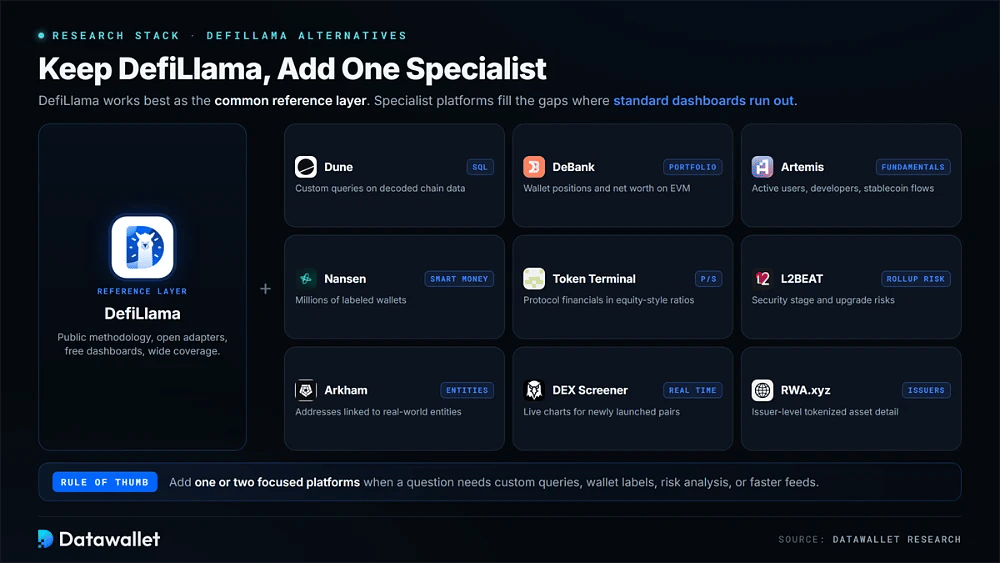
Specialist tools become more useful when a question requires custom blockchain queries, individual wallet labels, deeper risk analysis, or faster market feeds. Analysts can keep DefiLlama as the common reference layer, then add one or two focused platforms where the standard dashboards do not provide enough detail.
DefiLlama Alternatives
DefiLlama offers one of the broadest collections of DeFi metrics, but specialist platforms provide greater depth in specific areas. Analysts commonly combine it with one or two additional services when they need custom queries, wallet labels, or dedicated risk analysis.
These alternatives fill the gaps that DefiLlama leaves open:
- Dune: Allows analysts to write SQL against decoded blockchain data and publish community dashboards, making it better suited to bespoke questions that no standard DefiLlama page addresses.
- DeBank: Tracks individual wallet positions, net worth, and transaction history across EVM chains, making it far more useful for portfolio monitoring than broad market research.
- Artemis: Supplies institutional-grade fundamentals including active users, developer activity, and stablecoin flows in spreadsheet-friendly formats designed for funds and analysts accustomed to equities.
- Nansen: Labels millions of wallets and highlights smart money flows, allowing traders to follow which funds and whales are accumulating tokens before price movement becomes visible.
- Token Terminal: Converts protocol financials into familiar metrics such as price-to-sales ratios and annualized revenue, making it a close fundamentals-focused alternative to DefiLlama's fees, revenue, and earnings pages.
- L2BEAT: Focuses on Ethereum scaling and evaluates each rollup's security stage, data availability, and upgrade risks in greater depth than general trackers of Layer 2 networks.
- Arkham: Links wallet addresses to real-world entities and maps fund flows among exchanges, funds, and individuals, supporting both onchain investigations and routine counterparty checks.
- DEX Screener: Provides real-time price charts, liquidity information, and trade feeds for newly launched pairs, serving short-term traders who need faster data than daily dashboards can offer.
- RWA.xyz: Concentrates on tokenized treasuries, private credit, and equities with issuer-level detail, making it a useful cross-check for DefiLlama's RWA data and Datawallet's own tokenization statistics.
Final Thoughts
DefiLlama in 2026 has moved far beyond its origins as a TVL leaderboard. The platform now functions as a broad market terminal, placing DeFi liquidity, stablecoins, tokenized assets, exchange quality, and public equities in the same environment. LlamaAI adds a plain-language interface for querying that data.
The core service is still free, its methodology remains public, and the team continues to remove figures it cannot verify. Start with the free dashboards. Pro makes sense when exports or AI research create meaningful time savings, while important capital decisions should still be checked against primary sources.