


Who Is Jack Dorsey?
Jack Dorsey was born on November 19, 1976, in St. Louis, Missouri, and wrote dispatch software for taxi firms as a teenager. He studied at the Missouri University of Science and Technology, then transferred to New York University and left before finishing.
He co-founded Twitter in 2006 and ran it as CEO twice, until 2008 and again from 2015 until he stepped down in November 2021. In 2009 he co-founded Square with Jim McKelvey, which rebranded as Block in December 2021 and where he is still chair and chief executive.
Among major tech founders, Dorsey has been Bitcoin's most consistent advocate, describing it as the eventual single currency of the internet. That conviction now sits at the center of Block's strategy, not at its edges.
%201.webp)
Jack Dorsey's Net Worth in 2026
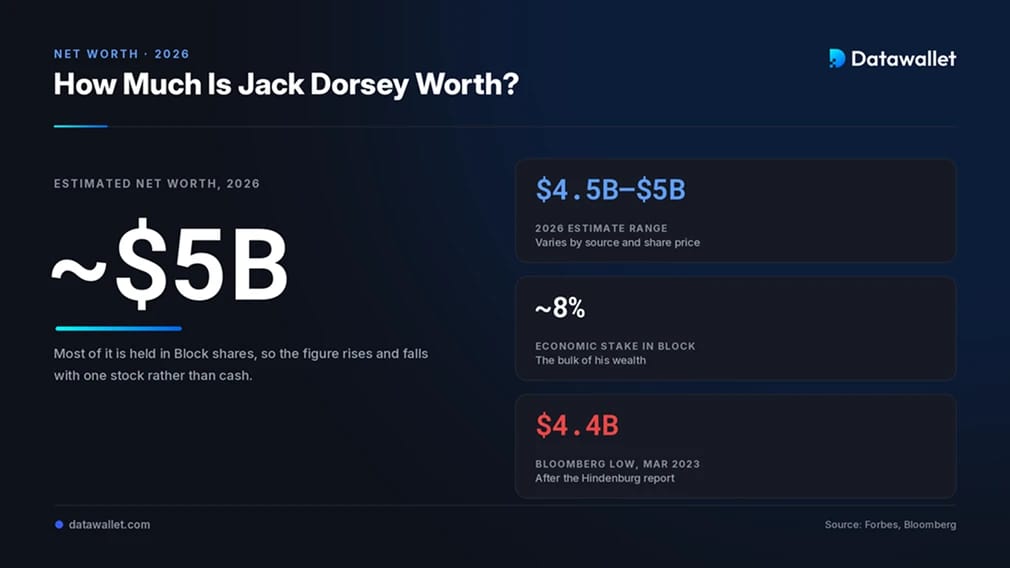
Estimates of Dorsey's wealth in 2026 cluster between $4.5 billion and $5 billion, almost all of it tied to Block. The company carries a market value near $40 billion to $45 billion and trades on the NYSE as XYZ, with CHESS Depositary Interests listed on the ASX for Australian investors.
Because his fortune sits in one equity, it swings with sentiment around Block. Bloomberg clocked an 11% single-day drop to $4.4 billion in March 2023 after short seller Hindenburg Research targeted the company, and the stock has ranged widely since.
What Makes Up Jack Dorsey's Net Worth
Most of Dorsey's fortune is a single position. He holds an estimated 8% economic stake in Block, plus Class B shares carrying ten votes each that hand him control well beyond that level. The rest sits in cash from the Twitter exit, an undisclosed personal Bitcoin holding, and other liquid assets.
The mix explains why the figure lands near $5 billion rather than higher. He routed more than $1 billion of equity into Start Small in 2020, first for COVID-19 relief and later education, universal basic income, and women's health, and that money left his balance sheet for good. The components above overlap and shift with Block's share price, so treat them as estimates.
How Much Bitcoin Does Jack Dorsey Own?
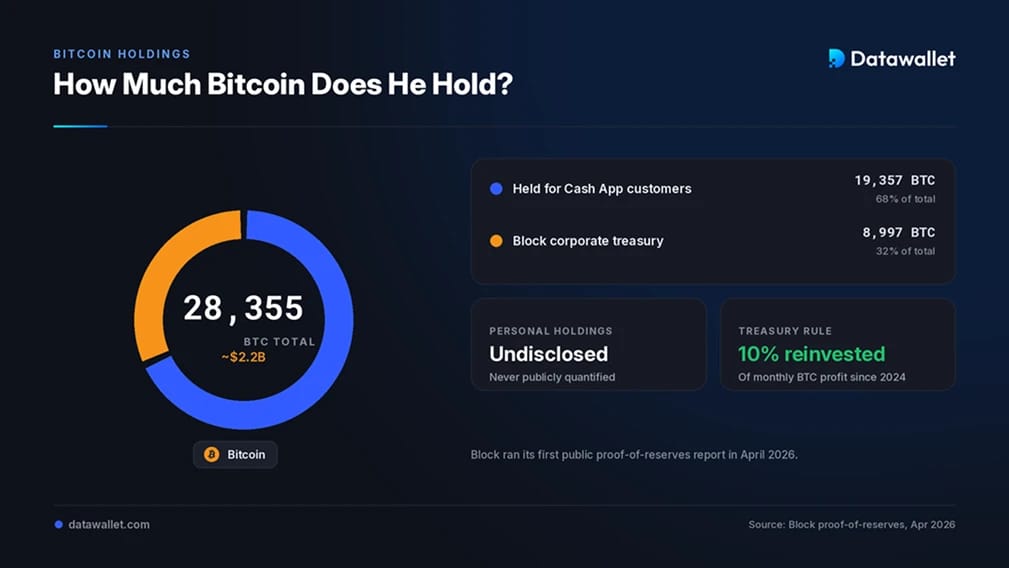
Dorsey has never disclosed his personal Bitcoin holdings, though he has said the asset makes up a meaningful share of his own savings. What is documented is what Block holds, and the two are often confused.
Block published its first proof-of-reserves report in April 2026, showing close to 9,000 BTC in the corporate treasury plus 19,357 BTC held for Cash App customers, a combined 28,355 BTC worth about $2.2 billion at the time. Only the corporate share counts as a company asset.
The treasury grows on a fixed rule. Since April 2024, Block reinvests 10% of monthly Bitcoin gross profit into Bitcoin, a policy more common at crypto startups than S&P 500 members. See how it ranks against holders like Strategy on the Bitcoin Treasury tracker, and compare the founders behind them in our Michael Saylor net worth coverage.
Inside Block's Bitcoin and AI Pivot
Two thresholds reset how the market sees Block. It changed its ticker from SQ to XYZ in January 2025, then joined the S&P 500 on July 23, 2025, replacing Hess Corp. Inclusion gave index-fund investors indirect exposure to a Bitcoin-heavy balance sheet, echoing Coinbase's earlier addition under Brian Armstrong.
The sharper move came on February 26, 2026, when Block disclosed a workforce cut of more than 40% in an SEC filing, taking headcount from over 10,000 to under 6,000 and booking roughly $450 million to $500 million in charges. Dorsey cast it as an AI-first overhaul, folding routine work into internal AI tools and dissolving the TBD unit to refocus on core products and Bitcoin. The stock jumped more than 20%.
Early results split the difference. Block posted a Q1 2026 net loss near $308.7 million from the restructuring, alongside record adjusted EBITDA around $1 billion, gross profit up 27% year over year, and raised guidance. It also reserved $240 million for talks with the Department of Justice over Cash App compliance issues tracing back to the 2023 short-seller report.
After a 2025 preview and early-seller onboarding, Square began auto-enabling Bitcoin payments for eligible US merchants on March 30, 2026. Around 4 million businesses can now take Bitcoin over the Lightning Network, settling in dollars by default with no fees through 2027. That pits Block against payment founders like Jack Mallers, whose Strike runs the same rails. Proto, Bitkey, and Spiral round out its Bitcoin stack across mining, self-custody, and open-source work.
Dorsey's Push Into Decentralized Protocols
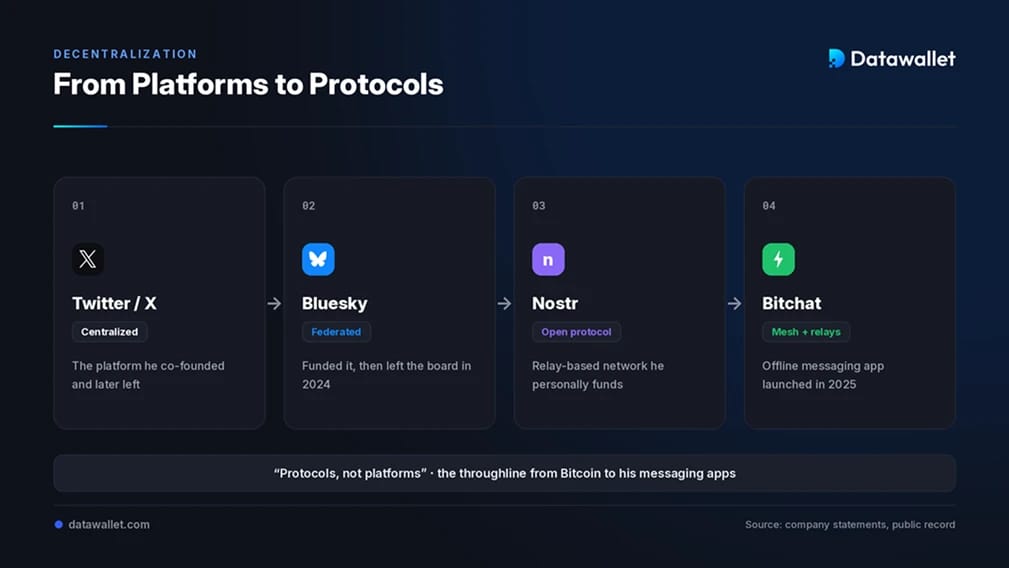
Outside Block, Dorsey has spent two years backing communication tools no single company controls. He quit the Bluesky board in May 2024 and later walked away from the app, arguing the project he once funded had drifted back into another centralized platform instead of an open protocol.
His focus shifted to Nostr, a relay-based social protocol he has personally funded, and to two messengers built on it. In July 2025 he released Bitchat, an open-source app that relays encrypted messages between nearby phones over Bluetooth mesh, with no internet, servers, or accounts, later adding Nostr and Lightning support. He followed it with White Noise, a Nostr and MLS-encrypted messenger backed by OpenSats and the Human Rights Foundation.
The throughline is a preference for protocols over platforms, and tools that keep working when infrastructure or governance fails. It is the same instinct that drew him to Bitcoin, applied to speech instead of money.
How Jack Dorsey Built His Fortune
Dorsey's wealth has always come from ownership, not salary. Twitter gave him scale and a public profile; Square, later Block, gave him the equity that still anchors his balance sheet. He built Square with McKelvey around a simple card reader for small merchants, then grew it into Cash App, Afterpay, TIDAL, and a stack of Bitcoin products.
Two events shaped the size of that fortune as much as the businesses did. The Musk deal turned his roughly 18 million Twitter shares into about $978 million in 2022, and the 2020 Start Small transfer deliberately shrank his holdings. The result is a founder whose sway over payments, Bitcoin, and decentralized software runs well ahead of his rank on any rich list.
Final Thoughts
Jack Dorsey enters 2026 worth an estimated $5 billion, a figure that rises and falls on Block's share price more than anything else. The company has reorganized around two bets, AI for efficiency and Bitcoin for everyday payments, and early numbers suggest the market will reward the pair.
His Bitcoin conviction, long dismissed by Wall Street, now sits inside an index-listed company processing payments for millions of merchants. Track the wider institutional shift through our Bitcoin ETF tracker, and watch your own positions with the Datawallet portfolio tracker.