



Ledger Nano S Plus vs Nano X: Overview
Ledger is a French security company founded in 2014 that produces physical devices for storing cryptographic private keys offline. The firm says its hardware protects around 20% of the world's crypto assets. No Ledger device has ever been drained because of a hardware flaw.
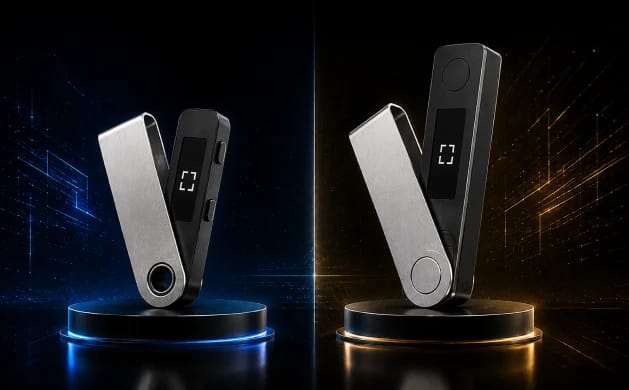
The Nano S Plus arrived in 2022 as the wired replacement for the retired Nano S. Ledger introduced the Nano X in 2019 as its first Bluetooth model. Both retain the USB-stick design, 1.1-inch screen, and two-button controls.
The table compares the specifications that distinguish them:
Ledger Nano S Plus vs Nano X: Security
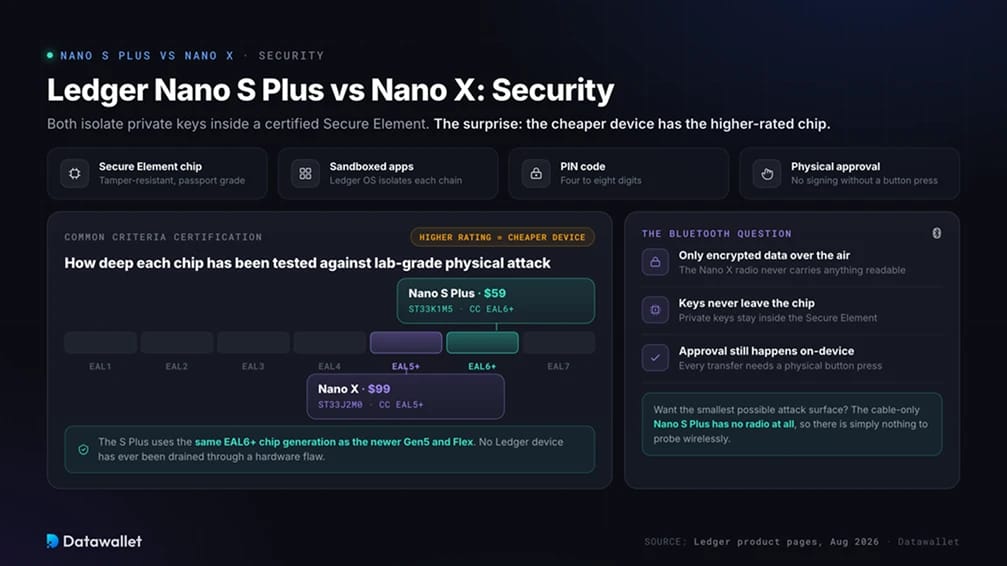
Every Ledger creates and stores private keys inside a certified Secure Element. This tamper-resistant chip is similar to those used in passports and bank cards. Ledger OS isolates each blockchain app inside a separate sandbox, while a four- to eight-digit PIN secures the device. Transactions cannot proceed without a physical button press.
One detail often surprises buyers. The Nano S Plus contains the ST33K1M5 chip rated CC EAL6+, which is also used in the newer Gen5 and Flex. The Nano X has the older ST33J2M0 rated CC EAL5+. Common Criteria levels measure the depth of testing against laboratory-grade physical attacks, giving the cheaper model the higher rating.
Bluetooth introduces a separate security consideration. The Nano X transmits only encrypted data over its wireless connection, and private keys remain inside the chip. Each transfer still needs on-device approval. Even so, buyers seeking the smallest possible attack surface may prefer the cable-only Nano S Plus because it has no radio.
Ledger Nano S Plus vs Nano X: Design and Connectivity
The two devices are close in appearance. Each combines a brushed stainless steel cover with a plastic body and displays transaction details on the same 1.1-inch OLED screen. Navigation depends on two buttons mounted along the top. Reading a long smart contract on the 128 x 64 pixel display requires patience with either model.
Connection methods create the main practical difference. The Nano S Plus draws power from the computer or Android phone attached to its USB-C port. With no battery, there is nothing to charge, degrade or replace. Apple does not permit the wired setup the device requires, excluding iPhone owners.
The Nano X removes that limitation. Bluetooth Low Energy 5.2 connects it to Ledger Wallet on phones running iOS 14+ or Android 10+. Its internal 100 mAh battery provides around five hours of untethered use. Those additions result in a larger 34-gram body, and the battery will lose capacity after years in storage.
Our tests matched these differences. We used the Nano X when a transaction needed approval away from a desk. For computer-based signing, the Nano S Plus was the natural choice because Bluetooth added no value.
.webp)
Ledger Nano S Plus vs Nano X: Supported Assets and Apps
Both devices cover the same assets, so compatibility should not decide the comparison. Ledger lists support for more than 15,000 coins, tokens, and NFTs. More than 500 assets can be managed directly in the Ledger Wallet app, while third-party wallets provide access to the rest.
That additional software layer is important. Either Nano can approve transactions created through MetaMask, Phantom, and dozens of other interfaces. Private keys stay offline while users interact with DeFi protocols or NFT marketplaces. Our MetaMask vs Phantom comparison explains which pairing is better suited to different chains.
Memory is the only meaningful difference. The Nano X provides 2 MB of storage, compared with 1.5 MB on the Nano S Plus, although both allow up to 100 installed apps. We never reached the limit on either device. Removing an app does not remove any assets because the coins remain on the blockchain and the device stores only their keys.
.webp)
Ledger Nano S Plus vs Nano X: Price
As of August 2026, Ledger charges $59 for the Nano S Plus and $99 for the Nano X through its official store. The extra $40 buys wireless pairing, an internal battery and iPhone access. It does not provide a newer security chip, since that advantage belongs to the cheaper model.
The better value depends on how transactions are signed. Someone confirming a few transfers each year from a desktop receives little benefit from Bluetooth. A person managing positions by phone is more likely to use the Nano X's wireless connection regularly.
Another model is worth considering for buyers with a larger budget. The Nano Gen5 costs $179 and replaces physical buttons with an E Ink touchscreen. The two classics are still the least expensive certified entries into Ledger's ecosystem, led by the Nano S Plus.
Ledger Nano S Plus vs Nano X: Software and Ecosystem
The same software works with both devices, giving each access to Ledger's broader set of storage and transaction tools.
The following tools are available on either Nano:
- Ledger Wallet App: Renamed from Ledger Live in late 2025, the companion app tracks portfolios and provides access to buying, swapping, and staking. It supports 100+ chains through more than 50 integrated providers.
- Clear Signing: Supported transactions appear in readable terms on the device. The screen shows the recipient and amount, allowing users to approve visible details instead of a raw hash.
- Ledger Security Key: Either device can function as a two-factor passkey for supported platforms, approving account logins with the hardware used to secure crypto assets.
- Ledger Recover: This optional paid subscription divides an encrypted seed backup among three independent custodians. Recovery requires identity verification, while the standard 24-word sheet remains the default backup.
- NFT Management: The app displays collections on supported chains. Transfers receive the same on-device confirmation required for other transactions.
.webp)
How the Nano Classics Fit Ledger's Current Lineup
Ledger's late 2025 relaunch shifted the range toward touchscreen signing. Priced at $179, the Nano Gen5 brought a 2.8-inch E Ink touchscreen, Bluetooth, NFC, and a bundled Recovery Key. The $249 Flex and $399 Stax occupy the premium tiers with larger displays and metal or curved-glass construction.
Ledger now markets the Nano S Plus and Nano X as classic backup signers. They are intended for buyers seeking proven protection at the lowest price or a secondary device that mirrors a primary wallet. Both remain fully supported, continue to receive firmware updates, and are still released in new colors.
The change also shows how transaction verification is developing. Multi-step DeFi activity is easier to read on a touchscreen than on a two-button device, so Ledger reserves its most advanced Clear Signing experience for newer displays. The classics are no less secure, but larger screens are becoming the industry's response to blind signing.
.webp)
Is the Ledger Nano X Better than the Nano S Plus?
The Nano X justifies its higher price only for mobile-first owners. Bluetooth, a battery, and iPhone compatibility make it the only one of the two suited to people who sign mainly from a phone. Its older EAL5+ chip still provides a security barrier that has never been broken in the wild.
For everyone else, the Nano S Plus is the stronger purchase. It is $40 cheaper and carries the higher-certified chip. Removing the battery and radio also eliminates two potential failure points, while support for assets, apps, and software features remains unchanged. Desktop users would pay more for functions they rarely need by choosing the Nano X.
Final Thoughts
This decision comes down to connection preferences rather than security tiers. Both devices isolate private keys inside certified chips and require physical confirmation before signing. Each also uses the same Ledger Wallet ecosystem for buying, staking, and third-party wallet access.
We recommend the Nano S Plus for most buyers because it combines the stronger certification with the lower price. The Nano X is the better choice for phone-first management or Apple hardware. Anyone interested in a touchscreen should compare the Nano Gen5 before buying either classic model.
For alternatives from another manufacturer, our Ledger Nano S Plus vs Trezor comparison covers the closest rival. Our guide to the best crypto wallets also ranks hardware and software choices across the wider market.