







About MEXC
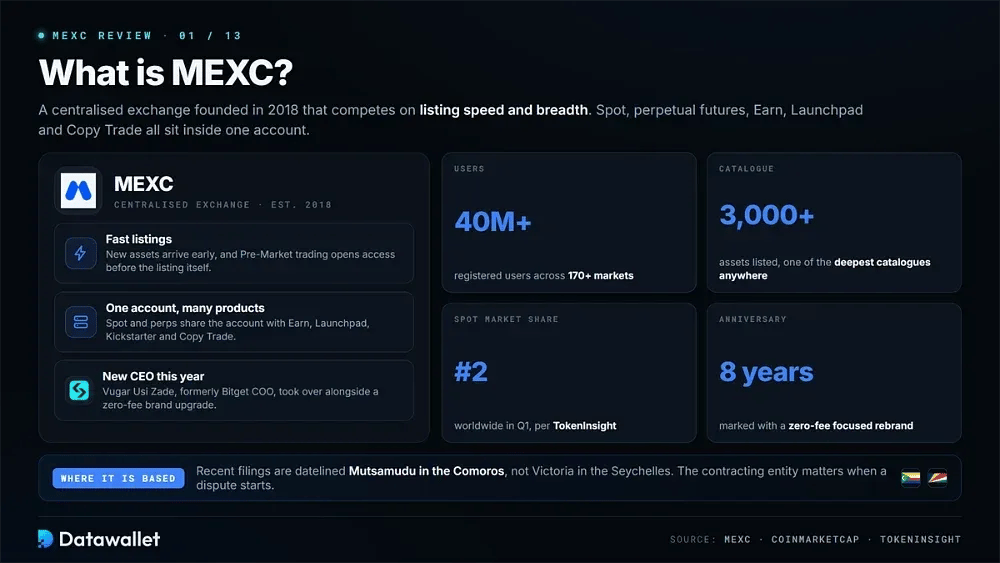
Founded in 2018, MEXC is a centralised exchange that competes through fast listings and a broad product range. Spot and perpetual futures sit within one account, alongside MEXC Earn, Launchpad, Kickstarter and Copy Trade. Pre-Market trading provides access to early listings.
With 40+ million users across 170+ markets and more than 3,000 assets, MEXC ranks among the world's largest exchanges on CoinMarketCap. TokenInsight placed it second worldwide by spot market share in the first quarter, reinforcing its position as a high-coverage venue for active traders.
The leadership changed this year when Vugar Usi Zade, formerly chief operating officer at Bitget, became CEO. MEXC also marked its eighth anniversary with a zero-fee-focused brand upgrade. Recent filings are datelined Mutsamudu in the Comoros rather than Victoria in the Seychelles.
MEXC Features
Frequent traders are MEXC's core audience. Wide spot coverage sits beside an extensive futures offering, while products such as Lanchpad and Kickstarter give active users more reasons to remain within the app.
That breadth provides considerable flexibility. It also means traders can move quickly into leverage or thinly traded new listings, where losses can escalate just as fast.
Trading Types
MEXC ranges from straightforward spot orders to leveraged derivatives. Traders can begin with simpler products before moving into more complex exposure as their risk rules develop.
- Spot trading: Standard order book trading across a very large coin selection, with MEXC marketing 3,000+ coins.
- Spot margin trading: Collateral can be used to borrow and increase spot exposure. We suggest treating this as futures-lite by keeping position sizes small and planning exits in advance.
- Perpetual futures: MEXC's futures offering centres on perpetual contracts and is marketed with leverage of up to 500x. That level of leverage is precisely what makes the product dangerous for newer traders.
- Margin modes: Stablecoin and Coin-M setups are available. The collateral currency affects both profit-and-loss treatment and liquidation behaviour.
- Futures order types: Limit, Market, Trigger, Trailing Stop and Post Only orders are available, covering most execution styles.
- Leveraged ETF products: These ETF-style products package leveraged exposure without requiring traders to manage margin directly.
- Demo trading: MEXC publishes a futures demo guide for practising leverage and stop-loss placement before live collateral is at risk.
Earn Options
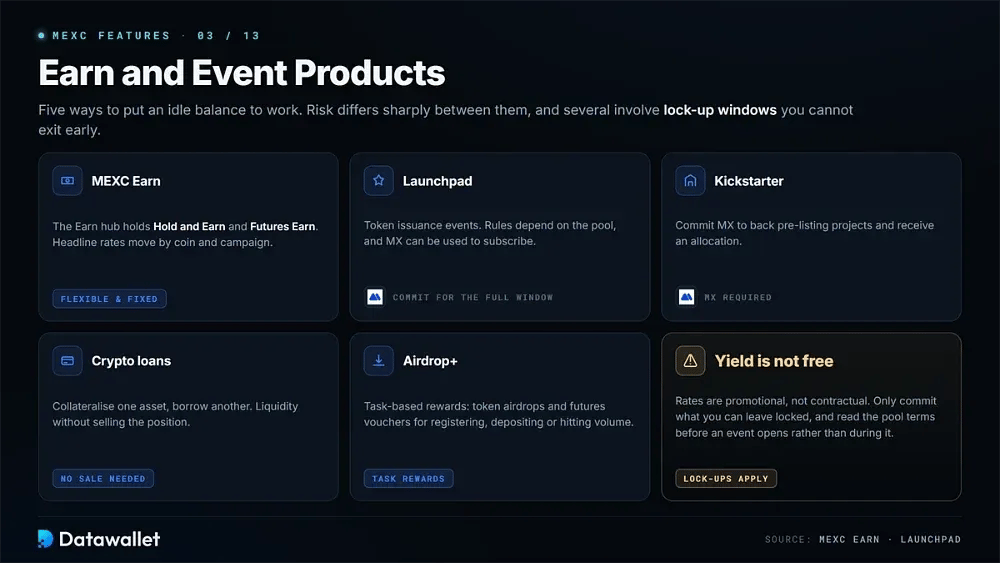
MEXC offers yield and event products for putting idle balances to work. Risk differs substantially between them, and some involve lock-up periods.
- MEXC Earn: The Earn hub contains Hold and Earn and Futures Earn categories. Headline rates vary by coin and campaign.
- Launchpad: Participation rules for this token issuance platform depend on the relevant event pool. Commit only an amount you can hold for the entire window.
- Kickstarter: Users commit MX, MEXC's native token, to support pre-listing projects and receive allocations.
- Crypto loans: Holders can collateralise one asset and borrow another, providing liquidity without requiring a sale.
- Airdrop+: This task-based rewards hub distributes token airdrops and futures vouchers for activities such as registering, depositing or reaching volume targets.
Additional Services
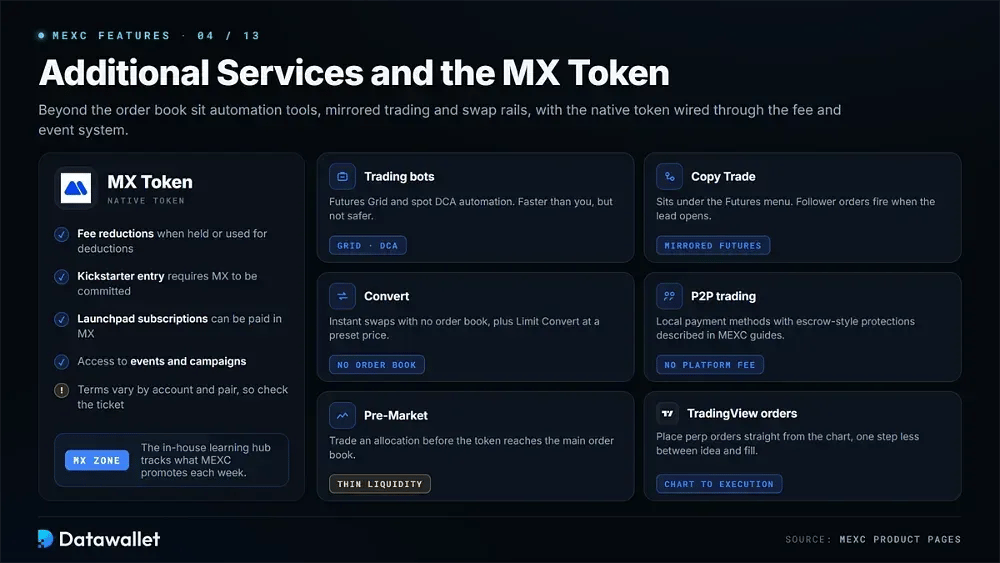
MEXC also provides tools for faster execution and automated strategies, as well as features that let users mirror experienced futures traders.
- MX Token: The native token is primarily used for fee reductions and access to events. MX is required for Kickstarter entry and can also be used for Launchpad subscriptions.
- MX Zone: This in-house learning hub publishes platform guides, token explainers and event posts, making it useful for following what MEXC promotes each week.
- Trading bots: The available automation includes a Futures Grid bot and spot DCA tooling. Bots execute faster than you can, but they do not eliminate risk.
- Copy Trade: Located under the Futures menu, this follow-and-mirror feature places follower orders when a lead trader opens positions.
- Convert: Users can make instant swaps without an order book or use Limit Convert to execute conversions at a preset price.
- P2P trading: The peer-to-peer desk supports local payment methods, with escrow-style protections described in MEXC's guides.
MEXC Stocks and TradFi Products
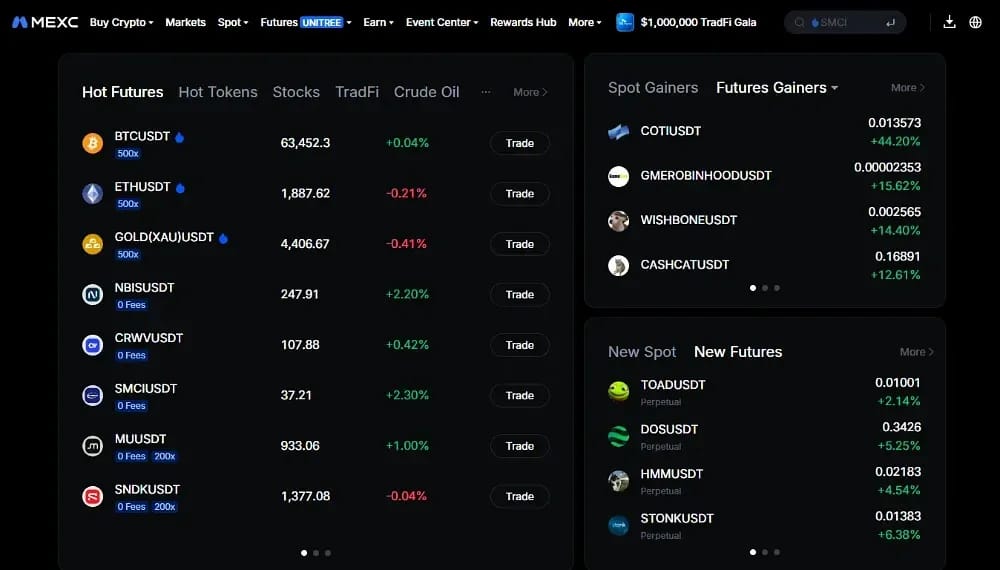
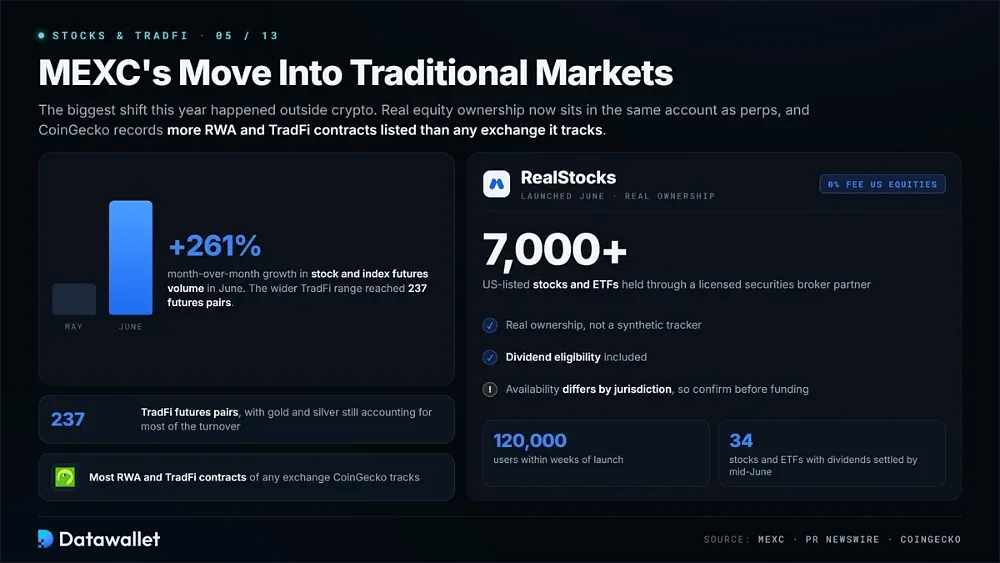
This year's biggest shift for MEXC has taken place outside crypto. From the same account, the exchange now offers real equity ownership and pre-IPO exposure alongside tokenised stocks and stock futures. CoinGecko recorded MEXC listing more RWA and TradFi contracts than any other exchange it tracks.
The expansion has translated into substantial activity. Stock and index futures volume rose roughly 261% month over month in June. The broader TradFi range reached 237 futures pairs, while gold and silver continued to account for most of the turnover.
RealStocks and Pre-IPO Access
Launched in June, RealStocks gives eligible users real ownership of more than 7,000 US-listed stocks and ETFs through a licensed securities broker partner, with dividend eligibility included. Within weeks it had passed 120,000 users. By mid-June, dividend settlements had been completed for 34 stocks and ETFs.
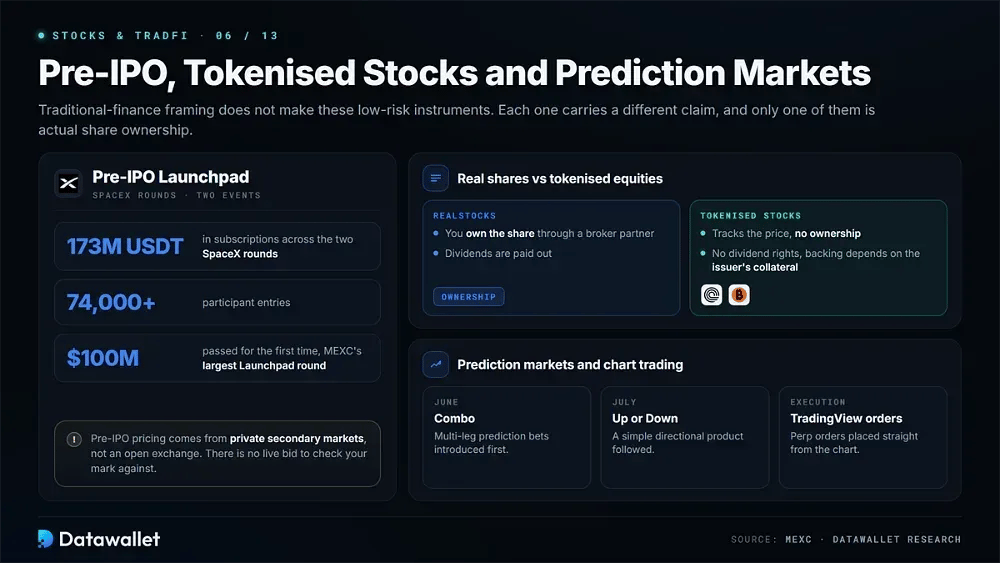
Pre-IPO Launchpad provides early exposure to private companies before they list. Across two events, the SpaceX rounds attracted more than 173 million USDT in subscriptions and over 74,000 participant entries. This made it MEXC's first $100 million Launchpad round.
The traditional-finance framing does not make these low-risk instruments. Pre-IPO prices are based on private secondary markets rather than an open exchange. RealStocks availability also differs by jurisdiction, so confirm eligibility before funding a position.
Tokenised Stocks and Prediction Markets
MEXC lists tokenised equities alongside real shares. These instruments track share prices without providing ownership and include Ondo's tokenised version of Strategy's preferred stock. They carry no dividend rights, and their backing depends on the issuer's collateral arrangements rather than a broker relationship.
The exchange has expanded into prediction markets as well, introducing a Combo feature in June followed by an Up or Down product in July. Users can now place perpetual futures orders directly from TradingView charts, removing one step between analysis and execution.
MEXC User Reviews
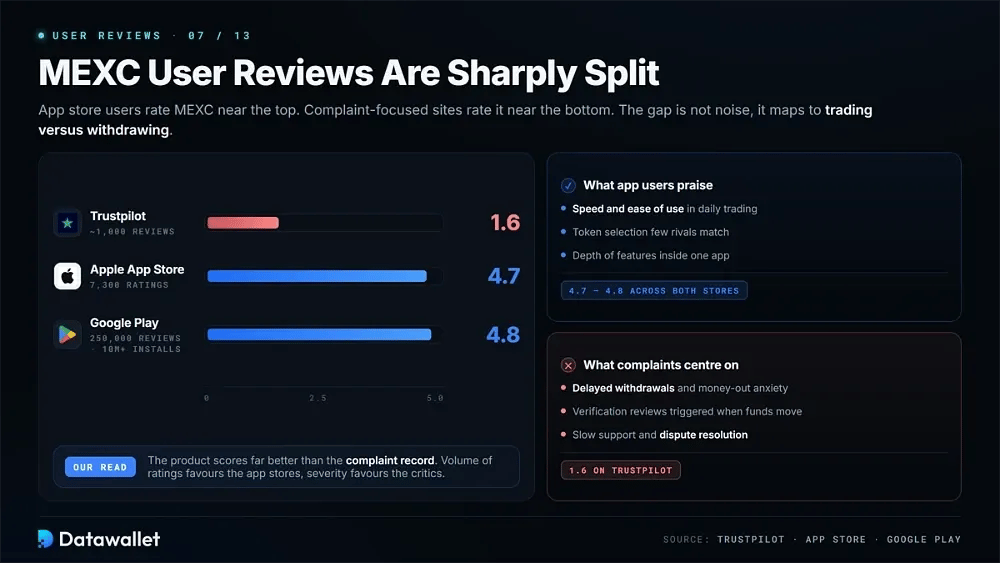
Ratings for MEXC differ sharply depending on the platform. App store users score it highly for its coverage, speed and tools. Complaint-focused sites, by contrast, are dominated by reports of withdrawal holds and slow support.
Here is a summary of the exchange's ratings:
- Trustpilot: 1.6/5 from roughly 1,000 reviews. Delayed withdrawals and verification reviews triggered when users move funds are recurring themes, creating considerable money-out anxiety.
- Apple App Store: 4.7/5 from 7,300 ratings. Reviewers commonly praise the app's speed and ease of use, along with its token selection and feature depth.
- Google Play: 4.8/5 from 250,000 reviews and 10M+ downloads. Feedback reflects similar strengths around speed and coverage.
Our experience shows the same split. MEXC's in-app trading receives much stronger reviews than its complaint record for withdrawals and dispute resolution.
Is MEXC Safe?
We consider MEXC safest when used as a trading venue rather than a store of value. In our testing, the practical approach is to deposit, trade and withdraw. Use 2FA and passkeys, whitelist withdrawals, and keep long-term holdings off-exchange.
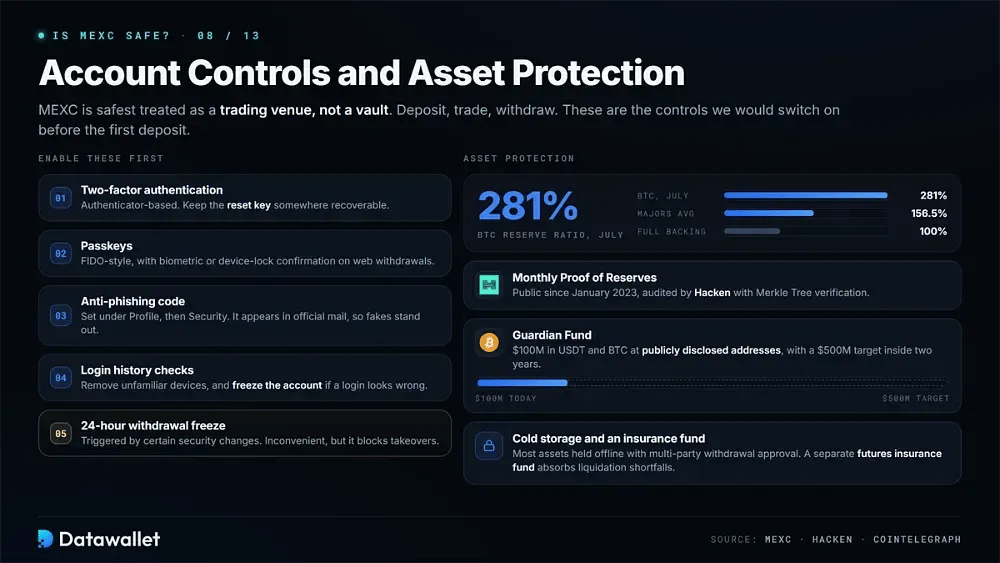
Reserve transparency has strengthened. Monthly Proof of Reserves reports are audited by Hacken using Merkle Tree verification. In July, MEXC reported a 281% BTC reserve ratio, compared with a 156.5% average across major assets the previous month.
Those reserves do not eliminate counterparty or trading risk. Withdrawals can still be delayed by risk controls.
Account Safety Measures
We would enable the following controls first because they address common attack routes, including phishing and SIM swaps, as well as stolen sessions and drain attempts.
- Two-factor authentication: MEXC recommends authenticator-based 2FA and emphasises keeping the reset key somewhere recoverable.
- Passkeys: FIDO-style passkeys are supported, including biometric or device-lock confirmation for web withdrawals.
- Anti-phishing code: Users can set a custom code under Profile, then Security. It appears in official communications, making fraudulent emails easier to identify.
- Login history checks: MEXC advises checking login history and removing unfamiliar devices. Users are also prompted to freeze the account if logins appear suspicious.
- Withdrawal freeze: Certain security-setting changes activate a 24-hour withdrawal freeze. It can be inconvenient when funds need to move quickly, but it helps protect against account takeovers.
Asset Protection
- Proof of Reserves: MEXC has made reserve data public since January 2023. Monthly reports audited by Hacken allow users to verify that their balances are included within platform reserves.
- Guardian Fund: The $100M Guardian Fund holds USDT and BTC at publicly disclosed addresses. MEXC plans to expand it to $500 million within two years.
- Futures Insurance Fund: This separate fund covers liquidation losses during extreme conditions, reducing the likelihood that shortfalls pass to profitable counterparties.
- Wallet architecture: Most assets are kept offline through a separation of cold and hot wallets, while withdrawals require multi-party authorisation.
Security History
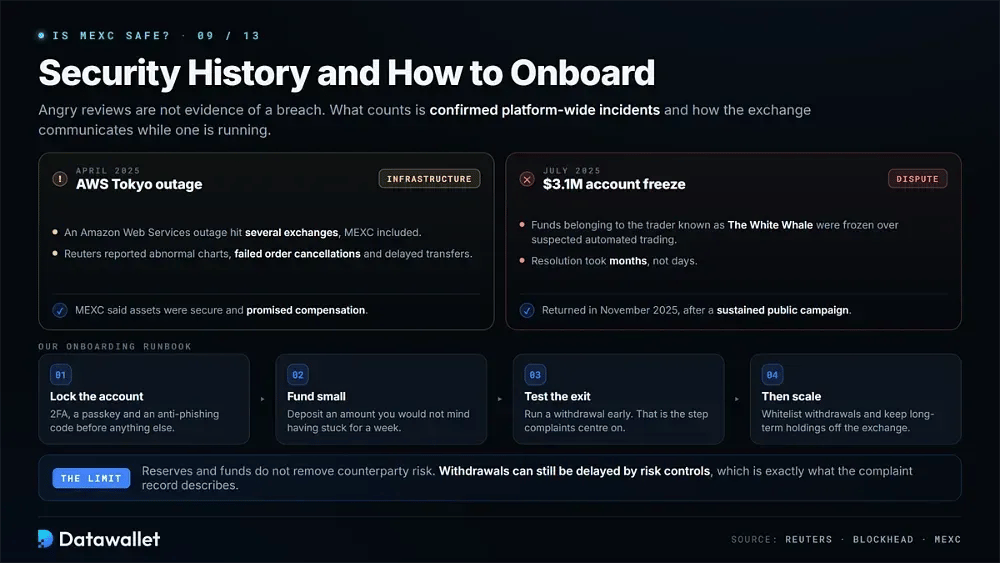
Negative user reports are not, by themselves, evidence of a breach. We focus instead on confirmed platform-wide incidents and the way MEXC communicates when they occur.
- April 2025 AWS outage: An Amazon Web Services outage in Tokyo affected several exchanges, including MEXC. Reuters reported abnormal charts and failed order cancellations, along with delayed transfers. MEXC said assets were secure and promised compensation.
- Account freeze disputes: In July 2025, MEXC froze roughly $3.1 million belonging to the trader known as The White Whale over suspected automated trading. The exchange later returned it following a sustained public campaign.
Our recommendation is to secure the account with 2FA, a passkey and an anti-phishing code. Fund a small amount first, complete a test withdrawal, then scale.
Is MEXC Regulated?
Your country of residence affects MEXC's regulatory position, as do the service you use and the contracting entity identified in its legal documents. Our assessment is based on the regulator record for each entity.
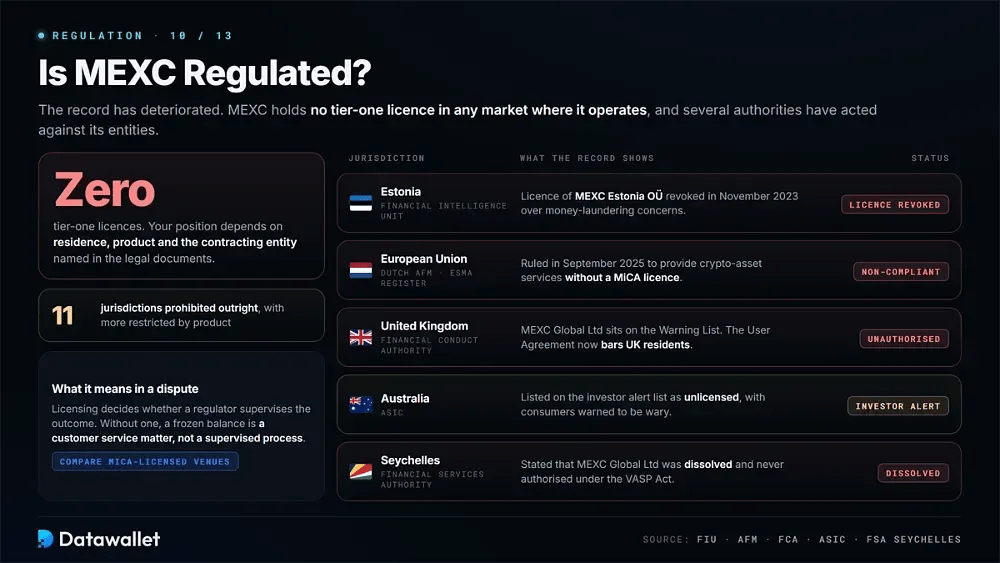
That record has deteriorated. MEXC does not hold a tier-one licence in any market where it operates, and multiple authorities have taken action against it.
Here is what primary sources confirm:
- Estonia: In November 2023, the Estonian Financial Intelligence Unit revoked the licence of MEXC Estonia OÜ over money-laundering concerns, bringing its Estonian authorisation to an end.
- European Union: In September 2025, the Dutch Authority for the Financial Markets ruled that MEXC Global provides crypto-asset services without a MiCA licence and placed it on ESMA's non-compliant register.
- United Kingdom: The FCA identifies MEXC Global Ltd on its Warning List as unauthorised. MEXC's User Agreement now prohibits UK residents outright.
- Australia: MEXC Global appears on the Australian Securities and Investments Commission investor alert list as unlicensed, with consumers warned to be wary.
- Seychelles: The Financial Services Authority published a statement saying that MEXC Global Ltd was dissolved and had never been authorised under the Virtual Asset Service Providers Act.
- Prohibited regions: Eleven jurisdictions are prohibited outright. Our guide to MEXC available and restricted countries provides the details.
For supervised alternatives, users can compare the best MiCA-licensed crypto exchanges.
MEXC Fee Schedule
We separate MEXC's costs into trading and non-trading charges. Trading fees are the maker and taker rates applied to spot and futures, while the other costs include withdrawals, funding and third-party payment charges.
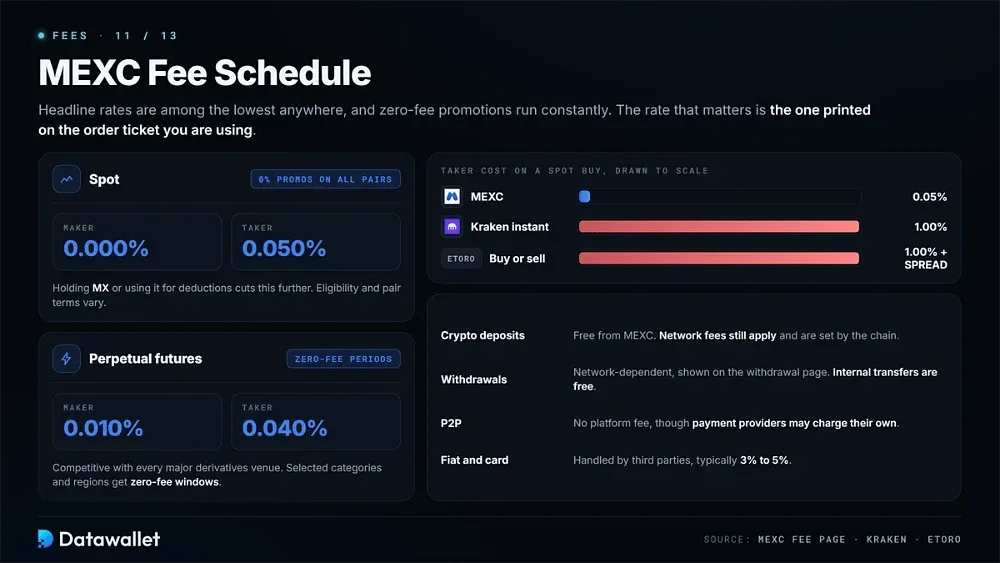
Zero-fee promotions run frequently on MEXC. As a result, the rates displayed on the order ticket you are actually using are the ones that matter.
Spot Fees
- Base rate: MEXC publishes a spot rate of 0.0000% maker and 0.0500% taker, placing it among the lowest headline fee schedules available.
- Zero promotions: The exchange has announced 0% maker and taker fees across all spot pairs, although eligibility and pair-specific terms can vary.
- MX discounts: Holding MX or using it for fee deductions can reduce charges, with the exact terms varying by account and pair.
Perpetual Futures Fees
- Base rate: MEXC's published futures rate is 0.010% maker and 0.040% taker, competitive with every major derivatives venue.
- Zero promotions: Selected futures categories and regions have also received zero-fee periods, with terms varying between promotions.
Deposits, Withdrawals and P2P
- Crypto deposits: These are generally free from MEXC's side. On-chain network fees still apply and are determined by the relevant blockchain.
- Withdrawals: Fees depend on the network, with the current rate shown on the withdrawal page. Transfers within MEXC are free.
- P2P: MEXC does not charge a platform fee on P2P transactions, although individual payment providers may impose their own charges.
- Fiat and card rails: Third-party providers handle fiat purchases, with fees typically falling in the 3% to 5% range.
For comparison, eToro charges 1% on crypto purchases and sales plus spreads, while Kraken lists 1% for instant buy and sell. MEXC remains one of the lowest-fee exchanges available. Our MEXC fees guide provides a line-by-line breakdown.
What is MEXC Card?
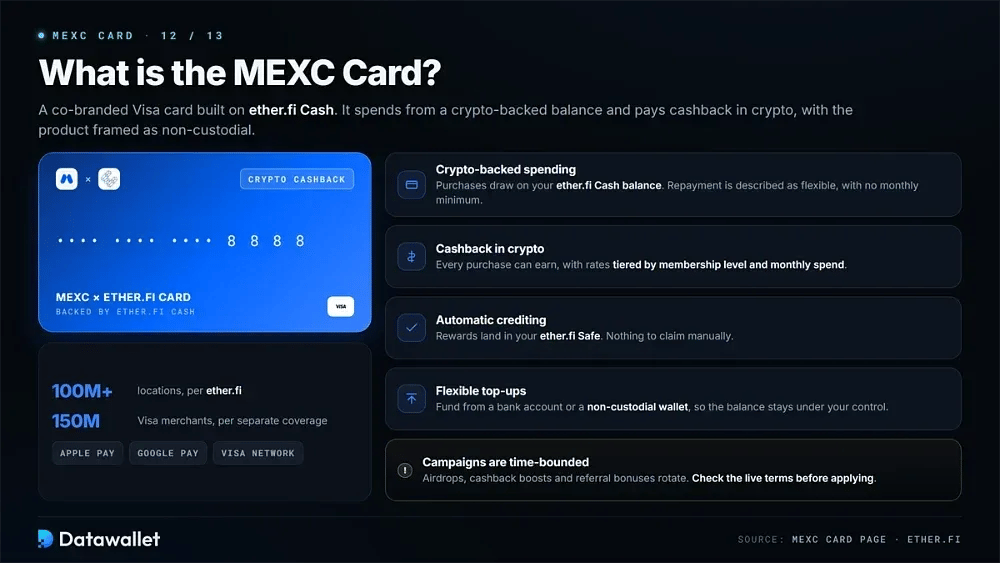
The MEXC Ether.fi Card is a co-branded spending card built on ether.fi Cash. It lets users spend from a crypto-backed balance while earning cashback in crypto.
According to the card page, Apple Pay and Google Pay are supported and the card is accepted wherever Visa works. Cashback is credited automatically after purchases, while its on-chain control messaging presents the product as non-custodial.
How it works in practice:
- Crypto-backed spending: Purchases draw from the user's ether.fi Cash balance. Repayment is described as flexible, with no monthly minimum stated.
- Cashback in crypto: Each purchase can generate crypto cashback, with rates tiered according to membership level and monthly spending.
- Automatic crediting: Earned crypto is sent automatically to the user's ether.fi Safe, with no manual claim required.
- Flexible top-ups: ether.fi Cash can be funded from a bank account or a non-custodial wallet, allowing the balance to remain under the user's control.
- Global acceptance: ether.fi states that the card can be used across 100M+ locations, while separate coverage refers to 150M Visa merchants.
Card-linked campaigns from MEXC advertise airdrops, cashback and referral bonuses. These programmes are time-bounded, so check the active terms before applying. Our MEXC referral code guide covers current offers.
MEXC vs Other Exchanges
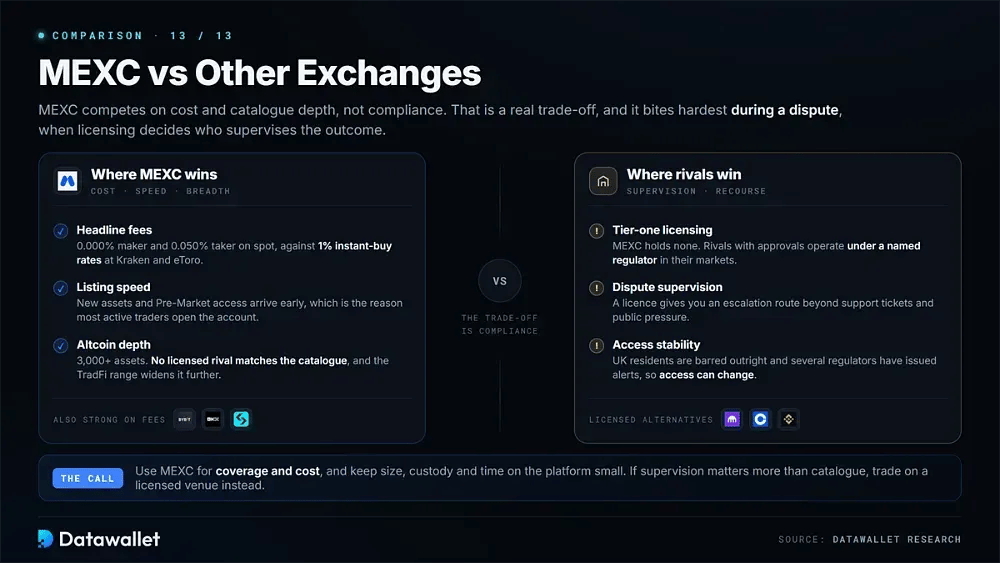
Cost and catalogue depth are where MEXC competes most aggressively, rather than compliance. That creates a clear trade-off against rivals with more regulatory approvals. The difference becomes especially important during a dispute, when licensing determines whether a regulator supervises the outcome.
On headline fees and listing speed, MEXC comes out ahead, while no licensed rival matches its altcoin depth. Traders focused on leveraged markets can compare the best crypto futures exchanges. Our exchange statistics provide context for MEXC's market share.
Final Thoughts
MEXC is best treated as a trading venue focused on breadth and speed. In supported markets, it offers one of crypto's deepest catalogues at fee levels that licensed competitors cannot match. That range now extends to stock and pre-IPO products.
The trade-off is recourse. MEXC has no tier-one regulator overseeing the platform, its Estonian licence has been revoked, and the account-freeze disputes illustrate the cost of that absence when a withdrawal stalls.
Before committing significant funds, confirm that your region is eligible. Enable 2FA and passkeys, set an anti-phishing code, and activate a withdrawal whitelist. Start with a small deposit and test a withdrawal before scaling, while keeping core holdings with a supervised exchange.
.webp)