
What is Blur?
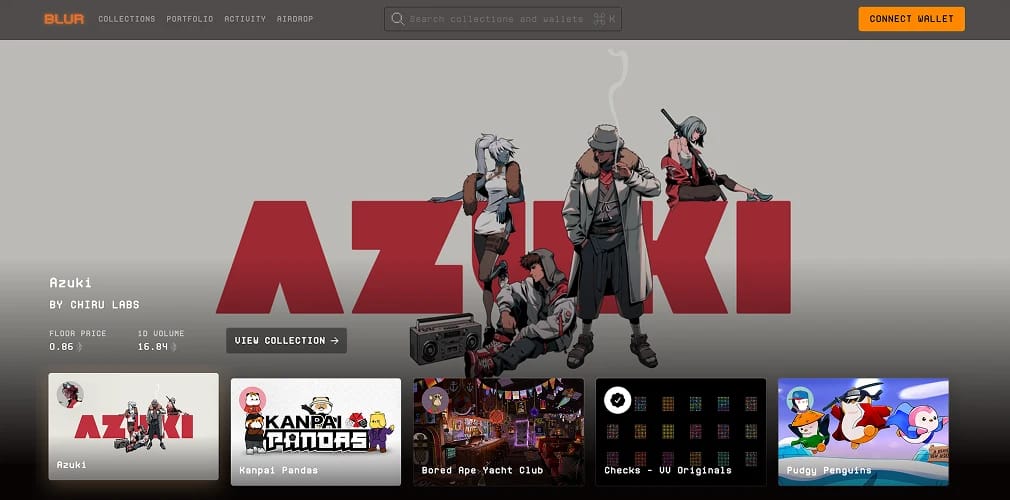
Blur is an NFT marketplace and aggregator on Ethereum built for high-volume traders rather than casual collectors. It combines its own order book with listings pulled from rival marketplaces, so users can compare prices, sweep collection floors, and execute batch trades from a single interface without paying any marketplace fee.
The platform launched in October 2022, backed by a seed round led by Paradigm, and grew rapidly after its February 2023 token launch. Airdrop seasons paid points for bidding and listing, and Blur captured the majority of Ethereum NFT trading volume within months, pushing OpenSea into second place for the first time.
That dominance has since faded alongside the wider NFT market. The Block's marketplace data shows OpenSea's share of Ethereum NFT volume jumping from 25.5% to 71.5% in February 2025 after it announced its SEA token. Most of that gain came directly out of Blur's share.
Blur remains the main venue for professional Ethereum NFT trading, and market trackers placed its share of Ethereum NFT volume near 38% in the first months of this year. Its lending protocol Blend is still the deepest NFT-backed borrowing market on any platform, even as overall activity sits far below the 2023 peak.
How Does Blur Work?
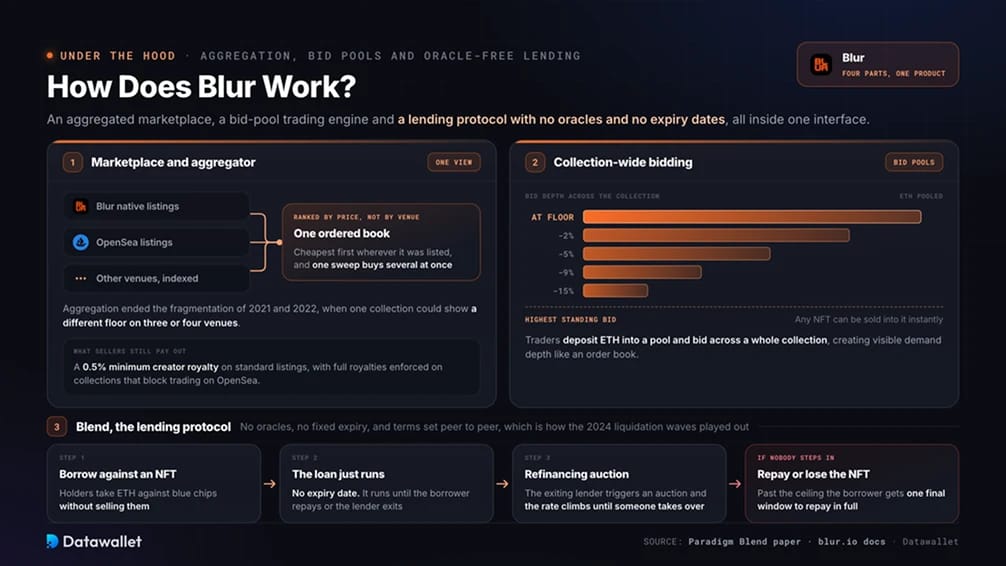
Blur combines an aggregated marketplace, a bid-pool trading engine, the Blend lending protocol, and a partially adjustable royalty model inside one product.
1. Marketplace and Aggregator
Blur runs its own native listings while also indexing NFTs listed on other marketplaces such as OpenSea. When a trader opens a collection page, every available listing appears in one ranked view, so the cheapest NFT can be bought regardless of where it was listed.
Aggregation reduces the price fragmentation of 2021 and 2022, when the same collection could show different floor prices across three or four venues. It also lets users sweep a floor in one transaction, buying multiple NFTs across marketplaces at once and saving repeated approval and gas costs.
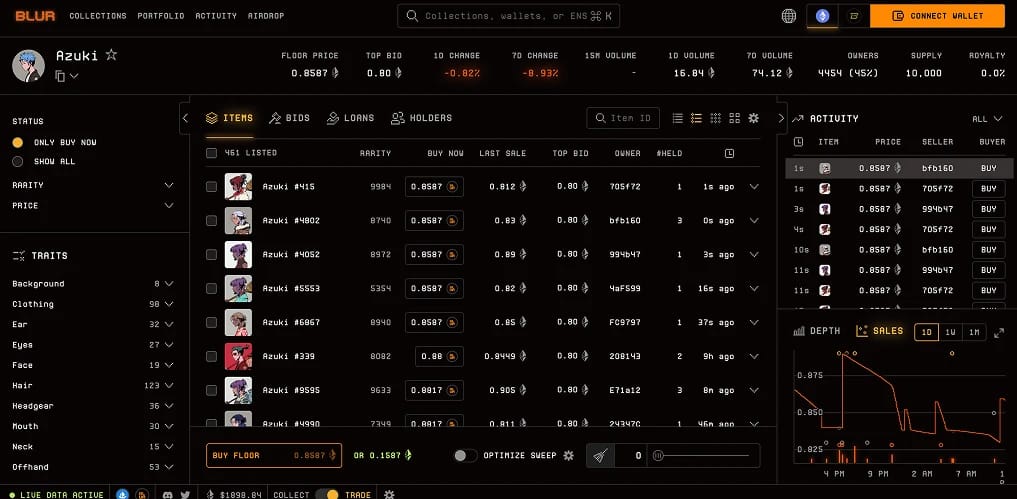
The interface resembles a trading terminal rather than a gallery. Depth charts, pending transactions, rarity data, and live activity feeds sit alongside each collection so traders can time entries and exits during volatile mints and sell-offs.
2. Bidding Pools and Trading Tools
Blur's most influential innovation is collection-wide bidding. Instead of bidding on one specific NFT, traders deposit ETH into a bidding pool and place bids across an entire collection at chosen price levels, creating visible demand depth similar to an order book on a token exchange.
Any NFT in the collection can be sold instantly into the highest standing bid, and bidders can accumulate NFTs at their target price without watching listings around the clock. During airdrop seasons, Blur's official bidding rules awarded the most points to the bids taking the most risk near the floor, which kept liquidity dense where sellers needed it.
Other core trading tools include:
- Floor sweeping: Buy multiple NFTs across aggregated listings in one transaction, sorted by price, with control over how many items to capture.
- Batch listing and delisting: List an entire portfolio with individual prices or floor-relative pricing, then cancel or reprice in bulk as markets move.
- Live analytics: Real-time floor movements, bid depth, holder distribution, and pending activity for each collection.
- Portfolio view: A filtered dashboard of held NFTs, active loans, open bids, and unrealized profit and loss, with spam collections filtered out.
3. Blend NFT Lending
Blend is Blur's peer-to-peer lending protocol, designed with Paradigm researchers and detailed in the firm's published protocol paper. It lets NFT holders borrow ETH against collections like Azuki, Milady, and Wrapped CryptoPunks without selling, and lets buyers purchase blue-chip NFTs with a smaller upfront payment.
The design has no price oracles and no fixed expiry dates. A loan runs until the borrower repays or the lender exits by triggering a refinancing auction, during which the offered interest rate rises until another lender takes over the position. If no lender steps in before the rate ceiling, the borrower gets a final window to repay in full or loses the NFT to the lender.
Interest rates and loan-to-value ratios are set peer to peer by whatever terms lenders offer rather than by a formula. That flexibility cuts both ways. Blend drew criticism in 2024 when falling floor prices triggered waves of liquidations on leveraged blue-chip positions, showing how fast borrowing against illiquid collateral can unwind.
4. Royalties and Listings
Blur's official royalty documentation sets a minimum 0.5% creator royalty on standard listings and commits to full royalty enforcement on collections that block trading on OpenSea. Sellers can choose to pay more than the minimum, though few do.
This model sat at the center of the 2023 royalty wars. Blur's trader-first approach forced OpenSea to loosen its own royalty enforcement, a decision that angered creators and reshaped how every major marketplace treats artist income. Royalties remain optional or minimal across most venues partly because of that fight.
How to Trade on Blur
Blur has no accounts, order forms, or fiat deposits. Everything runs through a self-custody Ethereum wallet, so wallet security and gas management matter as much as trade selection.
A typical Blur trade follows these steps:
- Prepare a wallet: Set up a self-custody Ethereum wallet, fund it with ETH for purchases, and keep extra for gas since every action settles onchain.
- Open the official site: Navigate directly to blur.io and check the domain carefully, because phishing clones of NFT marketplaces are a persistent theft vector.
- Connect and browse: Connect your wallet, then search a collection to see aggregated listings, bid depth, floor history, and holder data in one screen.
- Buy or sweep: Purchase a single NFT at the best aggregated price, or use the sweep tool to buy several floor items in one batch transaction.
- Place collection bids: Deposit ETH into the bidding pool and set bids at your target price levels to accumulate NFTs passively as sellers hit your bids.
- List holdings: Batch-list NFTs you want to sell, pricing them individually or relative to the floor, and adjust in bulk as the market moves.
- Manage loans carefully: If you borrow through Blend, track your position and the collection floor closely, since refinancing auctions leave limited time to respond.
- Account for gas: Zero marketplace fees do not mean free trading, so monitor Ethereum gas prices and batch actions during quiet network periods.
Blur NFT Marketplace Fees
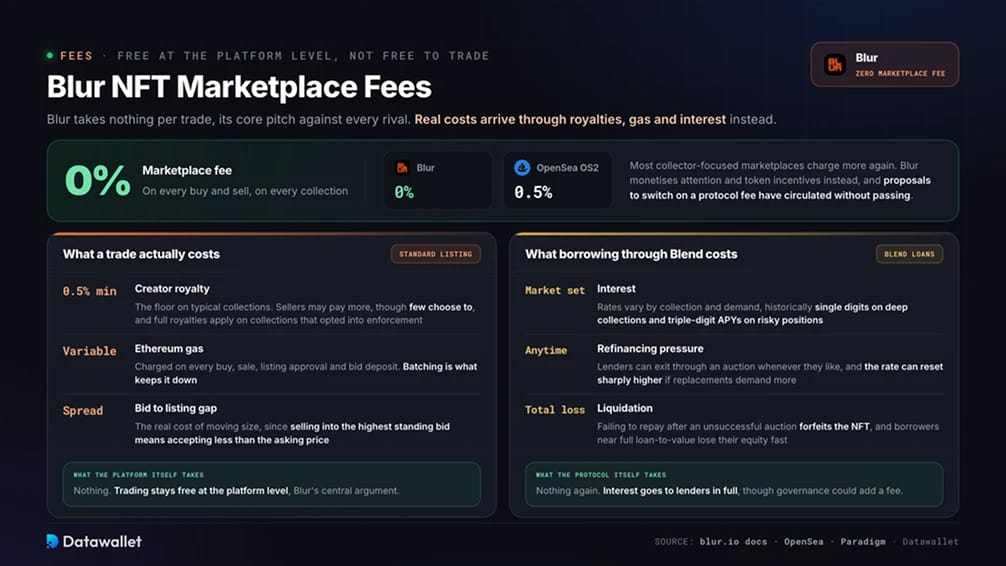
Blur charges no marketplace fee on trades, its core pitch against every rival. Real costs still arrive through royalties, gas, borrowing interest, and the spread between bids and listings rather than a platform cut.
Marketplace and Royalty Costs
The platform monetizes attention and token incentives rather than trade commissions. Community proposals to switch on a protocol fee and direct revenue to BLUR stakers have circulated without passing, so trading remains free at the platform level.
Costs on a standard Blur trade break down as:
- Marketplace fee: 0%, against 0.5% on OpenSea's rebuilt OS2 platform and higher rates on most collector-focused marketplaces.
- Creator royalty: A 0.5% minimum on typical collections, with full royalties enforced on collections that opted into enforcement tooling.
- Gas: Standard Ethereum network fees on every buy, sale, listing approval, and bid deposit, which batching minimizes.
Blend Borrowing Costs
Blend charges no protocol fee on loans, and the interest borrowers pay goes to lenders in full. The protocol's governance can vote to introduce fees, but none applied at the time of writing.
Borrowing through Blend involves these costs and risks:
- Interest: Market-set rates that vary by collection and demand, historically ranging from single digits on deep collections to triple-digit APYs on risky positions.
- Refinancing pressure: Lenders can exit at any time through an auction, and rates can reset sharply higher if replacement lenders demand more.
- Liquidation loss: Failing to repay after an unsuccessful auction forfeits the NFT, and borrowers near full loan-to-value can lose their remaining equity fast.
BLUR Tokenomics
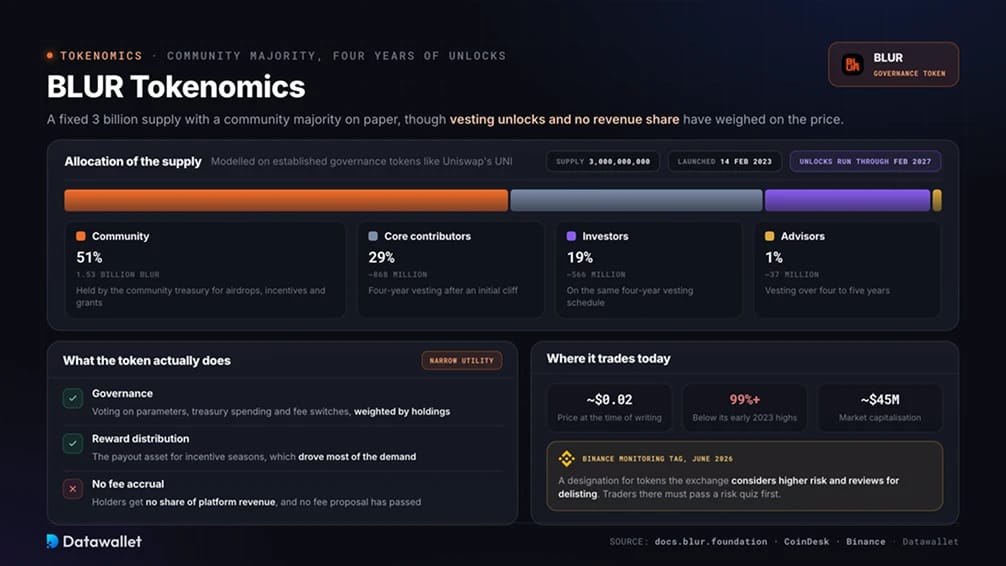
BLUR is the governance token of the Blur ecosystem, launched on February 14, 2023 with a fixed supply of 3 billion tokens. Its distribution favored the community on paper, though vesting unlocks and a lack of revenue sharing have weighed heavily on the price.
Allocation
The official tokenomics documentation modeled BLUR's structure on established governance tokens like Uniswap's UNI, pairing a majority community allocation with multi-year vesting for insiders. Final contributor and investor unlocks run through February 2027, ending a four-year dilution schedule.
The 3 billion BLUR supply breaks down as:
- Community: 51% (1.53 billion BLUR) held by the community treasury for airdrops, incentives, grants, and future initiatives.
- Core contributors: 29% (roughly 868 million BLUR) vesting over four years with an initial cliff.
- Investors: 19% (roughly 566 million BLUR) on the same four-year vesting schedule.
- Advisors: 1% (roughly 37 million BLUR) vesting over four to five years.
Utility
BLUR's utility is narrower than most large-cap tokens, which helps explain its price performance. CoinDesk price data showed the token trading around two cents at the time of writing, down more than 99% from its early 2023 highs, with a market capitalization near $45 million.
The token's current functions include:
- Governance: Voting on protocol parameters, treasury spending, and proposals such as fee switches, with weight proportional to holdings.
- Reward distribution: Serving as the payout asset for trading incentive seasons, which drove most historical demand.
- No fee accrual: Holders receive no share of platform revenue, since the marketplace charges no fees and no protocol fee proposal has passed.
In June 2026, Binance added BLUR to its Monitoring Tag list, a designation for tokens the exchange considers higher risk and reviews for potential delisting. Traders on Binance must now pass a periodic risk quiz to trade the token, and several previously tagged assets were later removed from the exchange.
Blur Airdrops
Blur's airdrop seasons created the template for points-based reward campaigns and remain the main reason it displaced OpenSea. The team ran rolling seasons that paid users retroactively for bidding, listing, and lending, keeping traders active for months chasing unknown future rewards.
Season 1 rewarded early users through care packages claimable at the February 2023 token launch, with around 360 million BLUR immediately available to historical traders and creators. Season 2 followed with more than 300 million BLUR for bidding and listing activity, closing in November 2023 as volumes were already cooling.
Season 3 tied Blur directly to Blast, the Ethereum Layer 2 launched by Blur's founder. Running until May 2024, it paid rewards in BLAST rather than BLUR, with 0.5% of BLAST supply for traders and 1.5% for token holders claimable from June 2024, and a further Season 4 pool of 500 million BLAST allocated to traders over the following year. No new season has been announced since, and activity has settled at a fraction of its peak.
Blur vs OpenSea
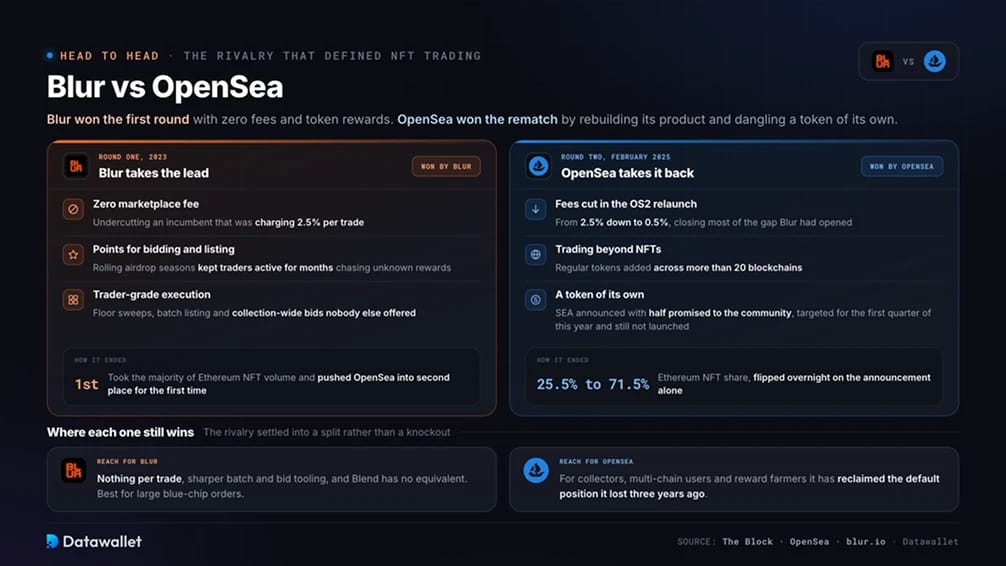
The rivalry that defined NFT trading has reversed since 2023. Blur won the first round by targeting professional traders with zero fees and token rewards, while OpenSea won the rematch by rebuilding its product and dangling a token of its own.
OpenSea's OS2 relaunch in February 2025 cut marketplace fees from 2.5% to 0.5%, added trading for regular tokens across more than 20 blockchains, and paired the rebuild with the announcement of its SEA token, half of which is promised to the community. The announcement alone flipped Ethereum NFT market share overnight, and OpenSea's pre-token reward programs have kept farmers on its platform since. The token was targeted for the first quarter of this year but had not launched at the time of writing.
Blur's counterargument is focus. It still charges nothing per trade, its execution tools remain sharper for batch trading and bid management, and Blend has no real equivalent on OpenSea. For a trader executing large orders in Ethereum blue-chip collections, Blur is usually still the cheaper and faster venue. For collectors, multi-chain users, and reward farmers, OpenSea has reclaimed the default position it lost three years ago.
Is Blur Safe?
Blur's core contracts have processed billions in volume since 2022 without a major exploit of user funds, and its aggregation model means it settles trades through audited, widely used marketplace contracts. The platform is non-custodial, so users hold their own keys and NFTs until a trade or loan executes.
The bigger risks sit around the platform rather than inside it. The NFT market itself has contracted severely, with The Block estimating roughly $5.5 billion in total NFT trade volume for 2025, down about 95% from the 2021 peak, and Dune Analytics data showing volume in the first half of this year falling more than 50% year on year. Several marketplaces, including Nifty Gateway and Foundation, shut down earlier this year.
Risks
Anyone trading on Blur or holding BLUR should weigh platform-specific hazards alongside that market backdrop. Most historical losses came from leverage and illiquidity rather than hacks.
Key risks include:
- Blend liquidations: Borrowing against NFTs can end in forced loss of the collateral when floors fall, as leveraged holders discovered during the 2024 liquidation waves.
- Illiquid collateral: NFT floor prices can gap down faster than any lending mechanism can react, leaving both borrowers and lenders underwater.
- Token dilution: Contributor and investor unlocks continue until February 2027, adding steady sell pressure to a token with no revenue claim.
- Exchange delisting: Binance's Monitoring Tag signals BLUR could lose its largest trading venue if reviews go against it, which would hit liquidity hard.
- Market dependence: Blur's business rises and falls with Ethereum NFT volume, a market that has shrunk for three consecutive years.
- Wash trading history: Points incentives rewarded volume, and researchers have long flagged that part of Blur's headline volume reflected farming rather than organic demand.
- Phishing: High-value NFT wallets are prime targets, and fake marketplace front-ends remain a common attack on active traders.
Blur Founders
Blur was founded by Tieshun Roquerre, known as Pacman, alongside a team drawn from MIT, Citadel, Five Rings, Twitch, Brex, and Y Combinator. Roquerre studied at MIT before dropping out as a Thiel Fellow, and previously co-founded Namebase, a registrar for Handshake domains that was later acquired by Namecheap.
Paradigm led Blur's seed funding and later co-designed Blend with the team. Zeneca, a well-known NFT educator, serves as director of the Blur Foundation, which stewards the token and community treasury.
Roquerre's second act shapes how many now view his first. He launched Blast, an Ethereum Layer 2 promising native yield, in November 2023, and it drew over $2 billion in deposits before its chain even existed. Messari data shows Blast's total value locked collapsing 97% from its 2024 peak to around $65 million after a poorly received token launch, an arc that mirrors Blur's own and raises fair questions about incentive-led growth.
Final Thoughts
Blur changed how NFTs trade. Collection-wide bids, aggregated floors, batch execution, and oracle-free lending were all niche or nonexistent before it arrived, and every serious marketplace has copied pieces of that playbook since.
What it never solved is what happens when incentives stop. The airdrop engine that took it past OpenSea also attracted mercenary volume that left when rewards did, and the token that funded the incentives has lost nearly all its value with no revenue mechanism to support it.
For active Ethereum NFT traders, Blur remains the most capable venue available, and we still reach for its sweep and bid tools first when moving in and out of collections. For anyone considering BLUR the token, the honest framing is a high-risk bet on an NFT trading recovery, carrying dilution until 2027 and a live delisting review at its biggest exchange.