



What is Azuki NFT?
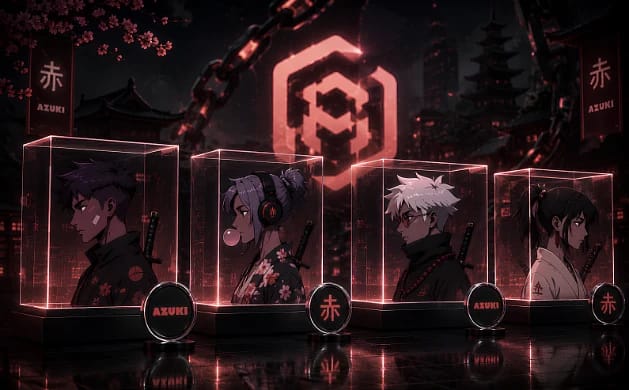
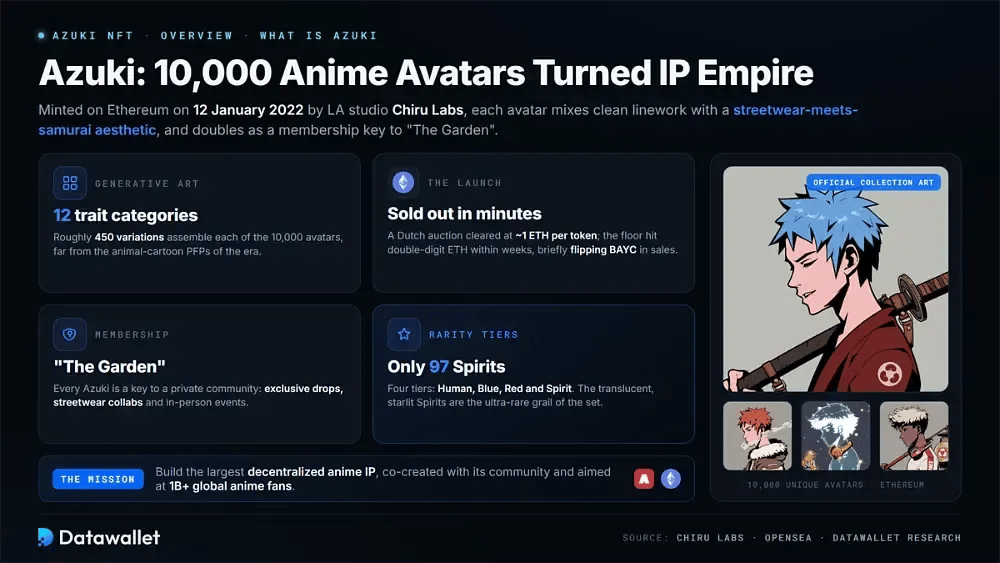
Azuki is a collection of 10,000 generative, anime-styled profile picture NFTs minted on Ethereum on 12 January 2022 by Los Angeles studio Chiru Labs. Each avatar is assembled from twelve trait categories spanning roughly 450 variations, blending clean linework with a streetwear-meets-samurai aesthetic that set it apart from the animal-cartoon PFPs of the era.
The launch was explosive. Chiru Labs sold the collection through a Dutch auction that cleared in minutes at around one ETH per token, and the secondary floor climbed into double-digit ETH within weeks. That momentum briefly pushed Azuki past Bored Ape Yacht Club as the highest-selling NFT project.
Beyond the art, every Azuki functions as a membership key to "The Garden," a private community where holders access exclusive drops, streetwear collaborations, and in-person events. Rarity spans four tiers, Human, Blue, Red, and Spirit, with only 97 ultra-rare Spirit avatars in existence.
The stated mission was always larger than a picture collection: Chiru Labs set out to build the largest decentralized anime intellectual property, co-created with its community. That vision now drives an ecosystem of companion collections, a fungible token, a purpose-built blockchain, and a consumer platform aimed at over a billion global anime fans.
The Azuki Ecosystem Collections
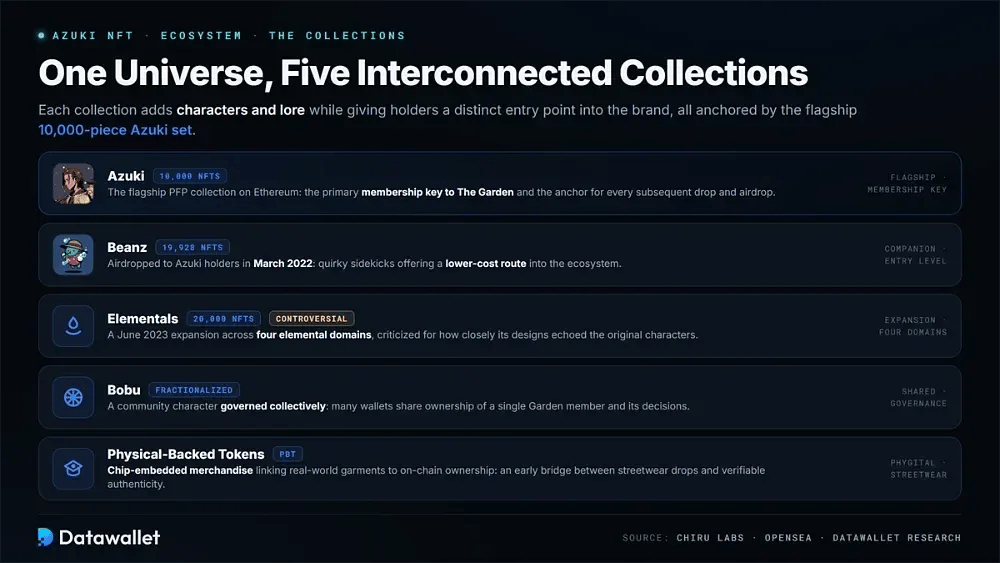
Azuki's universe extends across several interconnected NFT collections, each adding characters and lore while giving holders distinct entry points into the brand. The main collections are:
- Azuki: The flagship 10,000-piece PFP collection on Ethereum, serving as the primary membership key to The Garden and the anchor for every subsequent drop and airdrop.
- Beanz: A companion set of 19,928 NFTs airdropped to Azuki holders in March 2022, acting as quirky sidekicks and offering a lower-cost route into the ecosystem.
- Elementals: A 20,000-piece expansion launched in June 2023 across four elemental domains, controversial for how closely its designs echoed the original Azuki characters.
- Bobu: A fractionalized community character governed collectively by holders, letting many wallets share ownership of a single Garden member and its decisions.
- Physical-backed tokens: Chip-embedded merchandise linking real-world garments to on-chain ownership, an early experiment in bridging streetwear drops with verifiable authenticity.
What is AnimeChain?
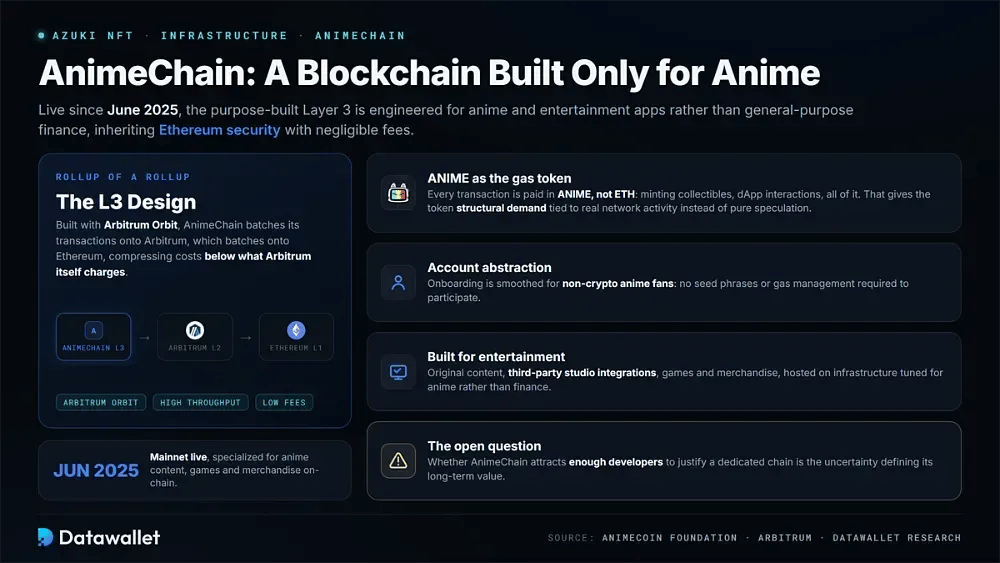
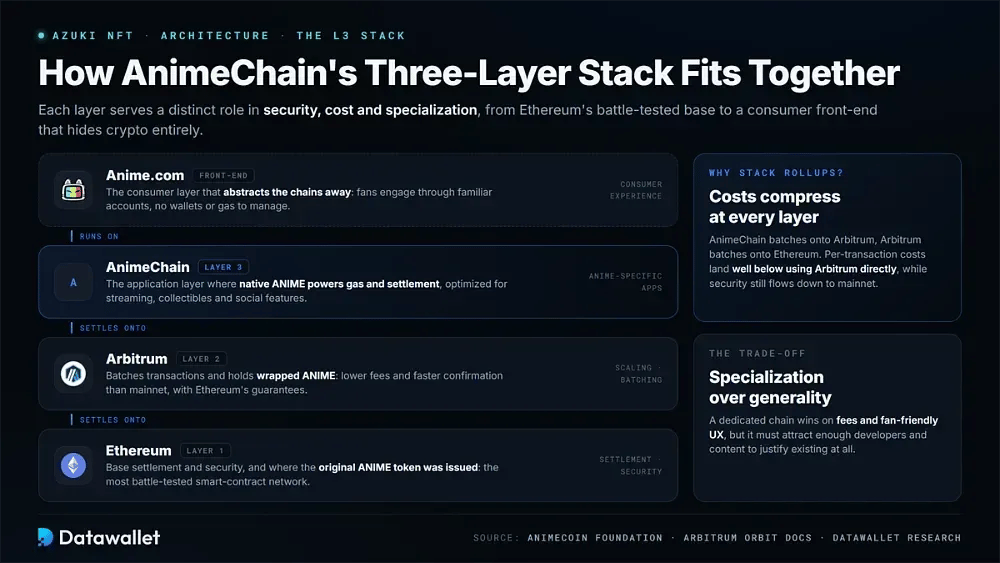
AnimeChain is a purpose-built Layer 3 blockchain that went live in June 2025, engineered specifically for anime and entertainment applications rather than general-purpose finance. It settles onto Arbitrum, which in turn settles onto Ethereum, inheriting mainnet security while specializing in high throughput and negligible fees.
The chain is built using Arbitrum Orbit, the framework for deploying custom L3 rollups. This "rollup-of-a-rollup" design batches AnimeChain transactions onto Arbitrum, which batches onto Ethereum, compressing per-transaction costs well below what using Arbitrum directly would charge.
What distinguishes AnimeChain is its use of ANIME as the native gas token rather than ETH. Every transaction, from minting collectibles to interacting with anime dApps, is paid in ANIME, giving the token structural demand tied to real network activity instead of pure speculation. Account abstraction further smooths onboarding for non-crypto anime fans.
The broader thesis is that anime is a durable, globally relevant culture, and that purpose-built infrastructure can host original content, third-party studio integrations, games, and merchandise on-chain. Whether AnimeChain attracts enough developers to justify a dedicated chain remains the open question defining its long-term value.
How AnimeChain's Layer 3 Architecture Works
AnimeChain sits at the top of a three-layer stack, with each layer serving a distinct role in security, cost, and specialization. Here is how the pieces fit together:
- Ethereum L1: The base settlement and security layer where the original ANIME token was issued, anchoring the entire stack to the most battle-tested smart-contract network.
- Arbitrum L2: The Layer 2 scaling layer that batches transactions and holds wrapped ANIME, offering lower fees and faster confirmation than mainnet while inheriting Ethereum's guarantees.
- AnimeChain L3: The application layer where native ANIME powers gas and settlement, optimized for anime-specific use cases like streaming, collectibles, and social features.
- Anime.com: The consumer front-end that abstracts the underlying chains away, letting fans engage through familiar accounts without directly managing crypto wallets or gas.
ANIME Tokenomics
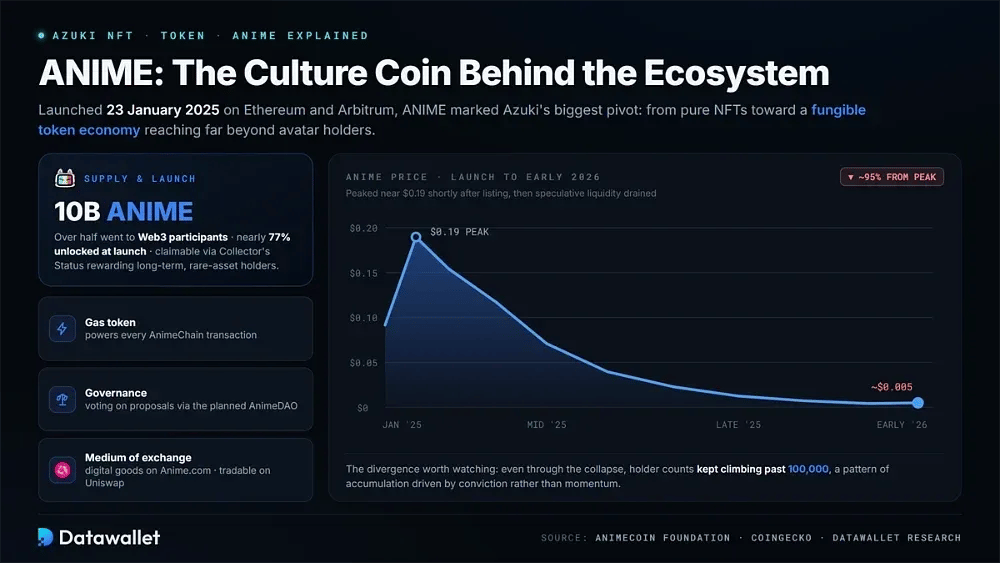
The Animecoin Foundation launched ANIME on 23 January 2025 as an ERC-20 "culture coin" on both Ethereum and Arbitrum, marking Azuki's biggest pivot from pure NFTs toward a fungible token economy that could reach a far wider holder base than avatars alone.
The distribution leaned heavily toward the community. Of the 10 billion total supply, more than half was allocated to Web3 participants, with 37.5% reserved for the Azuki, Elementals, and Beanz communities, claimable through a Collector's Status system rewarding long-term and rare-asset holders. Nearly 77% of supply unlocked at launch.
Utility centers on three roles. ANIME functions as the gas token for AnimeChain, as a governance asset letting holders vote on ecosystem proposals through the planned AnimeDAO, and as a medium of exchange on Anime.com for digital goods, content, and collectibles, tradable on venues like Uniswap. This ties token demand directly to platform usage.
Price performance has been brutal for early buyers. ANIME peaked near $0.19 shortly after listing, then collapsed as speculative liquidity drained, and by early 2026 it traded around $0.005, down roughly 95% from its high. Notably, holder counts kept climbing past 100,000 even through that decline, a divergence worth watching.
ANIME Token Allocation Breakdown
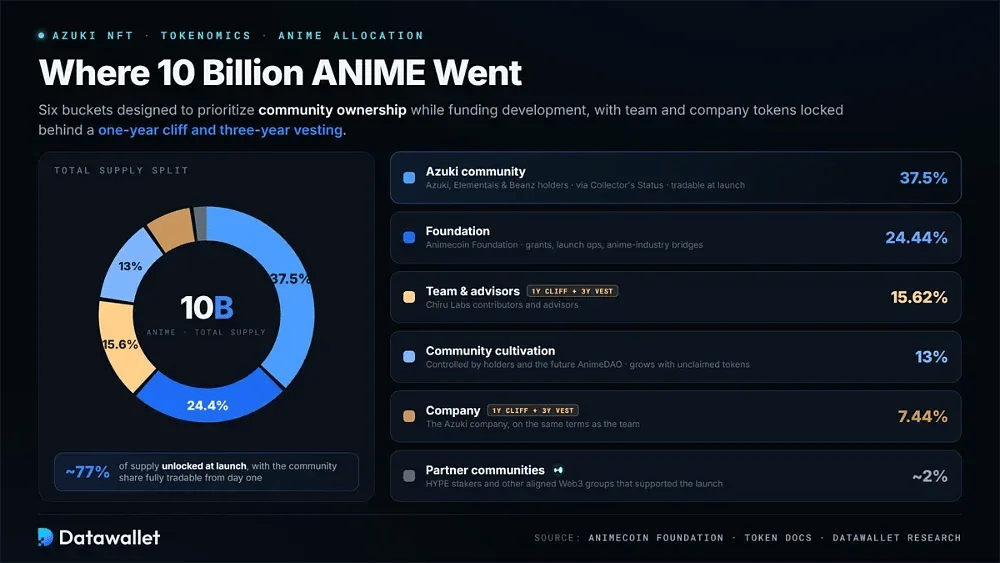
The 10 billion ANIME supply was split across six buckets designed to prioritize community ownership while funding development and rewarding contributors. The allocation breaks down as follows:
- Azuki community: 37.5% reserved for holders of Azuki, Elementals, and Beanz, distributed via Collector's Status and fully tradable from launch day.
- Foundation: 24.44% allocated to the Animecoin Foundation for grants, launch operations, and initiatives bridging the token with the wider anime industry.
- Team and advisors: 15.62% set aside for Chiru Labs contributors and advisors, subject to a one-year cliff followed by three-year linear vesting.
- Community cultivation: 13% controlled by ANIME holders and the future AnimeDAO to fund community-led initiatives, growing further from any unclaimed tokens.
- Company: 7.44% reserved for the Azuki company under the same one-year cliff and three-year vesting terms applied to the team allocation.
- Partner communities: The remainder distributed to aligned Web3 groups, including HYPE stakers and other collections that supported the launch.
Recent Developments and Ecosystem Growth
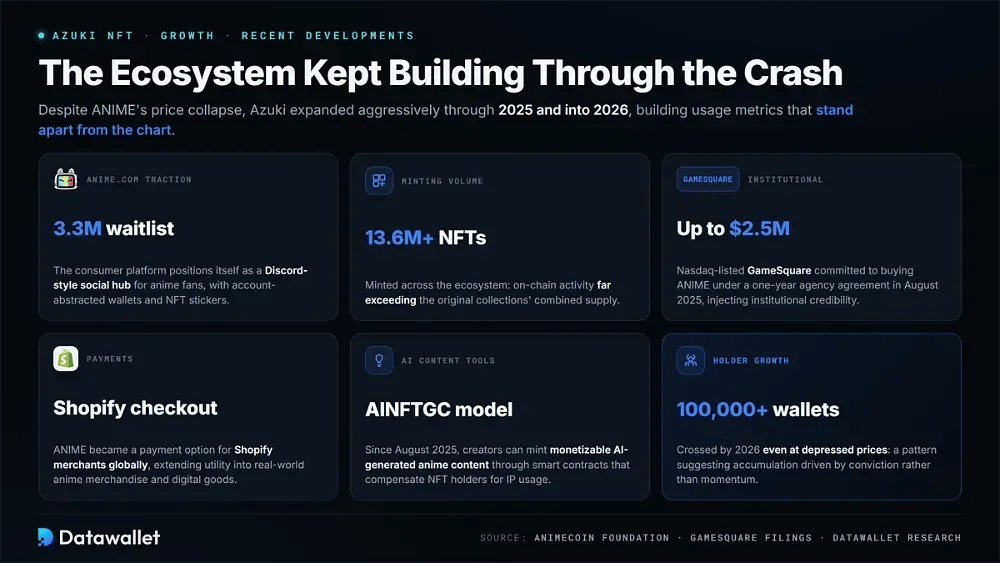
Despite the token's price collapse, the Azuki ecosystem expanded aggressively through 2025 and into 2026, building real usage metrics that stand apart from the chart. These developments reshaped the project's trajectory:
- Anime.com traction: The consumer platform surpassed a 3.3 million-address waitlist, positioning itself as a Discord-style social hub for anime fans with account-abstracted wallets and NFT stickers.
- NFT minting volume: Over 13.6 million NFTs were minted across the ecosystem, demonstrating on-chain activity far exceeding the original collections' combined supply.
- GameSquare partnership: In August 2025, Nasdaq-listed GameSquare committed to buying up to $2.5 million in ANIME under a one-year agency agreement, injecting institutional credibility into a retail-driven ecosystem.
- Shopify integration: ANIME became a payment option for Shopify merchants globally, extending the token's utility from on-chain activity into real-world anime merchandise and digital goods.
- AI content tools: The AINFTGC model arrived in August 2025, letting creators mint monetizable AI-generated anime content through smart contracts that compensate NFT holders for IP usage.
- Holder growth: ANIME crossed 100,000 wallet holders by 2026 even at depressed prices, a pattern suggesting accumulation driven by conviction rather than momentum.
What Happened with Azuki Elementals?
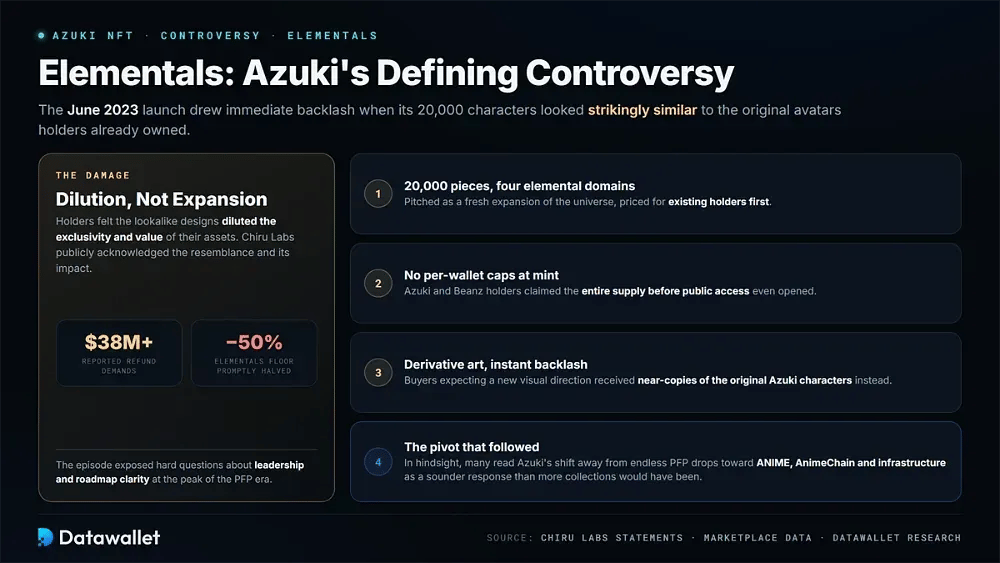
The June 2023 Elementals launch remains Azuki's defining controversy. The 20,000-piece collection drew immediate backlash because its characters looked strikingly similar to the original Azuki avatars, which holders felt diluted the exclusivity and value of the assets they already owned. Chiru Labs publicly acknowledged the resemblance and its impact.
The mint itself compounded the frustration. With no per-wallet caps, existing Azuki and Beanz holders claimed the entire supply before public access opened, and buyers expecting a fresh visual direction received derivative art instead. Refund demands from disgruntled holders reportedly totaled over $38 million, and the Elementals floor promptly halved.
The episode exposed questions about leadership and roadmap clarity. In hindsight, though, many observers read Azuki's subsequent pivot, away from endless PFP drops and toward ANIME, AnimeChain, and infrastructure, as a sounder response than more collections would have been.
Azuki NFT Floor Price in 2026
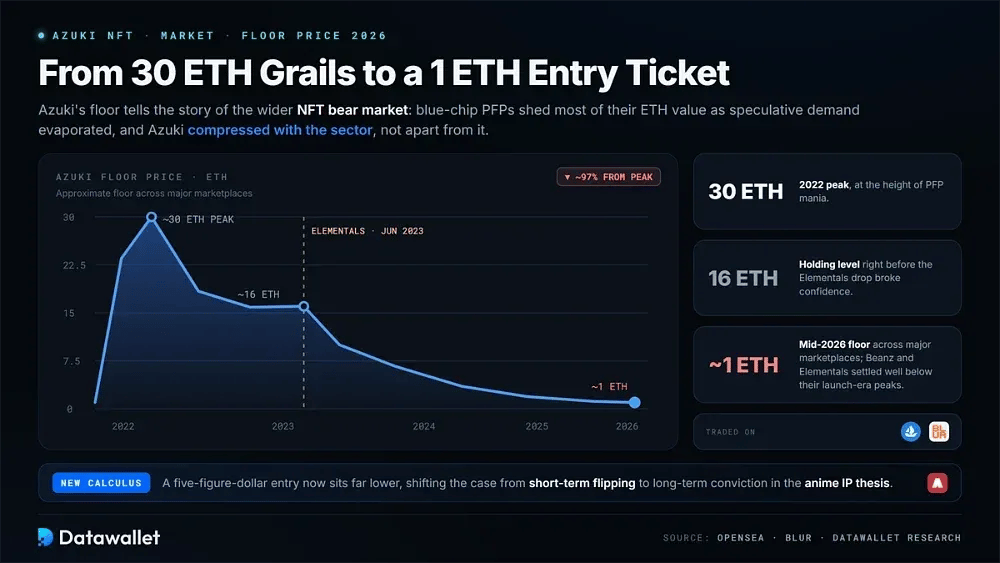
Azuki's floor price tells the story of the broader NFT bear market. After peaking near 30 ETH in 2022 and holding around 16 ETH before the Elementals drop, the floor has since compressed dramatically, trading in the region of 1 ETH across major marketplaces by mid-2026, a fraction of its former highs.
That decline mirrors the wider PFP sector rather than an Azuki-specific collapse. Blue-chip collections across the board shed most of their ETH-denominated value as speculative demand evaporated on NFT marketplaces like Blur, and Azuki's companion collections followed suit, with Elementals and Beanz floors settling well below their launch-era peaks.
For prospective buyers, the reset changes the calculus. What was once a five-figure-dollar entry now sits far lower, shifting the value proposition away from short-term flipping and toward long-term conviction in the anime IP thesis, the ANIME token economy, and whatever utility The Garden delivers next.
Who is the Azuki Founder?
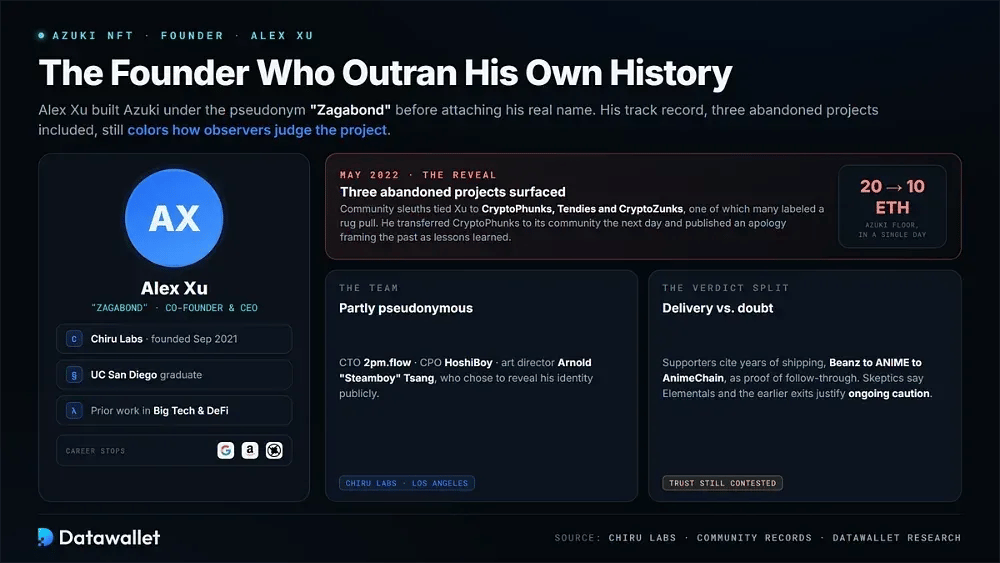
Azuki was founded by Alex Xu, who long operated under the pseudonym Zagabond before publicly attaching his real name to the project. He now serves as co-founder and CEO of Chiru Labs. A UC San Diego graduate, he previously worked at Google, Amazon, and the DeFi protocol 0x before launching Azuki in September 2021.
His track record became a lightning rod within months of launch. In May 2022, community members revealed that Xu had created and then abandoned three earlier NFT projects, CryptoPhunks, Tendies, and CryptoZunks, one of which many labeled a rug pull. Azuki's floor promptly fell from roughly 20 ETH to 10 ETH in a single day.
Xu moved quickly to contain the fallout, transferring CryptoPhunks ownership to its community the next day and publishing an apology framing the past as lessons learned. He was joined at Chiru Labs by a partly pseudonymous team, including CTO 2pm.flow, CPO HoshiBoy, and art director Arnold "Steamboy" Tsang, who chose to reveal his identity publicly.
That history still colors how observers assess the project. Supporters point to years of sustained delivery, from Beanz to ANIME to AnimeChain, as evidence the team followed through, while skeptics argue the Elementals handling and Xu's earlier exits justify ongoing caution given the risks inherent to any NFT investment.
Risks to Consider Before Buying
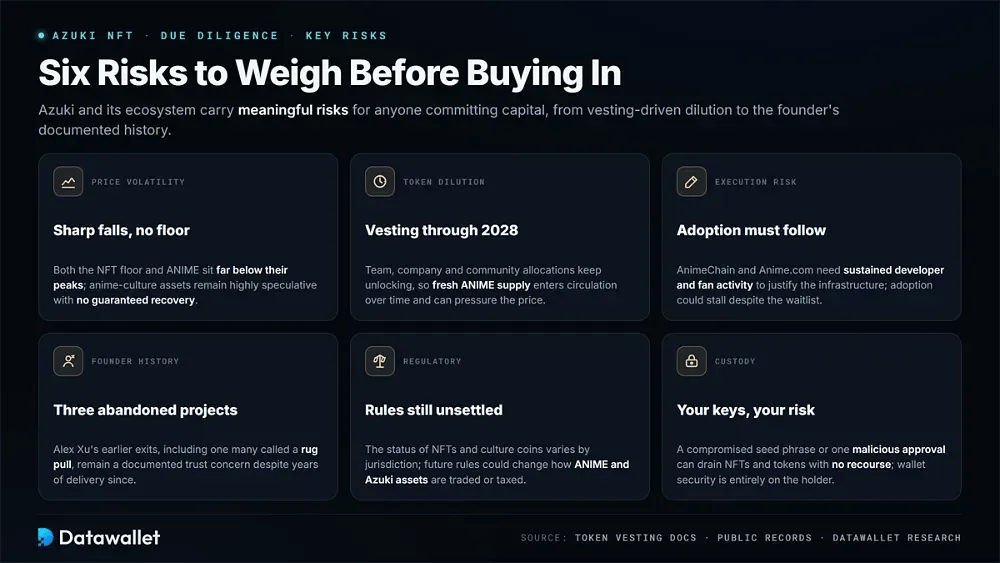
Azuki and its ecosystem carry meaningful risks that any prospective participant should weigh before committing capital. The most important considerations are:
- Price volatility: Both the NFT floor and the ANIME token have fallen sharply from their peaks, and anime-culture assets remain highly speculative with no guaranteed recovery.
- Token dilution: Team, company, and community allocations continue vesting through 2028, meaning fresh ANIME supply enters circulation over time and can pressure the price.
- Execution risk: AnimeChain and Anime.com must attract sustained developer and fan activity to justify their infrastructure, and adoption could stall despite strong early waitlist numbers.
- Founder history: Alex Xu's abandonment of three prior NFT projects, including one many called a rug pull, remains a documented trust concern despite his years of subsequent delivery on Azuki.
- Regulatory uncertainty: The status of NFTs and culture coins remains unsettled across jurisdictions, and future rules could affect how ANIME and Azuki assets are traded or taxed.
- Custody responsibility: Holding NFTs and tokens demands careful wallet security, since a compromised seed phrase or a malicious approval can drain assets with no recourse.
Final Thoughts
Azuki has done something few NFT projects managed: evolved from a 2022 profile-picture drop into a multi-layered anime brand with its own token, blockchain, and consumer platform, built around one of the world's largest fandoms.
The current chapter is defined by contradiction. The ANIME token trades far below its debut and the NFT floor has reset hard, yet holder counts, minting volume, and institutional partnerships all point upward. That divergence between price and adoption is the central tension for anyone evaluating the project today.
For collectors and observers, Azuki is best understood as a long-term bet on anime IP meeting blockchain rather than a quick trade. Treat the floor price as a reflection of the wider NFT cycle, verify every contract and approval before buying, and size any position against the real execution risk that still remains.