



Can I Add Bitcoin to a MetaMask Wallet?
Yes. On December 15, 2025, MetaMask added native Bitcoin support, so BTC now works in the wallet as a first-class asset. For most of MetaMask's history this was impossible, since it was built only for Ethereum and EVM-compatible chains, leaving wrapped tokens like WBTC as the only way to hold Bitcoin value.
The change took a while. Co-founder Dan Finlay signaled Bitcoin integration in February 2025 with a third-quarter target that slipped to December. It capped a year of expansion beyond Ethereum, with Solana added in May, Sei in August, and Monad in November. Each runs on the same multichain account structure, which now derives an EVM, Solana, and Bitcoin address from one account.
At launch the wallet uses the Native SegWit derivation path, with Taproot listed as coming later. BTC sent from MetaMask broadcasts straight to the Bitcoin network and confirms at Bitcoin's usual pace, slower than Ethereum or Solana.
How to Add Bitcoin to MetaMask
Since Bitcoin is native, there is no Snap to install and no network to configure by hand. Updating the wallet does the work:
- Update MetaMask: Install the latest extension or mobile app. Older versions predate Bitcoin support.
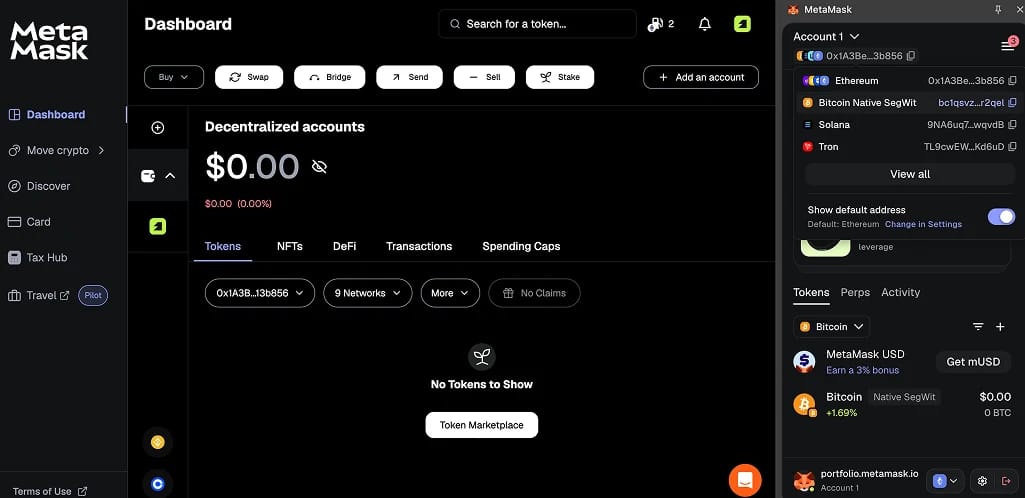
- Find your address: A Bitcoin address is created for each account through multichain accounts. Open the address dropdown under your account name and locate Bitcoin.
- Copy it: Use the copy icon for the address, or the QR icon for the scannable code.
- Fund it: Buy BTC with fiat, swap into it from an EVM or Solana token, or paste your address into an exchange like Coinbase to receive a transfer.
To move an existing balance over, import another wallet with its 12 or 24-word Secret Recovery Phrase via "Add wallet" then "Import a wallet." The imported wallet must use the Native SegWit path, and private-key import is not supported for Bitcoin.
What You Can Do With Bitcoin on MetaMask
With your address live, MetaMask treats BTC like any other supported asset.
- Buy: Tap Buy to purchase BTC with local currency. Options include cards, Apple Pay, PayPal, and bank transfer, and availability changes by region.
- Swap: The built-in Swap feature converts EVM or Solana tokens into BTC, and earns Rewards points on swaps into Bitcoin.
- Send and receive: Copy your address to receive BTC, or send it on the Bitcoin network like any transfer.
Confirmed transactions show in your asset list, and pending ones sit under Activity then Transactions. We would set expectations on timing, since Bitcoin block times mean a transfer can stay pending for a while before settling. That is normal for the network, not a wallet fault.
What MetaMask's Bitcoin Support Does Not Cover
MetaMask handles plain BTC on Bitcoin's base layer. It does not handle the assets built on top of it, including Ordinals, Runes, BRC-20 tokens, rare sats, Stacks and sBTC, or Bitcoin Layer 2s. To collect inscriptions, mint Runes, or use Bitcoin-native DeFi, you still need a purpose-built wallet.
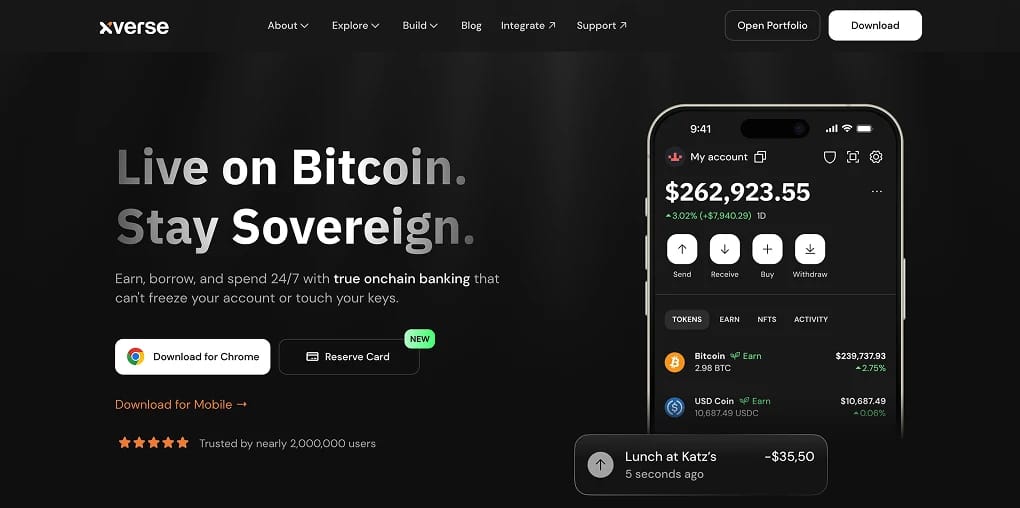
- Xverse: The most complete Bitcoin Web3 wallet for most people. It covers Ordinals, Runes, BRC-20, rare sats, Stacks, and Bitcoin L2s on mobile and browser, picks sats automatically so you do not spend an inscription by mistake, integrates with Ledger, and has been audited by Least Authority.
- Leather: The pick for Bitcoin DeFi. Beyond Ordinals and Runes, it connects to Stacks protocols such as ALEX, Bitflow, Velar, and Zest, and is building native sBTC support.
- Unisat: The power-user option for frequent inscribing and trading, covering Ordinals, BRC-20, Runes, and Alkanes, with unconfirmed inscriptions visible before they settle.
- Ledger: A hardware wallet for cold storage. Many collectors pair a Ledger device with Xverse to view inscriptions while keys stay offline.
For a wider comparison, see our guide to the best crypto wallets.
Using Bitcoin in DeFi With Wrapped BTC
Native BTC in MetaMask lives on Bitcoin's own chain, so it cannot plug into Ethereum DeFi by itself. Lending markets, DEXs, and yield protocols run on ERC-20 tokens, so Bitcoin value reaches them through wrapped versions backed one-to-one by BTC in reserve. You can hold these in MetaMask like any ERC-20.
The wrapped market spans several options. WBTC from BitGo is still the largest at roughly $8 billion in circulation. cbBTC from Coinbase launched in 2024 across Ethereum, Base, and Solana. tBTC from Threshold uses a decentralized signer model rather than one custodian, and Circle announced cirBTC in May 2026. Each carries the trust profile of whoever holds the underlying BTC, adding custodial and smart-contract risk that native Bitcoin avoids. We treat wrapped BTC as a tool for using Bitcoin inside DeFi applications, not a default way to hold it.
About Bitcoin
Bitcoin is the first cryptocurrency, launched in 2009 by the pseudonymous Satoshi Nakamoto. It runs on a proof-of-work blockchain secured by miners worldwide and has a fixed supply capped at 21 million coins. It is the largest digital asset by market capitalization and the settlement layer for a growing set of tokens, collectibles, and DeFi protocols built on its base layer.
Bottom Line
Adding Bitcoin to MetaMask no longer means working around the wallet, because BTC is a native asset you can buy, swap, send, and receive after a quick update. For straightforward holding and trading, it covers the job.
If your interest runs to Ordinals, Runes, or Bitcoin DeFi, a dedicated wallet like Xverse, Leather, or Unisat serves you better. For Bitcoin exposure inside Ethereum DeFi, a wrapped token such as WBTC gets you there.