



Can You Add Litecoin to MetaMask?
No, at least without workarounds. MetaMask manages accounts on Ethereum and EVM chains, which share one execution model and one 0x address format. Litecoin predates all of that. It launched in 2011 as a Bitcoin-style payments chain, records ownership as unspent transaction outputs rather than account balances, and secures its ledger through Scrypt proof of work mining.
The custom network screen only accepts Ethereum-style endpoints, and Litecoin exposes no Chain ID or RPC interface for MetaMask to read. Its addresses also look nothing like Ethereum's, starting with ltc1, L, or M instead of 0x, so the wallet cannot even display an LTC balance.
The gap is now a product decision rather than a technical wall. MetaMask shipped native Bitcoin support in December 2025, proving the codebase can handle a UTXO proof of work chain when the team chooses to build for one. Litecoin shares most of that architecture and still sits outside the lineup.
How to Set Up Trust Wallet for Litecoin
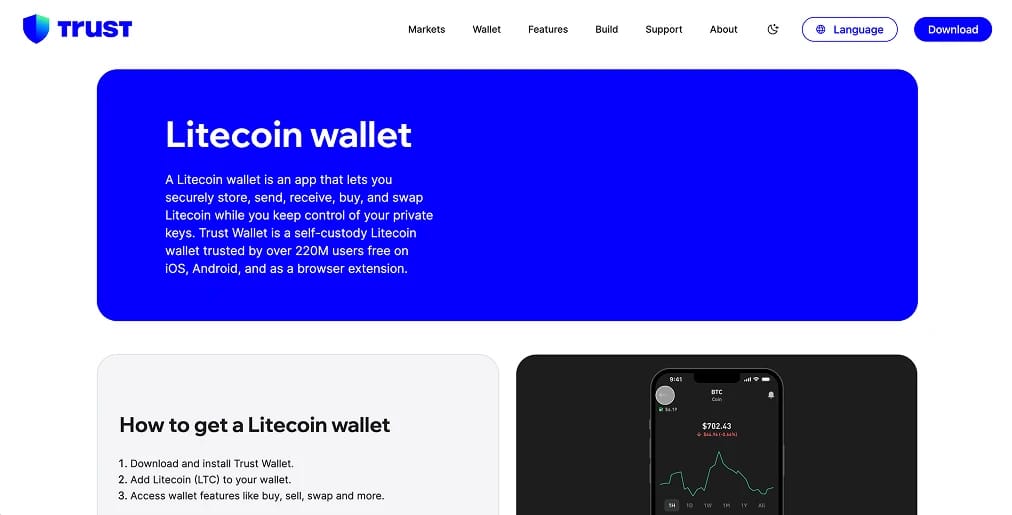
Trust Wallet is the closest match to MetaMask's experience for anyone holding LTC. It supports the Litecoin blockchain natively alongside dozens of other networks, runs on mobile and as a browser extension, and keeps keys on your device. Setup takes a few minutes:
- Download the app: Install Trust Wallet from the official site or your device's app store, never from a link sent in a message.
- Create a wallet: Set a strong passcode and write the recovery phrase on paper, keeping it away from screenshots and cloud storage.
- Receive LTC: Search for Litecoin in the asset list, copy your address, and withdraw from an exchange after confirming the Litecoin network is selected.
- Send and manage: Use the same asset screen to transfer LTC out, checking the first and last characters of every destination address before signing.
Start with a small test transfer when moving a meaningful balance. Litecoin transactions confirm in roughly 2.5 minutes, so the check costs little time.
Best Litecoin Wallet Alternatives
Trust Wallet suits multi-chain portfolios, but Litecoin has a deep bench of purpose-built options. These cover privacy, self-verification, and cold storage:
- Nexus Wallet: The Litecoin Foundation's current official app, built around one-tap MWEB so confidential transfers work like ordinary ones without extra configuration.
- Litewallet: The Foundation's earlier mobile wallet, retired at the end of 2025, so existing users should move their balance across to Nexus rather than keep relying on it.
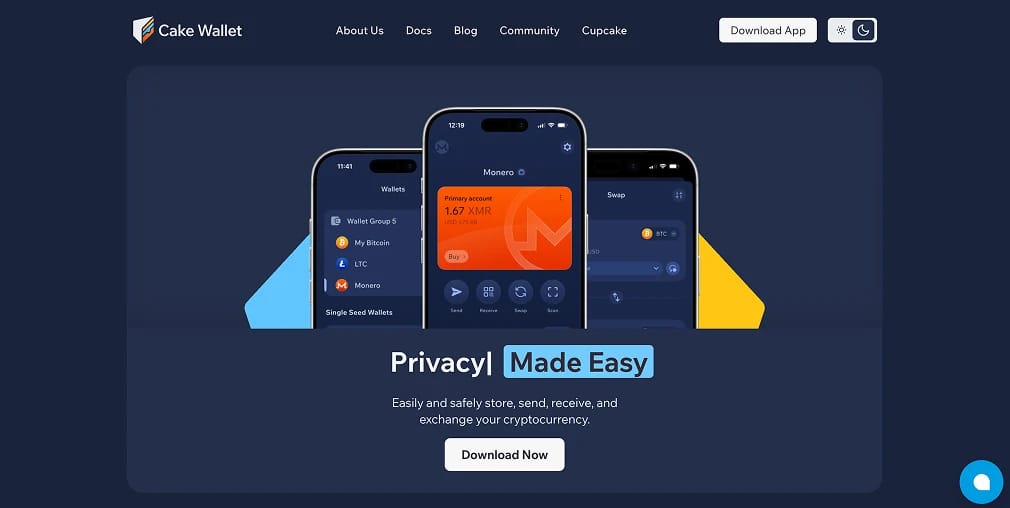
- Cake Wallet: A privacy-first mobile option pairing MWEB with Tor connectivity, popular with users who also hold Monero in the same app.
- Electrum-LTC: A desktop tool for power users, offering coin control, custom fees, multisig, and pairing with hardware devices.
- Litecoin Core: The reference full node client for anyone who wants to verify the chain independently rather than trust a third-party server.
- Ledger and Trezor: Hardware signing through Ledger or Trezor for larger balances, though MWEB support on hardware devices remains limited compared to software wallets.
A sensible split keeps long-term holdings on hardware and everyday amounts in a mobile wallet. Our best crypto wallets guide compares custody models across the wider market.
Holding Litecoin Exposure Inside MetaMask
Two workarounds put LTC exposure inside the MetaMask interface today, and each carries a real trade-off worth understanding before you commit funds:
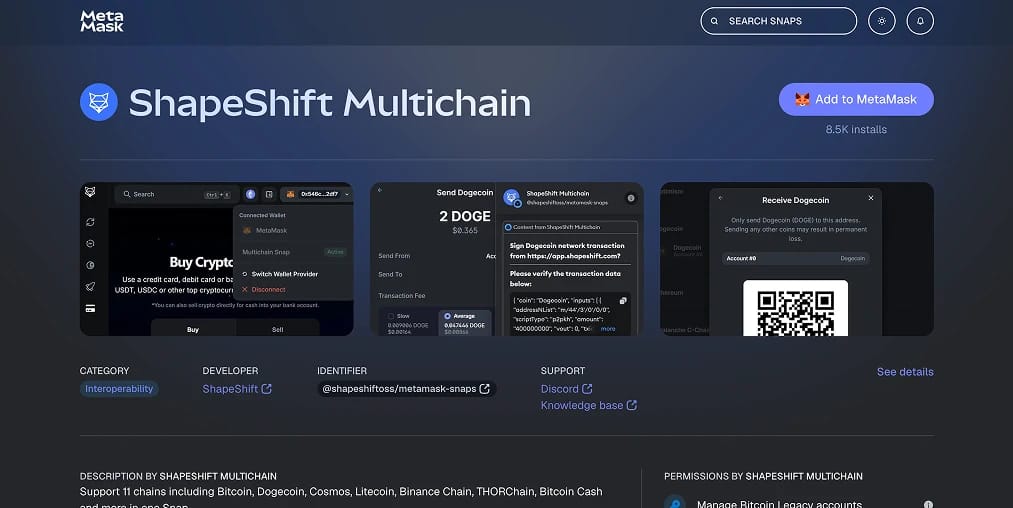
- ShapeShift Multichain Snap: Listed in the official Snaps directory, this extension covers native Litecoin among eleven chains. Transactions run through the ShapeShift web app rather than MetaMask's own screens, and Snaps stay extension-only rather than mobile.
- Binance-Peg Litecoin: A BEP-20 token on BNB Chain backed one to one by LTC held in Binance reserves. Import contract 0x4338665CBB7B2485A8855A139b75D5e34AB0DB94 after switching MetaMask to BNB Chain, and the token tracks LTC's price inside your normal wallet view.
Neither substitute equals native LTC. The wrapped token is a claim on Binance's reserves rather than coins you control on the Litecoin blockchain, its trading depth on decentralised exchanges is thin, and sending it to a native Litecoin address destroys the funds.
Snaps that manage keys pass a third-party audit before allowlisting, but every added permission still widens your attack surface. Our best crypto bridges guide covers how wrapped assets and their custody models differ.
Will MetaMask Ever Support Litecoin?
The question has shifted from whether MetaMask can support Litecoin to whether it will, and two developments frame the answer.
Reading the Multichain Expansion
MetaMask spent 2025 dismantling its Ethereum-only design. Native Solana support arrived in May, multichain accounts followed in October, and the Bitcoin launch in December rounded out the year, starting with SegWit addresses and Taproot planned next. Monad and Sei joined the lineup around the same window, and the team has said further networks follow this year.
Litecoin has not been named among them. Its wallet ecosystem is mature, its base chain runs no smart contracts for dApps to call, and MetaMask prioritises networks where users transact against applications. Until that calculus changes, native support looks possible in principle and unannounced in practice.
LitVM Changes the Question
LitVM is a zero knowledge rollup for Litecoin, built with Polygon CDK and BitcoinOS technology and unveiled at the Litecoin Summit with the Litecoin Foundation's endorsement. Its LiteForge testnet went live in the first quarter of this year and recorded millions of test transactions within days, letting developers deploy Solidity contracts against Litecoin for the first time.
Because the rollup is EVM compatible, MetaMask connects to it like any other network once mainnet launches, which the team expects in the second half of 2026. Fees are paid in LTC bridged onto the layer, so MetaMask users would hold and spend Litecoin value without the base chain changing at all. That path looks far likelier than a native integration.
Where Litecoin Stands Today
Litecoin was created by Charlie Lee in 2011 as a lighter counterpart to Bitcoin, and the design has barely moved since. Blocks arrive every 2.5 minutes, supply caps at 84 million coins, and the chain has run without downtime for its whole life, earning the durable "digital silver" label.
Common Litecoin Wallet Mistakes
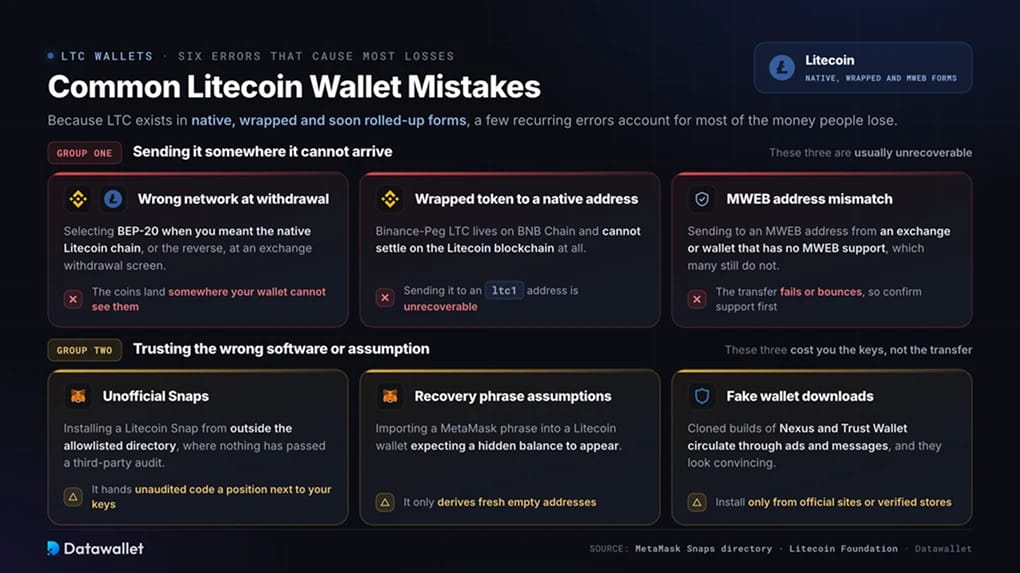
Because LTC exists in native, wrapped, and soon rolled-up forms, a few recurring errors cause most losses. Check these before moving anything:
- Wrong network withdrawals: Selecting BEP-20 at an exchange when you meant the native Litecoin chain, or the reverse, sends funds somewhere your wallet cannot see them.
- Wrapped tokens to native addresses: Binance-Peg LTC lives on BNB Chain and cannot settle on Litecoin, so transfers to an ltc1 address are unrecoverable.
- Unofficial Snaps: Installing a Litecoin Snap from outside the allowlisted directory hands unaudited code a position next to your keys.
- Recovery phrase assumptions: Importing a MetaMask phrase into a Litecoin wallet derives fresh empty addresses rather than revealing any existing balance.
- MWEB mismatches: Sending to an MWEB address from an exchange or wallet without MWEB support will fail or bounce, so confirm compatibility first.
- Fake wallet downloads: Cloned versions of Litewallet and Trust Wallet circulate through ads and messages, so install only from official sites or verified stores.
Final Thoughts
Native Litecoin remains outside MetaMask, and nothing MetaMask has announced suggests that changes soon. A dedicated wallet is still the right tool, whether that means Trust Wallet for a mixed portfolio, Litewallet or Nexus for MWEB privacy, or hardware for a balance you plan to keep.
The more interesting story is LitVM. If the rollup's mainnet ships as expected, MetaMask becomes a working Litecoin interface through the side door, connecting to an EVM layer that settles against the chain Charlie Lee launched fifteen years ago. Watch that launch rather than MetaMask's roadmap.