






Who is Balaji Srinivasan?
Balaji Srinivasan is an American entrepreneur, scientist, and investor who has spent the last decade moving between biotech, crypto, venture capital, and his own brand of political theory. He co-founded a genomics company, served as Coinbase's first chief technology officer, made partner at a16z, then left operating roles to build a "startup society" on an island near Singapore.
He works more as an idea machine than an operator. Marc Andreessen once called him the person with more good ideas per minute than anyone in the Bay Area, and credited him with pushing a16z into both biotech and crypto. Much of that output reaches readers directly through his Substack, where he posts long essays and first published the Network School manifesto.
What stands out to us is the gap between his reach and his ledger. Srinivasan shaped how billions in venture capital got deployed and how a generation of founders think about exit and sovereignty, yet his own money sits in scattered startup stakes and crypto rather than one headline company. His ideas travel further than his net worth does.
Balaji Srinivasan's Background
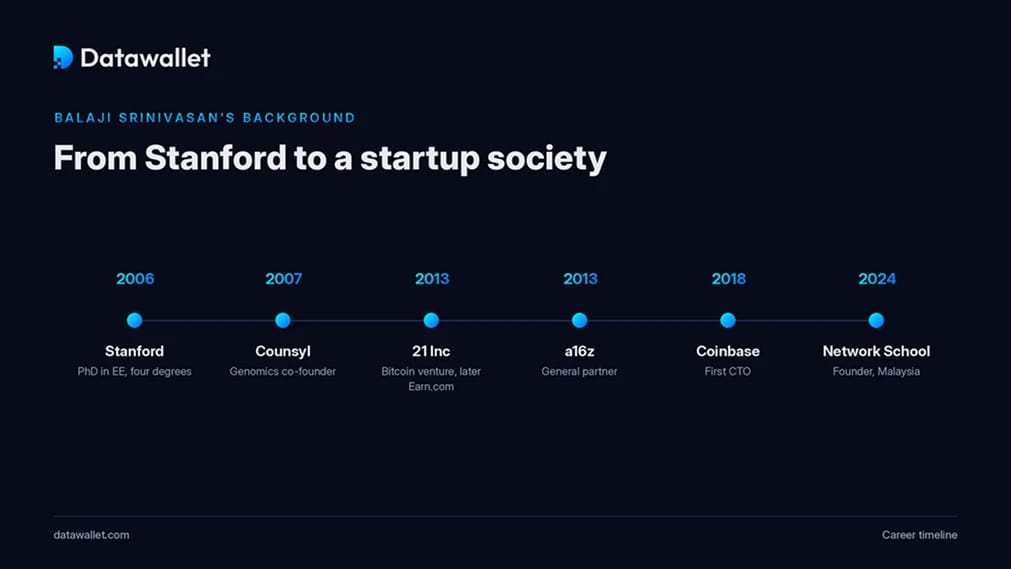
Srinivasan's path runs from a physician's household on Long Island through four Stanford degrees, a genomics startup, a Bitcoin venture that became Earn.com, a stint running technology at Coinbase, and the firm where he made his name as a talent spotter.
Early Life and Education
Balaji S. Srinivasan was born on May 24, 1980, in Plainview, Long Island, the son of physician parents who immigrated from Tamil Nadu, India. He grew up around medicine and science and carried that into an unusually long run at one university.
He earned four degrees from Stanford University: a BS, MS, and PhD in electrical engineering, plus an MS in chemical engineering, completing his doctorate in 2006. He then taught statistics and bioinformatics there and built an online course, Startup Engineering, that drew more than 250,000 students, an early signal of his instinct for reaching large audiences directly.
Counsyl and the Genomics Exit
In 2007, he co-founded Counsyl, a genetic testing company that screened prospective parents for more than a hundred inherited diseases. The work tied to his research in diagnostics and population genetics earned early recognition, including MIT Technology Review's Innovators Under 35 list in 2013.
Counsyl was acquired by Myriad Genetics for $375 million in 2018. That price was split among co-founders, employees, and venture backers who had funded the company for a decade, so Srinivasan's share was a fraction of the total.
21 Inc, Earn.com, and Coinbase
In 2013, he co-founded a Bitcoin venture that began as 21e6, became 21 Inc, and raised more than $116 million to build mining hardware. It later pivoted into Earn.com, a service that paid users in cryptocurrency to reply to emails and complete tasks.
In April 2018, Coinbase acquired Earn.com for a reported $120 million and made Srinivasan its first chief technology officer. Over the next year, he oversaw new asset listings, including Zcash and stablecoins, and took Coinbase equity that mattered when the company went public in 2021. He left in 2019.
Andreessen Horowitz and Angel Investing
Srinivasan joined Andreessen Horowitz as a general partner in December 2013, backing companies such as OpenGov, Omada Health, and Benchling while steering the firm toward crypto and biology. A general partner earns carried interest on a fund's gains, another building block of his wealth alongside the startup exits.
He has invested privately since the early 2010s, co-founded the job-search startup Teleport (acquired by Topia in 2017), and co-founded the crypto policy nonprofit Coin Center, where he remains a board member. The angel portfolio he built over these years is now the largest and least visible part of his finances.
Balaji Srinivasan's Net Worth in 2026
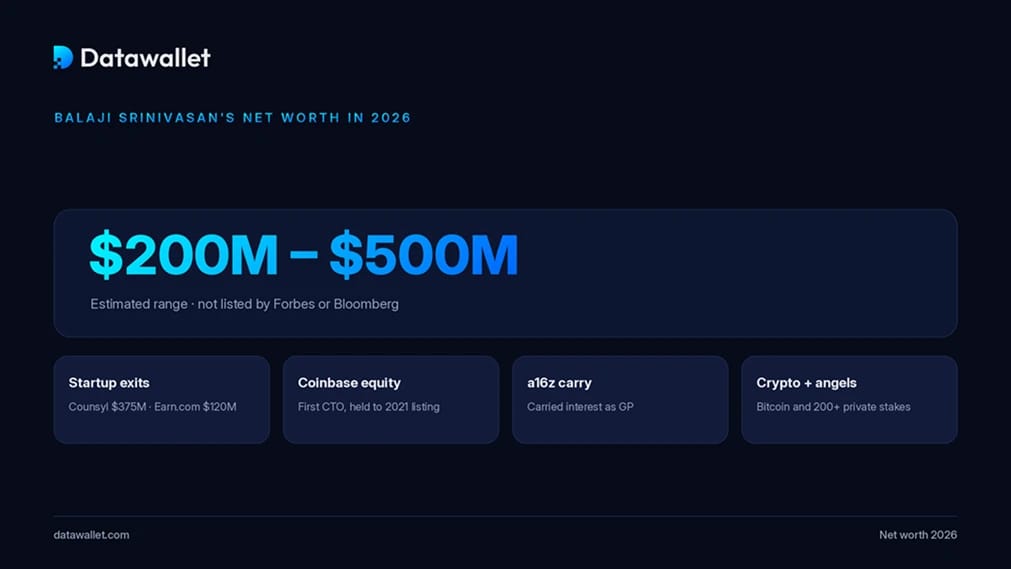
Balaji Srinivasan's net worth in 2026 is typically estimated between $200 million and $500 million, a wide range that reflects how little hard data exists. He is not tracked by Forbes or the Bloomberg Billionaires Index and has never published an audited figure, so every number attached to him is an estimate based on known exits and assumptions about his crypto.
The honest read is that no one outside his accountant knows. The figures that circulate come mostly from crypto media and SEO pages rather than a primary financial source, and they vary by hundreds of millions because the inputs are private.
The main components of his wealth are:
- Startup exits: His share of the 2018 Counsyl sale to Myriad ($375 million) and the Earn.com sale to Coinbase ($120 million), both diluted by years of venture funding and multiple stakeholders.
- Coinbase equity: Stock and options earned as the company's first CTO, which gained value through Coinbase's April 2021 listing.
- a16z carry: Carried interest from his years as a general partner backing biotech and crypto deals.
- Crypto holdings: Bitcoin and other tokens accumulated since the early 2010s, the value of which swings with the market.
- The angel book: Stakes across more than 200 private companies, including several unicorns, almost none of which trade at a public price.
The imprecision is the point. Most of what he owns cannot be marked to a live quote; his crypto moves daily, and his startup stakes are valued off old funding rounds. A figure that looked precise would be the least trustworthy part of any profile.
Balaji Srinivasan's Investment Portfolio
Srinivasan's capital now flows mainly through angel checks and the Balaji Fund, a rolling venture fund he launched on AngelList in December 2023, backed by Coinbase CEO Brian Armstrong, AngelList co-founder Naval Ravikant, and venture capitalist Fred Wilson.
He commits at least 1% of each quarterly fund himself, investing alongside his limited partners rather than purely on their money. The book spans crypto, AI, biotech, and frontier hardware. Public trackers like Pitchbook and Dealroom list more than 200 investments, with named positions including:
- Crypto protocols: Early exposure to Bitcoin, Ethereum, Solana, Avalanche, NEAR, Chainlink, Celestia, and StarkWare, with Avalanche, NEAR, and Celestia reaching unicorn status.
- Crypto companies: Stakes in OpenSea, Polymarket, CoinTracker, Alchemy, Paradigm, Polychain, and Zora.
- AI and software: Bets on Perplexity, Replit, Superhuman, Luma, and DigitalOcean.
- Frontier and biotech: Positions in Varda, Benchling, Omada Health, and the for-profit city project Prospera.
His 2025 and 2026 activity kept the same shape, with seed checks into Bitcoin data infrastructure, zero-knowledge identity, and AI tooling, including a 2026 investment in the Thiel-backed startup Objection.ai. The pattern is early, contrarian bets on technologies he expects to define the next decade, held privately and for the long term.
What is the Network State?
Srinivasan's signature project is an idea more than a company. In 2022, he self-published The Network State: How to Start a New Country, which argues that online communities will pool capital, buy territory worldwide, and eventually win diplomatic recognition as digital-first nations.
The book hit number two on the Wall Street Journal's bestselling e-book list and drew endorsements from Vitalik Buterin, Marc Andreessen, and Brian Armstrong.
He turned the theory into a physical pilot in September 2024 with the Network School, a live-in community inside Forest City, a stalled $100 billion megaproject on reclaimed land near Singapore. The first cohort drew more than 4,000 applications from over 80 countries for 128 places, paid roughly $1,000 to $2,000 a month in rent, and followed a "learn, burn, earn" routine pairing guest lectures with a Bryan Johnson fitness protocol and paid on-chain work.
By 2025, the school had moved to a year-long program for a few hundred members, hosted events with Ethereum, Solana, Coinbase, and Anthropic's Claude, and had started planning a permanent campus, with additional sites floated for Miami, Dubai, and Tokyo.
The reception splits sharply. Supporters see a serious attempt to test new forms of governance, while critics across the political left call the network state elitist, neo-colonialist, and a libertarian fantasy. It is the project most likely to define his public legacy.
.webp)
How Much Bitcoin Does Balaji Own?
Srinivasan's exact crypto holdings are not public, but his exposure is clearly large and long-standing. Forbes noted in 2023 that he owns "a considerable amount of Bitcoin," and he has backed Bitcoin, Ethereum, Solana, and other protocols since before they reached the mainstream. He funded the Network School partly through crypto and frames Bitcoin as a hedge against fragile fiat systems.
His most famous crypto moment was a bet, not a holding. On March 17, 2023, days after Silicon Valley Bank collapsed, he wagered with economist James Medlock that one Bitcoin would reach $1 million within 90 days, staking $1 million against it. He framed the bet as a warning about banking-system risk rather than a literal forecast.
Bitcoin did not move, ending the window roughly flat. Srinivasan conceded early and paid out about $1.5 million in total, including $500,000 to Bitcoin Core developers. Critics called it a marketing stunt, and the episode showed both his willingness to back a thesis with money and the cost of doing so on a deadline.
Unlike founders who publish a full portfolio breakdown, Srinivasan has never disclosed his wallet allocations. What is documented is the direction of his conviction, held for more than a decade, rather than a precise coin count.
Final Thoughts
Balaji Srinivasan's net worth resists a clean figure for reasons that set him apart from most founders we profile. He has no single dominant company, no public wealth tracker, and a fortune spread across diluted startup exits, Coinbase equity, undisclosed crypto, and a sprawling private portfolio. The $200 million to $500 million range is a reasonable guess, not a measured number.
The 2026 picture is one of influence outpacing accounting. His ideas now drive a global movement of startup societies, his school has become a fixture for crypto founders, and early bets on Avalanche, NEAR, and Celestia have matured into unicorns.
What we would watch from here is whether the Network State hardens into durable institutions or stays a well-funded experiment, because that, more than any single token, will decide how his fortune and reputation settle.
.webp)