





Compare Top Crypto Exchanges in Algeria
1. Bybit
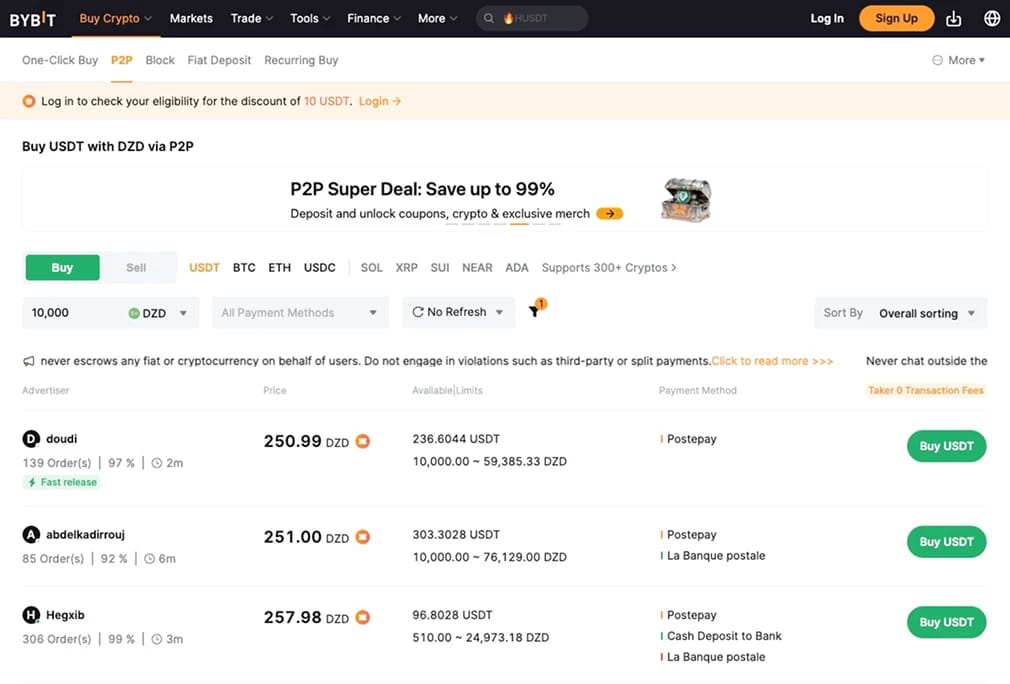
Bybit is the best overall exchange for Algerian investors because it processes DZD deposits via its P2P marketplace and offers a Shariah-compliant Islamic Account. Algeria appears on Bybit's own list of supported regions, and its DZD peer-to-peer desk has sufficient merchant depth to fill ordinary-sized orders during normal hours, with BaridiMob and CCP accepted.
The exchange itself is substantial. You get 2,800+ assets across spot, futures, and options, a copy-trading product, grid bots, and Bybit Earn for staking and savings. Spot fees sit at 0.1%, and the platform runs monthly Proof-of-Reserves and enforces full identity verification on every account, which removed the old no-KYC tier. We walk through the platform in our Bybit review.
For an Algerian user, Bybit's appeal lies in the combination of a credible global exchange with an active P2P route and cleaner verification, which raises the trust floor. The constraints are the same as everywhere here: no banking integration, no local license, and a legal regime that treats the activity as criminal. The cleaner product experience does not reduce that exposure.
Pros
- Openly lists Algeria as a served region, with a working DZD P2P desk.
- 2,800+ assets, copy trading, and Bybit Earn, with monthly Proof-of-Reserves.
- Provides shariah-compliant trading through its Islamic Account that adheres to Shariah principles.
Cons
- DZD merchant depth is thinner than Binance's, so larger orders may require time to be filled.
- No fiat banking rail; every deposit runs through a P2P counterparty.
- The activity remains illegal in Algeria, with the legal risk on the user.
2. Binance
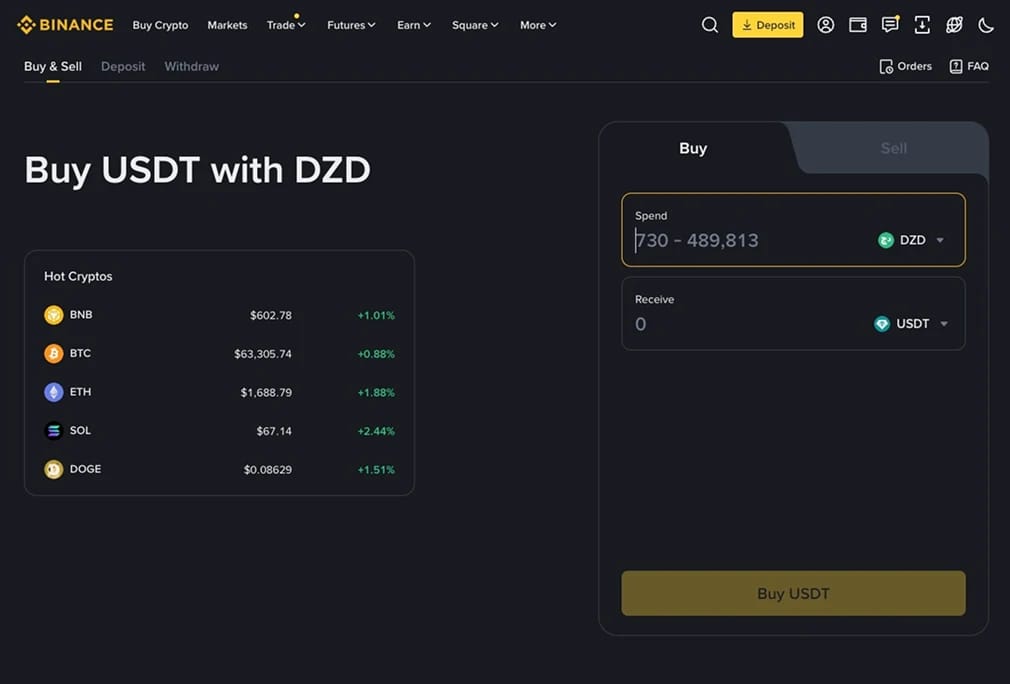
Binance is where most Algerians who use crypto end up, and the reason is liquidity rather than marketing. Its DZD peer-to-peer book carries more active merchants than any rival here, which matters because a thin order book means your dinar buy sits unfilled or you accept a worse rate. When we checked the DZD market, sell-side and buy-side ads ran into the hundreds.
Beyond funding, it is the most complete exchange on the list, listing 500+ assets across spot, futures, and Earn, with Launchpool and staking for anyone who wants yield. Spot fees are a flat 0.1%, falling further if you pay in BNB, and the platform publishes regular Proof-of-Reserves attestations. Our Binance review covers the fee tiers and product range in detail.
The caution is specific to Algeria. Binance holds no local license, settlement runs entirely through P2P merchants rather than any banking rail, and the legal status of the activity does not change because the platform is large. Treat every merchant as a counterparty to vet, use escrow on every trade, and keep the records that a bank might one day ask for.
Pros
- The deepest DZD peer-to-peer liquidity of any platform reachable from Algeria.
- 500+ assets across spot, futures, and Earn, with monthly Proof-of-Reserves.
- Flat 0.1% spot fees, reduced further with BNB.
Cons
- No local license, and funding depends entirely on P2P merchants.
- Crypto activity is illegal under Algerian law regardless of platform size.
- Banks may flag or freeze transfers they connect to crypto.
3. Gate
Gate earns its place on the list through sheer asset depth. With 4,800+ listings, it carries early and small-cap tokens that never reach the bigger apps, alongside the majors, so anyone hunting beyond the top fifty coins has more to work with here than almost anywhere. It reports tens of millions of users and publishes Proof-of-Reserves, which lifts its standing on transparency.
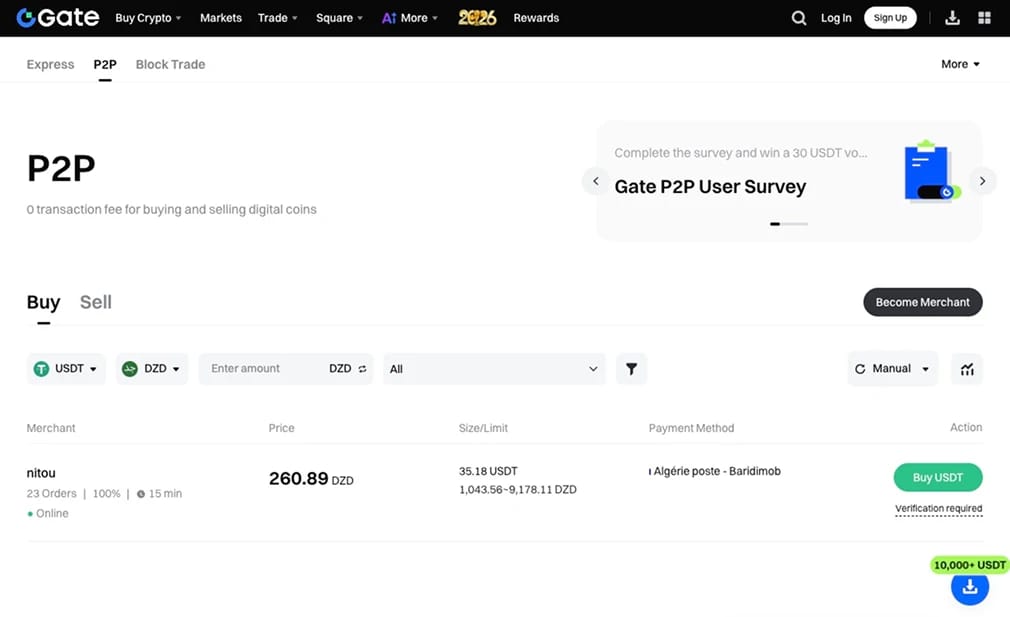
Funding from Algeria runs through the in-app P2P marketplace, where you buy USDT or another major coin with dinar through an escrowed transfer, then trade from there. Gate does not hold fiat directly, so cashing back to dinar means converting to USDT and selling through a P2P merchant. Spot fees are 0.1%, and KYC generally clears within a few hours.
The honest limits are practical. DZD merchant liquidity on Gate is shallower than on Binance or Bybit, so check how many sellers are active before placing a larger order, and accept that the website is best treated as app-led for this market. The legal position is identical to the rest of the list. The Gate review goes deeper into the trade-offs.
Pros
- One of the largest asset menus anywhere, at 4,800+ listings.
- Proof-of-Reserves published and a low 0.1% spot fee.
- Escrowed P2P supports dinar through local transfers.
Cons
- DZD P2P depth is thinner than Binance, so plan larger orders carefully.
- No fiat custody; exiting to dinar means converting back to USDT first.
- Crypto remains banned under Algerian law, with no recourse if a trade sours.
4. KuCoin
KuCoin suits Algerians who want idle holdings to earn rather than sit in their accounts. KuCoin Earn runs staking, savings, and dual-investment products on majors like ETH, SOL, and USDT, with headline campaign rates that can spike high but carry matching risk. Spotlight and Burningdrop layer on early-token access and airdrops for those who want them.
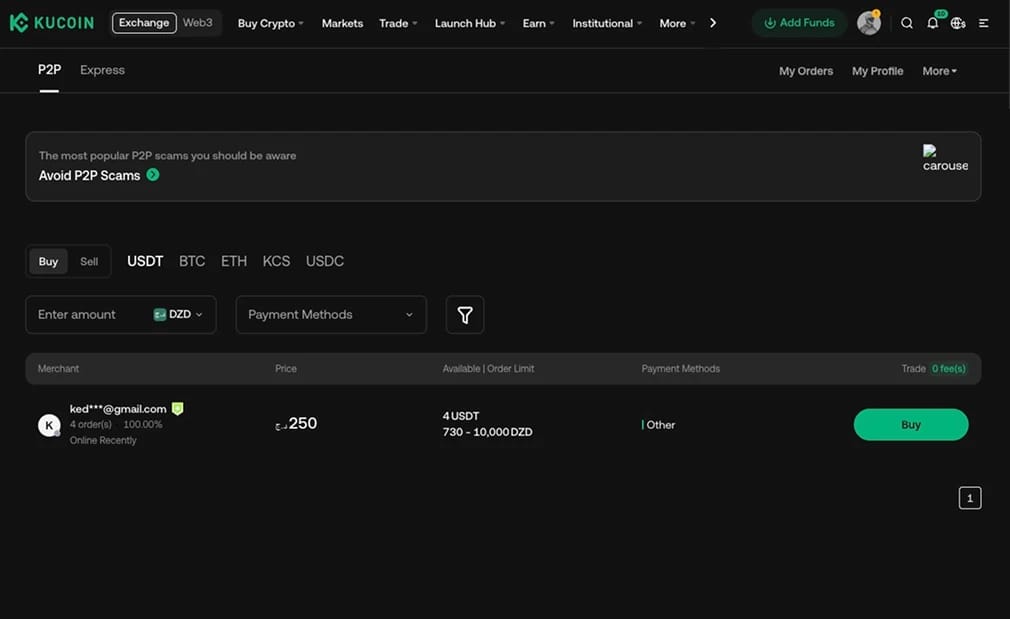
It is a deep exchange with 900+ assets across spot, margin, and futures, trading bots, crypto loans, and a Web3 wallet, with KCS holders earning discounts on the standard 0.1% spot fee. Funding from Algeria runs through escrow-backed P2P in USDT, settled by dinar bank transfer or BaridiMob from vetted merchants. The KuCoin review covers the Earn products in full.
Security has matured, with Proof-of-Reserves audits and ISO and PCI DSS certifications, though as a global venue with no Algerian banking link, the P2P counterparty risk is the same as elsewhere. Headline yield rates are variable, so read the terms before committing funds you cannot afford to lock.
Pros
- KuCoin Earn covers staking, savings, and dual investment on majors.
- 900+ assets, trading bots, crypto loans, and a Web3 wallet.
- Proof-of-Reserves audits plus ISO and PCI DSS certification.
Cons
- Headline Earn rates are variable and carry real downside.
- Funding is P2P USDT only, with no dinar banking relationship.
- The legal ban in Algeria applies to every part of the activity.
5. Bitget
Bitget makes the list on the strength of its copy-trading product, one of the largest in crypto, letting you mirror verified traders on audited track records. For someone who would rather follow proven strategies than pick tokens, it is the most developed option here, and our guide to the best copy trading platforms puts it in context.
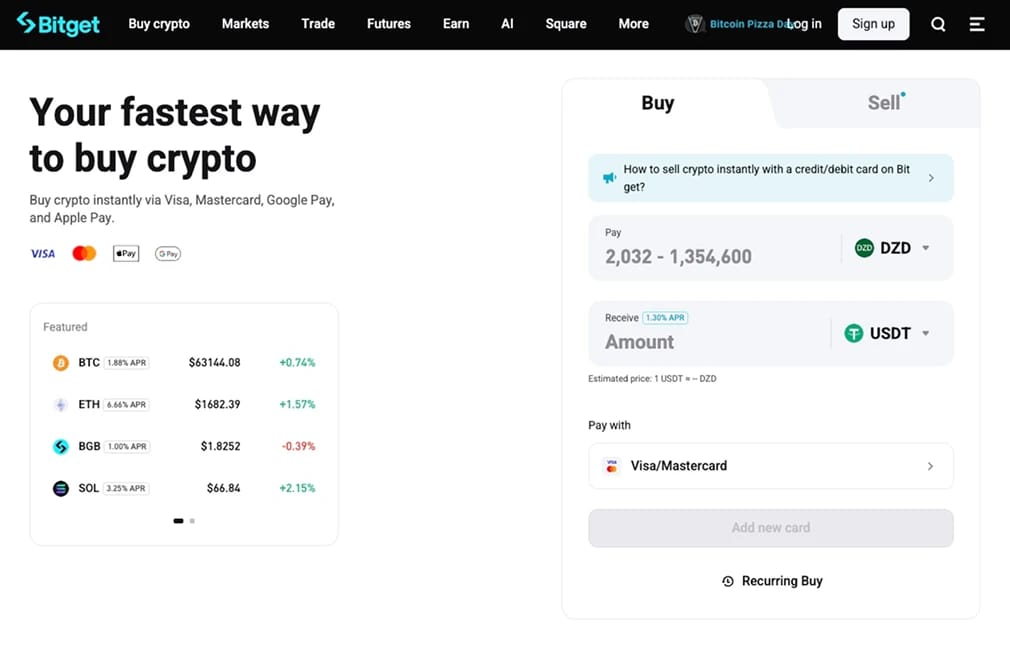
The platform offers 800+ assets across spot, margin, and futures, up to 125x leverage, plus grid bots, a Launchpad, Bitget Earn, and the multi-chain Bitget Wallet for Web3 and DeFi. Spot fees are 0.1%, cut further with the BGB token. It publishes Proof-of-Reserves and maintains a dedicated protection fund. Funding from Algeria runs through P2P, supporting bank transfers and mobile wallets.
Bitget leans toward derivatives, so a first-time buyer should stay on top and treat leverage with respect. DZD merchant depth is workable but not as deep as Binance, and, as with every name here, the legal ban means there is no consumer protection to fall back on if something goes wrong.
Pros
- Advanced copy trading with transparent trader records.
- 800+ assets, a Launchpad, and the Bitget Wallet for Web3.
- Proof-of-Reserves published, backed by a dedicated protection fund.
Cons
- Derivatives focus can overwhelm first-time buyers.
- DZD P2P depth trails Binance and Bybit.
- No banking rail and no legal protection under Algerian law.
6. MEXC
MEXC appears to draw strong Algerian traffic compared with many rivals, and the attraction is cost. Spot maker fees start at zero, taker fees are very low, and the listing pipeline is fast, so newer tokens often appear here before anywhere else. For an active trader squeezing fees, the economics are hard to match, and futures run up to 500x for those who understand the risk that carries.
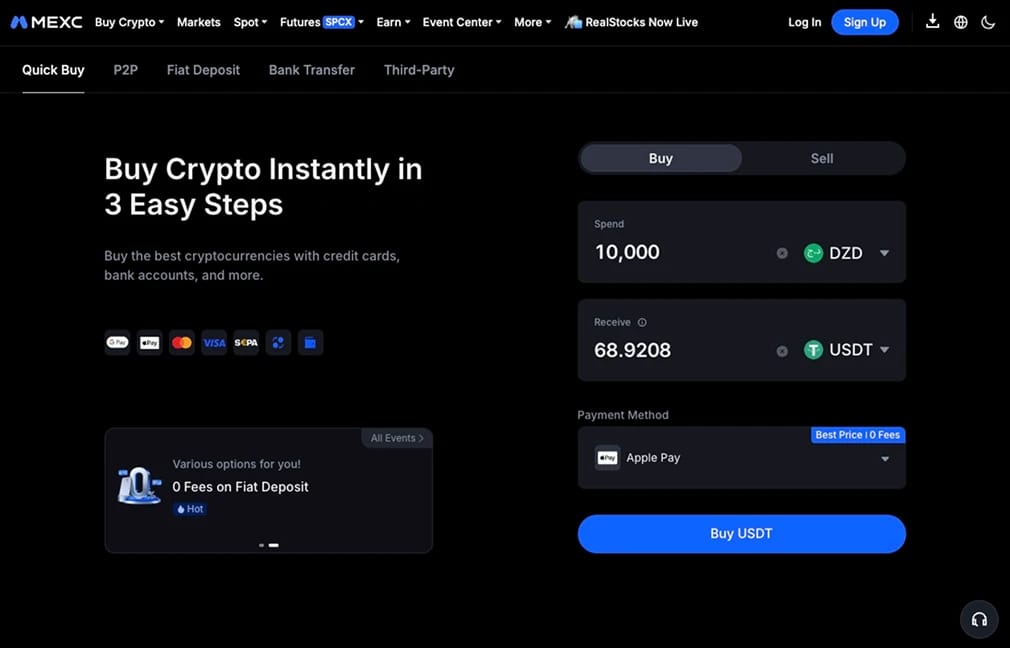
The wider product set includes spot, margin, and futures, copy trading, grid and DCA bots, and a Launchpool that hands out token allocations. Algerians fund it through escrow-backed P2P, buying USDT with dinar from vetted merchants, with cards available for smaller amounts at the usual processor markup. Our MEXC review lays out the fee structure.
The trade-off is disclosure. MEXC has historically been less consistent than its larger rivals on Proof-of-Reserves cadence, and the platform is built for traders rather than first-timers, with limited hand-holding. Combined with Algeria's legal ban, this makes it a venue for users who already know exactly what they are doing.
Pros
- Among the lowest fees anywhere, with 0% spot maker fees.
- The most widely used platform among Algerian crypto users by traffic.
- 2,800+ assets, fast listings, futures, copy trading, and bots.
Cons
- Less consistent Proof-of-Reserves disclosure than top-tier rivals.
- Trading-first design offers little support for beginners.
- Funding leans on P2P liquidity, under a legal ban that puts risk on the user.
How to Choose a Crypto Exchange in Algeria
Selection here begins with the law and ends with liquidity, because neither feature lists nor fees matter if you cannot fund an account or accept the legal exposure. Four checks the Datawallet team runs before treating any platform as usable:
- Understand the legal exposure first. Crypto activity is a criminal offense in Algeria under Law 25-10, so the real first question is whether you accept that risk, not which app looks best. No platform on this list removes that risk.
- Confirm the platform still serves Algeria. Availability changes. OKX now classifies Algeria as a strict national ban and offers no service, so check current access before signing up rather than assuming a global name works.
- Judge the DZD peer-to-peer depth. Since there is no banking rail, the only thing that funds an account is merchant liquidity. Binance has the deepest dinar book, Bybit and Gate are workable, and the rest vary, so match the venue to your order size.
- Vet the merchant, not just the platform. On P2P, your counterparty is a stranger. Use only escrow, trade with high-completion merchants, keep proof of every transfer, and never release funds outside the platform's escrow system.
Crypto & Bitcoin Regulation in Algeria
Algeria runs one of the strictest crypto regimes globally, and it tightened sharply in 2025. Ownership is not tolerated as a personal choice the way it is in some restrictive markets; it is prosecutable. Three elements define the framework:
- The 2018 starting point: Article 117 of the 2018 Finance Law (Law 17-11) prohibited the purchase, sale, use, and possession of virtual currency, defining it as a digital instrument with no physical backing. Enforcement in practice was light, and P2P trading continued.
- The 2025 hard line: Law No. 25-10, published in the Journal Officiel on 24 July 2025, folded crypto into the country's anti-money-laundering statute and criminalized the full chain of activity, including issuance, trading, use, possession, promotion, mining, and operating wallets or exchanges. Penalties run from two to twelve months in prison and fines of 200,000 to 1,000,000 dinars.
- The enforcing bodies: The Bank of Algeria and the Banking Commission monitor the financial system for crypto-linked flows, working alongside judicial and security authorities. Separately, Bank of Algeria Instruction 06-2025, which set the first fintech and digital-wallet rulebook, explicitly bars any integration with crypto or stablecoins and requires services to operate in dinars only.
The reading for a resident is blunt. There is no licensed venue, no legal protection, and no tax recognition, and the activity is a criminal matter. Anyone who proceeds does so outside the law and bears the full consequences.
How Is Crypto Taxed in Algeria?
There is no crypto tax framework in Algeria, and the reason is structural rather than generous. Because the law criminalizes digital assets outright, the tax code has no category to place them in, so gains, losses, and trading activity are neither recognized nor taxed by the authorities.
That absence is not a benefit. With no legal recognition, there is no mechanism to claim a loss, deduct a cost, or establish a paper trail the state will honor, and there is no consumer protection if a platform fails or a counterparty disappears. The flip side of "untaxed" here is "unprotected."
Some advisers suggest that anyone who has held crypto keep private records anyway, in case the legal position ever changes and a history of activity becomes useful. For now, the practical reality is that crypto sits entirely outside Algeria's financial perimeter, and engaging with it carries legal risk rather than a tax question. This is general information, not legal or tax advice.
%201.webp)
Cryptocurrency Adoption in Algeria
Despite the ban, Algeria has a sizable and durable crypto user base, driven by economics rather than speculation. The forces behind it explain why a prohibition has not made the activity disappear:
- A top regional market: In the Chainalysis 2024 Geography of Cryptocurrency Report, Algeria ranked sixth in the Middle East and North Africa by crypto value received, sustained activity for a country with a total ban in place.
- A dinar that does not convert: Algeria runs strict capital controls. According to the US State Department, residents can convert only a small annual allowance for travel at the official rate, and the parallel "Square" market in Algiers trades the euro and dollar at a premium of roughly 80% over the official rate. Stablecoins offer a way to hold dollar value that the formal system does not.
- Stablecoins as the core asset: Activity centers on USDT bought and sold through P2P, used for savings against dinar weakness, online purchases, and remittances, rather than on speculative altcoin trading. For the wider picture, see our crypto adoption statistics.
The pattern mirrors other capital-controlled economies, where a stable store of value matters more than upside.
It also sits in contrast to neighbors: our guides to the best exchanges in Morocco and Egypt show two markets that restrict crypto without criminalizing simple possession the way Algeria now does.
%201.webp)
How to Buy Bitcoin in Algeria
Before any steps, the position to be clear-eyed about: buying Bitcoin in Algeria means engaging in activity that is illegal under Law 25-10, with criminal penalties attached. The outline below describes how the P2P mechanism works in practice, not an endorsement of doing it.
- Weigh the legal risk. This is the real first step. There is no licensed route, no protection, and a criminal ban. If you proceed, you accept the full legal exposure yourself.
- Choose a platform that still serves Algeria. Bybit is the cleanest all-rounder still serving the country, and Binance holds the deepest dinar P2P book. Confirm current access, since venues like OKX have closed the country entirely.
- Complete identity verification. Global platforms require a government ID and a live selfie to clear KYC, which generally takes minutes to a day. The no-KYC tiers that once existed have largely been removed.
- Acquire USDT through P2P. Rather than a fiat deposit, you buy USDT from a vetted, high-completion merchant, paying in dinars by BaridiMob, CCP transfer, or a local bank such as BNA or CPA into the platform's escrow, which holds the crypto until your payment is confirmed.
- Trade and secure your holdings. Swap USDT for Bitcoin on the spot market, then move anything you are holding rather than trading to a self-custody wallet. Our guide to the best crypto wallets covers hardware options like Ledger and Trezor.
The discipline that limits the practical risk is the same everywhere on P2P: only verified merchants, only escrow, and a saved record of every transfer in case a bank queries the payment.
Final Thoughts
Algeria is the hardest market on this list to write honestly about, because the responsible answer is that the law says not to. As of July 2025, crypto activity is a criminal offense, banks block the rails, and the dinar does not convert, so there is no legal or low-risk path in.
For those who proceed regardless, the ranking reflects practical reality. Bybit is the best all-round pick and the cleanest exchange still openly serving the country.
Binance offers the deepest DZD peer-to-peer liquidity and is the default when a dinar order needs to fill; Gate has the widest asset range; KuCoin leads on yield products; Bitget is the copy-trading pick; and MEXC is the cheapest and the most used locally.
Unlike Nigeria, which moved from a crackdown to a licensing framework, or Morocco, which is drafting one, Algeria has chosen prohibition and enforcement. Until that shifts, the safest position is the one the law demands, and anyone weighing the alternative should understand exactly what they are taking on.
Our Methodology
We assessed every platform still reachable from Algeria by examining its live DZD peer-to-peer markets, merchant depth, accepted payment methods, global product range, security standards, and fee structure. We did not transact from inside Algeria, since that would breach Algerian law. Each platform scored across six criteria:
- Trust Score: Our rating out of 5 weights Proof-of-Reserves transparency, security history, regulatory standing where relevant, and platform longevity.
- DZD Access: The depth and reliability of dinar P2P liquidity, including the range of local payment methods merchants accept.
- Fees: Maker and taker fees, spreads, and any card or withdrawal charges on a representative round trip.
- Asset Availability: The range of coins and products, from majors and stablecoins to long-tail tokens, derivatives, and yield.
- Security and Custody: Audit coverage, Proof-of-Reserves, and account protections such as MFA and mandatory KYC.
- Local Usability: App performance, KYC requirements, and Arabic-language support.
Above all, our analysis treats Algeria's legal ban as the defining condition, not a footnote, and weights honest risk disclosure over any platform's marketing.
.webp)