







Compare Top Angolan Crypto Exchanges
1. Bybit
Bybit ranked first in our testing because it allows registration in Angola without restrictions and offers the widest range of AOA deposit methods. The full interface and customer support are available in Portuguese, and our identity check cleared within minutes. More than 2,400 cryptocurrencies are available with a flat 0.1% spot commission. Futures fees start at 0.055% for takers and 0.02% for makers.
Third-party providers handle card purchases through Visa, Mastercard, and Google Pay. Bybit also added Kwanza listings to its zero-commission P2P marketplace in March 2026, where escrow holds the seller's crypto until payment arrives. One of our test card purchases was declined; the P2P desk completed the equivalent order within fifteen minutes. Our Bybit review covers the rest of the platform.
The same account supports perpetual futures, copy trading, automated bots, and an Earn menu that ranges from flexible savings to structured products. Regular reserve attestations report full backing for customer assets. Bybit's record still includes the February 2025 theft of roughly $1.5 billion from a cold wallet, the largest exchange hack on record, although every affected customer was repaid within days.
Pros
- Portuguese support and unrestricted Angolan onboarding make Bybit the smoothest large exchange to join from Luanda.
- Its 0.1% spot fee covers one of the broadest coin catalogs available to Angolan users.
- Card and Google Pay purchases sit alongside kwanza P2P, providing more funding choices than most rivals in the country.
Cons
- Third-party processors reject Angolan cards often enough to make P2P the fallback.
- Bybit has fewer kwanza P2P listings than Binance, and large orders can move the price.
- Although customers were fully reimbursed, the 2025 cold wallet breach remains part of its security record.
.webp)
2. Binance
Binance operates crypto's deepest Kwanza peer-to-peer marketplace. It added AOA to its P2P platform in November 2022 and charges neither buyers nor sellers a P2P commission. Payment methods include Multicaixa Express, Angolan bank transfers, and E-Kwanza, which are already familiar to most residents. It is the world’s largest exchange by user base and trading volume, providing deep liquidity for AOA trading.
Kwanza cannot be deposited directly. Bank transfers to Binance are accepted only in dollars and euros, leaving P2P as the sole funding route from a local account. Its merchant depth makes that route work well: dozens of verified sellers quote prices around the clock. In our tests, this produced tighter spreads and faster settlement than any competing marketplace. Funded balances can be traded across 350+ cryptocurrencies at a 0.1% fee.
For larger operators, sub-accounts keep trading desks separate from custody, while the OTC service handles bulk conversions away from the public order book. Binance Pay settles merchant transactions in crypto. The 2023 settlement with US authorities cost $4.3 billion and led to its founder's resignation. The resulting compliance rebuild now includes monthly reserve reports. Our Binance review examines the complete product range.
Pros
- The kwanza P2P desk combines the most merchants with the tightest spreads and zero commission.
- Sellers accept Multicaixa Express, bank transfers, and E-Kwanza, aligning with common payment habits in Angola.
- Businesses moving amounts exceeding retail escrow limits can use sub-accounts and OTC quotes.
Cons
- Without direct kwanza deposits, every locally funded purchase requires a P2P counterparty.
- Merchant quality changes from day to day, while Kwanza volatility can widen price gaps.
- Binance's regulatory history includes crypto's largest corporate penalty, settled with US agencies in 2023.
3. MEXC
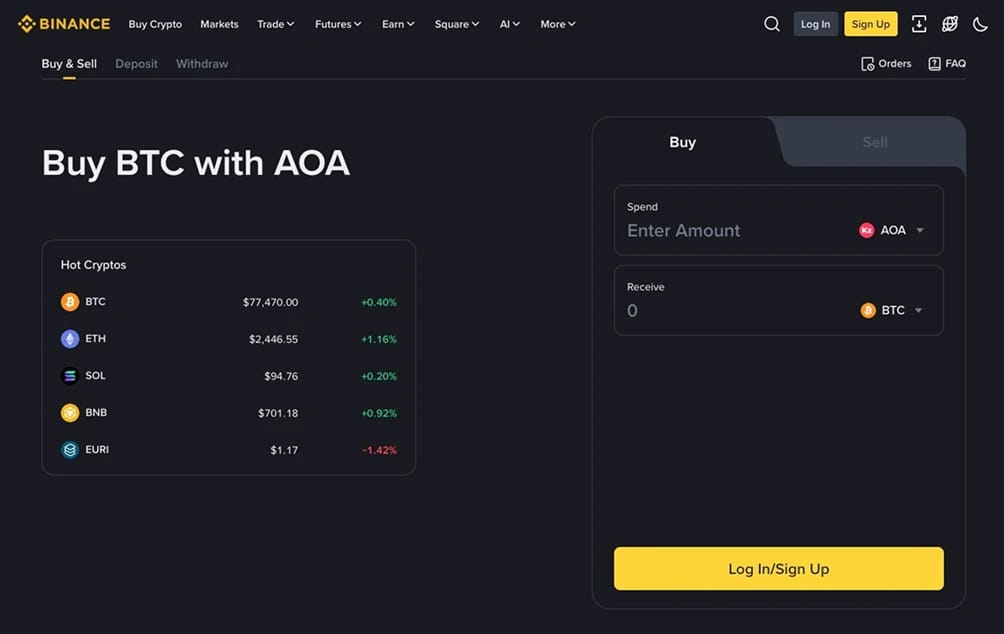
MEXC offers the lowest costs while still processing Kwanza. Its P2P desk supports AOA without charging either side of a trade. After funding, spot orders cost 0% for makers and 0.02% for takers. No other platform available in Angola pairs a working kwanza channel with fees this low. MEXC remains in the top five crypto exchanges by spot and futures trading volume.
The exchange lists more than 2,800 cryptocurrencies. New tokens often reach MEXC before larger platforms, so traders seeking early positions don’t need another account. Spot trading sits alongside futures with high leverage, TradFi trading, copy trading, trading bots, crypto loans, and Earn products, all accessible from the same balance.
MEXC's P2P desk carries fewer kwanza advertisements than Binance, so compare prices before placing a larger order. The company also lacks the licenses that support exchanges in supervised markets. Visit our MEXC review to learn more about the features and understand the fee mechanics for every product.
Pros
- Its 0% maker and 0.02% taker rates are the cheapest spot fee structure available to Angolan users.
- AOA trades carry no P2P commission, keeping the full conversion from kwanza to Bitcoin inexpensive.
- More than 2,800 coins and frequent new listings cover altcoins that most competitors lack.
Cons
- Fewer kwanza advertisements than Binance can mean wider spreads on bigger trades.
- MEXC holds no major regulatory licenses, so users depend on its internal controls.
- Token campaigns and promotional banners make an already busy interface harder for beginners to read.
4. Bitget
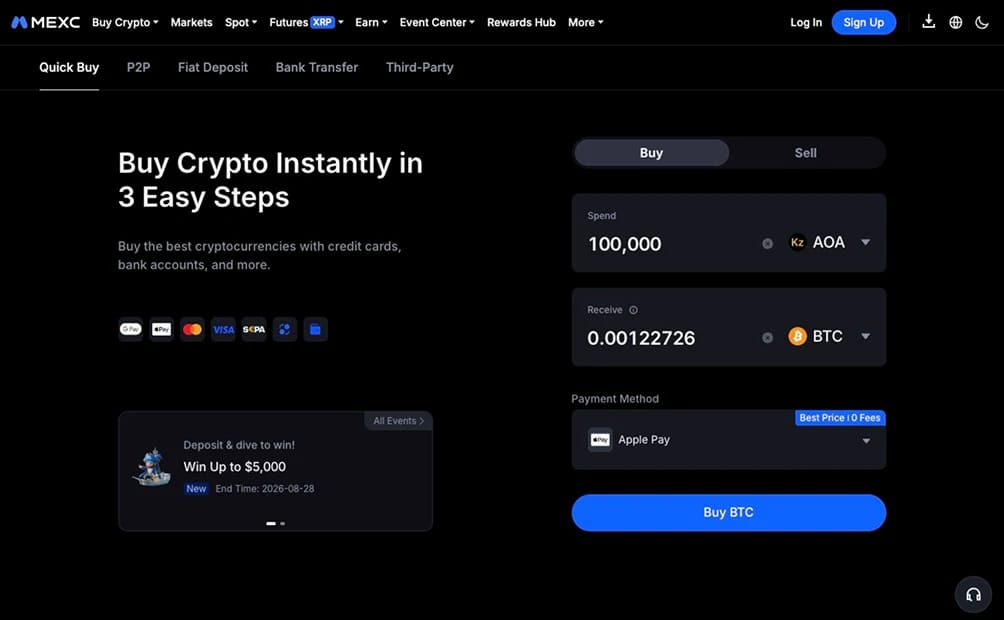
Bitget builds much of its product around copy trading. Followers can mirror spot positions, futures strategies, or automated bots. Before committing capital, they can review each lead trader's return history, win rate, and drawdown. Allocation caps and stop settings provide exposure to a single strategy, and our testing found these controls to be more granular than those on rival platforms.
More than 800 cryptocurrencies trade at a 0.1% spot commission. Bitget also offers tokenized stocks and gold settled in USDT, allowing users to move between crypto and steadier assets within one account. Kwanza funding comes from P2P sellers or from card purchases processed by payment partners, although listings are shallower than on higher-ranked marketplaces. The app includes an AI analysis assistant called GetAgent.
Bitget reports a monthly reserve ratio of at least 1:1. Its protection measures also include cold storage with offline multi-signature controls and a fund above $500 million for extreme events. For a broader comparison, read our best copy trading platforms guide or visit our Bitget review for a deeper dive into the platform's offerings.
Pros
- Copy trading covers spot, futures, and bots, with performance statistics shown for every lead trader.
- Tokenized stocks and gold share an account with crypto and use USDT for settlement.
- Monthly reserve reports and a protection fund above $500 million support customer balances.
Cons
- Futures followers inherit the strategy's leverage, so losses can arrive faster than casual users expect.
- The number of products can draw newcomers toward instruments they do not need.
- Sparse Kwanza P2P listings mean most funding still begins on another marketplace.
5. Bitunix
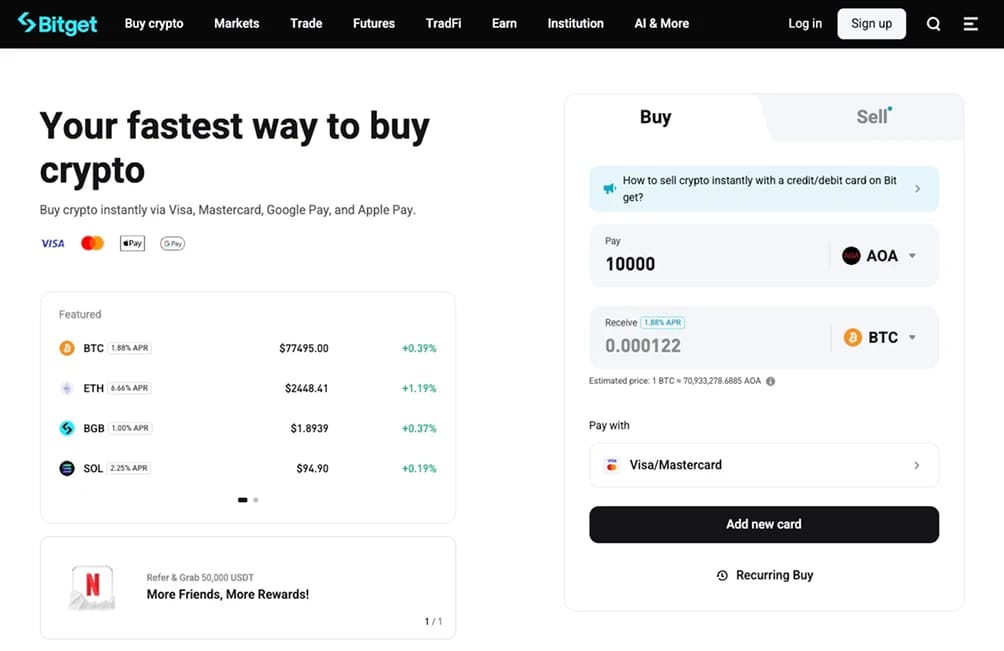
Bitunix is designed for traders who spend most of their time in charts. Its futures terminal feeds TradingView market data across spot and derivatives. Positions can therefore be managed with familiar indicators and drawing tools without leaving the platform. Execution speed and depth on major perpetual pairs held up during our test orders.
At 250+ cryptocurrencies, Bitunix has the smallest catalog in this ranking. Each spot market carries a 0.1% commission, and the limited selection reflects a deliberate emphasis on liquid markets rather than long-tail coverage. Kwanza enters through a web-based P2P desk with documented escrow. Advertisement counts are lower than on the larger marketplaces, so users should compare prices first.
Bitunix takes security seriously and offers 1:1 backing of customer assets with Merkle-tree verification, giving users peace of mind that their assets are properly secured. Wallets use Fireblocks MPC custody, and Elliptic screens transactions for illicit activity. We recommend reading our Bitunix review, which compares the platform with larger derivatives venues.
Pros
- TradingView works across spot and futures, keeping professional charting within one workflow.
- Fireblocks custody and Elliptic transaction screening provide institutional-grade infrastructure.
- Users can verify their own balances through Merkle checks of the reported 1:1 reserve backing.
Cons
- High perpetual leverage makes small mistakes costly, especially for inexperienced traders.
- A smaller pool of kwanza advertisements can produce wider P2P spreads than on major rivals.
- Anyone seeking smaller altcoins will find the coin list too limited.
6. Gate
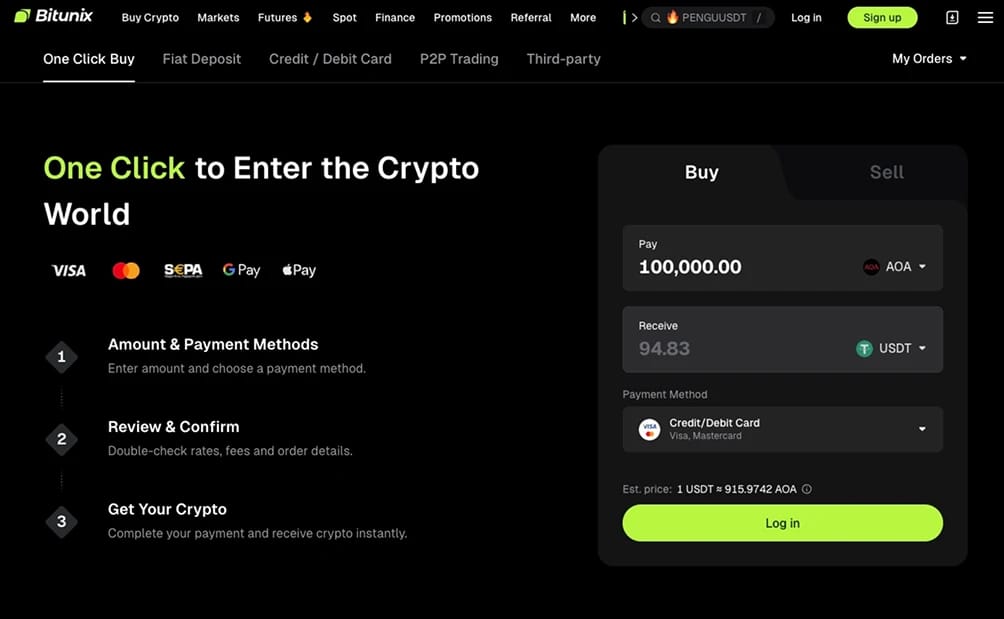
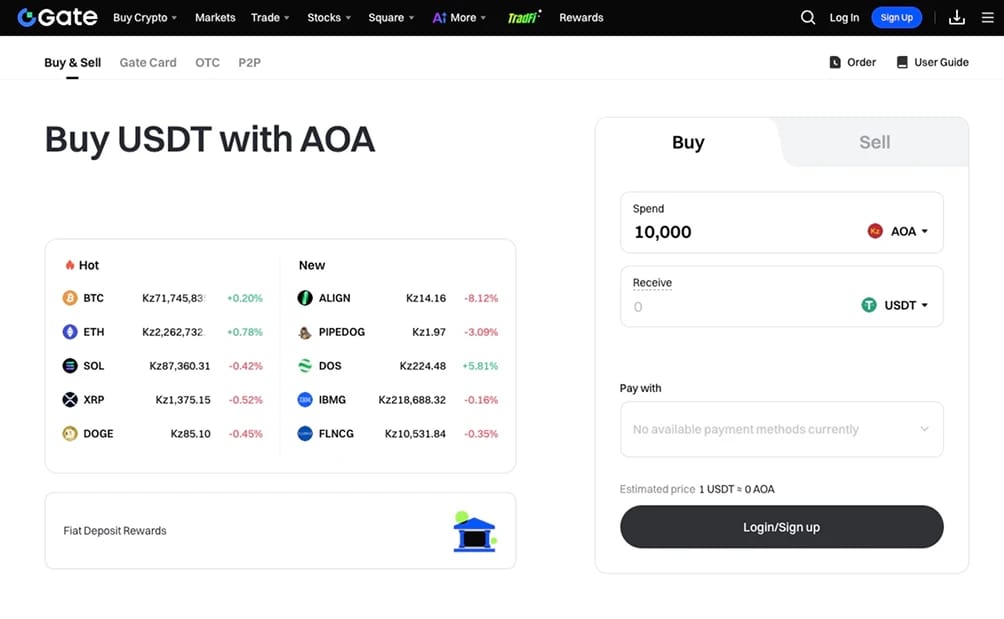
Gate is suited to investors looking beyond major coins, but it ranks last because direct AOA deposits are unavailable. The platform has no Kwanza P2P desk and does not process cards for Angolan users. Funding requires a crypto deposit, usually USDT purchased through another platform's P2P marketplace and then transferred to Gate. That added step incurs a network fee and makes Gate unsuitable as a first exchange.
Its main attraction for existing stablecoin holders is breadth. Gate lists more than 4,300 cryptocurrencies, several times the selection of any competitor here, and often adds new tokens earlier than other exchanges. Spot commissions start at 0.2%, which is the cost of accessing that catalog.
Gate publishes reserve audits showing coverage above customer liabilities. Its January 2026 update reported a 125% ratio across roughly $9.5 billion in assets. Futures, Simple Earn, trading bots, lending and borrowing, and a startup token platform complete the product set; our Gate review covers each one.
Pros
- Gate's list of more than 4,300 cryptocurrencies is the widest available to investors in Angola.
- January 2026 reserve coverage was reported at 125%, one of the highest disclosed ratios.
- Early listings provide access to new tokens months before they reach larger exchanges.
Cons
- With no direct AOA deposits, accounts must be funded with crypto purchased elsewhere.
- The 0.2% base spot commission is double the rate charged by the five competing platforms.
- Thin order books on small-cap tokens can make exits costly during selloffs.
How to Choose a Crypto Exchange in Angola
All six platforms are based outside Angola. Without a local regulator overseeing them, users must carry out their own due diligence. Complete these five checks before transferring money:
- Confirm Angola passes onboarding: Open an account and select Angola as your residence before depositing funds. A two-minute check is better than losing days to a platform that blocks the country at signup or approves an account only to restrict withdrawals.
- Inspect the kwanza P2P desk yourself: Filter the marketplace by AOA, then count the active sellers who accept Multicaixa Express or bank transfer. Merchant depth determines the effective exchange rate. Our best P2P crypto exchanges guide explains the protection escrow provides to both parties.
- Price the whole journey, not the commission: Spot fees are usually the smallest expense. Compare the P2P premium over the open market rate, any card charge, and the withdrawal network fee to find the cheapest platform for your order size.
- Check the security disclosures: Give preference to platforms that publish reserve reports, explain how customer assets are stored, and support authenticator app logins rather than SMS codes. Angolan deposit protection does not cover these accounts, leaving platform controls as the only safety layer.
- Complete one full test cycle: Start with a small deposit. Buy, sell, and withdraw the proceeds to your bank account before increasing the amount. This test exposes hidden charges and verifies that funds leave as easily as they arrive.
Crypto and Bitcoin Regulation in Angola
Angolan law does not prohibit cryptocurrency ownership or trading, but mining is a crime. The rules were developed through the following legislative steps:
- 28 February 2024: The National Assembly gave final approval to the mining prohibition bill with 104 votes in favor, 71 abstentions, and 2 against. It reserved the issuance of legal tender exclusively for the Banco Nacional de Angola (BNA).
- 10 April 2024: Law No. 3/24 appeared in the Diário da República and took effect that day. The law prohibits mining nationwide, connecting mining machines to the public power network, and using electrical installation licenses for mining.
- Penalties under the law: Possession of mining hardware carries a sentence of 1 to 5 years in prison and seizure of the equipment. Mining or drawing power from the national electricity system for that activity carries a 3-12 year penalty. Misuse of an electrical license adds three to eight years, while companies can face heavy fines or dissolution.
- April 2025: The tax authority opened a public consultation on a draft personal income tax code (IRPS). The proposal would combine the current separate income taxes and tax residents on worldwide income, expressly including offshore crypto gains.
- 30 December 2025: Law No. 14/25 approved the 2026 State Budget. From 1 January 2026, it removed the reduced 5% investment income tax rate and raised those categories to 10%.
This framework neither licenses exchanges nor protects their customers. The government has indicated that the Capital Markets Commission (CMC) will supervise crypto asset matters. An authorization regime has yet to be established, however, so customer safeguards depend on the chosen platform rather than Angolan law.
.webp)
How Does the AGT Tax Crypto?
The Administração Geral Tributária (AGT) has not published dedicated crypto tax rules. Digital asset income therefore falls within existing general categories, with the following practical outcomes for 2026:
- Holding is not a taxable event: Tax becomes due when crypto is sold, swapped, or spent. Purchase dates and kwanza values should still be recorded because the cost basis must be substantiated at disposal.
- Investment gains fall under the IAC: The Imposto sobre a Aplicação de Capitais applies rates of 10% or 15%, depending on the category of invested-capital income. Occasional gains earned by individuals generally fall into the 10% category, although the AGT considers frequency and organization when classifying an activity.
- The reduced 5% rate no longer exists: The 2026 State Budget withdrew the 5% concession for certain listed instruments held for more than three years. Those items are taxed at 10% from 1 January 2026.
- Trading as a business is company income: Habitual or structured activity, including operating a trading desk or brokering for clients, falls under the Industrial Tax regime for business profits.
- Moving money abroad carries its own levy: The 2.5% Special Contribution on Foreign Exchange Operations (CEOC) for transfers abroad through the banking system remained in place for 2026. This is one reason stablecoin transfers have grown as a cross-border alternative.
This is background information, not advice. Classification depends on individual circumstances, and the draft IRPS reform could change the rules within a year. Before filing, confirm your position with the AGT or a qualified Angolan tax adviser.
.webp)
Cryptocurrency Adoption in Angola
Crypto participation in Angola remains modest in absolute terms, but economic pressure is driving growth. Statista Market Insights projects about 600,000 digital asset users in 2026, representing less than 2% of the population, and market revenue of nearly $30 million.
The economic forces supporting adoption remain in place. After reaching a record 966 per dollar in October 2024, the kwanza has stayed near 915 through 2026. Dollars are still rationed, and formal overseas transfers can take up to three months to clear. Inflation has fallen from almost 28% two years earlier to about 10%.
Angola is part of the fastest-adopting crypto region outside Asia and Latin America. Chainalysis recorded $205 billion in Sub-Saharan African on-chain value during the year to June 2025, an increase of 52%. Our crypto adoption statistics page compares Angola's user figures with Nigeria, South Africa, and other countries across the continent.
.webp)
How to Buy Bitcoin in Angola
The most dependable route starts with a kwanza-to-USDT purchase through P2P escrow, followed by a USDT-to-Bitcoin trade on the spot order book. With an identity document prepared, it can be completed within half an hour:
- Open the account: Register on a platform that accepts Angolan residents. Bybit is our overall recommendation, while Binance has the deepest kwanza marketplace. Use Angola as your country at signup because inconsistent details can later cause withdrawal blocks.
- Verify your identity: Submit a Bilhete de Identidade or passport, then complete the selfie check. Approval usually arrives within minutes and unlocks full trading limits.
- Buy USDT with kwanza on P2P: Filter sellers by Multicaixa Express, bank transfer, or E-Kwanza, and favor merchants with completion rates above 95%. Use only the listed payment method. After sending the transfer, confirm it in the app; escrow releases the USDT when the seller acknowledges receipt.
- Trade USDT for Bitcoin on spot: Find the BTC/USDT pair, then place a limit order at your preferred price or use a market order for immediate execution. Express purchase screens offer poorer prices than the order book, making the extra minute worthwhile.
- Withdraw long-term holdings: Crypto intended for long-term storage should be kept in your own wallet rather than on an exchange. Our best crypto wallets ranking covers hardware models that store private keys offline.
To sell, follow the sequence in reverse and finish with a P2P transaction in which the buyer sends kwanza to your bank account. Export your transaction history every few months so the necessary records are available if a tax question arises.
Final Thoughts
Bybit takes first place because the experience works well from Portuguese-language onboarding to kwanza escrow, then through a 0.1% order book listing 2,400+ coins. Binance is equally important for local funding: the depth of its P2P merchant pool establishes the practical kwanza exchange rate against which other platforms are compared.
For now, the regulatory position is stable. Mining is criminal, while trading remains lawful and unsupervised. Recent policy has focused on taxation rather than prohibition, with the 2026 budget increasing investment income rates and a worldwide income reform still in draft. No announced measure restricts individual access to offshore platforms.
Careful execution matters more than small differences between platforms. Use escrow instead of making off-platform transfers, trade on the order book rather than an express screen, and move significant long-term holdings into self-custody. Keep records from the start. For more choices across the continent, consult our best crypto exchanges in Africa ranking.
Our Methodology
These rankings come from hands-on testing from an Angolan user's position, rather than a count of global features. The order is based on six criteria:
- Trust score: Datawallet's 5-point rating considers each platform's security record, reserve transparency, regulatory standing, and operating history.
- Angolan access: Every account was registered with Angola declared as the country of residence. We then confirmed that verification, trading, and withdrawals worked without restriction.
- Kwanza funding quality: Our assessment covered P2P merchant depth, spreads against the open market rate, and card acceptance. It also tested payment methods such as Multicaixa Express and E-Kwanza.
- True transaction cost: We completed a live, kwanza-funded Bitcoin purchase on every platform. The comparable figure combines the P2P spread, trading commission, and withdrawal network fee.
- Product range: We assessed the spot market, futures, earning products, and copy tools available to an Angola-registered account, rather than everything advertised on the global platform.
- Safety infrastructure: Each review covered reserve reporting, custody arrangements, login security, and incident history, while giving weight to recent enforcement actions.
Testing concluded in August 2026. Before publication, every regulatory and tax claim was checked against primary Angolan sources.
.webp)