







Compare Top Crypto Exchanges in Bahrain
1. Rain
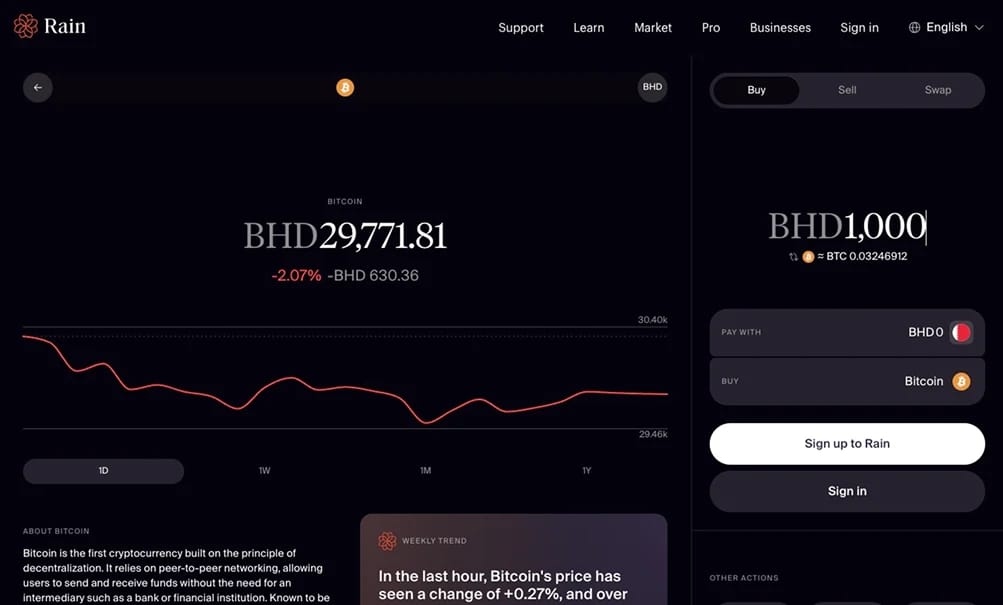
Rain ranks first because no competing platform is built as closely around Bahraini banking. The Manama company spent two years in the CBB regulatory sandbox before securing the Middle East's first crypto license in 2019. Its Category 3 Crypto-Asset Services License covers brokerage, trading, and custody. More than 2 million customers have traded over $11 billion across Rain's platforms.
Its local advantage is clearest when adding or withdrawing funds. Customers can deposit dinars through Fawri and Fawri+ bank transfers. Since May 2026, Rain has also offered the first in-app BenefitPay checkout from a Bahraini crypto platform, connecting customers with every CBB-licensed member bank around the clock. Both deposits and local BHD withdrawals are free.
Trading costs change sharply between interfaces. The standard screen adds a 0.5% brokerage fee to each trade, whereas Rain Pro charges 0% maker and 0.05% taker. Using the order book, therefore, reduces the fee for a market buy by 90%. Rain's 2026 partnership with Kraken added tokenized US stocks such as Tesla and Apple for eligible Bahrain customers. Our Rain review examines the full platform.
Pros
- Rain's Category 3 CBB license covers brokerage, trading, and custody. The Shariyah Review Bureau has certified all three services as Sharia-compliant.
- BenefitPay, Fawri, Fawri+, and cards provide the broadest selection of local funding channels in this ranking, with no deposit fees.
- Rain Pro charges 0% maker and 0.05% taker, lower than the base rates at every global platform listed here.
Cons
- Anyone who remains on the simple buy screen pays a 0.5% brokerage fee per side instead of Rain Pro's lower rates.
- Its roughly 150 listed assets include the major cryptocurrencies but not the long-tail selection found on Gate or KuCoin.
- Rain covered an April 2024 wallet breach worth $14.8 million from company funds. However, it remained silent for two weeks until an independent investigator disclosed the incident.
2. Binance
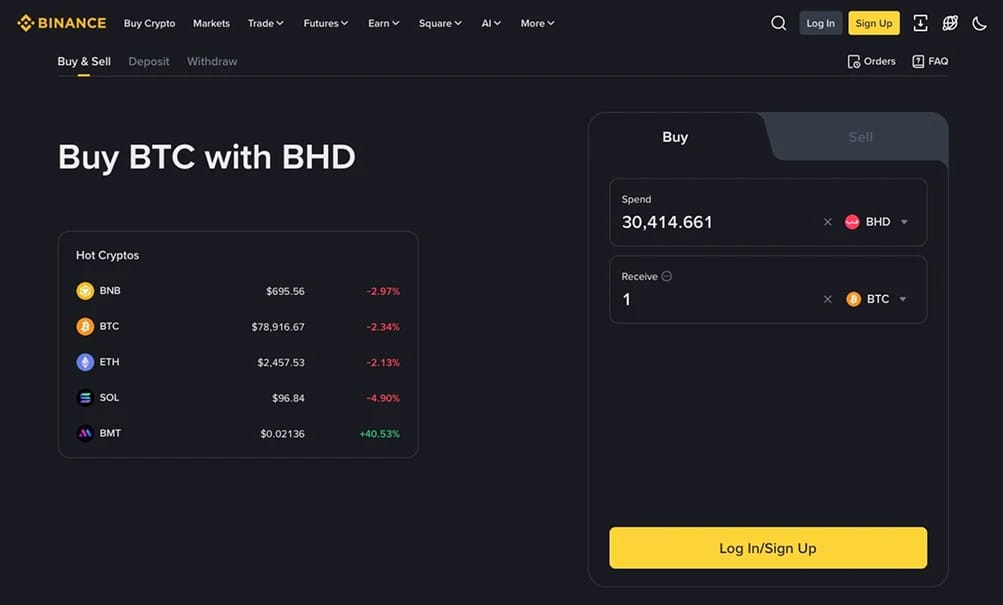
Binance is the only major global exchange licensed in Bahrain. Binance Bahrain B.S.C. received a Category 4 crypto-asset service provider license from the CBB in May 2022. It was the first license of its kind and placed the world's largest exchange under local supervision rather than offshore terms alone. By mid-2026, the platform had passed 323 million registered users.
For Bahraini customers, copy trading is a major reason to choose Binance over a smaller exchange. Thousands of lead traders publish live performance records, while allocation controls limit the amount assigned to each strategy. Deep order books help mirrored positions execute close to the lead trader's prices, which thinner platforms cannot reliably match.
The Bahrain offering extends beyond trading. Binance Pay lets customers spend exchange balances at more than 5,000 EazyPay terminals nationwide, including at a restaurant in Manama. Published proof of reserves and the SAFU emergency fund add further protection. Binance also offers a fully Arabic interface, and our Binance review assesses the platform as a whole.
Pros
- Binance Bahrain holds a Category 4 CBB license, the country's highest permission level for a crypto-asset provider.
- Its copy trading system draws on the industry's deepest liquidity, reducing slippage on mirrored positions compared with smaller venues.
- Binance Pay makes exchange balances spendable across thousands of Bahraini merchants connected to the EazyPay network.
Cons
- Spot, futures, options, and Earn share one app, allowing beginners to reach leveraged products sooner than intended.
- Quick-buy spreads are well above the 0.1% order-book fee, which can cause casual users to pay more without realizing it.
- Local funding is more limited than on Rain because Binance does not support BenefitPay deposits.
3. Bybit
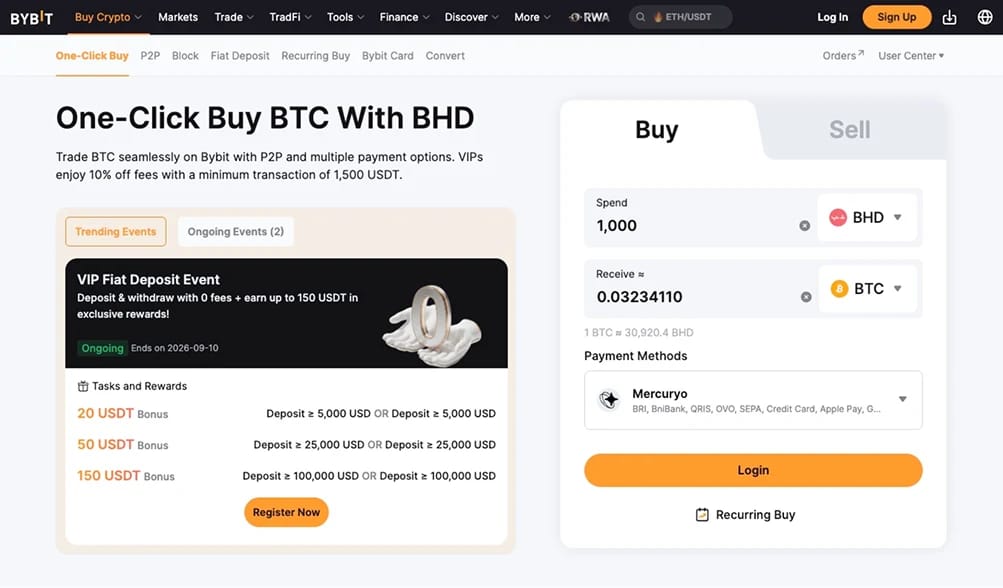
Bybit suits experienced Bahraini traders who have moved beyond simple crypto purchases. The Dubai-headquartered exchange ranks second worldwide by trading volume and has more than 80 million users. Its perpetual futures markets carry over $11 billion in open interest, allowing large orders to execute without affecting prices as they would on smaller venues.
Spot transactions cost 0.1%, while perpetual futures charge 0.02% maker and 0.055% taker with leverage up to 100x. One unified collateral balance can support every position. Bybit also provides automated bots, copy trading, and an Earn section. Newer TradFi products include tokenized gold and stock perpetuals, and Bahraini traders can open an Islamic Account, certified by CryptoHalal and ZICO Shariah Advisory Services.
Bybit's record includes the largest theft in crypto history. Attackers stole roughly $1.5 billion in Ether in February 2025. The exchange covered every balance, kept withdrawals open, and rebuilt its reserves within days. Hacken now verifies monthly proof-of-reserves reports covering Bybit's 50 largest assets. In mid-2026, those reports showed ratios above 100% across $16.5 billion. Visit our Bybit review for the complete record.
Pros
- Bybit ranks second globally for perpetual futures open interest. Fees start at 0.02% maker and 0.055% taker, with leverage reaching 100x.
- Monthly Hacken-verified reserve reports covered 50 assets in mid-2026, with every major ratio above 100%.
- The exchange secured a license from the UAE's Securities and Commodities Authority in October 2025 and offers Shariah-compliant trading.
Cons
- Bybit's roughly $1.5 billion loss in February 2025 remains the largest theft from a single exchange, although all customers were reimbursed.
- Customers can add BHD only via cards or peer-to-peer transactions, as Bahraini bank transfers are unavailable.
- Bybit lacks a CBB license, placing Bahraini accounts under its UAE and offshore entities.
4. Gate
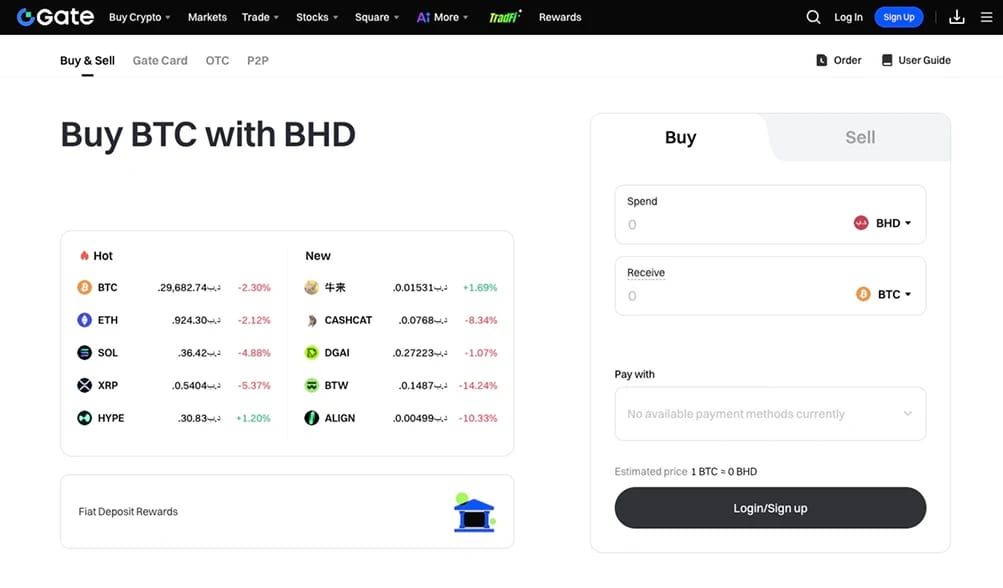
Gate focuses on cryptocurrencies missing from other exchanges. Operating since 2013, it lists more than 5,000 assets, over thirty times Rain's selection. That makes Gate the practical choice for Bahraini traders seeking new listings, memecoins, and small-cap projects. The exchange reports more than 58 million registered users, making it a top-five platform globally.
Few offshore exchanges publish transparency reports as often. Gate releases proof-of-reserves attestations every month, and its August 2026 report disclosed $8.2 billion in reserves with a 127% coverage ratio. Platform holdings therefore exceeded customer balances by a meaningful margin. We check the figure each month before continuing to recommend an unlicensed exchange.
Its products extend far beyond spot trading. Customers can access futures, automated bots, copy trading, lending and borrowing, and Simple Earn yield products from one account. Tokenized stock trading is also available, and the interface supports Arabic. Our Gate review examines its operating history and full fee structure.
Pros
- Gate's 5,000+ listed cryptocurrencies provide Bahraini altcoin traders with the largest selection available in the country.
- Its August 2026 proof-of-reserves report disclosed $8.2 billion in holdings and a 127% coverage ratio.
- One Arabic-supported account connects spot and futures trading with bots, Simple Earn, and copy trading.
Cons
- Customers can fund BHD purchases only by card. Those who prefer bank transfers must move stablecoins via a licensed platform.
- Many long-tail markets have limited liquidity, where wide spreads may cost more than the stated trading fee.
- Gate is not licensed by the CBB, leaving Bahraini customers reliant on offshore dispute procedures.
5. Bitget
Bitget is our recommended platform for Bahraini derivatives traders. It established its reputation through futures copy trading, where followers mirror leveraged strategies while setting position-level controls. Bitget later expanded into what it calls a Universal Exchange. This model places tokenized stocks, commodities, and foreign exchange priced in USDT alongside crypto.
Its safety disclosures are more extensive than those of most derivatives exchanges. Bitget has released monthly proof-of-reserves reports since December 2022, the longest uninterrupted run among major platforms. It also maintains a Protection Fund with a committed minimum value of $300 million, which averaged $451 million during March 2026. Multi-signature cold storage holds most customer assets.
Bahraini traders can fund their accounts by card or through the peer-to-peer marketplace. Futures fees are 0.02% maker and 0.06% taker, and the interface is available in both Arabic and English. We recommend visiting our Bitget review, which explains its copy trading system and VIP fee tiers.
Pros
- Bitget combines public trader leaderboards with allocation controls and risk limits, creating the most developed futures copy trading system of its kind.
- Monthly reserve attestations have been in place since December 2022, while a Protection Fund with a committed minimum of $300 million covers security incidents.
- Its Universal Exchange model brings tokenized stocks, gold, and FX into the same USDT-margined account as crypto.
Cons
- Leverage reaching 125x can liquidate an unprepared position within minutes, making Bitget's core product unsuitable for beginners.
- The broad product menu can pull new users away from a simple strategy and into instruments they do not understand.
- Bitget has no CBB license, so customers in Bahrain trade under offshore terms of service.
6. KuCoin
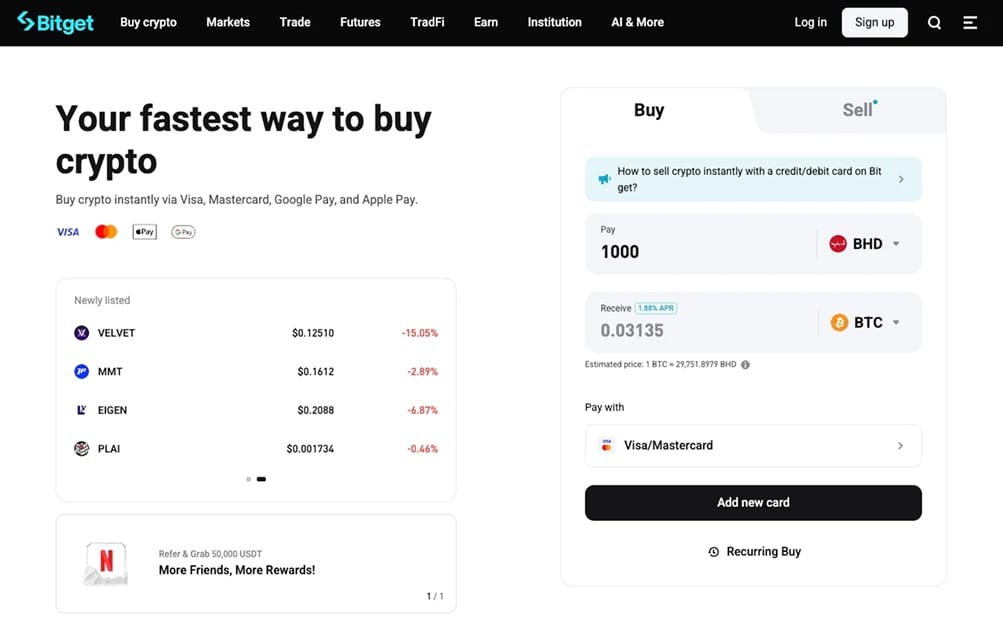
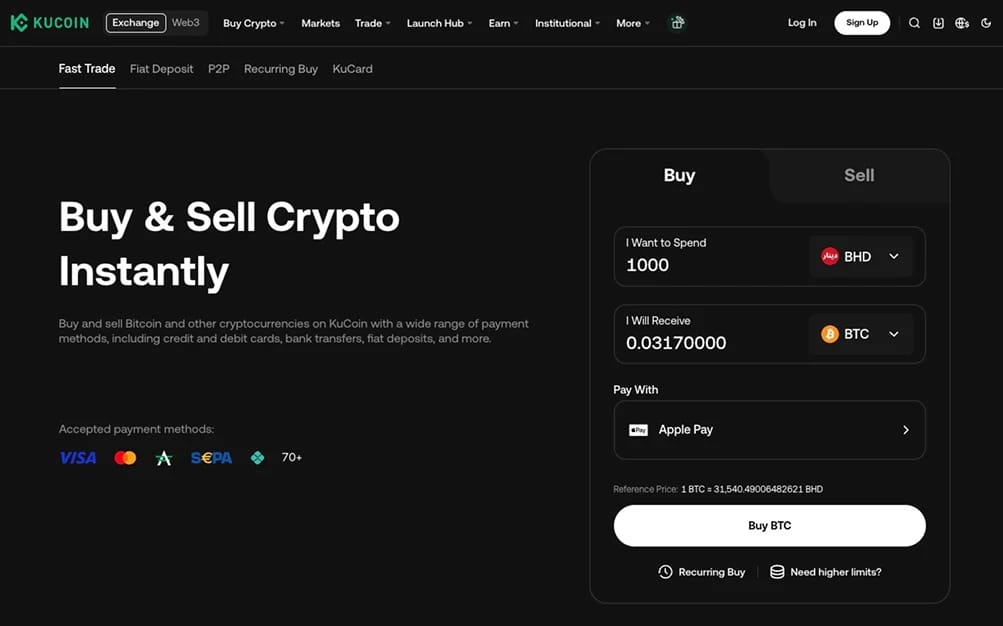
KuCoin is best suited to investors seeking yield. The exchange lists more than 1,000 cryptocurrencies, many of which have staking or Earn programs. This matters because smaller assets often provide their highest reward rates before appearing on more conservative platforms. New tokens can reach KuCoin months ahead of larger exchanges.
A complete trading suite sits alongside these yield products. Spot and futures markets connect to a customizable dashboard, the KuCard payment card, and a Web3 wallet through one account. KuCoin also provides round-the-clock support for Arabic speakers, which few offshore competitors match. Our KuCoin review examines the features and fees more closely.
External validation supports the platform's security case. KuCoin publishes proof-of-reserves data and states that assets are backed one-to-one. Its listed certifications include ISO 27001, SOC 2 Type II, and PCI DSS. Investors should weigh these measures against KuCoin's offshore status before keeping large balances there.
Pros
- Staking and Earn products across 1,000+ assets provide access to rewards that may never reach regulated exchanges.
- Spot and futures markets share an account with KuCard and the Web3 wallet, supported by 24-hour Arabic customer service.
- Proof-of-reserves reporting and certifications including ISO 27001, SOC 2 Type II, and PCI DSS support KuCoin's security claims.
Cons
- Advertised reward rates may include lockup periods, redemption queues, or later rate changes as disclosed in the product terms.
- KuCoin's complexity favors experienced traders, while beginners may enter leveraged positions in pursuit of yield.
- Without a CBB license, KuCoin is better used for trading than storing long-term savings.
How to Choose a Crypto Exchange in Bahrain
CBB-licensed platforms follow common client asset protection requirements. The meaningful differences are funding support, costs, and available products. We apply five checks before depositing dinars:
- Verify the license on the CBB register: Every authorized crypto-asset service provider and its permitted activities appear in the CBB licensing directory. Rain and Binance Bahrain are listed. Any platform absent from the register operates under foreign terms, leaving customers without local recourse.
- Test the BHD deposit screen before committing: Deposit menus do not always match marketing pages. Check for BenefitPay, Fawri, or Fawri+ by name. Card payments from NBB, BBK, or Ahli United Bank may face additional checks or currency conversion charges.
- Price the simple buy screen against the order book: Instant purchase screens often place much of their cost in the spread. Rain's 0.5% brokerage fee is ten times its 0.05% Pro taker rate. Our maker vs taker explainer details how each order type is charged.
- Plan the stablecoin bridge for offshore platforms: Bybit, Gate, Bitget, and KuCoin support cards or peer-to-peer transactions but not Bahraini bank transfers. A reliable approach is to buy USDT on a licensed local exchange and transfer it to the offshore platform, as explained in our buy USDT in Bahrain guide.
- Run a small withdrawal before scaling up: Start with a modest deposit, complete a trade, then return the proceeds to your bank. Testing with a small sum reveals verification problems, spreads, and settlement times before more money is at risk.
Crypto and Bitcoin Regulation in Bahrain
Owning and trading cryptocurrency is legal in Bahrain. The Central Bank of Bahrain regulates the sector through the Crypto-Asset Module (CRA) in Rulebook Volume 6. Licensed companies must meet capital standards and segregate client assets. They are also subject to anti-money-laundering requirements aligned with FATF guidance.
The regulatory framework developed through the following milestones:
- February 2019: The CBB introduced the CRA Module, the Gulf's first comprehensive licensing system for crypto-asset services. It covered trading, brokerage, custody, and advice.
- Mid 2019: Rain completed the regulatory sandbox and received a Category 3 license, the first awarded to a crypto company in the Middle East.
- Early 2021: CoinMENA became the second Bahrain-headquartered exchange to receive a license, securing Category 2 status and certification from the Shariyah Review Bureau.
- May 2022: Binance Bahrain became the first crypto-asset service provider with a full Category 4 license, the highest available tier.
- September 2022: The CBB authorized crypto payments through EazyPay and Binance Pay at more than 5,000 point-of-sale terminals.
- April 2024: A wallet breach cost Rain roughly $14.8 million. The company absorbed the loss from its own funds but faced criticism for remaining silent for two weeks.
- July 2025: The CBB released the Stablecoin Issuance and Offering (SIO) Module. It licenses issuers of BHD and USD stablecoins, including Sharia-compliant and yield-bearing versions.
- May 2026: Rain added BenefitPay for in-app purchases. It later introduced tokenized US equities for eligible Bahraini customers through a partnership with Kraken, under CBB oversight.
Check the operating company in the CBB licensing directory before depositing. Its listed permissions should cover every service you intend to use.
.webp)
How Does the NBR Tax Crypto?
Bahrain has one of the world's lightest tax systems for individual crypto investors. The National Bureau for Revenue (NBR) oversees the taxes that do apply. Three rules have practical importance:
- Individuals pay no tax on gains: Bahrain has neither personal income tax nor capital gains tax. Residents therefore have no filing obligation for profits earned from buying and selling crypto.
- Large multinationals face a 15% minimum: The Domestic Minimum Top-up Tax took effect on 1 January 2025 under Decree-Law 11 of 2024. It applies only to multinational groups with consolidated revenue of at least 750 million euros, excluding individual traders and ordinary Bahraini businesses.
- VAT applies at 10% to some services: The NBR generally assesses crypto activity under financial-services principles. Purchases and sales of payment tokens typically fall outside VAT, though fee-based business services may attract the standard 10% rate.
This section provides general guidance rather than tax advice. Anyone operating a crypto business or belonging to a multinational group should confirm their position with the NBR or a licensed advisor.
.webp)
Cryptocurrency Adoption in Bahrain
Crypto adoption in Bahrain is substantial for a country of its size. Seven years of regulatory clarity have supported growth, while its payments network was already accustomed to digital transactions. Statista Market Insights projects approximately 100,000 crypto users during 2026, equal to a penetration rate of nearly 6.4%.
Corporate and banking activity accelerated over the past year. In May 2025, Al Abraaj Restaurants Group became the first publicly listed GCC company to adopt a Bitcoin treasury strategy, purchasing Bitcoin for its Bahrain Bourse-listed balance sheet. CBB-licensed Category 3 firm ARP Digital partnered with the Bank of Bahrain and Kuwait (BBK) on stablecoin settlement.
Growth in everyday spending has attracted less attention. Binance Pay works at more than 5,000 EazyPay terminals, including those at Lulu Hypermarket and stc Bahrain. Rain customers can also use BenefitPay to purchase crypto instantly from any local bank account. Our crypto adoption statistics page compares Bahrain with other markets.
.webp)
How to Buy Bitcoin in Bahrain
The lowest-cost method combines a licensed exchange with a free BHD transfer and limit orders on the order book. When the required documents are ready, the process takes less than an hour:
- Open an exchange account: Rain works well for first-time buyers and customers seeking CBB protection. Binance adds merchant payments and copy trading, while Bybit and Gate suit derivatives or altcoin traders prepared to use offshore platforms.
- Complete identity verification: Submit a passport or Bahraini ID card and finish the selfie check before depositing. Rain usually approves accounts within one day when the name matches the identity document exactly.
- Deposit dinars: Rain charges nothing for BenefitPay and Fawri+ transfers, which usually arrive within minutes. The daily Fawri+ limit is BHD 1,000, so larger deposits require standard Fawri and take longer to settle.
- Buy on the order book: Open the BTC market and place a limit order at your chosen price to avoid the brokerage spread. A resting limit order on Rain Pro incurs a 0% maker fee.
- Transfer coins you plan to keep into your own wallet: Long-term holdings are safest when you control the keys. Our best crypto wallets guide compares hardware devices. Always verify the selected network before withdrawing.
To sell, complete the same steps in reverse. Rain does not charge for BHD withdrawals to local banks.
Final Thoughts
Rain ranks highest because its features closely match the needs of Bahraini customers. It supports free BHD funding via BenefitPay and Fawri, holds the Middle East's oldest crypto license, and offers Sharia certification unavailable on most global exchanges. Binance places second with a CBB Category 4 license and unmatched liquidity.
Bahrain's regulator continued to outpace neighboring markets over the past year. It introduced stablecoin issuance rules in July 2025, earlier than most major economies. Tokenized US equities then reached retail investors via a licensed exchange in 2026, giving residents access to supervised products that nearby markets offer only through offshore platforms.
Offshore exchanges remain useful for broader coin selection and derivatives, provided users keep balances modest and test withdrawals early. For a regional comparison, see our UAE exchange guide and Saudi Arabia exchange guide.
Our Methodology
We assessed exchanges accepting Bahraini customers in August 2026, giving the greatest weight to local licensing and BHD funding. The ranking used six criteria:
- Trust score: Our 5-point rating considers regulatory status, incident history, ownership transparency, and operating history.
- License verification: Each brand was traced to its legal entity, then checked against the CBB licensing directory for its category and permitted activities.
- BHD funding in practice: We deposited dinars through the available channels, recorded how long they took to become tradable, and withdrew funds to the same bank account.
- All-in cost per trade: Bitcoin purchases on each platform were assessed using trading fees, instant-buy spreads, and withdrawal charges.
- Product coverage: We reviewed coin selection and derivatives, along with staking and Earn programs, copy trading, and tokenized assets.
- Local relevance: Scores account for Arabic language quality, Sharia certification, support for BenefitPay and Fawri, and the presence of a Bahraini legal entity.
Testing ended in August 2026. Every licensing claim was checked against the CBB register before publication.
.webp)