






Compare Top Crypto Exchanges in Belarus
1. Bybit
Bybit is the best crypto exchange in Belarus. The second-largest exchange globally lists more than 2,800 assets, charges 0.10% on spot, with perpetual maker fees starting at 0.02%, and pools spot, derivatives, and margin under a single collateral balance through its Unified Trading Account. The user interface is available in Russian, and Russian-language customer support is available. Bybit also publishes monthly proof-of-reserves reports.
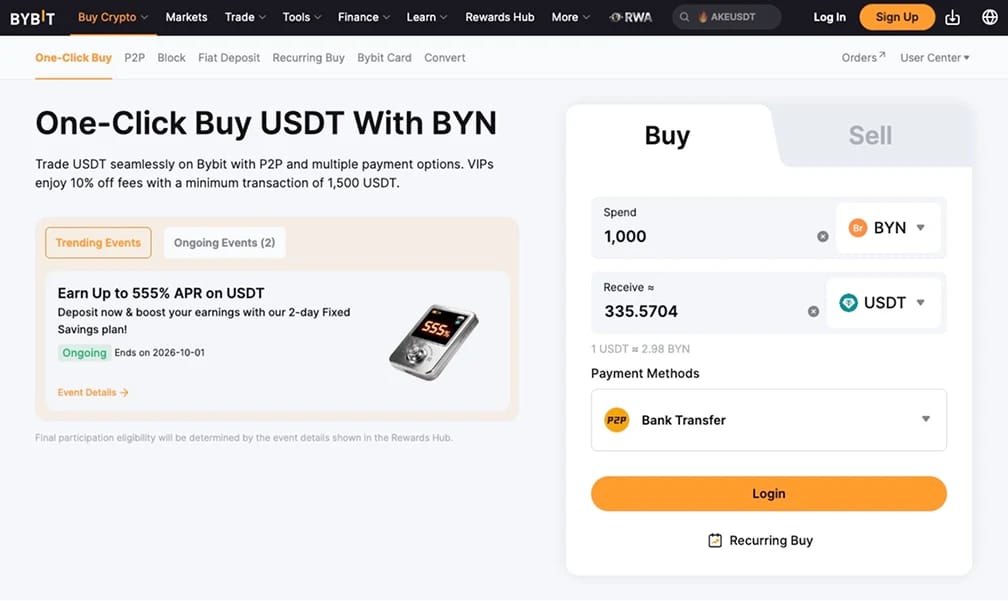
Ruble funding runs through the P2P marketplace, where merchants quote USDT against BYN and settle via transfers between local bank accounts (MTBank, Paritet Bank, PriorBank, and Privat Bank). Our test order matched within minutes at a spread under 1% of the interbank rate. Once funds are available in the app, users can access spot and futures trading, copy trading, Earn, trading bots, crypto loans, and demo trading.
Two events belong in any honest assessment. Belarusian regulators added bybit.com to the national blocklist in December before restoring it three days later, and North Korea's Lazarus Group stole $1.5 billion from the exchange in early 2025, a loss Bybit covered from its own reserves. No user funds were affected, and Bybit increased its security measures shortly after. Our Bybit review examines the recovery in detail.
Pros
- The broadest combination of spot, futures, and passive products reachable from Belarus.
- An active BYN P2P desk with merchants settling through the major local banks.
- Monthly proof-of-reserves reporting and a demonstrated ability to absorb a record theft.
Cons
- Its website was on the Belarusian blocklist for three days in December over an undetailed advertising complaint.
- The $1.5 billion Lazarus theft remains part of its record despite full repayment.
- Ruble conversion here sits outside the HTP regime, so gains carry a 13% declaration duty.
2. BingX
BingX earns second place as the derivatives specialist. Over 40 million people hold accounts here; the platform sits among the five largest crypto derivatives venues globally, and perpetual contracts stretch to 150x leverage. The TradFi market, added this year, lets the same USDT balance trade over 100 traditional instruments spanning gold, oil, forex, and stock indices, valuable where brokerage access to Western markets has largely closed.
A full demo mode lets newcomers practice leveraged positions with virtual funds, and the social feed shows the live positioning of ranked futures traders. Spot trading covers more than 1,000 assets at 0.10%. In addition to trading crypto, stocks, and commodities, users can access copy trading, trading bots, lending, borrowing, and fixed or flexible Earn products.
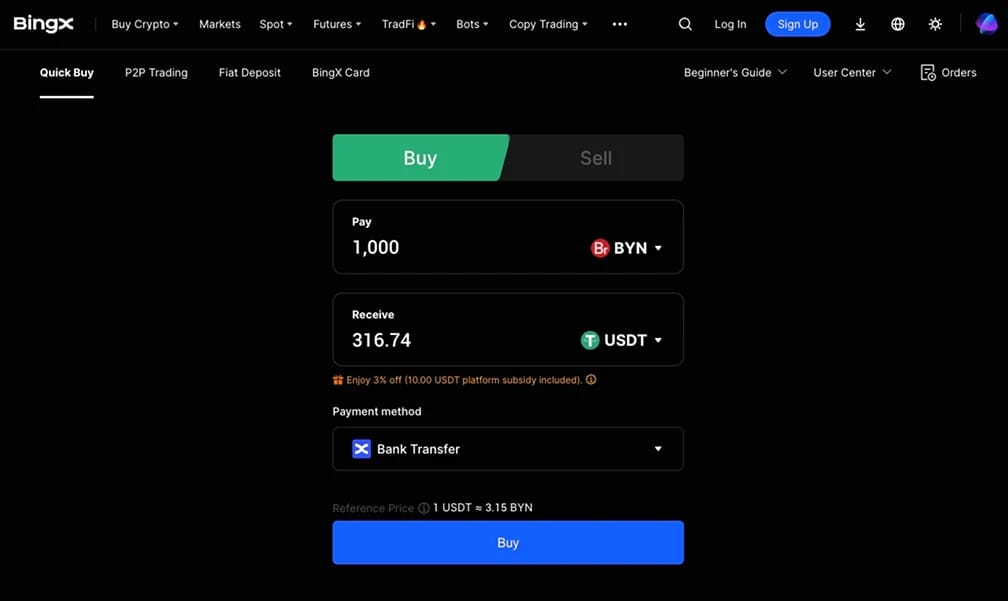
BingX spent the same three December days on the blocklist as Bybit. BYN funding runs through its P2P marketplace, though the merchant pool is shallower than on Bybit or Binance, so larger ruble orders fill faster elsewhere. Belarus does not appear on its excluded jurisdictions list, which we track in our BingX restricted countries guide.
Pros
- Futures leverage up to 150x, plus commodity and index perpetuals, from one USDT wallet.
- A complete demo environment for rehearsing strategies before risking rubles.
- Copy trading with transparent statistics on every listed trader.
Cons
- Fewer spot listings than Bybit or KuCoin once you move past the majors.
- A thinner BYN merchant pool means slower fills on larger P2P orders.
- It was among the six platforms blocked in December, even though access returned within days.
3. KuCoin
KuCoin serves Belarusians who trade beyond the major coins. The exchange counts 41 million registered users across 200+ countries. Over 900 assets trade at a flat 0.10% before KCS discounts apply, small caps and altcoins regularly list here first, and GemSPACE flags early-stage projects across AI, gaming, and DePIN.
Access is its quiet advantage. When the Ministry of Information blocked six rivals in December, KuCoin stayed reachable, which is continuity that matters to anyone carrying leveraged positions. Futures run to 125x on major pairs, users have created close to nine million grid and DCA bots on the platform, and the Earn section puts resting stablecoin balances to work.
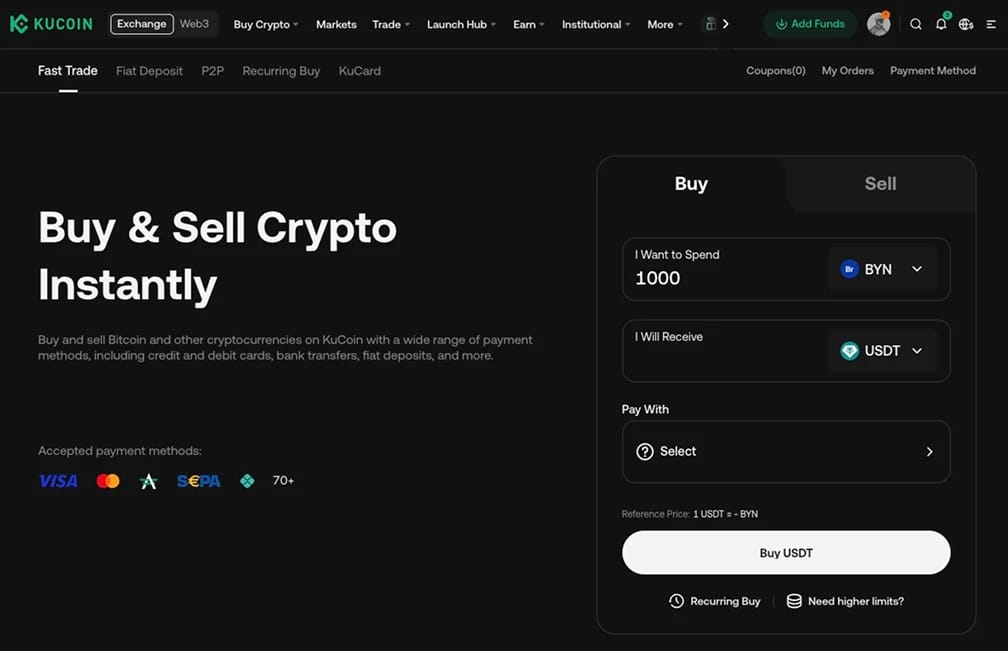
The record carries a $297 million blemish. KuCoin's operator pleaded guilty in a US federal case over unlicensed money transmission. Direct ruble entry is the other weakness, since few merchants quote BYN on its P2P section, so most users arrive holding USDT bought elsewhere. Visit our KuCoin review to learn more about the exchange’s security history, features, fees and more.
Pros
- The deepest altcoin catalog on this list, with early listings through GemSPACE.
- It stayed accessible through the December blocking of six competing platforms.
- Native bots and Earn products keep balances productive between trades.
Cons
- The US guilty plea and $297 million penalty are recent entries in its compliance record.
- BYN merchants are scarce on its P2P section, so direct ruble entry is impractical.
- Small-cap positions can be difficult to exit at a fair price when interest fades.
4. Binance
Binance remains the depth benchmark as the world’s largest crypto exchange by trading volume and user count. The platform passed 323 million registered users in July and settles over $20 billion in spot volume on an average day, roughly a third of the global spot market. Order books absorb large trades at tighter spreads than any rival here, and spot fees start at 0.10% and fall when paid in BNB.
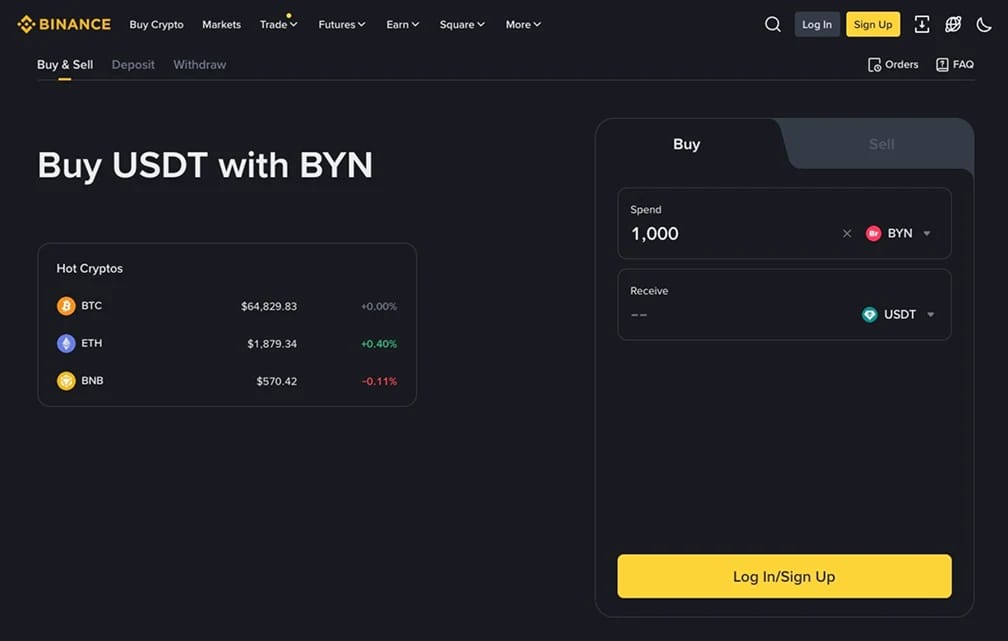
Its BYN P2P desk is the busiest we tested, with merchants settling through the large local banks and completing well over nine of every ten orders during Minsk hours. Auto-Invest handles recurring purchases, the bot library covers grid and rebalancing strategies, the Earn shelf spans flexible and locked products, and the Web3 wallet reaches dozens of networks. Lukashenko has named it among the exchanges handling growing external payment volumes.
Binance also avoided the December blocklist entirely. The counterweight is its 2023 settlement with US authorities for $4.3 billion, the largest in crypto's history, and an interface that buries a first-time buyer under products. Users can learn more about the exchange by visiting our Binance review, which tracks the compliance rebuild.
Pros
- The deepest liquidity and the busiest BYN merchant pool available to Belarusians.
- Auto-Invest, grid bots, and a Web3 wallet cover automation and on-chain access.
- It was never added to the December blocklist that caught six rivals.
Cons
- The $4.3 billion US settlement remains part of its global record.
- Product density makes the app genuinely confusing for a first purchase.
- Like every foreign venue, it operates outside the HTP regime that Belarusian law prefers.
5. Bitget
Bitget is built around borrowed expertise, making it the perfect platform for users who want to automate their trading. No rival has taken copy trading further, with over 190,000 lead traders open to followers, and its leaderboards expose each trader's return, drawdown, and capital under management, so a follower in Grodno can screen for risk instead of marketing.
Behind the social layer, the platform reports 120 million registered users and over $20 billion in daily volume across its books. Its own catalog runs past 800 digital assets at a 0.10% spot trading fee. The latest proof-of-reserves report showed total backing of 169%, a protection fund exceeding $400 million backing client assets, and a TradFi section extending the account into tokenized stocks and commodities.
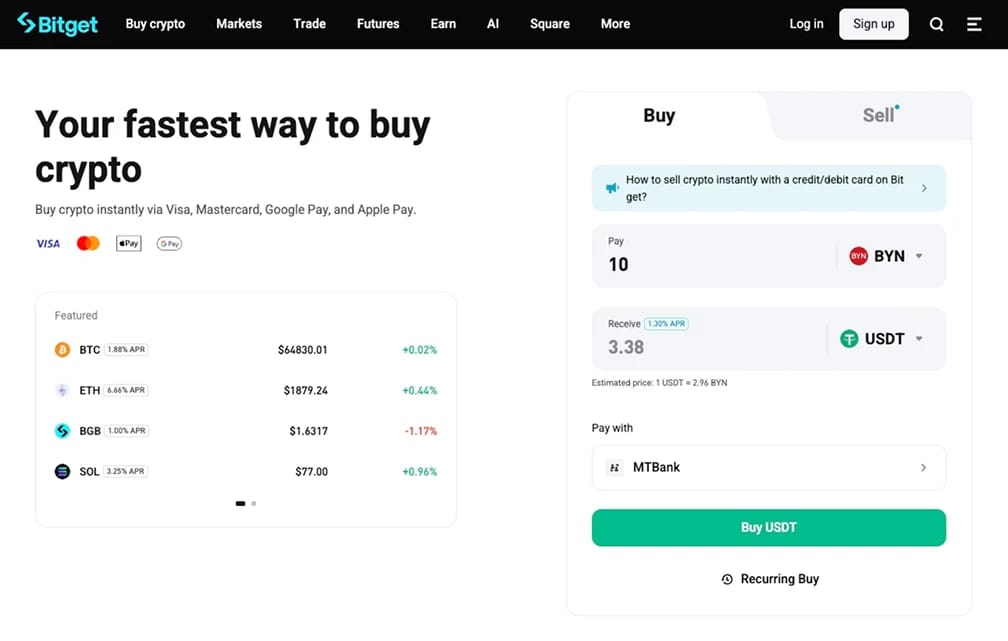
Bitget was blocked and restored alongside Bybit and BingX in December, and its BYN P2P pool is thin, so most Belarusian users fund it with stablecoins moved from another platform. However, it is one of the few exchanges that has never been subject to a cyber attack or serious security incident since its inception. Our Bitget review covers the full feature set.
Pros
- The most mature copy trading system reachable from Belarus, in both spot and futures.
- A 169% reserve ratio and a protection fund above $400 million.
- Earn products and a Web3 wallet round out the account.
Cons
- Followers often copy a strategy after its best month, and the tools cannot prevent that mistake.
- Direct BYN entry is weak, so funding usually arrives as USDT from elsewhere.
- Its website was blocked for three days in December before being restored.
6. BYNEX
BYNEX is the platform Belarusian law wants you on. As a registered HTP resident, it operates within the Decree No. 8 framework and meets the annual technical and financial audit requirements for residency. Deposits arrive through ERIP, BELKART, and local bank cards, and withdrawals land back in BYN.
Legal standing is the core advantage. Trades executed through an HTP platform stay exempt from personal income tax and need no annual declaration, and Decree No. 367 makes this category of platform the lawful place to turn tokens into rubles. Support answers in Russian, and the interface assumes a Belarusian bank account rather than working around one.
The compromise is scale. Roughly 20 assets trade here against a 0.25% fee; there are no derivatives, no yield products, and no published user or volume figures, and order books are shallow enough that large market orders pay a visible spread. Whitebird and Free2ex, the other consumer-facing HTP platforms, share the same limits. We treat BYNEX as the ruble gateway in a two-account setup rather than a complete trading venue.
Pros
- HTP registration makes it a lawful and tax-exempt way to move between BYN and crypto.
- ERIP, BELKART, and local card support that no foreign exchange can offer.
- Annual state-mandated audits and support in Russian from staff who know the local banks.
Cons
- A catalog of roughly 20 assets against thousands on the global platforms.
- No futures, margin, or copy trading for active strategies.
- Shallow order books make the 0.25% fee only part of the real cost on larger trades.
.webp)
How to Choose a Crypto Exchange in Belarus
No global platform is registered in Belarus, and no local platform matches global depth, so the sensible setup in Belarus is usually a pair of accounts.
- Confirm HTP registration: The Hi-Tech Park publishes its resident list, and consumer platforms on it include BYNEX, Whitebird, and Free2ex. A service advertising a Belarusian crypto license that does not appear there is misrepresenting its status.
- Split the job between a ruble gateway and a trading venue: Use an HTP platform for moving between BYN and crypto, where trades stay tax-exempt and lawful under Decree No. 367, and hold a global account for depth, derivatives, and altcoins, accepting the declaration duty attached.
- Assume your bank card fails abroad and plan around it: Card purchases on foreign exchanges rarely clear with Belarusian-issued cards, since processors decline the country code and several large banks sit under sanctions. ERIP covers local deposits and P2P covers the rest, a pattern our guide to buying USDT in Belarus walks through.
- Measure the BYN P2P desk before you need it: Count active merchants during Minsk daytime hours, skip anyone completing fewer than 95 of every 100 orders, and compare quoted USDT prices with the interbank rate. Binance and Bybit showed the deepest pools in our tests.
- Keep records for the March declaration from day one: Foreign-platform income must be declared each year to the tax authorities, and reconstructing entry prices years later is far harder than exporting statements as you go.
Crypto and Bitcoin Regulation in Belarus
Crypto is legal in Belarus, and almost nothing about it is unregulated. The state built the sector around the Hi-Tech Park and has spent recent years narrowing every path outside that perimeter, with the National Bank taking a growing supervisory role.
Here is a quick summary of the country’s regulatory framework over the past 10 years:
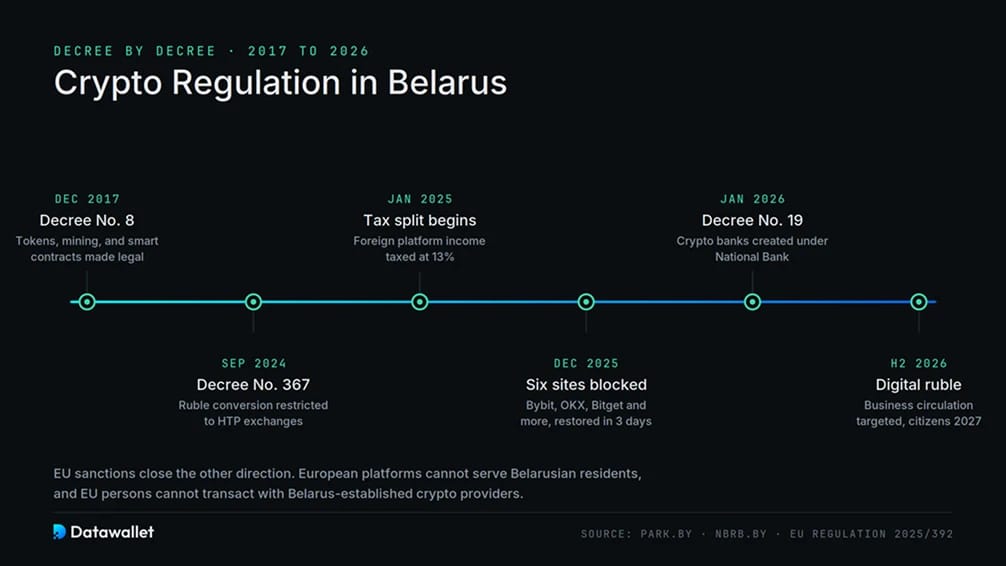
- December 2017: President Lukashenko signs Decree No. 8, "On the Development of the Digital Economy," giving tokens, mining, and smart contracts legal status before most governments had a position. The rules take effect the following March.
- 17 September 2024: Decree No. 367 narrows the field, requiring individuals to buy tokens and exchange them for rubles, foreign currency, or electronic money only through HTP resident companies. Running exchange activity outside that structure risks administrative liability and confiscation.
- 1 January 2025: HTP platform income stays exempt, while foreign platform and private-transfer income become declarable and taxable, ending the blanket exemption in place since 2018.
- 23 April 2025: Decree No. 166 targets prohibited activity, applying a profitability index set annually by the tax ministry to income from illegal token transactions so that undeclared gains can be assessed even without records.
- September 2025: Lukashenko urges banks to work with crypto for external payments as sanctions restrict conventional settlement channels, naming Binance, OKX, and KuCoin among platforms active in the country.
- 9 to 12 December 2025: The Ministry of Information blocks the websites of Bybit, OKX, Bitget, BingX, Gate, and Weex over "inappropriate advertising," then restores access three days later. Binance and KuCoin are never listed.
- 16 January 2026: Decree No. 19 creates crypto banks, joint-stock HTP residents that combine token services with conventional banking under National Bank supervision. The HTP approves a 26-token operating list in April, and the National Bank's registry rules enter into force on 18 July.
- Second half of 2026: The National Bank targets bringing the digital Belarusian ruble into circulation for businesses, with government agencies and citizens to follow in 2027.
Sanctions frame all of it from the other side. The EU prohibits its platforms from providing crypto wallet, account, or custody services to Belarusian citizens and residents, and its April 2026 package bans EU persons from transacting with Belarus-established crypto providers and with the future digital Belarusian ruble.
How Is Crypto Taxed in Belarus?
Belarus built its reputation on a total crypto tax holiday, and what survives is a split system that rewards staying inside the HTP perimeter. The Ministry of Taxes and Duties administers the rules, and where you traded determines what you owe.
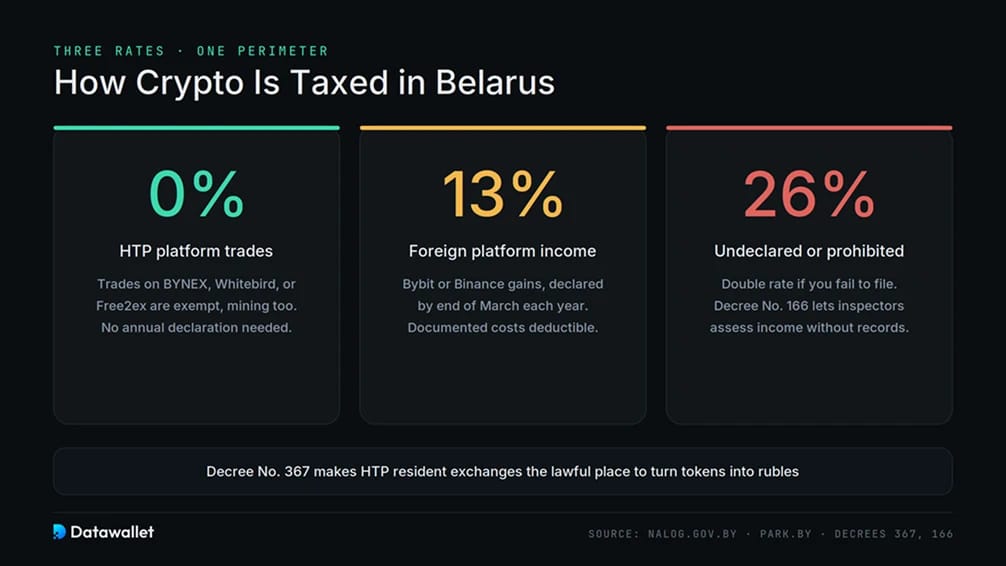
- HTP platform income stays tax-free: Gains from tokens bought and sold through HTP residents such as BYNEX, Whitebird, or Free2ex carry no personal income tax and no declaration requirement, a benefit the Hi-Tech Park confirms alongside the exemption for mining income.
- Foreign platform income is taxed at 13%: Income from tokens traded on foreign exchanges, or received from foreign companies and individuals, must be declared annually and is taxed at 13%, with documented purchase costs and commissions deductible from the base.
- Undeclared or prohibited income is taxed at 26%: Failing to file or earning through prohibited activity doubles the rate, and Decree No. 166 lets inspectors assess such income from a published profitability index instead of records.
- Declarations run on the standard calendar: Individuals report the previous year's foreign-platform income by the end of March.
- Inheritance and family gifts stay outside the net: Tokens received by inheritance, or by gift within the limits the law sets, are not treated as taxable income.
Every revision since 2024 has restricted activity outside the HTP, so treat the 13% rate as a floor that can rise, and take professional advice for anything beyond simple personal holdings.
Cryptocurrency Adoption in Belarus
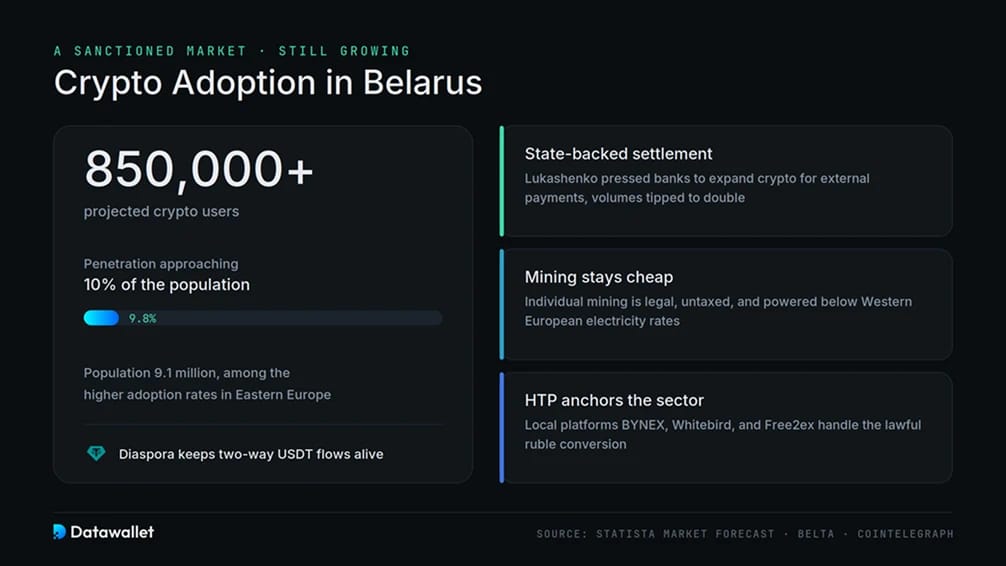
For a sanctioned country of 9.1 million, Belarus shows unusually high crypto activity, and the state is now an open participant rather than a bystander.
- Nearly one in ten Belarusians holds crypto: Statista's market forecast projects more than 850,000 crypto users in Belarus, with penetration approaching 10% of the population, among the higher rates in Eastern Europe.
- The state treats crypto as a settlement channel under sanctions: Lukashenko has publicly pressed banks to expand crypto use for external payments and claimed exchange-based settlement volumes could double within a year.
- Cheap electricity keeps mining attractive: Individual mining is legal and untaxed, and grid power, supported by the Astravets nuclear plant, costs far less than in Western Europe, which sustains a durable hobbyist mining base.
- The IT diaspora keeps stablecoins moving: Years of emigration by HTP-trained developers created steady two-way USDT traffic between Belarus and relocated relatives, which is why P2P desks quote BYN at all. Our crypto adoption statistics page sets these figures against the global picture.
Neighboring markets face a related but different squeeze, and readers comparing regimes can see how Moscow handles the same pressures in our guide to the best crypto exchanges in Russia.
How to Buy Bitcoin in Belarus
Buying BTC from Belarus takes under half an hour once you accept that the legal entry point and the deepest markets sit on different platforms.
- Find an exchange: BYNEX or another HTP resident for lawful ruble conversion, plus Bybit or Binance for depth, derivatives, or altcoins. Confirm that Belarus appears in the sign-up country list before verifying.
- Complete KYC: Every platform here accepted Belarusian documents in our tests. Match the spelling on the document exactly, since a name that differs from your bank details is the usual reason a first withdrawal stalls in review.
- Pick your BYN deposit method: On an HTP exchange, deposit BYN through ERIP or a BELKART card and buy directly. On a global exchange, open the P2P section, filter for BYN, choose a merchant with a strong completion record, and pay by local bank transfer while the USDT sits in escrow.
- Place a limit order: On both local and global platforms, the instant purchase screen quoted us a worse price than the order book, with the gap widest on the thin BYN pairs. A limit order on BTC/USDT costs a moment of patience and saves the spread.
- Decide where to store your assets: Long-term holdings belong in self-custody, and our best crypto wallets guide compares the options. Export your trade history the same day if anything ran through a foreign platform, since that record backs your March declaration.
Selling reverses the steps, with one caution. Bring value back to the HTP platform as USDT and sell for BYN there, keeping the fiat conversion inside the structure Belarusian law recognizes.
Final Thoughts
Bybit holds first place in Belarus on its catalog, its ruble P2P desk, and its full repayment of users after the largest theft in industry history. BingX earns its slot on derivatives, KuCoin on altcoins and uninterrupted access, Binance on depth, Bitget on copy trading, and BYNEX on being the platform the law was written around.
The deeper story is consolidation. A market that began as the region's freest is being drawn inside a perimeter of HTP platforms, crypto banks, and a coming digital ruble, and the December blocking showed how quickly access outside that perimeter can be interrupted.
Keep the local account funded, the foreign account documented, and long-term holdings in your own custody.
Our Methodology
We ranked these platforms as a resident would experience them, not as their marketing describes them. Accounts were verified with Belarusian documents, funded in rubles through ERIP and P2P transfers, put through real orders, and emptied back out. Six criteria set the order.
- Trust Score: Our proprietary 5-point rating, shaped by how openly reserves are disclosed, what each breach cost users and how it was resolved, years in operation, and legal standing under Belarusian law, since no foreign license protects anyone in Minsk.
- Belarus Availability: Confirmed that each platform accepts Belarusian sign-ups and documents, and checked its history on the national blocklist, including the December episode.
- BYN Funding Methods: Tested ERIP and BELKART deposits on the local platform and BYN P2P orders on the global ones, recording merchant depth, settlement times, and spreads against the interbank rate.
- Security Track Record: Studied each platform's incident record, where client assets are held, how regularly reserves are attested, what insurance or protection funds exist, and which defenses an account can switch on.
- Assets and Liquidity: Worked BTC, ETH, and one smaller pair on every venue with real orders, recording spread cost, quote depth, and how cleanly orders closed, with extra attention to the thin BYN pairs.
- Fee Structure: Priced a complete ruble round trip on each platform, counting trading fees, the P2P spread paid at entry and again at exit, and withdrawal costs on the networks Belarusians realistically use.
Platforms that reject Belarusian users, including all EU-licensed exchanges subject to the sanctions regime, were excluded before testing began. We tested through the first half of the year and re-verified access and blocklist status in July.
.webp)