







Compare Top Canadian Crypto Exchanges
1. Kraken
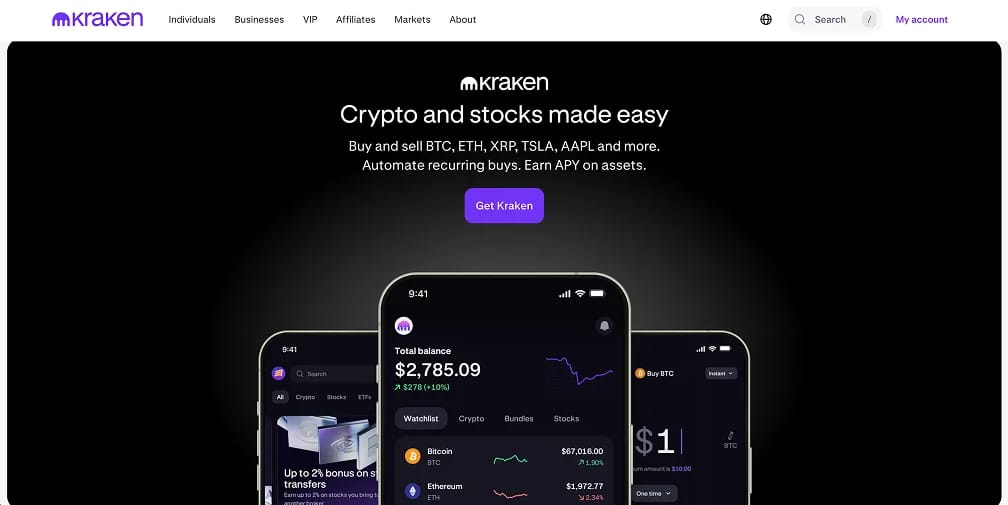
Kraken leads our Canadian rankings by pairing the deepest trading stack open to Canadians with a registration most global venues never earned. Payward Canada secured its restricted dealer registration from the OSC in April 2025 after a multi-year pre-registration undertaking, marking the milestone with free Interac e-Transfer deposits for Canadian clients. Its Canadian roots reach back to Calgary's CaVirtEx, acquired in 2016.
Pricing rewards anyone willing to open the Pro interface. Kraken Pro charges 0.25% maker and 0.40% taker at the base tier and falls with volume, against roughly 1% plus spread on the simple Buy Crypto widget. The catalogue runs past 600 assets with direct BTC/CAD and ETH/CAD books, proof-of-reserves attestations date back to 2014, and no client funds have been lost to a breach since 2011. Our e-Transfer from a TD account credited in under ten minutes.
The registration came with strings attached. Assets sit outside Canadian Investor Protection Fund coverage, Canadians are confined to the local platform without derivatives or margin, and the flexible staking programme closed to new Canadian users under the order. Kraken plans to pursue investment dealer status and CIRO membership next. Our Kraken review covers the wider platform.
Pros
- Free Interac e-Transfer deposits with settlement typically inside minutes.
- Kraken Pro fees of 0.25% and 0.40% undercut every Canadian-owned platform except NDAX.
- Proof of reserves published since 2014 and a clean custody record since 2011.
- The widest asset selection of any CSA-registered platform serving Canadians.
Cons
- Client assets sit outside Canadian Investor Protection Fund coverage, which every user must acknowledge.
- No margin or derivatives for Canadian retail under its restricted dealer conditions.
- Debit card deposits carry a fee of $0.25 plus 3.75%, so cards are best avoided.
2. Coinbase
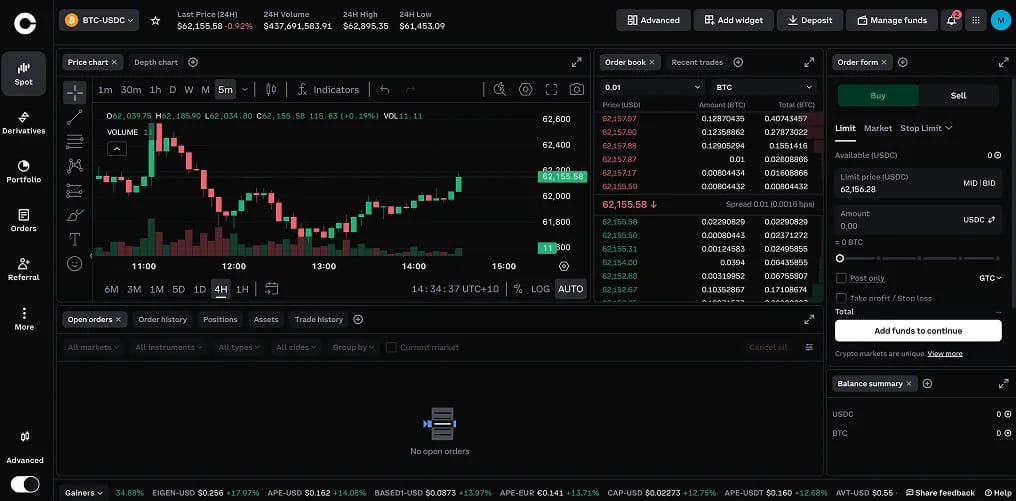
Coinbase became the first international exchange registered as a restricted dealer in Canada in April 2024 and pairs that registration with disclosure no crypto-native rival matches. The Nasdaq-listed company joined the S&P 500 in May 2025, publishes audited quarterly accounts, and runs Interac payment rails through Peoples Trust, so e-Transfer and EFT deposits in CAD carry no Coinbase fee. Around 200 assets trade for Canadian accounts, and USDC balances earn rewards automatically.
The two-interface split defines the cost picture. Simple buys stack a spread on a transaction fee, while Advanced Trade opens at 0.40% maker and 0.60% taker on a real order book, above Kraken Pro and NDAX but below most instant-buy screens. Staking covers the majors with commissions reaching 35% of rewards unless Coinbase One trims them.
Our testing surfaced one warning. The first e-Transfer stalled when the bank account name did not exactly match the Coinbase profile, and support took a day to untangle it. Line the names up before sending. Our Coinbase review and Coinbase vs Kraken comparison weigh the full trade-offs.
Pros
- Registered restricted dealer in every province and territory, backed by S&P 500 disclosure standards.
- Free Interac e-Transfer and EFT deposits with a $2 minimum, plus PayPal purchases.
- Automatic rewards on USDC balances and the gentlest onboarding for first-time buyers.
Cons
- Simple-buy pricing embeds a spread on top of the fee, the costliest path in the app.
- Interac deposits fail silently when account names do not match exactly.
- Staking commissions run to 35% of rewards without a Coinbase One subscription.
3. Wealthsimple
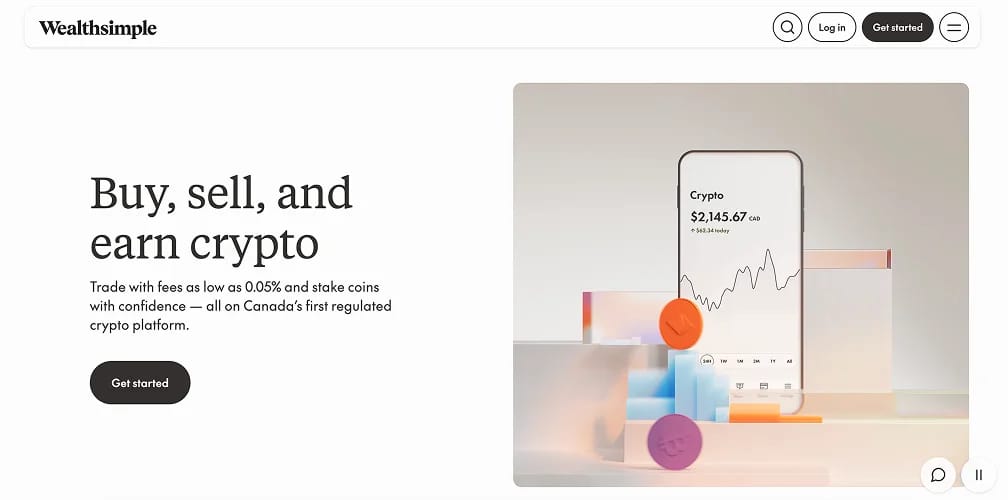
Wealthsimple holds the strongest regulatory position on this list. Its crypto product sits inside the same CIRO-regulated investment dealer as its stock and ETF brokerage, so cash balances carry Canadian Investor Protection Fund coverage up to $1 million, a backstop no restricted dealer can offer. The firm counts more than three million clients, and the crypto shelf spans 140+ assets with staking on ETH, SOL, ADA, and DOT.
Cost is where the honest conversation starts. The baseline trading fee is 2% for Core clients, sliding down a volume ladder with lower tiers for Premium and Generation households, while USDC trades against US dollars carry no fee. A $10,000 Bitcoin buy at the Core rate costs $200, a hundred times the same order on NDAX. Recurring buys funded through automate-your-pay skip the trading fee entirely, quietly making Wealthsimple one of Canada's cheapest ways to dollar cost average from a paycheque.
For a Canadian already running a TFSA, RRSP, and chequing account in the app, the convenience is hard to beat, though crypto sits in a non-registered account only. We unpack the fee mechanics and spreads in our guide to buying crypto with Wealthsimple.
Pros
- The only Canadian crypto platform inside a full CIRO investment dealer, with CIPF protection on cash.
- Fee-free recurring buys through automated pay deposits and zero-fee USDC trading against USD.
- Staking on four major networks plus instant deposits up to $50,000 for Core clients.
Cons
- The 2% Core trading fee is the most expensive baseline rate among regulated Canadian platforms.
- No USDT, no margin, and no advanced order tooling for active traders.
- Crypto cannot be held inside a TFSA, RRSP, or FHSA, only in a taxable account.
4. NDAX
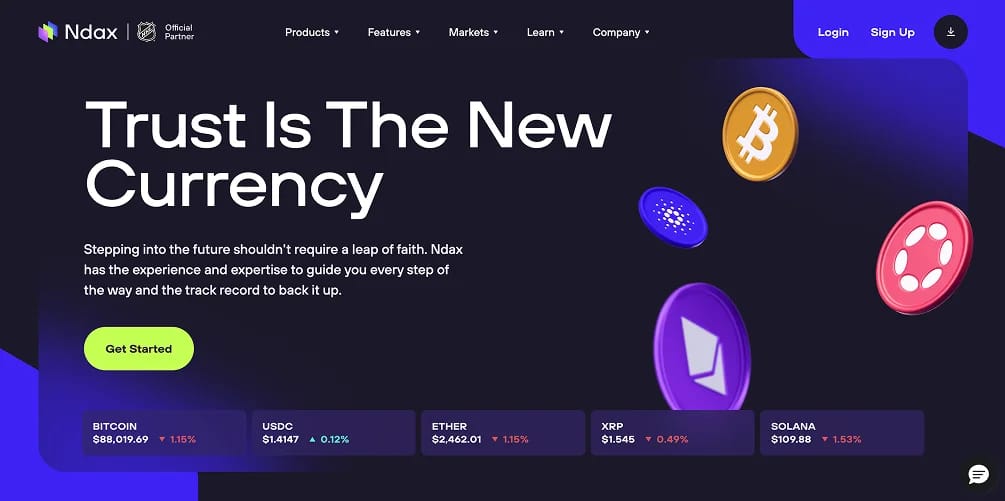
NDAX is the price leader among Canadian-owned platforms. The Calgary exchange charges a flat 0.2% on every trade with no tiers and no spread games, takes Interac e-Transfer, wire, and bank draft deposits at zero cost, and lists 55+ assets traded directly against the Canadian dollar. CIRO published NDAX's member exemptive relief decisions in late December 2024 as the platform moved beyond the restricted dealer track.
The product suits people who trade with intent. Limit, stop, and advanced order types sit on a proper order book, staking pays a 20% administration fee on rewards only, and NDAX Wealth runs an OTC desk for orders above $50,000. Cash withdrawals cost a flat $1.50 by e-Transfer or $4.99 by wire, predictable rather than punitive.
The compromises are scale and polish. The asset list is a fraction of what Kraken or Crypto.com carry, new listings arrive slowly, and the interface assumes some trading literacy. For a Canadian accumulating BTC and ETH every month at the lowest verifiable cost, none of that matters much.
Pros
- A flat 0.2% trading fee, the lowest headline rate of any regulated Canadian platform.
- Free CAD deposits by Interac e-Transfer, wire, and bank draft.
- Advanced order types, staking, and an OTC desk for larger Canadian investors.
Cons
- A coin list of around 55 assets trails the global venues on this page.
- Flat withdrawal fees sting on small cash-outs.
- The trader-focused interface can feel technical for a first-time buyer.
5. Shakepay
Shakepay does one thing and does it with more regulatory backing than any pure Bitcoin app in the country. The Montreal firm became the first Québec crypto platform admitted to CIRO as an investment dealer in January 2025, bringing CIPF coverage of up to $1 million on client cash, then became the first crypto-native member of Payments Canada. Around 1.5 million Canadians use it to buy Bitcoin and Ethereum, the only two assets offered.
The experience is built for habit rather than analysis. Interac e-Transfer funding lands quickly, ShakingSats pays a few satoshis for a daily phone shake, recurring buys automate a stack, and Lightning withdrawals give Bitcoin users a cheap exit to self-custody. A prepaid Visa returns spending rewards in Bitcoin, and a Bitcoin-backed loan launched this spring under exemptive relief from Québec's AMF.
Pricing hides in the quote. There is no listed commission, and the spread sits in the 1% to 2% band, so a round trip costs more than a limit order on an order book. For a Bitcoin-only saver who values simplicity and CIRO oversight, that trade reads fair.
Pros
- CIRO investment dealer status with CIPF protection on Canadian dollar balances.
- Frictionless Interac e-Transfer funding, recurring buys, and Lightning withdrawals.
- ShakingSats rewards and a prepaid Visa that pays back in Bitcoin.
Cons
- Bitcoin and Ethereum only, so any altcoin exposure requires a second platform.
- Spread-based pricing of roughly 1% to 2% costs more than order book venues.
- No advanced orders or trading tools of any kind.

6. Robinhood
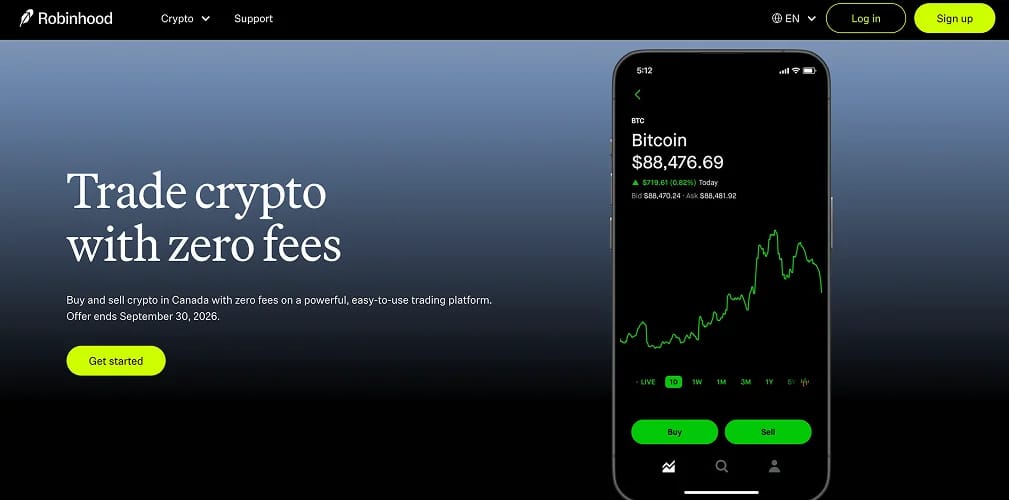
Robinhood is the newest name on a Canadian ranking and the oldest infrastructure underneath it. The US broker completed its acquisition of WonderFi in early June, taking over Bitbuy and Coinsquare, roughly 300,000 funded accounts, and more than C$2.1 billion in client assets under custody. Coinsquare Capital Markets brings a CIRO investment dealer registration into the group, and Robinhood has run a Toronto engineering hub since 2024.
The pitch to Canadians is a flat 0.5% fee per CAD trade inside the Robinhood app, with Bitbuy and Coinsquare users invited across as the migration proceeds. The rate lands between NDAX's 0.2% and Wealthsimple's Core tier, with a cleaner interface than either and a Nasdaq-listed parent that also owns Bitstamp. Interac e-Transfer deposits on legacy Bitbuy were free with a $50 minimum in our testing.
The caution is timing. Mid-migration, features, coin lists, and support can shift month to month, and the roughly 40 supported assets trail every global venue here. Canadians weighing the brand against Coinbase can start with our Coinbase vs Robinhood comparison.
Pros
- A flat 0.5% CAD trading fee with no spread mark-up on standard orders.
- Bitbuy and Coinsquare's regulatory footprint, including a CIRO investment dealer arm.
- Backing of a Nasdaq-listed parent with deep exchange infrastructure via Bitstamp.
Cons
- The Bitbuy and Coinsquare migration is still in progress, so the product is a moving target.
- Around 40 supported assets, one of the narrower selections on this list.
- 0.5% flat pricing costs more than NDAX or Kraken Pro for frequent traders.
7. Crypto.com
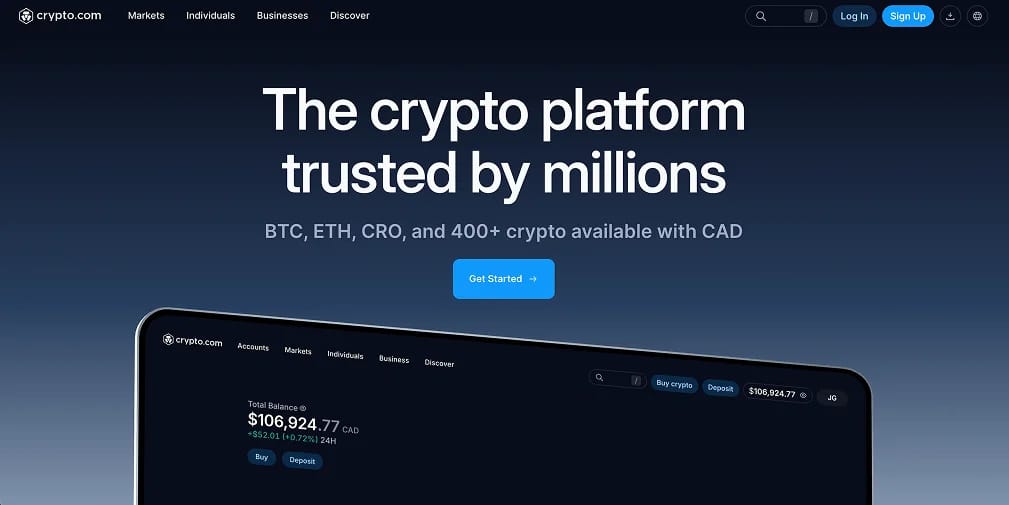
Crypto.com closes the list as the ecosystem play. It was the first platform to sign a CSA pre-registration undertaking in August 2022 and received its restricted dealer registration in every province and territory in May 2025, with CIRO membership still pending. Canadians get one of the largest regulated asset shelves in the country at 250+ cryptocurrencies, plus Earn products and the prepaid Visa cards that made the brand famous.
The app experience remains the slickest of the global entrants. Interac e-Transfer and bank transfer funding is straightforward, the card converts CRO lock-ups into cashback, and no rival here packs more features into a single login.
Pricing is the persistent criticism. App purchases are quoted with a spread you can only measure against mid-market, the best card and fee perks require locking up CRO, and comparing costs across tiers takes effort. Our Crypto.com review maps the structure in full.
Pros
- Restricted dealer registration nationwide and the earliest PRU signatory in Canada.
- 250+ assets, Earn products, and a prepaid Visa in one app.
- Simple Interac e-Transfer and bank funding with a polished mobile experience.
Cons
- Spread-based app pricing is hard to measure and beats only convenience buyers.
- The strongest perks require holding and locking CRO, turning fees into a token bet.
- Still awaiting CIRO membership, unlike Wealthsimple, Shakepay, and NDAX.
How to Choose a Crypto Exchange in Canada
Choosing a crypto exchange in Canada means verifying registration on official registers, funding by Interac e-Transfer, knowing your bank's crypto posture, and pricing the full trade rather than the headline fee.
- Verify the registration on the regulator's own register: Every legitimate platform appears on the CSA's list of registered crypto asset trading platforms or the CIRO dealer search. The CSA stopped accepting new pre-registration undertakings in 2024, so anything unregistered today operates outside the rules.
- Fund by Interac e-Transfer and learn your bank's limits: E-Transfer deposits are free on almost every platform we tested and settle in minutes, while cards cost 2% to 4%. Banks cap daily e-Transfer amounts, so larger buys go by EFT, wire, or bank draft instead.
- Know how your bank treats crypto payments: Most of the big five block credit card crypto purchases and several apply extra review to first transfers to an exchange. Our guides to buying crypto with TD Bank and RBC cover what each bank permits and how to avoid a frozen transfer.
- Price the whole trade, spread included: A flat 0.2% on NDAX, a 2% Core tier on Wealthsimple, and an unlabelled spread on Shakepay or Crypto.com produce very different all-in costs for the same Bitcoin order. Run a $100 buy and immediate sell on any shortlist candidate and measure the round trip.
- Plan for the CRA from your first order: Registered platforms already report large transactions, and the Crypto-Asset Reporting Framework extends that visibility internationally. Pick a platform with clean CSV exports or Koinly integration and keep records as you go.
Crypto and Bitcoin Regulation in Canada
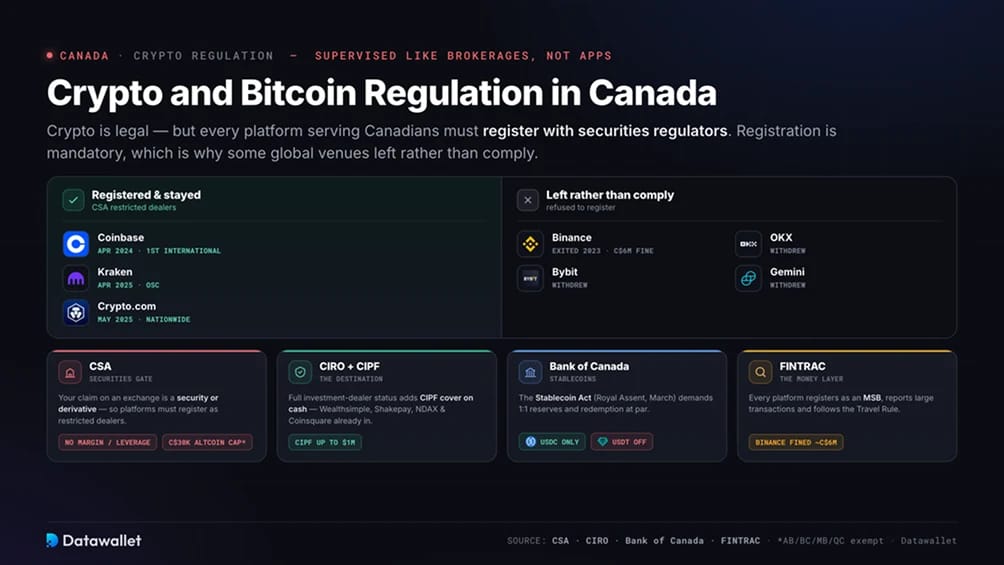
Crypto is legal in Canada, and the country regulates trading platforms more like brokerages than almost anywhere else.
- Securities regulators run the gate: The CSA treats the contractual claim you hold against an exchange as a security or derivative, so platforms serving Canadians must register. Coinbase became the first international restricted dealer in April 2024, Kraken followed in April 2025, and Crypto.com in May 2025, while Binance, OKX, Bybit, and Gemini left rather than comply.
- CIRO membership is the destination: Regulators have told restricted dealers to prioritise full investment dealer registration, and Wealthsimple, Shakepay, NDAX, and Coinsquare already sit inside CIRO. Membership brings CIPF coverage on client cash, a protection restricted dealers cannot offer.
- Retail guardrails apply: Registered platforms cannot offer Canadians margin or leverage, must run account appropriateness checks, and in most provinces cap annual net purchases of smaller altcoins at C$30,000, with Alberta, British Columbia, Manitoba, and Québec exempt from the limit.
- Stablecoins moved to the Bank of Canada: The Stablecoin Act received Royal Assent in March, requiring fiat-backed issuers to register with the Bank of Canada, hold 1:1 reserves in high-quality liquid assets, and redeem at par. Until that regime is fully in force, the CSA's interim rules mean USDC is the only stablecoin approved on registered platforms and USDT is unavailable.
- FINTRAC polices the money layer: Every platform must also register as a money services business, report large transactions, and follow the Travel Rule. FINTRAC fined Binance roughly C$6 million after its 2023 exit for registration failures.
The upshot is a smaller menu than offshore markets, in exchange for platforms that answer to regulators with real enforcement teeth.
How Does Canada Tax Crypto?
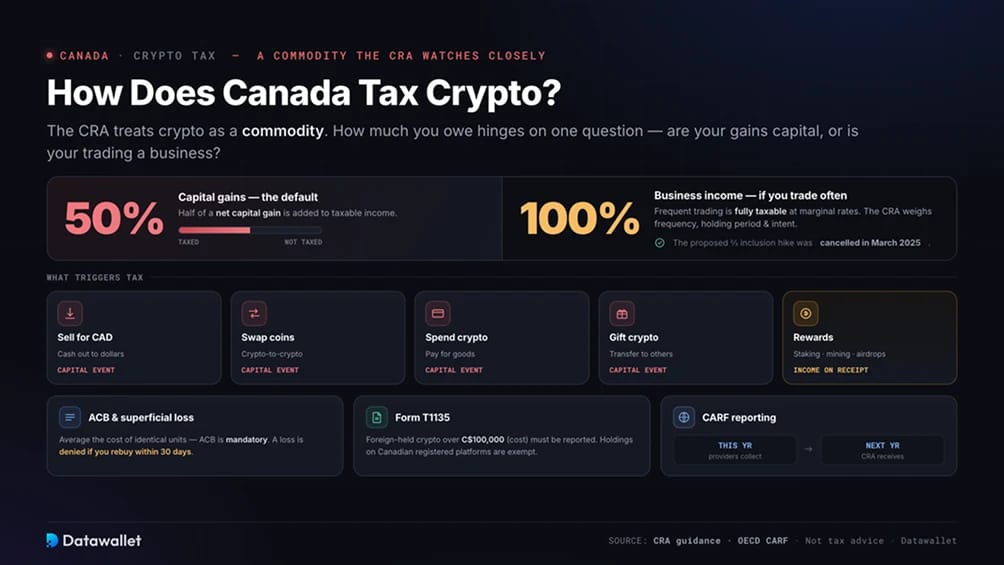
The CRA treats crypto as a commodity, and its visibility into Canadian trading activity grows every year.
- Most disposals are capital gains events: Selling for dollars, swapping one coin for another, spending crypto, and gifting it all trigger tax. Half of a net capital gain is added to taxable income under the 50% inclusion rate, after the proposed two-thirds increase was cancelled in March 2025.
- Frequent trading can be business income: The CRA weighs transaction frequency, holding periods, and commercial intent, and business income is fully taxable at marginal rates. Day traders should not assume capital treatment.
- Rewards are income on receipt: Staking rewards, mining proceeds, and airdrops are taxed at their CAD value when received, and that value becomes the cost base for a later disposal.
- The adjusted cost base method is mandatory: Canadians must average the cost of identical units across acquisitions, and the superficial loss rule blocks a loss claim if the same asset is repurchased within 30 days.
- Foreign platforms bring extra paperwork: Form T1135 applies when the cost of foreign-held crypto tops C$100,000 at any point in the year, while holdings on Canadian registered platforms are generally exempt.
- CARF closes the reporting gap: Canada is implementing the OECD's Crypto-Asset Reporting Framework, with service providers collecting data on this year's transactions and the first reports reaching the CRA next year for automatic exchange with other tax authorities.
None of this is tax advice, and DeFi edge cases deserve a crypto-literate accountant. Stablecoin buyers should read our guide to buying USDT in Canada, since disposal rules apply to stablecoins too.
Cryptocurrency Adoption in Canada
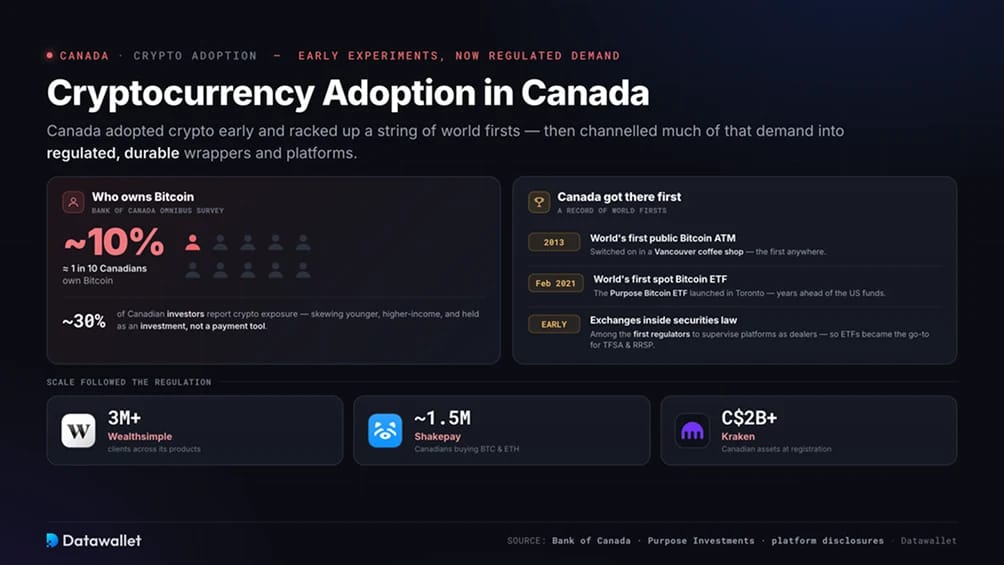
Canada adopted crypto early and then channelled much of that demand into regulated wrappers. The world's first public Bitcoin ATM went live in a Vancouver coffee shop in 2013, the Purpose Bitcoin ETF became the world's first spot Bitcoin ETF when it listed in Toronto in February 2021, and Canadian regulators were among the first to bring exchanges inside securities law.
Roughly one in ten Canadians holds Bitcoin today. The Bank of Canada's Bitcoin Omnibus Survey found ownership steady around 10%, concentrated among younger, higher-income men who treat it as an investment rather than a payment tool, while industry surveys put exposure among active Canadian investors closer to 30%. ETFs remain the preferred vehicle for TFSA and RRSP holders since direct crypto cannot sit in registered accounts, a market we follow on our Bitcoin ETF tracker.
Scale followed the regulation. Wealthsimple counts more than three million clients across its products, Shakepay serves around 1.5 million Canadians, and Kraken reported over C$2 billion in Canadian assets under custody at registration. Global comparisons sit on our crypto adoption statistics page, and the Canadian pattern within them is early experimentation converted into regulated, durable demand.
How to Buy Bitcoin in Canada
Buying Bitcoin in Canada takes about fifteen minutes once your ID is handy, and the cheapest path pairs a free Interac e-Transfer with a limit order on an order book.
- Pick the platform that fits your profile: Kraken for depth and low Pro fees, NDAX for the lowest flat rate, Wealthsimple for one-app convenience with CIPF-backed cash, Shakepay for a Bitcoin-only start. Confirm the registration on the CSA list before signing up.
- Complete verification: A driver's licence or passport plus a selfie clears most platforms in minutes, and registered dealers also run an investor questionnaire like any brokerage. Enter your name exactly as your bank records it.
- Deposit CAD by Interac e-Transfer: It is free on nearly every platform here and settles fast. Mind your bank's daily e-Transfer cap, and switch to EFT, wire, or bank draft for larger amounts. Skip cards entirely.
- Buy with a limit order where an order book exists: On Kraken Pro or NDAX, a limit order on BTC/CAD avoids instant-buy spreads and typically saves 1% or more per purchase.
- Decide on custody and start a record: Active traders can stay on a registered platform, while long-term holders should weigh self-custody using our best crypto wallets guide. Export your transaction history as you go, since ACB reconstruction at tax time is miserable work.
Selling reverses the path, with e-Transfer and EFT withdrawals usually landing the same day.
Final Thoughts
Kraken takes the top slot on the widest overlap of assets, low Pro fees, free e-Transfer funding, and a custody record no rival matches. Coinbase converts public-company disclosure into peace of mind, Wealthsimple owns the convenience lane with the only full CIRO wrapper in the country, NDAX wins on raw cost, Shakepay makes Bitcoin savings a habit, Robinhood arrives with Bitbuy and Coinsquare's bones and a sharp flat fee, and Crypto.com serves people who want the whole ecosystem in one app.
Canada's regulatory bet is paying off. The registration wave washed out platforms unwilling to be examined, CIRO membership is becoming the standard, and stablecoins now have a federal supervisor in the Bank of Canada. Platform risk has shifted from survival to price and product, a better position than most countries can claim.
Whichever exchange you choose, put $100 through it before committing real size. Deposit by e-Transfer, buy with a limit order where you can, sell, and withdraw. The all-in cost and the time your money spends in transit will tell you more than any review. Readers weighing the market next door can compare our guide to the best crypto exchanges in the USA.
Our Methodology
We opened accounts on each platform, completed KYC with Canadian documents, funded through Interac e-Transfer, EFT, wire, and cards from big-five accounts, traded live CAD pairs, and withdrew dollars back out. Each platform scored across six criteria.
- Trust Score: Our proprietary rating out of 5, weighting CSA registration or CIRO membership, custody and reserve transparency, security history, longevity, and audit coverage.
- CAD Funding Methods: Confirmed Interac e-Transfer, EFT, wire, bank draft, and card support, measuring settlement speed, deposit minimums, bank-side friction, and withdrawal times.
- Regulatory Standing: Verified restricted dealer registrations and CIRO memberships against the official registers, plus FINTRAC status and any enforcement history.
- Security Track Record: Reviewed breach history, cold storage and custody arrangements, insurance coverage, proof-of-reserves cadence, and account protections like 2FA and withdrawal allowlisting.
- Assets and Liquidity: Placed market and limit orders on BTC/CAD, ETH/CAD, and one mid-cap pair per venue where available, measuring spread, depth, and fill quality against mid-market.
- Fee Structure: Compared trading fees, embedded spreads, funding and withdrawal costs, and the all-in cost of a $1,000 CAD round trip on each platform.
We excluded platforms without CSA registration or CIRO membership, venues that exited Canada or serve Canadians without authorisation, and any exchange with unresolved compliance failures. Testing ran from March to July, with regulatory statuses rechecked after Robinhood's WonderFi close in June.
%20(1).webp)