







Compare Top Chinese Cryptocurrency Exchanges
1. Kraken
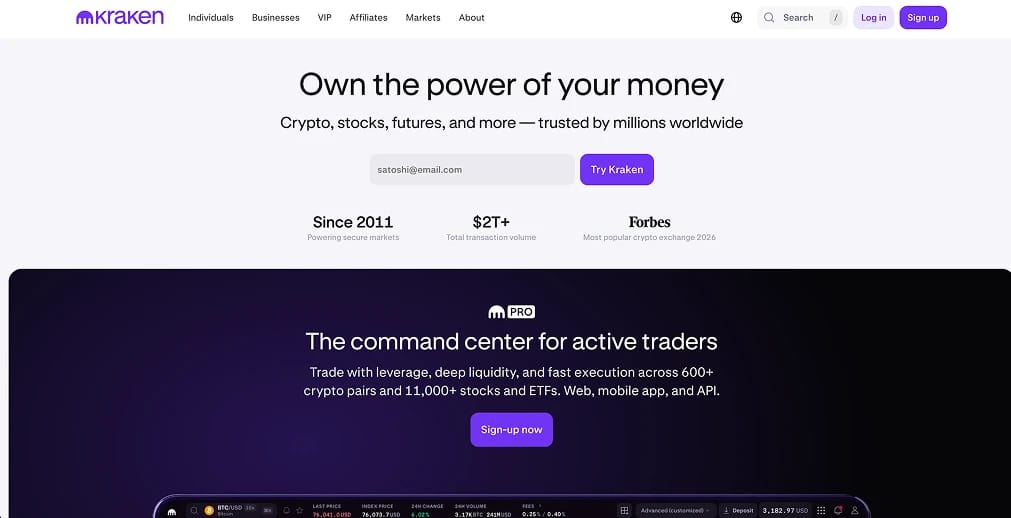
Kraken tops our list because of one quiet shift. As PANews documented in early 2025, Kraken began accepting mainland passports, 二代身份证 ID cards, and Chinese mobile numbers for KYC, with China selectable as country of residence. The site loads in mainland browsers without a VPN, and the interface offers a Simplified Chinese language toggle.
The path that works for friends in Shenzhen and Shanghai: register with a passport or ID, KYC to the intermediate tier, deposit USDT or USDC on-chain, swap to USD on Kraken Pro, then withdraw to a Hong Kong USD account at ZA Bank, iFastx, or Zhong An. From there, funds sit as USD, convert to HKD, or move back onshore via Wise within the SAFE USD 50,000 annual forex quota. Verified accounts withdraw up to USD 100,000 daily.
Important caveat. Kraken's published prohibited regions list doesn't include mainland China, which is unusual for a US-licensed exchange. The legal tension comes from the China side via the PBoC's 2021 9.24 Notice, which prohibits overseas exchanges from servicing mainland residents over the internet. November 2025's PBoC coordination meeting signals Beijing is sharpening enforcement, not relaxing it.
On the trading stack, Kraken is one of the most credible platforms anywhere. It holds FinCEN MSB registration, MiCA CASP authorisation via the Central Bank of Ireland (C468360), and OSC Restricted Dealer status. Proof of Reserves audits date back to 2014. Pro fees start at 0.16% maker and 0.26% taker across 640+ assets.
Pros
- Accepts mainland Chinese passports and 二代身份证 IDs for KYC, with a Simplified Chinese interface.
- Clean off-ramp through Hong Kong USD accounts at ZA Bank, iFastx, and Zhong An.
- FinCEN MSB, MiCA CASP, and OSC Restricted Dealer registrations make it the most regulated venue here.
- Offers crypto, futures and stocks like NVIDIA, Tesla and Apple or ETFs like S&P 500 and NASDAQ.
Cons
- Operating in mainland China sits against the 9.24 Notice, so the channel could close if enforcement tightens.
- No CNY P2P market, so first deposit usually means buying USDT elsewhere or using an offshore card.
- Kraken Pro interface is heavier than what a complete beginner would want.
2. Hyperliquid
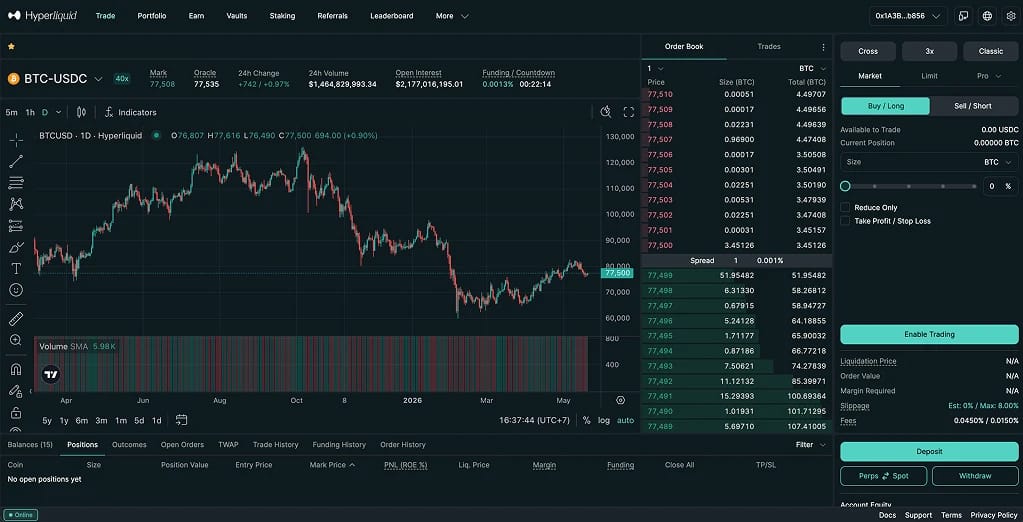
Hyperliquid sits second because it sidesteps the freeze problem entirely. No exchange account, no KYC, no bank-side touchpoint for AML systems to flag. You connect a self-custodial wallet, bridge USDC from Arbitrum or Ethereum, and trade perps and spot on a fully on-chain orderbook.
The wallet-first design solves the biggest pain point with offshore CEXs: account freezes tied to tainted P2P counterparties. Your USDC sits in a wallet you control, settlement runs on Hyperliquid's custom L1, no central party holds a freeze button. China is not named in the platform's restricted list, though users carry compliance responsibility. Similarweb data ranks Hong Kong third globally for Hyperliquid traffic at 6.43%, behind only the US and Singapore.
Product depth rivals centralised derivatives venues. The DEX supports 130+ perpetuals at up to 100x leverage, with maker rebates on most pairs and near-zero slippage on majors. Cumulative volume crossed $2 trillion in 2025. For traders who know what they want and aren't off-ramping into CNY, it's the cleanest venue available. Our perp DEX comparison covers alternatives.
Pros
- No KYC, no exchange account, no bank-side touchpoint that can trigger card freezes.
- 100x leverage on 130+ perpetuals with maker rebates and tight execution on majors.
- Self-custody throughout, so there's no platform-side freeze risk on your collateral.
Cons
- No direct CNY on-ramp, so you still need to source USDC through a P2P merchant first.
- Wallet management and bridging carry their own learning curve.
- Derivatives-heavy product, which doesn't suit someone who just wants to DCA into BTC.
3. OKX
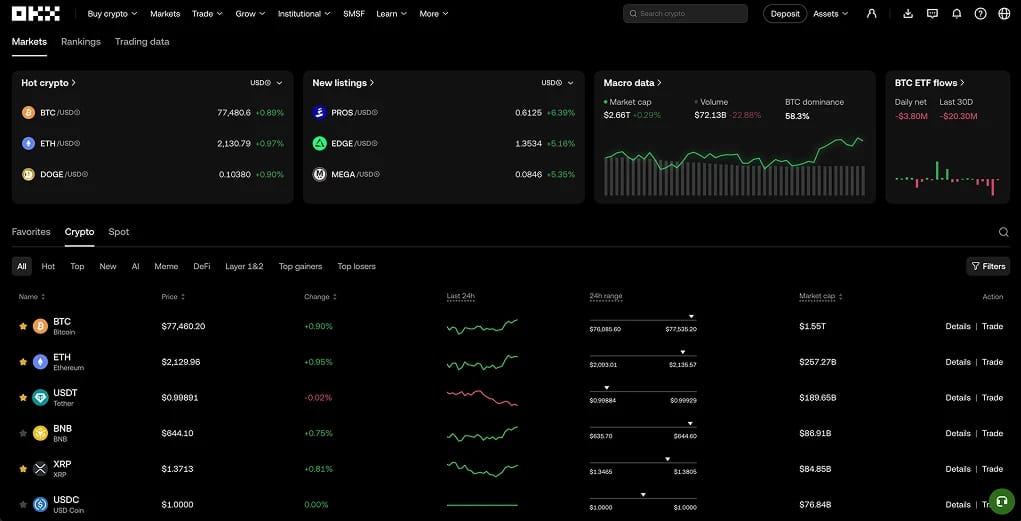
OKX takes the third slot on CNY P2P depth, which remains the deepest among centralised exchanges that mainland users can reach. The exchange was originally headquartered in Beijing before moving offshore in October 2021, and the Chinese-language product still shows that lineage.
The P2P desk supports Alipay, WeChat Pay, UnionPay, and bank transfer, with a Blue Shield programme that vets merchant compliance before they post ads. OKX also enforces a T+N withdrawal hold on P2P funds, which feels slow but cuts the chance of an instant card freeze from a counterparty whose CNY traced back to a phishing scam two days earlier.
OKX accepts mainland Chinese ID cards (二代身份证) for KYC, not just passports, which widens access since many onshore users don't hold a current passport. The built-in Web3 wallet covers 130+ chains, with X Routing scanning 400+ DEXs for best price. Spot fees: 0.08% maker and 0.10% taker across 350+ assets.
The structural issue: the November 2025 PBoC meeting flagged stablecoin activity as the next enforcement target. OKX's CNY P2P desk handles a significant share of mainland stablecoin volume and sits squarely in those crosshairs. It works today. Don't assume it will in six months.
Pros
- Deepest CNY P2P book of any centralised exchange mainland users can reach.
- Accepts mainland Chinese ID cards for KYC, broadening access beyond passport holders.
- Blue Shield merchants and T+N withdrawal hold meaningfully reduce card-freeze risk.
Cons
- VPN required for reliable access from the mainland.
- CNY P2P sits squarely in the enforcement window flagged by the PBoC's November 2025 meeting.
- Reputation is mixed on KYC reviews, particularly for sudden tier escalations.
4. MEXC
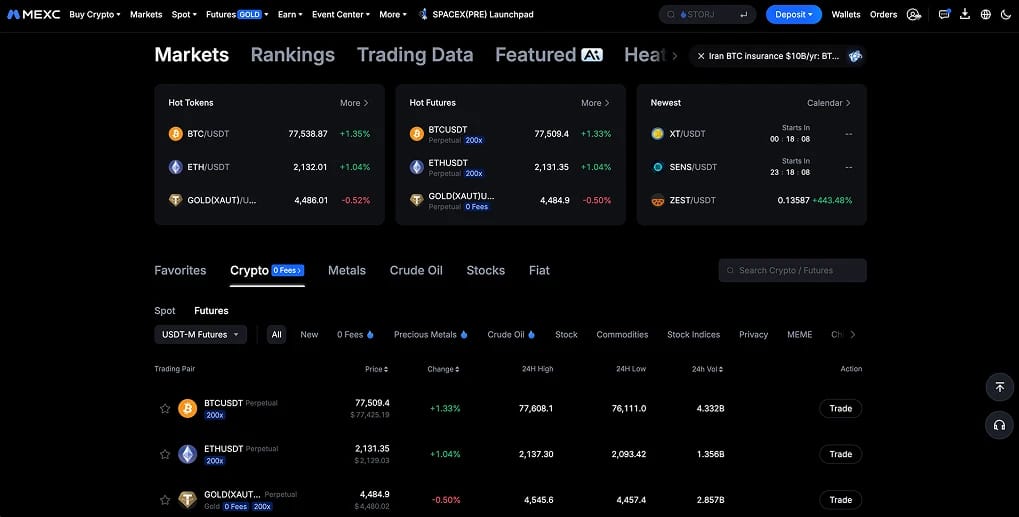
MEXC takes the fourth slot on fee structure. The platform runs 0% maker fees on spot trading across most pairs and 0.02% taker fees, the lowest combination on this list. For a mainland user DCA'ing into BTC or ETH on a recurring schedule, that fee compression saves real money against 0.10% elsewhere over a year.
MEXC lists 2,800+ cryptocurrencies, with new tokens often arriving before OKX or Kraken. A low-KYC tier lets users trade and withdraw smaller amounts without full ID verification, which appeals to mainland users who don't want a Chinese passport tied to a fully verified account. CNY P2P runs through Alipay and bank card, though merchant depth sits below OKX and HTX.
The trade-off is transparency. MEXC's proof-of-reserves cadence is less rigorous than OKX or Bitget, with a shorter disclosure history. Headquartered in Seychelles and licensed in Estonia, its terms officially bar mainland Chinese users even as the P2P desk accepts them in practice.
Pros
- 0% maker and 0.02% taker fees on spot, the lowest combination on this list.
- 2,800+ assets with a fast listing pipeline for newly launched tokens.
- Low-KYC tier supports smaller deposits and withdrawals without full verification.
Cons
- Proof-of-reserves cadence less rigorous than OKX or Bitget.
- CNY P2P merchant depth thinner than OKX or HTX.
- Officially restricts mainland users in its terms, even as practice differs.
5. HTX
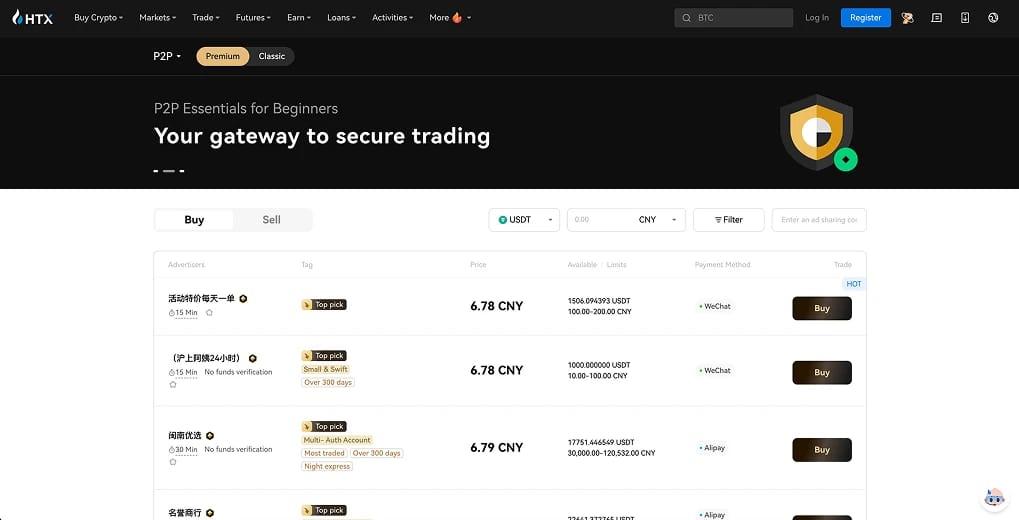
HTX, the rebranded Huobi, places fifth on CNY P2P depth and proximity to the Tron stablecoin ecosystem that dominates Chinese USDT activity. Huobi was one of the original Chinese exchanges and retains the deepest Alipay and WeChat Pay merchant network of any major platform, even after its 2021 mainland exit.
The P2P desk accepts Alipay, WeChat Pay, UnionPay, and direct bank transfer through a merchant base built up over more than a decade. For users who specifically fund through Alipay or WeChat Pay (most do, particularly in tier-two cities), HTX usually has the tightest USDT spreads and the most active merchants at any hour. We cover this path in our Alipay crypto buying guide.
The trade-off is brand baggage. Justin Sun's involvement, the Tron association, and the rebrand history all weigh on reputation. Proof-of-reserves disclosures exist but lag the cadence of OKX and Kraken, and HTX is slower than peers when KYC reviews hit a snag. Use it as a P2P venue, not long-term custody for size.
Pros
- Deepest Alipay and WeChat Pay merchant network for CNY P2P, particularly in Asian business hours.
- Strong Tron integration, which matters since 48.67% of global USDT supply is issued on Tron.
- Long-standing Chinese-language product with deep familiarity for legacy Huobi users.
Cons
- Brand reputation softer than Kraken or OKX, particularly post-rebrand.
- Proof-of-reserves disclosure cadence less consistent than top-tier competitors.
- KYC review snags more common, with slow escalation on disputed verifications.
6. Gate
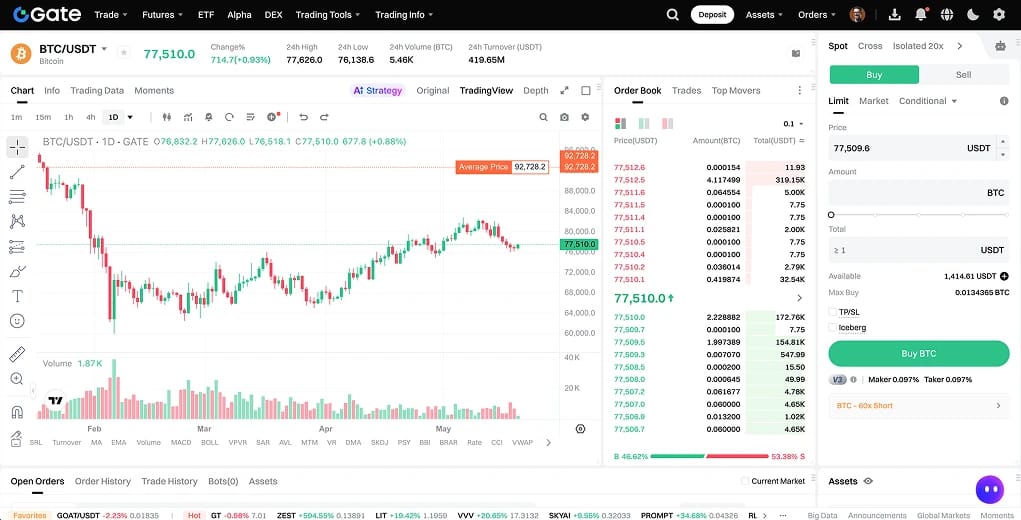
Gate closes the list as the venue for traders who care more about altcoin coverage than fiat on-ramp polish. The platform lists 3,600+ cryptocurrencies, the widest here by a margin, and routinely picks up smaller-cap tokens months before they reach OKX or Kraken.
CNY P2P exists through Alipay and bank card, though the merchant pool is thinner than OKX, HTX, or MEXC. Most Chinese Gate users fund elsewhere and bridge USDT in via TRC20. The platform runs a 126% on-chain proof-of-reserves ratio (the highest by ratio among majors, even with a smaller absolute base than Binance or OKX), a Gate Card, copy trading, and 0.09% / 0.10% spot fees.
The structural concern matches MEXC's: no mainland licensing, periodic KYC sweeps that occasionally bounce mainland accounts, and a regulatory profile behind Kraken and OKX. If you want long-tail altcoin exposure and you're comfortable bridging USDT in from self-custody, Gate is the venue. As a primary fiat on-ramp, harder to recommend.
Pros
- Widest altcoin selection on this list at 3,600+ assets, including newly launched tokens.
- 126% on-chain verified proof-of-reserves ratio, the highest by ratio among major exchanges.
- Solid product depth on copy trading, bots, leveraged tokens, and the Gate Card.
Cons
- CNY P2P merchant pool thinner than OKX, HTX, or MEXC.
- No mainland licensing and a less mature compliance profile than top-tier venues.
- Long-tail altcoin selection means many low-liquidity tokens require careful due diligence.
How to Choose a Crypto Exchange in China
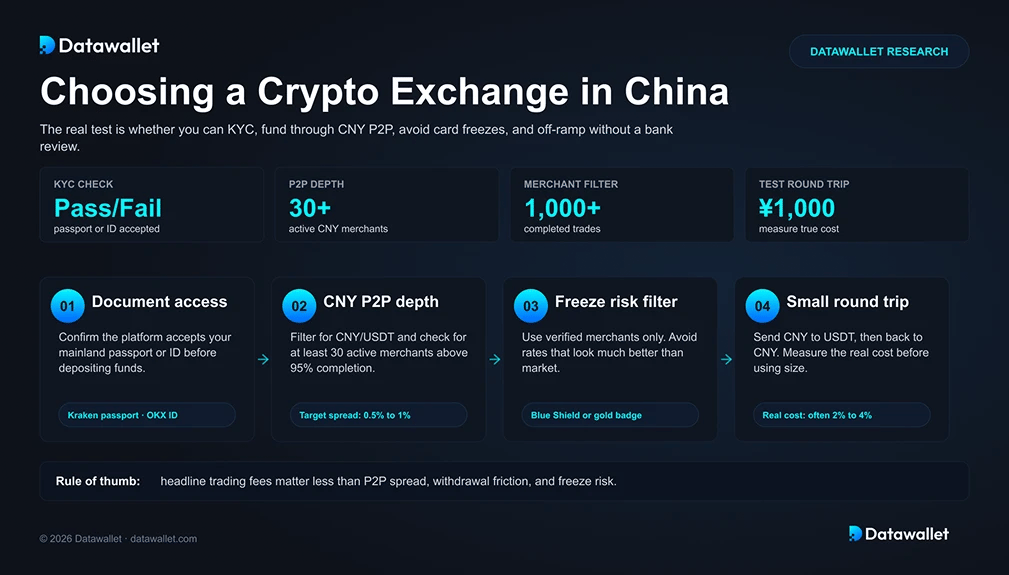
Choosing an exchange in mainland China is less about features and more about whether you can KYC, fund without your bank flagging the transfer, and withdraw to an account that won't freeze. Four checks I run:
- Confirm the platform will accept your documents. Most global venues block mainland residents outright, and failed KYC attempts can flag your passport across multiple platforms. Kraken is the most reliable for verified mainland passport KYC in 2026. OKX is the most reliable for mainland ID card KYC.
- Test CNY P2P depth before depositing. Open the P2P section, filter for CNY, and confirm at least 30 active merchants with completion rates above 95%. Spreads against mid-market USDT should sit within 0.5% to 1%. A thin desk during business hours means the platform isn't functional as a CNY on-ramp.
- Pick merchants carefully to avoid the freeze. The single largest source of bank card freezes is buying CNY from a merchant whose funds turn out to be tainted from phishing, telecom fraud, or gambling. Stick to verified merchants (OKX Blue Shield or HTX gold-badge) with 1,000+ completed trades and high completion rates. Be wary of merchants offering rates well above market average. That usually means CNY that needs cleaning quickly.
- Measure the all-in cost on a small round trip. Run a CNY 1,000 to USDT to CNY round trip and measure total slippage. Headline trading fees are the smallest component. The real cost sits in the P2P spread on both legs and the withdrawal fee. Platforms advertising 0.1% spot fees regularly cost 2 to 4% all-in.
Crypto and Bitcoin Regulation in China
China's crypto framework is one of the strictest in the world for service providers and more permissive than headlines suggest for individual ownership. Three pieces matter:
- The 9.24 Notice (2021): On 24 September 2021, the PBoC and nine other ministries issued the Notice on Further Preventing and Handling the Risk of Speculation in Virtual Currency Trading. The Notice classifies all crypto-related business activity as illegal financial activity and explicitly bars overseas exchanges from providing services to mainland residents online.
- The PBoC November 2025 reaffirmation: On 28 November 2025, the PBoC convened a coordination meeting with 13 government departments, including the Ministry of Public Security, the Cyberspace Administration, and the Supreme People's Court. The meeting reaffirmed the 9.24 framework and named stablecoins as a fresh enforcement focus, citing money-laundering and cross-border transfer risks.
- Personal ownership as virtual property: The Shanghai Songjiang People's Court ruled in November 2024 that Chinese citizens may legally hold cryptocurrencies as personal property, classifying them as virtual commodities with property-like attributes. The ruling does not extend to commercial activity.
The practical reading: holding crypto is legal. Operating a platform, providing services, or running crypto as a business is illegal. Everything in between, particularly P2P trading and offshore exchange access, sits in a grey zone. Individual-level enforcement remains rare, though the PBoC reaffirmed it will continue cracking down on illegal financial activity.
Hong Kong runs an entirely separate framework. The Securities and Futures Commission has licensed 12 virtual asset trading platforms as of early 2026, including OSL, HashKey Exchange, and HKVAX. For mainland users who can establish a Hong Kong identity or banking relationship, this is the most stable regulated path. Our Hong Kong exchange guide covers the venues in detail.
How Does China Tax Crypto?
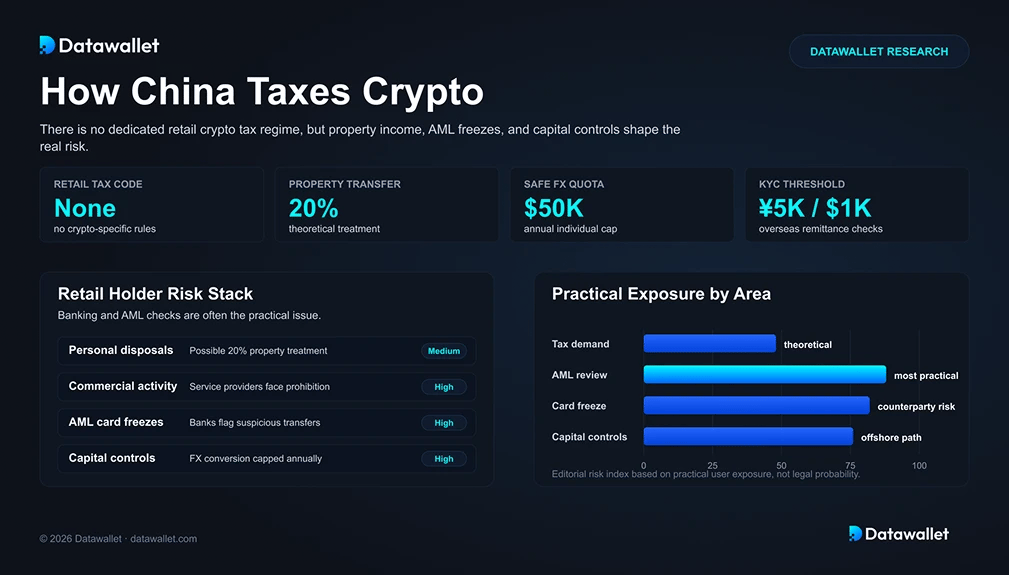
China has no dedicated retail crypto tax regime. The Individual Income Tax Law was not written with virtual property in mind, and the State Taxation Administration has not issued binding rules on personal crypto disposals. That leaves the picture in distinct buckets:
- Personal holding and disposal: Crypto gains could theoretically fall under property transfer income at 20%, under a 2008 STA ruling that the Shanghai tax service publicly cited in January 2024 before deleting the explainer days later. No crypto-specific guidance exists, and retail enforcement is rare but not zero.
- Business and commercial activity: Treated as illegal under the 9.24 framework, so taxation in the conventional sense doesn't apply. Proceeds from illegal financial activity are subject to confiscation.
- Anti-money laundering law: The PBoC-administered AML regime requires banks to flag and freeze accounts on suspicious crypto-linked transfers and report to the Ministry of Public Security. This is the real day-to-day exposure for individual users.
- Capital controls: The State Administration of Foreign Exchange caps individual foreign currency conversion at USD 50,000 per person per year. From 1 January 2026, banks must apply enhanced KYC on overseas remittances above RMB 5,000 or USD 1,000, tightening the offshore funding path.
For most retail mainland holders in 2026, the tax exposure stays theoretical, though enforcement cases exist. Keep records of every disposal and the CNY value at the time. The bigger day-to-day risk is an AML-driven card freeze, not a tax demand.
Cryptocurrency Adoption in China
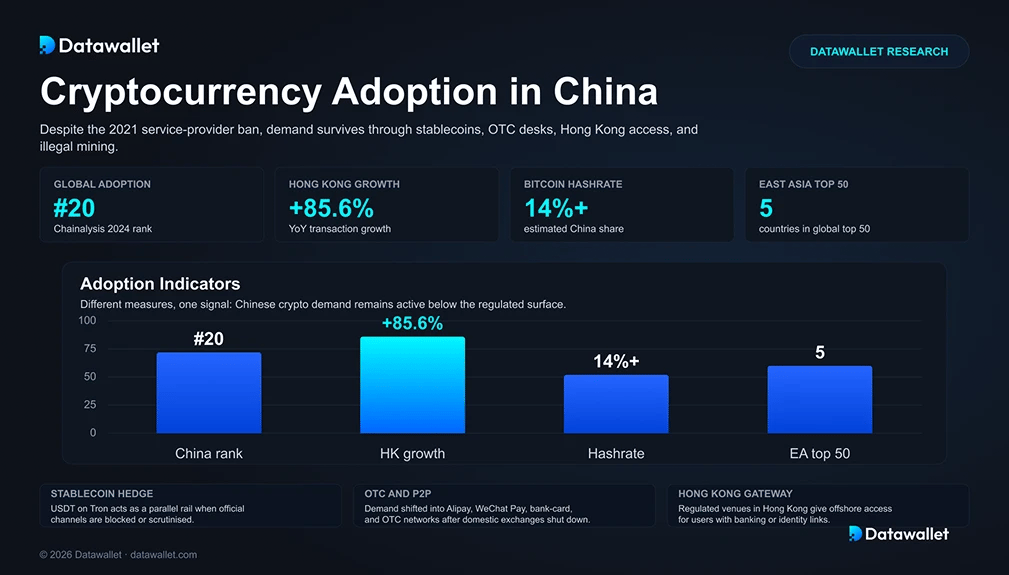
China placed 20th on Chainalysis' 2024 Global Adoption Index, one of five Eastern Asian countries in the global top 50, despite the 2021 ban. The drivers differ from most other markets:
- Capital flight hedge: A core mainland use case is moving wealth offshore beyond the SAFE quota. Stablecoins, particularly USDT on Tron, function as a parallel rail when official channels are blocked or scrutinised.
- OTC and P2P infrastructure: The 2021 shutdown of domestic exchanges did not eliminate demand. It pushed it into OTC desks and P2P networks running over Alipay, WeChat Pay, and bank card rails. Caixin reported in late 2025 that crypto speculation has "resurfaced", the framing the PBoC used to justify the November coordination meeting.
- Hong Kong as a regulated gateway: Hong Kong's 85.6% year-over-year transaction growth reflects the same demand redirected through a compliant channel.
- Mining presence: Despite the formal mining ban, China still accounts for over 14% of global Bitcoin hashrate, behind only the United States and Russia, almost entirely from illegal operations on stranded grid power.
Mainland Chinese crypto demand is structurally driven by the gap between domestic financial repression and overseas wealth optionality, not speculation alone. As long as that gap exists, P2P volume will too, regardless of how many coordination meetings the PBoC holds.
How to Buy Bitcoin in China
The cleanest path for mainland users in 2026 is the Kraken route: KYC with a passport, fund USDT through a CNY P2P purchase elsewhere, swap to USD on Kraken Pro, and withdraw to a Hong Kong USD account. From there, BTC purchases are a single trade.
The full sequence:
- Buy USDT through a CNY P2P merchant. Use OKX or HTX, filter for CNY/USDT, pick a Blue Shield or gold-badge merchant with 1,000+ trades and 98%+ completion. Pay via Alipay or bank card. Avoid merchants offering meaningfully better-than-market rates.
- Move USDT to Kraken. TRC20 is the cheapest and fastest. Whitelist the Kraken deposit address before sending.
- Convert and trade on Kraken Pro. Swap USDT for USD, then USD for BTC on BTC/USD. Skip Instant Buy, which carries wider spreads.
- Decide on custody. Active traders leave BTC on Kraken. Long-term holders transfer to a hardware wallet. Our best crypto wallets guide covers options.
- Sort the off-ramp in parallel. Open a Hong Kong bank account before you need to sell, not after. ZA Bank, Mox, and iFastx are reasonable starting points.
For users who'd rather not touch a CEX at all, the Hyperliquid equivalent is: source USDC through P2P, bridge to Arbitrum, fund a self-custody wallet, and trade BTC perps or spot directly. No fiat on-ramp exists on Hyperliquid, which is the point.
Final Thoughts
Pick by use case. For verified KYC and a Hong Kong USD off-ramp, Kraken, with the caveat that the channel could close if Beijing tightens on overseas exchanges. For zero bank-side touchpoint and self-custody, Hyperliquid. For Alipay or WeChat Pay funding, OKX or HTX still anchor the CNY P2P market.
Regulatory direction is tightening, not loosening. The PBoC's November 2025 meeting named stablecoins specifically. Cross-border KYC tightens from January 2026. Card freezes from tainted P2P counterparties continue to land on innocent users. Build your stack on the assumption that the easier paths today may close next year.
Before depositing, run a small CNY 1,000 round trip and confirm the off-ramp works for your specific bank. That five-minute exercise tells you more than any review.
Our Methodology
We tested 25+ exchanges available to Chinese users by creating mainland-residency accounts, attempting KYC with Chinese passports and IDs, funding through CNY P2P with Alipay and bank card, executing trades, and off-ramping to Hong Kong USD accounts. Each platform scored across six criteria:
- Trust Score: Our proprietary rating (out of 5) weights regulatory standing, proof-of-reserves transparency, security history, platform longevity, and audit coverage. Venues with FinCEN, MiCA, or major-jurisdiction licensing scored highest.
- Mainland Access: Whether the platform accepts mainland Chinese passports and IDs for KYC, whether the domain loads behind the Great Firewall without a VPN, and whether the Chinese-language product is fully functional.
- CNY Funding Methods: Confirmed Alipay, WeChat Pay, UnionPay, and direct bank transfer support through P2P, with testing on settlement speed, merchant depth, and spread against mid-market USDT.
- Off-Ramp Reliability: Tested withdrawals to Hong Kong USD accounts at ZA Bank, iFastx, and Zhong An, measuring transit time, bank-side friction, and AML reviews on first transfers.
- Freeze Risk: Reviewed merchant verification programmes, withdrawal hold policies (T+N), and historical incident reports on bank-card freezes tied to P2P counterparties.
- Assets and Liquidity: Placed market and limit orders on BTC/USDT, ETH/USDT, and at least one mid-cap pair to measure spread, depth, and fill quality.
We excluded exchanges that explicitly geoblock mainland Chinese users, platforms with persistent access issues even on VPN, and any venue without a functional path for mainland passport KYC or P2P funding. Testing ran from February to May 2026.
%20(1).webp)