







Compare Top Hong Kong Cryptocurrency Exchanges
1. Kraken
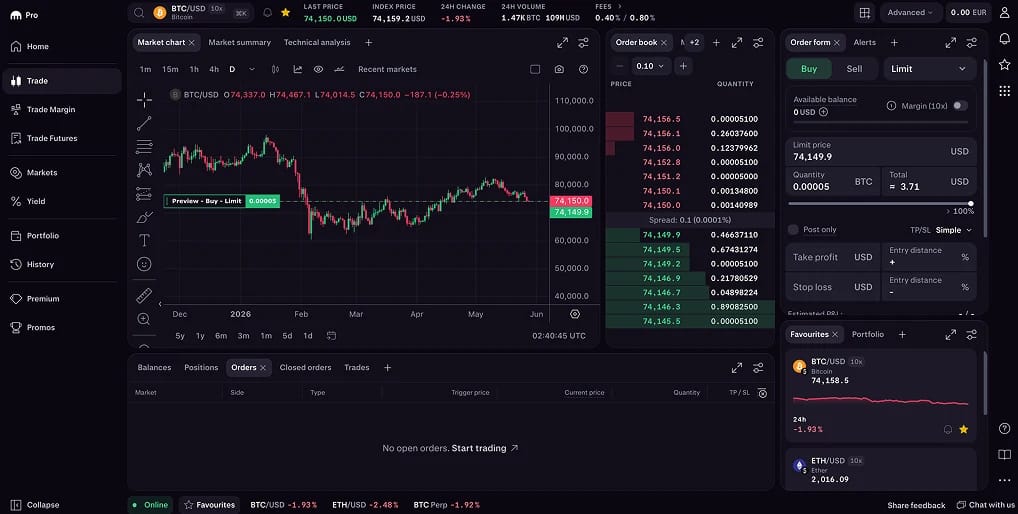
Kraken tops our 2026 list because no licensed local VATP comes close on asset selection, and on-ramp friction stays manageable for any resident with a multi-currency bank account. Kraken accepts HKID for KYC, the domain loads without restriction, and verified accounts trade 640+ supported assets versus the five cleared for retail locally.
Spot fees on Kraken Pro start at 0.16% maker and 0.26% taker, roughly half what HashKey charges, with Plus and Pro tiers dropping further. Regulatory coverage spans FinCEN MSB, MiCA CASP via the Central Bank of Ireland, and OSC Restricted Dealer status, with Proof of Reserves audits dating to 2014. The funding pattern: USD wire from HSBC, Standard Chartered, BOCHK, Citibank, or DBS, then back at your bank's FX spread (~0.5%, tighter on Premier).
The caveat: Kraken isn't an SFC-licensed VATP, so local investor-protection rules don't extend to your account. Round-trip cost on a USD 5,000 conversion typically lands at 0.7% to 1.2% all-in, still cheaper than most licensed VATPs once trading fees are included. For local regulator oversight, HashKey or OSL do that better; for everyone else, Kraken's combination of asset breadth, transparency, and execution wins.
Pros
- Accepts HKID and Hong Kong passport KYC with no domain blocking locally.
- 640+ supported assets, far beyond the five tokens approved for retail on licensed VATPs.
- FinCEN MSB, MiCA CASP, and OSC Restricted Dealer registrations with a long Proof of Reserves history.
- Spot fees starting at 0.16% / 0.26%, materially cheaper than licensed Hong Kong platforms.
Cons
- Not licensed by the SFC, so local investor-protection rules and dispute mechanisms don't apply.
- No native HKD support; every deposit and withdrawal sits in USD and depends on your bank's FX spread.
- Cannot actively market into Hong Kong, so customer support replies can take an extra day or two.
2. HashKey Exchange
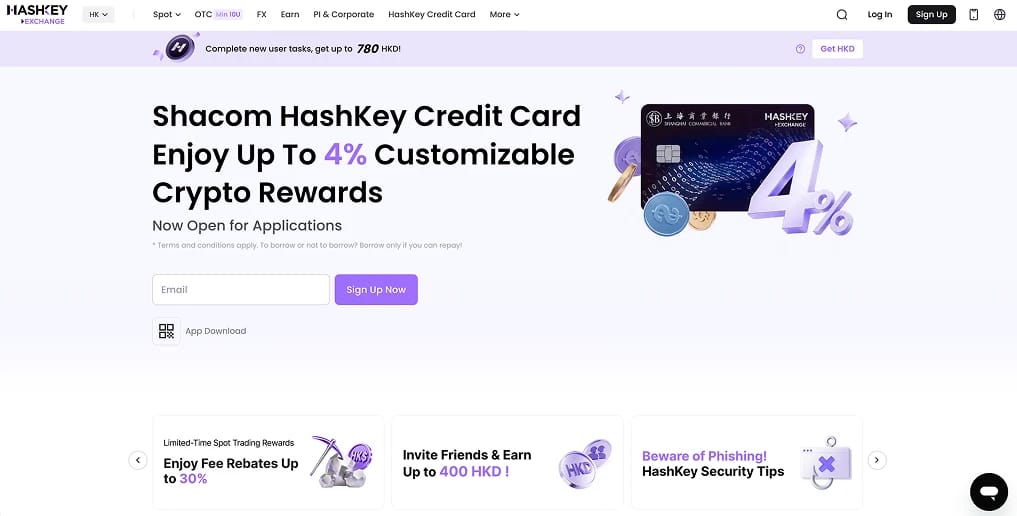
HashKey Exchange sits second because no other licensed VATP gets the local basics right at this level. Hash Blockchain Limited holds SFC Type 1, Type 7, and AMLO licences plus ISO 27001 and 27701 certifications. Total user assets passed HK$19 billion in 2025, making it the city's largest licensed digital asset exchange.
The HKD on-ramp is the real differentiator: fiat deposits are free, eDDA via FPS settles in seconds, and withdrawals to HSBC, BOCHK, ZA Bank, or Mox land same-day. Retail traders hold BTC, ETH, SOL, AVAX, and LINK against HKD or USD; Professional Investors with HK$8M+ portfolios access 40+ pairs. The ZA Bank integration puts HashKey Pro inside HK's largest digital bank, though the 1.5% bundled fee runs pricier than trading direct.
Where HashKey falls short is asset depth. Five tokens for retail is a ceiling set by SFC token-admission rules, and the 0.29% per-side fee runs roughly three times what you'd pay on Kraken or Binance spot. For BTC, ETH, or SOL with a clean HKD off-ramp and the strongest SFC oversight in Asia, HashKey is the answer. For long-tail exposure or fee-sensitive trading, it isn't.
Pros
- SFC Type 1, Type 7, and AMLO licences with ISO 27001 and 27701 certifications.
- Fee-free HKD deposits and withdrawals via eDDA over FPS.
- Direct ZA Bank integration for in-app crypto trading.
- Multi-currency fiat support across HKD, USD, EUR, CNH, SGD, and JPY.
Cons
- Only five tokens available to retail traders (BTC, ETH, SOL, AVAX, LINK).
- 0.29% spot fee runs high versus offshore venues.
- HK$10,000 first-deposit minimum is awkward for small test orders.
3. OSL
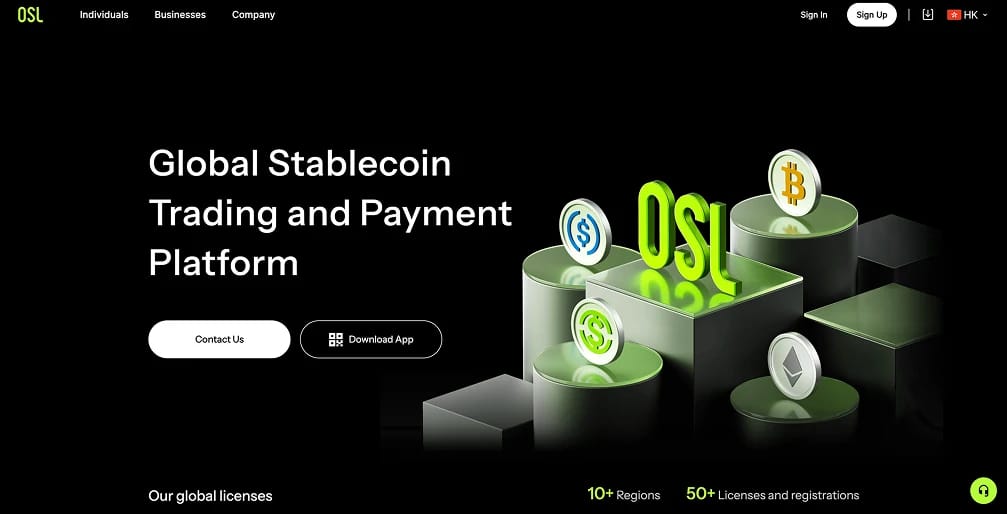
OSL earns third on something no other crypto venue matches: it's publicly listed on HKEX as 863.HK, audited by a Big Four firm, and backed by up to US$1 billion in client asset insurance. For higher-net-worth residents and family offices, that combination of disclosure and protection is hard to beat globally. OSL Digital Securities was the first SFC-licensed crypto platform in Hong Kong, granted 15 December 2020.
The platform offers Flash Trade (RFQ) and Pro Trade (order-book) with 0% maker and 0.05% taker fees, covering BTC, ETH, SOL, XRP, USDT, and USDC for retail. HKD pairs joined the Pro book in November 2025, with FPS or bank-wire funding free of charge and a 0.06% HKD-USD spread. Interactive Brokers' HK retail crypto routes through OSL, and OSL Group acquired Banxa in early 2026 to expand its global payment footprint.
The trade-off versus HashKey is that OSL skews toward larger tickets, with a HK$10,000 minimum initial deposit and a Pro interface that assumes order-book experience. For someone with HK$100,000-plus to deploy who wants institutional-grade custody and the cleanest audit trail for DIPN 39 record-keeping, OSL fits. For a first HK$5,000 test trade, HashKey's onboarding is easier.
Pros
- Only publicly listed and SFC-licensed digital asset exchange globally, with Big Four audit oversight.
- Up to US$1 billion in client asset insurance, the largest coverage of any crypto venue.
- 0% maker and 0.05% taker fees on Pro Trade with a 0.06% HKD-USD spread, materially tighter than peers.
- Direct HKD FPS deposits and withdrawals at zero fees on either side, plus full USD wire support.
Cons
- Pro Trade interface assumes order-book experience and isn't ideal for absolute beginners.
- USDT and USDC reserved for Professional Investors on the Pro book.
- HK$10,000 first-deposit threshold can deter very small test orders.
4. Hyperliquid
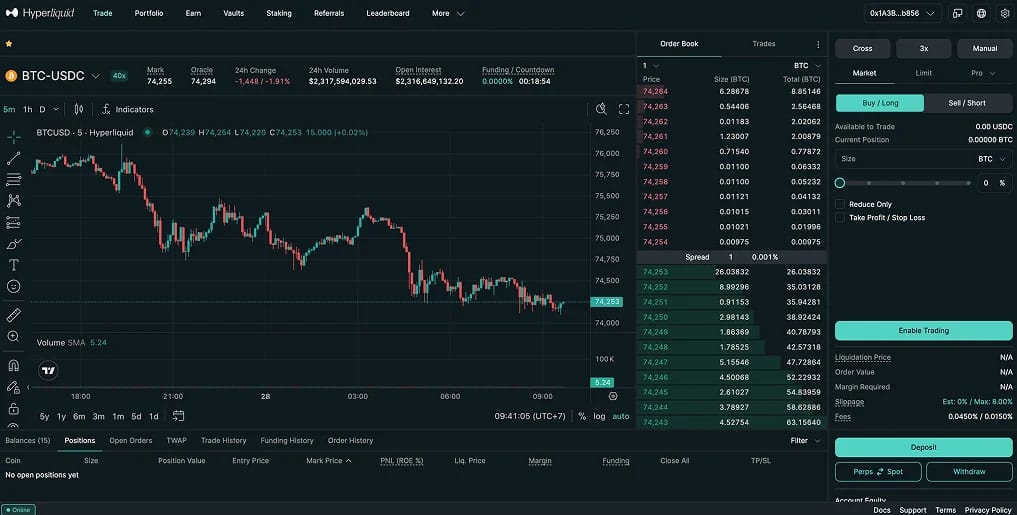
Hyperliquid sidesteps the licensed-versus-offshore question entirely. There's no exchange account, no KYC, no bank-side touchpoint. You connect a self-custodial wallet, bridge USDC from Arbitrum or Ethereum, and trade perpetuals and spot on a fully on-chain orderbook. For residents already comfortable with self-custody, it removes the "will my bank query this transfer" question completely.
The wallet-first design also helps the tax position. Under DIPN 39, the IRD looks at where trading operations occur to determine source, and self-custody outside a Hong Kong trade-or-business pattern strengthens the capital-treatment argument. Hyperliquid supports 130+ perpetuals at up to 100x leverage with maker rebates on most pairs, and cumulative volume crossed US$2 trillion in 2025. Similarweb ranks Hong Kong third globally for Hyperliquid traffic share at 6.43%.
The product is derivatives-heavy by design, which makes it the wrong starting point for spot DCA but the right one for active traders who'd otherwise have used a now-restricted offshore CEX derivatives product. Funding rates and open interest run tight against Binance and Bybit on majors, and the on-chain orderbook means no internal market-maker conflict on fills. Our perp DEX comparison covers alternatives.
Pros
- No KYC and no exchange account, removing bank-side AML triggers on funding.
- 100x leverage on 130+ perpetuals with maker rebates and tight execution on majors.
- Self-custody throughout, removing platform-side insolvency or freeze risk.
- Stronger structural position for arguing capital treatment under DIPN 39.
Cons
- No direct HKD or USD on-ramp; users source USDC through a licensed venue or P2P first.
- Wallet management and bridging carry their own learning curve and key-management risk.
- Derivatives-heavy product, which doesn't suit a buy-and-hold spot investor.
5. PantherTrade
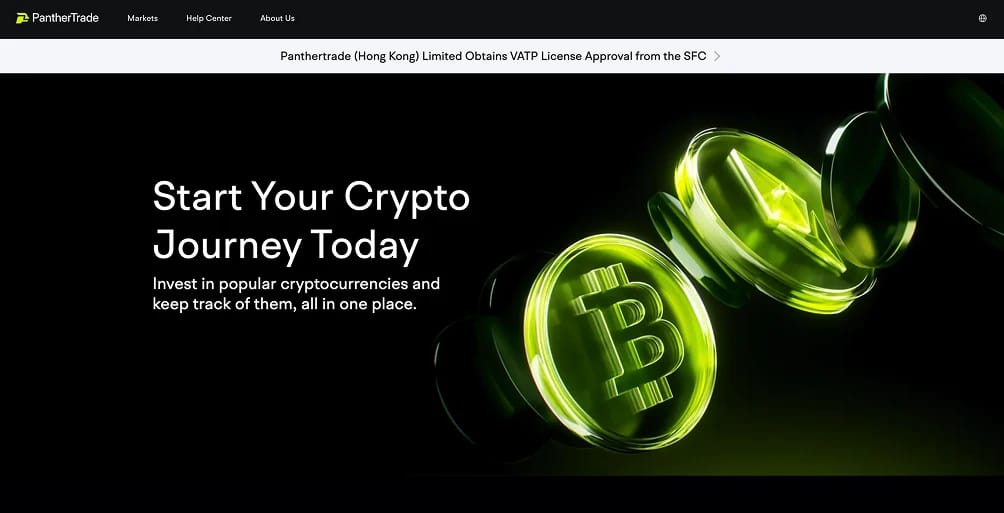
PantherTrade is the first brokerage-incubated VATP to receive a full SFC licence, owned by Futu Holdings (NASDAQ: FUTU) and granted operational status on 27 January 2025. As of March 2026 it's fully integrated with Futu Securities, letting a HK Futu account holder move HKD straight into crypto without a separate onboarding.
The integration is the reason to use it. If you already have a Futu account for HK stocks, US equities, or ETFs and want a 5% to 10% crypto allocation without another platform to manage, everything collapses into one login: HKD via FPS through Futu, fees around 0.25%, and Futu-grade matching and custody. The retail list is narrower than HashKey or OSL (BTC and ETH at launch, with SOL and stablecoin pairs expected).
YAX, Tiger Brokers' equivalent, was licensed the same day, giving Tiger users a similar integrated setup. For someone whose primary financial relationship is with HSBC or a digital bank rather than an online broker, PantherTrade doesn't offer much over HashKey or OSL. The value is specifically in the Futu integration, and combined securities-plus-crypto reporting simplifies record-keeping at tax time.
Pros
- First fully licensed brokerage-incubated VATP, with deep Futu Securities integration.
- HKD funding through Futu's existing FPS-connected account structure.
- Indicative spot fees around 0.25%, below HashKey's retail rate.
- Backed by a publicly traded parent (NASDAQ: FUTU) with established compliance infrastructure.
Cons
- Retail token list is the narrowest of the licensed VATPs at launch.
- Real value depends on already having or wanting a Futu account.
- Newer platform with shorter operating history than HashKey or OSL.
6. HKVAX
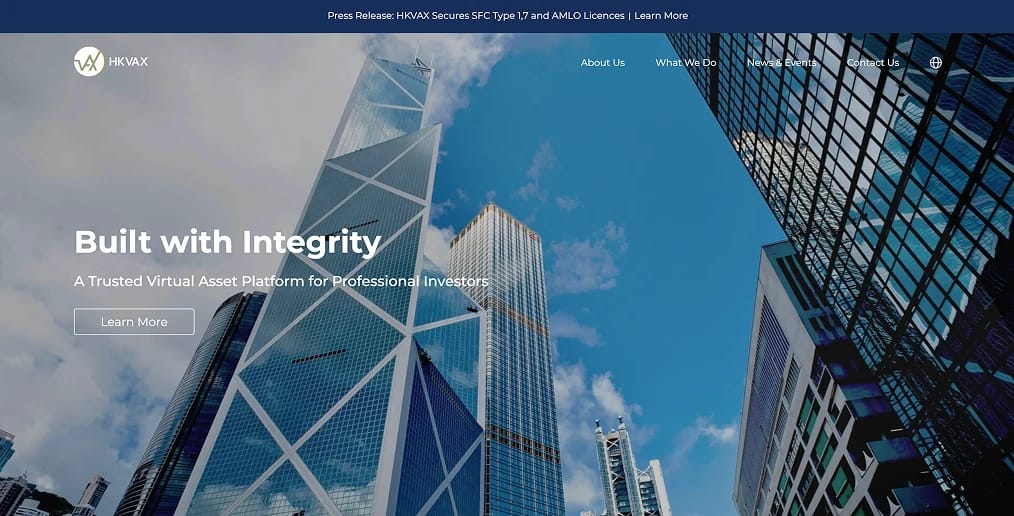
HKVAX closes the list as the licensed VATP focused on OTC, security token offerings, and real-world asset tokenisation rather than retail spot. It became the third licensed retail crypto exchange in Hong Kong on 4 October 2024, holding Type 1, Type 7, and AMLO licences, and positions itself as "the STO and RWA centre for Asia".
For retail BTC buyers, this isn't the right venue. The spot offering is thinner than HashKey or OSL, and onboarding still skews institutional. Where HKVAX earns its place is the OTC desk and tokenised asset roadmap: for block trades above HK$1 million, tiered OTC pricing typically beats licensed spot books and includes insured custody throughout settlement. HKVAX recently signed an MoU with Victory Securities (HKEX: 8540) on virtual asset brokerage.
If Hong Kong's STO and RWA market develops as the SFC intends, particularly after the November 2025 circulars, HKVAX is well-positioned. The retail takeaway: use HKVAX for a six- or seven-figure OTC execution, or if you specifically want tokenised real-world asset exposure. Otherwise HashKey or OSL handle the day-to-day better.
Pros
- SFC Type 1, Type 7, and AMLO licences with insured custody coverage.
- Focused OTC desk with competitive tiered pricing on block trades above HK$1 million.
- Specialised STO and RWA tokenisation capabilities not available on HashKey or OSL.
- Strong institutional partnerships including the Victory Securities MoU.
Cons
- Retail spot offering is the thinnest of the licensed VATPs.
- Onboarding skews institutional, with a steeper learning curve for retail clients.
- Less developed app and trading interface compared to HashKey or OSL.
How to Choose a Crypto Exchange in Hong Kong
Choosing an exchange in Hong Kong is less about cheapest fee and more about how much regulatory protection you want versus how much asset selection you need. Four checks I run:
- Decide between licensed VATP and offshore first. If you only want BTC, ETH, SOL, AVAX, or LINK and value SFC investor-protection rules, stay on HashKey or OSL. For anything outside that list (altcoins, derivatives, broader stablecoin exposure), you're offshore by definition, since SFC token-admission rules limit licensed VATPs to large-cap assets cleared individually by the regulator.
- Confirm your HKD on-ramp before depositing. Licensed VATPs support FPS eDDA, clearing in seconds during banking hours, free of charge. Offshore platforms need USD wires from HSBC, Standard Chartered, BOCHK, or a digital bank, adding 0.5% to 1% FX spread on the round trip plus 1 to 3 banking days for SWIFT transit. Test a HK$1,000 cycle first.
- Check what your bank does on the off-ramp. Major HK banks rarely query inbound transfers from licensed VATPs, but sometimes flag offshore-venue transfers above HK$200,000 for source-of-funds review. Digital banks (ZA Bank, Mox, WeLab) are lighter-touch. Knowing your bank's behaviour in advance saves a frozen transfer at the wrong moment.
- Measure all-in cost, not headline trading fee. A licensed VATP at 0.29% with free HKD deposits often beats an offshore venue at 0.10% plus 0.7% HKD-USD round-trip FX. Run a HK$5,000 test and convert both sides back to HKD before scaling. The cheapest-looking spot fee is rarely the cheapest path.
Crypto and Bitcoin Regulation in Hong Kong
Hong Kong has one of Asia's most developed crypto regulatory frameworks, anchored on three pieces of legislation and two regulators:
- VATP licensing under AMLO (June 2023): Under the Anti-Money Laundering and Counter-Terrorist Financing Ordinance, all centralised virtual asset trading platforms operating in or marketing to Hong Kong must hold a VATP licence from the SFC. The transition closed 31 May 2024; only licensed or deemed-licensed VATPs can operate.
- SFC Type 1 and Type 7 licences under the SFO: Most major VATPs also hold Type 1 (Dealing in Securities) and Type 7 (Providing Automated Trading Services) licences for the security-token side and automated execution. HashKey, OSL, HKVAX, PantherTrade, and YAX all carry this stack.
- Retail token admission rules: The SFC assesses each token against market cap, trading volume, liquidity, and major-index inclusion before retail listing. As of early 2026, only five tokens are approved for retail trading: BTC, ETH, SOL, AVAX, and LINK. Professional Investors with a HK$8M portfolio access wider menus.
- Stablecoins Ordinance (1 August 2025): Created an HKMA licensing regime for fiat-referenced stablecoin issuers, with HK$25 million paid-up capital and full reserve backing. No issuer licences granted as of Q1 2026, though several applications are under review.
- November 2025 SFC product expansion circulars: The November 2025 circulars allowed licensed venues to share order books with global affiliate platforms in approved jurisdictions, addressing the liquidity-fragmentation problem. The same circulars opened the door to staking services and selected professional-investor derivatives under a controlled rollout.
Holding and trading crypto in Hong Kong is fully legal on licensed platforms, with some of the strongest investor protections in Asia. The trade-off is a narrower retail asset menu than offshore. Hong Kong residents legally use offshore venues like Kraken at their own discretion, though SFC protections don't extend there. The SFC's 2026 roadmap includes expanded staking, professional-investor derivatives, and broader RWA tokenisation, so the licensed-venue menu will widen over the year.
.webp)
How Does Hong Kong Tax Crypto?
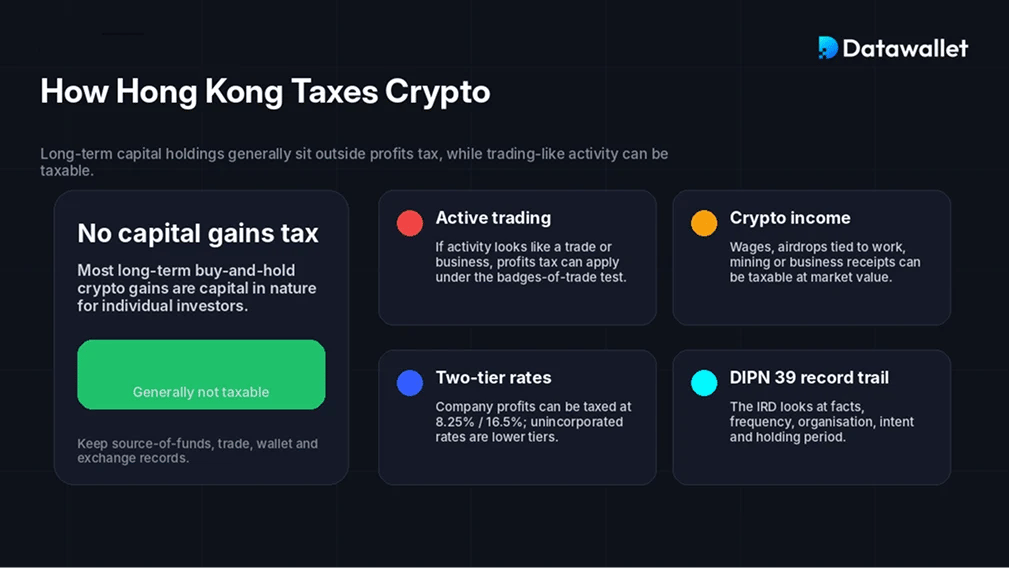
Hong Kong's crypto tax position is one of the most favourable in any major developed jurisdiction. There is no capital gains tax, and the Inland Revenue Department's DIPN 39 (revised March 2020) confirms that long-term crypto holdings generally fall outside the profits tax net for individual investors.
The framework splits into a few clear scenarios:
- Capital holdings (no tax): If you hold BTC, ETH, or other crypto as a long-term investment and your activity doesn't resemble a trade or business, gains on disposal are capital in nature and not taxable. Covers most retail buy-and-hold positions.
- Active trading (profits tax applies): The IRD applies the "badges of trade" test (frequency, organisation, profit-seeking intent, holding period) to determine whether your activity is a trade. If it is, profits sit under the two-tier profits tax rates: 8.25% / 16.5% for corporations, or 7.5% / 15% for unincorporated businesses. Hong Kong's territorial rule means only HK-sourced profits are taxed.
- Crypto received as employment income: Wages or bonuses paid in crypto are taxed at salaries tax rates (2% to 17% marginal) at market value on receipt. Relevant for Web3 employees receiving token compensation.
- Mining and staking: Business income at commercial scale. Casual staking rewards on personal holdings sit in a grey area, with most local tax practitioners treating them as capital unless the activity is organised and business-like.
- No VAT or sales tax: Hong Kong levies no VAT or GST, so crypto purchases and sales aren't subject to consumption tax.
For most HK residents holding spot BTC, ETH, or a small large-cap portfolio long-term, practical exposure is zero. Keep records of every disposal and the HKD value at the time, but don't expect to file. The picture changes for quant strategies or market-making, where the badges-of-trade test likely catches you and the DIPN 39 commercial activity rules apply.
Hong Kong's territorial source basis also means a trader operating from outside HK on offshore platforms generally falls outside profits tax even with an HKID, provided trading operations themselves occur abroad. Source is fact-driven and the IRD reviews case by case, so anyone running a meaningful operation should engage a local CPA.
Cryptocurrency Adoption in Hong Kong
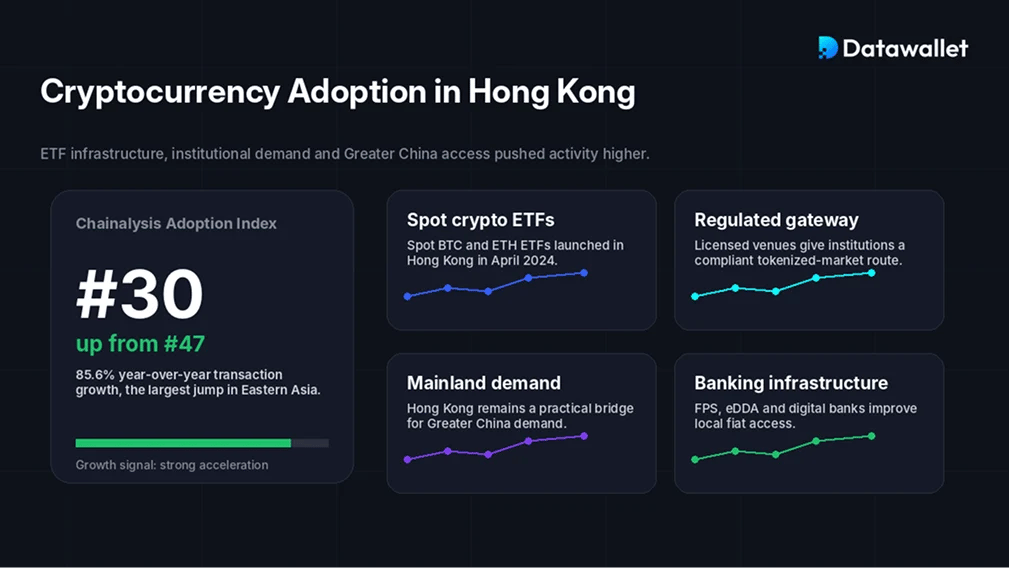
Hong Kong ranked 30th on Chainalysis' 2024 Global Crypto Adoption Index, up from 47th the prior year, with 85.6% year-over-year transaction growth, the largest jump in Eastern Asia. The drivers here differ from most regional markets:
- Institutional flows post-ETF launch: On 30 April 2024 the SFC approved Asia's first spot BTC and ETH ETFs, launched by ChinaAMC, Bosera HashKey, and Harvest. The HKEX listed nine virtual asset ETFs by August 2025. Track flows on our Bitcoin ETF tracker and Ethereum ETF tracker.
- Hong Kong as a regulated gateway for Greater China: A meaningful share of mainland Chinese crypto demand routes through Hong Kong's banking infrastructure. Our China exchanges guide covers how mainland users access compliant venues through HK USD accounts.
- Local retail momentum: A 2024 Hong Kong Investment Funds Association survey found 75% of retail investors interested in trading cryptocurrencies, with 41% preferring spot or futures crypto ETFs and 39% preferring locally licensed VATPs. That demand helped drive ZA Bank's in-app crypto trading launch in November 2024.
- Stablecoin demand and HKD-pegged push: The Stablecoins Ordinance triggered applications from Standard Chartered (Hong Kong), Ant International, and others. OSL is testing HKDAP, a regulated HKD-pegged stablecoin on Ethereum. First HKMA-licensed issuers expected during 2026.
Hong Kong's crypto demand is structurally tied to its position as the regulated gateway between Greater China and global crypto markets, and its role as Asia's main institutional finance hub. Both look durable. Spot ETF flows have remained net positive through most of 2025, and the HKEX expanded the virtual asset ETF lineup to nine listings by August 2025 with bid-ask spreads compressing to around 0.5% as institutional liquidity deepens.
How to Buy Bitcoin in Hong Kong
The cleanest path depends on what you want. For broad exposure beyond the SFC's five-token retail list, Kraken handles it. For BTC, ETH, or SOL with the tightest HKD on-ramp, HashKey wins. For listed-company disclosure and the largest insurance coverage, OSL fits.
The Kraken sequence (offshore, USD funded):
- Open a multi-currency USD account. HSBC Premier, Standard Chartered Priority, BOCHK SmartFunds, and Citibank IPB all support free USD wires within set monthly limits.
- Complete Kraken KYC with your HKID. Verification typically clears within 24 hours for clean profiles.
- SWIFT USD into Kraken. Funds arrive in 1 to 3 banking days. Whitelist the deposit address first.
- Trade BTC on Kraken Pro. Use the order book rather than Instant Buy to avoid wider spreads.
- Withdraw to self-custody or convert back. Long-term holders move BTC to a hardware wallet (see our best crypto wallets guide).
The HashKey sequence (HKD-native, licensed):
- Complete KYC with your HKID at HashKey. Verification clears within an hour for clean profiles; account name must match your HKID exactly.
- Set up eDDA from your bank account to HashKey. First setup takes 1 to 2 banking days; subsequent transfers settle in seconds via FPS.
- Buy BTC on the order book at limit. BTC/HKD spreads typically sit within 0.05% of the cross-rate against major USD pairs.
- Decide on custody. HashKey and OSL both run insured custody. Long-term holders should withdraw to a hardware wallet.
For brokerage-account exposure, the Hong Kong spot Bitcoin ETFs (ChinaAMC's 3042.HK, Bosera HashKey's 3008.HK, Harvest's 3439.HK) trade like any HKEX-listed product through Futu, Tiger, or HSBC. Institutional custody, listed-security tax treatment, 0.30% to 0.99% annual management fees, no self-custody. Worth considering for tax-sensitive long-term holders who want crypto exposure without managing keys or counterparty risk.
Final Thoughts
Pick by what you want to do. If you need broad asset exposure with the strongest regulatory portfolio anywhere, Kraken takes it. If your goal is BTC, ETH, or SOL with a clean HKD on-ramp and direct SFC oversight, HashKey is the local answer. If you're sitting on a larger position and want listed-company disclosure plus US$1 billion in insurance, OSL fits. For tax-sensitive long-term holders who don't want to manage keys, the Hong Kong spot Bitcoin ETFs on HKEX cover the same exposure inside a brokerage account.
The regulatory direction is widening, not tightening. The SFC's November 2025 circulars opened global liquidity sharing between licensed VATPs and offshore affiliates, the Stablecoins Ordinance will produce its first licensed HKD-pegged issuers during 2026, and the retail token list keeps growing. Three years ago this market barely existed; today it's one of the most credible regulated crypto environments anywhere, and the structural advantages (no CGT, FPS instant settlement, a robust banking system) are durable.
Before depositing anything material, run a HK$1,000 test through your chosen venue, confirm the HKD round-trip works with your bank, and check that the asset menu covers what you want to hold. That five-minute exercise tells you more than any review.
Our Methodology
We tested 12+ exchanges available to Hong Kong users by opening accounts with HKIDs, completing KYC at retail and Professional Investor tiers where available, funding HKD through FPS and eDDA, executing trades, and withdrawing back to HSBC, Standard Chartered, BOCHK, and ZA Bank accounts. Each platform scored across six criteria:
- Trust Score: Our proprietary rating (out of 5) weights regulatory standing, custody insurance, audit transparency, platform longevity, and security history. Venues holding SFC VATP plus Type 1/7 licences with insured custody scored highest, with extra credit for Proof of Reserves, public listing, and a clean breach record.
- Hong Kong Access and Onboarding: Whether the platform accepts HKID for KYC, supports retail or only Professional Investor onboarding, and how cleanly verification clears.
- HKD Funding Methods: Confirmed FPS eDDA, traditional bank transfer, and SWIFT support, with testing on settlement speed, fees, and minimum deposits.
- Asset Selection and Liquidity: Placed market and limit orders on BTC/HKD, BTC/USD, ETH/HKD, and at least one mid-cap pair to measure spread, depth, and fill quality.
- Off-Ramp Reliability: Tested withdrawals to HSBC, Standard Chartered, BOCHK, Hang Seng, ZA Bank, Mox, and WeLab, measuring transit time, friction, and AML reviews on first transfers.
- All-In Cost: Compared maker/taker fees, deposit and withdrawal charges, HKD-USD conversion spreads, and round-trip cost on a HK$10,000 BTC trade.
We excluded platforms that no longer accept Hong Kong residents, venues that withdrew their VATP applications without an offshore offering, and exchanges with serious recent compliance problems. Testing ran February to May 2026.
.webp)