







Compare Top Irish Crypto Exchanges
1. Kraken
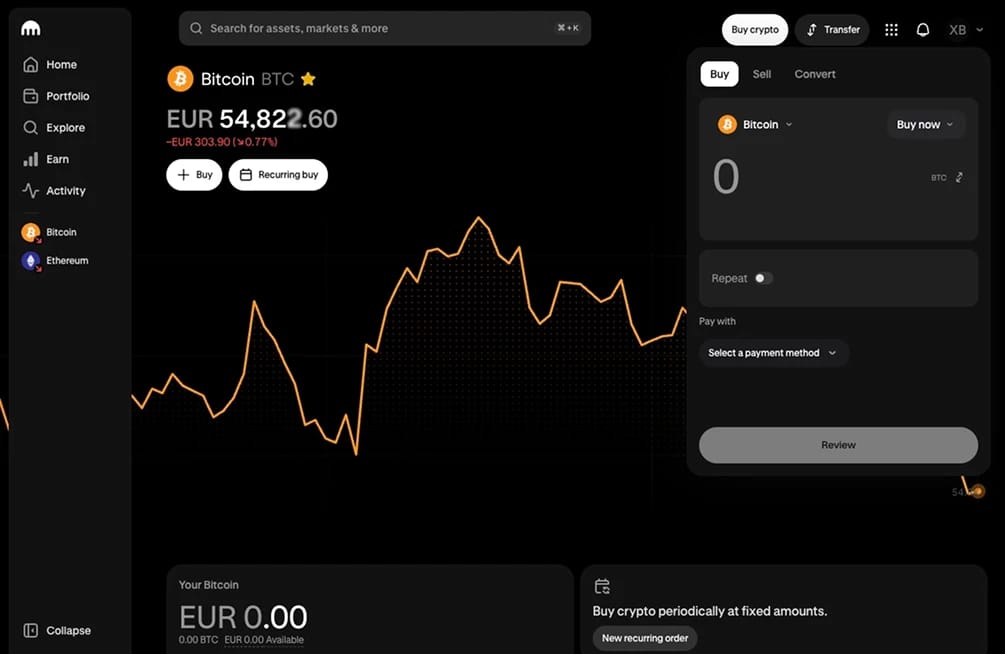
Kraken sits at the top of this ranking because no other platform is supervised as closely from inside Ireland. Its entity Payward Europe Solutions Limited became the first company to receive a MiCA CASP licence from the Central Bank of Ireland in June 2025, and a second Irish entity, Payward Ireland Limited, holds a CBI e-money permission covering the euro side of accounts.
The platform backs the licences with substance. Around 450 assets trade against some of the deepest EUR order books in Europe, Kraken Pro charges entry-tier fees of 0.25% for makers and 0.40% for takers, and eligible Irish clients can trade regulated futures through a separate Kraken investment firm supervised in Cyprus under MiFID II. Staking covers dozens of assets.
During our testing, a SEPA deposit from an Irish account became tradable within hours at no cost, and a euro withdrawal cleared the next business day. The exchange has operated since 2011 without ever losing client funds to a breach, a record none of its rivals can claim. Read our Kraken review for a feature-level breakdown.
Pros
- The CBI granted Payward Europe Solutions Limited the first Irish MiCA CASP authorisation, putting Kraken under home-country supervision no rival shares.
- Fifteen years of operation without a major security loss, reinforced by recurring Proof of Reserves publications.
- SEPA deposits from Irish banks are free and feed the deepest euro markets of any platform we tested.
Cons
- Deposit options cover only SEPA and cards, leaving out Apple Pay, Google Pay, and PayPal for Irish users.
- The default instant-buy screen prices trades well above Kraken Pro, so anyone who skips the Pro interface overpays.
- New tokens reach Kraken's curated list weeks after they appear on Gate or OKX, and some never arrive at all.
2. Bybit
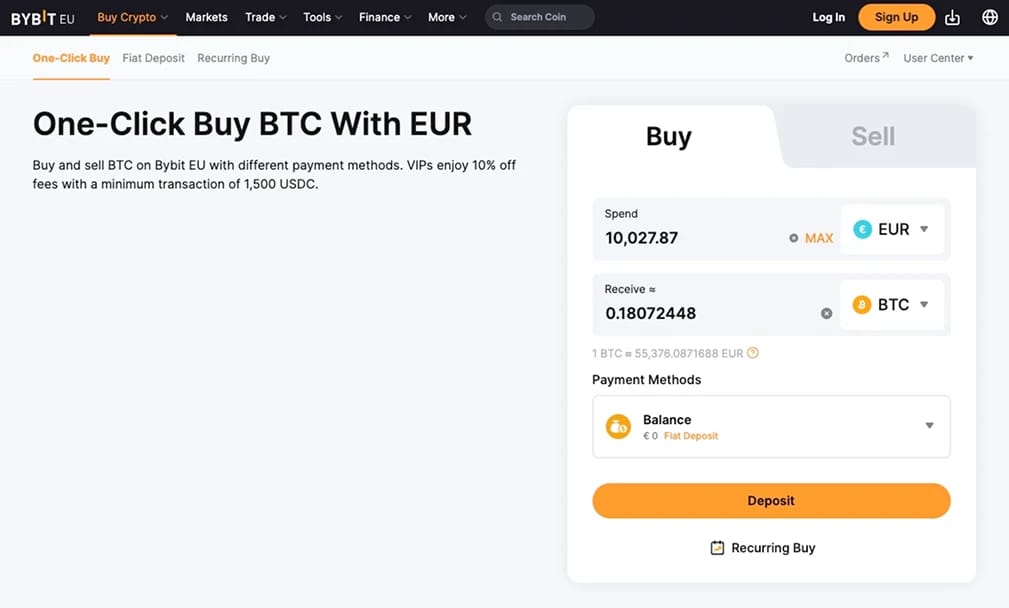
Bybit gives Irish traders the broadest toolkit of any authorised platform. This is because it is the world’s second-largest exchange for both spot and futures trading volume. One Bybit EU account covers 600+ cryptocurrencies, copy trading, automated bots, Earn products, crypto loans, the Bybit crypto card and a risk-free demo mode.
Irish accounts sit with Bybit EU GmbH, the Vienna company that Austria's FMA authorised under MiCA on 28 May 2025, and the permission passports to Ireland. In August 2026, a sister company, Bybit Payments GmbH, added an Austrian e-money licence that brings the payments side under supervision. Spot pricing is a flat 0.10% on maker and taker orders alike, and the app switches between a simplified view and a professional one.
Our SEPA transfer landed without a deposit charge, and card, Apple Pay, Google Pay, and PayPal top-ups are also available. Bybit is the only exchange on this list that processes PayPal deposits. The main downside is that the EEA platform carries none of the global version's derivatives, which active traders will notice. Read our Bybit review for a closer look at the features.
Pros
- Austria's FMA authorised Bybit EU GmbH under MiCA in May 2025, and the permission covers Irish clients through EEA passporting.
- Copy trading, bots, Earn, loans, and demo trading all live inside one account, a breadth no rival on this list matches.
- Euro deposits work through SEPA, cards, and the major mobile payment services, giving Irish users more funding choice than any competitor here.
Cons
- Constant bonus campaigns and promotional banners crowd the interface and distract from cost and risk.
- The European catalogue holds 600+ assets, a small share of the global version's list, and derivatives are absent entirely.
- Account tiers, campaign terms, and product rules differ from the global documentation, which makes independent research harder.
3. Gate
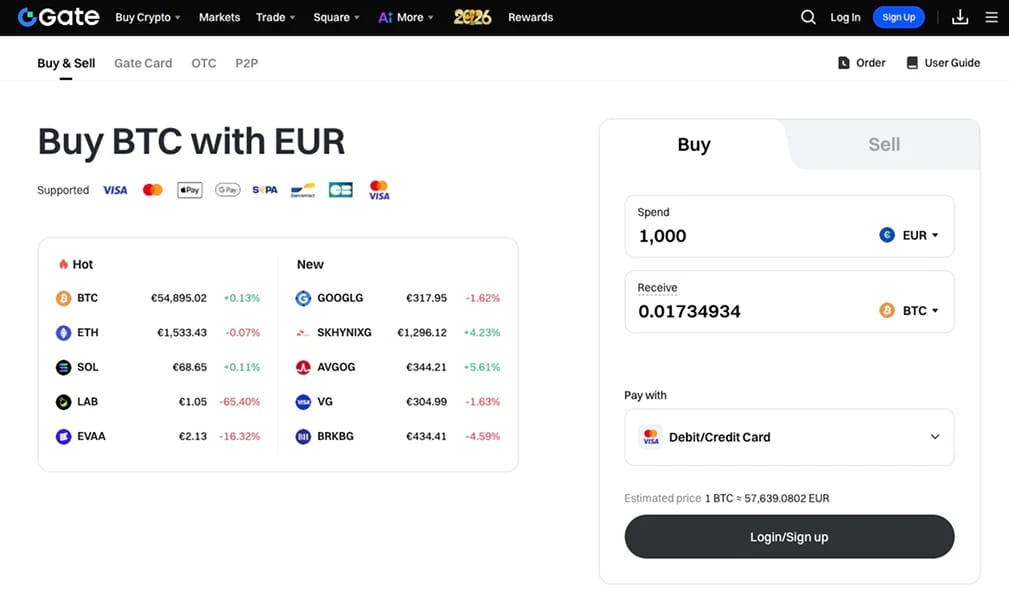
Gate is the account we recommend for the small-cap end of the market. Gate Technology Ltd, its Malta company, received a MiCA licence from the MFSA in September 2025, and its EEA platform lists more than 1,000 cryptocurrencies, the largest legal selection open to Irish residents. This is far less than the global offering of 4,800 digital assets, but still a wider range than any exchange on this list.
A full set of trading tools surrounds the catalogue. Spot markets charge 0.09% for makers and 0.10% for takers, among the cheapest pricing anywhere, and the account includes trading bots, copy trading, Earn products, and a launchpad for early token sales. The same Maltese entity added an EU payment institution licence in February 2026, extending its regulated footprint beyond crypto.
The scale hurts usability for beginners. Menus nest inside menus, campaign links compete for attention, and thinly traded pairs sit next to liquid ones with no visual distinction, so a spread can quietly erase the low headline fee on small tokens. We suggest running Gate alongside a primary exchange, using it to reach tokens the bigger names have not listed.
Pros
- Gate Technology Ltd holds a MiCA authorisation from Malta's MFSA, keeping the exchange fully legal for Irish clients.
- Over 1,000 listed cryptocurrencies give Irish users the widest regulated token selection in this ranking.
- Base fees of 0.09% and 0.10% undercut every other platform here, and bots and launchpad access add ways to deploy capital.
Cons
- The interface takes longer to learn than any rival on this list, and a first euro purchase involves several unnecessary screens.
- Long-tail tokens often trade thinly, so wide spreads can cost more than the low commission saves.
- The EEA catalogue is a fraction of the 4,000+ assets on Gate's global platform after compliance removals.
4. Coinbase
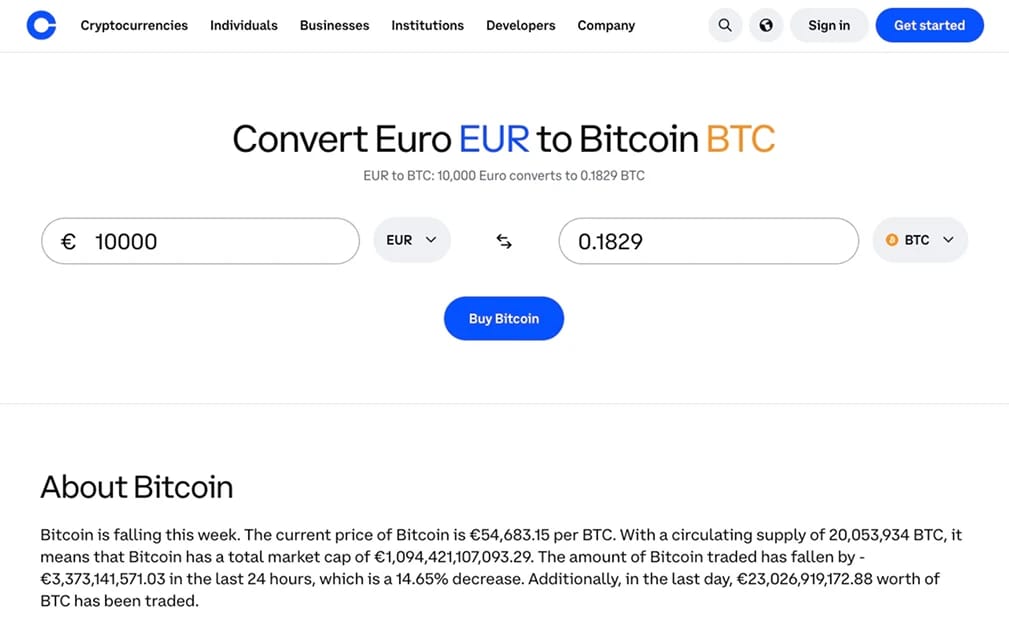
Coinbase remains the venue we recommend to Irish companies, funds, and anyone whose auditors expect a listed counterparty. It trades on Nasdaq, publishes SEC-audited financial statements, and serves Irish clients via Coinbase Luxembourg S.A., which the CSSF authorised under MiCA in mid-2025 when the group moved its EU hub from Dublin to Luxembourg.
Irish readers should know the history behind that move. In November 2025, the CBI fined Coinbase Europe Limited about EUR 21.5 million for transaction-monitoring failures between 2021 and 2025, its first enforcement action against a crypto firm. The sanctioned Irish entity has wound down, and Irish accounts now run on the Luxembourg company.
Coinbase Prime pairs trading with the cold-storage custody services used by several US spot Bitcoin ETFs rely on. Retail users get a polished app plus the Advanced Trade interface, priced at 0.40% for makers and 0.60% for takers. Our Coinbase fees guide and Coinbase review break the pricing down in detail.
Pros
- The CSSF authorised Coinbase Luxembourg S.A. under MiCA, so Irish clients kept uninterrupted access through the transition.
- A Nasdaq listing and SEC-audited accounts let institutions run standard due diligence that private exchanges cannot support.
- Prime brokerage and segregated cold custody serve corporate clients at a scale no other platform in this ranking offers.
Cons
- Base pricing on Advanced Trade, 0.40% and 0.60%, runs several times higher than Bybit, Gate, or OKX.
- The simple buy screen layers spreads and flat charges that punish small recurring purchases.
- Coinbase retains a 25% or higher commission on most staking rewards, the largest cut among the platforms listed here.
5. OKX
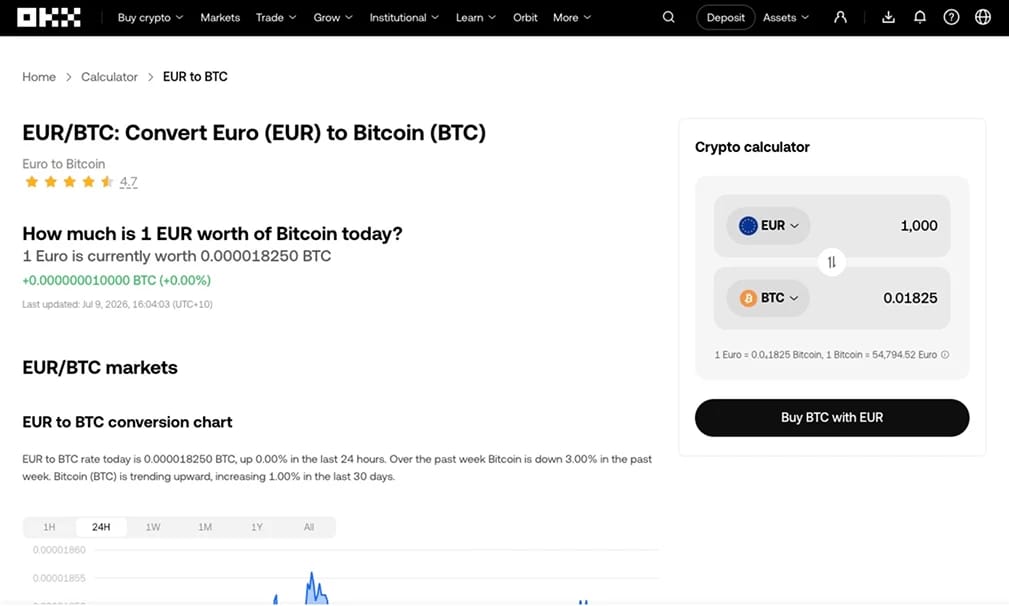
OKX is the pick for Irish users who want a regulated account that connects cleanly to self-custody. OKX Europe Limited secured its MiCA authorisation from Malta's MFSA in January 2025, months before most global rivals completed the process, and the platform publishes monthly Proof of Reserves reports covering client assets.
What separates OKX is the built-in Web3 wallet. From one app, users can move funds into a self-custodial wallet, reach decentralised exchanges through an aggregator, and use applications across 100+ networks. Base spot pricing of 0.08% for makers and 0.10% for takers undercuts every rival in this ranking, and roughly 300 assets trade on the EEA entity.
SEPA and SEPA Instant deposits arrived promptly in our testing, and moving a small balance to the Web3 wallet took under a minute. OKX is the best option for investors who are interested in both centralised and decentralised finance. Our OKX review examines the exchange and wallet in detail.
Pros
- Malta's MFSA granted OKX Europe Limited its MiCA authorisation, and the permission extends to Irish clients through passporting.
- The integrated Web3 wallet and DEX aggregator turn one account into a supervised entry point for on-chain activity.
- Maker fees of 0.08% and monthly Proof of Reserves combine low cost with verifiable backing.
Cons
- The sheer number of tabs, products, and campaign surfaces can disorient anyone making a first purchase.
- The EEA entity lists around 300 assets, far fewer than the thousands on OKX's global platform.
- Euro funding runs only through bank transfers, with no card or mobile wallet options for Irish users.
6. CoinJar
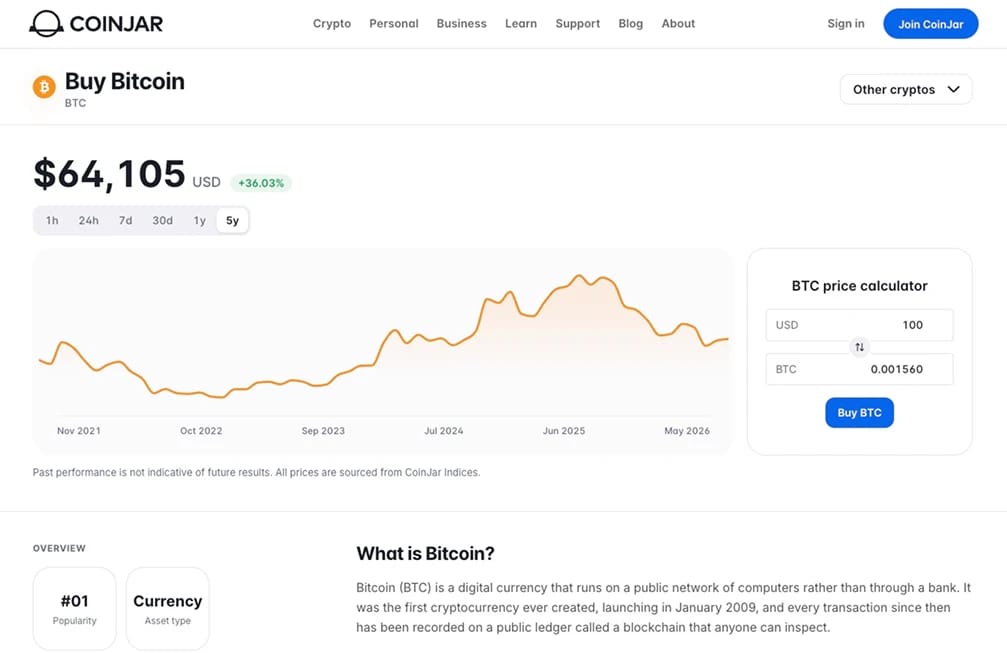
CoinJar is the second platform in this ranking supervised directly from Dublin. CoinJar Europe Limited became a CBI-authorised CASP with effect from 9 December 2025 under registration number C496731. The company has operated since 2013, making it one of the longest-running exchanges anywhere, and it chose Dublin as its European hub with a EUR 5 million investment and plans for 30 local roles.
The product is built for simple investing. Around 60 cryptocurrencies trade at a flat 1% fee, the quoted price includes the spread before you confirm, and SEPA deposits and withdrawals cost nothing. Recurring Buy automates weekly, fortnightly, or monthly purchases from a euro balance, Bundles group assets into themed baskets, and an OTC desk handles larger trades. Client assets sit in segregated CoinJar Europe wallets on Fireblocks infrastructure.
The limits show for active traders. The flat fee plus spread prices a frequent trader out against maker and taker schedules elsewhere, and the catalogue is a fraction of what Gate or Bybit list. MiCA also restricts one stablecoin function. The entity is not yet authorised to transfer e-money tokens, so USDC can be bought, sold, and deposited but not withdrawn to an external wallet. CoinJar also collects your PPS number to meet Irish reporting rules.
Pros
- A MiCA CASP licence from the Central Bank of Ireland puts CoinJar under the same home supervisor as Kraken, with complaints escalating to the FSPO.
- SEPA transfers in and out cost nothing, and Recurring Buy automates euro purchases on a schedule.
- Client assets are held in segregated wallets, and the company has operated continuously since 2013.
Cons
- The flat 1% conversion fee plus spread costs more per trade than maker and taker pricing on rival platforms.
- The platform centres on spot buying and holding, with no bots, copy trading, or derivatives.
- USDC cannot be sent to external wallets under the entity's current permissions.
How to Choose a Crypto Exchange in Ireland
Since each of the six platforms here has already cleared MiCA authorisation, the decision rests on supervision quality, euro funding, and how each fee model fits your habits. Five checks separate a good choice from an expensive one.
- Confirm the licence against the register: A MiCA permission attaches to one legal entity, such as Coinbase Luxembourg S.A. Search that exact name in the CBI registers or the ESMA record before sending money. Our best MiCA-licensed crypto exchanges guide lists platforms that have cleared this check.
- Finish verification before you deposit: Every authorised platform must identify its clients under MiCA and EU anti-money-laundering law. Type your personal details in the same form your bank has on record, since a mismatched name is the most common reason a first deposit gets frozen.
- Fund by SEPA from your bank: A transfer from AIB, Bank of Ireland, or a Revolut account usually arrives the same day and costs nothing, while card purchases add processor fees and a wider spread on top.
- Price the entire transaction: The advertised commission is one of three costs alongside the buy-screen spread and the withdrawal fee. Our maker versus taker fees explainer shows why a limit order on the exchange's professional interface routinely saves 1% or more against the instant-buy button.
- Test the exit early: Send a modest euro withdrawal and a small crypto transfer out before committing a meaningful balance. A trustworthy platform shows every fee before confirmation and returns euros to your Irish account within a business day.
Crypto and Bitcoin Regulation in Ireland
Crypto is fully legal to buy, hold, and trade in Ireland. Oversight sits with the Central Bank of Ireland, the national authority that authorises and supervises crypto firms under the EU's Markets in Crypto-Assets Regulation (MiCA), the single rulebook that replaced national registration regimes across the bloc.
These dates explain how the current Irish framework took shape:
- April 2021: The Criminal Justice Act extended anti-money-laundering obligations to virtual asset service providers, and firms offering exchange or custody services needed a CBI registration to operate.
- 30 December 2024: MiCA took effect for crypto firms throughout the EU. Ireland opted for a 12-month transitional window, half the maximum allowed, signalling that the CBI wanted firms authorised quickly.
- 25 June 2025: Kraken's Payward Europe Solutions Limited became the first company the CBI authorised as a CASP, and the exchange made Dublin its base for the whole EEA.
- 6 November 2025: The CBI announced a EUR 21.5 million fine against Coinbase Europe Limited for transaction-monitoring failures, its first enforcement action in the crypto sector, later confirmed by the High Court in January 2026.
- 9 December 2025: CoinJar Europe Limited received CASP authorisation, adding a second retail exchange to the CBI's own register weeks before the transition closed.
- 30 December 2025: Ireland's transitional period closed. VASP registrations lapsed, and only firms holding a CASP authorisation, Irish or passported, could continue serving Irish clients.
- 18 June 2026: The Department of Finance published its first national risk assessment of digital assets in seven years, flagging money-laundering risks and committing to new industry standards by late 2027.
- 1 July 2026: The grandfathering window closed across the whole EU. Binance, which had pulled its Greek application a week earlier, halted services for EU users, leaving withdrawals as the only open function. Our Binance restricted countries guide explains what existing account holders can still do.
Before depositing anywhere, check the terms of service for the operator's registered company name, then look that name up in the CBI registers or on ESMA's list, because a firm missing from both is operating unlawfully in Ireland.
.webp)
How Does Revenue Tax Crypto in Ireland?
The Revenue Commissioners apply Ireland's existing tax rules to crypto rather than a dedicated regime, treating coins and tokens as chargeable assets similar to shares. The summary below is for orientation, not tax advice.
- Capital Gains Tax at 33%: Selling crypto for euros, spending it, or gifting it to anyone other than a spouse is a disposal, and gains above the annual exemption are taxed at a flat 33% regardless of how long you held.
- The EUR 1,270 annual exemption: The first EUR 1,270 of total gains each year across all assets is tax-free. The allowance cannot be carried into a later year, so many investors realise small gains annually to use it.
- Crypto-to-crypto swaps are taxable: Trading BTC for ETH counts as a disposal of the Bitcoin at its euro value on the day. Frequent traders can build a CGT bill without ever converting back to euros.
- Income tax on earned crypto: Staking rewards, mining income, and airdrops received for services are taxed as income at 20% or 40%, with USC and PRSI on top where applicable, and later disposals trigger CGT separately.
- CARF reporting is live: Under the Crypto-Asset Reporting Framework, authorised platforms collect transaction data on Irish users from 1 January 2026, face a Revenue registration deadline of 31 December 2026, and file first returns by 31 May 2027.
Ireland's 33% tax rate ranks among the highest in the EU, and unlike several member states, there is no exemption for long-held coins. Anyone trading at scale or earning staking income across many platforms should confirm their position with an Irish tax adviser before the filing deadline.
.webp)
Cryptocurrency Adoption in Ireland
Irish crypto ownership is broad by European standards. Central Bank of Ireland (CBI) research published in December 2025 found that roughly one in ten people in Ireland holds crypto assets, a level the Department of Finance highlighted when it assessed the sector's risks in June 2026.
Dublin has also become a supervisory centre rather than only a consumer market. Twelve firms held CBI CASP authorisations by mid 2026, including Kraken's European headquarters, the Australian-founded exchange CoinJar, the trading firm StoneX Digital, the fiat-to-crypto provider Ramp Network, and Push by Aave Labs, one of the more diverse licensed populations in the EU.
Growth has brought scrutiny. The Criminal Assets Bureau seized EUR 30 million in crypto in March 2026, the national risk assessment labelled money laundering through digital assets a serious concern, and the government intends to introduce standards for crypto-linked funds by the second half of 2027. Irish adoption is rising inside an increasingly watchful system.

How to Buy Bitcoin in Ireland
The cheapest reliable path to Bitcoin in Ireland is a SEPA transfer into an authorised exchange followed by a limit order on the spot market.
- Pick an authorised platform: Confirm the operator appears in the CBI registers or the ESMA record before opening an account. Kraken is our first choice for Irish users on licensing, cost, and euro liquidity.
- Complete identity checks: Submit a passport or Irish driving licence, finish the liveness scan, and wait for full approval, since partially verified accounts face deposit caps and blocked withdrawals.
- Send euros by SEPA: A transfer from AIB, Bank of Ireland, PTSB, or Revolut normally settles the same working day and avoids the fees and spreads attached to card purchases.
- Place a limit order: Open the BTC/EUR pair on the professional interface and set your price rather than tapping the express buy button, whose built-in markup is typically a multiple of the posted trading fee.
- Store long-term coins offline: Anything you plan to hold should move to a hardware wallet, and our best crypto wallets shortlist compares the leading models. Verify both the address and the network before approving a transfer.
Export your transaction history every few months instead of reconstructing it at filing time. CARF reporting covers 2026 activity, so Revenue will receive your exchange data either way, and your CG1 figures need to match it.
Final Thoughts
Ireland ended up with one of the cleanest exchange markets in the EU because its regulator moved early. The 30 December 2025 cut-off removed unauthorised platforms six months before the rest of the bloc, and the firms that remain all answer to a named European supervisor.
Kraken leads the field as the first major global exchange licensed by the CBI itself. Bybit offers the widest toolkit, Gate the deepest altcoin catalogue, Coinbase the audited counterparty institutions need, OKX the cleanest bridge into self-custody, and CoinJar a second home-supervised option with free SEPA transfers.
Two habits matter more than the final choice between them. Fund by SEPA instead of card, and buy with limit orders instead of the express screen. Keep records as you trade, because the 15 December CGT deadline and CARF data-sharing arrive on schedule whether you are ready or not.
Our Methodology
A platform needed full MiCA authorisation and active availability to Irish residents to enter our test pool. Six criteria decided the scores:
- Trust score: Our internal 5-point score, built from regulator quality, reserve transparency, incident record, and years of safe operation with client funds.
- Licence verification: We looked up every operating entity in the CBI registers and on ESMA's list, then confirmed which regulated services each authorisation actually covers.
- Euro funding from Ireland: We deposited by SEPA from an Irish account, timed how quickly funds became tradable, and recorded the card and mobile payment alternatives.
- True trading cost: We placed a live order on each platform's BTC/EUR market and combined deposit charges, commissions, express-screen markups, and withdrawal fees into a single number.
- EEA asset coverage: We measured each European entity's catalogue rather than the global figure, since compliance removals shrank what Irish users can actually reach.
- Irish relevance: We weighed local supervision, behaviour with Irish banks, and each firm's physical and legal presence in the country.
Testing concluded in July 2026, after the EU-wide transitional period had closed, and we reconfirmed each licence in the public registers immediately before publishing. The comprehensive research and fact-checking process appears in our editorial methodology.
.webp)