



What is ERC-8004?
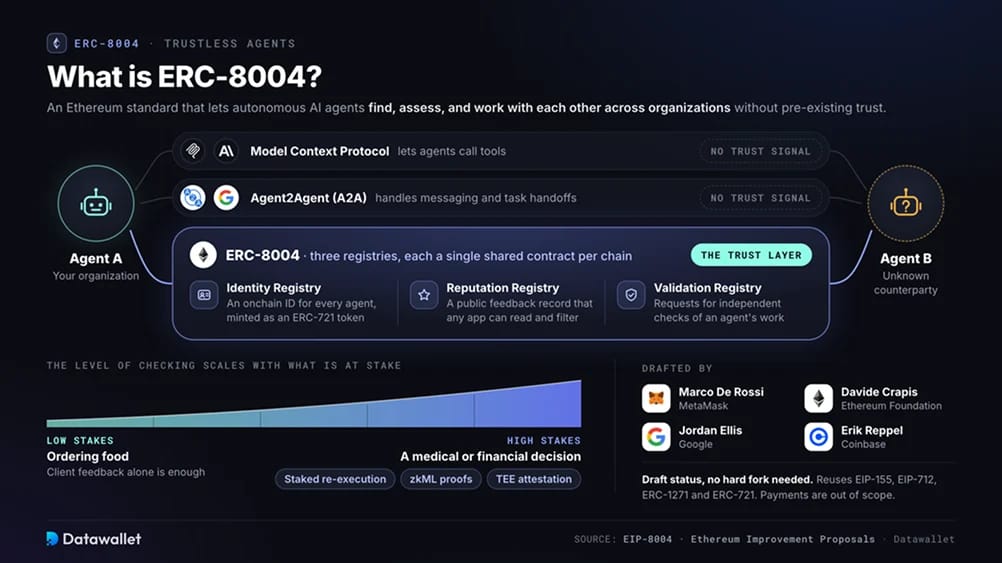
ERC-8004 is an Ethereum standard, published as EIP-8004, that allows autonomous AI agents to find, assess and work with each other across organizations without pre-existing trust. It defines three lightweight registries covering identity, reputation and validation. Each uses a single shared contract per chain, known as a singleton.
Marco De Rossi of MetaMask, Davide Crapis of the Ethereum Foundation, Jordan Ellis of Google and Erik Reppel of Coinbase drafted the proposal. It remains in Draft status. No hard fork, or change to Ethereum itself, is required because the standard reuses EIP-155 chain IDs, EIP-712 and ERC-1271 signatures, and ERC-721 tokens (NFTs).
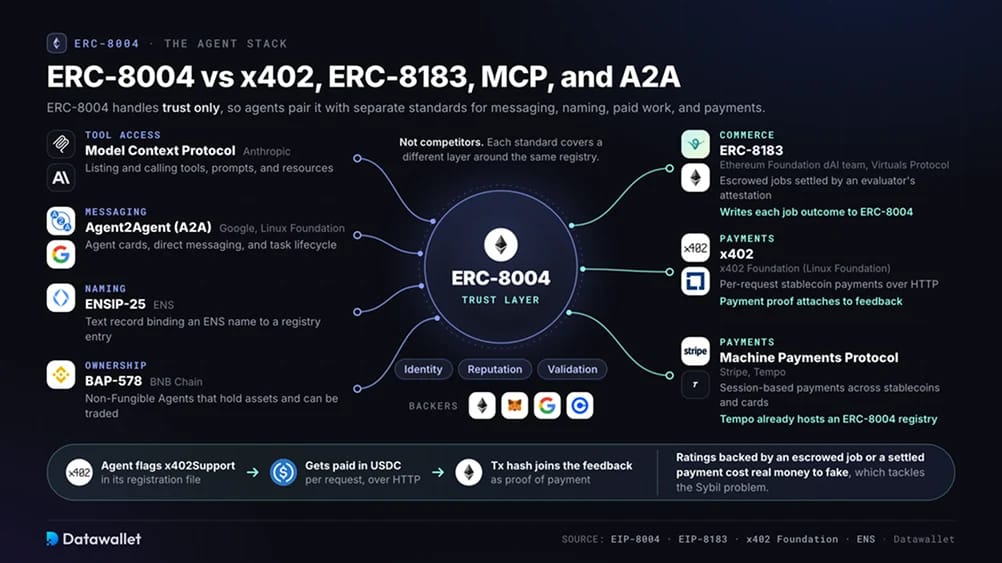
Anthropic's Model Context Protocol (MCP) lets agents call tools. Google's Agent2Agent (A2A) protocol handles messaging and task handoffs. Neither establishes whether an unknown counterparty deserves trust, which is the layer ERC-8004 supplies. Payments remain outside its scope, allowing any payment system to work alongside it.
Checks can scale with the stakes. Client feedback may be enough for ordering food. Medical or financial decisions can require validators to re-execute work with money on the line, or use zkML proofs to verify that a model ran as claimed. Another option is an attestation from a trusted execution environment (TEE), sealed hardware that proves which code ran.
How Does ERC-8004 Work?
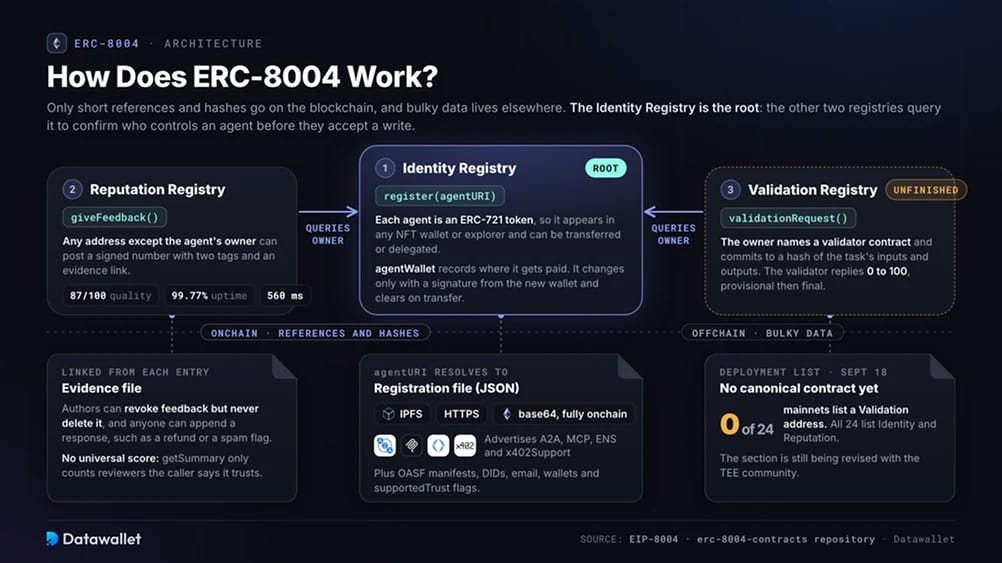
ERC-8004 keeps bulky data offchain. Only short references and hashes, the digital fingerprints of files, go on the blockchain. The Identity Registry sits at the root of the system. Before accepting a write, both the Reputation and Validation registries query it to confirm who controls the agent.
1. Identity Registry
Each agent is minted as an ERC-721 token with the URIStorage extension. It appears in any NFT-compatible wallet or explorer and can be transferred or delegated to operators. A global identifier combines an agentRegistry string, such as eip155:1 followed by the registry address, with an incrementing agentId.
The token's agentURI points to a JSON registration file. Operators can host it on the IPFS file-sharing network, serve it over HTTPS or store it fully onchain as a base64 data URI. Alongside a name and description, the file contains a services array advertising A2A agent cards, MCP servers, OASF manifests, ENS names, decentralized identifiers (DIDs), email and wallets. It also carries x402Support and supportedTrust flags.
Payment destinations sit in a reserved agentWallet field, which defaults to the owner's address. Changing it requires an EIP-712 or ERC-1271 signature from the new wallet. A transfer automatically clears the field so the buyer cannot inherit a stale payout address.
2. Reputation Registry
Any address other than the agent's owner or operators can call giveFeedback. Submissions contain a positive or negative number with up to 18 decimals, two optional tags, an endpoint and a link to an offchain evidence file. The same format accommodates an 87/100 quality rating, 99.77% uptime, a 560 ms response time or a negative trading yield.
Reviewers do not need to register first. Applications can cover their network fee (gas) through EIP-7702, the smart-wallet feature introduced in Ethereum's Pectra upgrade. Feedback authors can revoke a submission but cannot delete it. Anyone may append a response, whether an agent documenting a refund or an auditor flagging spam.
There is deliberately no universal score. To use getSummary, callers must supply the addresses of reviewers they trust, since unfiltered averages invite spam. The authors expect scoring firms, auditor networks and insurance pools to develop services using this shared raw data.
3. Validation Registry
An agent's owner calls validationRequest, naming a validator contract and committing to a hash of the task's inputs and outputs. The validator returns a response from 0 to 100 and may attach supporting evidence. Results can later be updated from provisional to final.
Validation remains unfinished. The official contracts repository warns that this section is still being revised with the TEE community. Our September 18 review of its deployment list found Identity and Reputation addresses for 24 mainnets, with no Validation address on any of them.
How to Register an AI Agent on ERC-8004
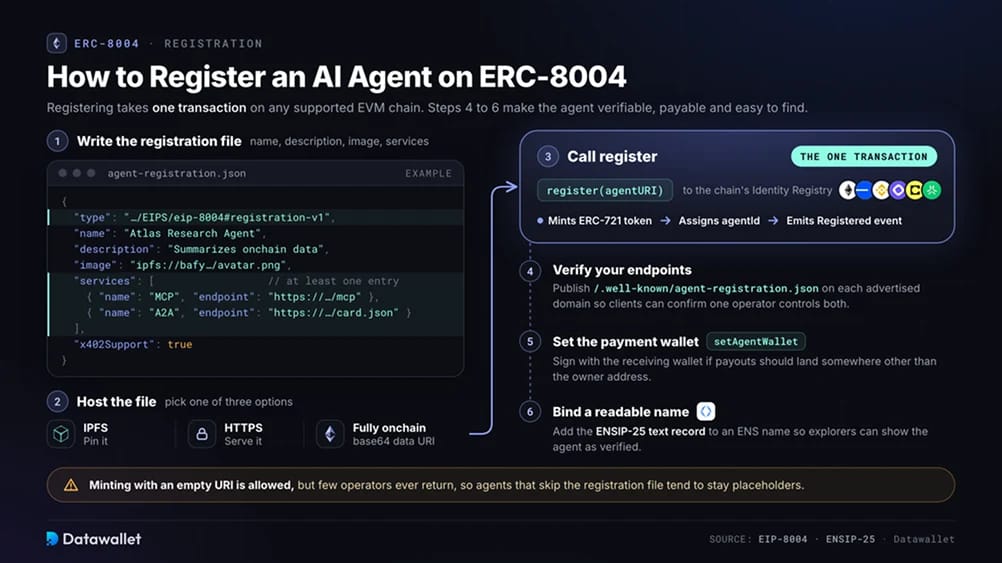
An agent can be registered in one transaction on any of the supported EVM chains, networks that run Ethereum-style smart contracts.
- Write the registration file: Create a JSON document with the type field set to the registration-v1 identifier. Include a name, description, image and at least one entry in the services array.
- Host the file: Pin it to IPFS or serve it over HTTPS. For metadata stored fully onchain, encode the file as a base64 data URI.
- Call register: Send register(agentURI) to the chain's Identity Registry. This mints the ERC-721 token, assigns an agentId and emits a Registered event.
- Verify your endpoints: Publish /.well-known/agent-registration.json on each advertised domain, allowing clients to confirm that one operator controls both the domain and the agent.
- Set the payment wallet: If payouts should go somewhere other than the owner address, call setAgentWallet with a signature from the receiving wallet.
- Bind a readable name: Add the ENSIP-25 text record to an ENS name so explorers can display the agent as verified under that name.
Operators may mint with an empty URI and add it later. Few return to do so, however, and registrations that omit the file tend to remain placeholders.
ERC-8004 Statistics & Adoption
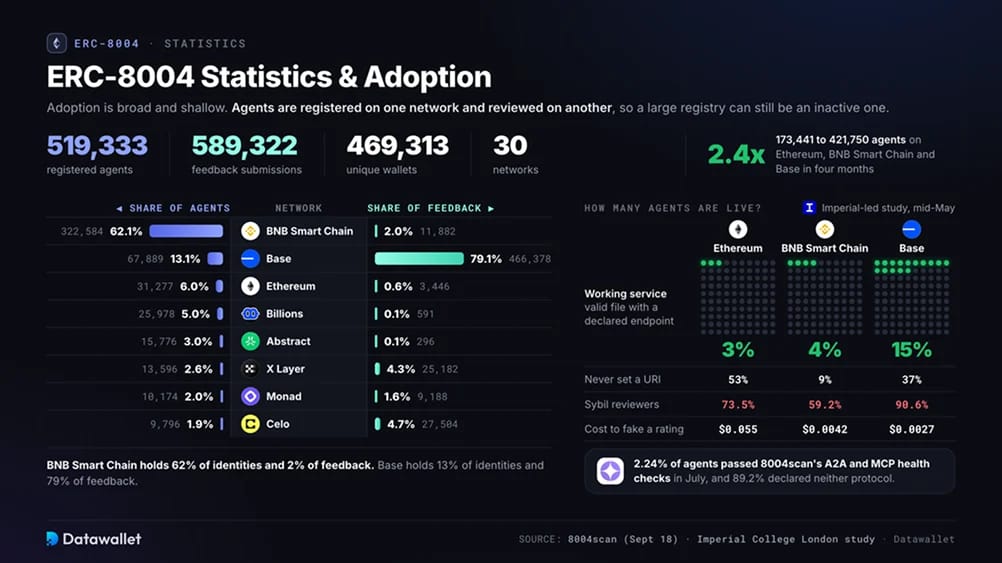
On September 18, 8004scan's homepage counters and network dashboard showed 519,333 registered agents, 589,322 feedback submissions and 469,313 unique wallets across 30 networks. Coverage now extends to payment-focused chains such as Tempo and Arc, as well as Robinhood Chain and a parallel registry program on Solana.
A six-author study led from Imperial College London counted 173,441 agents across Ethereum, BNB Smart Chain and Base on May 13. Four months later, those three chains held 421,750, an increase of about 2.4 times.
BNB Smart Chain accounts for 62% of identities but just 2% of feedback. Base has 13% of identities and 79% of feedback. Agents register on one network and receive reviews on another, so even a large registry can be inactive.
How Many Registered Agents Are Live?
The Imperial-led study measured how far registration totals exceeded usable agents through mid-May:
- Working services: A valid registration file with at least one declared service endpoint appeared for only 3% of Ethereum agents, 4% on BNB Smart Chain and 15% on Base.
- Empty identities: On Ethereum, 53% of agents never had a URI set. The figure was 37% on Base and 9% on BNB Smart Chain.
- Batch minting: Batch transactions produced 48.3% of Ethereum agents. The top 1% of wallets owned 58.5% of them, whereas ownership was far more evenly distributed on BNB Smart Chain.
- Sybil reviewers: Coordinated Sybil behavior appeared among 73.5% of Ethereum reviewers, 59.2% on BNB Smart Chain and 90.6% on Base.
- Cost of manipulation: Fabricating or destroying a rating cost a median of $0.055 on Ethereum, $0.0042 on BNB Smart Chain and $0.0027 on Base.
- Portability: Only 629 agents, or 0.4%, declared registrations on at least two mainnets. Their scores showed no correlation across chains.
8004scan reached a similar conclusion in its July ecosystem report. Roughly 2.24% of agents passed its A2A and MCP health checks; 89.2% declared neither protocol. Healthy, callable agents are now the explorer's preferred measure of progress.
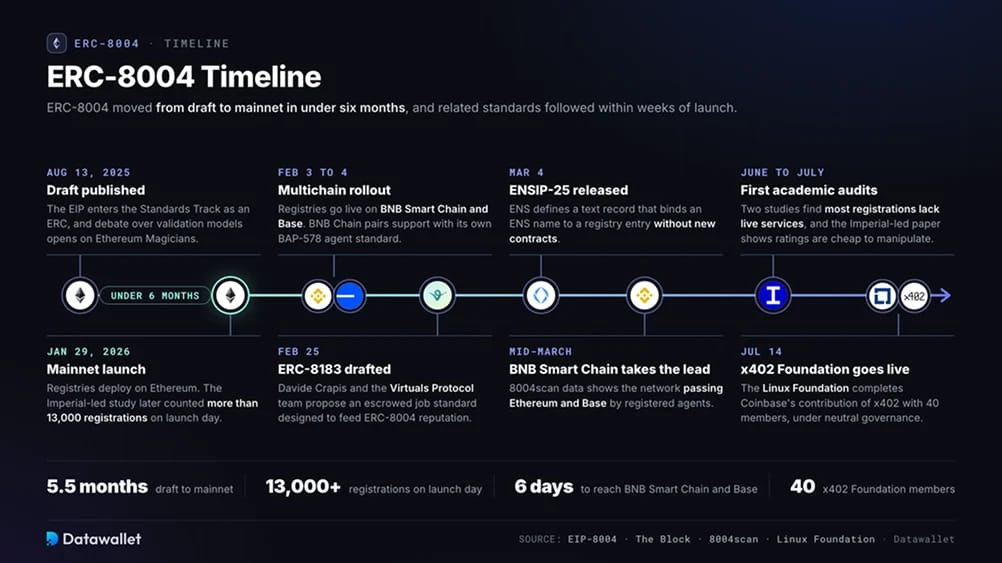
ERC-8004 Timeline
Less than six months separated ERC-8004's draft publication and mainnet deployment. Related standards began appearing within weeks of launch.
- Draft published (August 13, 2025): The EIP entered the Standards Track as an ERC. Discussion of validation models and trust tiers opened on the Ethereum Magicians thread.
- Mainnet launch (January 29): Registry deployment followed The Block's report of the planned rollout by one day. The Imperial-led study later counted more than 13,000 Ethereum registrations on launch day.
- Multichain rollout (February 3 to 4): Registries launched on BNB Smart Chain and Base. BNB Chain announced support alongside its own BAP-578 Non-Fungible Agent standard.
- ERC-8183 drafted (February 25): Davide Crapis and the Virtuals Protocol team proposed a standard for escrowed jobs designed to feed ERC-8004 reputation.
- ENSIP-25 released (March 4): ENS introduced a text record binding an ENS name to an ERC-8004 registry entry without requiring new contracts.
- BNB Smart Chain takes the lead (mid-March): The network overtook Ethereum and Base in registered agents, according to 8004scan data. BNB Chain later described itself as the top network for AI agents.
- First academic audits (June to July): Both the Imperial-led paper and a separate study of 10,000 Ethereum agents found that most registrations lacked live services. The Imperial-led research also showed how cheaply ratings could be manipulated.
- x402 Foundation goes operational (July 14): The Linux Foundation completed Coinbase's contribution of x402 with 40 members. This placed the payment protocol named in the ERC-8004 specification under neutral governance.
ERC-8004 vs x402, ERC-8183, MCP, and A2A
ERC-8004 covers trust. Agents use separate standards for messaging and naming, as well as paid work and payments.
The specification explicitly supports pairing with x402, which lets software pay per web request in stablecoins. An agent declares x402Support in its registration file and receives USDC over HTTP. Clients can then attach the transaction hash to feedback as proof of payment. Stripe and Paradigm's Tempo provides a competing payment protocol and already hosts an ERC-8004 registry.
Paid work between agents falls under ERC-8183. Clients lock funds in escrow and providers submit work, but only an evaluator can mark a job complete. The draft recommends recording each outcome in ERC-8004 so that every finished job contributes a reputation signal. It formalizes the Agent Commerce Protocol already running in production at Virtuals Protocol.
An escrowed job or settled payment makes the associated rating cost real money to fake. This directly addresses the Sybil problem created by free, unverified feedback in the first months after launch.
What Are ERC-8004 Agents Used For?
Declared services and the explorer's most active listings show live agents concentrated in a few categories. Operators write their own listings, which carry no endorsement.
- DeFi and fund management: Agents manage pooled investment vaults and allocate stablecoins for yield. Others trade futures funding rates, while some are developing zero-knowledge proofs to demonstrate that execution stayed within preset limits.
- Consumer payments: Agents on Celo advertise airtime, bill payments and gift cards across more than 170 countries, settling through x402 micropayments.
- Data and prediction feeds: Offerings include sports odds, market signals and content analytics. Many use commit-reveal records to lock in predictions before results are known.
- Risk scoring: Base's most common feedback tags concern trust scores, contract risk and counterparty checks, pointing to automated risk-rating services.
- Orchestration: Manager agents allocate tasks to specialists and monitor their quality while handling execution for multi-agent platforms.
MCP and A2A endpoints represented nearly half of declared services on Base, researchers found. Plain web endpoints made up about 70% on BNB Smart Chain. For the sector's tokens, see our AI crypto rankings.
ERC-8004 Pros and Cons
What Are the Risks of ERC-8004?
Applications must decide which ERC-8004 trust signals to believe, even though those signals share a standard format. The EIP's security section explicitly states that the standard cannot guarantee advertised capabilities are functional or non-malicious.
- Sybil reputation: Fake reviewers can inflate or destroy scores for fractions of a cent. Applications using unfiltered averages are exposed to this manipulation.
- Misleading registrations: A registration file identifies the agent that published it, without establishing whether its endpoints work or behave honestly.
- Upgradeable registries: The reference contracts are upgradeable singletons curated by the 8004 team. Trust therefore concentrates with the upgrade-key holders, making independent smart contract audits important.
- Key compromise: The owner key controls an agent's identity, URI and payout wallet. Theft compromises the agent everywhere that registry is read.
- Permanent records: Onchain pointers and hashes cannot be deleted. Careless metadata or feedback may leave an operator's working methods exposed indefinitely.
- Siloed scores: Reputation does not yet transfer between chains. Scoring services may also assign different rankings to the same agent.
- Specification churn: Integrations built today may need rework as the Validation Registry is redesigned and researchers press for feedback changes.
The Imperial-led authors proposed a standard responsiveness test and a tag registry specifying units and valid ranges. Their suggested fixes also include median or trimmed-mean aggregation, with influence scaled to staked capital or settled payment volume. None are present in the deployed contracts today.
Does ERC-8004 Affect Ethereum and ETH?
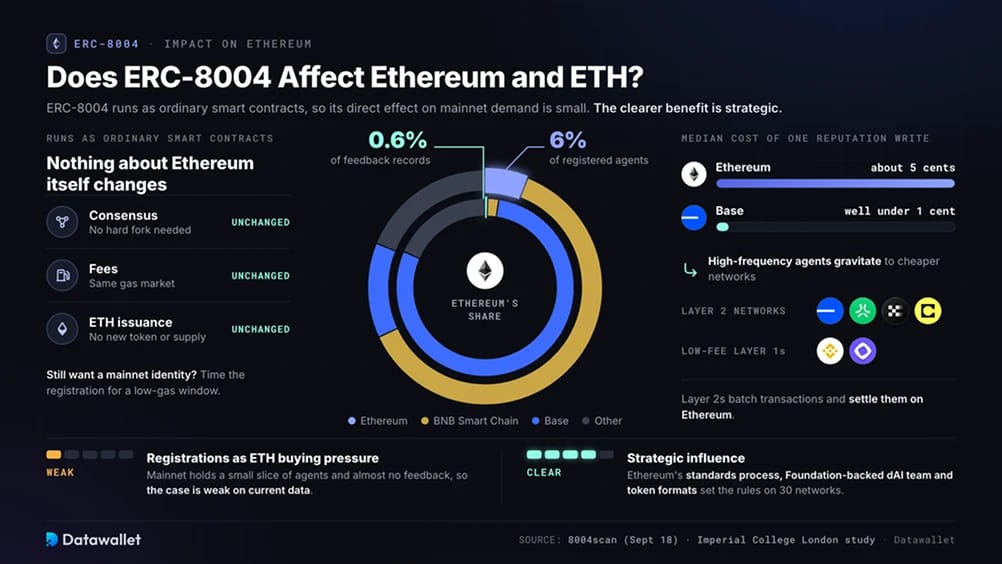
Running as ordinary smart contracts, ERC-8004 makes no changes to Ethereum's consensus, fees or issuance. Its direct contribution to mainnet demand is small. Ethereum accounts for 6% of registered agents and less than 1% of feedback records.
The study put the median cost of a Reputation Registry write at about five cents on Ethereum and well below one cent on Base. High-frequency agents consequently favor Layer 2 networks, which batch transactions and settle them on Ethereum, alongside low-fee alternative Layer 1s. Operators seeking a mainnet identity can use our Ethereum gas tracker to time registration.
Current data offers weak support for the claim that agent registrations generate buying pressure for ETH. The clearer benefit is strategic: Ethereum's standards process, Foundation-backed dAI team and token formats now define agent identity well beyond Ethereum itself.
Final Thoughts
Nearly eight months after launch, ERC-8004 has solved distribution while leaving quality unresolved. Dozens of EVM networks use the same registry addresses. ERC-8183 and ENSIP-25 were written around the standard, with explorers, SDKs and payment integrations built on top.
Most registrations remain placeholders. The chain with the most identities produces almost no feedback, and most reviewers look fake. The registry intended to secure high-value tasks is still not live.
We are tracking revisions to the Validation Registry and whether reputation becomes weighted by x402 or ERC-8183 payment evidence. The share of agents passing health checks is another key measure. Progress in any of these areas would show the directory developing into working trust infrastructure.