




Artificial intelligence is creating growing demand for private inference, open model access, and developer-friendly AI infrastructure. Venice AI approaches this demand through a privacy-first platform for chat, images, code, characters, and API-based AI applications.
Instead of treating AI as a closed, surveilled service, Venice focuses on user-controlled access to machine intelligence. Its model connects everyday users, developers, AI agents, private compute, and the VVV token into one crypto-native AI ecosystem.
Here is how Venice AI, its privacy architecture, and VVV tokenomics fit together. 👇
What is Venice AI?
Venice AI is a privacy-first generative AI platform built for chat, image creation, code assistance, character interactions, and developer inference. Its core pitch is “unrestricted intelligence”: users can access leading models while keeping prompts private, with data designed to stay on device rather than Venice’s servers.
Unlike a single-model chatbot, Venice operates as an AI studio and API layer. The web app serves everyday users who want private writing, research, images, video, music, and custom characters, while the API gives builders OpenAI-compatible access to text, image, audio, and character endpoints.
Venice positions itself as a less surveilled, less restrictive alternative to mainstream AI tools. Its documentation emphasizes no data retention, permissionless access, and compute users can permanently own, while its blog argues that private, uncensored inference matters for sensitive work, creative expression, and autonomous AI agents.
The project also has a crypto layer: the VVV token. Rather than being only a payment token, VVV is framed as an access key to Venice’s inference capacity. Users, developers, and AI agents can stake VVV to receive ongoing API compute allocation, reducing pay-per-request friction.

How Does Venice AI Work?
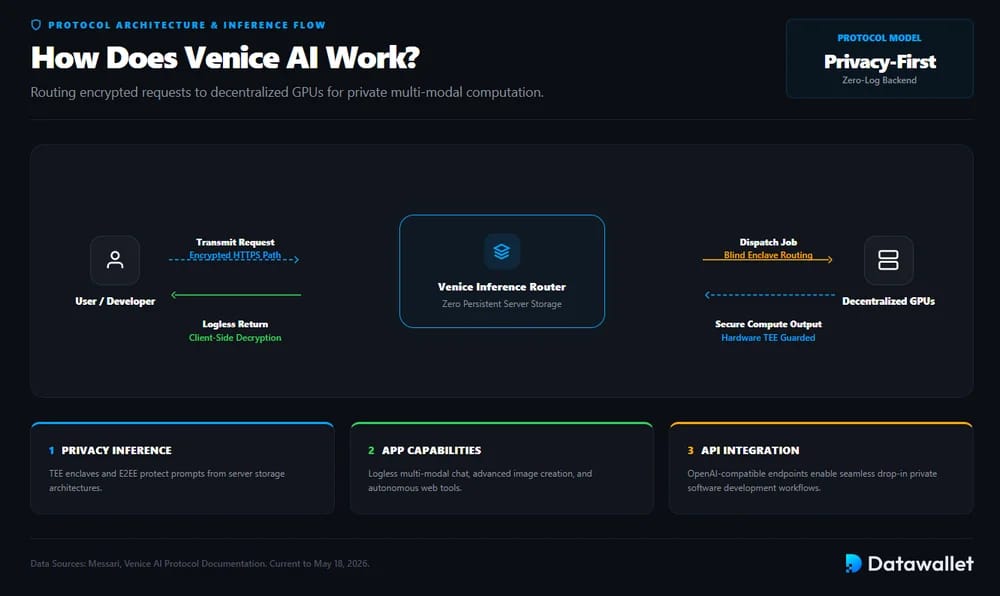
Venice AI works by combining a consumer app, a privacy-focused inference backend, and an OpenAI-compatible API that routes prompts to supported text, image, audio, video, code, and character models.
1. Privacy-First Inference
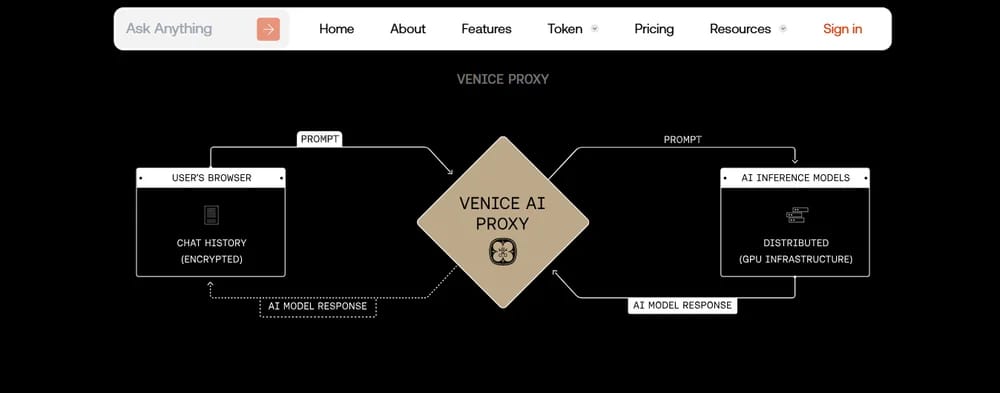
When a user sends a prompt, Venice forwards the request over encrypted HTTPS paths to GPUs operated across decentralized providers. Its documentation says prompts and responses are not stored or logged on Venice servers, making privacy part of the backend design, not only branding.
For stronger privacy, Venice also offers TEE and E2EE model options. TEE models run inside hardware-secured enclaves, while E2EE models encrypt prompts client-side before transmission, so only the protected execution environment can decrypt and process user data.
2. App and API Layer
Venice packages this infrastructure into two access points: a web app for individuals and an API for developers building private AI tools, agents, and integrations.
Key operating layers include:
- Chat: Users interact with supported language models for research, brainstorming, writing, coding, roleplay, and private question-answering without Venice retaining conversation logs on its servers.
- Images: The app and API support image generation and editing, letting creators produce visuals while keeping prompts within Venice’s privacy-focused inference architecture.
- Models: Developers can list available models across text, image, audio, video, and related inference types, then choose capabilities based on task requirements.
- Compatibility: Venice is designed as an OpenAI-style replacement, allowing developers to reuse existing SDK workflows by changing the base URL and API key.
- Tools: Documentation covers structured outputs, reasoning models, file inputs, prompt caching, web search, document parsing, blockchain RPC, and other app-building utilities.
- Agents: Venice supports autonomous and permissionless AI applications, including private research agents, messaging bots, crypto integrations, and wallet-authenticated workflows.
Venice Pricing
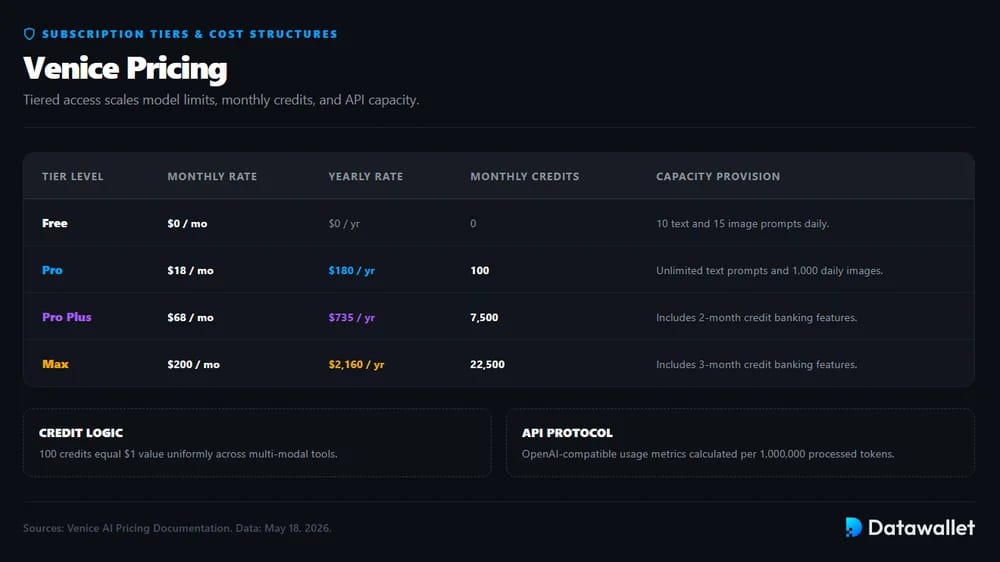
Venice uses a tiered pricing structure that starts with a free plan and scales into paid subscriptions for heavier creators, developers, and AI power users. The main difference between tiers is not privacy, which Venice says remains available across plans, but model access, usage limits, monthly credits, API capacity, and credit rollover.
Monthly Plans
The Free plan costs $0 per month and is built for testing Venice with base AI models. It includes 10 text prompts per day, 15 image prompts per day, and private, uncensored access, making it suitable for casual users who want to explore the product before paying.
Pro costs $18 per month and is Venice’s main paid plan for individual users. It unlocks Pro models, unlimited text prompts, 1,000 images per day, image tools such as upscaling and background removal, custom characters, extended context windows, encrypted chat backup, and 100 monthly credits for premium features and API usage.
Pro Plus costs $68 per month and is designed for higher-volume creators or developers. It includes everything in Pro, higher image generation limits, 7,500 monthly credits for video, music, frontier image generation, LLMs, and API use, plus two-month credit banking for unused credits.
Max costs $200 per month and targets the heaviest users. It includes everything in Pro Plus, Venice’s highest image generation limits, 22,500 monthly credits for frontier models and API workloads, and three-month credit banking, making it the most suitable plan for production agents or intensive creative pipelines.
Yearly Plans
Venice also offers annual billing for users who want a lower effective monthly cost. The yearly Free plan remains $0, while Pro is listed at $180 per year, Pro Plus at $735 per year, and Max at $2,160 per year. Venice’s site frames annual billing as a way to save compared with paying month to month.
Paid annual plans also support crypto payments, which fits Venice’s broader crypto-native positioning. The feature set remains broadly aligned with the monthly versions: Pro is for full app access, Pro Plus adds a major credit jump and rollover, and Max offers the largest credit allocation and longest banking window.
Credits and API Pricing
Venice credits act as a universal balance for premium features, including video generation, image upscaling, premium models, music generation, and API access. Venice states that 100 credits equal $1, which makes credits easier to understand as a spending unit across different model and media types.
For developers, Venice offers an OpenAI-compatible API with separate usage-based pricing. The API documentation lists model pricing mainly per 1 million tokens, while additional features such as web search and scraping are priced per request volume. API credits can be purchased with card or crypto, and USD-purchased credits do not expire.
The VVV Token
VVV is Venice AI’s Base-network token, designed to turn AI inference into a stake-based resource rather than only a pay-per-call service for users, developers, and autonomous agents.
Tokenomics
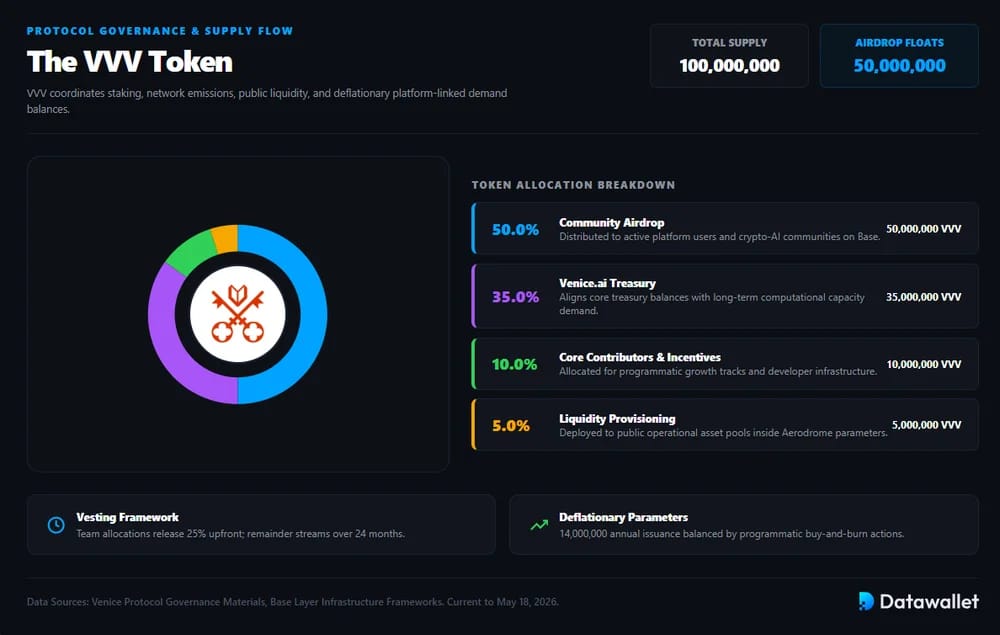
VVV launched on January 27, 2025, with a 100 million token genesis supply. Venice says the token had no presale, launched on Base as an ERC-20 asset, and was structured around staking, emissions, public liquidity, and platform-linked demand.
The initial distribution split half of the supply to the community and ecosystem, while the rest supported Venice, team incentives, growth programs, and liquidity.
- Airdrop: 50 million VVV, or 50% of genesis supply, was allocated to Venice users and the crypto-AI community on Base.
- Users: 25 million VVV went to more than 100,000 Venice users, with eligibility based on platform activity, points, and a December 31, 2024 snapshot.
- Ecosystem: 25 million VVV went to crypto-AI communities and protocols on Base, including projects such as Virtuals, AERO, DEGEN, AIXBT, GAME, LUNA, VADER, CLANKER, and MOR.
- Venice: 35 million VVV, or 35% of supply, was granted to Venice.ai, aligning the company’s treasury with long-term demand for the Venice platform.
- Team: 10 million VVV, or 10% of supply, was allocated to the team, with 25% unlocked upfront and the remainder streaming over 24 months.
- Incentives: 10 million VVV, or 10% of supply, was placed into the Venice Incentive Fund to support growth, ecosystem activity, and platform participation.
- Liquidity: 5 million VVV, or 5% of supply, was reserved for liquidity deployment, including Venice’s initial public liquidity pool on Aerodrome.
- Emissions: Venice says 14 million new VVV are created annually, paid to stakers and Venice according to API utilization, with the initial inflation rate starting at 14% and declining over time.
- Burns: Venice now frames VVV as a deflationary capital asset, stating that a portion of platform revenue is used for ongoing monthly buy-and-burn activity.
Utility
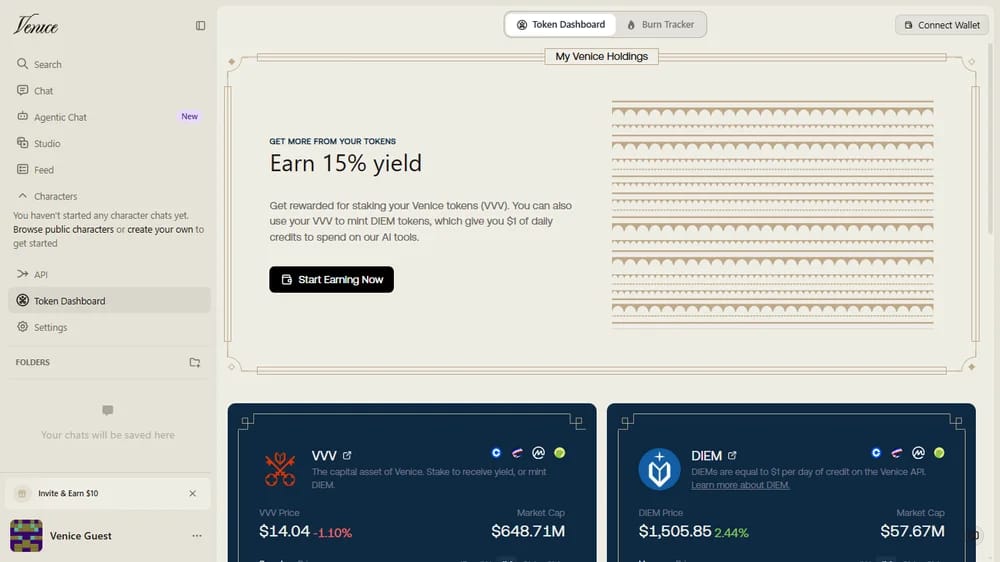
VVV’s primary utility is staking for access to Venice’s private AI inference capacity. Instead of spending tokens per request, users stake VVV to control a proportional share of API capacity, which can be used directly or resold to other AI consumers and applications.
Venice has also expanded VVV’s role beyond API access. The token page says staking 100 VVV unlocks Venice Pro, while stakers can mint DIEM, a second ecosystem token that provides $1 of Venice credit every day, and also earn up to 15% APY yield. Platform revenue buy-and-burns add another value-accrual mechanism.
Venice Use Cases
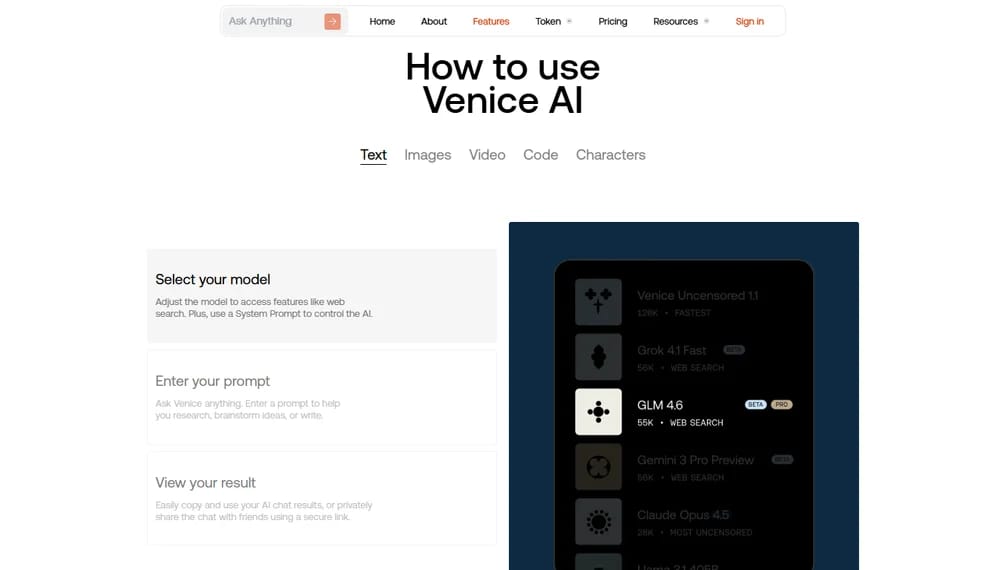
Venice AI is built for users who want generative AI across text, images, code, video, music, and characters without giving up privacy. Its features page presents the product as a private AI workspace for research, creativity, development, and personalized interaction.
The main Venice use cases include:
- Research: Venice’s text interface lets users ask questions, explore topics, compare ideas, and use web search-enabled models when they need more current or source-aware responses.
- Writing: Users can draft, rewrite, summarize, brainstorm, and refine content with model controls such as system prompts, temperature, Top P, and document uploads.
- Coding: Venice supports code-focused workflows through its model selection system, helping users generate, review, debug, and explain code inside the same private AI environment.
- Image Creation: The AI image generator supports creative prompting with controls such as negative prompts, aspect ratio, steps, adherence, high-resolution output, seeds, and optional watermark hiding.
- Image Editing: Paid users can access “image superpowers” such as upscaling, background removal, variants, and other editing tools, making Venice useful for creators refining visual assets.
- Video and Music: Pro-tier plans include credits for generating video and music, extending Venice beyond chat and static images into broader multimedia creation workflows.
- Characters: Venice lets users create and share custom AI characters, including no-filter characters, auto-generated profiles, rich backstories, and tools to duplicate or evolve personas.
- Private Sharing: After generating results, users can copy outputs or privately share chats with friends through a secure link, supporting collaborative review without making conversations public.
- Long-Form Work: Pro features include extended context windows, which help users manage longer conversations, deeper research, complex documents, and multi-step creative or technical projects.
- Developer Access: Venice also offers an OpenAI-compatible API, allowing developers to connect private AI inference to apps, agents, bots, and internal tools.
Venice AI Founders
Venice AI was founded by Erik Voorhees, a long-time crypto entrepreneur best known as the founder of ShapeShift and an early Bitcoin advocate. Venice’s own launch post introduces the platform under Voorhees’ name, framing it around private, permissionless, and uncensored AI access.
Voorhees’ background helps explain Venice’s crypto-native positioning. Official Venice materials describe him as Founder and CEO, while the company’s media page highlights coverage of his move from crypto infrastructure into generative AI, privacy, and “uncensorable” machine intelligence.
Funding
Venice has been described as largely founder-backed rather than venture-funded. At launch, The Block reported that Erik Voorhees was the sole investor and said the company had “no need for external funding,” positioning Venice as a crypto-founder-led AI venture rather than a traditional VC-backed startup.
Since then, Venice’s most visible capital program has been ecosystem-oriented. In May 2025, the company launched a $27 million Venice Incentive Fund to support developers building private AI apps, agents, integrations, model tooling, dApps, and infrastructure on the Venice API
Venice AI Risks
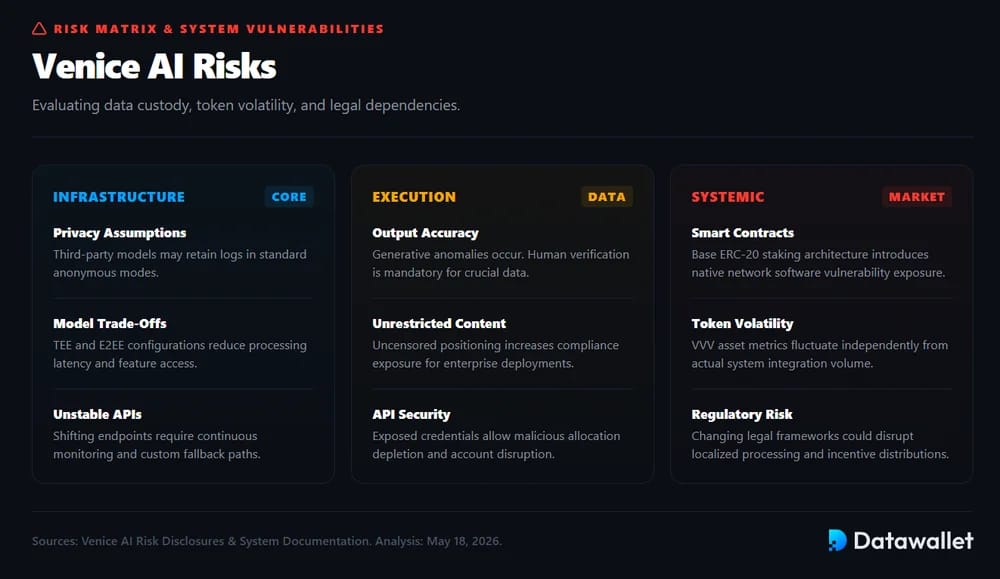
Venice’s main risks come from the same features that make it distinctive: privacy-first infrastructure, less restrictive model access, crypto-linked incentives, and developer-facing APIs. Users should separate product utility from token speculation and understand the platform’s technical, legal, and market dependencies.
Key risks to consider include:
- Privacy Assumptions: Venice offers several privacy modes, but protections vary. In “Anonymous” mode, Venice says third-party model providers may still see and likely save prompts, while “Private” mode relies on Venice and partners honoring zero-retention commitments.
- Model Trade-Offs: Stronger privacy modes can reduce convenience. Venice says TEE and E2EE models may be slower, support fewer models, and limit features such as web search or memory, which can affect usability for research-heavy workflows.
- Output Accuracy: Venice still relies on generative AI models, so responses can be wrong, outdated, biased, or incomplete. Its own documentation notes that AI-generated responses may contain mistakes, making human review important for financial, legal, medical, or technical work.
- Unrestricted Content: Venice’s “uncensored” positioning may appeal to privacy advocates, but it can also increase reputational, compliance, or misuse concerns for teams deploying the API in public products, regulated sectors, or enterprise environments.
- Smart Contracts: VVV runs on Base as an ERC-20 token, so users also face smart contract risk around staking, liquidity pools, token approvals, and contract interactions. Any bug, exploit, malicious approval, or integration failure could affect funds even if the Venice AI product itself keeps working.
- Experimental APIs: Some Venice endpoints are marked experimental or subject to change. Developers building production apps should expect possible breaking changes, shifting model behavior, endpoint updates, and the need for monitoring or fallback providers.
- API Security: Venice API keys are bearer credentials and must be kept secret. If exposed in client-side code, repositories, logs, or browser apps, attackers could consume credits, access account resources, or disrupt integrations.
- Token Volatility: VVV adds crypto exposure to the Venice ecosystem. Even if staking provides access to AI capacity, token price, liquidity, emissions, burns, and market sentiment can fluctuate independently from product adoption.
- Regulatory Risk: Venice sits at the intersection of AI, privacy, crypto, and content moderation. Future rules around AI safety, data protection, token incentives, or decentralized infrastructure could affect how Venice operates, markets, or prices its services.
Final Thoughts
Venice AI stands out by combining private generative AI, multimodal creation tools, developer APIs, and crypto-native incentives. Its strongest appeal is for users who value uncensored access, privacy-focused infrastructure, and flexible AI workflows across text, images, code, characters, and media.
VVV adds a distinctive economic layer by linking token staking to AI inference capacity. That model can reduce friction for heavy API users and agents, but it also introduces token volatility, smart contract exposure, and adoption risk.
Overall, Venice is best viewed as both an AI product and an experimental crypto-AI network. Its success depends on product quality, privacy execution, developer adoption, sustainable token demand, and the broader market’s appetite for private, permissionless AI.